
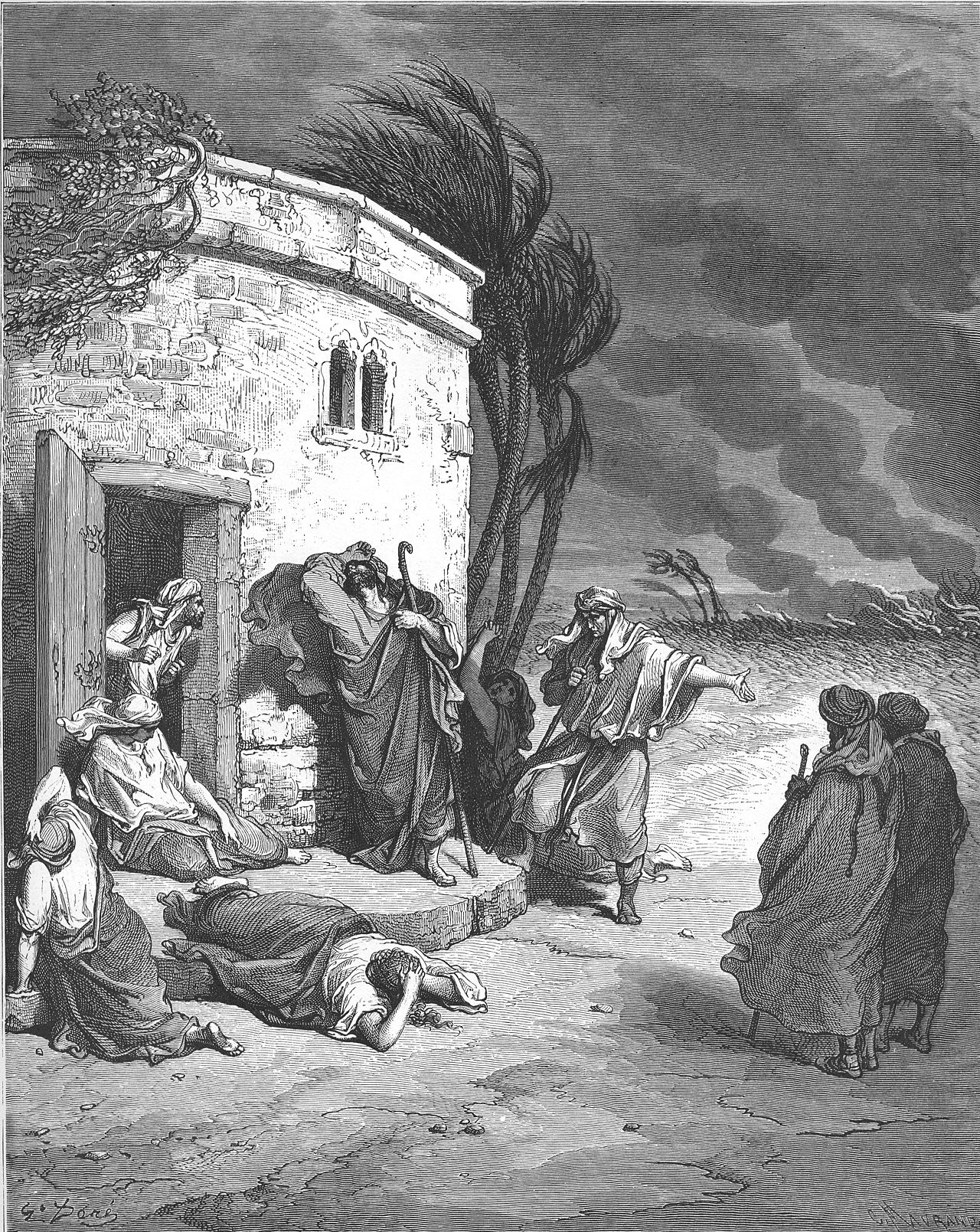
Jobchapter 14
22 verses · unknown · 10th century BC · Wisdom and poetry
Who can bring out clean from unclean? No one!
Introduction
unknown, Wisdom and poetry, Job Overview.
This chapter ends Job's answer to the first round and closes the first cycle of the debate. Job turns from his friends to the lot of every human being. His hearers buried their dead in family tombs and had no clear picture of what lay beyond the grave. Listen for the pictures of a short life, drawn from the field and from the hired man's labor. Listen above all for the comparison with a cut tree and for the question it raises. Job asks it as a man feeling in the dark, and the rest of Scripture takes it up.
Context
- Who
- Hearers who buried their dead in family tombs and had no clear picture of what came after
- What
- Job's lament over the brevity of human life, his question whether a man who dies will live again, and his hope that God will call him.
- Where
- The ash heap outside Job's town, with Job looking past his own death.
- When
- The close of Job's reply to the first round, ending the first cycle of speeches.
- Why
- To press the question of Job's case past the grave, since within one lifetime the accounts do not balance.
Historical context
The chapter opens with three pictures of a short life, all agricultural or domestic: a flower that comes up and is cut down, a shadow that does not stay, and a hired man's fixed term. Job then adds a legal touch, a man's days are determined and his bounds appointed so he cannot pass them, like a boundary a tenant may not cross.
Show the rest of the historical context, 3 more paragraphs
The centre of the chapter is a piece of real horticulture. A felled tree, he says, still has hope: through the scent of water it will bud and put out branches like a young plant, even if its root has grown old and its stump died in the ground. This is true of olive, terebinth, and several other trees of that region, which regrow vigorously from a cut stump, orchards were managed on exactly this principle. Job's grief is that a man is not a tree. He lies down and does not rise till the heavens are no more.
Then he asks the question outright: if a man die, shall he live again? And he answers it as a wish rather than a doctrine, that God would hide him in the grave until his anger passed, set him a fixed term, and then call, and he would answer. Israel's clear teaching on resurrection came later and fuller; here a man in the dark is feeling for it.
The chapter closes with erosion. Waters wear away stones, floods wash away the soil of the earth, and so God destroys the hope of man. Anyone who had watched a winter torrent take a hillside terrace knew precisely what that looked like.
Significance
The first cycle ends with the argument unresolved and Job pushing the question past the grave, because within a single lifetime the accounts obviously do not balance.
Show the rest of the significance, 1 more paragraph
Hearers in Israel, who sang psalms about the pit and the silence, would have recognised the reach in that question, and would have kept reading to see whether anyone answers it.
This chapter in Jewish lifeWhat this chapter is in Jewish life and reading.
What is done
Job 14 stands outside the synagogue's calendar of readings on the site's table. The probe of src/lib/hebraic/readings.ts printed parashot total 0 and haftarah uses total 0 for Job, and no festival reading.
The corpus carries the chapter into the Talmud at three places. It holds Yoma 71b:1 under the ninth verse, Berakhot 18b:4 under the twenty-first and Berakhot 18b:5 under the twenty-second. Jerusalem Talmud Berakhot 5:1:14 stands under the sixteenth. Through the Tanchuma it ties the first verse to Pekudei 3:17, the fifth to Bechukotai 1:1, the fifteenth to Tetzaveh 2:1 and the sixteenth to Metzora 1:1. Midrash Tanchuma Buber ties the fourth verse to Chukat 4:1 and Shmini 13:1.
How it is read
Rashi is quoted here from The Judaica Press complete Tanach with Rashi, translated by A. J. Rosenberg, which Sefaria reports as CC-BY. He reads the chapter as Job's plea for a mortal who cannot be clean. Man comes from a putrid drop and unclean seed. "Not one of them is clean, that he should not sin" (Rashi on Job 14:4:1).
If man's days are limited to a day set for death (Rashi on Job 14:5:1), then let God turn from him in those few days. Let him rest from pain until in old age he desires his death "like a hireling who desires the completion of his day’s work" (Rashi on Job 14:6:1).
The tree has hope that it will renew itself (Rashi on Job 14:7:1). At the eleventh verse Rashi gives two readings of the failing waters. In the first they fail from the source that comes to the river from the sea. In the alternative, set in brackets, the waters went away from the source that feeds the river (Rashi on Job 14:11:1). The first names the sea as the source of the river's water, and the alternative leaves the sea out.
Rashi reads Job's hope as lasting all his days (Rashi on Job 14:14:1). He calls the fifteenth verse a supplication, Job asking God to call so that he may answer and prove his case (Rashi on Job 14:15:1). His transgression is sealed and kept "in a cloth bundle like silver and pearls, lest it be lost" (Rashi on Job 14:17:1).
Even a falling mountain gives forth dust, Rashi reads, and so some hope of benefit (Rashi on Job 14:18:1). Man's sons grow heavy with silver and gold, and he does not know it (Rashi on Job 14:21:1). The chapter ends on the pain of the dead. "A worm is as painful to the dead as a needle in the flesh of the living" (Rashi on Job 14:22:1).
Malbim is quoted from Malbim's Job, translated by Jeremy I. Pfeffer (Ktav, 2003), which Sefaria reports as CC-BY. His one note in English on the chapter stands on the thirteenth verse, inside Job's speech. It says that punishment in an eternal world would at least end one day. Then it states, "But the notion that there is another world, where the injustices of this world are corrected, defies reason" (Malbim on Job 14:13:1).
The corpus carries seven further notes on this chapter without an English text, each marked linked because Sefaria holds no English version of the ref. They stand cited and unquoted at Malbim on Job 14:1:1 and 14:2:1, and at Metzudat David on Job 14:1:1, 14:2:1, 14:8:1, 14:10:1 and 14:12:1.
What the rabbis say
The corpus carries forty rabbinic locators on this chapter and the text of none, so each is cited here by ref alone. On the first verse it holds Avot DeRabbi Natan, Recension B 42:5, Bereshit Rabbati, Parashat Bereshit 68, Midrash Tanchuma, Pekudei 3:17 and Midrash Tehillim 143:1. On the fourth it holds Bamidbar Rabbah 19:1, Ein Yaakov, Niddah 1:2 and the two Tanchuma Buber passages named above. On the fifth it holds Midrash Sekhel Tov, Shemot 11:7:1, Bechukotai 1:1 in both editions of the Tanchuma and Yalkut Shimoni on Torah 671:1.
On the seventh verse the corpus holds Bereshit Rabbah 61:2 and Yalkut Shimoni on Torah 109:15. On the eighth it holds Ein Yaakov (Glick Edition), Yoma 7:4, Ein Yaakov, Yoma 7:5 and Otzar Midrashim, Midrash Minayin 1:15. On the ninth it holds Yoma 71b:1. On the fourteenth it holds Bereshit Rabbah 10:5 and Bereshit Rabbati, Parashat Bereshit 58. On the fifteenth it holds Midrash Tanchuma, Tetzaveh 2:1, Shemot Rabbah 36:4 and Vayikra Rabbah 31:3.
On the sixteenth verse the corpus holds Jerusalem Talmud Berakhot 5:1:14, Midrash Tanchuma, Metzora 1:1 and Midrash Tehillim 139:3. On the eighteenth it holds Aggadat Bereshit 25:1 and Bereshit Rabbah 51:11 and 52:1. On the nineteenth it holds Avot DeRabbi Natan 6:2, Avot DeRabbi Natan, Recension B 12:3 and Bereshit Rabbah 30:8. On the twentieth it holds Bamidbar Rabbah 13:12 and Bereshit Rabbah 11:2 and 12:6.
On the twenty-first verse the corpus holds Berakhot 18b:4 and Ein Yaakov, Berakhot 3:3. On the twenty-second it holds Berakhot 18b:5, Bereshit Rabbah 100:7 and Ein Yaakov (Glick Edition), Shabbat 1:15. What each of them teaches is a saying of the rabbis, and is reported as theirs wherever this site quotes one. The quotations wait on a fetch that carries the text.
Sources: Rashi, Rashi on Job 14:3:1 to 14:22:1, The Judaica Press complete Tanach with Rashi, translated by A. J. Rosenberg, reported CC-BY; Malbim, Malbim on Job 14:13:1, Malbim's Job, trans. Jeremy I. Pfeffer, Ktav, 2003, reported CC-BY; Malbim, Malbim on Job 14:1:1 and 14:2:1, cited by ref because the corpus carries no English text; Metzudat David, Metzudat David on Job 14:1:1, 14:2:1, 14:8:1, 14:10:1 and 14:12:1, cited by ref because the corpus carries no English text; The Sefaria corpus, scripts/data/sources/sefaria/job/14.json, the 40 Talmud and Midrash locators of this chapter; The site's own files, src/lib/hebraic/readings.ts, printing no portion, no Haftarah and no festival reading for this book.
The heads below are this chapter's scenes. The numbered points under each are its verses.
Job: Man That Is Born of a Woman Is of Few Days
Job 14:1-2
who is born of woman: In the Old Testament the phrase "born of woman" belongs to this book alone. It returns at 15:14 from Eliphaz and 25:4 from Bildad, who turn Job's confession into an argument for man's uncleanness. "Like a flower, he comes forth, then withers away" measures a life in a single bloom.
Job 14:1
“Man that is born of a woman - See the notes at Job 13:28. The object of Job in these verses, is to show the frailty and feebleness of man. He, therefore, dwells on many circumstances adapted to this, and this is one of the most stirring and beautiful. He alludes to the delicacy and feebleness, of the female sex, and says that the offspring of one so frail must himself be frail; the child of one so feeble must himself be feeble.”
1 more voice on this verseWhat preachers and commentators have said about this verse, in their own words.
Job 14:1
“This may refer to the first woman, who was called Eve, because she was the mother of all living. Of her, who being deceived by the tempter was first in the transgression, we are all born, and consequently derive from her that sin and corruption which both shorten our days and sadden them.”
Matthew Henry · Commentary on the Whole Bible (1707-1721)puritan
Like a flower, he comes forth: Barnes lists the places where Scripture uses this picture of the flower, among them Isaiah 40:6 and Psalm 103:15. Clarke adds that man, as he appears among men, is only the shadow of his true and eternal self. The days of man are short and fleeting.
Job 14:2
“He cometh forth like a flower - This is a frequent image both in the Old and New Testament writers; I need not quote the places here, as the readers will find them all in the margin. He fleeth also as a shadow - Himself, as he appears among men, is only the shadow of his real, substantial, and eternal being. He is here compared to a vegetable; he springs up, bears his flower is often nipped by disease, blasted by afflictions and at last cut down by death.”
Adam Clarke · Commentary on the Bible (1810-1826)evangelical
1 more voice on this verse
Job 14:2
“Yet, since man's days are so full of trouble, it is well that they are few, that the soul's imprisonment in the body, and banishment from the Lord, are not perpetual, are not long. When we come to heaven our days will be many, and perfectly free from trouble, and in the mean time faith, hope, and love, balance the present grievances.”
Matthew Henry · Commentary on the Whole Bible (1707-1721)puritan
Job 14:3-4
open Your eyes to one like this?: Job turns to ask why God should "open Your eyes to one like this". The question "Will You bring him into judgment before You" keeps the courtroom of chapter 13 open. The question "Who can bring out clean from unclean" and its answer, "No one", state man's inherited condition.
Job 14:3
“And dost thou open thine eyes upon such an one? - Is one so weak, so frail, so short-lived, worthy the constant vigilance of the infinite God? In Zec 12:4, the expression “to open the eyes” upon one, means to look angrily upon him. Here it means to observe or watch closely. And bringest me into judgment with thee - Is it equal or proper that one so frail and feeble should be called to a trial with one so mighty as the infinite God?”
Who can bring out clean from unclean?: Jamieson, Fausset and Brown read the verse as an early witness to original sin, the corruption inherited by every man born of woman. Barnes hears Job pleading his frailty as a ground for mercy. Gregory answers the question: God alone can make the unclean clean.
Job 14:4
“Who can make clean a thing conceived of unclean seed? Is it not Thou, Who only Art? He That alone is clean in Himself can cleanse the unclean thing. For man, who lives in a corruptible flesh, has the uncleannesses of temptation engrained in him, seeing that he derived them from his birth. For his very conception, for the sake of fleshly gratification, is uncleanness. Hence the Psalmist saith, Behold, I was shapen in wickedness, and in sin hath my mother conceived me. Hence it is therefore that he is very often tempted even against his will.”
Gregory the Dialogist · written before 604 · Morals on the Book of Job, Book XIpatristic
3 more voices on this verse
Job 14:4
“Who can bring a clean thing - This verse is thus rendered by the Chaldee: “Who will produce a clean thing from man, who is polluted with sins, except God, who is one?” By Coverdale thus: Who can make it cleane, that commeth of an uncleane thinge? No body. The text refers to man’s original and corrupt nature. Every man that is born into the world comes into it in a corrupt or sinful state. This is called original sin; and is derived from fallen Adam, who is the stock, to the utmost ramifications of the human family.”
Adam Clarke · Commentary on the Bible (1810-1826)evangelical
Job 14:4
“Our habitual corruption is derived with our nature from our parents, and is therefore bred in the bone. Our blood is not only attainted by a legal conviction, but tainted with an hereditary disease. Our Lord Jesus, being made sin for us, is said to be made of a woman, Gal. iv.”
Matthew Henry · Commentary on the Whole Bible (1707-1721)puritan
Job 14:4
JOB considered himself to be unclean in the sight of God. Yet, if we speak the plain truth about him, we must say that he was as clean as any man who lived in that age, or, indeed, in any other! We have the witness of the Holy Spirit, in this very Book, that Job, "was perfect and upright, and one that feared God, and eschewed evil."
Charles Spurgeon · written before 1892 · The Metropolitan Tabernacle Pulpit, Sermon No. 2734: “Out of Nothing Comes Nothing” (lightly modernized text, CCEL edition)Particular Baptist
Job 14:5-6
his days are determined: "Since his days are determined and the number of his months is with You" states the providence the whirlwind speeches set out. The plea to "look away from him and let him rest" asks for a hired hand's ease. Barnes notes a laborer who has earned a pause.
Job 14:5
“Seeing his days - are “determined” Since man is so frail, and so short-lived, let him alone, that he may pass his little time with some degree of comfort and then die; see the notes at Job 7:19-21. The word “determined” here means “fixed, settled.” God has fixed the number of his days, so that they cannot be exceeded; compare the notes at Isa 10:23, and notes at Psa 90:10. The number of his months are with thee - Thou hast the ordering of them, or they are determined by thee.”
1 more voice on this verse
Job 14:5
“Three things we are here assured of:-- (1.) That our life will come to an end; our days upon earth are not numberless, are not endless, no, they are numbered, and will soon be finished, Dan. v. 26 .”
Matthew Henry · Commentary on the Whole Bible (1707-1721)puritan
look away from him and let him rest: Job asks God to turn His eyes away from the close watch of verse 3. Jamieson, Fausset and Brown compare the hired hand of Job 7:1, who endures hard work in hope of rest and wages at the end. Job asks for that little rest.
Job 14:6
“Turn from him, that he may rest - Cease to try him by afflictions and distresses, that he may enjoy some of the comforts of life, before he be removed from it: and thus, like a hireling, who is permitted by his master to take a little repose in the heat of the day, from severe labor, I shall also have a breathing time from affliction, before I come to that bound over which I cannot pass. See Job 10:20 (note), where there is a similar request.”
Adam Clarke · Commentary on the Bible (1810-1826)evangelical
1 more voice on this verse
Job 14:6
“Turn--namely, Thine eyes from watching him so jealously (Job 14:3). hireling-- (Job 7:1). accomplish--rather, "enjoy." That he may at least enjoy the measure of rest of the hireling who though hard worked reconciles himself to his lot by the hope of his rest and reward [UMBREIT].”
Jamieson, Fausset & Brown · Commentary Critical and Explanatory on the Whole Bible (1871)reformed
Job 14:7-9
there is hope for a tree: The words "there is hope for a tree" open the chapter's central contrast, a felled tree that buds again "at the scent of water". The line "its tender shoots will not fail" names a persistence in a plant the chapter is about to deny a man.
Job 14:7
“For there is hope of a tree - This passage to Job 14:12, is one of exquisite beauty. Its object is to state reasons why man should be permitted to enjoy this life. A tree, if cut down, might spring up again and flourish; but not man. He died to rise no more; he is cut down and lives not again. The passage is important as expressing the prevalent sentiment of the time in which Job lived about the future condition of man, and is one that deserves a close examination.”
its stump dies in the soil: Barnes notes that even a very old root keeps some life in it. Job sets the tree beside man in verses 7 to 10. The stump that seems dead in the ground still holds hope, while a man breathes his last and is gone.
Job 14:8
“Though the root thereof wax old - Though life becomes almost extinct. The idea is, though the root of the tree be very old, yet it does not become wholly lifeless. It is not like an old man, when life goes out altogether. In the very aged root there will be vitality still; but not so in man. Though the stock thereof - The stump - literally that which is cut off - גזעוּ geza‛ô.”
at the scent of water it will bud: Barnes calls the picture delicate: the Hebrew word for scent means the fragrance a thing gives off, a touch of water that wakes the root. Clarke likens it to strong scents that revive a fainting man. The old stump puts forth twigs like a sapling.
Job 14:9
“Yet through the scent of water - The word here rendered “scent” (ריח rêyach) means properly the odor or fragrance which anything exhales or emits; Son 2:13; Son 7:13; Gen 27:27. The idea is very delicate and poetic. It is designed to denote a gentle and pleasant contact - not a rush of water - by which the tree is made to live. It inhales, so to speak, the vital influence from the water - as we are refreshed and revived by grateful odorifles when we are ready to faint.”
Job 14:10-12
But a man dies and is laid low: w" answers the tree directly, and "where is he?" presses a question the plant never faces, since no scent of water calls a dead man back. The words "so a man lies down and does not rise" carry the comparison past sleep.
Job 14:10
“After death, where is he? Not where he was: his place knows him no more. Yes, he is gone to the world of spirits, gone into eternity, gone, never to return to this world!”
John Wesley · Explanatory Notes upon the Old Testament (1765)evangelical
1 more voice on this verse
Job 14:10
“Adam, a man of the earth, because earthy, gives up the ghost. Note, Man is a dying creature. He is here described by what occurs, (1.) Before death: he wastes away; he is continually wasting, dying daily, spending upon the quick stock of life.”
Matthew Henry · Commentary on the Whole Bible (1707-1721)puritan
As water disappears from the sea: Barnes reads the picture as water that dries up and leaves the bed bare, as a man passes away and leaves nothing. Clarke takes it of water drawn up from the sea and a river parched in the desert sand. The tree had hope; the dry river has none.
Job 14:11
“As the waters fail from the sea,.... the words may be rendered either without the as, and denote dissimilitude, and the sense be, that the waters go from the sea and return again, as with the tide: and the flood decays and dries up; and yet is supplied again with water: "but man lieth down, and riseth not again", Job 14:12; or else with the as, and express likeness; as the waters when they fail from the sea, or get out of lakes, and into another channel, never return more; and as a flood, occasioned by the waters of a…”
2 more voices on this verse
Job 14:11
“As the waters fail from the sea - As the waters evaporate wholly, and leave the bottom wholly dry, so it is with man, who passes entirely away, and leaves nothing. But to what fact Job refers here, is not known. The sea or ocean has never been dried up, so as to furnish a ground for this comparison.”
Job 14:11
“The waters of life are soon exhaled and disappear. The body, like some of those waters, sinks and soaks into the earth, and is buried there; the soul, like others of them, is drawn upwards, to mingle with the waters above the firmament.”
Matthew Henry · Commentary on the Whole Bible (1707-1721)puritan
so a man lies down and does not rise: Clarke reads the limit, until the heavens are no more, as reaching to the end of the world and the general resurrection. Matthew Henry pictures the body sinking into the earth like water and the soul drawn upward. Job asks in verse 14 whether a man will live again.
Job 14:12
“So man lieth down - He falls asleep in his bed of earth. And riseth not - Men shall not, like cut down trees and plants, reproduce their like; nor shall they arise till the heavens are no more, till the earth and all its works are burnt up, and the general resurrection of human beings shall take place. Surely it would be difficult to twist this passage to the denial of the resurrection of the body.”
Adam Clarke · Commentary on the Bible (1810-1826)evangelical
Job: If a Man Die, Shall He Live Again?
Job 14:13-15
If only You would hide me in Sheol: "When a man dies, will he live again?" states the book's central question, a hope 19:25 carries further. "I will wait, until my renewal comes" turns the question into resolve, and "You will call, and I will answer" answers his demand of 13:22.
Job 14:13
“Oh that thou wouldest hide me in the grave; - compare the notes at Job 3:11 ff. Hebrew “in Sheol” - ב־שׁאול bı̂-she'ôl. Vulgate, “in inferno.” Septuagint ἐν ἅδῃ en Hadē - “in Hades.” On the meaning of the word “Sheol,” see the notes at Isa 5:14. It does not mean here, I think, the grave. It means the region of departed spirits, the place of the dead, where he wished to be, until the tempest of the wrath of God should pass by.”
1 more voice on this verse
Job 14:13
“Job wishes to be kept hidden in the grave until God's wrath against him shall have passed away. So while God's wrath is visiting the earth for the abounding apostasy which is to precede the second coming, God's people shall be hidden against the resurrection glory (Isa 26:19-21). set time--a decreed time (Ac 1:7).”
Jamieson, Fausset & Brown · Commentary Critical and Explanatory on the Whole Bible (1871)reformed
When a man dies, will he live again?: Barnes calls the question a sudden turn: the hope of verse 13, hidden in Sheol, raises the thought of life after death. Job resolves to wait through all the days of his hard service. Matthew Henry reads the renewal as the change every believer awaits.
Job 14:14
“If a man die, shall he live again? - The Chaldee translates, If a wicked man die, can he ever live again? or, he can never live again. The Syriac and Arabic thus: “If a man die, shall he revive? Yea, all the days of his youth he awaits till his old age come.” The Septuagint: “If a man die, shall he live, having accomplished the days of his life? I will endure till I live again.” Here is no doubt, but a strong persuasion, of the certainty of the general resurrection.”
Adam Clarke · Commentary on the Bible (1810-1826)evangelical
1 more voice on this verse
Job 14:14
“The time of life is an appointed time; that time is to be reckoned by days; and those days are to be spent in waiting for our change. That is, First, We must expect that it will come, and think much of it. Secondly, We must desire that it would come, as those that long to be with Christ.”
Matthew Henry · Commentary on the Whole Bible (1707-1721)puritan
You will desire the work of Your hands: Clarke hears God's call at the resurrection, with body and soul joined at His word, and gives the verb for desire as to long for. Barnes reads the call as a summons to court in Job's own day. God longs for the work of His hands.
Job 14:15
“Answer thee - Thou shalt call my soul to thyself: and I will cheerfully answer, Here I am: knowing thou wilt have a desire to the work of thy hands - A love for the soul which thou hast made, and new-made by thy grace.”
John Wesley · Explanatory Notes upon the Old Testament (1765)evangelical
Job 14:16-17
You would count my steps: Verse 16 speaks of what God would do: "You would count my steps, but would not keep track of my sin". Job pictures "My transgression would be sealed in a bag". Gill gives the figure of a merchant's sealed bag, its contents unchanged until the day it is opened.
Job 14:16
“For now thou numberest my steps,.... Or "but now" (g), at this present time thou seemest to have no desire to me, or affection for me, but the reverse.”
1 more voice on this verse
Job 14:16
“For now thou numberest my steps - כי עתה ki attah, Although thou, etc. Though thou, by thy conduct towards me, seemest bent on my utter destruction, yet thou delightest in mercy, and I shall be saved.”
Adam Clarke · Commentary on the Bible (1810-1826)evangelical
sealed in a bag: Barnes explains that the ancients sealed a counted bag of money where a lock would now be used. Clarke sees evidence sealed and kept for trial. In the hope of verses 13 to 17, Job pictures his transgression sealed away and his iniquity covered.
Job 14:17
“My transgression is sealed up - The verb rendered sealed up (חתם châtham) means to seal, to close, to shut up; see the notes at Isa 8:16; compare the notes at Job 9:7. It was common with the ancients to use a seal where we use a lock. Money was counted and put into a bag, and a seal was attached to it. Hence, a seal might be put to a bag, as a sort of certificate of the amount, and to save the necessity of counting it again. In a bag - - בצרור bı̂tserôr.”
Job 14:18-19
as a mountain erodes and crumbles: The mountain that "erodes and crumbles" and the rock "dislodged from its place" widen the scale from one life to the most permanent things. The line "so You destroy a man’s hope" closes the comparison bluntly, naming man's hope as more fragile than the mountain's rock.
Job 14:18
“The mountain falling cometh to naught - Every thing in nature is exposed to mutability and decay: - even mountains themselves may fall from their bases, and be dashed to pieces; or be suddenly swallowed up by an earthquake; and, by the same means, the strongest and most massive rocks may be removed.”
Adam Clarke · Commentary on the Bible (1810-1826)evangelical
1 more voice on this verse
Job 14:18
“And surely the mountain falling - Margin, “Fadeth.” The sense of this is, that the hope of man in regard to living again, must certainly fail - as a mountain falls and does not rise again; as the rock is removed, and is not replaced; or as the waters wear away the stones, and they disappear. The hope of dying man was not like the tree that would spring up again Job 14:7-9; it was like the falling mountain, the wasting waters Job 14:11, the rock that was removed.”
so You destroy a man’s hope: Jamieson, Fausset and Brown trace a descent from mountain to rock to stones to soil, the firmest things worn down at last. Aquinas notes that water wears away stones that seem very hard. So God wears away the hope of a man.
Job 14:19
“The Hebrew order is more forcible: "Stones themselves are worn away by water." things which grow out of--rather, "floods wash away the dust of the earth." There is a gradation from "mountains" to "rocks" (Job 14:18), then "stones," then last "dust of the earth"; thus the solid mountain at last disappears utterly.”
Jamieson, Fausset & Brown · Commentary Critical and Explanatory on the Whole Bible (1871)reformed
Job 14:20-22
You forever overpower him: m, and he passes on" states defeat as final. "You change his countenance and send him away" pictures death as a dismissal. "If his sons receive honor, he does not know it" carries the loss past death, the dead man unaware of his household's fortune.
Job 14:20
“Thou prevailest for ever against him - It is impossible for him to withstand thee: every stroke of thine brings him down. Thou changest his countenance - Probably an allusion to the custom of covering the face, when the person was condemned, and sending him away to execution. See the case of Haman, in the note on Esther, Est 7:8 (note).”
Adam Clarke · Commentary on the Bible (1810-1826)evangelical
1 more voice on this verse
Job 14:20
“Note, Man is an unequal match for God. Whom God contends with he will certainly prevail against, prevail for ever against so that they shall never be able to make head again. Note further, The stroke of death is irresistible; it is to no purpose to dispute its summons.”
Matthew Henry · Commentary on the Whole Bible (1707-1721)puritan
If his sons receive honor: The dead father is unaware when his sons receive honor or are brought low. Jamieson, Fausset and Brown set this beside Ecclesiastes 9:5, and Barnes notes that the honor that would most gladden a father never reaches him. Matthew Henry adds that God knows what comes of the sons.
Job 14:21
“He is going to that world where he will be a perfect stranger to all those things which here filled and affected him. The consideration of this should moderate our cares concerning our children and families. God will know what comes of them when we are gone.”
Matthew Henry · Commentary on the Whole Bible (1707-1721)puritan
1 more voice on this verse
Job 14:21
“One striking trait is selected from the sad picture of the severance of the dead from all that passes in the world (Ec 9:5), namely, the utter separation of parents and children.”
Jamieson, Fausset & Brown · Commentary Critical and Explanatory on the Whole Bible (1871)reformed
The man in Sheol feels the pain of his body and mourns for himself. Jamieson, Fausset and Brown read that pain as a figure, the feelings of the living given to the dead. Clarke sums up the days of man as pain of body and distress of soul.
Job 14:22
In the unseen world, Job in a gloomy frame anticipates, man shall be limited to the thought of his own misery. "Pain is by personification, from our feelings while alive, attributed to the flesh and soul, as if the man could feel in his body when dead. It is the dead in general, not the wicked, who are meant here."
Jamieson, Fausset & Brown · Commentary Critical and Explanatory on the Whole Bible (1871)reformed
1 more voice on this verse
Job 14:22
“But his flesh upon him shall have pain - The sum of the life of man is this, pain of body and distress of soul; and he is seldom without the one or the other, and often oppressed by both. Thus ends Job’s discourse on the miserable state and condition of man. The last verse of the preceding chapter has been differently translated and explained. Mr. Good’s version is the following, which he vindicates in a learned note: - For his flesh shall drop away from him; And his soul shall become a waste from him.”
Adam Clarke · Commentary on the Bible (1810-1826)evangelical
Keep studying
Sources for this chapter
The summary
Jamieson, Fausset & Brown, Commentary Critical and Explanatory; John Wesley, Notes on the Old Testament and Matthew Henry, Complete Commentary.
The exposition
Adam Clarke, Commentary on the Bible; Albert Barnes; Franz Delitzsch, Biblical Commentary on the Book of Job; Gregory the Dialogist, Morals on the Book of Job; Gregory the Great, Morals on the Book of Job; Jamieson, Fausset & Brown, Commentary Critical and Explanatory on the Whole Bible; John Gill, Exposition of the Old Testament; Matthew Henry, Commentary on the Whole Bible and Thomas Aquinas, Commentary on Job.