
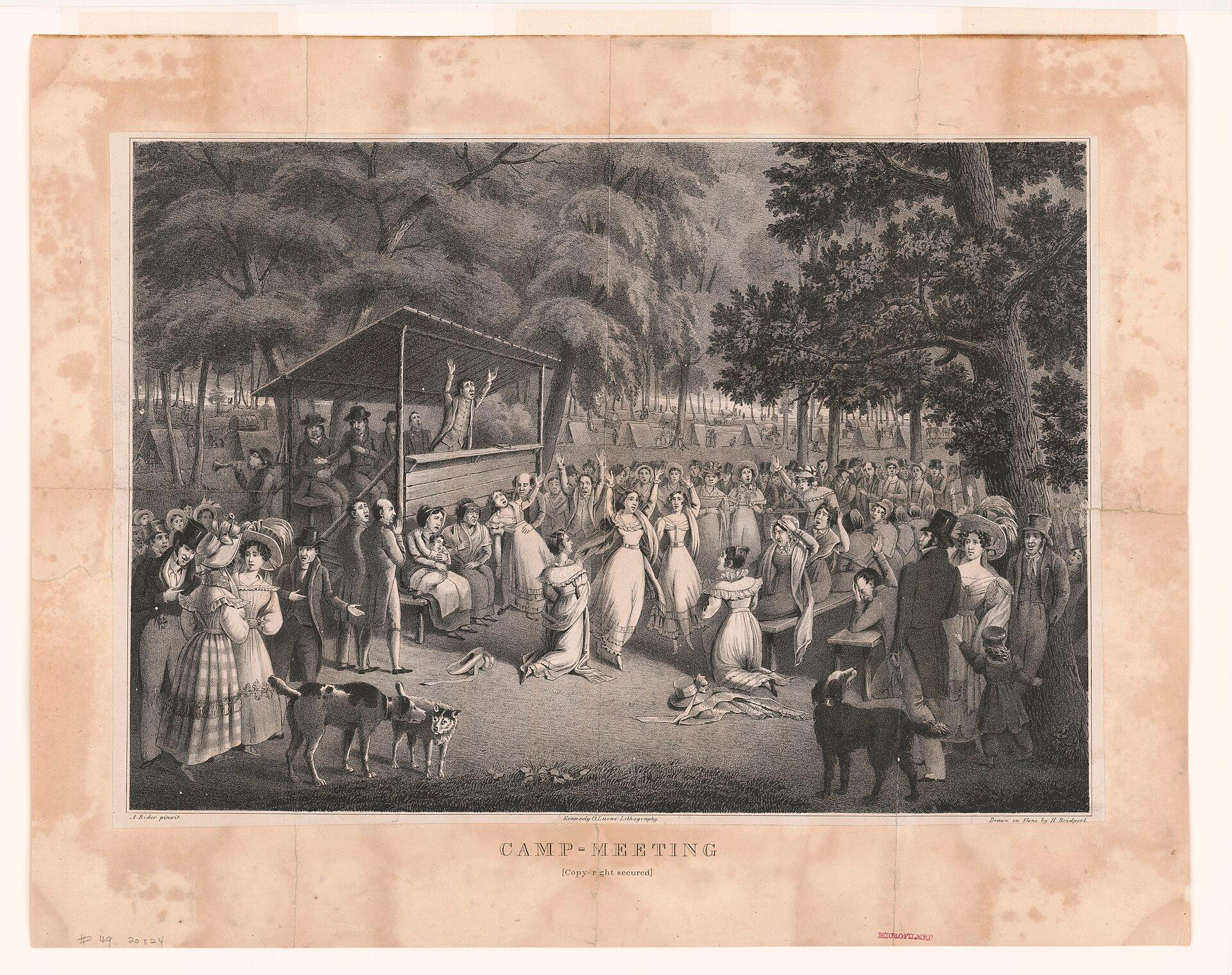
Alexander Rider, Camp-meeting, 1829. Public domain.
Habakkuk 3:2 · Debate · Featured Study
Revival and Revivalism
Edwards, Finney and Nettleton asked whether a revival is sent by God or brought about by means.
- The question
- Is a revival a work God sends, which the church must test, or the result of the right use of means?
- The texts
- Habakkuk 3:2, 1 Peter 1:8, 1 Thessalonians 5:21, 1 John 4:1
In 1835 Charles Finney told his congregation that a revival is not a miracle in any sense.
O LORD, I have heard the report of You; I stand in awe, O LORD, of Your deeds. Revive them in these years; make them known in these years. In Your wrath, remember mercy!
Summary
Jonathan Edwards wrote in 1746 that strong feeling proves nothing either way, so the church must test it by other signs. Charles Finney taught that a revival comes from the right use of means. He called for new measures to catch people's attention.
- Edwards built his book of signs on 1 Peter 1:8.
- Finney took Habakkuk's prayer as the text of his first lecture.
- Asahel Nettleton opposed the new measures in letters of 1827 and 1828.
The Texts Both Sides Read
Finney and Edwards each built on one verse, and both sides were told to test.
Finney opened his lectures on Habakkuk's prayer and Edwards opened his treatise on Peter's words to believers who love a Christ they have not seen.
The prayer and the joy
Though you have not seen Him, you love Him; and though you do not see Him now, you believe in Him and rejoice with an inexpressible and glorious joy,
Edwards drew from this verse the doctrine that true religion lies in great part in holy affections.
1 Peter 1:8BSB
The commands to test
but test all things. Hold fast to what is good.
Both sides held that a work called revival must be tested, and they differed over the tests.
Beloved, do not believe every spirit, but test the spirits to see whether they are from God. For many false prophets have gone out into the world.
John's command to test the spirits bears on every attempt to judge a revival.
1 John 4:1BSB
1 Thessalonians 5:21, 1 John 4:1
The Two Answers Side by Side
Four questions, each answered from Edwards and Nettleton and from Finney.
The two sides agreed that revival comes from God through preaching and differed on the place of method.
| The question | Edwards and Nettleton | Finney |
|---|---|---|
| What is a revival? | Edwards: true religion lies in great part in holy affections, which the church must tell apart from false ones. | Finney: the right exercise of the powers a person already has, produced by means as other effects are. |
| Does strong feeling prove a true work? | Edwards: affections raised very high are no sign either way. | Finney: people so reluctant to obey God will not act until they are excited. |
| What place has a new method? | Nettleton: the attempt to bring in the new measures had in many places been followed with a blight. | Finney: new measures are needed from time to time to bring the gospel to bear on the public mind. |
| How is a convert tested? | Edwards: by Christian practice, the twelfth sign, which he called the chief of all the signs. | Finney: by a public step such as the anxious seat, which he held would detect deception and prevent false hopes. |
Each Answer in Its Own Words, and the Site's Tradition
Edwards and Finney argued their answers in print, followed by the site's tradition.
Edwards wrote that some condemn all high affections and some approve them all. He held that the right way is to distinguish among them.
Finney taught that a revival is a purely philosophical result of the right use of the constituted means. He held it to be as much an effect of means as any other.
He allowed that a miracle may stand among its causes. He held that the miracles of the apostles drew attention to their message and were never the revival itself.
MannaFest stands in the Wesleyan-Pentecostal tradition, which prays for revival as a work of the Holy Spirit and holds His gifts in full operation today.
The New Measures, 1827 to 1835
Finney's lectures defended the new measures that Nettleton had opposed.
Finney delivered the lectures to his own congregation from week to week. The editor of the New York Evangelist reported them before they were printed as a book.
In the lecture on measures to promote revivals he defended the anxious seat. This was a seat set apart in the meeting where the anxious could come to be addressed and prayed for.
Asahel Nettleton wrote from Albany on 13 January 1827 to the Rev. Mr. Aikin of Utica against the new measures.
In that letter he objected among other things to women praying in mixed assemblies, a practice he feared would set the churches quarrelling for good.
Lyman Beecher and Nettleton printed their letters on the new measures at New York in 1828.
Bennet Tyler, Nettleton's biographer, wrote in 1845 that Nettleton never adopted the anxious seat or any of its kindred measures.
Tyler printed a letter of 1835 from Nettleton. In it Nettleton said he opposed the measures for the mischief they had done in bringing the very name of revival into disgrace.
In Their Own Words
Jonathan Edwards (1703 to 1758)
A Treatise Concerning Religious Affections, Part II, the first sign, page 152
Edwards held that high feeling proves nothing either way.
“It is no sign one way or the other, that religious affections are very great, or raised very high.”
Congregationalist
About this saying1 paragraph
Edwards opened Part II of the treatise of 1746 with this rule.
Asahel Nettleton (1783 to 1844)
Letter to the Rev. Mr. Aikin of Utica, Albany, 13 January 1827, in Letters of the Rev. Dr. Beecher and Rev. Mr. Nettleton, on the New Measures in Conducting Revivals of Religion, page 17
Nettleton would not keep silent about the fire.
“Fire is an excellent thing in its place, and I am not afraid to see it blaze among briers and thorns; but when I see it kindling where it will ruin fences, and gardens, and houses, and burn up my friends, I cannot be silent.”
Congregational evangelist
About this saying1 paragraph
Nettleton set down this figure of a fire burning past its place in his letter of January 1827.
Charles G. Finney (1792 to 1875)
Lectures on Revivals of Religion, Lecture I, What a Revival of Religion Is, page 12
Finney called a revival the result of the right use of means.
“It is not a miracle, or dependent on a miracle, in any sense. It is a purely philosophical result of the right use of the constituted means”
Presbyterian and Congregational revivalist
About this saying1 paragraph
Finney gave this as the third of his reasons that a revival is no miracle, in his first lecture of 1835.
Where the Answers Are Contested
The two readings divide over the place of method in a work of God.
Edwards's tests and Finney's measures give two answers to how the church should seek and judge a revival.
Books to Read Next
A Treatise Concerning Religious Affections
Jonathan Edwards · 1746
Edwards sets out the signs that prove nothing and the signs that mark a true work.
Free at the Internet ArchiveLectures on Revivals of Religion
Charles G. Finney · 1835
Finney's case for the means and the new measures, as he gave it to his congregation.
Free at the Internet ArchiveA Work of God and the Means
Edwards asked how to know a true work of God, and Finney asked how to bring one about. The quarrel of the new measures set the two questions against each other.
Sources
Scripture is the Berean Standard Bible.
- The Holy Bible, Berean Standard Bible (read 2026)
- Jonathan Edwards, A Treatise Concerning Religious Affections (Elizabeth-Town: Shepard Kollock for Robert Hodge, 1787), Part I, page 122, and Part II, pages 152 to 153.
- Letters of the Rev. Dr. Beecher and Rev. Mr. Nettleton, on the New Measures in Conducting Revivals of Religion (New York: G. and C. Carvill, 1828), Nettleton to Aikin, 13 January 1827, pages 14 to 17.
- Bennet Tyler, Memoir of the Life and Character of Rev. Asahel Nettleton, D.D., second edition (Hartford: Robins and Smith, 1845), pages 213 to 214.
- Charles G. Finney, Lectures on Revivals of Religion, second edition (New York: Leavitt, Lord and Co., 1835), Lectures I, XI and XIV.
Keep Studying
Studies1
Subjects1
People and groups1
Doctrines1