
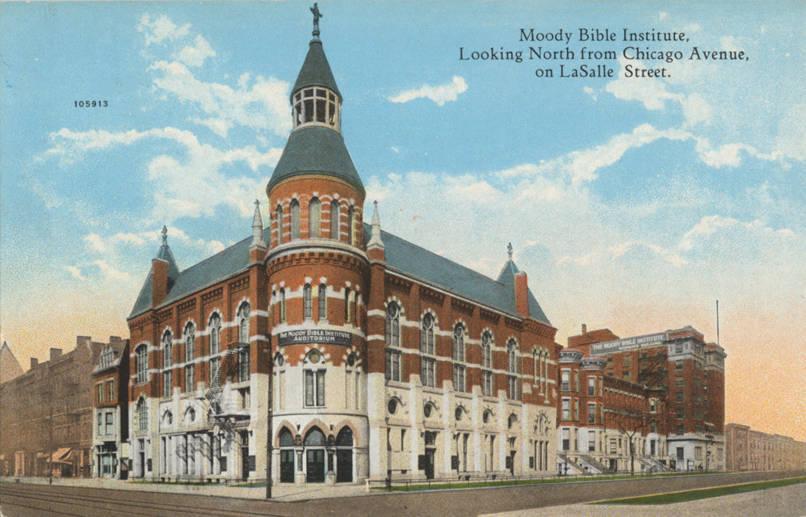
Moody Bible Institute, Curt Teich postcard, 1925. Public domain.
Anhwei, to 1934 · Person · Featured Study
John and Betty Stam
They were missionaries of the China Inland Mission, killed by soldiers of the Red Army in Anhwei in December 1934.
- Born
- John in 1907 at Paterson, New Jersey; Betty in 1906 or 1907 at Albion, Michigan (probable)
- Died
- 8 December 1934, at Miaosheo in Anhwei
- Family
- daughter: Helen Priscilla Stam; John's father: Peter Stam; Betty's father: Charles Ernest Scott; Betty's mother: Clara Scott
- Places
- Paterson, Tsinan, Wuhu, Tsingteh, Miaosheo
Soldiers led the two missionaries to a hill outside Miaosheo and killed them there, and their baby was left behind in an empty house.
For to me, to live is Christ, and to die is gain.
Summary
John Stam was born at Paterson, New Jersey. Betty Scott was the daughter of Presbyterian missionaries in Shantung. Both studied in Chicago, and in 1933 they married at Tsinan. Their daughter Helen was born at Wuhu in September 1934. That November the family set out for a new station at Tsingteh.
- John wrote two letters to the mission as a prisoner, and both were printed the next year.
- Their daughter Helen lived, and she was brought to her grandparents at Tsinan.
- A story that a freed prisoner died to save the baby was printed with a note that it was not yet proved.
The Verse Betty Wrote on Her Photograph
Betty took one verse of Paul as her motto, and John closed his first letter as a prisoner with the verse before it.
When Betty finished at Moody Bible Institute she gave friends her photograph, inscribed with her life motto, Philippians 1:21. John ended his letter of 6 December with "may God be glorified, whether by life or by death" and the reference Philippians 1:20.
The question of this life is how much the papers printed after their deaths can show, and where they rest on report alone.
I eagerly expect and hope that I will in no way be ashamed, but will have complete boldness so that now as always Christ will be exalted in my body, whether by life or by death.John took his closing words from this verse.
The Two Lives in Order
The early years stand on the family's clippings, and the last weeks on the letters Hamilton printed.
Five of the dates fall in the last three months of their lives.
- 1906 or 1907Elisabeth Alden Scott was born at Albion, MichiganA newspaper clipping in the Scott papers; her school's tablet
- 1907John Cornelius Stam was born at Paterson, New JerseyA newspaper clipping in the Scott papers; the library heading of 1935
- 1928Betty graduated from Wilson College in Chambersburg, PennsylvaniaA memorial article in the Scott papers
- 1931 and 1932Betty went to China in 1931 and John in 1932A Paterson newspaper report
- 25 October 1933R. A. Torrey Jr. married them at TsinanHamilton, page 5
- 11 September 1934Helen Priscilla was born at the mission hospital in WuhuThe sequel, page 15
- 12 November 1934The family left the railhead at Suan Cheng for TsingtehThe sequel, page 16
- 6 December 1934Soldiers took the town and held the family for ransomHamilton, page 10
- 7 December 1934The pair spent the night tied to the foot of a bedHamilton, pages 4 and 11
- 8 December 1934Both were put to death on the third day of their captivityA clipping of 1935 in the Scott papers
- 18 December 1934Betty's parents held a service of thanksgiving at TsinanCharles Scott, as Hamilton quotes him
Each step of the two lives stands with its witness.
12 November 1934, 6 December 1934, 7 December 1934, 8 December 1934, 18 December 1934
From Paterson and Tsinan to Miaosheo
John's letters from captivity and the report of Evangelist Lo carry the last days.
John's father, Peter Stam, ran the Star of Hope Mission in Paterson. Betty's parents, Charles Ernest and Clara Scott, took her to China before she was a year old.
Both went to China under the China Inland Mission. John rented a Chinese house at Tsingteh, a station in the mountains of southern Anhwei. The family lived there less than three weeks before the Red Army came.
The soldiers reached the town on the morning of 6 December, and they opened the jail and set its prisoners free. John wrote to the mission that day, "Their demand is twenty thousand dollars for our release."
The next day the soldiers marched the family fifteen miles to Miaosheo, Betty riding part of the way on a horse. Asked on the road where they were going, the two answered, "We do not know where these are going; but we are on our way to Heaven".
On the morning of 8 December they were driven through the streets with their hands bound and killed on a little hill outside the town. A Chinese Christian named Chiang Shu-sen came out of his medicine shop and knelt to plead for them, and the soldiers killed him too.
Helen lay for a day and a half in a deserted house, unfed and unharmed. Neighbours pointed a Chinese evangelist to the house by stealth. He found her still wrapped on the bed, with two five-dollar notes pinned in her clothes.
He and his wife carried Helen and their own small son in two baskets on a pole. They found nursing mothers along the way and bought a tin of dry milk with the two notes. The evangelist and an old Christian woman, the first convert of Miaosheo, laid John and Betty in coffins and hid them from the soldiers.
The Pamphlet and the Papers
A pamphlet from Suchowfu and the clippings Betty's family kept carry the account.
E. H. Hamilton wrote "Not Worthy to Be Compared" at Suchowfu in Kiangsu between January and March 1935, with a sequel on the baby. It prints the letters of both families. Its account of the rescue is the one Howard Van Dyck of the Christian and Missionary Alliance at Wuhu gave.
The pamphlet notes that Mrs. Howard Taylor of the mission was preparing a fuller life of the pair. It appeared the same year at Philadelphia as The Triumph of John and Betty Stam.
The Scott family's papers, with Hamilton's pamphlet, the clippings and Betty's poems, are kept by the Princeton Theological Seminary Library. A note among the papers says that most of the poems were rescued from the debris after the soldiers looted their home.
In Their Own Words
Each saying stands with the day and the place it was written.
John Stam (1907 to 1934)
Letter of 6 December 1934 to the China Inland Mission, Shanghai, page 10
Peace in our hearts
“All our possessions and stores are in their hands, but we praise God for peace in our hearts, and for a meal tonight. God grant you wisdom in what you do, and us fortitude and courage, and peace of heart.”
Protestant
About this saying1 paragraph
John wrote this at Tsingteh on 6 December 1934 to the mission at Shanghai, on the day the soldiers took the town.
John Stam
Letter of 7 December 1934 from Miaosheo, page 11
He is able
“Famine relief money, and our personal money and effects are all in their hands. God give you wisdom in what to do, and give us grace and fortitude. He is able.”
Protestant
About this saying1 paragraph
On 7 December 1934, in the post office at Miaosheo, friends slipped John paper and a pencil, and he wrote his last letter, which ends with these lines.
Betty Stam (died 1934)
Her words at a farewell meeting in Philadelphia, as Hamilton reports them, page 7
Whether living or dying
“Whether living or dying, I am the Lord’s”
Protestant
About this saying1 paragraph
Hamilton, writing in 1935, gives these as Betty's last words at a great farewell meeting in Philadelphia.
Betty Stam
My Testimony, a poem of 22 February 1929, page 8, the first stanza
And shall I fear
“And shall I fear / That there is anything / That men hold dear / Thou wouldst deprive me of, / And nothing give in place?”
Protestant
About this saying1 paragraph
Betty wrote the poem "My Testimony" at Moody Bible Institute in 1929, on her decision to serve in China, and it opens with these lines.
John Stam
Letter to his father of 1934, enclosing Hamilton's poem, page 9
The poem he sent home
“This poem exactly expresses my feelings”
Protestant
About this saying1 paragraph
In 1934 John sent his father a poem of Hamilton's, written after the killing of John W. Vinson about three years earlier. His father had the letter a few days before the news of December 1934.
The People Around Them
Their families, the Chinese Christians of Miaosheo and the missionaries at Wuhu stand in the record.
Three of the people who kept Helen alive were Chinese Christians.
| Person | Tie to John and Betty | The record |
|---|---|---|
| Helen Priscilla Stam | Their only child, eleven weeks old when they died | Van Dyck's account, in The Miracle Baby |
| Peter Stam | John's father, a preacher of the gospel in New Jersey | Hamilton, page 6 |
| Charles Ernest and Clara Scott | Betty's parents, Presbyterian missionaries in Shantung | The Scotts' letter from Tsinan, in Hamilton |
| Evangelist Lo and Mrs. Lo | A Chinese preacher and his wife, who brought Helen back to the mission | Van Dyck's account, in The Miracle Baby |
| Chiang Shu-sen | A shopkeeper of the town who died with them | Hamilton, page 12 |
| R. A. Torrey Jr. | A friend who led the service of thanksgiving | Charles Scott's letter, in Hamilton |
| Hyla S. Watters | The surgeon whose operation saved mother and child | Hamilton's pamphlet |
| E. H. Hamilton | A missionary poet whose verses John sent home | Hamilton, page 9 |
Hyla S. Watters, E. H. Hamilton
The Places of Their Lives
The record runs from New Jersey and Chicago to Shantung and the mountains of southern Anhwei.
Most of the record centres on the mission stations of Anhwei.
| Place | What the records say | The record |
|---|---|---|
| Paterson, New Jersey | John's home town and his father's mission | Hamilton, page 6 |
| Chicago | Both studied at Moody Bible Institute, and they spent a day of prayer there before Betty sailed | A letter of John's, quoted in the Scott papers |
| Tsinan, Shantung | Betty's parents served there, and the pair married there | Hamilton, pages 2 and 5 |
| Wuhu, Anhwei | A hospital town on the Yangtze, where the mission had its home | The Miracle Baby |
| Suan Cheng | The end of the railway, sixty-five miles from their station | The Miracle Baby, page 16 |
| Tsingteh, Anhwei | Their new station in the mountains | The Miracle Baby, page 16 |
| Miaosheo, Anhwei | A town fifteen miles from their station, where they were held | Hamilton, pages 4 and 11 |
What Their Deaths Did
Students offered themselves, and both families answered with prayer for the killers.
At a memorial service at Moody, the pamphlet reports, over seven hundred young men and women pledged themselves to take the Stams' places. Over two hundred did the same at Wheaton College. Charles Scott wrote that the two had flung out a challenge to the young, "Come and suffer for the Name".
John's mother wrote to the Scotts later that month, "May be in glory we may meet some of these bandits. We pray for them".
The Voices
Two teachers on Philippians 1:21.
Ambrose of Milan (died 397)
On the Decease of His Brother Satyrus, Book 2
Death with Christ is gain
“We see, then, that this death is a gain and life a penalty, so that Paul says: ‘To me to live is Christ and to die is gain.’ What is Christ but the death of the body, the breath of life? And so let us die with Him, that we may live with Him.”
on Philippians 1:21Patristic
Albert Barnes (1798 to 1870)
Notes, Explanatory and Practical, on the Old and New Testaments (1832 to 1869)
Paul lived for the one purpose of glorifying Christ
“His aim was not honor, learning, gold, pleasure; it was, to glorify the Lord Jesus. This was the single purpose of his soul - a purpose to which he devoted himself with as much singleness and ardor as ever did a miser to the pursuit of gold, or a devotee of pleasure to amusement, or an aspirant for fame to ambition.”
on Philippians 1:21Evangelical
What the Records Leave Open
Readers differ on Betty's birth year, the freed prisoner, the soldiers and John's year at Moody.
The freed prisoner and the babyHamilton; Howard Van Dyck
Hamilton tells a story given to Mr. Hanna of the China Inland Mission, that a prisoner freed from the jail offered to die for the baby and was killed. Hamilton calls it "yet to be verified", and he wrote that Charles Scott planned a trip to Tsingteh and Miaosheo to learn the truth.
Hamilton himself writes only that it is clear someone interceded for the baby, and Van Dyck's account finds Helen on the bed where her parents had left her.
The year of Betty's birthHer school's tablet; Hamilton; a newspaper clipping
The bronze tablet unveiled to her at the North China American School in 1937 reads "1906". Hamilton writes that one of her poems was dated on her twenty-second birthday in February 1929, which points to 1907, and one newspaper clipping gives 1907 with another day.
Who the soldiers wereHamilton; the Moody clipping
Hamilton writes of the Red Army in retreat after its defeat in Kiangsi. A clipping from Moody Bible Institute calls the killers "presumably communist bandits".
John's year at MoodyThe Moody clipping; a newspaper clipping
The Moody clipping calls John a graduate of 1932, and a newspaper clipping gives 1931.
Books to Read Next
Not Worthy to Be Compared, and The Miracle Baby
E. H. Hamilton · 1935
Its two parts were written within months of the deaths, from the letters and reports that reached the missionaries in China.
Read the pamphlet free at the Internet ArchiveThe Triumph of John and Betty Stam
Mrs. Howard Taylor · 1935
The China Inland Mission published this fuller life in the year after their deaths.
In print: find it wherever books are sold.
What the Stams Left
John and Betty Stam left two letters from captivity, the poems saved from their house, and a daughter carried to safety by Chinese Christians.
Sources
Scripture is the Berean Standard Bible.
- The Holy Bible, Berean Standard Bible (read 2026)
- E. H. Hamilton, "Not Worthy to Be Compared": The Story of John and Betty Stam, and "The Miracle Baby": Helen Priscilla Stam, Suchowfu, 1935, with the letters of John Stam, Charles Ernest Scott and Mrs. Peter Stam.
- Scott Family papers, memorials, obituaries and tributes to John and Elisabeth Scott Stam, newspaper and magazine clippings of 1934 to 1937.
- Mrs. Howard Taylor, The Triumph of John and Betty Stam, Philadelphia, China Inland Mission, 1935, the library record.
- Ambrose of Milan, On the Decease of His Brother Satyrus, book 2, on Philippians 1:21.
- Albert Barnes, Notes, Explanatory and Practical, on Philippians 1:21.
Keep Studying
Read it1
People and groups3
Go further1
Church history6
Trials of life1
Values1