
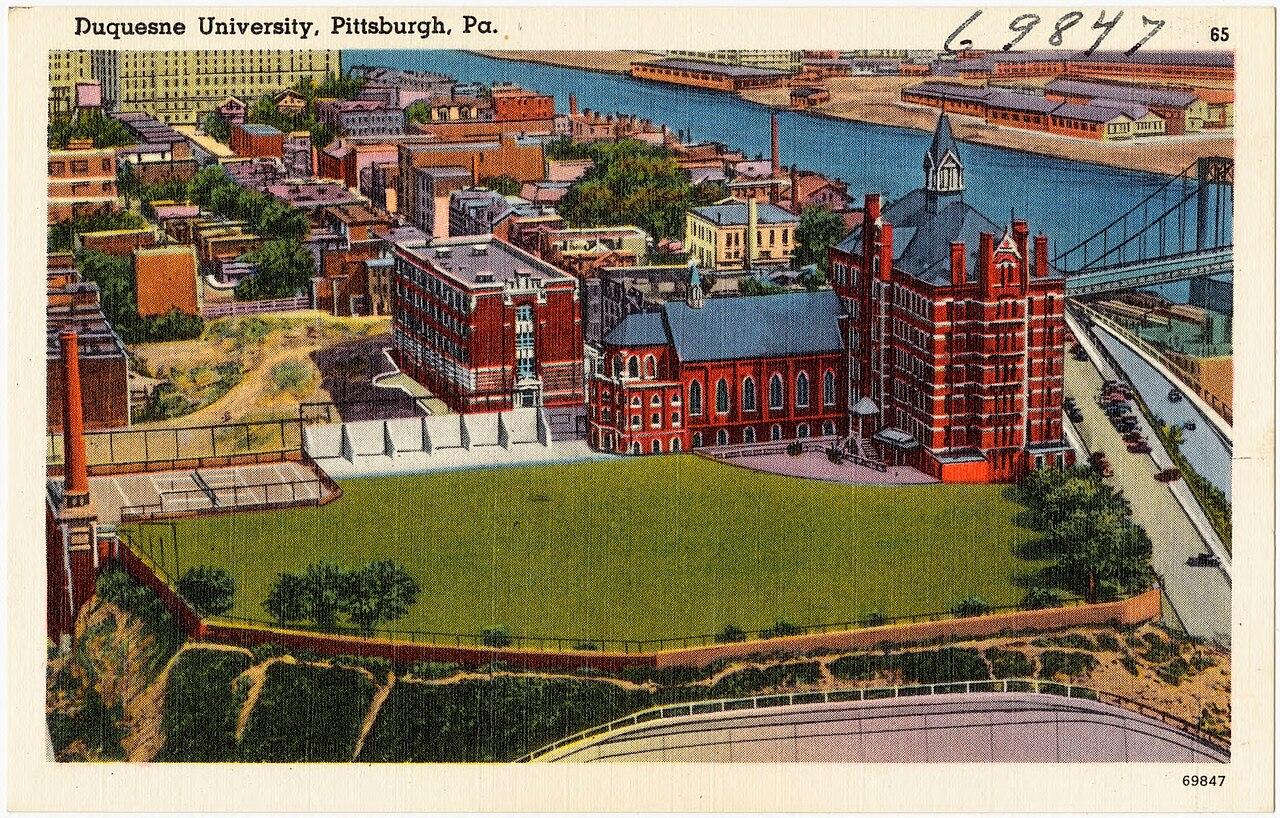
Mullen Brothers and Tichnor Brothers, Duquesne University, Pittsburgh, Pa., 1930 to 1945. Public domain.
Pittsburgh, February 1967 · Story · Featured Study
The Duquesne Weekend, 1967
A Catholic journal dates the first Catholic Pentecostals to Duquesne University and follows them to Notre Dame.
- Where
- Duquesne University, Pittsburgh, The University of Notre Dame
- Who
- Edward O'Connor, Kevin and Dorothy Ranaghan
- When
- February 1967
A Catholic writer set the movement beside the prayer of Pope John XXIII that God would renew His wonders "as by a new Pentecost".
And they were all filled with the Holy Spirit and began to speak in other tongues as the Spirit enabled them.
Summary
In February 1967 a study group at Duquesne University said they had received the gift of tongues. They were Catholic students and teachers. They had prayed with Pentecostals. Charles De Celles told the story in 1971.
- De Celles writes that Notre Dame became the centre of the movement.
- Catholics wrote its first books and articles.
- He counts over thirty thousand Catholics baptized in the Spirit by then, and gives no method.
The Texts the Movement Read
Passages of Acts and of Paul stand behind the account.
De Celles begins his account with the Day of Pentecost in Acts 2 and with the promise of Jesus in Acts 1. For the gifts given to every believer he cites 1 Corinthians 12 and Romans 12 through the Second Vatican Council's Constitution on the Church.
The Spirit poured out at Pentecost
But you will receive power when the Holy Spirit comes upon you, and you will be My witnesses in Jerusalem, and in all Judea and Samaria, and to the ends of the earth.”
De Celles reads the courage of the apostles after Pentecost as this promise kept.
Acts 1:8BSB
The gifts given to the church
All these are the work of one and the same Spirit, who apportions them to each one as He determines.
The Council's Constitution on the Church quotes this verse, and De Celles cites it for the gifts given to the faithful.
We have different gifts according to the grace given us. If one’s gift is prophecy, let him use it in proportion to his faith;
De Celles points to Romans 12 for the gifts of ministry, exhortation, generosity, presiding and mercy.
Romans 12:6BSB
1 Corinthians 12:11, Romans 12:6
The Record by Date
Each row gives a date and the page or the catalogue that prints it.
The movement went from a study group to a printed literature in five years.
- 1966Students and teachers at Duquesne study tongues and the baptism of the Spirit and pray with Pentecostals of other churches.De Celles, page 407
- February 1967Four members of the study group say they have received the gift of tongues.De Celles, page 407
- After February 1967The experience reaches Notre Dame, then the Newman Centers at Michigan and Michigan State.De Celles, page 407
- 19 August 1967Edward O'Connor writes on the baptism of the Spirit in Ave Maria.De Celles, note 16
- 20 July 1968James F. Powers writes on the Catholic Pentecostals in America.De Celles, note 19
- 1969Kevin and Dorothy Ranaghan publish Catholic Pentecostals with the Paulist Press.The library catalogue
- 1971Edward O'Connor publishes The Pentecostal Movement in the Catholic Church with the Ave Maria Press.The library catalogue
- December 1971The Dominican journal Cross and Crown prints De Celles's account of the movement.De Celles, page 403
A timeline of eight dates from the study group to De Celles's count, each with the place it is printed.
1971, December 1971
From Duquesne to Notre Dame
The first record tells of a study group, a gift of tongues and a spread from campus to campus.
De Celles dates the start of the movement to 1966. Several students and teachers at Duquesne University then studied the gift of tongues and the baptism of the Spirit together. They began to meet for prayer with Pentecostal Christians of the Protestant churches.
From Duquesne the experience went to Notre Dame, and from there to the Newman Centers at the University of Michigan and Michigan State. Holy Cross, Fordham, Catholic University and Iowa State followed.
De Celles writes that the meetings were held mostly on college campuses but that most who came were not students. He names faculty members, graduate students, priests, sisters, brothers and townspeople from the meetings he attended at Fordham, Catholic University and Marywood College.
How the Meetings Were Held
De Celles describes what was done when the groups met.
In the prayer meeting De Celles saw, one person prayed aloud in praise or thanks, and another read a passage of Scripture and prayed from it. Others sang, taught or told what God had done in their lives. A person could speak in a tongue and pray for its interpretation, and another could prophesy.
He writes that the baptism in the Spirit was kept apart from the prayer meeting. A baptized Christian asked the Spirit to change his life and make him more like Christ, while others prayed with him. He often received the gift of tongues.
The community laid hands on the one who asked. De Celles writes that people also asked for the laying on of hands to rededicate themselves to God and to pray for the sick.
How the Key Verse Was Taught
Three teachers of three eras on the disciples filled with the Spirit and speaking in tongues.
Gregory the Dialogist (died 604)
Forty Gospel Homilies, Homily 30
Gregory the Great preached that the Spirit gave the frightened disciples both the tongues and the boldness to speak of Christ.
“Let us consider what kind of men our holy preachers were when this day found them, and what kind it made them. Certainly those who were sitting in one room out of fear of the Jews knew each one the language of their birth, and yet they did not presume to speak openly of Christ even in that language which they knew. The Spirit came, and in their mouths taught them through the diversity of tongues, while in their minds he strengthened them with authority.”
on Acts 2:4Patristic
John Wesley (1703 to 1791)
Explanatory Notes upon the New Testament
John Wesley read the tongues of Pentecost as a promise that the whole world would praise God.
“And this family praising God together, with the tongues of all the world, was an earnest that the whole world should in due time praise God in their various tongues. As the Spirit gave them utterance - Moses, the type of the law, was of a slow tongue; but the Gospel speaks with a fiery and flaming one.”
on Acts 2:4Evangelical
Jonathan Goforth (1859 to 1936)
By My Spirit, chapter I
Jonathan Goforth held that Pentecost was the normal life of the church.
“But though we speak of the manifestations at Pentecost as being abnormal, yet we maintain that Pentecost was normal Christianity.”
Presbyterian missionary
In Their Own Words
A student on the retreat tells its start, and three Catholic writers of 1968 and 1969 give their reasons for it.
Karin Sefcik
Kevin and Dorothy Ranaghan, Catholic Pentecostals (Paramus, N.J.: Paulist Press, 1969), the chapter Bearing Witness, Internet Archive catholicpentecos00rana, read by full-text search fragments on 2026-11-11, at the running head of page 29
A phrase with a bright smile
“‘Baptism in the Spirit’ was a phrase Ralph Keifer seriously, yet with a bright smile on his face, brought up at an organizational meeting for our student retreat weekend at Duquesne University in February, 1967. Before a few weeks had passed I glowed like him.”
Roman Catholic
About this saying1 paragraph
Karin Sefcik, a Duquesne student on the weekend of February 1967, told the start in the Ranaghans' book of 1969.
Kevin and Dorothy Ranaghan
Charles De Celles, "The Catholic Pentecostal Movement", Cross and Crown 23, no. 4 (December 1971), page 404, which quotes their Catholic Pentecostals (1969), pages 155 to 156, in its note 4
An openness of the whole Church
“There is an openness of the whole Church to everything Jesus would have it be. In such an atmosphere Jesus is able to break through the walls of human weakness with the result that the charismatic life of the Church grows once again.”
Roman Catholic
About this saying1 paragraph
Kevin and Dorothy Ranaghan wrote in 1969 of why the present age suited the Spirit's work.
Edward D. O'Connor
Charles De Celles, "The Catholic Pentecostal Movement", Cross and Crown 23, no. 4 (December 1971), page 405, which quotes his "Pentecost and Catholicism", Ecumenist 6 (July to August 1968), page 163, in its note 5
A special need of signs
“Those who lack the support of the institutional Church and the grace of the sacraments have a special need of manifest signs from God.”
Roman Catholic
About this saying1 paragraph
Father Edward O'Connor wrote this in 1968 of why Christians outside the Catholic Church may have known the experience first.
What the Baptism in the Spirit Is
The Pentecostal churches and the Catholic writers named the experience in their own terms.
De Celles reports that the Pentecostal churches teach tongues as the sure sign of having received the baptism of the Spirit. The Wesleyan and Pentecostal tradition teaches the baptism in the Spirit as an experience of the Spirit's power after conversion, as at Pentecost.
De Celles himself thought the word baptism "probably not well chosen" and used it in the sense of initiation. He compared the laying on of hands to the sacramentals of the Catholic Church.
He cites Stephen Clark, who in 1969 saw the baptism of the Spirit as a renewal of confirmation. In it the Spirit already given is known more fully.
Books to Read Next
The Catholic Pentecostal Movement
Charles De Celles · 1971
De Celles describes the movement's meetings from his own attendance.
Read De Celles free at the Internet ArchiveCatholic Pentecostals
Kevin and Dorothy Ranaghan · 1969
De Celles calls the Ranaghans leaders of the Catholic charismatic renewal and quotes their reasons for the outpouring.
In print: find it wherever books are sold.
The Pentecostal Movement in the Catholic Church
Edward D. O'Connor · 1971
De Celles cites O'Connor's articles of 1967 and 1968, and this book followed them.
In print: find it wherever books are sold.
What the Duquesne Students Left
The students of Duquesne carried the prayer of Acts 2 into the Catholic Church. Within five years a Catholic journal counted tens of thousands who had joined them.
Sources
Scripture is the Berean Standard Bible.
- The Holy Bible, Berean Standard Bible (read 2026)
- Charles De Celles, "The Catholic Pentecostal Movement", Cross and Crown 23, no. 4 (December 1971), pages 403 to 416, printed for the Dominican Fathers of the Province of St. Albert the Great, Chicago.
- Kevin and Dorothy Ranaghan, Catholic Pentecostals (Paramus, N.J.: Paulist Press, 1969)
- Edward O'Connor, "Pentecost and Catholicism", Ecumenist 6 (July to August 1968), page 163.
- Edward D. O'Connor, The Pentecostal Movement in the Catholic Church (Notre Dame, Ind.: Ave Maria Press, 1971)
- The church history plan, row 133, citing David Mangan, God Loves You and There's Nothing You Can Do About It (Servant, 2008), a memoir written forty-one years after the events.
Keep Studying
People and groups3
Subjects1
Church history3