
2 Thessalonians 3:17
in 2 Thessalonians 3This greeting is in my own hand—Paul. This is my mark in every letter; it is the way I write.
BSB
The same verse in ASV and KJV ▾
ASV
The salutation of me Paul with mine own hand, which is the token in every epistle: so I write.
KJV
The salutation of Paul with mine own hand, which is the token in every epistle: so I write.
⋯
This verse in 2 Thessalonians 3
Commentary
11 notes on this verseAt the end of every letter he wrote his name both in Hebrew letters and in the Greek, lest what may come from one of the false apostles may be allowed to corrupt them.
This site's exposition
Now may the Lord of peace Himself
on 2 Thessalonians 3:16-18
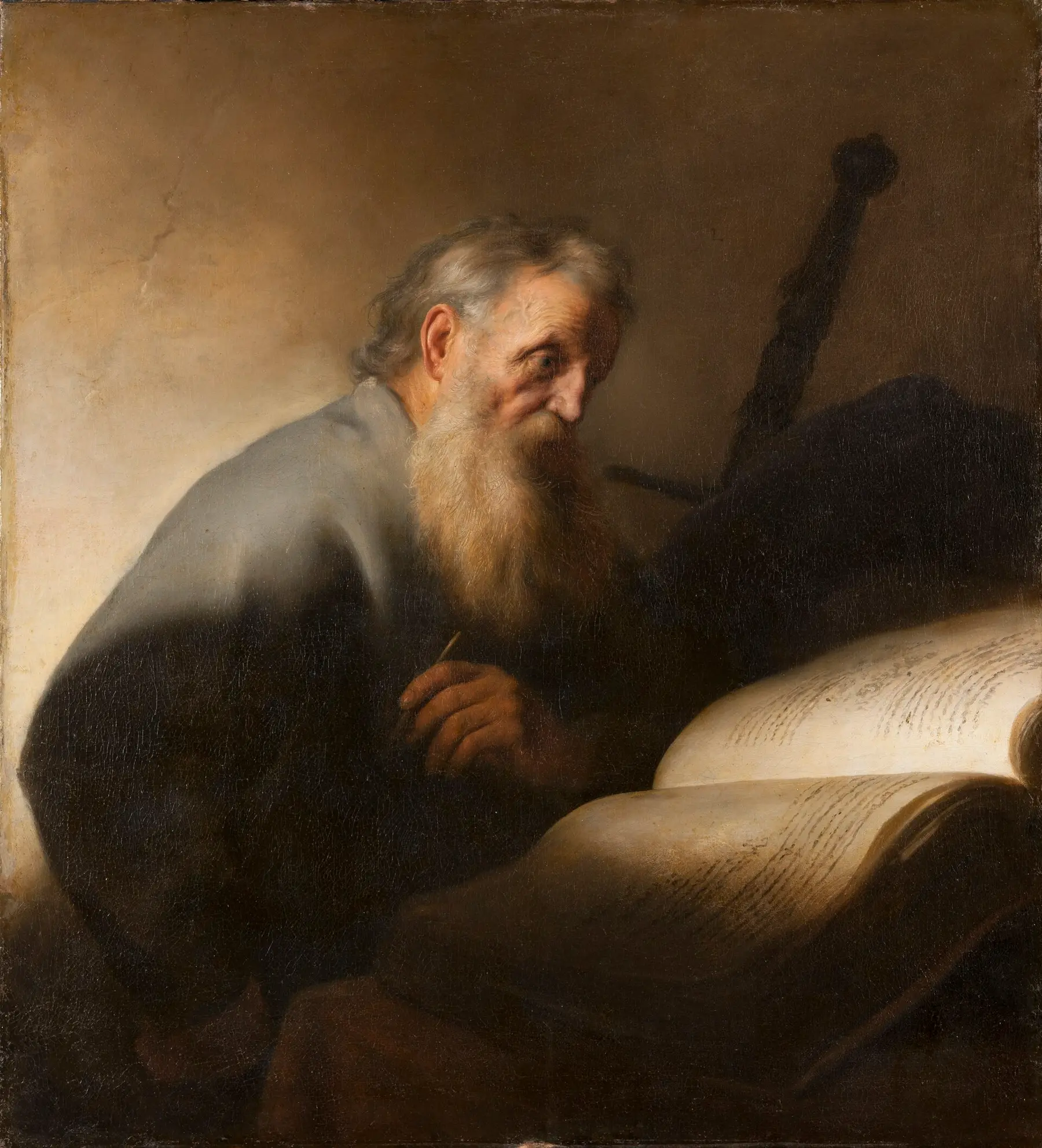
Paul takes the pen, This greeting is in my own hand, a mark in every letter. A letter seeming to be from us had alarmed them at 2:2. A secretary wrote the body, and the closing hand was a signature the churches could check.
This site's exposition
in my own hand
A secretary wrote the body of the letter, and Paul took the pen for the closing lines. The signature was a mark the churches could check, which mattered because a letter falsely claiming to be from him had unsettled them at 2:2. Haimo of Auxerre read it the same way.
The record, by era
The Church Fathers2 voices
"The salutation of me Paul with mine own hand, which is the token in every Epistle: so I write. The grace of our Lord Jesus Christ be with you all." This he says that he writes in every Epistle, that no one may be able to counterfeit them, his subscription being subjoined as a great token. And he calls the prayer a salutation, showing that everything they then did was spiritual; even when it was proper to offer salutation, the thing was attended with advantage; and it was prayer, not merely a symbol of friendship. With this he began, and with it he ended, guarding with strong walls what he had said elsewhere, and laying safe foundations, he brought it also to a safe end. "Grace be unto you and peace," he says; and again, "The grace of our Lord Jesus Christ be with you all. Amen." This the Lord also promised, saying to His disciples, "Lo, I am with you alway, even unto the end of the world." But this takes place when we are willing. For He will not be altogether with us, if we place ourselves at a distance. "I will be with you," He says, "always." Let us not therefore drive away grace.
Whence then shall we know them, he says? For this very reason, he added, "The salutation of me Paul with mine own hand, which is the token in every Epistle: so I write. The grace of our Lord Jesus Christ be with you all." He does not here mean, that this is the token,-for it is probable that others also imitated this,-but that I write the salutation with mine own hand, as is the custom also now among us. For by the subscription the writings of those who send letters are made known.
The Medieval Church2 voices
"The salutation of Paul, with my own hand." He says this because of unbelievers who were twisting his epistles. "See with what kind of letters I write to you with my own hand" (Gal 6:11). "Which is the sign in every epistle. So I write."
He calls the greeting a prayer, showing by this that even when it was necessary to greet, this was accomplished with spiritual benefit and prayer, and was not a simple sign of friendship. So that letters would not be composed in my name by any …
The Puritans and the Awakening1 voice
The Apostle's Pious Request. 1 Finally, brethren, pray for us, that the word of the Lord may have free course, and be glorified, even as it is with you: 2 And that we may be delivered from unreasonable and wicked men: for all men have not faith. 3 But the Lord is faithful, who shall stablish you, and keep you from evil.
quarantine:scripture (2026-07-29) — scripture-overlap:92%@v1-3
3 more voices on this verse
The Puritans and the Awakening1 voice
The salutation of Paul with mine own hand,....
The Nineteenth Century2 voices
A commentator
Albert Barnes1798–1870
Notes, Explanatory and Practical, on the Old and New Testaments (1832-1869)
The salutation of Paul with mine own hand; - See the notes, 1Co 16:21. “Which is the token in every epistle.” Greek: “sign.” That is, this signature is a sign or proof of the genuineness of the epistle; compare the notes on Gal 6:11. So I write - Referring, probably, to some mark or method which Paul had of signing his name, which was well known, and which would easily be recognized by them.
The salutation of Paul with mine own hand - It is very likely that Paul employed an amanuensis generally, either to write what he dictated, or to make a fair copy of what he wrote. In either case the apostle always subscribed it, and wrote the salutation and benediction with his own hand; and this was what authenticated all his epistles. A measure of this kind would be very necessary if forged epistles were carried about in those times. See the note on 1Co 16:21, and see Col 4:18 (note).
The words behind it
14 Greek wordsEvery Greek word of this verse in the order it stands, with what it means and the door to its own study. The last column counts the times a word stands in the whole Bible: the rarer the word, the more the places it appears belong together.
| Greek | Sound | Meaning | Word study | In the Bible |
|---|---|---|---|---|
| Ὁ | ho | The | G3588 → | 19766 times |
| ἀσπασμὸς | aspasmos | greeting | G783 → | |
| τῇ | tea | <the> | G3588 → | 19766 times |
| ἐμῇ | emea | in my own | G1473 → | |
| χειρὶ | cheiri | hand — | G5495 → | |
| Παύλου, | paulou | by Paul, | G3972 → | |
| ὅ | ho | which | G3739 → | 1405 times |
| ἐστιν | estin | is | G1510 → | 2333 times |
| σημεῖον | semeion | [my] sign | G4592 → | |
| ἐν | en | in | G1722 → | 2738 times |
| πάσῃ | pase | every | G3956 → | 1235 times |
| ἐπιστολῇ· | epistolea | letter; | G1992 → | 24 times |
| οὕτως | houtos | In this manner | G3779 → | |
| γράφω.¶ | grapho | I write. | G1125 → |
ὉThe
hoG3588 →19766 times
ἀσπασμὸςgreeting
aspasmosG783 →
τῇ<the>
teaG3588 →19766 times
ἐμῇin my own
emeaG1473 →
χειρὶhand —
cheiriG5495 →
Παύλου,by Paul,
paulouG3972 →
ὅwhich
hoG3739 →1405 times
ἐστινis
estinG1510 →2333 times
σημεῖον[my] sign
semeionG4592 →
ἐνin
enG1722 →2738 times
πάσῃevery
paseG3956 →1235 times
ἐπιστολῇ·letter;
epistoleaG1992 →24 times
οὕτωςIn this manner
houtosG3779 →
γράφω.¶I write.
graphoG1125 →
A shaded row is a word that stands 400 times or fewer in the Bible.
The walk
8 stopsEach card is a verse this one points to, and under it the verses that one points to in turn. Where several paths arrive at the same place, that place is listed first: the text keeps returning to it.
Through
2 Thessalonians 1:5All this is clear evidence of God’s righteous judgment. And so you will be counted worthy of the kingdom of God, for which you are suffering.
it leads to
- Philippians 1:28
without being frightened in any way by those who oppose you. This is a clear sign of their destruction but of your salvation, and it is from God.
- Acts 14:22
strengthening the souls of the disciples and encouraging them to continue in the faith. “We must endure many hardships to enter the kingdom of God,” they said.
- Philippians 1:28
Through
1 Corinthians 16:21This greeting is in my own hand—Paul.
it leads to
- Galatians 6:11
See what large letters I am using to write to you with my own hand!
- Colossians 4:18
This greeting is in my own hand—Paul. Remember my chains. Grace be with you.
- Galatians 6:11
Through
Colossians 4:18This greeting is in my own hand—Paul. Remember my chains. Grace be with you.
it leads to
- Hebrews 13:3
Remember those in prison as if you were bound with them, and those who are mistreated as if you were suffering with them.
- 1 Timothy 6:21
which some have professed and thus swerved away from the faith. Grace be with you all.
- 2 Timothy 4:22
The Lord be with your spirit. Grace be with you all.
- Hebrews 13:3
Through
Joshua 2:12Now therefore, please swear to me by the LORD that you will indeed show kindness to my family, because I showed kindness to you. Give me a sure sign
it leads to
- Joshua 2:18
unless, when we enter the land, you have tied this scarlet cord in the window through which you let us down, and unless you have brought your father and mother and brothers and all…
- Joshua 2:18
Where this verse is studied
About 2 Thessalonians
This page draws on 11 works. Open the list of works
This page draws on Adam Clarke, Commentary on the Bible; Albert Barnes, Notes on the New Testament; Albert Barnes, Notes, Explanatory and Practical, on the Old and New Testaments (1832-1869); Haimo of Auxerre, Commentary (church-history corpus); Jamieson, Fausset & Brown, Commentary Critical and Explanatory on the Whole Bible; John Chrysostom, Homily on 2 Thessalonians 5; John Chrysostom, Homily on 2 Thessalonians 1; John Gill, Exposition of the New Testament (1746-1748); Matthew Henry, Commentary on the Whole Bible; Theophylact of Ohrid, Commentary on 2 Thessalonians and Thomas Aquinas, Commentary on 2 Thessalonians.