
Psalm 98
9 verses · Psalm of the LORD's kingship
Sing to the LORD a new song, for He has done wonders; His right hand and holy arm have gained Him the victory.
Introduction
Author unstated, the Song of Victory, Book 4: The LORD reigns, Poetry, Psalms Overview.
This psalm is headed only as a psalm and names no writer. It is a song for a victory already won, sung after the rescue it describes. It names no battle and no year, so any generation that has seen God save can sing it. It calls first on Israel, then on the whole earth, then on the sea, the rivers and the hills, to join the music. Listen for the instruments, named one after another, and for the reason given at the end: the King comes to judge, and His judgment is good news.
Context
- Who
- Israel first, then the whole earth, the sea, the rivers and the mountains it calls in by name
- What
- A new song for a victory God has already won, calling Israel, the nations and the whole creation to praise.
- Where
- The temple service, with the lyre, the harp, the trumpets and the ram's horn named in the psalm
- When
- Undated; the psalm names no battle and no year.
- Why
- To answer God's saving act with praise and to welcome Him as the coming Judge.
Historical context
The psalm names four instruments in two verses: the lyre and the harp of the sanctuary, the metal trumpets the priests blew, and the ram's horn, the shofar used at festivals and in war. The right hand and the holy arm of verse 1 are the language of a fighter, and Isaiah 52:10 uses the same picture of God baring His arm in the sight of the nations. The clapping rivers of verse 8 borrow the acclamation people gave when they greeted a king. The psalm names no battle, which is unusual for a victory song, and states what it celebrates as salvation, righteousness, love and faithfulness shown to the house of Israel in the sight of the nations.
Significance
For a hearer the order was the point. The act came first and the song came after, so the psalm is a response to what God had done. Calling the sea and the mountains to join told Israel that the whole created world was summoned to the same thanksgiving.
This chapter in Jewish lifeWhat this chapter is in Jewish life and reading.
How it is read
The psalm stands in the group this site calls the enthronement psalms, Psalms 93 and 95 to 99 (src/components/book/dossier-content/psalms-structure.ts). That is a statement about the collection rather than about any service, and it is given here as one.
The corpus holds only two comments of Rashi on this chapter, and both are short. On the opening call to sing he writes that "all these are for the future", which places the whole psalm where he placed Psalms 96 and 97 (Rashi on Psalms 98:1:1, Rashi on Psalms, The Judaica Press complete Tanach with Rashi, translated by A. J. Rosenberg, CC-BY).
The second comment is a rule for reading poetry. On the rivers clapping hands in verse 8 Rashi writes that "the prophets spoke in a language that the ear can hear", and that the rivers have no hand, the words being an expression of joy and gladness (Rashi on Psalms 98:8:1, same edition). A Christian reader meets in that line the same instinct the church fathers had about figures of speech in the Psalms, reached from inside the Jewish tradition.
Ibn Ezra, Radak, Metzudat David and Malbim carry twenty two comments on this chapter for which Sefaria holds no English version, which is the largest block of untranslated commentary in these thirty psalms. They are cited by reference (Ibn Ezra on Psalms 98:1:1, Radak on Psalms 98:1:1, Metzudat David on Psalms 98:2:1, Malbim on Psalms 98:4:1 and the references beside them).
What the rabbis say
The corpus records forty places where the Midrash and the Talmud cite this psalm, thirty seven under Midrash and three under Talmud, and it carries the locator for each one with no text. The Babylonian Talmud cites the first verse at Avodah Zarah 24b:16, verse 3 at Megillah 11a:3 and the trumpets of verse 6 at Rosh Hashanah 27a:14.
The new song of verse 1 carries eighteen locators here, among them Bereshit Rabbah 54:4, three places in Midrash Tehillim at 1:18, 18:4 and 137:1, and two in Midrash Tanchuma on Beshalach at 10:11 and 11:1. Verse 2 is read at Midrash Tehillim 117:2, and verse 9 at Vayikra Rabbah 30:4. The site reports where the rabbis cite the verse and reports no saying, because the locator carries none.
Sources: MannaFest, the enthronement psalms, at src/components/book/dossier-content/psalms-structure.ts, 2026; Rashi, Rashi on Psalms 98, in The Judaica Press complete Tanach with Rashi, translated by A. J. Rosenberg, CC-BY; Ibn Ezra, Radak, Metzudat David and Malbim, their comments on Psalms 98, cited by reference; Sefaria holds no English version; The Midrash and the Talmud, the forty locators on Psalms 98 in scripts/data/sources/sefaria/psalms/98.json.
Psalms 98:1-3
for He has done wonders: The new song answers a victory already won by His right hand and holy arm. Isaiah 52:10 draws the same picture, the bared holy arm and the ends of the earth seeing the salvation of God. Luke 1:54 puts that remembered mercy in Mary's mouth.
Psalms 98:1
“O sing unto the Lord a new song; for he hath done marvellous things. We had a new song before (Ps 96:1-13) because the Lord was coming, but now we have another new song because he has come, and seen and conquered. Jesus, our King, has lived a marvellous life, died a marvellous death, risen by a marvellous resurrection, and ascended marvellously into heaven. By his divine power he has sent forth the Holy Spirit doing marvels, and by that sacred energy his disciples have also wrought marvellous things and astonished all the earth.”
Charles Spurgeon · The Treasury of David, Vol. 4 (1874)Particular Baptist
1 more voice on this verseWhat preachers and commentators have said about this verse, in their own words.
Psalms 98:1
“His own right hand has saved for him. What he says is this: He saved men — not another's work, but his own; that is, what he had made for himself, he himself saved for himself. He had made man for salvation, who by his own fault had perished: this One died, that he might save man for himself by his own right hand. Here 'right hand' is put for power, and 'arm' for strength. And his holy arm.”
Jerome · written before 420 · Homily 25, on Psalm 97patristic
revealed His righteousness to the nations: What God did for Israel was done where the nations could see it. His salvation was proclaimed and His righteousness made known in public. The victory served as a message to the world.
Psalms 98:2
“The Lord has made known his salvation. He did not say 'he showed,' but 'he made known.' What he says is this: what before they had known of God, and by their own fault had forgotten. Therefore God, coming by his grace, made manifest to them this thing which they had lost.”
Jerome · written before 420 · Homily 25, on Psalm 97patristic
2 more voices on this verse
Psalms 98:2
“The Lord hath made known his salvation, by the coming of Jesus and by the outpouring of the Holy Ghost, by whose power the gospel was preached among the Gentiles. The Lord is to be praised not only for effecting human salvation, but also for making it known, for man would never have discovered it for himself; nay, not so much as one single soul would ever have found out for himself the way of mercy through a Mediator; in every case it is a divine revelation to the mind and heart. In God's own light his light is seen.”
Charles Spurgeon · The Treasury of David, Vol. 4 (1874)Particular Baptist
Psalms 98:2
“Salvation - The redemption of the world by the Messiah: which was hitherto reserved was a secret among the Jews, yea was not throughly known by the most of the Jews themselves. Righteousness - His faithfulness in accomplishing this great promise.”
John Wesley · Explanatory Notes upon the Old Testament (1765)evangelical
He has remembered His love and faithfulness: The victory is traced to memory, God keeping His promises to the house of Israel. Love and faithfulness are the two words of His covenant. The ends of the earth see what He did for one people.
Psalms 98:3
“He hath remembered his mercy and his truth toward the house of Israel. To them Jesus came in the flesh, and to them was the gospel first preached; and though they counted themselves unworthy of eternal life, yet the covenant was not broken, for the true Israel were called into fellowship and still remain so. The mercy which endureth for ever, and the fidelity which cannot forget a promise, secure to the chosen seed the salvation long ago guaranteed by the covenant of grace. All the ends of the earth have seen the salvation of our God.”
Charles Spurgeon · The Treasury of David, Vol. 4 (1874)Particular Baptist
2 more voices on this verse
Psalms 98:3
“He has remembered his mercy. 'He has shut up all things under sin, that he might have mercy on all.' And his truth to the house of Israel. He remembers mercy: he fulfills truth. He has remembered his mercy: that is, toward the people of the nations. And his truth to the house of Israel: fulfilling by this work what he had promised to the patriarchs.”
Jerome · written before 420 · Homily 25, on Psalm 97patristic
Psalms 98:3
“God is said, in sending Christ, to perform the mercy promised to our fathers, and to remember the holy covenant, Luke i. It was in consideration of that, and not of their merit.”
Matthew Henry · Commentary on the Whole Bible (1707-1721)puritan
Psalms 98:4-6
Make a joyful noise to the LORD: The call is a command to the whole earth, and it is the earth that has to make the noise. The instruments are named one after another, the lyre, the harp, the trumpet and the ram's horn. All of it is aimed at the LORD, the King.
Psalms 98:4
“Make a joyful noise unto the Lord, all the earth,.... That is, all the inhabitants of the earth, as the Targum, to whom the joyful sound of the Gospel comes; See Gill on Psa 95:1, make a loud noise, rejoice, and sing praise; exalt and extend the voice to the highest pitch, in the most musical and melodious strains; this heap of words is used to express the intenseness of mind, vehemency of affection, and strength of spirit and exceeding greatness of joy, with which the Lord should be praised for his great and marvellous works.”
2 more voices on this verse
Psalms 98:4
“Rejoice in God, all the earth. Not Judea alone, but all the earth — rejoice in the Lord. Send forth the standards of the victorious army. Sing and exult and make melody. Sing — in thought; but make melody — that is, with all your members. Let the hand make melody in almsgiving, let the foot make melody by going about in good work.”
Jerome · written before 420 · Homily 25, on Psalm 97patristic
Psalms 98:4
“We are here called upon again to sing unto the Lord a new song, as before, Ps. xcvi. "Sing a most excellent song, the best song you have." Let the song of Christ's love be like Solomon's on that subject, a song of songs. A song of praise for redeeming love is a new song, such a song as had not been sung before; for this is a mystery which was hidden from ages and generations.”
Matthew Henry · Commentary on the Whole Bible (1707-1721)puritan
Sing praises to the LORD with the lyre: Sing praises with the lyre, and again with the harp, in melodious song: in Hebrew both are the kinnor. David played it for Saul at 1 Samuel 16:23. The song to the LORD is sung with strings.
Psalms 98:5
“Sing unto the Lord with the harp. Skill in music should not be desecrated to the world's evil mirth, it should aid the private devotions of the saint, and then, like George Herbert, he will sing, Martin Luther was thus wont to praise the Lord, whom he loved so well. God's praises should be performed in the best possible manner, but their sweetness mainly lies in spiritual qualities.”
Charles Spurgeon · The Treasury of David, Vol. 4 (1874)Particular Baptist
1 more voice on this verse
Psalms 98:5
“Make melody to the Lord on the harp. Let all your strings have voice. There cannot be a harp if one string is missing. What does it profit you if you are chaste, and yet greedy? What does it profit you if you are both chaste and generous in almsgiving, and yet envious? What does it profit you if you have six strings whole and one broken? If one string is lacking, the perfect sound of the harp cannot exist.”
Jerome · written before 420 · Homily 25, on Psalm 97patristic
shout for joy before the LORD, the King: The trumpets were the silver ones of Numbers 10:2, blown by priests, and the ram's horn was the shofar. The shout goes up before the LORD as King. At 1 Kings 1:39 the horn and a shout greeted Solomon's anointing.
Psalms 98:6
“With trumpets and sound of cornet make a joyful noise. God's worship should be heartily loud. The far resounding trump and horn well symbolise the power which should be put forth in praise. Before the Lord, the King. On coronation days, and when beloved monarchs ride abroad, the people shout and the trumpets sound till the walls ring again. Shall men be more enthusiastic for their earthly princes than for the divine King? Is there no loyalty left among the subjects of the blessed and only Potentate?”
Charles Spurgeon · The Treasury of David, Vol. 4 (1874)Particular Baptist
3 more voices on this verse
Psalms 98:6
“On beaten trumpets and with the sound of the horned trumpet. We read in the book of Numbers that there are two kinds of trumpets: one kind of trumpet beaten out of silver, and another kind of trumpets made of horn. So here both are named: On beaten trumpets and with the sound of the horned trumpet. What is said is this. The trumpet beaten out of silver is the word of God. 'The words of the Lord are chaste words: silver tried by fire, purified sevenfold.'”
Jerome · written before 420 · Homily 25, on Psalm 97patristic
Psalms 98:6
“Carnal mirth is an enemy to this holy joy. When David danced before the ark he pleaded that it was before the Lord; and the piety and devotion of the intention not only vindicated what he did, but commended it.”
Matthew Henry · Commentary on the Whole Bible (1707-1721)puritan
Psalms 98:6
“With trumpet and sound of cornet,.... The Septuagint, Vulgate Latin, and Ethiopic versions, render it with ductile trumpets, such as were made of silver, as the two trumpets for the calling of the assembly, Num 10:2 to which the allusion seems to be here, called "asosra" by Josephus (c) according to the Hebrew language חצוצרות; which he says were in length a little less than a cubit, but the pipe narrow, somewhat thicker than a flute, having a sufficient breadth at the mouth to blow with, ending after the manner of a bell.”
Psalms 98:7-9
Let the sea resound: The sea, the rivers and the mountains are called to join the noise the worshiper was just commanded to make. Psalm 96:11 to 13 closes the same way, though it puts fields and trees where this psalm puts rivers and mountains. Here the judging is done with righteousness and equity.
Psalms 98:7
“Let the sea roar, and the fulness thereof,.... See Gill on Psa 96:11, the world, and they that dwell therein; men, the inhabitants of the world; that is, let them rejoice because this glorious King has taken to himself his great power, and reigns, Rev 11:15.”
2 more voices on this verse
Psalms 98:7
“Let the sea be moved, and the fullness thereof. Let the sea be moved, and let the bitter waters be changed into sweet. In fact, Marah too was changed and made into a sweet taste. Nothing else made that bitter water sweet except the wood of the cross, which had been cast into it. It seems to me that the bitter sea is the law of Moses. This is what is called Marah, that is, 'bitter.' This bitter water of the old law received the wood of the cross, and was made sweet.”
Jerome · written before 420 · Homily 25, on Psalm 97patristic
Psalms 98:7
“This intimates that the kingdom of Christ would be a blessing to the whole creation; but that, as the inferior creatures declare the glory of the Creator ( Ps. xix. 1 ), so they declare the glory of the Redeemer, for by him all things not only subsist in their being, but consist in their order.”
Matthew Henry · Commentary on the Whole Bible (1707-1721)puritan
Let the rivers clap their hands: Clapping greeted a new king, as at 2 Kings 11:12 when the people clapped for Joash. The rivers give that applause, and the mountains sing together. Isaiah 55:12 gives the trees of the field the same gesture.
Psalms 98:8
“Let the floods clap their hands,.... Or "rivers" (e), dashing against their banks, as they pass along; a prosopopoeia, as the preceding and following, expressing great joy on account of the Messiah, the reigning King. Aben Ezra interprets this of men that are in rivers, as the sea; in the preceding verse of such that are in ships at sea; and the hills in the next clause of such that dwell on them; let the hills be joyful together; see Isa 55:12. (e) נהרות "fluvii", Cocceius, Gejerus, so Ainsworth.”
2 more voices on this verse
Psalms 98:8
“The rivers shall clap their hands together. Let us ask the Jews, who understand according to the letter. Do rivers have hands? Do rivers have voices? Do rivers have feet? Do rivers have a belly? Someone may say: It is not written about a belly, about feet. But I say to you: from one member we understand the rest as well; for we cannot understand hands without feet, without a belly, without the other members. The rivers shall clap their hands together. The rivers, which have drunk from the fountain of Jesus.”
Jerome · written before 420 · Homily 25, on Psalm 97patristic
Psalms 98:8
“Let the floods clap their hands. The rolling rivers, the tidal estuaries, the roaring cataracts, are here summoned to pay their homage, and to clap their hands, as men do when they greet their sovereigns with acclamation. Let the hills be joyful together, or in concert with the floods.”
Charles Spurgeon · The Treasury of David, Vol. 4 (1874)Particular Baptist
He comes to judge the earth: The joy of creation has a reason: the Judge is coming. He judges with righteousness and equity, fairness without partiality. The earth looks for His coming as a rescue.
Psalms 98:9
“Before the Lord, for he cometh to judge the earth,.... See Gill on Psa 96:13, with righteousness shall he judge the world, and the people with equity; both at his first and second coming, and during the intermediate time; see the note as before. The only difference is, that in Psa 96:13, it is said that he shall judge the people "with his truth", here "with equity", or "uprightnesses" (f); in the most upright manner, according to the strictest rules of justice and judgment; see Isa 11:3. (f) במשרים "in rectitudinibus", Montanus, Michaelis.”
2 more voices on this verse
Psalms 98:9
“He shall judge the world in righteousness, and the peoples in equity. Righteousness is set down, and equity. If righteousness is set down, and afterward equity, it is properly called εὐθύτης (euthytēs), 'straightness,' which makes the crooked straight. So he comes to judge in his righteousness, that what is crooked may in him be made straight. To whom be glory forever and ever. Amen.”
Jerome · written before 420 · Homily 25, on Psalm 97patristic
Psalms 98:9
“Before the Lord; for he cometh to judge the earth. Stiller music such as made the stars twinkle with their soft kind eyes suited his first coming at Bethlehem, but his second advent calls for trumpets, for he is a judge; and for all earth's acclamations, for he has put on his royal splendour. The rule of Christ is the joy of nature. All things bless his throne, yea, and the very coming of it.”
Charles Spurgeon · The Treasury of David, Vol. 4 (1874)Particular Baptist
How this psalm is built
The form: A new song for a new occasion of triumph, since an old song could not speak out the feeling of a fresh deliverance, as Spurgeon classes it.
The patterns in this chapter
| Device | What it does | Where to see it |
|---|---|---|
| The instruments named in order | Verses 5 and 6 bring in the lyre, then the harp, then trumpets and the blast of the ram's horn, each in its own clause. Adam Clarke names the two horns by their Hebrew words and marks that the second is the one usually rendered trumpet, so the list is of distinct instruments rather than of one repeated.Adam Clarke, Commentary on the Bible, 1832, on Psalm 98:6. | Psalm 98:5, Psalm 98:6 |
| The creation called in after the congregation | Verse 4 commands the whole earth, verses 5 and 6 give it instruments, and verses 7 and 8 hand the same task to the sea, the world, the rivers and the mountains. Spurgeon reads the rivers as clapping hands the way men do when they greet a sovereign, so the order runs from the worshipper outward.Charles Spurgeon, The Treasury of David, Vol. 4, 1874, on Psalm 98:8. | Psalm 98:4, Psalm 98:7, Psalm 98:8 |
| The arm and the right hand | Verse 1 puts His right hand and His holy arm in the same line and gives both the same victory. Isaiah 52:10 uses the bared holy arm and the ends of the earth in the same way, so the psalm is using a settled picture of God acting in public.Albert Barnes, Notes, Explanatory and Practical, on the Old and New Testaments, 1832 to 1869, on Psalm 98:1. | Psalm 98:1 |
In the New Testament
7 more paragraphs on the patterns
The psalm's first three verses stand very close to Isaiah 52:10, where the LORD bares His holy arm in the sight of all the nations and all the ends of the earth see the salvation of our God. The same remembered mercy appears again in Mary's song at Luke 1:54, where God helps His servant Israel in remembrance of His mercy. The new song of verse 1 carries into Revelation 5:9 and 14:3, where the song is new because the deliverance is.
In the Psalter
The close of the psalm repeats the close of Psalm 96 almost exactly, and the difference is in the choir. Psalm 96 calls the fields and the trees of the forest; Psalm 98 calls the rivers and the mountains. Both end with the same two words for how He will judge. The new song of verse 1 is the phrase that joins this psalm to Psalm 96:1 and Psalm 149:1.
The debated point
What deliverance the psalm celebrates is not named in the text, and the commentators fill the gap differently. John Wesley takes the salvation of verse 2 as the redemption of the world by the Messiah, hitherto a secret even among the Jews. Jerome presses the wording instead, that the LORD made known His salvation rather than showed it, and reads it as the recovery of what men had known of God and had forgotten by their own fault. Adam Clarke keeps the reading inside Israel's own history, that God delivered His people in such a way as to show the deliverance was supernatural. The site carries all three at the tier the sources give them, since the psalm names no event.
The door
The singing God carries the place of music in Scripture, which this psalm assumes when it names four instruments in two verses.
Keep studying
Sources for this chapter
The summary
Jamieson, Fausset & Brown, Commentary Critical and Explanatory; John Calvin, Commentaries; John Wesley, Notes on the Old Testament and Matthew Henry, Complete Commentary.
The form and classifications
Charles Spurgeon, The Metropolitan Tabernacle Pulpit, Sermon No. 496, 1862; Jamieson, Fausset and Brown, Commentary Critical and Explanatory on the Whole Bible, 1871, on Psalm 98:4 and John Wesley, Explanatory Notes upon the Old Testament, 1765, on Psalm 98:2.
The exposition
Albert Barnes, Notes on the Book of Psalms; Charles Spurgeon, The Treasury of David; Franz Delitzsch, Biblical Commentary on the Psalms; John Gill, Exposition of the Old Testament and Matthew Henry, Commentary on the Whole Bible.
The painting
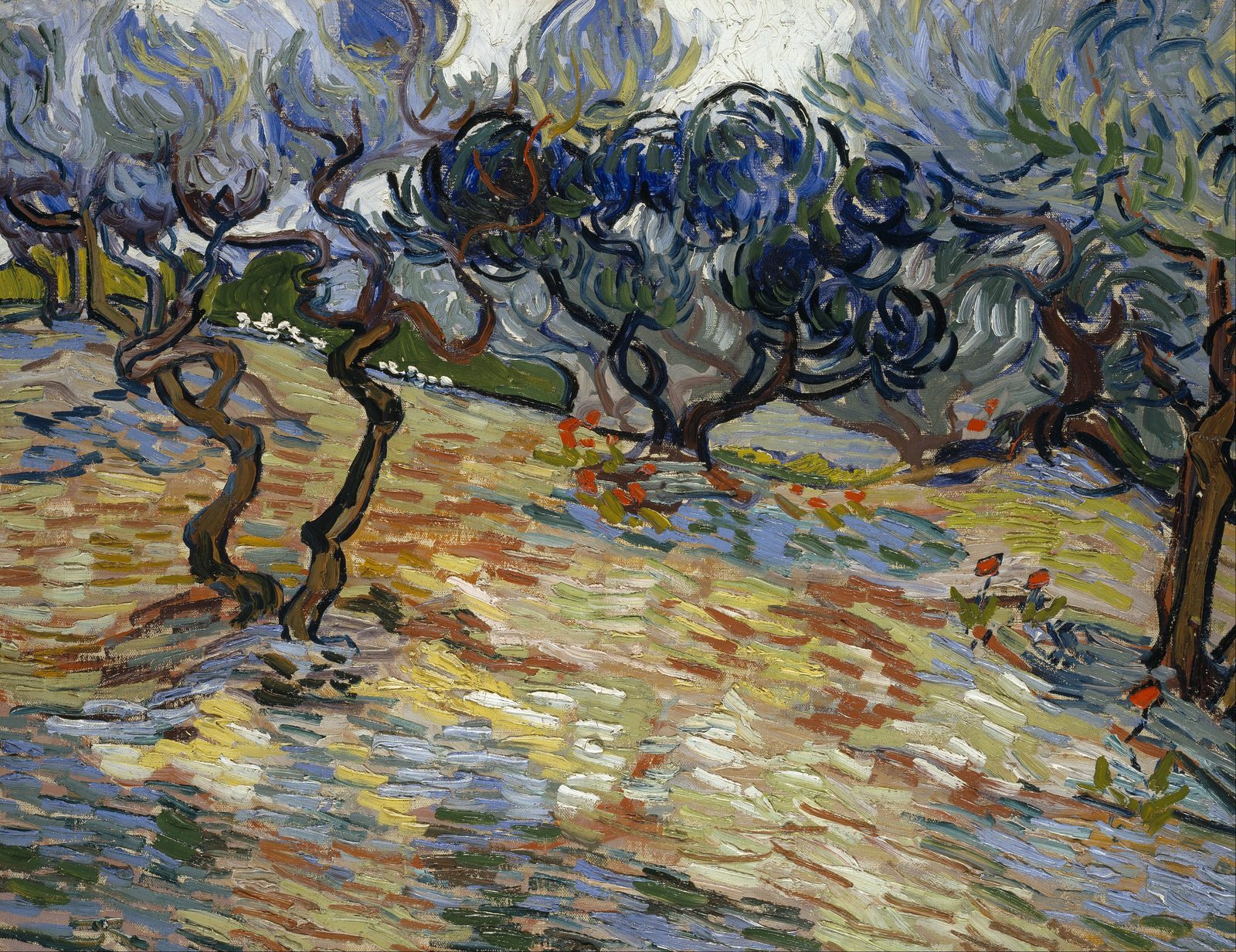
Olive Trees. Vincent van Gogh, Saint-Rémy-de-Provence, November 1889. Wikimedia Commons. Public domain.