
Psalm 95
11 verses · Call to worship and warning
For He is our God, and we are the people of His pasture, the sheep under His care. Today, if you hear His voice,
Introduction
Author unstated, the Call to Worship, Book 4: The LORD reigns, Poetry, Psalms Overview.
This psalm has no title in the Hebrew, and the Letter to the Hebrews quotes it as spoken through David. It was written for a congregation coming up to worship, and it gives them words to sing and then a posture to take. Then God speaks and reminds them of their ancestors in the wilderness, who saw His works and still refused to trust Him. Listen for the two invitations, one loud and one low, and for the warning that ends the psalm with no praise after it. The church has long sung it at the start of morning prayer.
Context
- Who
- A gathered congregation, addressed as the flock of the God who made them
- What
- A call to worship in two movements, praise and then bowing down, followed by God's warning from the wilderness years.
- Where
- The sanctuary, where a congregation was called to sing and then to kneel
- When
- Undated and untitled in the Hebrew; Hebrews 4:7 quotes it as spoken through David.
- Why
- To bring worshippers to listen and obey today, where their ancestors hardened their hearts.
Historical context
The psalm names two postures and both were real: verse 1 calls for singing and shouting, and verse 6 calls for bowing down and kneeling. Verse 3 calls the LORD a great King above all gods, a claim about rank made to hearers whose neighbours each had their own god of a place. Verses 4 and 5 measure the world from bottom to top, the depths of the earth and the mountain peaks, the sea and the dry land. Meribah and Massah in verse 8 are two names Exodus 17:7 gives to one place, the first from the people's quarrel and the second from their testing of God. The people had the bread from heaven and the water from the rock in front of them while they were testing Him.
Significance
The psalm put a congregation in the place of their own ancestors. The same people called to kneel in verse 6 are told in verse 8 not to harden their hearts, so the warning is aimed at worshippers. The word Today made the warning current: the door the fathers were shut out of was still open to the people singing, and open on the same terms.
This chapter in Jewish lifeWhat this chapter is in Jewish life and reading.
What is done
Metzudat David records what the bowing of verse 6 meant as a bodily act, glossing the word for worship as "lying the entire body on the ground" (Metzudat David on Psalms 95:6:1, Metzudat David on Psalms, Sefaria Community Translation, CC0).
How it is read
The psalm stands in the group this site calls the enthronement psalms, Psalms 93 and 95 to 99, the psalms that say the LORD reigns and call the whole earth to sing (src/components/book/dossier-content/psalms-structure.ts). That is a statement about the collection rather than about any service, and it is given here as one.
Radak reads the opening call as spoken by Israel to one another in the days of the Messiah, singing to the Lord who redeemed them, and he adds that the word for come is a word of alacrity in the action rather than of walking (Radak on Psalms 95:1:1, Radak on Psalms, Sefaria Community Translation, CC0).
The second half of the psalm is read as the wilderness generation and as a warning still open. Rashi glosses the today of verse 7 as "in this world" (Rashi on Psalms 95:7:1, Rashi on Psalms, The Judaica Press complete Tanach with Rashi, translated by A. J. Rosenberg, CC-BY), and on verse 10 he has God quarrelling with that generation for forty years and saying of them that they are of erring heart (Rashi on Psalms 95:10:1, same edition).
Radak dates the forty years from the matter of the spies, and reads the verse as God seeing them rebel (Radak on Psalms 95:10:1). The resting place withheld in verse 11 Rashi reads as the land of Israel and Jerusalem, and he sends the reader to Psalm 132:14 for the name (Rashi on Psalms 95:11:1). Ibn Ezra, Radak and Metzudat David carry fourteen further comments for which Sefaria holds no English version, and they are cited by reference (Ibn Ezra on Psalms 95:1:1 and the thirteen references beside it).
What the rabbis say
The corpus records forty places where the Midrash and the Talmud cite this psalm, thirty three under Midrash and seven under Talmud, and it carries the locator for each one with no text. The Babylonian Talmud cites verse 5 at Ketubot 5a:12, verse 7 at Sanhedrin 98a:17, verse 10 at Sanhedrin 99a:2 and verse 11 at Chagigah 10a:7, and the Jerusalem Talmud cites verse 7 at Taanit 1:1:18 and verse 11 at Chagigah 1:8:2.
Midrash Tehillim treats the psalm at 95:1, 95:2 and 95:3, and cites its verses from three other psalms at 19:2, 66:1 and 90:2. Bereshit Rabbah reads the bowing of verse 6 at 56:2, Shemot Rabbah reads verse 7 at 25:12, and Sifrei Devarim reads verse 10 at 30:2. The site reports where the rabbis cite the verse and reports no saying, because the locator carries none.
Sources: MannaFest, the enthronement psalms, at src/components/book/dossier-content/psalms-structure.ts, 2026; Radak, Radak on Psalms 95, Sefaria Community Translation, CC0; Rashi, Rashi on Psalms 95, in The Judaica Press complete Tanach with Rashi, translated by A. J. Rosenberg, CC-BY; Metzudat David, Metzudat David on Psalms 95, Sefaria Community Translation, CC0; Ibn Ezra, Ibn Ezra on Psalms 95, cited by reference; Sefaria holds no English version; The Midrash and the Talmud, the forty locators on Psalms 95 in scripts/data/sources/sefaria/psalms/95.json.
Psalms 95:1-2
let us sing for joy: The psalm opens with a call to sing and shout to the LORD, the Rock of salvation. Verse 2 names the way in, entering His presence with thanksgiving, then a joyful noise in song. The Rock is the place to stand.
Psalms 95:1
“O come, let us sing unto the Lord. Other nations sing unto their gods, let us sing unto Jehovah. We love him, we admire him, we reverence him, let us express our feelings with the choicest sounds, using our noblest faculty for its noblest end. It is well thus to urge others to magnify the Lord, but we must be careful to set a worthy example ourselves, so that we may be able not only to cry "Come", but also to add " let us sing", because we are singing ourselves.”
Charles Spurgeon · The Treasury of David, Vol. 4 (1874)Particular Baptist
1 more voice on this verseWhat preachers and commentators have said about this verse, in their own words.
Psalms 95:1
“By this he showed that the outward worship of God principally consisted in the sacrifice of praise, and not in dead ceremonies. He enjoins haste upon them; by which they might testify their alacrity in this service. For the Hebrew word qdm, kadam, in the second verse, which I have rendered, let us come before, etc., means to make haste.”
John Calvin · Commentaries (1554)reformed
enter His presence with thanksgiving: Presence is literally His face, so the worshippers come before Him in person. Thanksgiving leads the way in. The joyful noise is a loud shout, the kind raised when a king appears.
Psalms 95:2
“Let us come before his presence with thanksgiving. Here is probably a reference to the peculiar presence of God in the Holy of Holies above the mercy seat, and also to the glory which shone forth out of the cloud which rested above the tabernacle. Everywhere God is present, but there is a peculiar presence of grace and glory into which men should never come without the profoundest reverence.”
Charles Spurgeon · The Treasury of David, Vol. 4 (1874)Particular Baptist
1 more voice on this verse
Psalms 95:2
“Spiritual joy is the heart and soul of thankful praise. It is the will of God (such is the condescension of his grace) that when we give glory to him as a being infinitely perfect and blessed we should, at the same time, rejoice in him as our Father and King, and a God in covenant with us.”
Matthew Henry · Commentary on the Whole Bible (1707-1721)puritan
Psalms 95:3-5
a great King above all gods: The reason for the summons is the LORD's rank, a great God, a great King over all other gods. Verses 4 and 5 pair the depths of the earth with the mountain peaks, and the sea with the dry land, bottom to top. All of it is in His hand.
Psalms 95:3
“For the Lord is a great God, and a great King above all gods. No doubt the surrounding nations imagined Jehovah to be a merely local deity, the god of a small nation, and therefore one of the inferior deities; the psalmist utterly repudiates such an idea. Idolaters tolerated gods many and lords many, giving to each a certain measure of respect; the monotheism of the Jews was not content with this concession, it rightly claimed for Jehovah the chief place, and the supreme power.”
Charles Spurgeon · The Treasury of David, Vol. 4 (1874)Particular Baptist
1 more voice on this verse
Psalms 95:3
“We know that there has always been a host of gods in the world, as Paul says, "There are many on the earth who are called gods," (1 Corinthians 8:5.) We are to notice the opposition stated between the God of Israel and all others which man has formed in the exercise of an unlicensed imagination.”
John Calvin · Commentaries (1554)reformed
the depths of the earth: The depths are places no man has searched, and the peaks are heights no man has climbed. Both are in His hand. What lay out of Israel's reach lay within His.
Psalms 95:4
“In his hand are the deep places of the earth. He is the God of the valleys and the hills, the caverns, and the peaks. Far down where the miners sink their shafts, deeper yet where lie the secret oceans by which springs are fed, and deepest of all in the unknown abyss where rage and flame the huge central fires of earth, there Jehovah's power is felt, and all things are under the dominion of his hand. As princes hold the mimic globe in their hands, so does the Lord in very deed hold the earth.”
Charles Spurgeon · The Treasury of David, Vol. 4 (1874)Particular Baptist
1 more voice on this verse
Psalms 95:4
“For our salvation the Son of God is made the Son of man. Nine months he awaits his birth in the womb, undergoes the most revolting conditions and comes forth covered with blood, to be swathed in rags and covered with caresses. "He who clasps the world in his fist" is contained in the narrow limits of a manger. I say nothing of the thirty years during which he lives in obscurity, satisfied with the poverty of his parents. When he is scourged, he holds his peace; when he is crucified, he prays for his crucifiers.”
Jerome · written before 420 · LETTER 22.39patristic
The sea is His, for He made it: The verse gives its own reason for His ownership: He made it. The neighbouring peoples gave the sea a god of its own, and this verse claims it for the LORD. Formed is the potter's verb, used of hands shaping clay.
Psalms 95:5
“The sea is his, and he made it,.... He made it, and therefore it is, and all creatures in it; he sets bounds to it, and its waves, and restrains the raging of it at his pleasure, Mat 8:26, and his hands formed the dry land; the whole world, all besides the sea, the vast continent; he is the Maker of it, and all creatures in it; without him was nothing made that is made; and, being the Creator of all things, is the proper object of worship, Joh 1:2, as follows.”
2 more voices on this verse
Psalms 95:5
“The sea is his. This was seen to be true at the Red Sea when the waters saw their God, and obediently stood aside to open a pathway for his people. It was not Edom's sea though it was red, nor Egypt's sea though it washed her shores. The Lord on high reigned supreme over the flood, as King far ever and ever.”
Charles Spurgeon · The Treasury of David, Vol. 4 (1874)Particular Baptist
Psalms 95:5
“To him all power is given both in heaven and in earth, and into his hand all things are delivered. It is he that sets one foot on the sea and the other on the earth, as sovereign Lord of both ( Rev. x. 2 ), and therefore to him we must sing our songs of praise, and before him we must worship and bow down.”
Matthew Henry · Commentary on the Whole Bible (1707-1721)puritan
Psalms 95:6-7
let us worship and bow down: The summons comes again in a lower posture, bowing and kneeling. Verse 7 gives the ground, a flock and its shepherd, with the pasture His and the sheep under His care. The last line turns to a condition, Today, if you hear His voice.
Psalms 95:6
“Here the exhortation to worship is renewed and backed with a motive which, to Israel of old and to Christians now, is especially powerful; for both the Israel after the flesh and the Israel of faith may be described as the people of his pasture, and by both he is called "our God." O come, let us worship and bow down. The adoration is to be humble. The "joyful noise" is to be accompanied with lowliest reverence.”
Charles Spurgeon · The Treasury of David, Vol. 4 (1874)Particular Baptist
Today, if you hear His voice: The people of His pasture are the sheep under His care, literally the flock of His hand. The verse ends by turning from praise to warning. Today makes the warning apply to whoever is listening, at the hour they hear it.
Psalms 95:7
“For he is our God. Here is the master reason for worship. Jehovah has entered into covenant with us, and from all the world beside has chosen us to be his own elect. If others refuse him homage, we at least will render it cheerfully. He is ours, and our God; ours, therefore will we love him; our God, therefore will we worship him. Happy is that man who can sincerely believe that this sentence is true in reference to himself. And we are the people of his pasture, and the sheep of his hand.”
Charles Spurgeon · The Treasury of David, Vol. 4 (1874)Particular Baptist
2 more voices on this verse
Psalms 95:7
“Pasture - Whom he feeds and keeps in his own pasture, or in the land which he hath appropriated to himself. The sheep - Which are under his special care.”
John Wesley · Explanatory Notes upon the Old Testament (1765)evangelical
Psalms 95:7
“The gospel church is his flock. Christ is the great and good Shepherd of it. We, as Christians, are led by his hand into the green pastures, by him we are protected and well provided for, to his honour and service we are entirely devoted as a peculiar people, and therefore to him must be glory in the churches (whether it be in the world or no) throughout all ages, Eph. iii.”
Matthew Henry · Commentary on the Whole Bible (1707-1721)puritan
Cross references
Psalms 95:7
- Quoted inHebrews 3:7“Therefore, as the Holy Spirit says: “Today, if you hear His voice,”
'To day if ye will hear his voice, harden not your hearts' ('as the Holy Ghost saith')
ConnectionsHebrews 3:7
Psalms 95:8-11
do not harden your hearts: Israel quarreled and tested the LORD at Meribah and Massah, two names Exodus 17:7 gives to one place. Forty years of anger followed, and an oath barring that generation from His rest. Hebrews 3:7 to 11 quotes it, and Hebrews 4:9 says a Sabbath rest remains.
Psalms 95:8
“Harden not your heart. If ye will hear, learn to fear also. The sea and the land obey him, do not prove more obstinate than they! We cannot soften our hearts, but we can harden them, and the consequences will be fatal. Today is too good a day to be profaned by the hardening of our hearts against our own mercies. While mercy reigns let not obduracy rebel. "As in the provocations, and as in the day of temptation in the wilderness" (or, "like Meribah, like the day of Massah in the wilderness"). Be not wilfully, wantonly, repeatedly, obstinately rebellious.”
Charles Spurgeon · The Treasury of David, Vol. 4 (1874)Particular Baptist
1 more voice on this verse
Psalms 95:8
“Harden not your hearts,.... Against Christ, against his Gospel, against all the light and evidence of it. There is a natural hardness of the heart, owing to the corruption of nature; and an habitual hardness, acquired by a constant continuance and long custom in sinning; and there is a judicial hardness, which God gives men up unto. There is a hardness of heart, which sometimes attends God's own people, through the deceitfulness of sin gaining upon them; of which, when sensible, they complain, and do well to guard against.”
tested and tried Me: Here God begins to speak in His own voice. The fathers tested Him though they had seen His work, the plagues, the sea and the manna. Sight gave them no trust.
Psalms 95:9
“When your fathers tempted me. As far as they could do so they tempted God to change his usual way, and to do their sinful bidding, and though he cannot be tempted of evil, and will never yield to wicked requests, yet their intent was the same, and their guilt was none the less. God's way is perfect, and when we would have him alter it to please us, we are guilty of tempting him; and the fact that we do so in vain, while it magnifies the Lord's holiness, by no means excuses our guilt.”
Charles Spurgeon · The Treasury of David, Vol. 4 (1874)Particular Baptist
For forty years I was angry: Forty years is the length of the whole wilderness wandering, a generation's lifetime. God's charge puts the fault in the heart before the feet: their hearts went astray and they did not know His ways. Moses asked to know those ways at Exodus 33:13.
Psalms 95:10
“Note, Sins are errors, practical errors, errors in heart; such there are, and as fatal as errors in the head. When the corrupt affections pervert the judgment, and so lead the soul out of the ways of duty and obedience, there is an error of the heart. [4.] God's resentment of their sin: Forty years long was I grieved with this generation.”
Matthew Henry · Commentary on the Whole Bible (1707-1721)puritan
2 more voices on this verse
Psalms 95:10
“Forty years long was I grieved with this generation. The impression upon the divine mind is most vivid; he sees them before him now, and calls them "this generation." He does not leave his prophets to upbraid the sin, but himself utters the complaint and declares that he was grieved, nauseated, and disgusted.”
Charles Spurgeon · The Treasury of David, Vol. 4 (1874)Particular Baptist
Psalms 95:10
“Do err - Their hearts are insincere and bent to backsliding. Not known - After all my teaching and discoveries of myself to them; they did not know, nor consider, those great things which I had wrought for them.”
John Wesley · Explanatory Notes upon the Old Testament (1765)evangelical
The rest was the land, which that generation shall never enter. God swore it on oath in His anger, and the psalm ends there with no praise after it. The warning of verse 8 is left standing.
Psalms 95:11
"See, O people, the grace of Christ about you. Even while you are harassed on earth, you have possessions in heaven. There, then, let your heart be, where your possession is." This is the rest that is due the just and is denied the unworthy. Wherefore says the Lord, "As I swore in my wrath, that they shall not enter into my rest."
Ambrose of Milan · written before 397 · On the Death of Theodosius 29patristic
2 more voices on this verse
Psalms 95:11
“Unto whom I sware in my wrath that they should not enter into my rest. There can be no rest to an unbelieving heart. If manna and miracles could not satisfy Israel, neither would they have been content with the land which flowed with milk and honey.”
Charles Spurgeon · The Treasury of David, Vol. 4 (1874)Particular Baptist
Psalms 95:11
“Observe, [1.] Whence this sentence came--from the wrath of God. He swore solemnly in his wrath, his just and holy wrath; but let not men therefore swear profanely in their wrath, their sinful brutish wrath. God is not subject to such passions as we are; but he is said to be angry, very angry, at sin and sinners, to show the malignity of sin and the justice of God's government.”
Matthew Henry · Commentary on the Whole Bible (1707-1721)puritan
Cross references
Psalms 95:11
- Quoted inHebrews 4:3“Now we who have believed enter that rest. As for the others, it is just as God has said: “So I swore on oath in My anger, ‘They shall never enter My rest.’” And yet His works have been finished since the foundation of the world.”
'They shall not enter into my rest' (the remaining sabbath-rest)
How this psalm is built
The form: A burst of praise that closes in the solemn tones of exhortation, warning men to hearken to the voice of their God, as Spurgeon classes it.
The patterns in this chapter
| Device | What it does | Where to see it |
|---|---|---|
| The summons given twice, in two postures | Verse 1 calls the people to sing and shout, and verse 6 calls them again to worship, bow down and kneel. The second call is the same invitation in a lower posture, and the ground shifts with it, from the Rock of our salvation to the LORD our Maker.John Calvin, Commentaries, 1554, on Psalm 95:2. | Psalm 95:1, Psalm 95:6 |
| The world measured top to bottom | Verses 4 and 5 pair the depths of the earth with the mountain peaks and the sea with the dry land, so the four names take in everything there is. Matthew Henry notes that the deep places are out of our sight and the heights are out of our reach, and both are in His hand.Matthew Henry, Commentary on the Whole Bible, 1710, on Psalm 95:4. | Psalm 95:4, Psalm 95:5 |
| The psalm turns and God speaks | Through verse 7 the psalm speaks to the congregation about God. At the words Today, if you hear His voice, it turns, and from verse 8 to the end it is God speaking about His own anger and His own oath. Spurgeon marks how direct the change is, since God does not leave the prophets to upbraid the sin but utters the complaint Himself.Charles Spurgeon, The Treasury of David, Vol. 4, 1874, on Psalm 95:10. | Psalm 95:7, Psalm 95:8, Psalm 95:11 |
| The two names of one place | Verse 8 names Meribah and Massah, which Exodus 17:7 gives as two names for one place, the first from the people's quarrel and the second from their testing. Naming both is the psalm's way of stating the charge twice in one line.Jamieson, Fausset and Brown, Commentary Critical and Explanatory on the Whole Bible, 1871, on Psalm 95:8. | Psalm 95:8 |
In the New Testament
9 more paragraphs on the patterns
Hebrews 3:7 to 11 quotes the second half of this psalm whole, and then preaches on it for the length of two chapters. The word the writer of Hebrews presses is the hinge word: Today, taken as a day still open to his own readers. Hebrews 4:9 draws the conclusion, that a Sabbath rest remains for the people of God, so the psalm's closed door is read as evidence that the rest itself was never entered rather than that it was withdrawn.
Where it comes from
The history behind verses 8 to 11 is Exodus 17:1 to 7 and Numbers 14, the water from the rock and the refusal to go up. The psalm compresses both into one charge, that they tested Him though they had seen His work. Matthew Henry names the aggravation: they had the bread from heaven and the water from the rock in front of them while they did it.
The debated point
What the rest of verse 11 means is the psalm's contested line. Ambrose reads it as a possession kept in heaven for the just and denied the unworthy. The writer of Hebrews reads it as a rest still open, which is why he presses the word Today. Matthew Henry guards the language about God's anger from a third side, that God is said to be angry, very angry, at sin and sinners in order to show the malignity of sin and the justice of His government, while He is not subject to passions as men are. The three readings are compatible and the site carries all three with their holders.
In the Psalter
Psalm 100 gives the same picture of the flock in almost the same words, and Psalm 96 to Psalm 99 take up the reign of the LORD that this psalm states at verse 3. The psalm belongs to the enthronement run by its third verse and to the wilderness psalms by its last four.
The door
The wilderness generation carries the forty years this psalm charges, and Sabbath rest carries the rest that Hebrews reads out of verse 11.
Keep studying
Sources for this chapter
The summary
Jamieson, Fausset & Brown, Commentary Critical and Explanatory; John Calvin, Commentaries; John Wesley, Notes on the Old Testament and Matthew Henry, Complete Commentary.
The context
C. H. Spurgeon, The Treasury of David, on Psalm 95 and Matthew Henry, Commentary on the Whole Bible.
The form and classifications
Charles Spurgeon, The Metropolitan Tabernacle Pulpit, Sermon on Psalm 95, 1873; Jamieson, Fausset and Brown, Commentary Critical and Explanatory on the Whole Bible, 1871, on Psalm 95:8 and John Calvin, Commentaries, 1554, on Psalm 95:1.
The exposition
Albert Barnes, Notes on the Book of Psalms; Charles Spurgeon, The Treasury of David; Franz Delitzsch, Biblical Commentary on the Psalms; John Gill, Exposition of the Old Testament and Matthew Henry, Commentary on the Whole Bible.
The painting
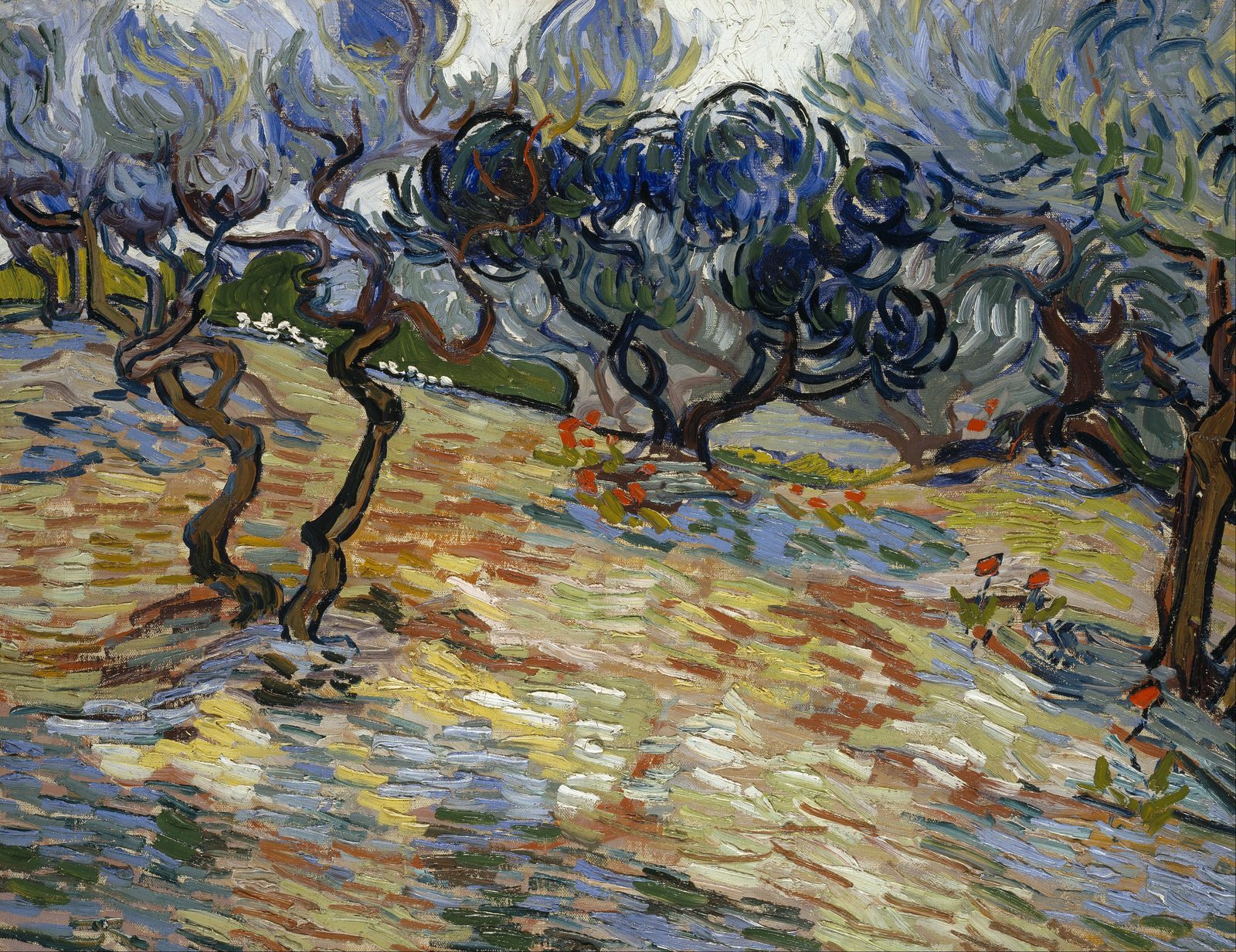
Olive Trees. Vincent van Gogh, Saint-Rémy-de-Provence, November 1889. Wikimedia Commons. Public domain.