
Psalm 6
10 verses · Penitential psalm
For there is no mention of You in death; who can praise You from Sheol?
Introduction
David, the First Penitential Psalm, Book 1: The book of David, Poetry, Psalms Overview.
David wrote this from a sickbed, and the church has long counted it the first of seven penitential psalms. He is ill, he believes God is correcting him, and the people around him read his suffering as a verdict. He asks for mercy inside the correction. The whole prayer is spoken to God until the last lines, when he turns and speaks to his enemies. Listen for how long the night has been, and then for the sudden change near the end, when nothing outside him has moved yet and he speaks as a man who has been heard.
Context
- Who
- Israelites praying through an illness that everyone around them read as a verdict
- Where
- A sickbed at night, with the sufferer's household and his enemies both watching
- When
- The reign of David; the psalm the church later placed first among the penitential seven. c. 1010 to 970 BC on the superscription, which Young's Literal Translation renders To the Overseer with stringed instruments, on the octave, a Psalm of David
Historical context
The heading adds a term, Sheminith in the Hebrew, which means something like on the eighth and most likely names a lower musical range or an instrument of eight strings. It shows that Israel's laments were scored, rehearsed and sung in public. Mourning in Israel was loud and physical, so the flooded bed of verse 6 is the language of grief working at full volume over a practice a first hearer had seen. The plea of verse 5 rests on what Israel then said about death, since a living man can give thanks and a body in a rock tomb gives none. Sickness was widely read as a sign of divine displeasure, which is why the enemies of verse 7 are circling while the body fails.
Significance
Israelites who sang this had words for the thing hardest to say, that the correction may be deserved and that mercy is still what they ask for inside it. The turn in the last three verses is sudden on purpose. The circumstances stand where they stood, the singer has learned that his weeping was heard, and on that alone the enemies are sent back.
This chapter in Jewish lifeWhat this chapter is in Jewish life and reading.
How it is read
The heading of this psalm names an instrument, and Radak uses the word to show the reader how he weighs a tradition. He is quoted here from the Finch translation of 1919, which is public domain. He reports that some take the word for an eight-stringed lyre, and that the haggadic reading applies it to circumcision, which is performed on the eighth day. Radak names the Talmudic place for that reading and then rejects it in two words, "but this is far-fetched" (Radak on Psalms 6:1:1). Rashi keeps to the instrument, "a harp of eight strings", and proves it from the record of the singers (Rashi on Psalms 6:1:1, the Judaica Press Tanach with Rashi).
Radak then does something that shapes how the whole Psalter is used in Jewish practice. He holds that David composed many of the psalms "which combine prayer and supplication that they might be suitable for any suppliant", so that a sick man in any century has words ready made. He offers three settings for this one: David's own sickness, the speech of anyone crushed by sickness, and the exile, "for Israel in exile was like those who are sick and crushed". Ibn Ezra is the holder of the third reading. The corpus carries his comments on this chapter without an English text, so he stands here cited and unquoted at Ibn Ezra on Psalms 6:1:1, 6:2:1, 6:9:1 and 6:10:1. Metzudat David is cited the same way at Metzudat David on Psalms 6:6:1.
The prayer itself is read as a plea about the manner of correction rather than against correction. Radak gives the sense of the second verse in one word, gently, so that the man may be able to bear it, and sets Jeremiah's request for judgment beside it (Radak on Psalms 6:2:1). He reads the trouble of the fourth verse as the fear of dying from the sickness (Radak on Psalms 6:4:1). Rashi hears the same verse as a complaint about delay: "how long will You look on and not heal" (Rashi on Psalms 6:4:1). The weeping of the seventh verse Rashi takes as literal wetting of the bed with tears, and records Menachem's reading of the verb as swimming (Rashi on Psalms 6:7:1).
The sixth verse is where a Christian reader should stop, because Radak sets out an account of death that the New Testament also reaches for. He reads the argument as a bargain a dying man may make, that a dead man gives no thanks, so let the living be healed and give them. Then he divides the man: "the body after the departure of the spirit is as a dumb stone, and it descends to Sheol; but the spirit ascends and praises and glorifies for ever without ceasing". His reason for wanting life is the work still to do, so that the righteous man may "increase the reward of his soul in the world to come" (Radak on Psalms 6:6:1). The classical Jewish reading here holds a conscious life after death and a reward to come. What it carries no word of is the resurrection of Christ as the ground of that hope. The church reads this psalm as the first of the seven penitential psalms, which stand together at /featured/the-penitential-psalms as a Christian grouping rather than a Jewish order of prayer.
Rashi closes the chapter with a saying of two named rabbis on why the wicked are shamed twice. Rabbi Johanan taught that God will sentence the nations to Gehinnom, take them back when they complain, show them their records again and return them, "a double embarrassment". Rabbi Shmuel bar Nachmani taught that every nation will call to its god without answer, and then call to God, who will refuse because they made the idols first (Rashi on Psalms 6:11:1). Radak reads the ninth verse as spoken either after the recovery or during the sickness by the Holy Spirit. He adds that "every sick man who prays by this Psalm is able to say this" (Radak on Psalms 6:9:1).
What the rabbis say
The corpus carries forty locators on this psalm and the text of none, so each is cited and linked here rather than quoted. Only three are Talmudic. They stand at Tractate Soferim 19:2 on the heading, Tractate Soferim 7:2 on the fourth verse, and Sanhedrin 107a:12 on the seventh.
Midrash Tehillim carries thirteen, anchored across the chapter at 6:1, 6:2 and 6:6 on the heading, 6:3 on the third verse, 6:4 on the fourth, 85:1 on the fifth, and 146:1 on the sixth. It continues at 6:7 and 73:2 on the seventh and eighth verses, 6:8 on the tenth, and 6:5, 7:1 and 31:3 on the eleventh. Three entries of Midrash Tanchuma stand on the heading and the fourth verse, at Beha'alotcha 7:1, Beha'alotcha 12:1 in the Buber recension, and Sh'lach 12:1 with Sh'lach 23:1 in Buber. On the heading the corpus also carries Bamidbar Rabbah 15:11, Sifrei Devarim 36:9 and Midrash Tannaim on Deuteronomy 6:9:12.
Three entries of Learning to Read Midrash stand on the seventh verse, all in a chapter on David's heart after his sin. Beside them on that verse stand Aggadat Bereshit 38:1 and Shemot Rabbah 25:8. On the ninth verse the corpus carries two locators that read the psalm against the book of Esther, at Sifrei Aggadah on Esther, Midrash Abba Guryon 5:1, and an entry of Otzar Midrashim on Purim. On the eleventh it carries Vayikra Rabbah 32:2, Kohelet Rabbah 10:20:1 and Aggadat Bereshit 8:3. Two entries of Ruth Rabbah stand on the second verse, at 5:6 and at 5:6:2 in the Lerner edition. What each of them teaches is a saying of the rabbis, and is reported as theirs wherever this site quotes one. The quotations wait on a fetch that carries the text.
Sources: Rashi, Rashi on Psalms 6:1:1 to 6:11:2, the Judaica Press complete Tanach with Rashi, translated by A. J. Rosenberg; Radak, Radak on Psalms 6:1:1 to 6:10:1, R. David Kimhi on the first book of Psalms, translated by R. G. Finch, London, 1919; Ibn Ezra, Ibn Ezra on Psalms 6:1:1, 6:2:1, 6:9:1 and 6:10:1, cited by ref because the corpus carries no English text; Metzudat David, Metzudat David on Psalms 6:6:1, cited by ref because the corpus carries no English text; MannaFest, the penitential psalms, at /featured/the-penitential-psalms; The Sefaria corpus, scripts/data/sources/sefaria/psalms/6.json, the 3 Talmud and 37 Midrash locators of this chapter.
Psalms 6:1-3
do not rebuke me in Your anger: David asks the LORD to hold anger and wrath out of his correction. He gives his ground at once, that he is frail, his bones are in agony, and his soul is deeply distressed. It closes in a question, how long.
Psalms 6:1
“Having read through the first division, in order to see it as a whole, we will now look at it verse by verse. "O Lord, rebuke me not in thine anger." The Psalmist is very conscious that he deserves to be rebuked, and he feels, moreover, that the rebuke in some form or other must come upon him, if not for condemnation, yet for conviction and sanctification. "Corn is cleaned with wind, and the soul with chastenings." It were folly to pray against the golden hand which enriches us by its blows.”
Charles Spurgeon · The Treasury of David, Vol. 1 (1869)Particular Baptist
2 more voices on this verseWhat preachers and commentators have said about this verse, in their own words.
Psalms 6:1
“No matter though sickness make his bones ache, if God's wrath do not make his heart ache; therefore his prayer is, " Lord, rebuke me not in thy wrath; let me not lie under the impressions of that, for that will sink me." Herein David was a type of Christ, whose sorest complaint, in his sufferings, was of the trouble of his soul and of the suspension of his Father's smiles.”
Matthew Henry · Commentary on the Whole Bible (1707-1721)puritan
Psalms 6:1
“'For her that obtaineth the inheritance' — since in the fifth psalm we discussed, interpreting that the psalm had been sung in the person of the Church, which has obtained the inheritance of Christ. But the sixth pertains properly to the resurrection of the Lord, which is the eighth day. For we have both a first day and an eighth day. For on the eighth day we received the kingdom of heaven. The eighth day is after the sabbath, the first at the beginning.”
Jerome · written before 420 · Homily 3, on Psalm 7patristic
Be merciful to me, O LORD, for I am frail: The cry for mercy rests on one plea, I am frail. Charles Spurgeon called this the right way to plead with the LORD, bringing weakness and sin before Him. The word for frail pictures a plant that withers, and heal answers the bones in agony.
Psalms 6:2
“Have mercy - I have no merit. I deserve all I feel and all I fear. O Lord, heal me - No earthly physician can cure my malady. Body and soul are both diseased, and only God can help me. I am weak - אמלל umlal. I am exceedingly weak; I cannot take nourishment, and my strength is exhausted. My bones are vexed - The disease hath entered into my bones.”
Adam Clarke · Commentary on the Bible (1810-1826)evangelical
3 more voices on this verse
Psalms 6:2
“The spirit of a man will sustain his infirmity, if that be in good plight; but, if that be wounded, the grievance is intolerable. David's sickness brought his sin to his remembrance, and he looked upon it as a token of God's displeasure against him; that was the vexation of his soul; that made him cry, I am weak, heal me.”
Matthew Henry · Commentary on the Whole Bible (1707-1721)puritan
Psalms 6:2
“Every fault arises from weakness because the spirit is always inclined to a wicked disposition, on account of which it flees to the Savior and Healer, namely, the Son of God. For when one comes to the word and reason of God, he gives up his unreasonable actions; as wisdom frees the spirit from foolishness, justice from injustice, truth from lying.”
Eusebius of Caesarea · written before 339 · Commentary on Psalms 6:2-4patristic
Psalms 6:2
"O Lord, heal me; for my bones are vexed." Here he prays for healing, not merely the mitigation of the ills he endured, but their entire removal, and the curing of the wounds which had arisen therefrom. His bones were "shaken, " as the Hebrew has it. His terror had become so great that his very bones shook; not only did his flesh quiver, but the bones, the solid pillars of the house of manhood, were made to tremble. "My bones are shaken."
Charles Spurgeon · The Treasury of David, Vol. 1 (1869)Particular Baptist
How long, O LORD, how long?: The verb behind deeply distressed is the one used of his bones in verse 2, and verse 10 turns it on his enemies. The Hebrew leaves the question unfinished. Charles Spurgeon recorded that How long, O Lord, was a cry John Calvin often used.
Psalms 6:3
“My soul is also sore vexed - The word “soul” here is used in the sense in which it is commonly with us, as denoting the mind. The idea is, that his sorrows were not merely those of the bodily frame. They had a deeper seat than even the bones. His mind, his soul, was full of anguish also, in view of the circumstances which surrounded him, and which had brought on these bodily afflictions. But thou, O Lord - This is a broken sentence, as if he had commenced an address to God, but did not complete it.”
Psalms 6:4-5
Turn, O LORD, and deliver my soul: David asks the LORD to turn and deliver him for the sake of His loving devotion. Verse 5 presses for haste, since death holds no mention of God and Sheol, the place of the dead, no praise. He asks for life so he can praise.
Psalms 6:4
"Return, O Lord; deliver my soul." As God's absence was the main cause of his misery, so his return would be enough to deliver him from his trouble. "Oh save me for thy mercies' sake." He knows where to look, and what arm to lay hold upon. He does not lay hold on God's left hand of justice, but on his right hand of mercy. He knew his iniquity too well to think of merit, or appeal to anything but the grace of God. "For thy mercies' sake." What a plea that is! How prevalent it is with God!
Charles Spurgeon · The Treasury of David, Vol. 1 (1869)Particular Baptist
2 more voices on this verse
Psalms 6:4
“The pleas with which he enforces his petitions, not to move God (he knows our cause and the true merits of it better than we can state them), but to move himself. He pleads God's mercy; and thence we take some of our best encouragements in prayer: Save me, for thy mercies' sake.”
Matthew Henry · Commentary on the Whole Bible (1707-1721)puritan
Psalms 6:4
“Return, O Lord - Once I had the light of thy countenance, by sin I have forfeited this; I have provoked thee to depart: O Lord, return! It is an awful thing to be obliged to say, Return, O Lord, for this supposes backsliding; and yet what a mercy it is that a backslider may Return to God, with the expectation that God will return to him!”
Adam Clarke · Commentary on the Bible (1810-1826)evangelical
who can praise You from Sheol?: This verse gives the reason for the plea of verse 4, turn, deliver, save. In death and Sheol there is no mention or praise of the LORD, and Isaiah 38:18 and Psalm 30:9 ask the same question. Fuller light came at 2 Timothy 1:10.
Psalms 6:5
“And now David was in great fear of death—death temporal, and perhaps death eternal. Read the passage as you will, the following verse is full of power. "For in death there is no remembrance of thee; in the grave who shall give thee thanks?" Churchyards are silent places; the vaults of the sepulchre echo not with songs. Damp earth covers dumb mouths. "O Lord!" saith he, "if thou wilt spare me I will praise thee.”
Charles Spurgeon · The Treasury of David, Vol. 1 (1869)Particular Baptist
3 more voices on this verse
Psalms 6:5
“In hell there is no amendment. No means of satisfaction can be given where no act of the will remains any longer, as David says in prophecy: "Since in death there is no one who remembers you, who will give you thanks in hell?" Let us flee harmful pleasures, dangerous joys and desires that perish right away. What fruit is there, what use is there, in wanting these things incessantly, things that we must abandon even if they do not abandon us? Let the love of ephemeral things be transferred to incorruptible ones.”
Leo the Great · written before 461 · SERMON 35:4patristic
Psalms 6:5
“To depart and be with Christ is most happy for the saints themselves; but for them to abide in the flesh is more profitable for the church. This David had an eye to when he pleaded this, In the grave who shall give thee thanks? And this Christ had an eye to when he said, I pray not that thou shouldst take them out of the world.”
Matthew Henry · Commentary on the Whole Bible (1707-1721)puritan
Psalms 6:5
There is no incredulity as to a future state. The contrast is between this scene of life, and the grave or Sheol, the unseen world of the dead. give . . . thanks--or, "praise for mercies."
Jamieson, Fausset & Brown · Commentary Critical and Explanatory on the Whole Bible (1871)reformed
Psalms 6:6-7
I am weary from groaning: The grief in this psalm is physical. He is weary from groaning, he floods his bed with weeping all night, and his eyes fail and grow dim. Long weeping does that to a man's sight, and the psalm lays the cause on his foes.
Psalms 6:6
“The Psalmist gives a fearful description of his long agony: "I am weary with my groaning." He has groaned till his throat was hoarse; he had cried for mercy till prayer became a labour. God's people may groan, but they may not grumble. Yea, they must groan, being burdened, or they will never shout in the day of deliverance. The next sentence, we think, is not accurately translated. It should be, "I shall make my bed to swim every night" (when nature needs rest, and when I am most alone with my God).”
Charles Spurgeon · The Treasury of David, Vol. 1 (1869)Particular Baptist
they grow dim because of all my foes: The eyes that fail from grief are worn by the weeping of verse 6, all night on a flooded bed. Albert Barnes read grow dim as growing old, the eye aging before its time. Psalm 31:9 uses the same verb for fail, to waste away.
Psalms 6:7
"I water my couch with my tears. Mine eye is consumed because of grief; it waxeth old because of all my enemies." As an old man's eye grows dim with years, so, says David, my eye is grown red and feeble through weeping. Conviction sometimes has such an effect upon the body, that even the outward organs are made to suffer. May not this explain some of the convulsions and hysterical attacks which have been experienced under convictions in the revivals in Ireland?
Charles Spurgeon · The Treasury of David, Vol. 1 (1869)Particular Baptist
3 more voices on this verse
Psalms 6:7
“For in quarrels the very light of the soul, the light of good intent, is blocked. Whence the Psalmist says, "Mine eye is troubled because of anger." And what remains in us of well-doing, if we lose peace from the heart, without which we cannot see the Lord?”
Gregory the Dialogist · written before 604 · Register of Epistles, Book 11, Epistle 46patristic
Psalms 6:7
“In this great sorrow David was a type of Christ, who often wept, and who cried out, My soul is exceedingly sorrowful, Heb. v. 7 . The petitions which he offers up to God in this sorrowful and distressed state. That which he dreads as the greatest evil is the anger of God.”
Matthew Henry · Commentary on the Whole Bible (1707-1721)puritan
Psalms 6:7
“Mine eye is consumed - The word here rendered “consumed” - עשׁשׁ ‛âshêsh - means properly to fall in, to fall away, and is applied here to the “eye” as pining or wasting away from care, anxiety, and sorrow. Tears were poured forth from the eye, and it seemed to be exhausting itself in this manner. The meaning is, that it had grown “dim,” or that its sight began to fail, like that of an old man, on account of his troubles.”
Psalms 6:8-10
all you workers of iniquity: The psalm turns at verse 8, where he orders the workers of iniquity away, for the LORD has heard his weeping and accepts his prayer. Jesus speaks the same dismissal at Matthew 7:23, where He sends away the workers of lawlessness. His enemies turn back in sudden disgrace.
Psalms 6:8
“Depart from me, all ye workers of iniquity - It seems that while he was suffering grievously through the disease, his enemies had insulted and mocked him; - upbraided him with his transgressions, not to increase his penitence, but to cast him into despair. The Lord hath heard the voice of my weeping - The Lord pitifully beheld the sorrows of his heart, and mercifully forgave his sins.”
Adam Clarke · Commentary on the Bible (1810-1826)evangelical
2 more voices on this verse
Psalms 6:8
“Hath heard - By the workings of God's grace upon his heart, he knew his prayer was accepted. His tears had a voice, in the ears of the God of mercy. Silent tears are no speechless ones.”
John Wesley · Explanatory Notes upon the Old Testament (1765)evangelical
Psalms 6:8
“Hitherto, all has been mournful and disconsolate, but now— Your harps, ye trembling saints, Down from the willows take." Ye must have your times of weeping, but let them be short. Get ye up, get ye up, from your dunghills! Cast aside your sackcloth and ashes! Weeping may endure for a night, but joy cometh in the morning. David has found peace, and rising from his knees he begins to sweep his house of the wicked. "Depart from me, all ye workers of iniquity." The best remedy for us against an evil man is a long space between us both.”
Charles Spurgeon · The Treasury of David, Vol. 1 (1869)Particular Baptist
the LORD accepts my prayer: Verse 8 said the LORD has heard his weeping, and verse 9 repeats has heard for his cry for mercy. Heard looks back, and accepts looks ahead to the answer. The name LORD stands three times in two verses.
Psalms 6:9
"The Lord hath heard my supplication." The Holy Spirit had wrought into the Psalmist's mind the confidence that his prayer was heard. This is frequently the privilege of the saints. Praying the prayer of faith, they are often infallibly assured that they have prevailed with God. We read of Luther that, having on one occasion wrestled hard with God in prayer, he came leaping out of his closet crying, "Vicimus, vicimus;" that is, We have conquered, we have prevailed with God."
Charles Spurgeon · The Treasury of David, Vol. 1 (1869)Particular Baptist
1 more voice on this verse
Psalms 6:9
“The Lord hath heard my supplication - Repeating the sentiment in the previous verse, to express his assurance and his joy. Nothing is more natural in such circumstances than to dwell on the joyous thought, and to repeat it to ourselves, that it may make its full impression. The Lord will receive my prayer - As he has done it, so he will still do it. This allays all fears of the future, and makes the mind calm.”
All my enemies will be ashamed and dismayed: Dismayed renders the verb used of his bones in verse 2 and his soul in verse 3. The terror he felt now passes to his foes, and turn back is the verb of verse 4, where he asked the LORD to turn. Their disgrace comes in a moment.
Psalms 6:10
"Let all mine enemies be ashamed and sore vexed." This is rather a prophecy than an imprecation, it may be read in the future, "All my enemies shall be ashamed and sore vexed." They shall return and be ashamed instantaneously, —in a moment;—their doom shall come upon them suddenly. Death's day is doom's day, and both are sure and may be sudden. The Romans were wont to say, "The feet of the avenging Deity are shod with wool." With noiseless footsteps vengeance nears its victim, and sudden and overwhelming shall be its destroying stroke.
Charles Spurgeon · The Treasury of David, Vol. 1 (1869)Particular Baptist
2 more voices on this verse
Psalms 6:10
“He prays not against his enemies but in their behalf so that they may be changed and may blush with shame at their sins; and they may blush not briefly but forcibly; not with delay but immediately.”
Jerome · written before 420 · Brief Commentary on Psalm 6patristic
Psalms 6:10
“Ashamed and sore vexed - May they as deeply deplore their transgressions as I have done mine! May they return; may they be suddenly converted! The original will bear this meaning, and it is the most congenial to Christian principles.”
Adam Clarke · Commentary on the Bible (1810-1826)evangelical
How this psalm is built
The form: A psalm of a man conscious that he deserves the rebuke, asking that it come without wrath, as Spurgeon classes it.
The patterns in this chapter
| Device | What it does | Where to see it |
|---|---|---|
| Rebuke and discipline, anger and wrath | Verse 1 says one thing twice, do not rebuke me in Your anger and do not discipline me in Your wrath, so the request is against the temper of the correction rather than against the correction. Matthew Henry reads the distinction plainly, that aching bones are bearable if the heart does not ache under God's wrath.Matthew Henry, Commentary on the Whole Bible, 1710, on Psalm 6:1. | Psalm 6:1 |
| The grief counted through the body | The psalm measures the trouble by parts of a man, the bones in agony at verse 2, the soul deeply distressed at verse 3, the bed flooded and the couch drenched at verse 6, and the eyes failing and growing dim at verse 7. Charles Spurgeon reads the eye as an old man's eye, grown red and feeble through weeping, and Albert Barnes glosses the verb as falling in or wasting away.Charles Spurgeon, The Treasury of David, Vol. 1, 1869, on Psalm 6:7. | Psalm 6:2, Psalm 6:6, Psalm 6:7 |
| How long, the question at the centre | Verse 3 breaks off in the middle of its own sentence and asks how long, O LORD, how long, which is the only question the psalm asks and the place where the complaint stops describing itself. The verses on either side of it are a plea for mercy and a plea for God to turn.Albert Barnes, Notes, Explanatory and Practical, on the Old and New Testaments, 1832 to 1869, on Psalm 6:3. | Psalm 6:3 |
| The LORD has heard, said three times | The turn at verse 8 is carried by one clause repeated, the LORD has heard my weeping, the LORD has heard my cry for mercy, the LORD accepts my prayer. Albert Barnes reads the repetition as a man dwelling on the joyous thought until it has its full effect, and John Wesley reads the first of them as grace working on the heart, since silent tears are not speechless ones.Albert Barnes, Notes, Explanatory and Practical, on the Old and New Testaments, 1832 to 1869, on Psalm 6:9. | Psalm 6:8, Psalm 6:9 |
In the New Testament
9 more paragraphs on the patterns
The dismissal at verse 8 is spoken again by Jesus. Matthew 7:23 sends away the workers of lawlessness in the same words, at the end of the Sermon on the Mount, which puts the psalmist's sentence into the mouth of the judge.
The debated concept: the Sheol lines of verse 5
Verse 5 belongs to a line of Old Testament verses that press God for life on the ground of praise, and the readers of it differ. Jamieson, Fausset and Brown hold that the verse sets this scene of life against the grave, the unseen world of the dead, and that the psalmist shows no disbelief about a future state while he prays (Commentary Critical and Explanatory on the Whole Bible, 1871). Matthew Henry reads the plea as an argument from usefulness, since to depart and be with Christ is happiest for the saints themselves while to abide in the flesh is more profitable for the church (Commentary on the Whole Bible, 1710). Leo the Great reads the verse as a statement about what cannot be done after death, since no satisfaction is made in hell and no act of the will remains there, and turns it into a call to leave harmful pleasures now (Sermon 35.4, 461). Charles Spurgeon reads the plea as the fear of a man facing death itself while his sin is before him (The Treasury of David, Vol. 1, 1869). Gregory of Nazianzus reads the same ground and holds that the departed have in the grave no confession and no restoration, since God has confined life and action to this world and left the scrutiny of what has been done to the world to come (On His Father's Silence, Oration 16.7, 390). The psalm states what the man praying can see from where he lies, and the readers differ over how much of the later revelation about the dead may be read back into it.
The debated concept: the sentence on the enemies at verse 10
The last verse asks that the enemies be ashamed and dismayed, and three readers take it three ways. Charles Spurgeon holds that the line is prophecy rather than imprecation and may be read in the future, that all the enemies shall be ashamed and their doom shall come suddenly (The Treasury of David, Vol. 1, 1869). Adam Clarke holds that the shame asked for is repentance, that they may deplore their transgressions as the psalmist deplored his and be suddenly converted, which he takes to be the reading most congenial to Christian principles (Commentary on the Bible, 1832). Jerome holds the same aim in plainer words, that the psalmist prays in their behalf so that they may be changed and blush at their sins, forcibly and at once (Brief Commentary on Psalm 6, 420).
Where it sits in the Psalter
The psalm stands first in the group the church has long read together, the penitential psalms, which are Psalms 6, 32, 38, 51, 102, 130 and 143. A student who reads all seven in order watches the same movement from the flooded bed to the heard prayer done seven ways.
The penitential pattern
Psalm 6 is the first of the seven psalms the church came to read together as penitential, Psalms 6, 32, 38, 51, 102, 130 and 143. Cassiodorus uses that grouping in his Explanation of the Psalms in the sixth century. This site's table of the kinds of psalm lists six of them under that head, with Psalm 130 counted elsewhere (src/components/book/dossier-content/psalms-structure.ts). The form runs in a fixed order: the plea against wrath, the body and the grief laid out before God, the question of how long, and the turn to assurance. Psalm 6 keeps that order, so the plea for mercy is made while the correction is still felt and before anything outside the singer has changed. Possidius records that Augustine of Hippo had the penitential psalms written out on the wall beside his bed in his last illness (Life of Augustine 31, about 432).
Keep studying
Studies1
Sources for this chapter
The summary
Jamieson, Fausset & Brown, Commentary Critical and Explanatory; John Calvin, Commentaries; John Wesley, Notes on the Old Testament and Matthew Henry, Complete Commentary.
The form and classifications
Charles Spurgeon, The Treasury of David, Vol. 1, 1869, on Psalm 6:1; Jerome, Homily 3, on Psalm 7, 420, on the heading of Psalm 6 and Matthew Henry, Commentary on the Whole Bible, 1710, on Psalm 6:4.
The exposition
Albert Barnes, Notes on the Book of Psalms; Charles Spurgeon, The Treasury of David; Franz Delitzsch, Biblical Commentary on the Psalms; Jamieson Fausset and Brown, Commentary Critical and Explanatory on the Whole Bible; John Gill, Exposition of the Old Testament and Matthew Henry, Commentary on the Whole Bible.
The painting
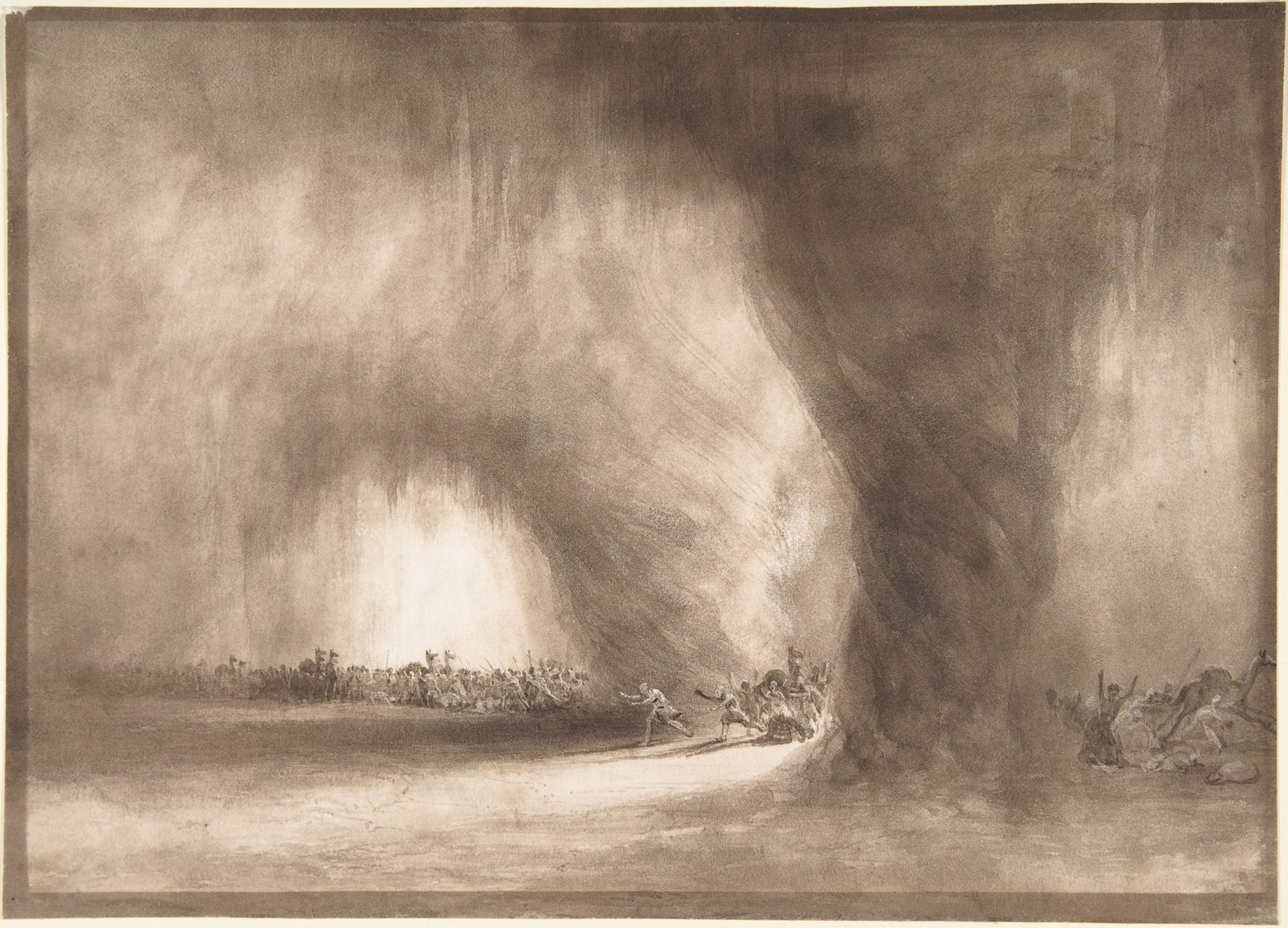
A Column of Oriental Travelers Scattered by a Dust Storm. William West, 1820-40. Wikimedia Commons. CC0.