
Psalm 24
10 verses · Hymn of praise
The earth is the LORD’s, and the fullness thereof, the world and all who dwell therein.
Introduction
David, the King of Glory, Book 1: The book of David, Poetry, Psalms Overview.
This is a processional song, written to be sung by two groups as the ark of the covenant was carried up into Jerusalem. David is named in its heading, and the likeliest occasion is the day he brought the ark into his city. It opens with the whole world and narrows to one hill and one gate. Listen for the questions and answers called back and forth between the singers, and for the question asked twice at the city's gate about the name of the one entering. The answer grows fuller the second time. Read it as the song of a people welcoming their God into their capital.
Context
- Who
- Israelites lining the streets as the ark of the covenant came home
- What
- A processional hymn sung at the gates of Jerusalem as the ark of the covenant was carried in.
- Where
- The gates of Jerusalem, with a procession outside and the ark carried in
- When
- The reign of David, about 1000 BC, most likely at the ark's entry into the city.
- Why
- To ask who may stand in God's presence and to welcome the King of Glory into His city.
Historical context
The psalm is written for two choirs and a set of doors: a procession comes up, a challenge is called, an answer is given and the doors open. Ancient cities had massive gate complexes, thick timber leaves plated with bronze set in a chambered stone gateway, and verse 7 addresses the lintel and the doors themselves as though they should stand taller for who is coming. The ark was a gold-covered chest with carrying poles, and the Law required Levites to bear it on their shoulders. The first attempt to move it on a new cart ended in a man's death at the threshing floor of Nacon, and three months passed before David tried again. The titles of verses 8 and 10 are military, since the LORD of Hosts names the armies of Israel and the armies of heaven together.
Significance
The psalm claims the whole earth and everything in it for the LORD and then walks him through one city's gates, so its first hearers felt that the God of the whole world had chosen an address. It also asked something of them at the door. A city could open its gates to the King of Glory and still be full of people with dirty hands, so the psalm makes them answer the question before the procession moves.
This chapter in Jewish lifeWhat this chapter is in Jewish life and reading.
What is done
The Levites sang a set psalm for each day of the week in the Temple, and the list of the seven stands in the Mishnah, in tractate Tamid 7:4. This repository cites that tractate in the Danby translation, at scripts/data/historical-context/ch3-psalms-b.mjs, and the days it records there are the third, the fourth, the fifth, the sixth and the seventh. The psalms of the first and second days are carried by no file here. On the writer's reading this is the psalm of the first day, and it is marked as the writer's reading until the tractate itself is checked and the line is filed. Radak sets the psalm at an occasion rather than a weekday. He is quoted here from the Finch translation of 1919, which is public domain. He holds that "David composed this Psalm that they might recite it as they brought the ark to the Most Holy House". The burnt offering on Mount Moriah had shown him where the House would stand (Radak on Psalms 24:1:1).
How it is read
The chapter falls into two halves in both commentators' hands, and the second half is a procession. Radak reads the gates of the seventh verse in two ways and gives both. In the plain sense the psalm speaks figuratively, as other psalms have the sea roar and the field exult. In the rabbinic reading, "the gates were fastened together when Solomon sought to bring in the ark into the house of the Holy of Holies" (Radak on Psalms 24:7:1). Rashi, quoted from the Judaica Press Tanach with Rashi, carries the same tradition with its ending. The gates clung to each other, and Solomon "recited twenty-four praises, but he was not answered" until he asked God to remember the kind deeds of David his servant (Rashi on Psalms 24:7:1). So the psalm's question at the door is read as a real moment when the doors refused to open, and what opened them was the memory of a dead man's faithfulness.
Radak notices something in the text that most readers walk past. The eighth verse calls God mighty in battle and the tenth does not, and he explains the difference from the ark's own history. The ark "used to go out with them in battle", so the first answer names war (Radak on Psalms 24:8:2). Once it had rested in the House of Eternity "it should not go out again to battle", so the second answer drops the word (Radak on Psalms 24:10:1). He then gives Ibn Ezra's reading beside his own, that the second call hints at "the return of the Glory at the coming of the Redeemer" (Radak on Psalms 24:9:1). On Ibn Ezra's plan the word for battle is absent the second time because the age it describes is the age when swords are beaten into ploughshares. A Christian reader should notice that a classical Jewish commentator is reading the second half of this psalm as messianic. The disagreement between him and Radak is over timing rather than over whether the Redeemer comes.
The first half is a gate of another kind. Radak reads the founding on the seas as a distinction between the earth, made for all creatures, and the holy hill, made "for the clean of hand and pure of heart" (Radak on Psalms 24:2:1). He carries a haggadic list of the seven seas and four rivers that the land rests among. Rashi names the four rivers in the same order, the Jordan, the Yarmuk, the Karmion and the Pigah (Rashi on Psalms 24:2:1). Radak reads the fourth verse as the same three dispositions he found in the fifteenth psalm, action, thought and speech. In the three of them "the man will be perfect who shall be clean in his actions, pure in his heart, and trustworthy in his speech" (Radak on Psalms 24:4:1). Rashi puts the whole test in one line: although all the world is God's, "not everyone deserves to come near to Him" (Rashi on Psalms 24:3:1). Ibn Ezra and Metzudat David comment on the middle verses, and the corpus carries their refs without English text. They stand cited and unquoted at Ibn Ezra on Psalms 24:3:1, 24:4:1 and 24:5:1, and at Metzudat David on Psalms 24:2:1.
What the rabbis say
The corpus carries forty locators on this psalm and the text of none, so each is cited and linked here rather than quoted. Nine are Talmudic. Three stand in Arakhin, at 11b:20 and 12a:4 on the first verse and 17a:3 later in the chapter. Two stand in Avot DeRabbi Natan, at 1:8 on the first verse and 13:7 of Recension B. Four more stand at Bava Batra 74b:12 on the second verse, Niddah 30b:24 on the fourth, Chagigah 12b:12 on the fifth, and Rosh Hashanah 32b:7 on the ninth and tenth.
Ein Yaakov carries nine, which is the largest share here. In the Glick Edition they are Bava Batra 5:23 on the second verse, and Moed Katan 1:4 with Shabbat 2:10 on the seventh. Three more are Menachot 4:3 on the eighth verse, Sanhedrin 11:105 on the ninth, and Gittin 5:15 later in the chapter. Beside them stand Bava Batra 5:17, Niddah 3:6 on the fourth verse, Khagigah 2:4 on the fifth and Arakhin 3:11 on the sixth.
The third verse, which asks who may ascend, carries four: Bereshit Rabbah 59:5 and 82:2, Devarim Rabbah 11:2 and Midrash Lekach Tov on Deuteronomy 1:9:1. The eighth verse draws the Exodus midrashim, at Mekhilta DeRabbi Shimon Ben Yochai 19:18, Mekhilta DeRabbi Yishmael, Shirah 1:16 and Midrash Sekhel Tov on Exodus 15:21:6. On the tenth verse the corpus carries Bamidbar Rabbah 15:13 and three entries of Midrash Tanchuma Buber, on Beha'alotcha 14:1 and 15:1 and Vaera 6:1. The rest are single. They are Bereshit Rabbah 34:9 on the second verse, Shemot Rabbah 4:1 and 22:3 on the fourth, Midrash Tehillim 24:8 on the fifth, and Bamidbar Rabbah 14:3 with Eikhah Rabbah 2:13 on the seventh. Three more stand on the ninth verse and later, at an entry of Learning to Read Midrash, one of Otzar Midrashim on the seven vowels, Sifrei Devarim 54:1 and Mekhilta DeRabbi Yishmael, Pischa 13:8. What each of them teaches is a saying of the rabbis, and is reported as theirs wherever this site quotes one. The quotations wait on a fetch that carries the text.
Sources: Radak, Radak on Psalms 24:1:1 to 24:10:2, R. David Kimhi on the first book of Psalms, translated by R. G. Finch, London, 1919; Rashi, Rashi on Psalms 24:1:1 to 24:9:1, the Judaica Press complete Tanach with Rashi, translated by A. J. Rosenberg; Ibn Ezra, Ibn Ezra on Psalms 24:3:1, 24:4:1 and 24:5:1, cited by ref because the corpus carries no English text, and reported by Radak on Psalms 24:9:1 and 24:10:2; Metzudat David, Metzudat David on Psalms 24:2:1, cited by ref because the corpus carries no English text; The Mishnah, tractate Tamid 7:4, the Danby translation, as cited in scripts/data/historical-context/ch3-psalms-b.mjs; The Sefaria corpus, scripts/data/sources/sefaria/psalms/24.json, the 9 Talmud and 31 Midrash locators of this chapter.
The earth is the LORD’s: The earth and its fullness belong to the LORD. The world and all who dwell in it are His, founded upon the seas and set on the waters. Paul quotes this at 1 Corinthians 10:26 to settle what a believer may eat.
Psalms 24:1
“The earth is the Lord's, and the fulness thereof,.... The whole universe, all the terraqueous globe, both land and water, and the circumambient air, and all that is therein; the fishes of the sea, the fowls of the air, the beasts of the field, all plants and vegetables that spring out of the earth, and metals and minerals in the bowels of it; all which are the riches of the Lord the earth is full of, Psa 104:24; see Psa 50:10; the world, and they that dwell therein; the habitable world, and the dwellers on it, rational and irrational.”
3 more voices on this verseWhat preachers and commentators have said about this verse, in their own words.
Psalms 24:1
“How very different is this from the ignorant Jewish notion of God which prevailed in our Saviour's day? The Jews said, "The holy land is God's, and the seed of Abraham are his only people;" but their great Monarch had long before instructed them, — "The earth is the Lord's, and the fulness thereof." The whole round world is claimed for Jehovah, "and they that dwell therein"are declared to be his subjects.”
Charles Spurgeon · The Treasury of David, Vol. 1 (1869)Particular Baptist
Psalms 24:1
“The foolish man thinks his own that which never belongs to him, ignorant seemingly in his greed that "the earth is the Lord's, and the fulness thereof," for "God is king of all the earth." It is the passion of having which gives men a false title of lordship over that which can never belong to them.”
Gregory of Nyssa · written before 395 · On Virginity 4patristic
Psalms 24:1
“These indeed, in the kingdom of grace, are justly looked upon as emptiness; for they are vanity of vanities, nothing to a soul; but, in the kingdom of providence, they are fulness.”
Matthew Henry · Commentary on the Whole Bible (1707-1721)puritan
Cross references
Psalms 24:1
- Quoted in1 Corinthians 10:26for, “The earth is the Lord’s, and the fullness thereof.”
'The earth is the Lord's, and the fulness thereof' (meat offered to idols)
Psalms 24:2
In the second verse we have the reason why the world belongs to God, namely, because he has created it, which is a title beyond all dispute. "For he hath founded it upon the seas." It is God who lifts up the earth from out of the sea, so that the dry land, which otherwise might in a moment be submerged, as in the days of Noah, is kept from the floods. The hungry jaws of ocean would devour the dry land if a constant fiat of Omnipotence did not protect it. "He hath established it upon the floods."
Charles Spurgeon · The Treasury of David, Vol. 1 (1869)Particular Baptist
1 more voice on this verse
Psalms 24:2
“Poetically represents the facts of Ge 1:9. The form of a question gives vivacity. Hands, tongue, and heart are organs of action, speech, and feeling, which compose character. hill of the Lord--(compare Ps 2:6, &c.).”
Jamieson, Fausset & Brown · Commentary Critical and Explanatory on the Whole Bible (1871)reformed
Who may ascend the hill of the LORD?: Psalm 15:1 asks who may abide in God's tent; this psalm asks who may climb the hill. The answer is clean hands and a pure heart, with no idol lifted up and no oath sworn falsely. Blessing and vindication come to him as a gift.
Psalms 24:3
“THERE IS little doubt that this Psalm has a primary reference to the Lord Jesus Christ. He it is who alone ascended up on high by his own merits, and by virtue of a perfect obedience stands in God’s holy place. He alone of mortal race hath clean hands and a pure heart; he hath not lifted up his soul unto vanity, nor hath he sworn deceitfully therefore hath he received the blessing and righteousness from the God of his salvation.”
2 more voices on this verse
Psalms 24:3
“Standing is the posture of ministers or servants. Who shall serve God, with God's acceptation. Holy place - In the place which he hath sanctified for his service.”
John Wesley · Explanatory Notes upon the Old Testament (1765)evangelical
Psalms 24:3
“Where should you stand, you who seek sanctification from God? The writer says, "You have established my feet on the rock." "Christ was the rock." Let us learn about the one who follows these promises.”
Origen of Alexandria · written before 253 · Selections from the Psalms 24:3patristic
Psalms 24:4
“Yet in vain do those pretend to have pure and good hearts whose hands are defiled with the acts of sin. That is a pure heart which is sincere and without guile in covenanting with God, which is carefully guarded, that the wicked one, the uncle an spirit, touch it not, which is purified by faith, and conformed to the image and will of God; see Matt. v. 8 .”
Matthew Henry · Commentary on the Whole Bible (1707-1721)puritan
1 more voice on this verse
Psalms 24:4
"He that hath clean hands." Outward, practical holiness is a very precious mark of grace. To wash in water with Pilate is nothing, but to wash in innocency is all-important. It is to be feared that many professors have perverted the doctrine of justification by faith in such a way as to treat good works with contempt; if so, they will receive everlasting contempt at the last great day. It is vain to prate of inward experience unless the daily life is free from impurity, dishonesty, violence, and oppression. Those who draw near to God must have "clean hands."
Charles Spurgeon · The Treasury of David, Vol. 1 (1869)Particular Baptist
Psalms 24:5
“It must not be supposed that the persons who are thus described by their inward and outward holiness are saved by the merits of their works; but their works are the evidences by which they are known. The present verse shows that in the saints grace reigns and grace alone. Such men wear the holy livery of the Great King because he has of his own free love clothed them therewith. The true saint wears the wedding garment, but he owns that the Lord of the feast provided it for him, without money and without price.”
Charles Spurgeon · The Treasury of David, Vol. 1 (1869)Particular Baptist
Psalms 24:6
"This is the generation of them that seek him, that seek thy face, O Jacob." These are the regeneration, these are in the line of grace; these are the legitimate seed. Yet they are only seekers; hence learn that true seekers are very dear in God's esteem, and are entered upon his register. Even seeking has a sanctifying influence; what a consecrating power must lie in finding and enjoying the Lord's face and favour! To desire communion with God is a purifying thing.
Charles Spurgeon · The Treasury of David, Vol. 1 (1869)Particular Baptist
3 more voices on this verse
Psalms 24:6
“In every age there is a remnant of such as these, men of this character, who are accounted to the Lord for a generation, Ps. xxii. And they are such as seek God, that seek they face, O Jacob! [1.] They join themselves to God, to seek him, not only in earnest prayer, but in serious endeavours to obtain his favour and keep themselves in his love.”
Matthew Henry · Commentary on the Whole Bible (1707-1721)puritan
Psalms 24:6
“No one seeking the face of God will see his face and live, … unless he or she has been changed.”
Origen of Alexandria · written before 253 · Selections from the Psalms 24:6patristic
Psalms 24:6
Jacob--By "Jacob," we may understand God's people (compare Isa 43:22; 44:2, &c.), corresponding to "the generation," as if he had said, "those who seek Thy face are Thy chosen people."
Jamieson, Fausset & Brown · Commentary Critical and Explanatory on the Whole Bible (1871)reformed
Lift up your heads, O gates!: The command is given to the gates themselves, ancient doors told to lift their own heads for the King. Verse 8 answers its own question with a soldier's title, the LORD mighty in battle. The ark went up into Jerusalem at 2 Samuel 6.
Psalms 24:7
“The king - The Messiah, the king of Israel, and of his church, called the King, or Lord of glory, 1 Cor. ii, 8 James ii, 1, both for that glory which is inherent in him, and that which is purchased by him for his members.”
John Wesley · Explanatory Notes upon the Old Testament (1765)evangelical
3 more voices on this verse
Psalms 24:7
“It was not the Word himself that needed an opening of the gates, being Lord of all; nor were any of his works closed to their maker; but we it was that needed it, whom he carried up by his own body. For as he offered it to death on behalf of all, so by it he once more made ready the way up into the heavens.”
Athanasius of Alexandria · written before 373 · On the Incarnation of the Word 25patristic
Psalms 24:7
“These last verses reveal to us the great representative man, who answered to the full character laid down, and therefore by his own right ascended the holy hill of Zion. Our Lord Jesus Christ could ascend into the hill of the Lord because his hands were clean and his heart was pure, and if we by faith in him are conformed to his image we shall enter too. We have here a picture of our Lord's glorious ascent.”
Charles Spurgeon · The Treasury of David, Vol. 1 (1869)Particular Baptist
Psalms 24:7
“It is supposed that the psalm was penned upon occasion of David's bringing up the ark to the place prepared for it, and that the intention of it was to lead the people above the pomp of external ceremonies to a holy life and faith in Christ, of whom the ark was a type.”
Matthew Henry · Commentary on the Whole Bible (1707-1721)puritan
Psalms 24:8
The watchers at the gate hearing the song look over the battlements and ask, "Who is this King of glory?" A question full of meaning and worthy of the meditations of eternity. Who is he in person, nature, character, office and work? What is his pedigree? What his rank and what his race? The answer given in a mighty wave of music is, "The Lord strong and mighty, the Lord mighty in battle."
Charles Spurgeon · The Treasury of David, Vol. 1 (1869)Particular Baptist
3 more voices on this verse
Psalms 24:8
“Who is this King of glory?.... Which question is put by the church, or particular believers; not through ignorance, as the daughters of Jerusalem, Son 5:9; or the Pharisees, when Christ made his public entrance into Jerusalem, Mat 21:10; much less in pride and haughtiness, in scorn and derision, as Pharaoh, Exo 5:1; and the Capernaites, Joh 6:42; but as wondering at the glories and excellencies of his person, and as desirous of knowing more of him.”
Psalms 24:8
“This is the gospel call and demand, that we let Jesus Christ, the King of glory, come into our souls, and welcome him with hosannas, Blessed is he that cometh. That we may do this aright we are concerned to ask, Who is this King of glory? --to acquaint ourselves with him, whom we are to believe in, and to love above all.”
Matthew Henry · Commentary on the Whole Bible (1707-1721)puritan
Psalms 24:8
“The Lord - He is no ordinary person, no other than Jehovah, who hath given so many proofs of his almightiness, who hath subdued all his enemies, and is now returned in triumph.”
John Wesley · Explanatory Notes upon the Old Testament (1765)evangelical
Lift up your heads, O gates!: Verse 9 repeats the call to the gates and the ancient doors word for word, and the answer changes. The title is now the LORD of Hosts, the name that carries the armies of heaven. The psalm ends with He is the King of Glory.
Psalms 24:9
"Lift up your heads, O ye gates; even lift them up, ye everlasting doors; and the King of glory shall come in." The words are repeated with a pleasing variation. There are times of deep earnest feeling when repetitions are not vain but full of force. Doors were often taken from their hinges when Easterns would show welcome to a guest, and some doors were drawn up and down like a portcullis, and may possibly have protruded from the top; thus literally lifting up their heads.
Charles Spurgeon · The Treasury of David, Vol. 1 (1869)Particular Baptist
2 more voices on this verse
Psalms 24:9
But after he had destroyed his enemies through his passion, the Lord, who is mighty in battle and strong, … goes, bearing victory and trophies, with the body that arose from the dead.… Certain powers say, "Who is this that is coming from Edom, with scarlet garments from Bosra, so beautiful?" And those escorting him say to those stationed at the gates of heaven, "Lift up your gates, and the King of glory will come in."
Origen of Alexandria · written before 253 · Commentary on the Gospel of John 6:287-88patristic
Psalms 24:9
“Lift up - The same verse is repeated again, to awaken the dulness of mankind, who are so hardly brought to a serious preparation for such solemnities; and to signify the great importance of the matter, contained under these expressions.”
John Wesley · Explanatory Notes upon the Old Testament (1765)evangelical
Psalms 24:10
Gabriel, who is called the strength of God, is also sent to Mary. For he came to announce him who deigned to appear humble to conquer the powers of the air. Of whom it is said through the Psalmist: "Lift up your gates, O princes, and be lifted up, eternal gates, and the King of glory shall enter. Who is this King of glory? The Lord strong and mighty, the Lord mighty in battle." And again: "The Lord of hosts, he is the King of glory."
Gregory the Dialogist · written before 604 · Forty Gospel Homilies, Homily 34patristic
2 more voices on this verse
Psalms 24:10
“Who is this King of glory?.... This is repeated, because of the preceding words, and in order to have a further account of his glorious Person, as follows: the Lord of hosts, he is the King of glory; he who is the Lord of sabaoth, the Lord of the armies, both of the heavens and the earth; at whose dispose and control all things are in both worlds, above and below: this is the great and glorious Person that condescends to dwell in his churches, and in the hearts of his people; and this honour have his saints.”
Psalms 24:10
“The closing note is inexpressibly grand. Jehovah of hosts, Lord of men and angels, Lord of the universe, Lord of the worlds, is the King of glory. All true glory is concentrated upon the true God, for all other glory is but a passing pageant, the painted pomp of an hour. The ascended Saviour is here declared to be the Head and Crown of the universe, the King of Glory. Our Immanuel is hymned in sublimest strains. Jesus of Nazareth is Jehovah Sabaoth.”
Charles Spurgeon · The Treasury of David, Vol. 1 (1869)Particular Baptist
How this psalm is built
The form: A psalm for bringing the ark to the place prepared for it, written to lead the people above the pomp of external ceremonies to a holy life and faith in Christ, as Henry classes it.
The patterns in this chapter
| Device | What it does | Where to see it |
|---|---|---|
| The call and the challenge said twice | Verses 7 and 9 give the same command to the gates in almost the same words, and verses 8 and 10 put the same question and answer it differently each time. Spurgeon reads the second round as repetition with a pleasing variation, and holds that in times of deep earnest feeling a repetition carries force rather than emptiness. Barnes reads it the same way, as repetition designed to give emphasis to what is announced.Charles Spurgeon, The Treasury of David, Vol. 1, 1869, on Psalm 24:9. | Psalm 24:7, Psalm 24:8, Psalm 24:9, Psalm 24:10 |
| The gates spoken to as though they could hear | The first six verses speak about God and about the men who may come to Him. From verse 7 the psalm turns and speaks to the doors themselves, telling them to lift up their heads. Spurgeon notes the practice behind the picture, that eastern doors were sometimes taken off their hinges to welcome a guest and that some were drawn up and down like a portcullis, so that lifting a head is what such a door actually does. Augustine takes the command a second way and hears it spoken to the princes who hold the entrances.Charles Spurgeon, The Treasury of David, Vol. 1, 1869, on Psalm 24:9. | Psalm 24:7, Psalm 24:9 |
| The four marks of the one who may ascend | Verse 4 answers the question of verse 3 with a list of four things rather than with a name or a tribe. Clean hands, a pure heart, no lifting of the soul to an idol, no swearing deceitfully. Augustine sets the first pair as the guiltless in deed and the pure in thought, and reads the third mark as a man who refuses to count his own soul among the things that pass away. Spurgeon reads the whole list as character, since those who stand as courtiers in the palace of the living God are not distinguished by race.Augustine of Hippo, Exposition on Psalm 24, 430, on Psalm 24:4. | Psalm 24:3, Psalm 24:4, Psalm 24:6 |
The structure
10 more paragraphs on the patterns
Repetition is the psalm's main device. Verses 7 and 9 give the same command in almost the same words, and verses 8 and 10 put the same question and answer it differently each time. Spurgeon reads the second round as repetition with a pleasing variation and holds that in times of deep earnest feeling a repetition carries force. Barnes reads it as emphasis. The psalm also narrows and then opens again: the whole earth in verse 1, one hill in verse 3, one gate in verse 7, and the Lord of armies at the close.
The debate
Verse 6 carries a textual question. Adam Clarke reports that the word Elohey, O God, has been lost out of the Hebrew in most manuscripts, and that two of Kennicott's manuscripts keep it, along with the Syriac, Vulgate, Septuagint, Ethiopic, Arabic and Anglo-Saxon, which together give who seek thy face, O God of Jacob. Jamieson, Fausset and Brown read the received text as it stands and take Jacob as a name for God's people, so that those who seek His face are His chosen people. Both readings leave the verse describing the same men.
The second question is what the gates of verses 7 to 10 are. Justin Martyr, Hippolytus of Rome and Origen of Alexandria read them as the gates of heaven opened at the ascension, and Justin argues that no gatekeeper in Jerusalem ever asked that question of Solomon or of the ark. Jamieson, Fausset and Brown record that some take the actual enlargement of the ancient gates of Jerusalem as the basis of the figure, and hold that either way the effect is a conception of the matchless majesty of God.
The prophecy and the New Testament
John Wesley reads the King of glory of verse 7 by 1 Corinthians 2:8 and James 2:1, the two places where the New Testament gives Christ that title, and takes it of the glory that is his own and the glory he purchased for his members. Eusebius of Caesarea reads the LORD of Hosts of verse 10 as the Lord of powers, and sets verse 1 beside the prophet's cry that the whole earth is full of His glory. Gregory the Dialogist reads the titles of verse 8 in his homily on Gabriel's mission to Mary.
Where it stands in the Psalter
Matthew Henry reads the generation of verse 6 with Psalm 22, where a seed is accounted to the Lord for a generation. Albert Barnes reads the question of verse 3 with Psalm 15:1, which asks the same thing in nearly the same words and answers it at the same length. Jamieson, Fausset and Brown send the hill of the LORD in verse 3 to Psalm 2:6, where God sets His King on His holy hill.
Where to go deeper
The ark the psalm was written for has its own page at /featured/the-ark-of-the-covenant, and the reading of verses 7 to 10 that the early church held has one at /featured/the-ascension.
Keep studying
Studies7
People and groups1
Words11
Subjects1
Sources for this chapter
The summary
Jamieson, Fausset & Brown, Commentary Critical and Explanatory; John Calvin, Commentaries; John Wesley, Notes on the Old Testament and Matthew Henry, Complete Commentary.
The form and classifications
Augustine of Hippo, Exposition on Psalm 24, 430, on Psalm 24:1; Charles Spurgeon, The Metropolitan Tabernacle Pulpit, Sermon No. 396, "Climbing the Mountain" (lightly modernized text, CCEL edition), 1861 and Matthew Henry, Commentary on the Whole Bible, 1710, on Psalm 24:7 to 10.
The exposition
Albert Barnes, Notes on the Book of Psalms; Charles Spurgeon, The Treasury of David; Franz Delitzsch, Biblical Commentary on the Psalms and Matthew Henry, Commentary on the Whole Bible.
The painting
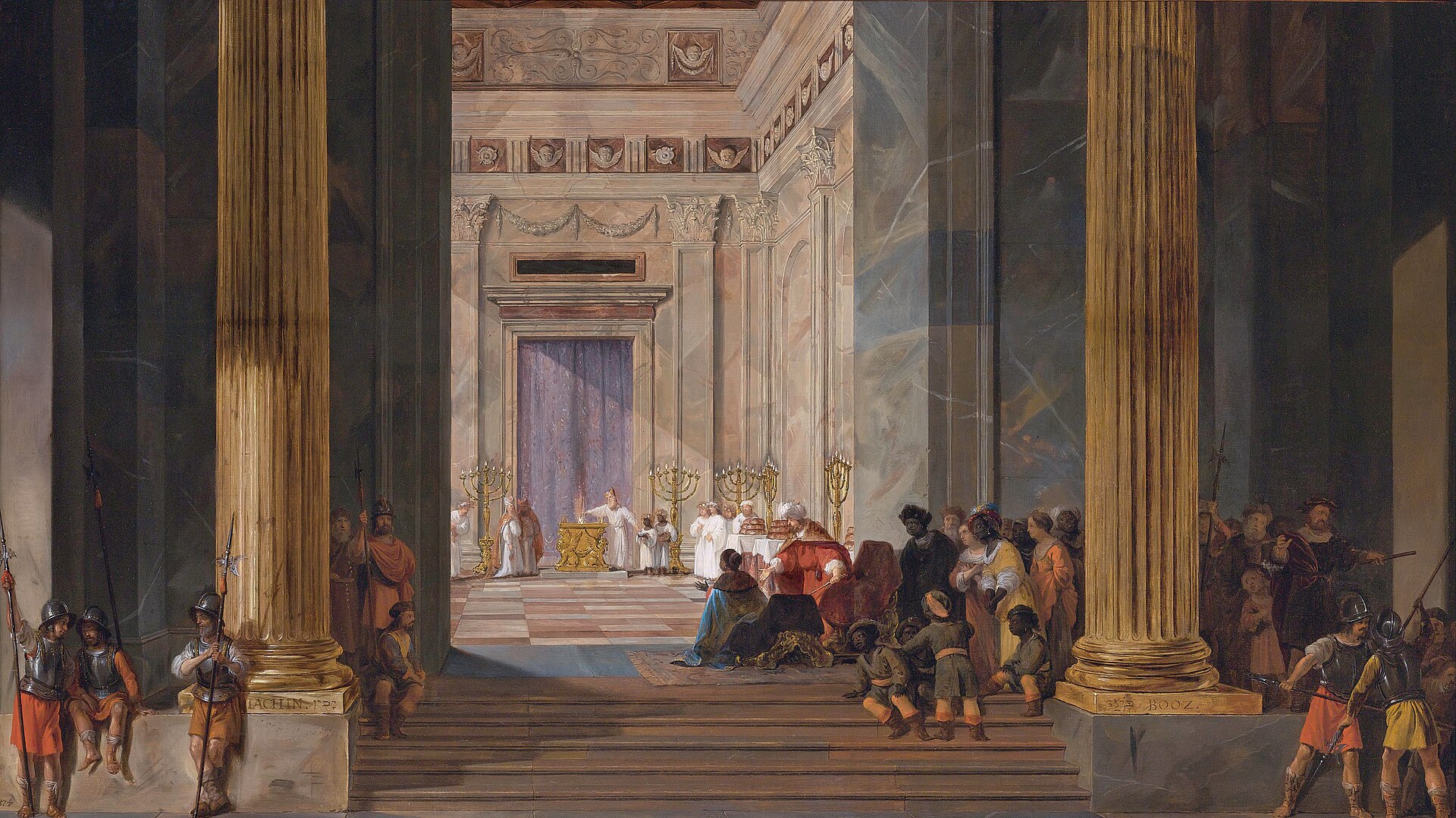
The Queen of Sheba before the temple of Solomon in Jerusalem. Salomon de Bray, 1657. Sotheby's. Public domain.