
Psalm 21
13 verses · Royal psalm
For You welcomed him with rich blessings; You placed on his head a crown of pure gold.
Introduction
David, the King's Thanksgiving, Book 1: The book of David, Poetry, Psalms Overview.
This psalm belongs beside the one before it. Psalm 20 is the prayer a people raised as their king rode out to war, and this is the song they sang when he came home. David is named in its heading, and the psalm speaks of the king in the third person, so it reads as the people's song about him. Listen for where the praise is sent, since every gift the king holds is traced to its giver. Listen also for the change of speaker partway through, when the singers turn to the king himself, and for the closing line, which lifts the song from the throne to God.
Context
- Who
- Israelites celebrating a king who had gone out with their prayers and come home
- What
- A royal thanksgiving in which the people praise God for the victory He gave their king.
- Where
- Jerusalem after a victory, with the king back on the throne and spoil brought in
- When
- The reign of David, about 1010 to 970 BC by the superscription.
- Why
- To give the credit for a king's success to the LORD who answered the prayer of Psalm 20.
Historical context
The crown of pure gold in verse 3 was treasury as much as ornament, and the account of David's Ammonite campaign gives the crown taken from the enemy king's head a weight of a talent of gold. The gift of life in verse 4 was the standard shout raised to kings across the region, that the king may live forever. Israel sang it over a king who was plainly mortal, which left the phrase reaching for someone it fitted. The fiery furnace of verse 9 draws on the bread oven of an Israelite house or village, a clay dome heated with brushwood until the walls glowed. Wiping a man's descendants from the earth, in verse 10, is how a dynasty was ended.
Significance
Read beside Psalm 20 this is the receipt. The people prayed that the king would be helped from the sanctuary, and here they sing that he was. The king rejoices in God's strength, and the last line turns the singing away from the king entirely and asks the LORD to be exalted in his own strength.
This chapter in Jewish lifeWhat this chapter is in Jewish life and reading.
How it is read
This chapter carries the plainest statement in the whole corpus of why a classical Jewish commentator sometimes turns away from a messianic reading, and it is stated by Rashi himself. He is quoted here from the Judaica Press Tanach with Rashi. On the second verse he records the reading of the Rabbis first: they "interpreted it as referring to the King Messiah". He then gives his own and says what it is for. The verse "may correctly be interpreted further as referring to David himself, in order to refute the sectarians, who became bold because of it" (Rashi on Psalms 21:2:1). The sectarians in Rashi's France were the Christians, who read the psalm's king as Christ. Rashi is stating openly that the Christian use of the messianic reading is part of why he prefers the plain sense of David here.
A Christian reader should take that at face value and weigh it fairly. Rashi is a commentator under Christian rule, writing for a community under pressure, and he says so. He does not suppress the messianic reading; he reports it, and even supplies its proof texts. At the seventh verse he records that "our Rabbis, who interpreted it as referring to the King Messiah, brought proof on that matter". The proof is the one brought near to the Ancient of Days in Daniel, and the ruler God brings near in Jeremiah (Rashi on Psalms 21:7:2). So the corpus preserves both readings on the same page, with the older one named and its evidence given. This is the pattern the founder's order names from Isaiah 53, seen here in a psalm.
On the plain sense Rashi ties the psalm to particular moments of David's life. The blessing that came before the asking, in the fourth verse, is the promise God sent through Nathan the prophet. It was to raise up David's seed and establish the throne of his kingdom (Rashi on Psalms 21:4:1). The gold crown of the same verse is the crown taken at Rabbah and set on David's head (Rashi on Psalms 21:4:2). The life asked for in the fifth verse is the prayer David prayed while he fled from Saul outside the land. The answer is that God "restored me to the land of Israel" (Rashi on Psalms 21:5:1 and 21:5:2). The joy of the seventh verse he places "before You in Paradise" (Rashi on Psalms 21:7:2).
From the ninth verse the psalm turns on the king's enemies, and Rashi names them out of his own century. The fruit to be destroyed in the eleventh verse is "the descendants of the wicked Esau" (Rashi on Psalms 21:11:1). The evil directed against God in the twelfth verse he refers to "the wicked Titus, who said that he had killed Him" (Rashi on Psalms 21:12:1). Those are readings about the destroyers of the Temple and the powers that followed them, and the site reports them as Rashi's own rather than as the sense of the verse. Rashi ends the psalm on a petition, that God exalt himself over those who rise up, so that the people may sing (Rashi on Psalms 21:14:1). Ibn Ezra, Radak and Malbim comment on this chapter, and the corpus carries their refs without English text. They stand here cited and unquoted at Ibn Ezra on Psalms 21:2:1, 21:3:1, 21:6:1, 21:8:1 and 21:9:1, and at Radak on Psalms 21:1:1 with Malbim on Psalms 21:1:1. This psalm and the one before it stand together as a prayer before the battle and a thanksgiving after it, and that pair is owed a page under the royal psalms row of docs/lanes/FEATURE-PAGES-OWED.md.
What the rabbis say
The corpus carries forty locators on this psalm and the text of none, so each is cited and linked here rather than quoted. Only two are Talmudic, at Eruvin 54a:12 on the third verse and Sukkah 52a:6 on the fifth.
The second verse draws the Exodus midrashim, because the psalm's word for rejoicing in God's strength recalls the song at the sea. On it the corpus carries Mekhilta DeRabbi Shimon Ben Yochai 15:2 and 15:13, Mekhilta DeRabbi Yishmael, Shirah 3:1 and 9:10, Midrash Lekach Tov on Exodus 15:2:2, and Midrash Sekhel Tov on Exodus 15:21:10.
The sixth verse carries six more. They are Bamidbar Rabbah 14:3 and 15:13, and four entries of Midrash Tanchuma, at Beha'alotcha 9:1 and Nasso 30:1, with Beha'alotcha 15:1 and Nasso 34:1 in the Buber recension. The fourth verse carries six as well, at Midrash Tehillim 21:4 and 104:4, Shemot Rabbah 8:1, Yalkut Shimoni on Torah 180:1, and Midrash Tanchuma, Vaera 8:2 with Vaera 7:1 in Buber.
The twelfth verse, where Rashi names Titus, carries five: Midrash Tehillim 74:3 and 140:1, Aggadat Bereshit 31:2, and Shemot Rabbah 23:6 and 51:5. On the third verse the corpus carries Bereshit Rabbah 9:3, Kohelet Rabbah 1:16:1, Midrash Tehillim 21:3, and Ein Yaakov, Eiruvin 5:6 in the Glick Edition with Eiruvin 5:7. On the fifth it carries Midrash Tehillim 2:10, Pirkei DeRabbi Eliezer 19:14, Midrash Sekhel Tov on Genesis 26:8:1 and Ein Yaakov, Sukkah 5:9. Four more stand at Midrash Tehillim 21:5 on the seventh verse, and at Esther Rabbah 1:6 on the ninth with Midrash Lekach Tov on Genesis 36:23:3 and Midrash Sekhel Tov on Genesis 36:24:3. Two stand on the tenth, at Eikhah Rabbah 4:23 and an entry of Sifrei Aggadah on Esther. What each of them teaches is a saying of the rabbis, and is reported as theirs wherever this site quotes one. The quotations wait on a fetch that carries the text.
Sources: Rashi, Rashi on Psalms 21:2:1 to 21:14:1, the Judaica Press complete Tanach with Rashi, translated by A. J. Rosenberg; Ibn Ezra, Ibn Ezra on Psalms 21:2:1, 21:3:1, 21:6:1, 21:8:1 and 21:9:1, cited by ref because the corpus carries no English text; Radak, Radak on Psalms 21:1:1, cited by ref because the corpus carries no English text; Malbim, Malbim on Psalms 21:1:1, cited by ref because the corpus carries no English text; MannaFest, the royal psalms row of docs/lanes/FEATURE-PAGES-OWED.md; The Sefaria corpus, scripts/data/sources/sefaria/psalms/21.json, the 2 Talmud and 38 Midrash locators of this chapter.
the king rejoices in Your strength: The king's joy is in God's strength and God's salvation, both of them God's gift. Verse 2 reports the answer, his heart's desire granted and the request of his lips not withheld. Spurgeon reads Psalm 20 and this psalm as prayer and thanksgiving.
Psalms 21:1
"The king shall joy in thy strength, O Lord." Jesus is a Royal Personage. The question, "Art thou a King then?" received a full answer from the Saviour's lips: "Thou sayest that I am a King. To this end was I born, and for this purpose came I into the world, that I might bear witness unto the truth." He is not merely a King, but the King; King over minds and hearts, reigning with a dominion of love, before which all other rule is but mere brute force.
Charles Spurgeon · The Treasury of David, Vol. 1 (1869)Particular Baptist
1 more voice on this verseWhat preachers and commentators have said about this verse, in their own words.
Psalms 21:1
“I think that these words had been prophesied by those who had spoken long before David. Since David had learned from the lofty oracles that those words were looking not only at the strength of his own salvation but also that which was going to come forth from his seed, concerning which he said he would rejoice and praise with enthusiasm. Having been assured of those things and the enemies having been thoroughly subjugated with mighty power, to you, God, the author of the victory, he grants the prize of his victory.”
Eusebius of Caesarea · written before 339 · Commentary on Psalms 21:2patristic
Psalms 21:2
“Thou hast given him his heart's desire,.... Which the church had prayed for in Psa 20:4; whatever Christ's heart desired, or his lips requested, has been given him; and hast not withholden the request of his lips.”
1 more voice on this verse
Psalms 21:2
"Thou hast given him his heart's desire." That desire he ardently pursued when he was on earth, both by his prayer, his actions, and his suffering; he manifested that his heart longed to redeem his people, and now in heaven he has his desire granted him, for he sees his beloved coming to be with him where he is. The desires of the Lord Jesus were from his heart, and the Lord heard them; if our hearts are right with God, he will in our case also "fulfil the desires of them that fear him."
Charles Spurgeon · The Treasury of David, Vol. 1 (1869)Particular Baptist
a crown of pure gold: God meets the king with rich blessings and crowns him with pure gold. The king asked for life and was given length of days, forever and ever, which Delitzsch found too long for any human reign. Gill reads it of Christ.
Psalms 21:3
The crown of the Lord is the church gathered from the various nations, about which Paul in the person of the believers says, "My joy and my crown."
Jerome · written before 420 · Brief Commentary on Psalm 21patristic
1 more voice on this verse
Psalms 21:3
"For thou preventest him with the blessings of goodness." The word prevent formerly signified to precede or go before, and assuredly Jehovah preceded his Son with blessings. Before he died saints were saved by the anticipated merit of his death, before he came believers saw his day and were glad, and he himself had his delights with the sons of men. The Father is so willing to give blessings through his Son, that instead of his being constrained to bestow his grace, he outstrips the Mediatorial march of mercy.
Charles Spurgeon · The Treasury of David, Vol. 1 (1869)Particular Baptist
Psalms 21:4
"He asked life of Thee, and Thou gavest him length of days for ever and ever;" indicating that it is the Father of all who imparts continuance for ever and ever on those who are saved. For life does not arise from us, nor from our own nature; but it is bestowed according to the grace of God.
Irenaeus · written before 202 · Against Heresies 2:34.3patristic
3 more voices on this verse
Psalms 21:4
"He asked life of thee, and thou gavest it him, even length of days for ever and ever." The first words may suit King David, but the length of days for ever and ever can only refer to the King Messiah. Jesus, as man, prayed for resurrection and he received it, and now possesses it in immortality. He died once, but being raised from the dead he dieth no more. "Because I live, ye shall live also, " is the delightful intimation which the Saviour gives us, that we are partakers of his eternal life.
Charles Spurgeon · The Treasury of David, Vol. 1 (1869)Particular Baptist
Psalms 21:4
“But this was more eminently fulfilled in Christ, who asked of his father, life, or to be saved from death, Heb. v, 7, though with submission to his will: but his father, though he saw it necessary to take away his temporal life, yet instantly gave him another, far more noble, even the perfect possession of an everlasting life both in his soul and body, at his right hand.”
John Wesley · Explanatory Notes upon the Old Testament (1765)evangelical
Psalms 21:4
“He was dead, indeed, that we might live through him; but he is alive, and lives for evermore, and of the increase of his government and peace there shall be no end; and because he thus lives we shall thus live also.”
Matthew Henry · Commentary on the Whole Bible (1707-1721)puritan
his glory in Your salvation: The king's glory, splendor and majesty are all laid on him by God. Verse 6 gives the source of his gladness, the joy of God's presence. Barnes traces the king's joy to that nearness.
Psalms 21:5
"His glory is great in thy salvation." Immanuel bears the palm; he once bore the cross. The Father has glorified the Son, so that there is no glory like unto that which surroundeth him. See his person as it is described by John in the Revelation; see his dominion as it stretches from sea to sea; see his splendour as he is revealed in flaming fire. Lord, who is like unto thee? Solomon in all his glory could not be compared with thee, thou once despised Man of Nazareth!
Charles Spurgeon · The Treasury of David, Vol. 1 (1869)Particular Baptist
Psalms 21:6
"For thou hast made him most blessed for ever." He is most blessed in himself, for he is God over all, blessed for ever; but this relates to him as our Mediator, in which capacity blessedness is given to him as a reward. The margin has it, thou hast set him to be blessings; he is an overflowing wellspring of blessings to others, a sun filling the universe with light. According as the Lord sware unto Abraham, the promised seed is an everlasting source of blessings to all the nations of the earth.
Charles Spurgeon · The Treasury of David, Vol. 1 (1869)Particular Baptist
the king trusts in the LORD: ; the loving devotion of the Most High holds him steady. That devotion is hesed, the covenant loyalty God keeps toward the man he has bound himself to. The verse turns the psalm from blessings received to enemies judged.
Psalms 21:7
"For the king trusteth in the Lord." Our Lord, like a true King and leader, was a master in the use of the weapons, and could handle well the shield of faith, for he has set us a brilliant example of unwavering confidence in God. He felt himself safe in his Father's care until his hour was come, he knew that he was always heard in heaven; he committed his cause to him that judgeth right, and in his last moments he committed his spirit into the same hands.
Charles Spurgeon · The Treasury of David, Vol. 1 (1869)Particular Baptist
Your right hand will seize: The enemies here are God's own, the ones who hate Him. The hand that crowned the king seizes them, and at His appearing they are put in a fiery furnace. Fire is named twice in verse 9, engulfing and consuming.
Psalms 21:8
"Thine hand shall find out all thine enemies: thy right hand shall find out those that hate thee." The destruction of the wicked is a fitting subject for joy to the friends of righteousness; hence here, and in most scriptural songs, it is noted with calm thanksgiving. "Thou hast put down the mighty from their seats, " is a note of the same song which sings, "and hast exalted them of low degree." We pity the lost for they are men, but we cannot pity them as enemies of Christ.
Charles Spurgeon · The Treasury of David, Vol. 1 (1869)Particular Baptist
2 more voices on this verse
Psalms 21:8
“They hated David because God had set him apart for himself, hated Christ because they hated the light; but both were hated without any just cause, and in both God was hated, John xv.”
Matthew Henry · Commentary on the Whole Bible (1707-1721)puritan
Psalms 21:8
“The address is now made to the king. hand--denotes power, and right hand--a more active and efficient degree of its exercise. find out--reach, lay hold of, indicating success in pursuit of his enemies.”
Jamieson, Fausset & Brown · Commentary Critical and Explanatory on the Whole Bible (1871)reformed
Psalms 21:9
"Thou shalt make them as a fiery oven in the time of thine anger." They themselves shall be an oven to themselves, and so their own tormentors. Those who burned with anger against thee shall be burned by thine anger. The fire of sin will be followed by the fire of wrath. Even as the smoke of Sodom and Gomorrah went up to heaven, so shall the enemies of the Lord Jesus be utterly and terribly consumed. Some read it, "thou shalt put them as it were into a furnace of fire."
Charles Spurgeon · The Treasury of David, Vol. 1 (1869)Particular Baptist
1 more voice on this verse
Psalms 21:9
“Those that might have had Christ to rule and save them, but rejected him and fought against him, shall find that even the remembrance of that will be enough to make them, to eternity, a fiery oven to themselves: it is the worm that dies not.”
Matthew Henry · Commentary on the Whole Bible (1707-1721)puritan
wipe their descendants from the earth: The sentence reaches the enemies' descendants and their offspring, a whole line wiped from the earth. Verse 11 gives the ground for it, that they intended harm against God Himself and their schemes failed. They turn and run when the bow is trained on them.
Psalms 21:10
"Their fruit shalt thou destroy from the earth." Their life's work shall be a failure, and the result of their toil shall be disappointment. That in which they prided themselves shall be forgotten; their very names shall be wiped out as abominable, "and their seed from among the children of men." Their posterity following in their footsteps shall meet with a similar overthrow, till at last the race shall come to an end.
Charles Spurgeon · The Treasury of David, Vol. 1 (1869)Particular Baptist
2 more voices on this verse
Psalms 21:10
“But the seed of the godless and the fruit of the wicked are their words, teachings and unrighteous writings, which they have disseminated through people after they are forgotten. God, being good, scatters each one and destroys them from the midst so that neither the fruit nor the seed of the wicked remains.”
Eusebius of Caesarea · written before 339 · Commentary on Psalms 21:11patristic
Psalms 21:10
“The enemies of God's kingdom, in every age, shall fall under the same doom, and the whole generation of them will at last be rooted out, and all opposing rule, principality, and power, shall be put down.”
Matthew Henry · Commentary on the Whole Bible (1707-1721)puritan
Psalms 21:11
"For they intended evil against thee." God takes notice of intentions. He who would but could not is as guilty as he who did. Christ's church and cause are not only attacked by those who do not understand it, but there are many who have the light and yet hate it. Intentional evil has a virus in it which is not found in sins of ignorance; now as ungodly men with malice aforethought attack the gospel of Christ, their crime is great, and their punishment will be proportionate.
Charles Spurgeon · The Treasury of David, Vol. 1 (1869)Particular Baptist
Psalms 21:12
"Turned away" [is] an expression properly applied to the sinner, for "Cain went out from the face of the Lord," and the psalmist says, "You will make them turn their back." One who is righteous does not turn away from the Lord but runs to meet him and says, "My eyes are ever toward the Lord." And when the Lord said, "Whom shall I send?" Isaiah offered himself of his own accord and said, "Behold, here I am."
Ambrose of Milan · written before 397 · On Joseph the Patriarch, Chapter 3patristic
2 more voices on this verse
Psalms 21:12
“Therefore shall thou make them turn their back,.... Or flee and run away to private places, to hide themselves from the wrath of God and of the Lamb, though to no purpose; or "make them turn behind thy back": God will turn his back upon them, and be negligent and careless of them, and not regard them when they cry in their misery and destruction.”
Psalms 21:12
"Therefore shalt thou make them turn their back, when thou shalt make ready thine arrows upon thy strings against the face of them." For a time the foes of God may make bold advances, and threaten to overthrow everything, but a few ticks of the clock will alter the face of their affairs. At first they advance impudently enough, but Jehovah meets them to their teeth, and a taste of the sharp judgment of God speedily makes them flee in dismay.
Charles Spurgeon · The Treasury of David, Vol. 1 (1869)Particular Baptist
Be exalted, O LORD, in Your strength: The psalm ends where it began, with the LORD's strength, now asked to be exalted in it. The voice has changed from the king's joy in verse 1 to a whole congregation promising to sing and praise God's power. Strength is His, and the praise goes back to Him.
Psalms 21:13
"Be thou exalted, Lord, in thine own strength." A sweet concluding verse. Our hearts shall join in it. It is always right to praise the Lord when we call to remembrance his goodness to his Son, and the overthrow of his foes. The exaltation of the name of God should be the business of every Christian; but since such poor things as we fail to honour him as he deserves, we may invoke his own power to aid us.
Charles Spurgeon · The Treasury of David, Vol. 1 (1869)Particular Baptist
1 more voice on this verse
Psalms 21:13
“Not for being lowly is God exalted, nor does he receive what he does not possess; instead, what he possesses he reveals … your exaltation is revealed in your ineffable power, which we shall continue to celebrate and sing, recounting your marvelous works.”
Theodoret of Cyrus · written before 458 · Commentary on the Psalms 21:8patristic
How this psalm is built
The form: The subject's thanksgiving for the king, with an eye to Messiah the Prince and the glory of his kingdom, as Henry classes it.
The patterns in this chapter
| Device | What it does | Where to see it |
|---|---|---|
| The strength named at the opening and at the close | Verse 1 says the king rejoices in Your strength, and verse 13 asks the LORD to be exalted in Your strength. The psalm begins and ends on the same word, and the strength that won the day is God's at both ends of it. Spurgeon reads the last verse as the place where the singers hand the whole matter back, since men who fail to honour God as He deserves may call on His own power to help them.Charles Spurgeon, The Treasury of David, Vol. 1, 1869, on Psalm 21:13. | Psalm 21:1, Psalm 21:13 |
| The gifts told one after another | Verses 2 to 6 name what was given rather than summing it up. The heart's desire, the request of the lips, rich blessings, a crown of pure gold, life, length of days, glory, splendor and majesty, and joy in God's presence are listed in order. Barnes reads the list as the answer to what the people had asked in the psalm before, so that all that had been wished and all that had been prayed for had now been granted.Albert Barnes, Notes, Explanatory and Practical, on the Old and New Testaments, 1832 to 1869, on Psalm 21:2. | Psalm 21:2, Psalm 21:3, Psalm 21:4, Psalm 21:5, Psalm 21:6 |
| The turn of speech at verse 8 | The first seven verses speak to God about the king. Jamieson, Fausset and Brown mark verse 8 as the place where the address is now made to the king, and from there the psalm speaks to him about the enemies his hand will reach. They read the hand as power and the right hand as the more active exercise of it. Verse 13 turns a second time and speaks to the LORD again.Jamieson, Fausset and Brown, Commentary Critical and Explanatory on the Whole Bible, 1871, on Psalm 21:8. | Psalm 21:1, Psalm 21:8, Psalm 21:13 |
The structure
9 more paragraphs on the patterns
Three shapes hold the psalm together. The word strength stands in verse 1 and again in verse 13, so the psalm opens and closes on it. Verses 2 to 6 are a list of gifts rather than a summary of them, which Barnes reads as the answer to all that the people had asked. Jamieson, Fausset and Brown mark verse 8 as the point where the address turns from God to the king. A Selah stands at the end of verse 2, which sets the first granting apart from the gifts that follow it.
The debate
The readers divide over how much of the psalm is David's and how much is the Messiah's. Adam Clarke reports that some interpreters have understood it of Hezekiah's sickness, his recovery and the fifteen years added to his life, a reading that fits the plain sense of asking for life and being granted it. Clarke himself reads it of the Messiah, of whom David was the type and in several respects the representative. Spurgeon puts the division inside verse 4, granting that the first words may suit King David while holding that length of days for ever and ever can refer to the King Messiah alone.
The prophecy and the New Testament
The pool's readers bring New Testament places to the psalm. Augustine reads the heart's desire of verse 2 by Luke 22:15, where Jesus desired to eat the Passover, and by John 10:18, where He lays down His life and takes it up again, and reads the life of verse 4 as the resurrection asked for at John 17:1. John Wesley reads verse 4 by Hebrews 5:7, where the Son asked to be saved from death, and holds that the life given back was everlasting. Matthew Henry reads the hatred of verse 8 by John 15.
Where it stands in the Psalter
Psalm 20 asks God to give the king the desires of his heart and to make all his plans succeed. Psalm 21 says the desire was granted and the request of his lips was not withheld. Gill, Barnes and Clarke all make that link at verse 2, so the pairing is the reading the commentators have carried rather than a modern arrangement.
Where to go deeper
The crown of pure gold in verse 3 has a page of its own at /featured/the-crown, and the covenant behind the length of days in verse 4 has one at /featured/the-davidic-covenant. A page for the royal psalms as a group is owed, and a row for it stands in docs/lanes/FEATURE-PAGES-OWED.md.
Keep studying
Studies1
Sources for this chapter
The summary
Jamieson, Fausset & Brown, Commentary Critical and Explanatory; John Calvin, Commentaries; John Wesley, Notes on the Old Testament and Matthew Henry, Complete Commentary.
The form and classifications
Adam Clarke, Commentary on the Bible, 1832, on Psalm 21:1; Eusebius of Caesarea, COMMENTARY ON PSALMS 21:2, 339 and Matthew Henry, Commentary on the Whole Bible, 1710, on Psalm 21:7 to 13.
The exposition
Adam Clarke, Commentary on the Bible; Albert Barnes, Notes on the Book of Psalms; Charles Spurgeon, The Treasury of David; Franz Delitzsch, Biblical Commentary on the Psalms; John Gill, Exposition of the Old Testament and Matthew Henry, Commentary on the Whole Bible.
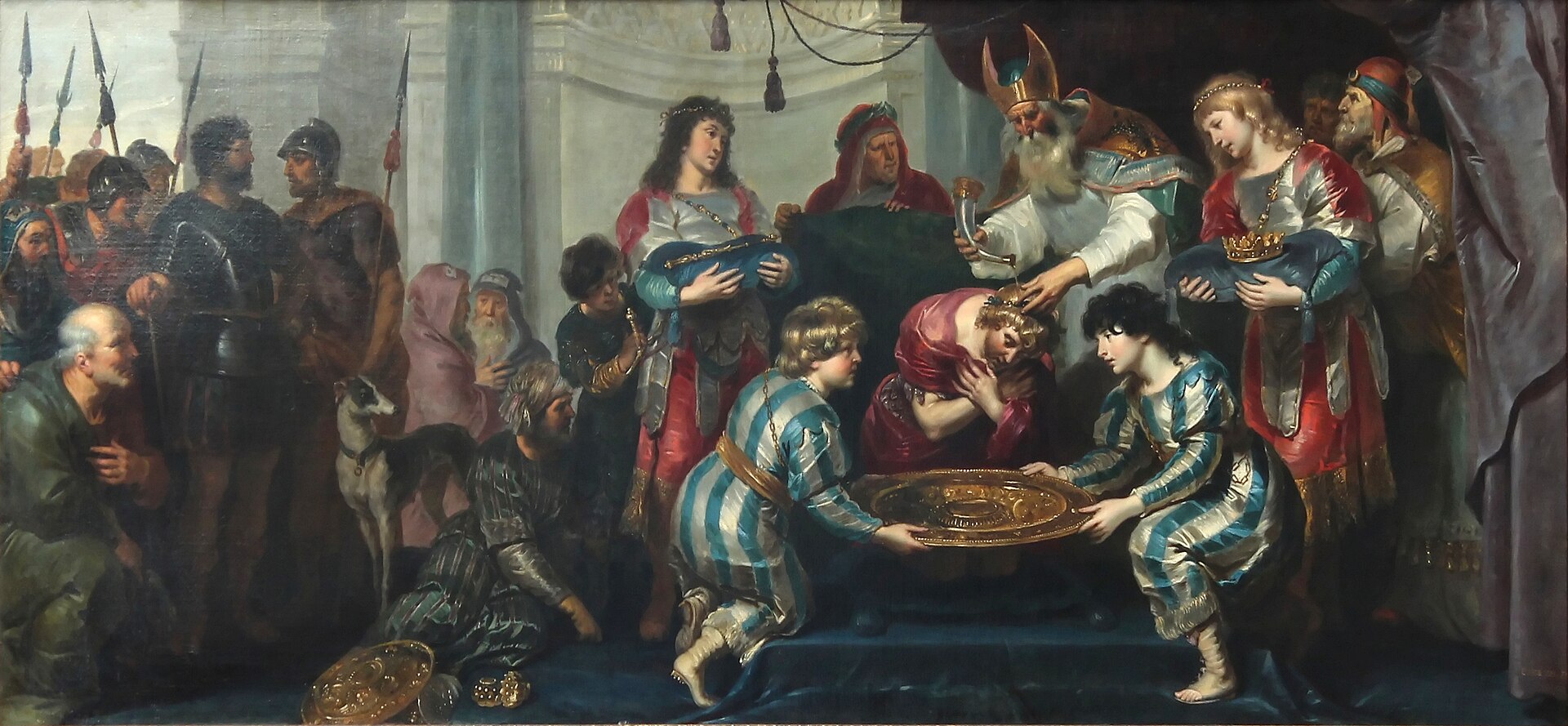
The painting
The anointing of Solomon. Cornelis de Vos, 17th century. Wikimedia Commons. Public domain.