
Psalm 148
14 verses · Hallelujah psalm of praise
Praise Him, all His angels; praise Him, all His heavenly hosts.
Introduction
Author unstated, Creation's Choir, Book 5: The return and the great Hallelujah, Poetry, Psalms Overview.
The third of the Psalter's closing praise psalms calls every part of creation to worship, from the heights of the sky down to the depths of the sea. Its writer is not named. It was sung among nations that worshipped the sun, the moon and the storm, and it gives each of those things a place in Israel's choir. Listen for the order of the roll call, from the heights down to the earth and then to people of every rank and age, and for the small nation named at the close.
Context
- Who
- Israelites who lived among nations that worshipped the very things this psalm orders to worship
- Where
- The whole creation, called out rank by rank from the highest heaven down to the smallest crawling thing
- When
- The closing Hallelujah psalms of the Psalter. No author and no event are named; the psalm belongs to the set of five sung to close the book
Historical context
The psalm carries no name and no occasion, only the Hallelujah that opens and closes it, and it is the third of the five that end the Psalter. It is a roll call taken in order: first the heights, angels, sun, moon and stars, then the sea, the weather, the mountains, the trees and the animals, and last kings, princes, young men and maidens, old and young together. Almost every item on that list was a god somewhere in Israel's neighbourhood, since Egypt worshipped the sun, Babylon the moon and the stars, and Canaan the storm. The psalm puts them all in the choir and gives them a conductor. Ancient people watched the sky as the one perfectly reliable thing in the world, and the psalm reads that reliability as obedience to a decree. Raising a horn for His people is the picture of strength lifted, and it is the last item after all creation has sung.
Significance
For Israelites surrounded by powerful religions, this song settled the ranking question by seating everything on the same bench. It also gave them a place in it, since after the stars, the sea creatures and the kings of the earth have all been called, the psalm ends with a people near to Him.
This chapter in Jewish lifeWhat this chapter is in Jewish life and reading.
What is done
Psalm 148 is the third of the final Hallel, which the book's structure file and the site's page at /featured/the-hallel both give as Psalms 146 to 150, the five psalms that open and close with Hallelujah and stand as the doxology of the whole Psalter. The psalm calls the whole creation to praise, working downward from the heights to the earth and then through the orders of creatures and of people. The corpus holds no liturgical locator for this chapter beyond the rabbinic references below, so this site records the collection it belongs to and the reading.
How it is read
The corpus is thin for this chapter in what it allows to be quoted, and Rashi's five comments are short. He glosses the stars of light in the third verse as the stars of the night, the sea creatures of the seventh as huge fish, and the hail and snow of the eighth with their Old French names. His one comment of substance is on the sixth verse, where he reads the decree God set over the host of heaven as an ordering of service: one serves by day and another serves by night, and that decree does not change. Ibn Ezra comments on nine verses, Radak on eight and Metzudat David on two. The corpus holds no English version of any of theirs on this chapter under a licence permitting quotation, so they stand as citations: Ibn Ezra on Psalms 148:1:1, Radak on Psalms 148:1:1, Metzudat David on Psalms 148:3:1. Malbim carries no entry at all for this chapter.
What the rabbis say
The corpus records forty locators on this chapter, thirty-three Midrash and seven Talmud. The call to praise from the heavens is taken up at Midrash Tehillim 148:1, Bereshit Rabbah 8:1 and 12:11 and Kohelet Rabbah 3:20:1. The angels and the host are taken up at Midrash Tehillim 33:1 and 104:1 and Pesachim 2a:7. The waters above the heavens are taken up at Bereshit Rabbah 1:9. The sea creatures and the deeps are taken up at Chagigah 12b:11 and 14b:4, and the fire, hail, snow and storm wind at Bereshit Rabbah 51:3, Chagigah 12b:2 and Jerusalem Talmud Chagigah 2:1:2. The beasts and birds are taken up at Vayikra Rabbah 14:1 and Chullin 139b:18, and the horn raised for His people at Bamidbar Rabbah 1:5 and 1:9, Devarim Rabbah 2:15 and 8:7 and Aggadat Bereshit 12:1. Each is a locator without text in the corpus.
Sources: Rashi, Rashi on Psalms 148:3:1, 148:6:1, 148:7:1, 148:8:1 and 148:8:2, the Judaica Press complete Tanach with Rashi, translated by A. J. Rosenberg, CC-BY; Ibn Ezra, Ibn Ezra on Psalms 148:1:1, cited only, no English version in the corpus; Radak, Radak on Psalms 148:1:1, cited only; Metzudat David, Metzudat David on Psalms 148:3:1, cited only; Midrash, Midrash Tehillim 148:1, 33:1, 104:1, 119:25 and 24:3, Bereshit Rabbah 8:1, 12:11, 1:9 and 51:3, Kohelet Rabbah 3:20:1, Vayikra Rabbah 14:1, Bamidbar Rabbah 1:5, 1:9 and 12:7, Devarim Rabbah 2:15 and 8:7, Aggadat Bereshit 12:1; Babylonian Talmud, Pesachim 2a:7, Chagigah 12b:2, 12b:11 and 14b:4, Chullin 139b:18; Jerusalem Talmud, Chagigah 2:1:2 and 2:1:3; MannaFest, the final Hallel, at /featured/the-hallel and in src/components/book/dossier-content/psalms-structure.ts, 2026.
Psalms 148:1-6
Praise the LORD from the heavens: Seven things are called from the heavens: angels, heavenly hosts, sun, moon, shining stars, the highest heavens, and the waters above the skies. God gave the command and they were created. Matthew Henry notes idolaters made the sun, moon and stars their gods, while this psalm makes them fellow worshippers.
Psalms 148:1
“Praise ye the Lord. Whoever ye may be that hear this word, ye are invited, entreated, commanded, to magnify Jehovah. Assuredly he has made you, and, if for nothing else, ye are bound, upon the ground of creatureship, to adore your Maker. This exhortation can never be out of place, speak it where we may; and never out of time, speak it when we may. Praise ye the Lord from the heavens. Since ye are nearest to the High and Lofty One, be ye sure to lead the song.”
Charles Spurgeon · The Treasury of David, Vol. 7 (1885)Particular Baptist
1 more voice on this verseWhat preachers and commentators have said about this verse, in their own words.
Psalms 148:1
“This psalm has two alleluias in its title; and many think this is because they belong to the title of the psalm itself. But we ought to know that one alleluia belongs to the end of the preceding psalm, while the other alleluia is the beginning of the following psalm. And we ought to take up this rule and understand that all the psalms which have alleluia at their beginning have it also at their end. Many, however, suppose that it is the beginning of another psalm.”
Jerome · written before 420 · Homily 58, on Psalm 148patristic
all His heavenly hosts: Albert Barnes reads the heavenly hosts as the angels marshalled into armies, with God as their Head and Leader. Charles Spurgeon lets the word take in the heavenly bodies too. Verse 3 then calls those bodies by name.
Psalms 148:2
“Praise him, all his angels. Do you see in what rank the angels are? First the thrones are named: thrones, seats. Let us not suppose these to be chairs on which God sits: but certain powers among the heavenly beings on which God ever sits, as it were in his own chariot. Praise him, all his angels. All his angels. He who is an angel, let him praise: he who is a demon cannot praise. Praise him, all his hosts.”
Jerome · written before 420 · Homily 58, on Psalm 148patristic
1 more voice on this verse
Psalms 148:2
“That there is above us a world of blessed angels by whom God is praised, an innumerable company of them. Thousand thousands minister unto him, and ten thousand times ten thousand stand before him; and it is his glory that he has such attendants, but much more his glory that he neither needs them, nor is, nor can be, any way benefited by them.”
Matthew Henry · Commentary on the Whole Bible (1707-1721)puritan
O sun and moon: Jerome counted the ranks and found the sun, which pagans and Manichaeans called a god, placed fifth among those that praise. He also marked the order, sun before moon, the greater light praising first. Charles Spurgeon pairs them as joint rulers of day and night.
Psalms 148:3
“Praise ye him, sun and moon: praise him, all ye stars of light. The Psalmist enters into detail as to the heavenly hosts. As all, so each, must praise the God of each and all. The sun and moon, as joint rulers of day and night, are paired in praise: the one is the complement of the other, and so they are closely associated in the summons to worship. The sun has his peculiar mode of glorifying the Great Father of lights, and the moon has her own special method of reflecting his brightness.”
Charles Spurgeon · The Treasury of David, Vol. 7 (1885)Particular Baptist
2 more voices on this verse
Psalms 148:3
“Idolaters made the sun, moon, and stars, their gods, and praised them, worshipping and serving the creature, because it is seen, more than the Creator, because he is not seen; but we, who worship the true God only, make them our fellow-worshippers, and call upon them to praise him with us, nay, as Levites to attend us, who, as priests, offer this spiritual sacrifice.”
Matthew Henry · Commentary on the Whole Bible (1707-1721)puritan
Psalms 148:3
“Praise him, sun and moon. Look, you pagans: look, you Manichaeans. The sun praises, it is not praised. Praise him, sun and moon. You call the sun a god. See after how many others it praises. Praise from the heavens, praise in the heights, praise, you angels, praise, all you hosts. Your god is placed as one that praises in the fifth rank. Praise him, sun and moon. He did not say, moon and sun; but, sun and moon. What is greater in light praises first. See the order of the visible things.”
Jerome · written before 420 · Homily 58, on Psalm 148patristic
you waters above the skies: Barnes read the highest heavens as heavens of heavens, one heaven above another, and set the phrase beside 1 Kings 8:27. The waters above the skies go back to Genesis 1:7, where God separated the waters above from the waters below. Adam Clarke took them as clouds, rain and snow.
Psalms 148:4
“Praise him, ye heavens of heavens. By these are meant those regions which are heavens to those who dwell in our heavens; or those most heavenly of abodes where the most choice of spirits dwell. As the highest of the highest, so the best of the best are to praise the Lord. If we could climb as much above the heavens as the heavens are above the earth, we could still cry out to all around us, "Praise ye the Lord." There can be none so great and high as to be above praising Jehovah.”
Charles Spurgeon · The Treasury of David, Vol. 7 (1885)Particular Baptist
1 more voice on this verse
Psalms 148:4
“Praise him, you heavens of heavens. We speak of several heavens. Indeed even Paul says that he was caught up into the third heaven. See therefore how great is the splendor, that there should be a heaven of heaven. And the rest, which follow, he said concerning the visible things.”
Jerome · written before 420 · Homily 58, on Psalm 148patristic
He gave the command and they were created: The verse gives the reason for verses 1 to 4. Augustine read the angels inside this sentence, so the psalm counts them among the things God made. Jerome put it in one line: for God to have commanded is to have made.
Psalms 148:5
“Let them praise the name of the Lord; for he commanded, and they were created. Here is good argument: The Maker should have honour from his works, they should tell forth his praise: and thus they should praise his name —by which his character is intended. The name of Jehovah is written legibly upon his works, so that his power, wisdom, goodness, and other attributes are therein made manifest to thoughtful men, and thus his name is praised. The highest praise of God is to declare what he is.”
Charles Spurgeon · The Treasury of David, Vol. 7 (1885)Particular Baptist
1 more voice on this verse
Psalms 148:5
“The causes of the beginnings of all things are seeds. And the apostle of the Gentiles has said that the human body is a seed. And so in succession after sowing there is the substance that is needed for the resurrection. But even if there were no substance and no cause, who could think it difficult for God to create people anew whence he will and as he wills. Who commanded the world to come into being out of no matter and no substance? Look at the heaven, behold the earth. Whence are the fires of the stars?”
Ambrose of Milan · written before 397 · On the Death of Satyrus 2.64patristic
a decree that will never pass away: Albert Barnes took the word for decree in the sense of a bound, a fixed law the heavens cannot pass. Charles Spurgeon calls God Preserver here as well as Creator. Matthew Henry called their forever a short ever, lasting as long as there is occasion for them.
Psalms 148:6
“He established them for ever, and for age upon age: he set a decree, and it shall not pass away. Great is the honor of man, and great his unhappiness. The sun runs its course for you, the elements serve you: and you do not know your Creator. He set a decree, and it shall not pass away. He set a decree for the sun: behold, through so many years the decree of God has never passed away. So far has it not passed away, that its course has even been grasped by human observation.”
Jerome · written before 420 · Homily 58, on Psalm 148patristic
1 more voice on this verse
Psalms 148:6
“He hath also stablished them for ever and ever. The continued existence of celestial beings is due to the supporting might of Jehovah, and to that alone. They do not fail because the Lord does not fail them. Without his will these things cannot alter; he has impressed upon them laws which only he himself can change. Eternally his ordinances are binding upon them. Therefore ought the Lord to be praised because he is Preserver as well as Creator, Ruler as well as Maker. He hath made a decree which shall not pass.”
Charles Spurgeon · The Treasury of David, Vol. 7 (1885)Particular Baptist
Psalms 148:7-10
Praise the LORD from the earth: Fifteen kinds are named in these verses. The list starts with sea creatures and ocean depths, climbs through lightning, hail, snow, clouds and wind to mountains, hills, fruit trees and cedars. Wild animals, cattle, crawling creatures and flying birds close it, and the wind carries a task, fulfilling His word.
Psalms 148:7
“Praise the Lord from the earth. The song descends to our abode, and so comes nearer home to us. We who are "bodies terrestrial", are to pour out our portion of praise from the golden globe of this favoured planet. Jehovah is to be praised not only in the earth but from the earth, as if the adoration ran over from this planet into the general accumulation of worship. In Ps 148:1 the song was "from the heavens"; here it is "from the earth": songs coming down from heaven are to blend with those going up from earth.”
Charles Spurgeon · The Treasury of David, Vol. 7 (1885)Particular Baptist
1 more voice on this verse
Psalms 148:7
“The call on the earth, as opposed to heaven, includes seas or depths, whose inhabitants the dragon, as one of the largest (on leviathan, see on Ps 104:26), is selected to represent. The most destructive and ungovernable agents of inanimate nature are introduced.”
Jamieson, Fausset & Brown · Commentary Critical and Explanatory on the Whole Bible (1871)reformed
powerful wind fulfilling His word: Charles Spurgeon recalls lightning and hail working together in the plagues of Egypt. Augustine read the clause about the wind as an answer to those who think God rules things above and leaves things below to chance. Albert Barnes hears the storm's obedience as its praise.
Psalms 148:8
“Fire - Lightnings and other fireworks of the air. Vapor - Or, fumes: hot exhalations. Fulfilling his word - Executing his commands, either for the comfort or punishment of the inhabitants of the earth.”
John Wesley · Explanatory Notes upon the Old Testament (1765)evangelical
fruit trees and all cedars: Albert Barnes reads the pair as fruit trees and forest trees, with the cedar standing for the whole forest. Matthew Henry notes that the fruitless cedars still served in God's temple. Charles Spurgeon makes the greater and lesser mountains one in adoration.
Psalms 148:9
“Mountains, and all hills. Towering steeps and swelling knolls alike declare their Creator. "All hills" are to be consecrated; we have no longer Ebal and Gerizim, the hill of the curse and the hill of the blessing, but all our Ebals are turned to Gerizims. Tabor and Hermon, Lebanon and Carmel, rejoice in the name of the Lord. The greater and the lesser mounts are one in their adoration. Not only the Alps and the mountains of the Jura thunder out his praise; but our own Cotswolds and Grampians are vocal with songs in his honour.”
Charles Spurgeon · The Treasury of David, Vol. 7 (1885)Particular Baptist
crawling creatures and flying birds: Adam Clarke gives the Hebrew words, hachaiyah for the wild beasts and behemah for the animals kept for the house and the field. Albert Barnes sees each pair built to take in the whole, from the creatures that creep on the ground to the birds that rise highest.
Psalms 148:10
“Beasts, and all cattle. Animals fierce or tame; wild beasts and domestic cattle; let all these show forth the praises of Jehovah. Those are worse than beasts who do not praise our God. More than brutish are those who are wilfully dumb concerning their Maker. Creeping things, and flying fowl. The multitudes that throng the earth and the air; insects of every form and birds of every wing are called upon to join the universal worship. No one can become familiar with insect and bird life without feeling that they constitute a wonderful chapter in the history of divine wisdom.”
Charles Spurgeon · The Treasury of David, Vol. 7 (1885)Particular Baptist
Psalms 148:11-13
kings of the earth and all peoples: People come last, by rank and age: kings and peoples, princes and rulers, young men and maidens, and the old with the young. The summons given to sun and stars at verse 5 comes back at verse 13: His splendor stands above the earth and the heavens.
Psalms 148:11
“Kings of the earth, and all people: princes, and all judges of the earth. Now the poet has reached our own race, and very justly he would have rulers and subjects, chieftains and magistrates, unite in worshipping the sovereign Lord of all. Monarchs must not disdain to sing, nor must their people refrain from uniting with them. Those who lead in battle and those who decide in courts must neither of them allow their vocations to keep them from reverently adoring the Chief and Judge of all. All people, and all judges, must praise the Lord of all.”
Charles Spurgeon · The Treasury of David, Vol. 7 (1885)Particular Baptist
old and young together: Charles Spurgeon has the old teach the children to praise from experience, and the children stir the old to song by their cheerfulness. Adam Clarke found the pairing fitting. Childhood and old age, in his reading, show nearly the same passions and infirmities.
Psalms 148:12
“Both young men, and maidens; old men, and children. Both sexes and all ages are summoned to the blessed service of song. Those who usually make merry together are to be devoutly joyful together: those who make up the ends of families, that is to say, the elders and the juveniles, should make the Lord their one and only end. Old men should by their experience teach children to praise; and children by their cheerfulness should excite old men to song.”
Charles Spurgeon · The Treasury of David, Vol. 7 (1885)Particular Baptist
for His name alone is exalted: Them gathers every creature named since verse 1. Jamieson, Fausset and Brown read the last clause as the united splendor of earth and heaven falling short of His. Augustine drew the lesson for the reader: let no man seek to exalt his own name.
Psalms 148:13
“Let them praise the name of the Lord. All that is contained in the name or character of Jehovah is worthy of praise, and all the objects of his creating care will be too few to set it forth in its completeness. For his name alone is excellent. It alone deserves to be exalted in praise, for alone it is exalted in worth. There is none like unto the Lord, none that for a moment can be compared unto him. His unique name should have a monopoly of praise.”
Charles Spurgeon · The Treasury of David, Vol. 7 (1885)Particular Baptist
He has raised up a horn for His people: A horn is raised for His people. Israel is a people near Him, the praise of His saints, from qarob, a word used of a kinsman as well as of a place. Matthew Henry reads that nearness as God at hand for whatever they called on Him for.
Psalms 148:14
“He also exalteth the horn of his people. He hath made them strong, famous, and victorious. His goodness to all his creatures does not prevent his having a special favour to his chosen nation: he is good to all, but he is God to his people. He lifts up the down trodden, but he in a peculiar manner lifts up his people.”
Charles Spurgeon · The Treasury of David, Vol. 7 (1885)Particular Baptist
1 more voice on this verse
Psalms 148:14
“They had him nigh to them in all that which they called upon him for. This blessing has not come upon the Gentiles, through Christ, for those that were afar off are by his blood made nigh, Eph. ii. It is the greatest honour that can be put upon a man to be brought near to god, the nearer the better; and it will be best of all when nearest of all in the kingdom of glory.”
Matthew Henry · Commentary on the Whole Bible (1707-1721)puritan
How this psalm is built
The form: A praise psalm taken as a roll call, in which every work of God's hand is addressed and each is told to praise according to its nature, as Clarke classes it.
The patterns in this chapter
| Device | What it does | Where to see it |
|---|---|---|
| The roll call, from the height down | The psalm is taken in order and the order is the point. Verses 1 to 4 call the heights, angels, heavenly hosts, sun and moon, shining stars, the highest heavens and the waters above the skies. Verses 7 to 12 call the earth: sea creatures and ocean depths, lightning and hail, snow and clouds, wind. Then mountains and hills, fruit trees and cedars, wild animals and cattle, crawling creatures and flying birds. Then kings, princes, rulers, young men, maidens, old and young. Nothing in the list is left out and nothing is placed above anything else.Charles Spurgeon, The Treasury of David, Vol. 7, 1885, on Psalm 148:3. | Psalm 148:2, Psalm 148:7, Psalm 148:9, Psalm 148:11, Psalm 148:12 |
| Let them praise the name of the LORD, twice | The same sentence closes each half. Verse 5 closes the heavens with let them praise the name of the LORD and gives the ground, that He gave the command and they were created. Verse 13 closes the earth with the same sentence and gives its ground, that His name alone is exalted. The two halves are built to match.Albert Barnes, Notes, Explanatory and Practical, on the Old and New Testaments, 1832 to 1869, on Psalm 148:1. | Psalm 148:5, Psalm 148:13 |
| Praise from the heavens, praise from the earth | Verse 1 and verse 7 open the two halves with the same construction and the opposite location. Barnes reads the first as praise on the part of the heavens, offered by those who dwell there. The psalm divides the created order in two and then treats both halves identically.Albert Barnes, Notes, Explanatory and Practical, on the Old and New Testaments, 1832 to 1869, on Psalm 148:1. | Psalm 148:1, Psalm 148:7 |
| Hallelujah at both ends | Like the four psalms it stands among, this one opens and closes on the word. Jerome notes that the psalm carries two alleluias in its title in the Greek tradition and discusses whether both belong to the title or one opens the psalm itself.Jerome, Homily 58, on Psalm 148, on Psalm 148:1. | Psalm 148:1, Psalm 148:14 |
The structure
7 more paragraphs on the patterns
Two halves of equal build. Verses 1 to 6 are the heavens, with the call, the roll, the summarising sentence at verse 5 and the ground at verse 6. Verses 7 to 14 are the earth, with the call, a longer roll, the same summarising sentence at verse 13 and the ground at verse 14. The psalm names about twenty five classes of creature and never repeats one.
The prophecy and the New Testament's use
No New Testament writer quotes Psalm 148. Its scene appears again at Revelation 5:13. There every creature in heaven and on earth and under the earth and in the sea is heard giving praise to the One on the throne and to the Lamb. The psalm calls for that and the Revelation reports it as heard.
The debate
What it means to tell a star or a sea creature to praise is a real question and the commentators answer it two ways. Clarke takes the address as a figure with a real ground: every work of God partakes of His goodness, so calling a thing to praise is calling attention to what it already shows. Jerome answers the Manichaeans of his own day with the sharper form, that the sun praises and is not praised. That makes the address a statement about the sun's rank rather than a request to it. Both readings agree against the idolatry the list implies, and neither treats the creatures as conscious worshippers.
Where it sits
Psalm 148 is the widest of the five closing psalms. Psalm 146 is one voice, Psalm 147 is one city, Psalm 148 is everything that exists, Psalm 149 is the assembly of the godly, and Psalm 150 is the sanctuary and every breathing thing.
Keep studying
Studies2
Words7
Subjects1
Sources for this chapter
The summary
Jamieson, Fausset & Brown, Commentary Critical and Explanatory; John Calvin, Commentaries; John Wesley, Notes on the Old Testament and Matthew Henry, Complete Commentary.
The form and classifications
Adam Clarke, Commentary on the Bible, 1832, on Psalm 148:3; Charles Spurgeon, The Treasury of David, Vol. 7, 1885, on Psalm 148:3 and Matthew Henry, Commentary on the Whole Bible, 1710, on Psalm 148:3.
The exposition
Adam Clarke, Commentary on the Bible; Albert Barnes; Alexander Maclaren, The Psalms, Expositor's Bible; Augustine of Hippo; Charles Spurgeon, The Treasury of David; Franz Delitzsch, Biblical Commentary on the Psalms; Jamieson, Fausset & Brown, Commentary Critical and Explanatory on the Whole Bible; Jerome, Homily 58, on Psalm 148; John Gill, Exposition of the Old Testament and Matthew Henry, Commentary on the Whole Bible.
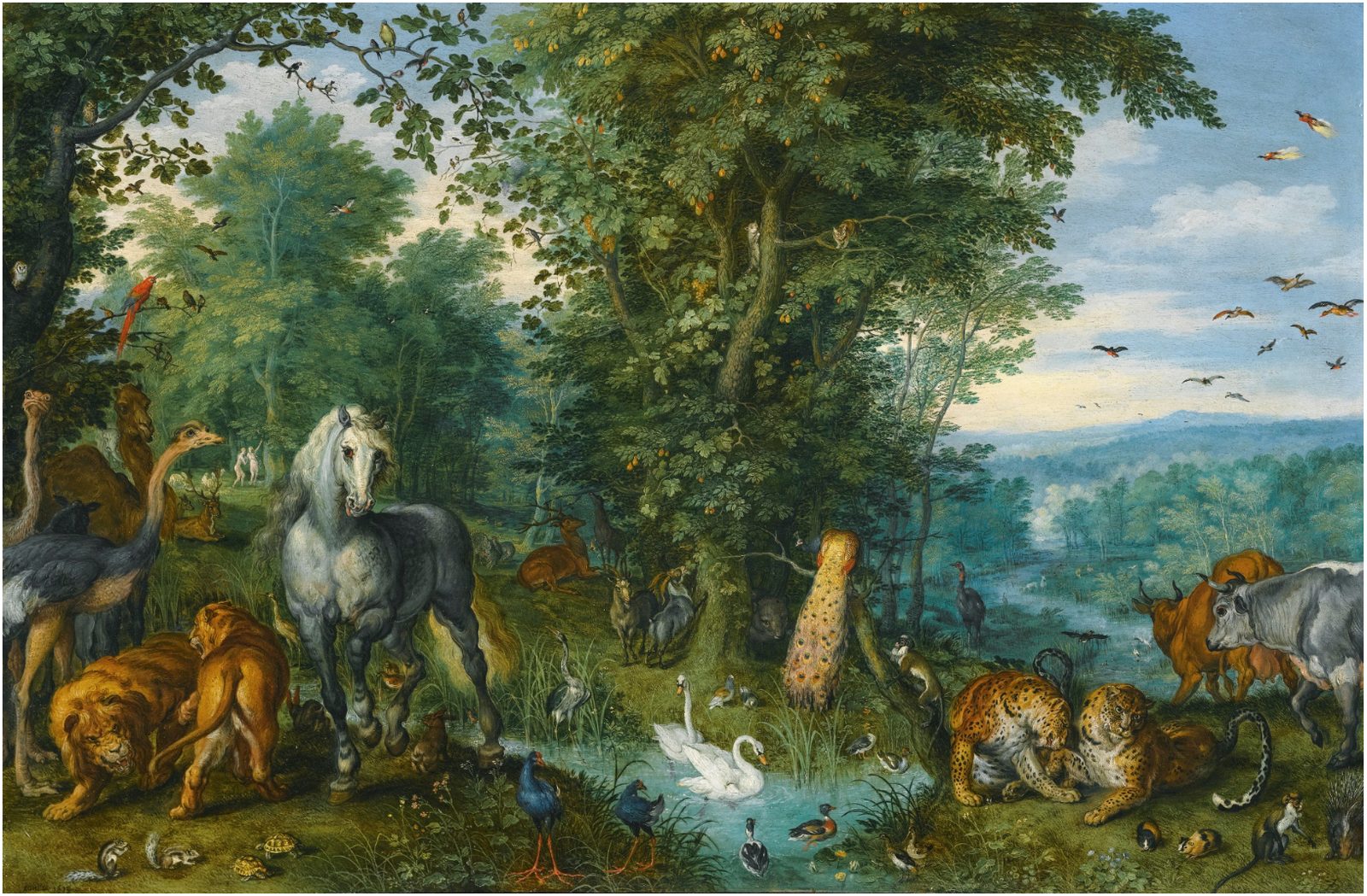
The painting
The Garden of Eden with the Fall of Man. Jan Brueghel the Elder, 1613. Wikimedia Commons. Public domain.