
Psalm 141
10 verses · Lament psalm
May my prayer be set before You like incense, my uplifted hands like the evening offering.
Introduction
David, the Evening Prayer, Book 5: The return and the great Hallelujah, Poetry, Psalms Overview.
David prays this at the close of a day, at the hour when Israel's evening offering went up, and he prays it far from the altar. He is a man with enemies close at hand, yet his first concern is his own speech and his own heart. Listen for the language of the sanctuary carried into a private prayer, and for the way he asks God to guard him from the inside before he asks to be guarded from others. It teaches a reader to pray for integrity while under pressure.
Context
- Who
- Israelites who marked the end of every day by a sacrifice and a rising of incense
- Where
- Evening, at the hour when the day's last offering went up at the sanctuary
- When
- The united monarchy under David. The heading reads A Psalm, by David, which places it in his reign, about 1010 to 970 BC
Historical context
The heading names David and no occasion. What the psalm does name is an hour, and that hour is the key to it. Exodus 30:7 and 8 appoint fragrant incense to be burned before the LORD every morning and again at twilight, so that smoke rose while the people prayed outside. The singer asks that his prayer be counted as the incense and his lifted hands as the evening offering. Incense had a fixed recipe and could not lawfully be made for private use, so asking for a prayer to be received like incense is asking for it to be treated as the real thing, offered at the right hour by the right hands. Sharing a meal in that culture carried loyalty with it, so at the wicked man's table the company is the point.
Significance
The first hearers offered sacrifices they could see. This song told them that a prayer spoken at the same hour, from a house miles away, rose in the same smoke. Before asking to be rescued from traps, the singer asks to be kept from becoming like the men who set them.
This chapter in Jewish lifeWhat this chapter is in Jewish life and reading.
What is done
Psalm 141 stands in the third Davidic collection, which the book's structure file gives as Psalms 108 to 110 and 138 to 145. Its second verse asks that prayer be set before God as incense and the lifting of hands as the evening offering, and that verse carries more rabbinic locators than any other in the chapter, eighteen of the thirty the corpus records, among them Berakhot 6b:28 and Jerusalem Talmud Berakhot 4:1:18. The corpus gives the locators without text, so this site names where the rabbis took the verse up and leaves what they made of it to the reader who follows them.
How it is read
Rashi reads the psalm as a prayer about speech. He takes the request for a guard on the mouth as a request made while praying, that the words be fit to be accepted, and glosses the door of the lips as the upper lip. On the fifth verse he reads the striking by a righteous man as the reproof of a true prophet, and says that all such blows and reproof are kindness. He then reads the second half of that verse against David's own anointing: the royal oil poured on his head should not turn him away "from the reproof of the righteous man, to go and eat bread with the workers of iniquity" (Rashi on Psalms 141:5:2, the Judaica Press complete Tanach with Rashi, translated by A. J. Rosenberg, CC-BY). On the sixth verse he reads the judges as leaders led astray by the evil inclination and a heart of stone, then names the rabbinic reading and declines it. The Sages in the Baraitha of Sifrei applied the verse to Moses and Aaron, and Rashi says he cannot reconcile the end of the verse with its beginning on that reading, offering instead a comparison of stubbornness. That is a case of a classical commentator setting aside a rabbinic reading on the plain sense, which is worth a Christian reader's notice. Radak, Ibn Ezra, Metzudat David and Malbim comment with no English version in the corpus and stand as citations: Radak on Psalms 141:1:1, Ibn Ezra on Psalms 141:2:1, Metzudat David on Psalms 141:1:1, Malbim on Psalms 141:1:1.
What the rabbis say
The corpus records thirty locators on this chapter, twenty-eight Midrash and two Talmud. The prayer set as incense is taken up at Bamidbar Rabbah 13:4 and 13:18, Midrash Tanchuma, Achrei Mot 9:1, Pirkei DeRabbi Eliezer 50:2, Sifrei Devarim 41:18, Midrash Tehillim 108:2, Berakhot 6b:28 and Jerusalem Talmud Berakhot 4:1:18. The guard on the mouth is taken up at Midrash Tehillim 39:3, and the request that the heart not incline to evil at Vayikra Rabbah 5:7 and Pesikta DeRav Kahana 21:3. The reproof of the righteous is taken up at Midrash Tehillim 18:23, and the sixth verse, which Rashi discusses, at Sifrei Devarim 26:3, Midrash Tannaim on Deuteronomy 3:23:2 and Vayikra Rabbah 31:4. Each is a locator without text in the corpus.
Sources: Rashi, Rashi on Psalms 141:3:1, 141:3:2, 141:5:1, 141:5:2, 141:6:1, 141:6:2 and 141:7:2, the Judaica Press complete Tanach with Rashi, translated by A. J. Rosenberg, CC-BY; Radak, Radak on Psalms 141:1:1, cited only, no English version in the corpus; Ibn Ezra, Ibn Ezra on Psalms 141:2:1, cited only; Metzudat David, Metzudat David on Psalms 141:1:1, cited only; Malbim, Malbim on Psalms 141:1:1, cited only; Sifrei, the Baraitha of Sifrei on Deuteronomy 3:23, as Rashi cites it; Sifrei Devarim 41:18 and 26:3; Midrash, Midrash Tehillim 141:1, 108:2, 39:3 and 18:23, Bamidbar Rabbah 13:4 and 13:18, Midrash Tanchuma, Achrei Mot 9:1, Pirkei DeRabbi Eliezer 50:2, Vayikra Rabbah 5:7 and 31:4, Pesikta DeRav Kahana 21:3, Midrash Tannaim on Deuteronomy 3:23:2; Babylonian Talmud, Berakhot 6b:28; Jerusalem Talmud, Berakhot 4:1:18; MannaFest, the collections of the Psalter, src/components/book/dossier-content/psalms-structure.ts, 2026.
Psalms 141:1-2
I call upon You, O LORD: I call upon You opens a prayer that asks to be received the way an offering is received. The incense and uplifted hands belong to the worship at the altar, and Henry notes David was shut out of that court. Spurgeon read the incense as something prepared with care.
Psalms 141:1
“O Lord, I have cried to you, hear me. Moses was standing with the people, and Pharaoh was pursuing behind his back, and on every side there was distress for him. At that time he wept to God, and immediately God said to him: 'Why do you cry out to me?' While he was praying in silence, he was heard; yet Scripture does not record that he spoke, but only that he wept. And the blood of the martyrs always cries out to the Lord, and it is heard.”
Jerome · written before 420 · Homily 51, on Psalm 140patristic
2 more voices on this verseWhat preachers and commentators have said about this verse, in their own words.
Psalms 141:1
“Lord, I cry unto thee. This is my last resort: prayer never fails me. My prayer is painful and feeble, and worthy only to be called a cry; but it is a cry unto Jehovah, and this ennobles it. I have cried unto thee, I still cry to thee, and I always mean to cry to thee. To whom else could I go? What else can I do? Others trust to themselves, but I cry unto thee. The weapon of all prayer is one which the believer may always carry with him, and use in every time of need.”
Charles Spurgeon · The Treasury of David, Vol. 7 (1885)Particular Baptist
Psalms 141:1
“His crying denotes fervency in prayer; he prayed as one in earnest. His crying to God denotes faith and fixedness in prayer. And what did he desire as the success of his prayer?”
Matthew Henry · Commentary on the Whole Bible (1707-1721)puritan
like the evening offering: Adam Clarke noted that the evening offering is the minchah, an offering with no blood shed, where zebach would have named a slaughtered animal. Albert Barnes read the verb set as to fix or make firm. At Revelation 5:8 the incense is the prayers of the saints.
Psalms 141:2
“Let my prayer be directed as incense in your sight. That is, let my prayer come straight to you, having no filth or faults or diabolical thoughts. Now incense is the prayers of the saints. And this we know from the Apocalypse, when the twenty-four elders held censers and said: 'These are the prayers of the saints.' The lifting up of my hands an evening sacrifice. The lifting up of the hands points to the Lord, and in the lifting up of the hands we behold the Creator.”
Jerome · written before 420 · Homily 51, on Psalm 140patristic
1 more voice on this verse
Psalms 141:2
“Let my prayer be set forth before thee as incense. As incense is carefully prepared, kindled with holy fire, and devoutly presented unto God, so let my prayer be. We are not to look upon prayer as easy work requiring no thought.”
Charles Spurgeon · The Treasury of David, Vol. 7 (1885)Particular Baptist
Psalms 141:3-4
Set a guard, O LORD: The prayer asks God to set a guard over the mouth, at the place words come out. The next verse carries the request to a heart that could be drawn toward evil and a table with delicacies of men who do iniquity. Speech, heart and appetite are guarded in turn.
Psalms 141:3
“Set a watch, O Lord, before my mouth. That mouth had been used in prayer, it would be a pity it should ever be defiled with untruth, or pride, or wrath; yet so it will become unless carefully watched, for these intruders are ever lurking about the door. David feels that with all his own watchfulness he may be surprised into sin, and so he begs the Lord himself to keep him. When Jehovah sets the watch the city is well guarded: when the Lord becomes the guard of our mouth the whole man is well garrisoned.”
Charles Spurgeon · The Treasury of David, Vol. 7 (1885)Particular Baptist
1 more voice on this verse
Psalms 141:3
“Set, O Lord, a guard to my mouth. 'Death and life are in the hands of the tongue.' And again: 'Amen I say to you, that for every idle word which you have spoken, you shall render an account on the day of judgment.' This therefore the prophet asks, that everything he speaks may not be idle, but holy and worthy of God. And set a door of enclosure to my lips. He asks for a door of enclosure like a wall around the whole house, so that he may be overcome in nothing.”
Jerome · written before 420 · Homily 51, on Psalm 140patristic
let me not feast on their delicacies: Albert Barnes set this request beside the Lord's Prayer and its plea to be kept from temptation. Adam Clarke read the delicacies as foods the Law forbade or feasts held in honor of idols. Matthew Henry chose a dinner of herbs far from temptation.
Psalms 141:4
“Let me eat not of their dainties - This may refer either to eating things forbidden by the law; or to the partaking in banquets or feasts in honor of idols.”
Adam Clarke · Commentary on the Bible (1810-1826)evangelical
1 more voice on this verse
Psalms 141:4
“Incline not my heart to words of malice, to make excuses for excuses in sins. O most wretched human race, who excuse our sins, saying, I was overcome by nature: when it is in our power both to sin and not to sin. We always excuse ourselves, and say: I did not want to sin, my flesh overcame me. That woman came to me, she sent for me, she touched me, she said that to me, she called me; and instead of doing penance and saying, Lord, I have sinned, we make excuses and join sins to sins.”
Jerome · written before 420 · Homily 51, on Psalm 140patristic
Let the righteous man strike me: asks for correction, and the rebuke is called chesed, covenant loyalty. The oil is poured on the head of the man corrected, and the verse asks that he not refuse it. Henry took such a reproof as a piece of friendship.
Psalms 141:5
“Let the righteous smite me; it shall be a kindness. He prefers the bitters of gracious company to the dainties of the ungodly. He would rather be smitten by the righteous than feasted by the wicked. He gives a permit to faithful admonition, he even invites it—"let the righteous smite me." When the ungodly smile upon us their flattery is cruel; when the righteous smite us their faithfulness is kind.”
Charles Spurgeon · The Treasury of David, Vol. 7 (1885)Particular Baptist
3 more voices on this verse
Psalms 141:5
“Break - Not hurt, but heal and greatly refresh me. Calamities - In the calamities of those righteous persons who reproved him. When they came into such calamities as those wherein he was involved he would pity them and pray for them.”
John Wesley · Explanatory Notes upon the Old Testament (1765)evangelical
Psalms 141:5
“When a person is advanced in years, you must not be too ready to believe evil of him; his past life is itself a defense, and so also is his rank as an elder. Still, since we are but human and sometimes in spite of the ripeness of our years fall into the sins of youth, if I do wrong and you wish to correct me, accuse me openly of my fault: do not backbite me secretly.”
Jerome · written before 420 · LETTER 125.19patristic
Psalms 141:5
“We are here taught how to receive the reproofs of the righteous and wise. We must desire to be reproved for whatever is amiss in us, or is done amiss by us: "Lord, put it into the heart of the righteous to smite me and reprove me. If my own heart does not smite me, as it ought, let my friend do it; let me never fall under that dreadful judgment of being let alone in sin." 2.”
Matthew Henry · Commentary on the Whole Bible (1707-1721)puritan
Psalms 141:6-7
When their rulers are thrown down: is the turn that wins these words a hearing. Verse 7 puts plowing in the picture, the Hebrew palach for the plow and baqa for breaking the soil open. The scattered bones lie at the mouth of Sheol.
Psalms 141:6
“This is a verse of which the meaning seems far to seek. Does it refer to the righteous among the Israelites? We think so. David surely means that when their leaders fell never to rise again, they would then turn to him and take delight in listening to his voice. When their judges are overthrown in stony places, they shall hear my words; for they are sweet. And so they did: the death of Saul made all the best of the nation look to the son of Jesse as the Lord's anointed; his words became sweet to them.”
Charles Spurgeon · The Treasury of David, Vol. 7 (1885)Particular Baptist
2 more voices on this verse
Psalms 141:6
“Those that make the greatest figure in this world do not always meet with level smooth ways through it. And those that slighted the word of God before will relish it, and be glad of it, when they are in affliction, for that opens the ear to instruction. When the world is bitter the word is sweet.”
Matthew Henry · Commentary on the Whole Bible (1707-1721)puritan
Psalms 141:6
“When their judges are overthrown in stony places,.... The judges of David's adversaries, the workers of iniquity; meaning Saul, Abner, &c. Arama refers this to Saul and his sons being slain on the mountains of Gilboa, 1Sa 31:1; which might be here prophetically spoken of.”
our bones have been scattered: The plural pronoun makes the scattered bones a company, and Charles Spurgeon saw the godly party broken up by Saul, with no order or head. John Gill thought of the eighty-five priests of Nob whom Saul had killed in 1 Samuel 22. Verse 8 turns from those bones to God.
Psalms 141:7
“David's case seemed hopeless: the cause of God in Israel was as a dead thing, even as a skeleton broken, and rotten, and shovelled out of the grave, to return as dust to its dust. Our bones are scattered at the grave's mouth. There seemed to be no life, no cohesion, no form, order, or headship among the godly party in Israel: Saul had demolished it, and scattered all its parts, so that it did not exist as an organized whole.”
Charles Spurgeon · The Treasury of David, Vol. 7 (1885)Particular Baptist
1 more voice on this verse
Psalms 141:7
“As the thickness of the earth. Everything thick is near to the earth: and the soul that sins clings to the earth. For the Lord from the beginning made all things thin. By his own fault, therefore, each one is made thick, and is drawn down to the earth. Let us give an example. As a wound in the body, swelling, is thick, and is full of pus, when the physician comes he cuts it, and heals it and makes it thin, then it is brought back to its own nature, as it was also created.”
Jerome · written before 420 · Homily 51, on Psalm 140patristic
Psalms 141:8-10
But my eyes are fixed on You: turns the prayer from the traps to the one who can keep a man out of them. Spurgeon read those eyes as seeing nothing to fear. The request asks that the nets the wicked laid take the wicked, while the psalmist walks past.
Psalms 141:8
“But mine eyes are unto thee, O God the Lord. He looked upward and kept his eyes fixed there. He regarded duty more than circumstances; he considered the promise rather than the external providence; and he expected from God rather than from men. He did not shut his eyes in indifference or despair, neither did he turn them to the creature in vain confidence, but he gave his eyes to his God, and saw nothing to fear. Jehovah his Lord is also his hope. Thomas called Jesus Lord and God, and David here speaks of his God and Lord.”
Charles Spurgeon · The Treasury of David, Vol. 7 (1885)Particular Baptist
Keep me from the snares: Verse 3 asked God to guard the lips, and Charles Spurgeon saw the prayer grow here to the whole man. He found David more troubled by hidden plots than open battle. Augustine told the two dangers apart, the trap set by persecutors and the stumbling of those who fell away.
Psalms 141:9
“Keep me from, the snares which they have laid for me. He had before asked, in Ps 141:3, that the door of his mouth might be kept; but his prayer now grows into "Keep me." He seems more in trouble about covert temptation than concerning open attacks. Brave men do not dread battle, but they hate secret plots. We cannot endure to be entrapped like unsuspecting animals; therefore we cry to the God of wisdom for protection. And the gins of the workers of iniquity. These evil workers sought to catch David in his speech or acts.”
Charles Spurgeon · The Treasury of David, Vol. 7 (1885)Particular Baptist
1 more voice on this verse
Psalms 141:9
“Keep me from the snare which they have set for me. Always either heretics or demons stretch snares for us. For faults are near to virtues. They have set a snare for me in almsgiving, if I stretch out my hand so that men may see, and, as though doing a good deed, I come into a fault and into sin. But if I give a tunic to a brother so that another may see, they have set a snare for me. Always nets are stretched for stags and snares are set, where the hunter has caught their tracks.”
Jerome · written before 420 · Homily 51, on Psalm 140patristic
while I pass by in safety: Albert Barnes noted that the Hebrew joins the two events in one moment: the net closes on the wicked as the psalmist passes over it. Charles Spurgeon called the request a just one. Matthew Henry saw the trapping of the wicked prove at times the escape of the righteous.
Psalms 141:10
“Let the wicked fall into their own nets, whilst that I withal escape. It may not be a Christian prayer, but it is a very just one, and it takes a great deal of grace to refrain from crying Amen to it; in fact, grace does not work towards making us wish otherwise concerning the enemies of holy men. Do we not all wish the innocent to be delivered, and the guilty to reap the result of their own malice? Of course we do, if we are just men.”
Charles Spurgeon · The Treasury of David, Vol. 7 (1885)Particular Baptist
2 more voices on this verse
Psalms 141:10
“The sinners shall fall into his net. Above he said, Keep me from the snare which they have set for me, concerning many; but now concerning one, The sinners shall fall into his net. Just as the Lord casts a net, and catches a multitude of fish, and has the apostles as fishermen gathering and bringing to him, that is, those who believe through them: so also the devil has demons, who are subject to him, who both deceive men and bring them to him.”
Jerome · written before 420 · Homily 51, on Psalm 140patristic
Psalms 141:10
“All that are bound over to God's justice are held in the cords of their own iniquity. But let me at the same time obtain a discharge. The entangling and ensnaring of the wicked sometimes prove the escape and enlargement of the righteous.”
Matthew Henry · Commentary on the Whole Bible (1707-1721)puritan
How this psalm is built
The form: An evening prayer whose second verse alludes directly to the legal ceremonies of the sanctuary, as Calvin classes it.
The patterns in this chapter
| Device | What it does | Where to see it |
|---|---|---|
| The prayer as incense, the hands as the offering | Verse 2 is one request in two halves, each matching a part of the sanctuary's evening service. Spurgeon reads the first half by the way incense was made, carefully prepared, kindled with holy fire and devoutly presented. Barnes notes that the word rendered set forth means to fit, to establish, to make firm, so the prayer is asked to be aimed rather than merely uttered.Charles Spurgeon, The Treasury of David, Vol. 7, 1885, on Psalm 141:2. | Psalm 141:2 |
| A guard at the mouth and a watch at the door | Verse 3 says the same thing twice with two pictures from a city's defence, a sentry posted and a doorkeeper set. Matthew Henry reads it as the reason a bridle is not enough, since we must pray to God to keep the mouth and not only resolve to keep it ourselves. Clarke adds the situation, a man watched by spies who has to be doubly guarded.Matthew Henry, Commentary on the Whole Bible, 1710, on Psalm 141:3. | Psalm 141:3 |
| The delicacies and the oil | Verse 4 refuses to feast on the delicacies of wicked men and verse 5 accepts a rebuke from a righteous man as oil for the head. The two verses set a good meal against a hard word and prefer the hard word. Spurgeon puts it directly, that the singer prefers the bitters of gracious company to the dainties of the ungodly.Charles Spurgeon, The Treasury of David, Vol. 7, 1885, on Psalm 141:5. | Psalm 141:4, Psalm 141:5 |
| Their nets and his passage | The psalm opens with a cry for God to come quickly. It closes at verses 9 and 10 with the snares and lures of the same enemies, asking that they fall into their own nets while the singer passes by in safety. The request at the end is the request at the beginning with the danger named.John Gill, Exposition of the Old Testament, 1748 to 1763, on Psalm 141:9. | Psalm 141:1, Psalm 141:9, Psalm 141:10 |
The structure
8 more paragraphs on the patterns
Verse 2 is one request in two halves, each matching a part of the evening service, the prayer as incense and the lifted hands as the offering. Verse 3 says one thing twice with two pictures from a city's defence, a sentry posted at the mouth and a doorkeeper set at the lips. Verses 4 and 5 set a wicked man's delicacies against a righteous man's rebuke and prefer the rebuke. The psalm opens with a cry for God to come quickly and closes on the nets of the same enemies. The request at the end is the request at the beginning with the danger named.
The prophecy and the New Testament's use
No New Testament writer quotes Psalm 141, and its picture is what the New Testament takes up. Revelation 5:8 says the golden bowls of incense held before the Lamb are the prayers of the saints. Revelation 8:3 puts much incense on the golden altar along with the prayers of all the saints. The psalm asks for one prayer what those passages say of all of them.
The debate
Verses 5 to 7 are contested at the level of the text itself as well as of its meaning. Spurgeon says plainly that the passage is very difficult in the original and that its sense is hard to fix with absolute certainty.
On verse 6 he takes the rulers thrown down as the leaders of the singer's adversaries, after whose fall the people will listen. Gill reports the Jewish reading that takes them as Saul and his house, and Arama refers the line to Saul and his sons. Verse 7, with bones scattered at the mouth of Sheol, is read by Spurgeon as the cause of God in Israel lying like a broken skeleton. A student should know that the obscurity is in the Hebrew rather than in the translation.
Where it sits
Psalm 140 asks to be kept from the snares of violent men. Psalm 141 asks first to be kept from becoming like them. Psalm 142 is the same man with nowhere left to go. The middle psalm of the three is the only one that treats the singer's own mouth as the first danger.
Keep studying
Studies2
Words9
Sources for this chapter
The summary
Jamieson, Fausset & Brown, Commentary Critical and Explanatory; John Calvin, Commentaries; John Wesley, Notes on the Old Testament and Matthew Henry, Complete Commentary.
The form and classifications
Adam Clarke, Commentary on the Bible, 1832, on Psalm 141:1; Charles Spurgeon, The Treasury of David, Vol. 7, 1885, on Psalm 141:1 and John Calvin, Commentaries, 1554, on Psalm 141:1.
The exposition
Adam Clarke, Commentary on the Bible; Albert Barnes; Augustine of Hippo, Exposition on Psalm 141; Charles Spurgeon, The Treasury of David; Franz Delitzsch, Biblical Commentary on the Psalms; John Gill, Exposition of the Old Testament and Matthew Henry, Commentary on the Whole Bible.
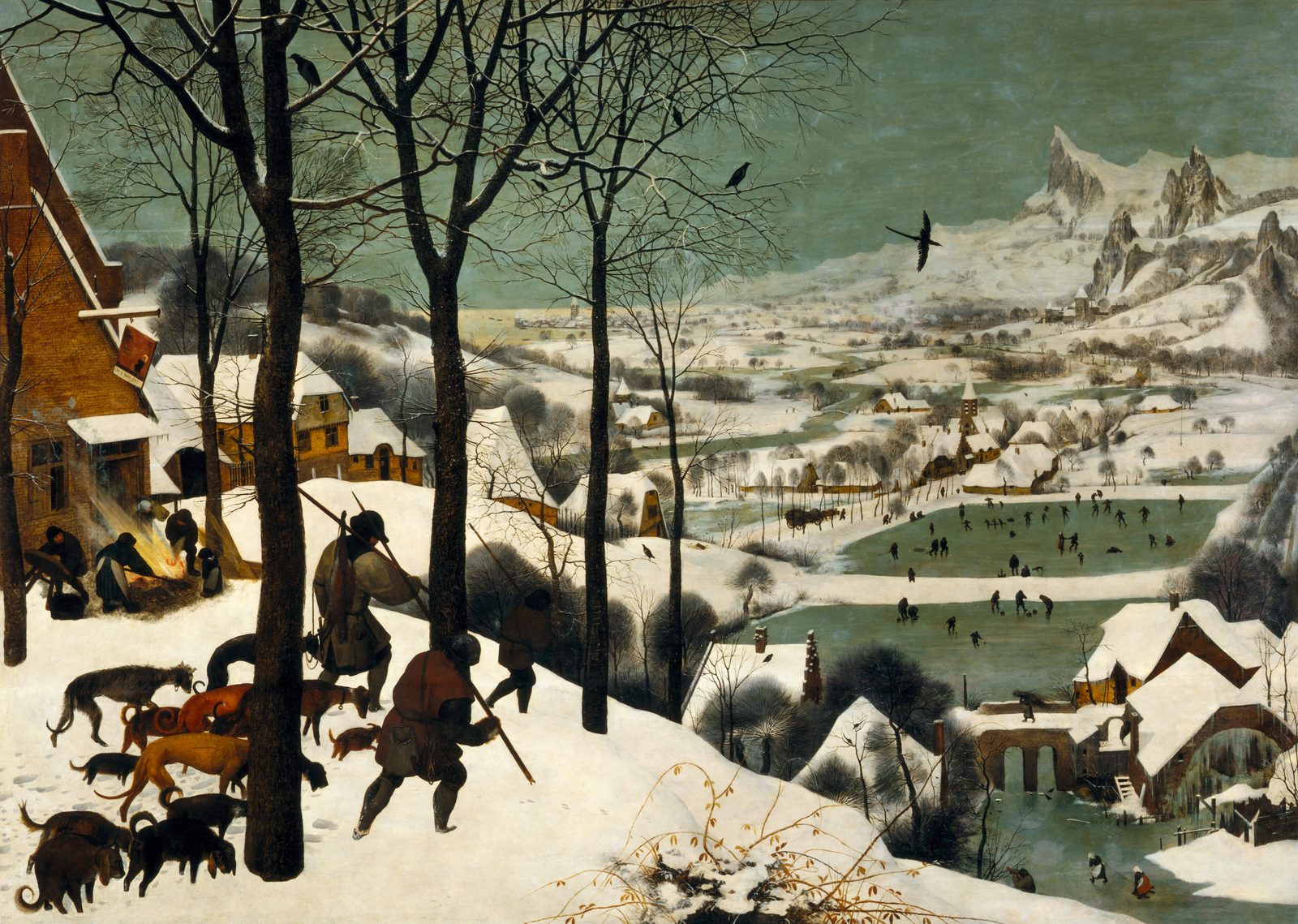
The painting
The Hunters in the Snow. Pieter Brueghel the Elder, 1565. Wikimedia Commons. Public domain.