
Psalm 12
8 verses · Community lament
The words of the LORD are flawless, like silver refined in a furnace, like gold purified sevenfold.
Introduction
David, the Pure Words, Book 1: The book of David, Poetry, Psalms Overview.
David wrote this prayer in a season when honest speech seemed to have gone out of the land. Its subject is words, flattery and boasting and double dealing on one side and the promises of God on the other. The psalm opens as a cry for help and turns at its centre, where God Himself answers in the first person. Listen for that one line of divine speech, and for the picture from the silversmith's furnace that follows it. The psalm closes with the trouble still in view and its confidence placed in the word that lasts.
Context
- Who
- Israelites doing business in a marketplace full of flattery and double talk
- What
- A prayer for help against lying speech, answered at its centre by a word from the LORD.
- Where
- The towns of Judah, where deals and verdicts were settled by a spoken word at the gate.
- When
- The reign of David, about 1010 to 970 BC by the superscription.
- Why
- To set the flawless words of the LORD against the speech of men when honest people seem to have disappeared.
Historical context
The centre of the psalm is a refiner's shop. Silver was purified by heating the ore in a crucible or a clay furnace with air driven in by bellows, so that the lead and the dross came off, and the workman ran the cycle again until the surface stood bright and still. Purified sevenfold is the workman's way of saying that silver is all that is left, and the psalm compares the words of the LORD to that. The double heart of verse 2 reads in the Hebrew as a heart and a heart, which is a man keeping two sets of books. Most transactions were closed by a spoken word before witnesses at the gate, so a man with two hearts broke the only machinery the community had. The boast of verse 4 belongs to people who have found that speech is free and that consequences come slowly.
Significance
The opening cry gave Israel language for feeling outnumbered, and the psalm lets the feeling stand. What it does with it is set two kinds of speech side by side, the puffed talk of men and words refined in a furnace sevenfold, and tell the singer which of them will still be standing when vileness is exalted among men.
This chapter in Jewish lifeWhat this chapter is in Jewish life and reading.
How it is read
Rashi is the only commentator the corpus carries with an English text on this chapter, and he reads it from inside the years David spent hiding. He is quoted here from the Judaica Press Tanach with Rashi. The heading names the same eight-stringed harp as the sixth psalm (Rashi on Psalms 12:1:1). The failure of the faithful in the second verse he makes concrete, and puts the betrayal in the mouths of the men of Ziph who told Saul where David was (Rashi on Psalms 12:2:3). The double heart of the third verse he explains by the Hebrew itself, which says a heart and a heart. Such men "feign friendliness, but there is hatred hidden in their heart" (Rashi on Psalms 12:3:1).
At the sixth verse Rashi names who the plundered poor are. They are David, his men, and the priests of Nob who were killed for helping him (Rashi on Psalms 12:6:1). The promise of the seventh verse he reads as a statement about who can keep a word. God's sayings are pure "for He has the ability to fulfill them", while the sayings of men fail when the men die (Rashi on Psalms 12:7:1). He then makes it personal to David, since God "promised me salvation and the throne" (Rashi on Psalms 12:7:2). Ibn Ezra, Radak and Metzudat David all comment on this chapter, and the corpus carries their refs without English text. They stand here cited and unquoted at Ibn Ezra on Psalms 12:1:1, 12:3:1, 12:4:1, 12:5:1 and 12:8:1, at Radak on Psalms 12:1:1, 12:3:1, 12:4:1 and 12:5:1, and at Metzudat David on Psalms 12:4:1.
The last verse is hard in Hebrew, and Rashi's note on it is worth a Christian reader's attention. He reads the difficult phrase as the elevation of a man his neighbours thought base. The envy of the wicked is envy of David's rise, "that I was taken from behind the sheep to be a king". Then he sets the verse beside another line of the Psalter, "the stone that the builders rejected became a cornerstone" (Rashi on Psalms 12:9:2). That line is the one the New Testament applies to Jesus, at Matthew 21:42 and at Acts 4:11. Rashi is reading a pattern rather than a prophecy, in which the rejected man is the one God raises. Rashi also reports that the Midrash Aggadah applies the verse to Israel in the future, and that Menachem read it of a wild ox devouring men. Three readings stand in one note, and Rashi leaves all three on the page.
What the rabbis say
The corpus carries forty locators on this psalm and the text of none, so each is cited and linked here rather than quoted. Eleven are Talmudic, and one tractate carries six of them. Arakhin stands at 13b:11 on the heading, at 15b:17, 15b:18 and 15b:20 on the fourth verse, and at 15b:6 on the fifth. Berakhot stands at 6b:18 and 6b:21 on the ninth verse. The Jerusalem Talmud stands at Berakhot 9:5:21 on the heading, Sotah 9:13:1 on the second verse, and Peah 1:1:40 on the fifth. One more stands at Niddah 65a:9 later in the chapter.
Ein Yaakov carries ten, more than any other midrashic work here. In the Glick Edition they are Sotah 9:11 on the second verse, Sanhedrin 1:9 on the sixth, and Berakhot 1:25 and 1:26 on the ninth. Beside them stand Arakhin 2:9 and Menakhot 4:3 on the heading, Sotah 9:10 on the second verse, Arakhin 3:4 on the fourth, Sanhedrin 1:11 on the sixth, and Berakhot 1:36 on the ninth.
Bamidbar Rabbah carries four, at 19:2 on the sixth verse and at 13:16, 13:20 and 14:12 on the seventh. Bereshit Rabbati carries four more, on Toldot 17 and Vayera 25 at the heading, and on Bereshit 4 and Vayishlach 30 at the seventh verse. On the second and fourth verses the corpus carries Devarim Rabbah 11:10 and 6:14, with Midrash Aggadah on Numbers 13:14:1. On the fifth it carries Kohelet Rabbah 9:12:1, Midrash Lekach Tov on Leviticus 14:2:3 and Midrash Tanchuma Buber, Metzora 5:1. Four more stand at Bereshit Rabbah 75:1 and Midrash Mishlei 13:3 on the sixth verse, and Midrash Tehillim 7:8 with Vayikra Rabbah 26:2 on the eighth, with Pesikta Rabbati 14:1 later in the chapter. What each of them teaches is a saying of the rabbis, and is reported as theirs wherever this site quotes one. The quotations wait on a fetch that carries the text.
Sources: Rashi, Rashi on Psalms 12:1:1 to 12:9:2, the Judaica Press complete Tanach with Rashi, translated by A. J. Rosenberg; Ibn Ezra, Ibn Ezra on Psalms 12:1:1, 12:3:1, 12:4:1, 12:5:1 and 12:8:1, cited by ref because the corpus carries no English text; Radak, Radak on Psalms 12:1:1, 12:3:1, 12:4:1 and 12:5:1, cited by ref because the corpus carries no English text; Metzudat David, Metzudat David on Psalms 12:4:1, cited by ref because the corpus carries no English text; The Sefaria corpus, scripts/data/sources/sefaria/psalms/12.json, the 11 Talmud and 29 Midrash locators of this chapter.
Psalms 12:1-2
Help, O LORD: opens the psalm, and the trouble named is a shortage of honest men, the godly gone and the faithful vanished. Verse 2 names the corruption, flattering lips and a double heart, which Matthew Henry called the devil's image complete, malice and falsehood together.
Psalms 12:1
“The merciful man hath failed. Some think that this is a complaint that the righteous had been unjustly put to death; as if the Psalmist had said, Saul has cruelly cut off all who observed justice and faithfulness. But I would understand the words in a simpler sense, as meaning that there is no longer any beneficence or truth remaining among men.”
John Calvin · Commentaries (1554)reformed
2 more voices on this verseWhat preachers and commentators have said about this verse, in their own words.
Psalms 12:1
“THIS was a prayer of David. It was offered under peculiar circumstances. He had been treacherously betrayed again and again. He delivered the city of Keilah from the Philistines and then had to flee from the place, or the men of Keilah would have delivered him up to his enemy, Saul. He went to the wilderness of Ziph and the men of Ziph at once ran to Saul to betray him. Doeg was present when David received some help from Ahimelech the priest and he set off straightway to inform the king.”
Charles Spurgeon · written before 1892 · The Metropolitan Tabernacle Pulpit, Sermon No. 3097: “A Suitable Watchword” (lightly modernized text, CCEL edition)Particular Baptist
Psalms 12:1
“There is no righteous one left anywhere, he said, who can become the author of my deliverance. Truly I lack a Savior, and since there is none, you yourself, Lord, be my Savior.”
Eusebius of Caesarea · written before 339 · Commentary on Psalms 12:2-3patristic
they speak with flattering lips: The double heart is in Hebrew a heart and a heart, as Calvin and Augustine both noted. Spurgeon heard in the flattering lips an old Scottish proverb, praise given to men to get praise back. Each lie to another is returned in kind.
Psalms 12:2
“Regard for truth is in danger of being snuffed out, with everyone, you might say, suffering from distrust in one another.… They pretend friendship and perform the actions of enemies.… Some use their lips to direct falsehood into their neighbor's heart; others return the compliment.”
Theodoret of Cyrus · written before 458 · Commentary on the Psalms 12:2patristic
3 more voices on this verse
Psalms 12:2
"They speak vanity every one with his neighbour." They utter that which is vain to hear, because of its frivolous, foolish, want of worth; vain to believe, because it was false and lying; vain to trust to, since it was deceitful and flattering; vain to regard, for it lifted up the hearer, filling him with proud conceit of himself. It is a sad thing when it is the fashion to talk vanity. "Ca'me, and I'll ca'thee." is the old Scotch proverb; give me a high sounding character, and I will give you one.
Charles Spurgeon · The Treasury of David, Vol. 1 (1869)Particular Baptist
Psalms 12:2
“Our speech, therefore, must be sincere in order that it may be as it were a mirror, in which the uprightness of our heart may be beheld. __________________________________________________________________ Calvin's words literally rendered are, with a heart and a heart, and this is a very literal translation of the Hebrew words vlv vlv, be-leb va-leb.”
John Calvin · Commentaries (1554)reformed
Psalms 12:2
“This is the devil's image complete, a complication of malice and falsehood. The times are bad indeed when there is no such thing as sincerity to be met with, when an honest man knows not whom to believe nor whom to trust, nor dares put confidence in a friend, in a guide, Mic. vii.”
Matthew Henry · Commentary on the Whole Bible (1707-1721)puritan
Psalms 12:3-4
cut off all flattering lips: Verse 3 asks the LORD to cut off the flattering lips of verse 2 and every boastful tongue with them. Verse 4 gives their boast, that their tongues will prevail and no one is their master. Spurgeon reads it as the tongue made its own sovereign.
Psalms 12:3
Total destruction shall overwhelm the lovers of flattery and pride, but meanwhile how they hector and fume! Well did the apostle call them "raging waves of the sea, foaming out their own shame." Free-thinkers are generally very free-talkers, and they are never more at ease than when railing at God's dominion, and arrogating to themselves unbounded license. Strange is it that the easy yoke of the Lord should so gall the shoulders of the proud, while the iron bands of Satan they bind about themselves as chains of honour: they boastfully cry unto God, "Who is lord over us?"
Charles Spurgeon · The Treasury of David, Vol. 1 (1869)Particular Baptist
1 more voice on this verse
Psalms 12:3
“When the Lord wipes out those things that are base, he will destroy those very things, so that when those things that have come on a person unexpectedly have been destroyed, the foremost creation of God whom the baser things had overtaken may take up the higher things.”
Origen of Alexandria · written before 253 · Selections from the Psalms 12:4patristic
Barnes took the boast as a rule these men lived by, the tongue being the power by which they meant to prevail. Henry asked who made the mouth and the lips they claim to own. The LORD is the Master they deny.
Psalms 12:4
“With mouths agape they heedlessly utter whatever occurs to them, scornful of divine long-suffering and giving no thought to their falling under the lordship of God.”
Theodoret of Cyrus · written before 458 · Commentary on the Psalms 12:3patristic
The LORD Himself speaks here, the one place in the psalm where He does, and Barnes reads the verse as the psalm's center. He will arise for the oppressed and the needy, and the safety He promises goes to the man who yearns for it.
Psalms 12:5
“In due season the Lord will hear his elect ones, who cry day and night unto him, and though he bear long with their oppressors, yet will he avenge them speedily. Observe that the mere oppression of saints, however silently they bear it, is in itself a cry to God: Moses was heard at the Red Sea, though he said nothing; and Hagar's affliction was heard despite her silence. Jesus feels with his people, and their smarts are mighty orators with him. By-and-by, however, they begin to sigh and express their misery, and then relief comes post-haste.”
Charles Spurgeon · The Treasury of David, Vol. 1 (1869)Particular Baptist
Psalms 12:6-8
words of the LORD are flawless: The words of the LORD are flawless, tried like silver in a furnace and purified like gold sevenfold. Gill set them against the flattering lips of verse 2. Verse 8 ends the psalm with the wicked walking free and vileness exalted among men.
Psalms 12:6
“What a contrast between the vain words of man, and the pure words of Jehovah. Man's words are yea and nay, but the Lord's promises are yea and amen. For truth, certainty, holiness, faithfulness, the words of the Lord are pure as well-refined silver.”
Charles Spurgeon · The Treasury of David, Vol. 1 (1869)Particular Baptist
1 more voice on this verse
Psalms 12:6
“The words of the Lord are pure words,.... This observation the psalmist makes in reference to what is just now said in Psa 12:5,, and in opposition to the words of wicked men in Psa 12:2; which are deceitful, sinful, and impure. The Scriptures are the words of God; and they are pure and holy, free from all human mixtures, and from all fraud and deceit; they are the Scriptures of truth.”
You will forever guard us: Barnes read a text that says them, and took it for the oppressed and needy of verse 5, kept and guarded by the LORD. Augustine's text has the first person, as the Berean does. Barnes took this generation for the whole race of flatterers.
Psalms 12:7
“In the worst of times God has his remnant, and in every age will reserve to himself a holy seed and preserve that to his heavenly kingdom. In singing this psalm, and praying it over, we must bewail the general corruption of manners, thank God that things are not worse than they are, but pray and hope that they will be better in God's due time.”
Matthew Henry · Commentary on the Whole Bible (1707-1721)puritan
The wicked wander freely: The psalm ends where verse 1 began, among men with the godly vanished, and Spurgeon called it a return to the fount of bitterness. When vileness is exalted in those who rule, he wrote, the men under them are no better. Augustine's text has the wicked wander in a circle.
Psalms 12:8
“Bad men are base men, the vilest of men, and they are so though they are ever so highly exalted in this world. Antiochus the illustrious the scripture calls a vile person, Dan. xi. But it is bad with a kingdom when such are preferred; no marvel if wickedness then grows impudent and insolent.”
Matthew Henry · Commentary on the Whole Bible (1707-1721)puritan
1 more voice on this verse
Psalms 12:8
“Here we return to the fount of bitterness, which first made the psalmist run to the wells of salvation, namely, the prevalence of wickedness. When those in power are vile, their underlings will be no better. As a warm sun brings out noxious flies, so does a sinner in honour foster vice everywhere. Our turf would not so swarm with abominables if those who are styled honourables did not give their countenance to the craft.”
Charles Spurgeon · The Treasury of David, Vol. 1 (1869)Particular Baptist
How this psalm is built
The form: A lament over the failure of honest speech, answered in the middle by the LORD's own word, as Psalter classes it.
The patterns in this chapter
| Device | What it does | Where to see it |
|---|---|---|
| The generation named by its mouth | Verses 2 to 4 take the organs of speech one at a time, lying to one another, flattering lips, a double heart, a boastful tongue, and a claim of ownership over the lips themselves. Matthew Henry calls the pairing of verse 2 the devil's image complete, malice and falsehood together, and marks the state of a time in which an honest man knows neither whom to believe nor whom to trust. John Calvin sets the standard the verse falls short of, that speech should be sincere so that it serves as a mirror in which the uprightness of the heart may be seen.Matthew Henry, Commentary on the Whole Bible, 1710, on Psalm 12:2. | Psalm 12:2, Psalm 12:3, Psalm 12:4 |
| The LORD speaking once, in the middle | Verse 5 is the one place in the psalm where the LORD Himself speaks, and it answers the prayer of verse 1 in His own voice, I will now arise, for the cause of the oppressed and the groaning of the needy. This site's published exposition note on the verse reads it as the centre of the psalm and cites Albert Barnes for the reading. Cassiodorus takes I will arise as a figure, since the One who never lies down out of weakness rises in the sense of appearing and being made manifest in the Son. Matthew Henry reads the safety promised as restoration rather than protection alone.Cassiodorus, Explanation of the Psalms 12:6, 585. | Psalm 12:5 |
| Two metals against two lips | Verse 6 says one thing twice, silver refined in a furnace and gold purified sevenfold, and the doubling is aimed at verse 2. John Gill sets the words of the LORD directly against the deceitful words of wicked men earlier in the psalm. Charles Spurgeon draws the same contrast and holds that for truth, certainty, holiness and faithfulness the words of the LORD are pure as well refined silver. Eusebius of Caesarea presses the refining itself, silver drawn through the flame again and again until nothing false or foreign is left in it.John Gill, Exposition of the Old Testament, 1748 to 1763, on Psalm 12:6. | Psalm 12:2, Psalm 12:6 |
| The same streets at the beginning and at the end | The psalm opens on a generation where the godly are no more and the faithful have vanished from among men, and it closes on the wicked wandering freely with vileness exalted among men. Charles Spurgeon marks the return and calls it the fount of bitterness that first sent the psalmist running to the wells of salvation. Nothing in the streets has changed between verse 1 and verse 8, and what stands between them is the word of verse 5 and the promise of verse 7.Charles Spurgeon, The Treasury of David, Vol. 1, 1869, on Psalm 12:8. | Psalm 12:1, Psalm 12:8 |
What is debated
6 more paragraphs on the patterns
The first question is what verse 7 says and to whom. Adam Clarke records a divided text, several manuscripts reading them where the Septuagint, the Vulgate and the Arabic read us, and he holds the sense equally good in both. The Berean text follows the second reading, You, O LORD, will keep us.
The second question is what the keeping covers. Matthew Henry reads it of a remnant, that in the worst of times God has His own and in every age reserves to Himself a holy seed and preserves it to His heavenly kingdom. Adam Clarke reads it of a nation in history, since God brought Israel out of Babylon according to His word, separated them from that generation and has preserved them from generation to generation since. Augustine of Hippo reads the keeping as reaching past this life, needy and poor here and wealthy and rich there. Theodoret of Cyrus holds both ends at once, escape from the wiles of the present generation and everlasting salvation after it. Diodorus of Tarsus keeps the promise in the present trouble, that the besieged are rendered superior by God's help. The positions divide over the span of the promise rather than over its terms.
The words of the LORD
Verse 6 is the psalm's most quoted line and it needs stating at its own weight. What the verse says is that the words of the LORD are flawless, and it says so with two pictures from the refiner's fire, silver in a furnace and gold purified sevenfold. What the commentators do with it is wider than the verse alone. Origen of Alexandria reads the words of the Lord as the only ones with no lie mixed into them, true as silver purged and proven in the furnace, so that nothing declared in them is ever to be doubted. John Gill takes the verse as a statement about the Scriptures, set against the words of wicked men in verse 2. Charles Spurgeon preached the verse under the title The Bible Tried and Proved and found his consolation in it when the faithful were failing around him. The verse itself speaks of the words the LORD had just spoken at verse 5, and the application to the whole of Scripture is the commentators' reading of it, offered here at that weight.
The occasion the commentators look for
The psalm names no event. Charles Spurgeon offers one and names the circumstances, that David had been treacherously betrayed again and again, and that after he delivered the city of Keilah from the Philistines he had to flee the place or be handed over by the men he had rescued. The account is Spurgeon's reading of the psalm against 1 Samuel 23 rather than a statement of the psalm's heading, which carries no such note. John Calvin records that some read verse 1 as a complaint that the righteous had been put to death unjustly, with Saul cutting off those who kept justice and faithfulness, and Calvin prefers a simpler sense of the words.
Keep studying
Sources for this chapter
The summary
Jamieson, Fausset & Brown, Commentary Critical and Explanatory; John Calvin, Commentaries; John Wesley, Notes on the Old Testament and Matthew Henry, Complete Commentary.
The form and classifications
Charles Spurgeon and This site's published structure of the Psalter, src/components/book/dossier-content/psalms-structure.ts, the kinds of psalm table.
The exposition
Albert Barnes; Augustine of Hippo, Exposition on Psalm 12; Charles Spurgeon, The Treasury of David; Franz Delitzsch, Biblical Commentary on the Psalms; John Calvin, Commentaries; John Gill, Exposition of the Old Testament and Matthew Henry, Commentary on the Whole Bible.
The painting
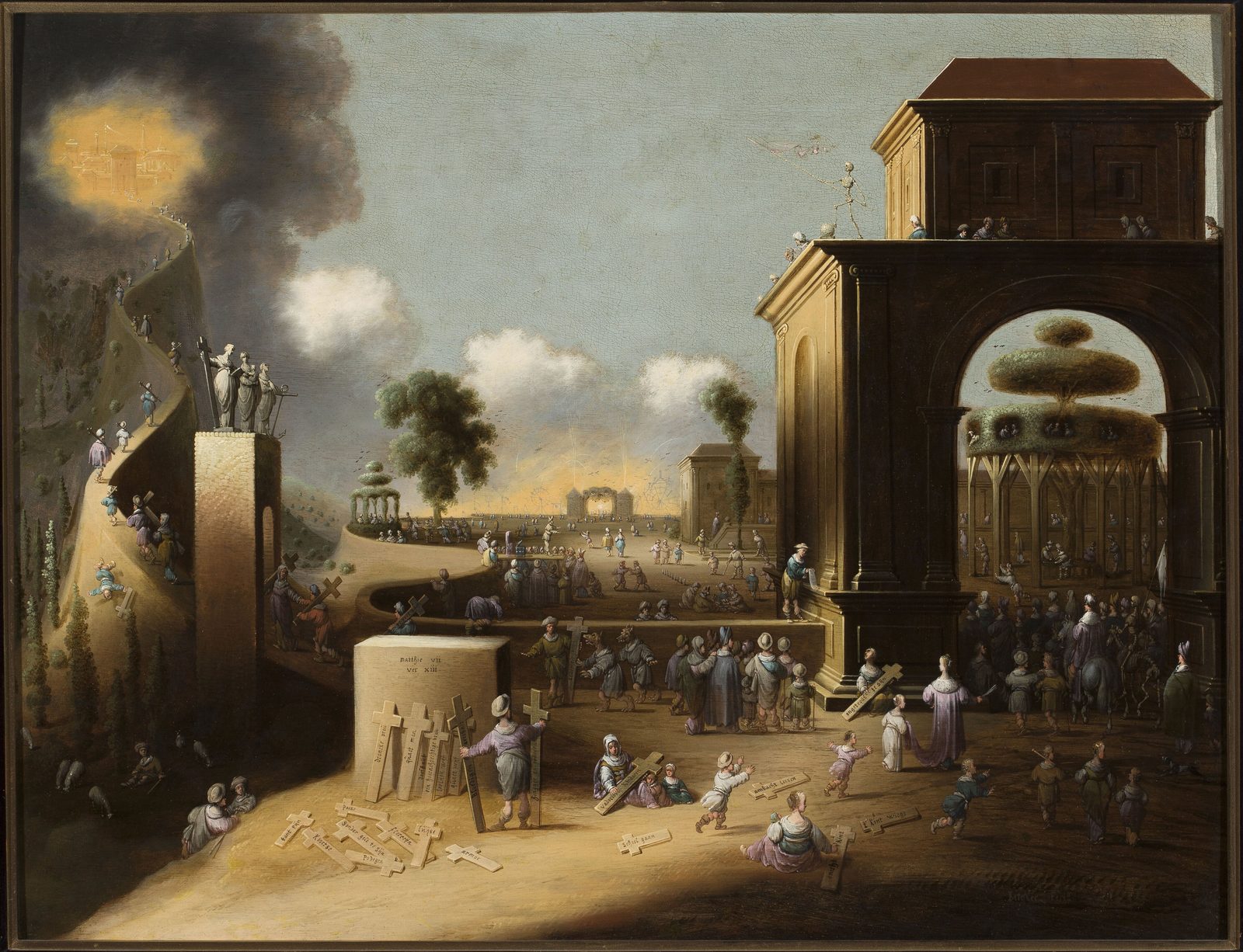
Narrow Road of Virtue and Wide Road of Sin. Jan Micker, not stated on the file page. National Museum in Warsaw. Public domain.