
Psalm 125
5 verses · Song of Ascents, psalm of trust
Those who trust in the LORD are like Mount Zion. It cannot be moved; it abides forever.
Introduction
Author unstated, the Mountains Around Jerusalem, Book 5: The return and the great Hallelujah, Poetry, Psalms Overview.
This psalm names no writer. It was sung by people who could see the hills around Jerusalem as they sang, and who lived under a power that could take the land their families held. It sets the ground under their feet beside the LORD who keeps His people, and then it prays for the upright and warns those who wander from the road. Listen for the landscape in every line, and for the blessing on Israel that closes it.
Context
- Who
- Israelites living under foreign officials who could take a family's land
- What
- A psalm of trust that compares those who trust the LORD to Mount Zion and the hills around Jerusalem.
- Where
- Jerusalem, seen from inside the ring of higher hills that surround it
- When
- Undated; it fits any time a foreign or wicked power held the land.
- Why
- To steady people living under a wicked power that could take their land.
Historical context
No name stands in the heading, and the psalm is built out of the ground the singer was standing on. Jerusalem sits on a spur with higher ground around it on almost every side, and the Mount of Olives rises above the city to the east. A pilgrim in the city looked up at hills in a circle. Mount Zion is the ridge the sanctuary stood on, in a land where earthquakes were common. The scepter of the wicked resting on the allotted land is a property phrase. Israel's land had been divided by lot to families and was meant to stay in the family, and a foreign governor or a wealthy creditor holding a scepter over an inheritance was the specific fear.
Significance
People who had lost land, or feared losing it, were told that God surrounds His people the way those hills surround the city, permanently and on all sides. The promise is measured. The scepter will not remain, it says, which grants that it is there at the moment of singing.
This chapter in Jewish lifeWhat this chapter is in Jewish life and reading.
What is done
Psalm 125 is the sixth of the fifteen Songs of Ascents, sung within the collection whose setting this site records at /featured/psalms-of-ascent from Mishnah Middot 2:5 and Mishnah Sukkah 5:4. Its figure is the ring of hills around Jerusalem, which a pilgrim walking up to the city had in front of him, and the commentators read the figure out of the walk.
How it is read
Rashi puts the psalm's claim in one sentence: those who trust in the LORD will not falter, "for just as Jerusalem is surrounded by mountains, so is the Holy One, blessed be He, around His people" (Rashi on Psalms 125:1:1, the Judaica Press complete Tanach with Rashi, translated by A. J. Rosenberg, CC-BY). Ibn Ezra reads the same figure as a claim about siege, that the hills stand around her and the LORD around His people within her, so that the enemy cannot come and lay siege (Ibn Ezra on Psalms 125:2:1, translated by Rabbi Mike Feuer, Jerusalem Anthology, CC-BY). Radak parts from both and reads the verse against the city as it stood in his own day, under the rule of one nation after another: the hills surround her and she still lacks strength, and she will have none "until the people of the Lord are within her" (Radak on Psalms 125:2:1, Feuer translation, CC-BY). On the third verse Rashi reads the rod of the wicked as a rule God will not let rest on the righteous, because the righteous keep their own hands from wrongdoing. Malbim and Metzudat David comment on all five verses and stand here as citations, at Malbim on Psalms 125:1:1 and Metzudat David on Psalms 125:1:1.
What the rabbis say
The corpus records forty locators on this chapter, thirty-five Midrash and five Talmud. The opening figure of Mount Zion that cannot be moved is taken up at Midrash Tehillim 125:1 and Berakhot 58b:4. The verse about the rod of wickedness is the one the rabbis worked hardest, at Bereshit Rabbah 60:5, Bereshit Rabbah 87:2, Esther Rabbah 7:11, Sotah 2a:8 and Jerusalem Talmud Ketubot 1:3:5. The prayer for those who are good and upright in heart is taken up at Vayikra Rabbah 17:1, Eikhah Rabbah 3:9, Midrash Tehillim 4:3, Midrash Tehillim 22:2 and Menachot 53b:3, and the closing line about those who turn aside at Berakhot 19a:5.
Sources: Rashi, Rashi on Psalms 125:1:1, 125:3:1 and 125:5:1, the Judaica Press complete Tanach with Rashi, translated by A. J. Rosenberg, CC-BY; Ibn Ezra, Ibn Ezra on Psalms 125:2:1, translated by Rabbi Mike Feuer, Jerusalem Anthology, CC-BY; Radak, Radak on Psalms 125:2:1, Feuer translation, Jerusalem Anthology, CC-BY; Malbim, Malbim on Psalms 125:1:1, cited only, no English version in the corpus; Metzudat David, Metzudat David on Psalms 125:1:1, cited only; Midrash, Midrash Tehillim 125:1, 4:3 and 22:2, Bereshit Rabbah 60:5 and 87:2, Esther Rabbah 7:11, Vayikra Rabbah 17:1, Eikhah Rabbah 3:9; Babylonian Talmud, Berakhot 58b:4 and 19a:5, Sotah 2a:8, Menachot 53b:3; Jerusalem Talmud, Ketubot 1:3:5; Mishnah, Middot 2:5 and Sukkah 5:4, as /featured/psalms-of-ascent records them; MannaFest, the Songs of Ascents, at /featured/psalms-of-ascent, 2026.
Psalms 125:1-2
are like Mount Zion: Trust is measured against a mountain, and those who trust are as unmoved as Mount Zion. Verse 2 uses one word twice, sabiv, a circle: the mountains around Jerusalem, the LORD around His people. The mountains a pilgrim saw picture the LORD Himself.
Psalms 125:1
“For to those who thus examine themselves and conform their hearts to the Lord, nothing adverse shall happen; for indeed, their hearts are strengthened by confidence in the Lord, as it is written, "They who trust in the Lord are as Mount Zion; he who dwells in Jerusalem shall not be moved forever."”
Athanasius of Alexandria · written before 373 · Letter 11.6patristic
1 more voice on this verseWhat preachers and commentators have said about this verse, in their own words.
Psalms 125:1
“THIS is the first verse of one of the Songs of degrees. These Songs were probably sung by the pilgrims as they went up to Jerusalem, when they halted at the various stations or passed certain places of interest. It is very possible that this Psalm burst forth from joyful lips at the moment when Zion first came into sight and the worshippers gazed upon the city of their solemnities. Happy pilgrims!”
As the mountains surround Jerusalem: Charles Spurgeon reads verses 1 and 2 as a double security: those who trust are made like a mount, and then mountains surround them. John Gill names the Mount of Olives on the east.
Psalms 125:2
“As the mountains are round about Jerusalem, so the Lord is round about his people from henceforth even for ever. The hill of Zion is the type of the believer's constancy, and the surrounding mountains are made emblems of the all surrounding presence of the Lord. The mountains around the holy city, though they do not make a circular wall, are, nevertheless, set like sentinels to guard her gates.”
Charles Spurgeon · The Treasury of David, Vol. 7 (1885)Particular Baptist
1 more voice on this verse
Psalms 125:2
“As the mountains are round about Jerusalem,.... There was Mount Zion on the side of the north, and the mount of Olives on the east, and other mountains on the other sides of it; so that it was encompassed with them, and was naturally as well as artificially fortified.”
the scepter of the wicked: The verb is nuach, to settle down, so the promise runs on how long the wicked scepter may rest. Matthew Henry reads it the same way: the wicked power may fall on their lot, and it will not stay there. The purpose follows: the righteous keep their hands off injustice.
Psalms 125:3
“For the rod of the wicked shall not rest upon the lot of the righteous,.... Which, according to Kimchi, is Jerusalem; but Aben Ezra interprets it of the Israelites that inherit the land.”
2 more voices on this verse
Psalms 125:3
“For the rod of the wicked shall not rest upon the lot of the righteous. The people of God are not to expect immunity from trial because the Lord surrounds them, for they may feel the power and persecution of the ungodly. Isaac, even in Abraham's family, was mocked by Ishmael. Assyria laid its sceptre even upon Zion itself. The graceless often bear rule and wield the rod; and when they do so they are pretty sure to make it fall heavily upon the Lord's believing people, so that the godly cry out by reason of their oppressors.”
Charles Spurgeon · The Treasury of David, Vol. 7 (1885)Particular Baptist
Psalms 125:3
“God may even try His people to the uttermost: when nothing is before our eyes but pure despair, then He delivers us and gives life in death, and makes us blessed in the curse (2Co 1:8, 9) [LUTHER]. the lot--the possession, literally, "Canaan," spiritually, the heavenly inheritance of holiness and bliss which is appointed to the righteous.”
Jamieson, Fausset & Brown · Commentary Critical and Explanatory on the Whole Bible (1871)reformed
Psalms 125:4-5
Do good, O LORD: The prayer asks the LORD to do good to the upright. Jamieson, Fausset and Brown mark the word their in verse 5 as emphatic, the crooked ways coming out of their own hearts. Those who turn are banished with the evildoers, and the psalm's last words are peace upon Israel.
Psalms 125:4
God is good, but he is also just, and it is the nature of the just to reward in proportion to merit, as it is written: "Do good, O Lord, to those that are good and to the upright of heart. But such as turn aside to their own crooked ways, the Lord shall lead out with the workers of iniquity." He is merciful, but he is also a judge, for "the Lord loves mercy and judgment," says the psalmist. And he therefore also says, "Mercy and judgment I will sing to you, O Lord."
Basil of Caesarea · written before 379 · The Long Rules, Prefacepatristic
2 more voices on this verse
Psalms 125:4
“Do good, O Lord, unto those that be good, and to them that are upright in their hearts. Men to be good at all must be good at heart. Those who trust in the Lord are good; for faith is the root of righteousness, and the evidence of uprightness. Faith in God is a good and upright thing, and its influence makes the rest of the man good and upright.”
Charles Spurgeon · The Treasury of David, Vol. 7 (1885)Particular Baptist
Psalms 125:4
“With the upright God will show himself upright. He does not say, Do good, O Lord! to those that are perfect, that are sinless and spotless, but to those that are sincere and honest. God's promises should quicken our prayers.”
Matthew Henry · Commentary on the Whole Bible (1707-1721)puritan
those who turn to crooked ways: Albert Barnes finds the word for crooked ways only once more, at Judges 5:6, where travelers left the highways for the byways. Barnes and Charles Spurgeon read it of people once in the upright way who turn aside to crooked ways. The same peace upon Israel closes Psalm 128.
Psalms 125:5
“As for such as turn aside unto their crooked ways, the Lord shall lead them forth with the workers of iniquity. Two kinds of men are always to be found, the upright and the men of crooked ways. Alas, there are some who pass from one class to another, not by a happy conversion, turning from the twisting lanes of deceit into the highway of truth, but by an unhappy declension leaving the main road of honesty and holiness for the bypaths of wickedness.”
Charles Spurgeon · The Treasury of David, Vol. 7 (1885)Particular Baptist
1 more voice on this verse
Psalms 125:5
“Those who turn aside (under temptation) permanently show that they are hypocrites, and their lot or portion shall be with the wicked (Ps 28:3). crooked ways--(Compare De 9:16; Mal 2:8, 9). their--is emphatic; the "crooked ways" proceed from their own hearts. The true Israel is here distinguished from the false.”
Jamieson, Fausset & Brown · Commentary Critical and Explanatory on the Whole Bible (1871)reformed
How this psalm is built
The form: A song of the ascents whose comfort is drawn from the ground the pilgrim was standing on, as Delitzsch classes it.
The patterns in this chapter
| Device | What it does | Where to see it |
|---|---|---|
| The circle, twice in one verse | Verse 2 uses one Hebrew word twice, sabiv, a circle. The mountains are around Jerusalem and the LORD is around His people. What a pilgrim could see from the road becomes the picture of what he could not see.Franz Delitzsch, Biblical Commentary on the Psalms, on Psalm 125:2. | Psalm 125:2 |
| Mount Zion as the measure | Verse 1 does not say the trusting are safe. It says they are like Mount Zion, which cannot be moved and abides forever, so trust is measured against a piece of ground rather than described as a feeling.Charles Spurgeon, The Treasury of David, Vol. 7, 1885, on Psalm 125:1. | Psalm 125:1 |
| The two ways at the end | Verses 4 and 5 sort the same people two ways. The good and the upright in heart are prayed for, and those who turn aside to crooked ways are banished with the evildoers. The last words stand outside both, peace be upon Israel.Jamieson, Fausset & Brown, Commentary Critical and Explanatory on the Whole Bible, 1871, on Psalm 125:5. | Psalm 125:4, Psalm 125:5 |
The structure
12 more paragraphs on the patterns
Five verses in two parts. Verses 1 to 3 are the statement of confidence, and verses 4 and 5 are the prayer, with the last words standing outside both.
Verse 2 uses one Hebrew word twice, sabiv, a circle. The mountains are around Jerusalem and the LORD is around His people. Verse 1 does not say the trusting are safe; it says they are like Mount Zion, so trust is measured against a piece of ground rather than described as a feeling.
Verses 4 and 5 sort the same people two ways, the good and upright prayed for and those who turn to crooked ways banished with the evildoers. The closing line, peace be upon Israel, stands outside the sorting.
Across the canon
The closing words close Psalm 128 as well, and the charge to pray for the peace of Jerusalem stands at Psalm 122:6. Three psalms of the collection end or turn on the same word.
The immovable mountain of verse 1 stands against the shaken ground of the psalms around it. Psalm 124 has waters that would have swept Israel away and Psalm 126 has a people who could not believe their own return. Between them this psalm puts something that cannot be moved.
In the New Testament
No New Testament writer quotes this psalm. Galatians 6:16 pronounces peace and mercy on the Israel of God, which is the psalm's last line in Paul's hands. Hebrews 12:28 speaks of an unshakable kingdom that believers are receiving, which is the claim of verse 1 carried forward.
What is debated
How far verse 1 promises is argued. Read strictly it says those who trust cannot be moved and abide forever, which is a promise about the person. Read with verse 3 in view it is a promise about a season, that the wicked rule will not be allowed to settle, which leaves a great deal of shaking inside the guarantee. Matthew Henry takes the second line and reads verse 3 as a limit on duration rather than a denial of the trouble. Both readings sit inside the psalm and it does not choose between them.
The Songs of Ascents
Psalm 125 is the sixth of the fifteen songs of ascents. Charles Spurgeon holds that pilgrims probably sang these songs going up to Jerusalem, as they halted at the stations of the road (The Metropolitan Tabernacle Pulpit, Sermon 1450, on Psalm 125:1). He takes this one as the song for the moment Zion first came into sight. Albert Barnes records the reading that takes the title Songs of Degrees from an ascent of thought in these psalms (Notes on the Book of Psalms, on Psalm 124:2). On that reading a line takes up the words of the line before and carries them one step further. Here Mount Zion in verse 1 becomes the mountains that surround Jerusalem in verse 2, and the word surround is taken up at once for the LORD around His people. It closes on Peace be upon Israel, the same words that close Psalm 128.
Keep studying
Sources for this chapter
The summary
Jamieson, Fausset & Brown, Commentary Critical and Explanatory; John Calvin, Commentaries; John Wesley, Notes on the Old Testament and Matthew Henry, Complete Commentary.
The form and classifications
Charles Spurgeon, The New Park Street Pulpit, Sermon No. 161, 1857; Franz Delitzsch, Biblical Commentary on the Psalms, on Psalm 125:2 and Matthew Henry, Commentary on the Whole Bible, 1710, on Psalm 125:3.
The exposition
Albert Barnes, Notes on the Book of Psalms; Charles Spurgeon, The Treasury of David; Franz Delitzsch, Biblical Commentary on the Psalms; Jamieson, Fausset & Brown, Commentary Critical and Explanatory on the Whole Bible; John Gill, Exposition of the Old Testament and Matthew Henry, Commentary on the Whole Bible.
The painting
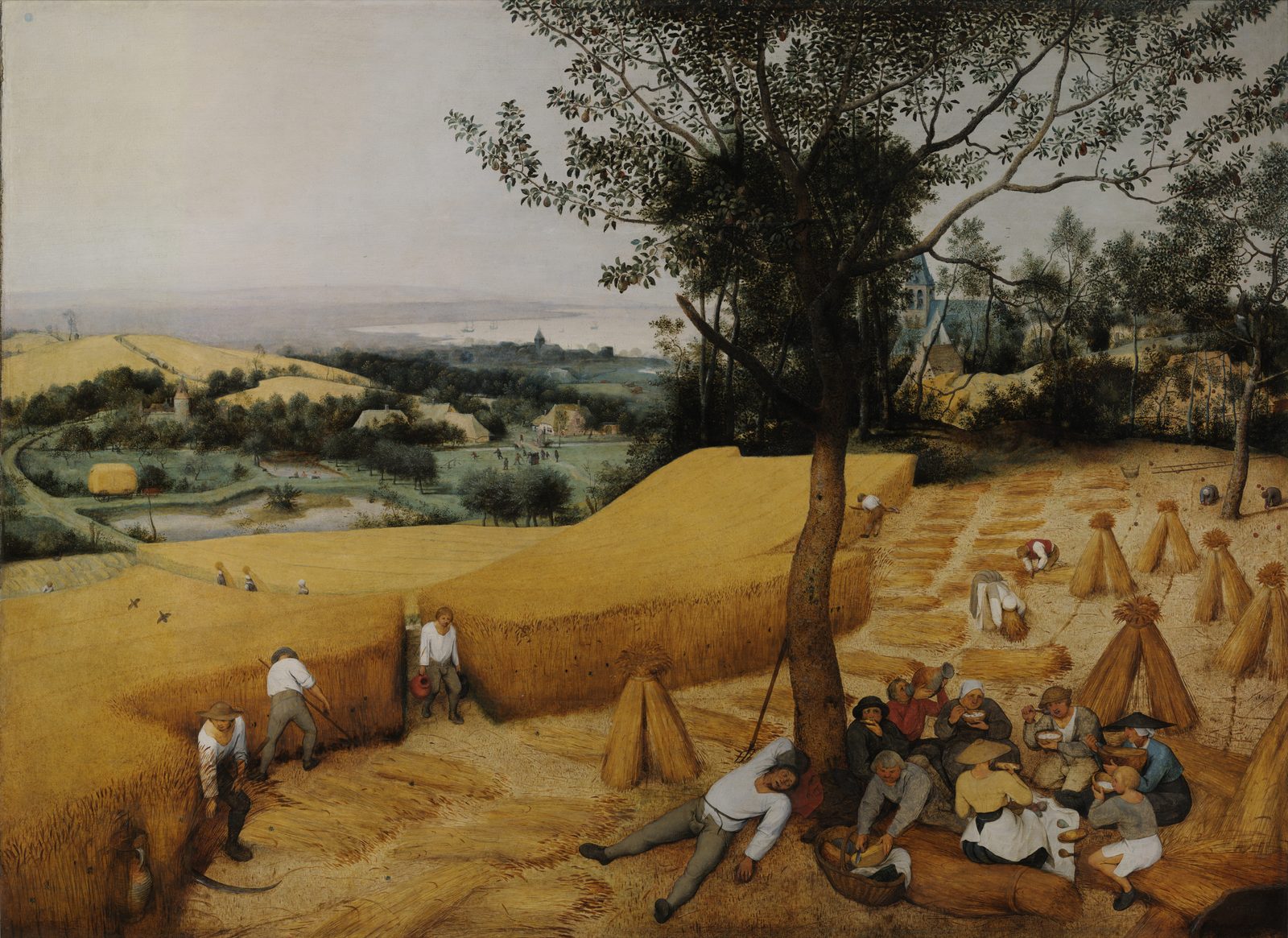
The Harvesters. Pieter Brueghel the Elder, 1565. Wikimedia Commons. Public domain.