
Psalm 115
18 verses · David and others · 10th to 5th century BC · Wisdom and poetry
Their idols are silver and gold, made by the hands of men.
Introduction
Author unstated, the Living God and the Idols, Book 5: The return and the great Hallelujah, Poetry, Psalms Overview.
This psalm was sung by a small people whose neighbours mocked them for worshipping a God no one could see. Its writer is not named, and it belongs with the songs Israel sang at Passover. It answers the mockery by giving the glory to God's name and by describing the gods of the other nations as the craftsmen made them. Listen for the long inventory of what those statues have and cannot use. Then listen for the three calls to trust, each to a wider circle of worshippers, and the blessing that follows them.
Context
- Who
- Israelites whose temple held no image, surrounded by peoples whose temples held many
- What
- A congregational psalm that gives glory to God's name and sets the living God against the idols of the nations.
- Where
- Judah, among neighbouring peoples whose temples held images of their gods.
- When
- The second temple period, about 538 to 400 BC, with the author unnamed.
- Why
- To answer the nations who ask where Israel's God is, and to call Israel, the priests and all who fear the LORD to trust Him.
Historical context
The taunt in verse 2 was a serious argument in that world. A god's power was read off the fortunes of his people, so a small and defeated nation was assumed to have a small and defeated god, and the same taunt stands at Joel 2:17. The psalm's answer makes God's freedom the reply and leaves the people's condition out of the argument. Cult statues in the ancient Near East were wooden cores plated with silver and gold, given eyes, ears and mouths, and consecrated in a rite understood to open the mouth so the god could eat and speak. The psalm's list of seven organs that cannot work is a point by point denial of that rite. The three groups called at verses 9 to 11 are the nation, the priesthood, and those who fear the LORD, the wider circle a foreigner attached to Israel's worship would have fallen into.
Significance
It gave a small, imageless people a reply to the strongest argument their neighbours had: the gods in the other temples could not see, hear or move. Verse 8 added the sting, that the people with the impressive statues were being shaped by them into something as deaf as what they carried.
This chapter in Jewish lifeWhat this chapter is in Jewish life and reading.
What is done
This psalm stands third in the Hallel, Psalms 113 to 118, said as one unit at the appointed feasts (src/app/featured/the-hallel/page.tsx). It falls in the part of the set finished over the fourth cup at the seder, after the seam the Houses argued over at Psalms 113 and 114 (Mishnah Pesachim 10:6-7, as this site records it on its Hallel page).
The same set is said in the Temple court while the Passover lambs were killed, at Tabernacles with the lulav, and on the days of Dedication and at the New Moon (Mishnah Pesachim 5:7, Mishnah Sukkah 3:9 and Mishnah Taanit 4:5).
How it is read
The corpus holds four comments of Rashi on this chapter, and the first two set the psalm's argument. On the opening words he writes that God is asked to act "not for us or for the fitness of our deeds", and on the second half of the verse that the honour is for God's name so that the nations should not say, where is their God now (Rashi on Psalms 115:1:1 and 115:1:2, Rashi on Psalms, The Judaica Press complete Tanach with Rashi, translated by A. J. Rosenberg, CC-BY).
The third group named in verse 11 he identifies in four words. Where the psalm calls on the house of Israel, then the house of Aaron, then those who fear the Lord, Rashi writes of the third group that "these are the proselytes" (Rashi on Psalms 115:11:1, same edition). A Christian reader should notice how old that reading is, since the same three groups stand in the same order in the synagogue liturgy the psalm belongs to.
Ibn Ezra and Radak carry twenty comments on this chapter for which Sefaria holds no English version, and they are cited by reference (Ibn Ezra on Psalms 115:2:1, Radak on Psalms 115:2:1 and the eighteen references beside them).
What the rabbis say
The corpus records forty places where the Midrash and the Talmud cite this psalm, thirty one under Midrash and nine under Talmud, and it carries the locator for each one with no text. The Babylonian Talmud cites verse 2 at Pesachim 118a:18, which is the passage on the Hallel at the seder, and it reads verse 16 at Berakhot 35a:21.
The Jerusalem Talmud reads verse 1 at Berakhot 2:4:8 and Megillah 2:1:3, verse 7 at Peah 8:1:2, verse 8 at Avodah Zarah 4:7:3 and verse 17 at Sukkah 3:1:5. The verses that mock the idols, 4 to 8, draw Shemot Rabbah 30:21, Devarim Rabbah 1:12 and 5:9, and the Mekhilta twice at Tractate Shirah 8:8 and at 15:11 of the recension of Rabbi Shimon ben Yochai. The site reports where the rabbis cite the verse and reports no saying, because the locator carries none.
Sources: The Mishnah, Pesachim 5:7 and 10:6-7, Sukkah 3:9 and Taanit 4:5, as recorded at src/app/featured/the-hallel/page.tsx, about AD 200; Rashi, Rashi on Psalms 115, in The Judaica Press complete Tanach with Rashi, translated by A. J. Rosenberg, CC-BY; Ibn Ezra and Radak, their comments on Psalms 115, cited by reference; Sefaria holds no English version; The Midrash and the Talmud, the forty locators on Psalms 115 in scripts/data/sources/sefaria/psalms/115.json.
to Your name be the glory: The glory is turned away from the singers, twice over. It belongs to the LORD's name, on the ground of His loving devotion and His faithfulness. Spurgeon read the psalm as a prayer that God would act for His own name's sake.
Psalms 115:1
“It will be well to remember that this psalm was sung at the Passover, and therefore it bears relationship to the deliverance from Egypt. The burden of it, seems to be a prayer that the living God, who had been so glorious at the Red Sea and at the Jordan, should again for his own name's sake display the wonders of his power. Not unto us, O Lord, not unto us, but unto thy name give glory.”
Charles Spurgeon · The Treasury of David, Vol. 5 (1878)Particular Baptist
1 more voice on this verseWhat preachers and commentators have said about this verse, in their own words.
Psalms 115:1
“We must not assume the glory of it to ourselves, but ascribe it wholly to God. We must not imagine that we do any thing for God by our own strength, or deserve any thing from God by our own righteousness; but all the good we do is done by the power of his grace, and all the good we have is the gift of his mere mercy, and therefore he must have all the praise.”
Matthew Henry · Commentary on the Whole Bible (1707-1721)puritan
Psalms 115:2-3
Why should the nations say: The nations ask Where is their God, and the same taunt stands at Joel 2:17, where the priests are told to weep over it. The psalm answers that God is in heaven and does as He pleases. His freedom is the answer to the nations.
Psalms 115:2
“Wherefore should the Heathen say,.... The nations about Israel, the nations of the world; the Gentiles in any age; the Papists in ours, sometimes called the Heathen, Psa 10:16. The church expostulates with the Lord why those should be suffered to say, in a reproachful, insulting, manner, and by way of triumph, where is now their God? that they have boasted of would help them; in whom they have put their trust and confidence; why does not he help them, as he has promised, and they expect?”
1 more voice on this verse
Psalms 115:2
“Wherefore should the heathen say, Where is now their God? Or, more literally, "Where, pray, is their God?" Why should the nations be allowed with a sneer of contempt to question the existence, and mercy, and faithfulness of Jehovah? They are always ready to blaspheme; we may well pray that they may not derive a reason for so doing from the course of providence, or the decline of the church.”
Charles Spurgeon · The Treasury of David, Vol. 5 (1878)Particular Baptist
He does as He pleases: God is in heaven and does as He pleases, while the idols of verse 4 are made by the hands of men and do nothing. The Septuagint adds and on earth, John Gill noted. Psalm 135:6 repeats the second line and extends it to the seas and all their depths.
Psalms 115:3
“But our God is in the heavens,.... His habitation is in the heavens, as the Targum; the Septuagint and Arabic versions add, "and in earth": he is in both, and fills both with his presence; and cannot be contained in either. He is the Maker and Possessor of heaven and earth; the one is his throne, and the other is his footstool: he dwells in the highest heaven, and overlooks all persons and things on earth, and overrules all; he is higher than the highest, and his kingdom ruleth over all.”
1 more voice on this verse
Psalms 115:3
“But our God is in the heavens —where he should be; above the reach of mortal sneers, over hearing all the vain jangling of men, but looking down with silent scorn upon the makers of the babel. Supreme above all opposing powers, the Lord reigneth upon a throne high and lifted up. Incomprehensible in essence, he rises above the loftiest thought of the wise; absolute in will and infinite in power, he is superior to the limitations which belong to earth and time.”
Charles Spurgeon · The Treasury of David, Vol. 5 (1878)Particular Baptist
Psalms 115:4-8
Their idols are silver and gold: The idols are silver and gold. Seven organs are named: mouths, eyes, ears, noses, hands, feet and throats, and every one of them is dead. Verse 8 turns it on the maker: a man who makes an idol comes to resemble it, and so does everyone who trusts it.
Psalms 115:4
“Their idols are silver and gold, mere dead inert matter; at the best only made of precious metal, but that metal quite as powerless as the commonest wood or clay. The value of the idol shows the folly of the maker in wasting his substance, but certainly does not increase the power of the image, since there is no more life in silver and gold than in brass or iron. The work of men's hands.”
Charles Spurgeon · The Treasury of David, Vol. 5 (1878)Particular Baptist
1 more voice on this verse
Psalms 115:4
But this all inspired Scripture also teaches more plainly and with more authority, so that we in our turn write boldly to you as we do, and you, if you refer to Scripture, will be able to verify what we say. For an argument when confirmed by higher authority is irresistibly proved. From the first then the divine Word firmly taught the Jewish people about the abolition of idols when it said, "You shall not make for yourself a graven image or the likeness of anything that is in the heaven above or in the earth beneath."
Athanasius of Alexandria · written before 373 · Against the Heathen 45:2-3patristic
They have mouths, but cannot speak: Speech and sight come first, the two things men ask of a god they trust. Gill set the silence of idols beside 1 Kings 18:26, where the prophets of Baal called from morning until noon and no one answered. Spurgeon set it beside the God who spoke at Sinai.
Psalms 115:5
“They have mouths, but they speak not,.... These idols are carved with mouths, but they make no use of them; if any cry to them for they cannot answer them, nor save them from their troubles. Baal's priests cried to their idol, but was no voice heard, nor answer returned; they are rightly called dumb idols, Hab 2:18, 1Ki 18:26, but our God in the heavens, when his people cry to him, he answers them, and sends them relief; and tells them his grace is sufficient for them, and so they find it to be.”
1 more voice on this verse
Psalms 115:5
“They have mouths, but they speak not. The idols cannot utter even the faintest sound, they cannot communicate with their worshippers, they can neither promise nor threaten, command nor console, explain the past nor prophesy the future. If they had no mouths they might not be expected to speak, but having mouths and speaking not, they are mere dumb idols, and not worthy to be compared with the Lord God who thundered at Sinai, who in old time spake by his servants the prophets, and whose voice even now breaketh the cedars of Lebanon.”
Charles Spurgeon · The Treasury of David, Vol. 5 (1878)Particular Baptist
they have ears, but cannot hear: Ears and noses are the organs of a god receiving worship, one to hear prayer and one to take in the smoke of the offering. Spurgeon pictured the great carved ears of some idols, which no prayer shouted could reach. Psalm 116:2 answers with a LORD who inclines His ear.
Psalms 115:6
“They have ears, but they hear not. The Psalmist might have pointed to the monstrous ears with which some heathen deities are disfigured, —truly they have ears; but no prayer of their rotaries, though shouted by a million voices, can ever be heard by them. How can gold and silver hear, and how can a rational being address petitions to one who cannot even hear his words? Noses have they, but they smell not.”
Charles Spurgeon · The Treasury of David, Vol. 5 (1878)Particular Baptist
they cannot even clear their throats: The list runs from hands that cannot feel down to the throat, where the idols make no sound. The Hebrew verb is the one Psalm 1:2 uses for the man who meditates, a low sound under the breath. Spurgeon said an infant's hand has more power than theirs.
Psalms 115:7
“They have hands, but they handle not. Looking lower down upon the images, the Psalmist says, "They have hands, but they handle not, "they cannot receive that which is handed to them, they cannot grasp the sceptre of power or the sword of vengeance, they can neither distribute benefits nor dispense judgments, and the most trifling act they are utterly unable to perform. An infant's hand excels them in power. Feet have they, but they walk not.”
Charles Spurgeon · The Treasury of David, Vol. 5 (1878)Particular Baptist
1 more voice on this verse
Psalms 115:7
“They have hands, but they handle not,.... So as to feel any thing that is put into their hands; they cannot make use of their hands to stretch them out, and receive anything from their worshippers; nor can they give anything to them: but our God receives and accepts the sacrifices of his people, their prayers and their praises; and opens his hand, and liberally supplies their wants, both in providence and grace.”
Those who make them become like them: Gill reported that Kimchi and the ancient versions read the line as a prayer, and Spurgeon read it as a plain statement. Psalm 135:18 repeats the line word for word. Either way the one who trusts an idol ends with its blind eyes and silent mouth.
Psalms 115:8
“They that make them are like unto them. Those who make such things for worship are as stupid, senseless, and irrational as the figures they construct. So far as any spiritual life, thought, and judgment are concerned, they are rather the images of men than rational beings. The censure is by no means too severe. Who has not found the words leaping to his lips when he has seen the idols of the Romans? So is every one that trusteth in them.”
Charles Spurgeon · The Treasury of David, Vol. 5 (1878)Particular Baptist
Psalms 115:9-11
O Israel, trust in the LORD!: One call goes out three times, to Israel, to the house of Aaron, and to all who fear the LORD. Each line ends the same way, with God as their help and shield. The third address reaches past the nation and the priesthood.
Psalms 115:9
“O Israel, trust thou in the Lord. Whatever others do, let the elect of heaven keep fast to the God who chose them. Jehovah is the God of Jacob, let his children prove their loyalty to their God by their confidence in him. Whatever our trouble may be, and however fierce the blasphemous language of our enemies, let us not fear nor falter, but confidently rest in him who is able to vindicate his own honour, and protect his own servants. He is their help and their shield.”
Charles Spurgeon · The Treasury of David, Vol. 5 (1878)Particular Baptist
1 more voice on this verse
Psalms 115:9
“O Israel, trust thou in the Lord,.... Or, "the house of Israel hath trusted in the Lord": so the Septuagint, Vulgate Latin, Syriac, Arabic, and Ethiopic versions: the Targum is, "Israel trusteth in the Word of the Lord;'' in distinction from the Heathens, that trust in their idols.”
O house of Aaron, trust in the LORD!: The house of Aaron is the priesthood, set apart to serve at the altar. The call speaks to them and the refrain speaks about them, and Spurgeon read the change as the psalmist glad the priests did trust. Those nearest to God, he said, should trust Him most.
Psalms 115:10
“O house of Aaron, trust in the Lord. You who are nearest to him, trust him most; your very calling is connected with his truth and is meant to declare his glory, therefore never entertain a doubt concerning him, but lead the way in holy confidence. The priests were the leaders, teachers, and exemplars of the people, and therefore above all others they should place an unreserved reliance upon Israel's God. The Psalmist is glad to add that they did so, for he says, He is their help and their shield.”
Charles Spurgeon · The Treasury of David, Vol. 5 (1878)Particular Baptist
You who fear the LORD, trust in the LORD!: Matthew Henry and John Gill both read those who fear the LORD as proselytes, Gentiles who worshipped Israel's God, and Gill cited Jarchi for it. Paul addresses the men of Israel and the Gentiles who fear God at Acts 13:16. Spurgeon extended it to any nation.
Psalms 115:11
“The next verse is of the same tenor— Ye that fear the Lord, trust in the Lord, whether belonging to Israel, or to the house of Aaron, or not, all those who reverence Jehovah are permitted and commanded to confide in him. He is their help and their shield. He does aid and protect all those who worship him in filial fear, to whatever nation they may belong.”
Charles Spurgeon · The Treasury of David, Vol. 5 (1878)Particular Baptist
1 more voice on this verse
Psalms 115:11
“Note, Wherever there is an awful fear of God, there may be a cheerful faith in him: those that reverence his word may rely upon it. We are greatly encouraged to trust in God, and good reason is given us why we should stay ourselves upon him with an entire satisfaction.”
Matthew Henry · Commentary on the Whole Bible (1707-1721)puritan
Psalms 115:12-15
The LORD is mindful of us: , answering the taunt of verse 2. The three groups are blessed, Israel, the house of Aaron, and everyone who fears the LORD, and verse 14 carries the blessing to the children. Verse 15 names who blesses, the Maker of heaven and earth.
Psalms 115:12
“The Lord hath been mindful of us, or "Jehovah hath remembered us." His past mercies prove that we are on his heart, and though for the present he may afflict us, yet he does not forget us. We have not to put him in remembrance as though he found it hard to recollect his children, but he hath remembered us and therefore he will in future deal well with us. He will bless us.”
Charles Spurgeon · The Treasury of David, Vol. 5 (1878)Particular Baptist
2 more voices on this verse
Psalms 115:12
“The Lord hath been mindful of us,.... The Targum is, "the Word of the Lord hath remembered us for good.'' And is another reason why his people should trust in him: he has been mindful of his covenant with them and promises to them, and has kept them; he remembered them in their low estate, and sent redemption to them; goodness and mercy have followed them all their days.”
Psalms 115:12
“He has been mindful of our case, our wants and burdens, mindful of our prayers to him, his promises to us, and the covenant-relation between him and us. All our comforts are derived from God's thoughts to us-ward; he has been mindful of us, though we have forgotten him. Let this engage us to trust in him, that we have found him faithful.”
Matthew Henry · Commentary on the Whole Bible (1707-1721)puritan
small and great alike: Small and great covers every difference among those the LORD will bless, and Henry named several: the weak in grace and the strong. Spurgeon called it a cordial for the small in faith. Revelation 11:18 gives the same pair to those who fear His name.
Psalms 115:13
“He will bless them that fear the Lord,.... They shall want no good thing now, and have much goodness laid up for them to be enjoyed hereafter; the sun of righteousness rises upon them, and a book of remembrance is written on their account; the Lord delights in them, his eye is upon them; and they are blessed with more grace now, and will be blessed with glory hereafter. Both small and great; young and old, rich and poor, high and low, lesser or greater believers; be they children, young men, or fathers; see Rev 11:18.”
2 more voices on this verse
Psalms 115:13
“He will bless them that fear the Lord, both small and great. So long as a man fears the Lord it matters nothing whether he be prince or peasant, patriarch or pauper, God will assuredly bless him. He supplies the want of every living thing, from the leviathan of the sea to the insect upon a leaf, and he will suffer none of the godly to be forgotten, however small their abilities, or mean their position. This is a sweet cordial for those who are little in faith, and own themselves to be mere babes in the family of grace.”
Charles Spurgeon · The Treasury of David, Vol. 5 (1878)Particular Baptist
Psalms 115:13
“God has blessings in store for those that are good betimes and for those that are old disciples, both those that are poor in the world and those that make a figure. The greatest need his blessing, and it shall not be denied to the meanest that fear him. Both the weak in grace and the strong shall be blessed of God, the lambs and the sheep of his flock.”
Matthew Henry · Commentary on the Whole Bible (1707-1721)puritan
May the LORD give you increase: Increase is the blessing the LORD gave Israel in Egypt, where Exodus 1:7 says the people increased rapidly, and Spurgeon read it forward. Gill took it both ways, children and wealth given in this life and growth in grace. Deuteronomy 1:11 gives Israel the same blessing.
Psalms 115:14
“The Lord shall increase you more and more, you and your children. Just as in Egypt he multiplied the people exceedingly, so will he increase the number of his saints upon the earth; not only shall the faithful be blessed with converts, and so with a spiritual seed; but those who are their spiritual children shall become fruitful also, and thus the multitude of the elect shall be accomplished; God shall increase the people, and shall increase the joy.”
Charles Spurgeon · The Treasury of David, Vol. 5 (1878)Particular Baptist
2 more voices on this verse
Psalms 115:14
“The Lord shall increase you more and more,.... The Word of the Lord, as the Targum, shall do it; in a temporal sense, with a numerous posterity, with riches, wealth, and honour; and in a spiritual sense, with an addition of spiritual blessings; with renewed instances of divine layout: with an increase of the gifts and graces of the Spirit of God, as faith, hope, love, joy, patience, humility, and other graces; and with more knowledge of God and Christ, and of divine and spiritual things.”
Psalms 115:14
“He will bless you with the increase of knowledge and wisdom, of grace, holiness, and joy; those are blessed indeed whom God thus increases, who are made wiser and better, and fitter for God and heaven.”
Matthew Henry · Commentary on the Whole Bible (1707-1721)puritan
the Maker of heaven and earth: The idols of verse 4 are made by the hands of men, and the LORD who blesses here is the Maker of heaven and earth. Spurgeon heard Melchizedek's blessing on Abram at Genesis 14:19, blessed by God Most High, Creator of heaven and earth. Blessing comes from the Maker alone.
Psalms 115:15
“Ye are blessed of the Lord which made heaven and earth. This is another form of the blessing of Melchizedek: "Blessed be Abram of the Most High God, possessor of heaven and earth"; and upon us through our great Melchizedek this same benediction rests. It is an omnipotent blessing, conveying to us all that an Almighty God can do, whether in heaven or on earth. This fulness is infinite, and the consolation which it brings is unfailing: he that made heaven and earth can give us all things while we dwell below, and bring us safely to his palace above.”
Charles Spurgeon · The Treasury of David, Vol. 5 (1878)Particular Baptist
1 more voice on this verse
Psalms 115:15
“You are blessed of the Lord,.... The Arabic version reads it, "we are blessed"; with temporal and with spiritual blessings; being the beloved of the Lord, chosen of him; whose sins are pardoned, whose persons are justified by the righteousness of Christ; who are put among the children of God, and are heirs of God, and joint heirs with Christ; regenerated by his Spirit, favoured with communion with God, and wrought up to some degree of conformity to Christ, and shall ever be with him.”
Psalms 115:16-18
The highest heavens belong to the LORD: , and the earth is handed to mankind to live on. Praise comes from the living; those who descend into silence give none. The psalm ends with the living blessing the LORD forevermore.
Psalms 115:16
“The heaven, even the heavens, are the Lord's. There he specially reigns, and manifests his greatness and his glory: but the earth hath he given to the children of men. He hath left the world during the present dispensation in a great measure under the power and will of men, so that things are not here below in the same perfect order as the things which are above.”
Charles Spurgeon · The Treasury of David, Vol. 5 (1878)Particular Baptist
2 more voices on this verse
Psalms 115:16
“The Lord's - In a peculiar manner, where he dwelleth in that light and glory, to which no man can approach. Given - As the foregoing verse declares, that God was the creator of heaven and earth, so this asserts that he is also their Lord and governor to dispose of all men and things as he pleases.”
John Wesley · Explanatory Notes upon the Old Testament (1765)evangelical
Psalms 115:16
“He is greatly to be praised; for, (1.) His glory is high. See how stately his palace is, and the throne he has prepared in the heavens: The heaven, even the heavens are the Lord's; he is the rightful owner of all the treasures of light and bliss in the upper and better world, and is in the full possession of them, for he is himself infinitely bright and happy.”
Matthew Henry · Commentary on the Whole Bible (1707-1721)puritan
nor any who descend into silence: Silence here is the grave, the place Psalm 6:5 and Isaiah 38:18 describe as empty of praise. John Gill tied the line back to verse 8, reading the dead as the idol makers too, as lifeless as the idols they trust. Spurgeon limited it to this world.
Psalms 115:17
“The dead praise not the Lord —So far as this world is concerned. They cannot unite in the Psalms and hymns and spiritual songs with which the church delights to adore her Lord. The preacher cannot magnify the Lord from his coffin, nor the Christian worker further manifest the power of divine grace by daily activity while he lies in the grave. Neither any that go down into silence. The tomb sends forth no voice; from mouldering bones and flesh consuming worms there arises no sound of gospel ministry nor of gracious song.”
Charles Spurgeon · The Treasury of David, Vol. 5 (1878)Particular Baptist
1 more voice on this verse
Psalms 115:17
“The dead praise not the Lord,.... Not the dead in sin; such as the makers of idols, and those that trust in them, who are like unto them; men must be made spiritually alive, ere they can show forth the praises of God: nor the dead corporeally.”
both now and forevermore: Verse 18 answers the silence of verse 17. Spurgeon said neither affliction, old age nor death itself would make the living stop blessing the LORD. Both now and forevermore is the span Psalm 113:2 set on the name of the LORD.
Psalms 115:18
“But we will bless the Lord from this time forth and for evermore. We who are still living will take care that the praises of God shall not fail among the sons of men. Our afflictions and depressions of spirit shall not cause us to suspend our praises; neither shall old age, and increasing infirmities damp the celestial fires, nay, nor shall even death itself cause us to cease from the delightful occupation. The spiritually dead cannot praise God, but the life within us constrains us to do so.”
Charles Spurgeon · The Treasury of David, Vol. 5 (1878)Particular Baptist
How this psalm is built
The form: A psalm that asks God to act for His own name's sake rather than for the singers' credit, as Spurgeon classes it.
The patterns in this chapter
| Device | What it does | Where to see it |
|---|---|---|
| Not to us, not to us | The first verse says it twice before it says anything else. The glory is turned away from the singers in the psalm's opening words, and the ground given is His loving devotion and His faithfulness.Charles Spurgeon, The Treasury of David, Vol. 5, 1878, on Psalm 115:1. | Psalm 115:1 |
| The idol taken apart | Verses 4 to 7 name seven organs in order, mouths, eyes, ears, noses, hands, feet and throats, and say what each one cannot do. The list is built as an inventory of a body that has every part and no life.Adam Clarke, Commentary on the Bible, 1832, on Psalm 115:4. | Psalm 115:4, Psalm 115:5, Psalm 115:6, Psalm 115:7 |
| Those who make them become like them | Verse 8 turns the inventory on the maker. A man who makes a thing with eyes that cannot see comes to resemble it, and so does everyone who trusts it. The psalm makes worship a matter of what a person is turning into.Franz Delitzsch, Biblical Commentary on the Psalms, 1871, on Psalm 115:8. | Psalm 115:8 |
| Israel, the house of Aaron, those who fear the LORD | The same three groups are called to trust at verses 9 to 11 and blessed at verses 12 and 13. Each call ends the same way, with God as their help and shield, and the third address reaches past the nation and the priesthood to anyone who fears Him.John Wesley, Explanatory Notes upon the Old Testament, 1765, on Psalm 115:9. | Psalm 115:9, Psalm 115:10, Psalm 115:11, Psalm 115:12, Psalm 115:13 |
| The heavens and the earth divided | Verse 16 gives the highest heavens to the LORD and the earth to mankind, and verses 17 and 18 draw the consequence. Praise comes from the living, and the psalm ends with the living blessing Him forevermore.John Gill, Exposition of the Old Testament, 1748 to 1763, on Psalm 115:16. | Psalm 115:16, Psalm 115:17, Psalm 115:18 |
The inventory of an idol
7 more paragraphs on the patterns
Verses 4 to 7 name seven organs in order, mouths, eyes, ears, noses, hands, feet and throats, and say what each one cannot do. The seven are chosen to match the ways a god would have to act to be worth anything. A god who cannot speak cannot promise, one who cannot see cannot notice, one who cannot hear cannot be prayed to, and one who cannot walk cannot come. The list is a test the idols fail item by item.
The sentence that has travelled furthest
Verse 8 turns the inventory on the maker. Those who make them become like them, and so do all who trust in them. It is a claim about what worship does to a worshipper, and it is the ground of the Bible's repeated warning that idolatry deforms the idolater. Its reach goes past idols of silver and gold, since what it says is that a person becomes like what they trust.
The three groups
One call goes out three times at verses 9 to 11, to Israel, to the house of Aaron and to all who fear the LORD, and each line ends the same way, with God as their help and shield. The same three are blessed again at verses 12 and 13. Wesley reads the third address as the one that reaches past the nation and the priesthood to anyone at all.
The hardest lines
Verses 17 and 18 say flatly that the dead do not praise the LORD and that none who descend into silence do. Several Old Testament passages say the same, and the psalm uses the fact to press urgency on the living rather than to settle what lies beyond death. A reader should notice that the Old Testament's hope about death develops, and that this psalm is not the place where it is stated.
Keep studying
People and groups1
Sources for this chapter
The summary
Jamieson, Fausset & Brown, Commentary Critical and Explanatory; John Calvin, Commentaries; John Wesley, Notes on the Old Testament and Matthew Henry, Complete Commentary.
The form and classifications
Adam Clarke, Commentary on the Bible, 1832, on Psalm 115:8; Albert Barnes, Notes, Explanatory and Practical, on the Old and New Testaments, 1832 to 1869, on Psalm 115:3 and Charles Spurgeon, The Treasury of David, Vol. 5, 1878, on Psalm 115:1.
The exposition
Adam Clarke, Commentary on the Bible; Albert Barnes, Notes on the Book of Psalms; Charles Spurgeon, The Treasury of David; Franz Delitzsch, Biblical Commentary on the Psalms; Jamieson, Fausset & Brown, Commentary Critical and Explanatory on the Whole Bible; John Gill, Exposition of the Old Testament; John Wesley, Explanatory Notes upon the Old Testament and Matthew Henry, Commentary on the Whole Bible.
The painting
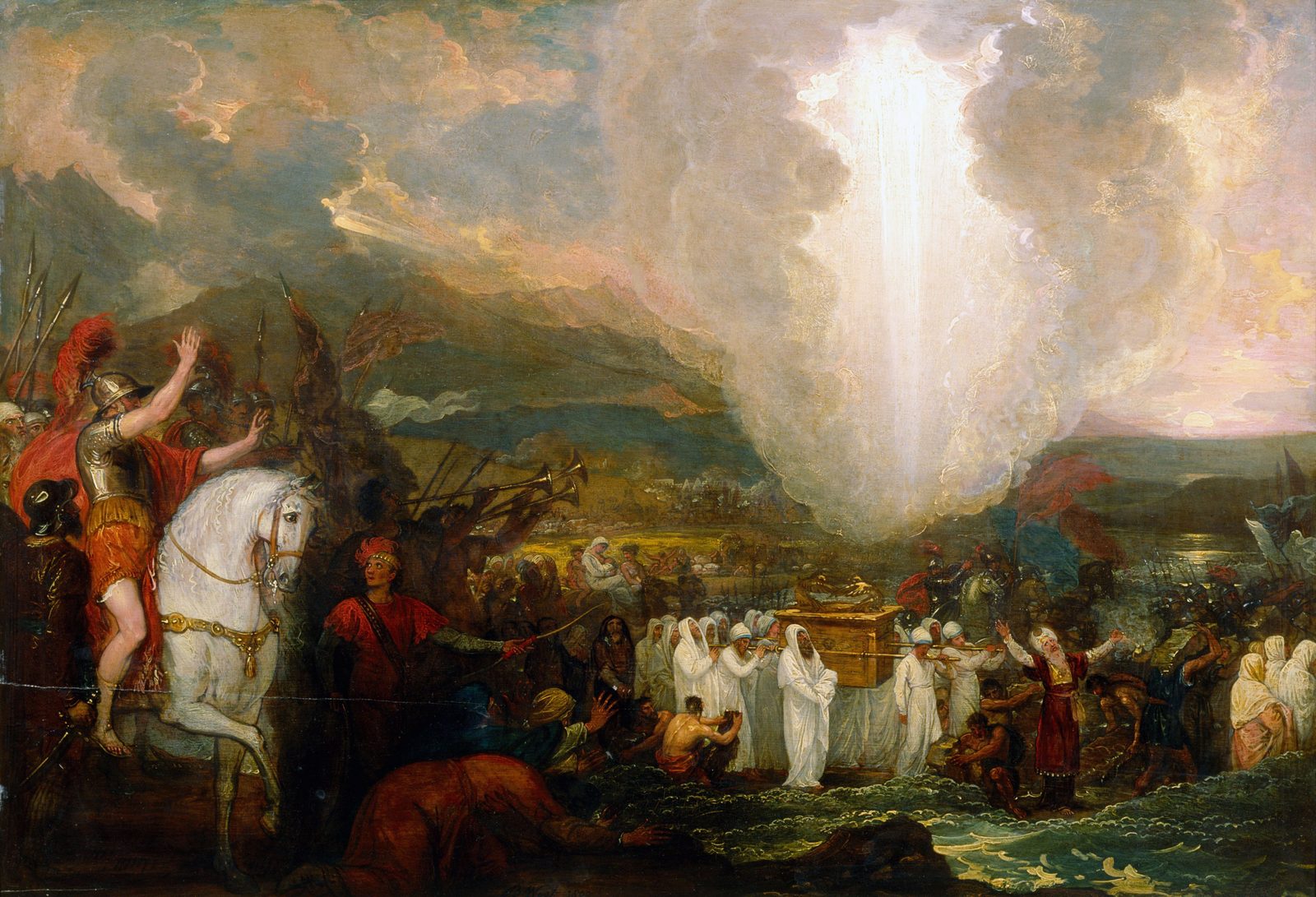
Joshua passing the River Jordan with the Ark of the Covenant. Benjamin West, 1800. Wikimedia Commons. Public domain.