
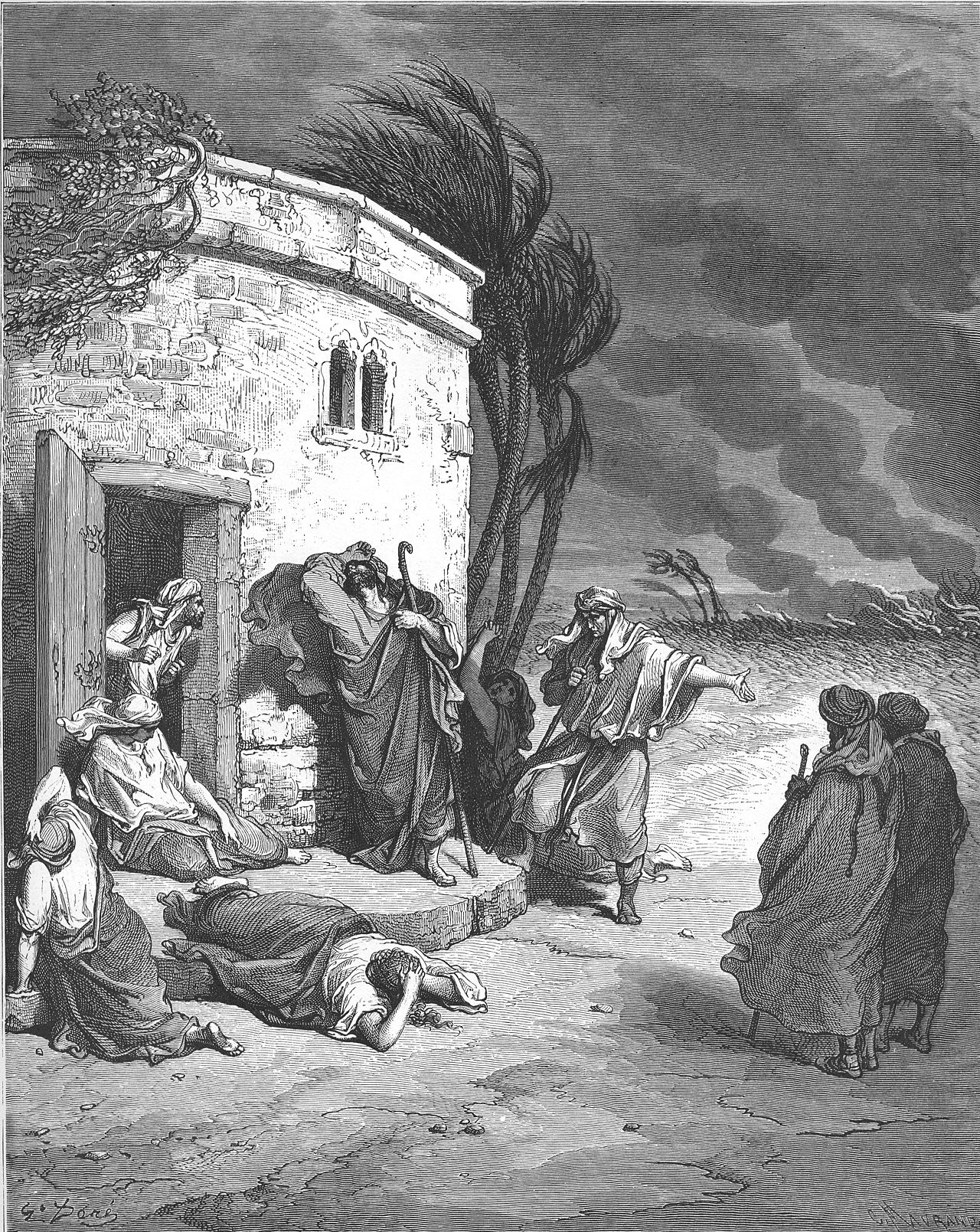
Jobchapter 4
21 verses · unknown · 10th century BC · Wisdom and poetry
Consider now, I plead: Who, being innocent, has ever perished? Or where have the upright been destroyed?
Introduction
unknown, Wisdom and poetry, Job Overview.
In this chapter Job's friends begin to answer him, and the book becomes a debate in three rounds. Eliphaz speaks first, likely as the eldest, and he comes from Teman in Edom, a district known for its wise men. His hearers shared his view that the world repays each person as he deserves. Listen for how gently he begins and how his tone changes. Listen closely to the night vision he reports, and ask what question it answers and whether it is Job's question. The book will later judge this speech, so weigh it as you hear it.
Context
- Who
- Hearers who had been told, kindly, that their trouble must be their own fault
- What
- The opening of Eliphaz's first speech, in which he reminds Job of his past counsel, states that the innocent do not perish, and reports a night vision.
- Where
- The ash heap outside Job's town; Eliphaz is from Teman in Edom.
- When
- Right after Job's lament in chapter 3, at the start of the first round of speeches.
- Why
- To set out the friends' first case, that suffering follows sin, in its most courteous and reasoned form.
Historical context
Eliphaz is from Teman, a district of Edom with a reputation across the region for wisdom, Jeremiah later asks whether counsel has perished from Teman. He speaks first because he is the eldest and the most respected, and he begins with real courtesy, reminding Job that he has strengthened many weak hands in his time.
Show the rest of the historical context, 3 more paragraphs
His authority rests on two things his world respected. The first is the settled principle that the innocent do not perish and the upright are not cut off, plough trouble, reap trouble. This was not a private opinion; it was the standard wisdom of the whole ancient Near East, taught in Egypt and Mesopotamia as well as in Israel, and it is mostly what the Book of Proverbs also says.
The second is a night vision. He describes a spirit passing before his face, the hair of his flesh standing up, a form he cannot make out, and a voice in the silence. Dream and vision oracles were a recognised channel of revelation in that world, and claiming one was a claim to unarguable authority. Hearers were meant to notice that the content of the vision, that no mortal is righteous before God, that even the angels are charged with folly, is true as far as it goes, and is being used to answer a question it was not addressed to.
The lion imagery in the middle uses several different words for lion, the roaring one, the fierce one, the old one, the whelps, a poetic sweep meaning the whole predatory household. His point is that the strongest wicked are broken and scattered anyway.
Significance
Eliphaz says nothing a devout hearer would have flagged as heresy. That is what makes the speech dangerous. Every sentence is orthodox, and the conclusion, that Job's disaster proves Job's guilt, is the one the whole book exists to demolish.
Show the rest of the significance, 1 more paragraph
First hearers were being trained to distinguish a true statement from a true diagnosis. Suffering is often the harvest of sin. It is not always. Treating a rule as a law turns comfort into accusation.
This chapter in Jewish lifeWhat this chapter is in Jewish life and reading.
What is done
Eliphaz's first speech has no reading in the site's table. The site's own table in src/lib/hebraic/readings.ts printed parashot total 0 and haftarah uses total 0 for Job, and no festival reading.
The corpus ties the chapter to study in two places. On the sixth verse it carries Bava Metzia 58b:9 with two entries of Ein Yaakov on the same tractate. On the second and third it carries Ein Yaakov on Sanhedrin. Midrash named for Torah portions appears as well: Midrash Tanchuma Buber, Nasso 26:1 on the seventeenth verse and Bereshit Rabbati, Parashat Toldot 10 on the twentieth.
How it is read
Rashi is the commentator whose English the corpus carries on this chapter, quoted here from The Judaica Press complete Tanach with Rashi, translated by A. J. Rosenberg, which Sefaria reports as CC-BY. He opens with who Eliphaz was. Eliphaz was Esau's son, and "because he was nurtured in Isaac’s bosom, he merited that the Shechinah rest upon him" (Rashi on Job 4:1:1). The Temanite comes from Tema, Esau's country, a note Rashi says is missing from some editions (Rashi on Job 4:1:2).
Rashi hears the speech as rebuke. Eliphaz marvels that one test has worn Job out (Rashi on Job 4:2:1). Job once steadied those who feared what had come on them, telling them, "Fear not, for that is the Divine Standard of Justice" (Rashi on Job 4:3:2). His words used to lift the stumbler (Rashi on Job 4:4:1). The ploughing and sowing of trouble Rashi reads as evil planned in thought and then done in deed (Rashi on Job 4:8:1). The three names for the lion he reads as the old, the middle and the cub, standing for kings, princes and slaves (Rashi on Job 4:10:1).
The longest note in the chapter explains how Eliphaz received his vision. Rashi reads the word as stolen, "because the Holy Spirit does not reveal itself to the prophets of the heathens in public" (Rashi on Job 4:12:1). He gives a parable of a king who visits his wife openly and his mistress in secret. God came to Abimelech, to Laban and to Balaam by night, and so to Eliphaz. With the prophets of Israel He spoke openly. Rashi adds that he found the passage in Midrash Tanchuma and points to Tanchuma Balak 8 and Tanchuma Buber Vayishlach 24.
That reading draws a line between the prophets of Israel and those of the nations, and a Christian reader should note it as Rashi's own. He does not deny that Eliphaz heard from God. He grants him the Shechinah in the first verse and prophecy here. The difference he draws lies in the manner of revelation.
The vision itself is read closely. The spirit that passed before Eliphaz was an angel (Rashi on Job 4:14:1). It stood before him, and he did not recognise its appearance (Rashi on Job 4:16:1). The question whether a mortal can be more righteous than God is "a wonder", a question that answers itself (Rashi on Job 4:17:1). The servants God does not trust are the righteous, whom He takes out of the world before their time (Rashi on Job 4:18:1). Their haughtiness and wisdom will be moved away and uprooted from them (Rashi on Job 4:21:1).
The corpus carries three further notes on this chapter without an English text, each marked linked because Sefaria holds no English version of the ref. They stand cited and unquoted at Ibn Ezra on Job 4:2:1, Metzudat David on Job 4:5:1 and Rashi on Job 4:13:1.
What the rabbis say
The corpus carries forty rabbinic locators on this chapter and the text of none, so each is cited here by ref. On the first verse it holds Aggadat Bereshit 56:1, Avot DeRabbi Natan 37:13 and Kohelet Rabbah 7:2:4. On the second it holds Bereshit Rabbah 31:5 and 56:4 and Ein Yaakov (Glick Edition), Sanhedrin 10:7. On the third it holds Ein Yaakov, Sanhedrin 10:9. On the sixth it holds Bava Metzia 58b:9, Ein Yaakov (Glick Edition), Bava Metzia 4:2 and Ein Yaakov, Bava Metzia 4:5.
The sayings on the fate of the wicked come next. On the seventh verse the corpus holds Midrash Lekach Tov, Leviticus 25:17:1, Midrash Sekhel Tov, Bereshit 27:33:3 and Otzar Midrashim, Midrash Vayosha ('And He Saved') 1:3. On the eighth it holds Midrash Lekach Tov, Exodus 10:13:1. On the ninth it holds Mekhilta DeRabbi Yishmael, Tractate Vayehi Beshalach 5:9 and Midrash Sekhel Tov at Bereshit 19:24:2 and Shemot 14:21:2. On the tenth it holds Bereshit Rabbah 31:12, 91:6 and 93:7.
The vision draws the largest group. On the twelfth verse the corpus holds Avot DeRabbi Natan, Recension B 16:6 and Bereshit Rabbah 52:5 and 74:7. On the thirteenth it holds Bamidbar Rabbah 20:12 and 22:2 and Midrash Lekach Tov, Genesis 20:3:1. On the fourteenth it holds Pirkei DeRabbi Eliezer 14:2. On the fifteenth it holds Midrash Tannaim on Deuteronomy 32:17:5 and Vayikra Rabbah 31:3. On the seventeenth it holds Bamidbar Rabbah 12:2, Bereshit Rabbah 53:2 and Midrash Tanchuma Buber, Nasso 26:1.
The close carries the rest. On the eighteenth verse the corpus holds Avot DeRabbi Natan, Recension B 43:18 and 44:11 and Midrash Tannaim on Deuteronomy 14:1:5. On the twentieth it holds Bereshit Rabbah 26:6 and Bereshit Rabbati, Parashat Toldot 10. On the twenty-first it holds Midrash Lekach Tov, Deuteronomy 32:6:1 and Midrash Tannaim on Deuteronomy 32:6:5. On the twenty-second it holds Vayikra Rabbah 18:1.
What each of them teaches is a saying of the rabbis, and is reported as theirs wherever this site quotes one. The quotations wait on a fetch that carries the text.
Sources: Rashi, Rashi on Job 4:1:1 to 4:21:1, The Judaica Press complete Tanach with Rashi, translated by A. J. Rosenberg, reported CC-BY; Rashi, Rashi on Job 4:13:1, cited by ref because the corpus carries no English text; Ibn Ezra, Ibn Ezra on Job 4:2:1, cited by ref because the corpus carries no English text; Metzudat David, Metzudat David on Job 4:5:1, cited by ref because the corpus carries no English text; The Sefaria corpus, scripts/data/sources/sefaria/job/4.json, the 40 Talmud and Midrash locators of this chapter; The site's own files, src/lib/hebraic/readings.ts, printing no portion, no Haftarah and no festival reading for this book.
The heads below are this chapter's scenes. The numbered points under each are its verses.
Eliphaz: Who Ever Perished Being Innocent?
Job 4:1-6
Then Eliphaz the Temanite replied: Eliphaz opens with a question that answers itself, so his gentleness is a formality before the argument begins. He recalls the counsel Job once gave, how he "strengthened their feeble hands". Then he turns that memory into a charge, "But now trouble has come upon you, and you are weary".
Job 4:1
“Then Eliphaz the Temanite answered - For seven days this person and his two friends had observed a profound silence, being awed and confounded at the sight of Job’s unprecedented affliction.”
Adam Clarke · Commentary on the Bible (1810-1826)evangelical
1 more voice on this verseWhat preachers and commentators have said about this verse, in their own words.
Job 4:1
“Eliphaz--the mildest of Job's three accusers. The greatness of Job's calamities, his complaints against God, and the opinion that calamities are proofs of guilt, led the three to doubt Job's integrity.”
Jamieson, Fausset & Brown · Commentary Critical and Explanatory on the Whole Bible (1871)reformed
Yet who can keep from speaking?: Eliphaz ventures a word with courtesy, and Barnes hears a gentle apology asking whether Job will be wearied by speaking. Clarke notes that the friends have words of rebuke ready, which Eliphaz expects Job to find heavy. Yet he cannot keep from speaking.
Job 4:2
“If we assay to commune with thee - Margin, A word. Hebrew - הנסה דבר dâbâr hanı̂câh. “May we attempt a word with thee?” This is a gentle and polite apology at the beginning of his speech - an inquiry whether he would take it as unkind if one should adventure on a remark in the way of argument. Jahn, in characterizing the part which Job’s three friends respectively take in the controversy, says: “Eliphaz is superior to the others in discernment and delicacy.”
Surely you have instructed many: Barnes reads the praise as sincere, for Job had instructed many who stumbled under trouble. Ephrem the Syrian adds that Job urged the weary to endure and so strengthened their feeble hands. Now Eliphaz sets that record beside Job's own trouble.
Job 4:3
“Behold, thou hast instructed many, and thou hast strengthened the weak hands. Thy words have upholden him that was falling, and thou hast strengthened the feeble knees. If the text of the historical account be regarded in itself, it is of great service to the reader, that in blessed Job, instead of the ripping up of vices, proclaim is made of his virtues by his reviling friends; for the testimony to our manner of life is never so strong, as when commendable things are told by him, who aims to fasten guilt upon our head.”
Gregory the Dialogist · written before 604 · Morals on the Book of Job, Book Vpatristic
1 more voice on this verse
Job 4:3
“Behold, thou hast instructed many - That is, thou hast instructed many how they ought to bear trials, and hast delivered important maxims to them on the great subject of the divine government. This is not designed to be irony, or to wound the feelings of Job. It is intended to recall to his mind the lessons which he had inculcated on others in times of calamity, and to show him how important it was now that he should reduce his own lessons to practice, and show their power in sustaining himself.”
Your words have steadied those who stumbled: Barnes notes that the Hebrew for stumbled can mean falling into sin or sinking under trouble, and the setting favours trouble. The feeble hands of verse 3 and the buckling knees here, which Clarke joins as one picture, return at Isaiah 35:3 and Hebrews 12:12. Job's words once steadied others.
Job 4:4
“Thy words have upholden him that was falling - That is, either falling into sin, or sinking under calamity and trial. The Hebrew will bear either interpretation, but the connection seems to require us to understand it of one who was sinking under the weight of affliction. The feeble knees - Margin, “bowing.” The knees support the frame. If they fail, we are feeble and helpless. Hence, their being weak, is so often used in the Bible to denote imbecility.”
But now trouble has come upon you: Trouble now strikes the man who steadied others, and Clarke paraphrases Eliphaz as saying Job cannot use the words he once gave. Matthew Henry answers that Eliphaz makes too light of Job's afflictions, as if trouble had only touched him. The one who strengthened others is dismayed.
Job 4:5
“But now it is come upon thee - That is, calamity; or, the same trial which others have had, and in which thou hast so successfully exhorted and comforted them. A similar sentiment to that which is here expressed, is found in Terence: Facile omnes, cum valemus, recta consilia aegrotis damus. And. ii. i. 9. It toucheth thee - That is, affliction has come to yourself. It is no longer a thing about which you can coolly sit down and reason, and on which you can deliver formal exhortations.”
Is your reverence not your confidence: Eliphaz questions Job's reverence and uprightness. Clarke hears a challenge asking where Job's fear of God has gone, and Wesley takes Eliphaz to mean Job's piety was mere talk and appearance. Matthew Henry answers from Proverbs 24:10 that faint strength in the day of distress is still strength.
Job 4:6
“Thy fear - We now plainly see what was the nature of thy fear of God, thy confidence in him, the uprightness of thy ways, and thy hope in God's mercy. Thy present carriage discovers that it was but mere talk and appearance. Innocent - Therefore thou art guilty of some great, though secret crimes, and thy sin hath now found thee out.”
John Wesley · Explanatory Notes upon the Old Testament (1765)evangelical
1 more voice on this verse
Job 4:6
“Is not this thy fear - I think Coverdale hits the true meaning: Where is now thy feare of God, thy stedfastnesse, thy pacience, and the perfectnesse of thy life? If these be genuine, surely there is no cause for all this complaint, vexation, and despair. That this is the meaning, the next words show.”
Adam Clarke · Commentary on the Bible (1810-1826)evangelical
Who, being innocent, has ever perished?: Eliphaz states the friends' case in one question, "Who, being innocent, has ever perished," the claim that suffering proves guilt. The reader of chapter 1 holds the counterexample, sitting in the ashes. Eliphaz rests on what he has observed, and chapters 1 and 2 show what heaven permitted unseen.
Job 4:7
“Did not righteous Abel perish being innocent? and was he not cut off in the beginning of his days? Was not righteous Lot burnt out of house and harbour, and forced to retire to a melancholy cave? Was not righteous Jacob a Syrian ready to perish?”
Matthew Henry · Commentary on the Whole Bible (1707-1721)puritan
Job 4:8-9
those who plow iniquity: Eliphaz supports his doctrine with a farmer's proverb, sowing and reaping standing for sin and its punishment. The next line, "By the breath of God they perish," carries the figure into judgment, breath and wind doing what plow and harvest only pictured.
Job 4:8
“Even as I have seen - Eliphaz appeals to his own observation, that people who had led wicked lives were suddenly cut off. Instances of this kind he might doubtless have observed - as all may have done. But his inference was too broad when he concluded that all the wicked are punished in this manner. It is true that wicked people are thus cut off and perish; but it is not true that all the wicked are thus punished in this life, nor that any of the righteous are not visited with similar calamities.”
2 more voices on this verse
Job 4:8
“Even, as I have seen, they that plough iniquity, and sow sorrows, and reap the same, by the blast of God do they perish, and by the breath of His nostrils are they consumed. To 'sow griefs' is to utter deceits, but to 'reap griefs' is to prevail by so speaking. Or, surely, they 'sow griefs,' who do froward actions, they 'reap griefs,' when they ate punished for this forwardness.”
Gregory the Dialogist · written before 604 · Morals on the Book of Job, Book Vpatristic
Job 4:8
“They that plough iniquity - A proverbial form of speech drawn from nature. Whatever seed a man sows in the ground, he reaps the same kind; for every seed produces its like.”
Adam Clarke · Commentary on the Bible (1810-1826)evangelical
By the breath of God they perish: Barnes takes the blast of His anger from the hot wind that sweeps a field, the harvest of those who plow iniquity in verse 8. Matthew Henry notes a reading in which the breath of God points at the wind of Job 1:19. Eliphaz never says it aloud.
Job 4:9
“The man of sin is said to be consumed with the breath of Christ's mouth, 2 Thess. ii. Some think that in attributing the destruction of sinners to the blast of God, and the breath of his nostrils, he refers to the wind which blew the house down upon Job's children, as if they were therefore sinners above all men because they suffered such things.”
Matthew Henry · Commentary on the Whole Bible (1707-1721)puritan
Job 4:10-11
The lion may roar: The lion images widen the doctrine from farming to power: the lion roars and growls, "yet the teeth of the young lions are broken". Delitzsch notes that the Hebrew names the lion five ways, strength named every way it can be named only to be dismantled in turn.
The old lion perishes for lack of prey: Barnes notes that the word for the old lion names a lion in his full strength. Jamieson, Fausset and Brown see the whole line die out, the strong lion starved and the cubs of the lioness scattered. The picture falls hard on a bereaved father.
Job 4:11
“The old lion - The word used here, לישׁ layı̂sh, denotes a lion, “so called,” says Gesenius,” from his strength and bravery,” or, according to Urnbreit, the lion in the strength of his old ago; see an examination of the word in Bochart, Hieroz. P. i. Lib. iii. c. 1, p. 720. Perisheth for lack of prey - Not withstanding his strength and power. That is, such a thing sometimes occurs. Eliphaz could not maintain that it always happened.”
Eliphaz's Night Vision: Can Mortal Man Be Just Before God?
Job 4:12-14
Now a word came to me secretly: Eliphaz turns from proverb to private experience, "my ears caught a whisper of it," and brings in the vision that carries his doctrine's authority. The setting is night. Davidson notes that Eliphaz stakes his argument on this experience, since no Scripture had yet been given him to appeal to.
Job 4:12
“Now a hidden word was spoken to me. For the invisible Son is called 'the hidden Word,' concerning Whom John saith, In the beginning was the Word. Which he the same person teaches to be 'hidden' in that he adds, and the Word was with God, and the Word was God. But this 'hidden Word' is delivered to the minds of the Elect, when the power of the Only-Begotten Son is made manifest to believers.”
Gregory the Dialogist · written before 604 · Morals on the Book of Job, Book Vpatristic
2 more voices on this verse
Job 4:12
“Now a thing was secretly brought to me - To give himself the more authority, he professes to have received a vision from God, by which he was taught the secret of the Divine dispensations in providence; and a confirmation of the doctrine which he was now stating to Job; and which he applied in a different way to what was designed in the Divine communication.”
Adam Clarke · Commentary on the Bible (1810-1826)evangelical
Job 4:12
“And it is but a little of divine knowledge that the best receive in this world. We know little in comparison with what is to be known, and with what we shall know when we come to heaven. How little a portion is heard of God! ch. xxvi.”
Matthew Henry · Commentary on the Whole Bible (1707-1721)puritan
In disquieting visions in the night: Barnes notes that the Hebrew for disquieting describes thoughts that divide and distract the mind. Wesley separates visions from dreams, God speaking to men awake in the one and asleep in the other. Eliphaz claims a revelation for his doctrine.
Job 4:13
“Visions differed from dreams herein, that God imparted his mind to men in dreams when asleep, but in visions, when they were awake. And these visions sometimes happened by day, but most frequently by night. Sleep - In the dead of the night, when men usually are in a deep sleep; though Eliphaz was not now asleep.”
John Wesley · Explanatory Notes upon the Old Testament (1765)evangelical
fear and trembling came over me: Barnes notes that the Greek version renders the fear as shuddering, a horror that made the bones of Eliphaz shake. Matthew Henry takes the trembling as the humbling God sends before He speaks. The dread lends weight to what follows.
Job 4:14
Fear came upon me - Margin, “Met me.” The Chaldee Paraphrase renders this, “a tempest,” זיקא. The Septuagint, φρίκη frikē - “shuddering,” or “horror.” The sense is, that he became greatly alarmed at the vision. Which made all my bones to shake - Margin, as in Hebrew, the multitude of my bones. A similar image is employed by Virgil, Obstupuere auimis, gelidusque per ima cucurrit Ossa tremor; Aeneid ii. 120. “A cold tremor ran through all their bones.”
Job 4:15-17
Then a spirit glided past my face: A spirit "glided past my face" and stood, its form beyond discerning. Then "a whispering voice" gave the doctrine's climax, "Can a mortal be more righteous than God, or a man more pure than his Maker". The book's crux is whether Eliphaz applied a true word to a false case.
Job 4:15
“Then a spirit passed before my face - He does not intimate whether it was the spirit of a man, or an angel who thus appeared. The belief in such apparitions was common in the early ages, and indeed has prevailed at all times. No one can demonstrate that God could not communicate his will in such a manner as this, or by a messenger deputed from his immediate presence to impart valuable truth to people. The hair of my flesh stood up - This is an effect which is known often to be produced by fear.”
1 more voice on this verse
Job 4:15
“A spirit - An angel in visible shape, otherwise he could not have discerned it. Stood up - Through that excessive horror caused by so glorious, unusual, and terrible a presence.”
John Wesley · Explanatory Notes upon the Old Testament (1765)evangelical
I heard a whispering voice: Jamieson, Fausset and Brown hear a gentle murmur, the sound of 1 Kings 19:12, where the LORD came to Elijah in a still, small voice. Ishodad of Merv notes that a whisper has no form to be seen. Eliphaz saw a form but no face.
Job 4:16
“It stood still--At first the apparition glides before Eliphaz, then stands still, but with that shadowy indistinctness of form which creates such an impression of awe; a gentle murmur: not (English Version): there was silence; for in 1Ki 19:12, the voice, as opposed to the previous storm, denotes a gentle, still murmur.”
Jamieson, Fausset & Brown · Commentary Critical and Explanatory on the Whole Bible (1871)reformed
1 more voice on this verse
Job 4:16
“An image - I saw some visible resemblance, though in a confused manner. Silence - The spirit, which possibly had made some noise with his motion, now standing still made no noise; all other persons and things about me were silent, and I also kept in my voice and breath, that I might distinctly hear. In the Hebrew, the words run thus, silence and a voice I heard.”
John Wesley · Explanatory Notes upon the Old Testament (1765)evangelical
The two words for man mark weakness and strength, as Jamieson, Fausset and Brown note, so no man, feeble or mighty, is righteous before God. Olympiodorus hears Eliphaz saying that no one is wholly blameless before the eye of God. Job grants the point at Job 9:2.
Job 4:17
“Shall mortal man be more just than God? Shall a man be more pure than his Maker? Human righteousness compared with the righteousness of God is unrighteousness, for even a candle is seen to shine bright in the dark, but being set in the ray of the sun its light is darkened. What then did Eliphaz learn when he was transported in contemplation, saving that man cannot be justified in comparison with God?”
Gregory the Dialogist · written before 604 · Morals on the Book of Job, Book Vpatristic
Job 4:18-21
If God puts no trust in His servants: If God "charges His angels with error," how much more those "who dwell in houses of clay, whose foundations are in the dust". Clarke reads the moth as the frailest of creatures, the measure of how quickly a house is destroyed. The speech ends with men who "die without wisdom".
Job 4:18
“I think it would bear this reading, repeating the negation, which is very common: He will put no trust in his saints; nor will he glory in his angels (in angelis suis non ponet gloriationem) or make his boast of them, as if their praises, or services, added any thing to him: it is his glory that he is infinitely happy without them.”
Matthew Henry · Commentary on the Whole Bible (1707-1721)puritan
1 more voice on this verse
Job 4:18
“Behold, His servants are not stedfast, and in His Angels He found folly: How much more in them that dwell in houses of clay, whose foundation is in the dust, which shall be consumed as by the moth? Though the Angelical nature, by being fixed in contemplation of the Creator, remains unchangeable in its own state, yet hereby, that it is a created being, it admits in itself the variableness of change. Now to be changed is to go from one thing into another, and to be without stability in one's self.”
Gregory the Dialogist · written before 604 · Morals on the Book of Job, Book Vpatristic
those who dwell in houses of clay: Jamieson, Fausset and Brown note that houses of sun-dried clay were common in the East and easily washed away. The body is the house, and its foundation is the dust of Genesis 3:19. Paul calls it an earthly tent at 2 Corinthians 5:1.
Job 4:19
“How much less - (אף 'aph). This particle has the general sense of addition, accession, especially of something more important;” yea more, besides, even.” Gesenius. The meaning here is, “how much more true is this of man!” He puts no confidence in his angels; he charges them with frailty; how much more strikingly true must this be of man!”
They are smashed to pieces from dawn to dusk: Barnes reads smashed to pieces from dawn to dusk as a life that lasts scarcely one day, as at Isaiah 38:12. Clarke adds that at every moment men perish while others are born. Eliphaz means that such frail men perish unnoticed.
Job 4:20
“They are destroyed from morning to evening - In almost every moment of time some human being comes into the world, and some one departs from it. Thus are they “destroyed from morning to evening.” They perish for ever - יאבדו yobedu; peribunt, they pass by; they go out of sight; they moulder with the dust, and are soon forgotten. Who regards the past generation now among the dead?”
Adam Clarke · Commentary on the Bible (1810-1826)evangelical
1 more voice on this verse
Job 4:20
“They shall be cut off from morning to evening. For the sinner is 'cut off from morning to evening,' in that from the beginning of his life to the end thereof he is ever getting wounded by the commission of sin. For the reprobate by increase in wickedness are at all times redoubling blows upon themselves, cut off by which, they may fall headlong into the pit. And it is well said of them by the Psalmist, Bloody and deceitful men shall not halve their days.”
Gregory the Dialogist · written before 604 · Morals on the Book of Job, Book Vpatristic
Are not their tent cords pulled up: The Hebrew word for tent cords can also mean what is excellent, and the King James reads their excellency. Clarke and Wesley take that excellency as beauty, strength and wisdom, all pulled up at death. Here men die like a tent pulled down.
Job 4:21
“The design of the spirit is to show that the continued existence of weak man proves the inconceivable wisdom and holiness of God, which alone save man from ruin [UMBREIT]. BENGEL shows from Scripture that God's holiness (Hebrew, kadosh) comprehends all His excellencies and attributes.”
Jamieson, Fausset & Brown · Commentary Critical and Explanatory on the Whole Bible (1871)reformed
1 more voice on this verse
Job 4:21
“Doth not their excellency ... - Dr. Good renders this, “Their fluttering round is over with them,” by a very forced construction of the passage. Translators and expositors have been very much divided in opinion as to its meaning; but the sense seems to be, that whatever is excellent in people is torn away or removed. Their excellence does not keep them from death, and they are taken off before they are truly wise. The word “excellency” here refers not only to moral excellency or virtue, but everything in which they excel others.”
Keep studying
Sources for this chapter
The summary
Jamieson, Fausset & Brown, Commentary Critical and Explanatory; John Wesley, Notes on the Old Testament and Matthew Henry, Complete Commentary.
The exposition
A. B. Davidson, The Book of Job, Cambridge Bible; Adam Clarke, Commentary on the Bible; Albert Barnes; Ephrem the Syrian, Commentary on Job; Franz Delitzsch, Biblical Commentary on the Book of Job; Ishodad of Merv, Commentary on Job; Jamieson, Fausset & Brown, Commentary Critical and Explanatory on the Whole Bible; John Gill, Exposition of the Old Testament; John Wesley, Explanatory Notes upon the Old Testament; Matthew Henry, Commentary on the Whole Bible and Olympiodorus of Alexandria, Commentary on Job.