
Jobchapter 36
33 verses · unknown · 10th century BC · Wisdom and poetry
Indeed, God is mighty, but He despises no one; He is mighty in strength of understanding.
Introduction
unknown, Wisdom and poetry, Job Overview.
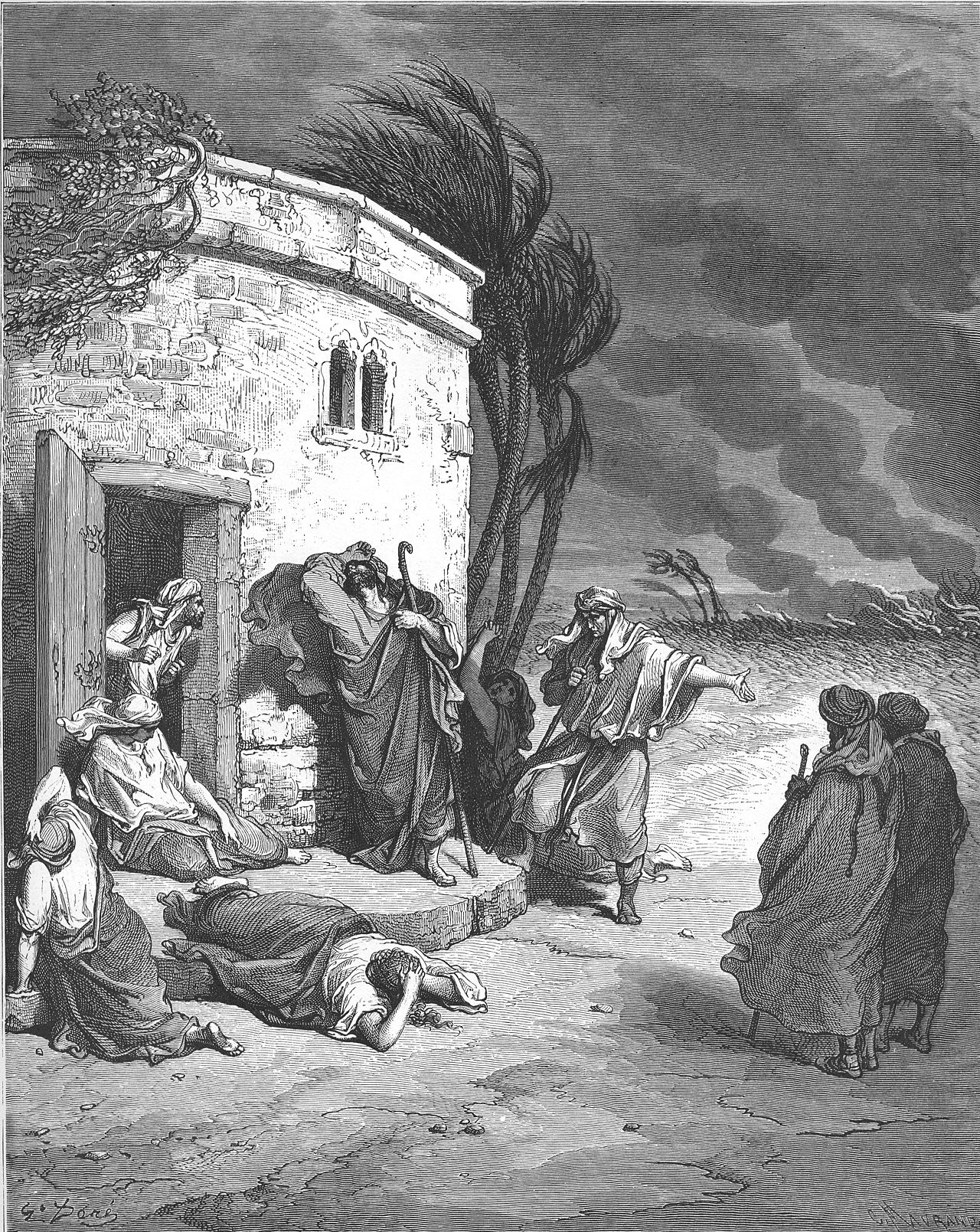
Elihu begins his last speech in this chapter, and it runs through chapter 37. He claims to speak on God's behalf with knowledge brought from afar. His hearers read the sky for a living, and while he talks a storm is building. The chapter moves from an argument about affliction to a description of rain and cloud. Listen for the idea that suffering can teach, and for the warning against bitterness. Then watch the weather, because the storm he describes is the one from which God will speak.
Context
- Who
- Hearers who read the sky for a living
- What
- The first part of Elihu's last speech, on affliction as God's instruction and on His power in rain and storm.
- Where
- The ash heap, with storm clouds gathering over the land.
- When
- The book sets Job in the age of the patriarchs, commonly placed about 2000 to 1800 BC, and it gives no date.
- Why
- To urge Job to learn from his suffering and to turn his eyes to God's greatness in the sky.
Historical context
Elihu's final speech starts as argument and ends as weather report, and the two run together because a storm is visibly building while he talks.
Show the rest of the historical context, 3 more paragraphs
His argument is that God uses affliction as instruction. He does not preserve the life of the wicked but gives justice to the poor; he does not withdraw his eyes from the righteous but sets them with kings on the throne. If they are bound in fetters and held in cords of affliction, then he shows them their work and commands that they return from iniquity. That is the discipline reading of suffering, and it is the most humane version of the case anyone in the book has made. His warning against it is that a man in that state must not choose bitterness, and must not let a large ransom turn him aside, the temptation to buy his way out rather than learn.
Then the sky takes over. He draws up the drops of water; they distil rain from his vapour, which the clouds pour down abundantly. That is a startlingly accurate description of the water cycle: water lifted, condensed, and returned. Can any understand the spreadings of the clouds, or the noise of his tabernacle?
The last lines are what a person actually sees at the front edge of a desert thunderstorm. He spreads his light on the clouds and covers the bottom of the sea; by these he judges the peoples and gives food in abundance; he covers his hands with the lightning and commands it to strike the mark. In that country rain was survival and a violent storm was terror, and both arrived in the same cloud.
Significance
Elihu's best contribution is here: suffering can be God's schoolroom rather than his courtroom. Hearers could use that, and Israel's later teaching on discipline sounds very like it.
Show the rest of the significance, 1 more paragraph
But he still assumes Job needs the lesson. And while he explains the storm as a sermon illustration, the storm itself is coming for a purpose he knows nothing about.
This chapter in Jewish lifeWhat this chapter is in Jewish life and reading.
What is done
This chapter has no place in the synagogue year. The site's own table in src/lib/hebraic/readings.ts printed parashot total 0 and haftarah uses total 0 for the book of Job, and no festival reading.
The corpus joins it to the study of the Torah portions through the Midrash arranged by them. Under the tenth verse it carries Midrash Tanchuma, Re'eh 2:1. Under the thirty-first verse it carries Midrash Tanchuma Buber, Beshalach 20:1.
How it is read
Rashi and Malbim are the two commentators on this chapter whose English the corpus carries. Rashi is quoted from The Judaica Press complete Tanach with Rashi, translated by A. J. Rosenberg, which Sefaria reports as CC-BY. Malbim is quoted from Malbim's Job, trans. Jeremy I. Pfeffer. Ktav, 2003, which Sefaria reports as CC-BY.
The speaker is Elihu, and Rashi explains why the chapter opens with him continuing. He reports from the reasons of Rabbi Moshe Hadarshan that Elihu gave three addresses, one for each of Job's three companions, and that this fourth is therefore called an addition (Rashi on Job 36:1:1). At the second verse he calls the phrase wholly Aramaic and reads its key word as waiting, after Jonathan's rendering of a verse in Isaiah (Rashi on Job 36:2:1). At the fourth verse Elihu begins because Job thinks his own knowledge perfect (Rashi on Job 36:4:1).
Rashi reads the eighth verse of righteous men bound by suffering and caught by poverty. That comes only because they sinned, and God requites them for their own good, to cleanse them and call them back to Him (Rashi on Job 36:8:1). At the ninth verse he gives the key to the whole speech. "All the words of Elihu were complete consolations and not chidings" (Rashi on Job 36:9:1). The sufferings tell the righteous that they sinned, and through them they repent of iniquity (Rashi on Job 36:10:1).
The wicked of heart curse and blaspheme when suffering comes upon them (Rashi on Job 36:13:1). The poor man God brings out of Gehinnom because of the poverty He brought upon him (Rashi on Job 36:15:1). At the sixteenth verse Rashi names a further benefit to Job. The sufferings drew him out of Gehinnom, whose mouth is narrow and whose base is wide (Rashi on Job 36:16:1). He is to accept them lovingly (Rashi on Job 36:17:1). He should not wish for the night that came to Amraphel, to Egypt and to Sennacherib, who perished from this world and from the world to come (Rashi on Job 36:20:1).
At the twenty-second verse Rashi sets God beside a mortal king. God warns the sinner before the plague, as He warned Pharaoh before each plague. A mortal king comes on his enemy suddenly, for a warning would let him repent and escape (Rashi on Job 36:22:1). Malbim frames the sixth verse by an idea embedded in the soul. God is the source of good and so must hate evil, and the wicked can expect no support from Him (Malbim on Job 36:6:2). Rashi closes with praise. To mention God's ways is already to magnify the works of His attributes (Rashi on Job 36:24:1).
The corpus carries two further notes on this chapter without an English text, each marked linked because Sefaria holds no English version of the ref. They stand cited by ref and unquoted. Two stand at Ibn Ezra on Job 36:3:1 and 36:12:1.
What the rabbis say
The corpus carries forty rabbinic locators on this chapter and the text of none, so each is cited and linked here rather than quoted. On the second verse it holds Avot DeRabbi Natan, Recension B 40:4. On the third verse it holds Aggadat Bereshit 81:1 and Bamidbar Rabbah 2:8. On the fifth verse it holds Berakhot 8a:3 and Ein Yaakov (Glick Edition), Berakhot 1:40. On the sixth verse it holds Taanit 3b:12. On the seventh verse it holds Aggadat Bereshit 70:5 and Bamidbar Rabbah 22:5. On the tenth verse it holds Midrash Tanchuma, Re'eh 2:1.
On the eleventh verse it holds Jerusalem Talmud Taanit 3:10:3 and Sanhedrin 108a:7. On the twelfth verse it holds Avot DeRabbi Natan 11:1. On the thirteenth verse it holds Ein Yaakov (Glick Edition), Sotah 7:35 and Ein Yaakov, Sotah 7:40. On the fourteenth verse it holds Mekhilta DeRabbi Shimon Ben Yochai 14:25 and Mekhilta DeRabbi Yishmael, Tractate Vayehi Beshalach 7:5. On the fifteenth verse it holds Ein Yaakov, Yevamot 12:2 and Pesikta DeRav Kahana 17:5. On the sixteenth verse it holds Aggadat Bereshit 61:1 and Bamidbar Rabbah 10:2. On the eighteenth verse it holds Midrash Aggadah, Genesis 49:11:4.
On the nineteenth verse it holds Ein Yaakov (Glick Edition), Sanhedrin 6:10 and Ein Yaakov, Sanhedrin 6:9. On the twenty-first verse it holds Bava Batra 116a:14 and Ein Yaakov, Bava Batra 8:7. On the twenty-second verse it holds Bamidbar Rabbah 21:22 and Ein Yaakov (Glick Edition), Berakhot 9:8. On the twenty-third verse it holds Jerusalem Talmud Kiddushin 1:7:6 and Jerusalem Talmud Peah 1:1:22. On the twenty-fourth verse it holds Berakhot 58a:6 and Jerusalem Talmud Berakhot 9:1:33. On the twenty-seventh verse it holds Bereshit Rabbah 13:10 and Bereshit Rabbah 13:15. On the thirtieth verse it holds Bereshit Rabbah 26:7.
On the thirty-first verse it holds Midrash Lekach Tov, Genesis 1:6:1 and Midrash Tanchuma Buber, Beshalach 20:1. On the thirty-second verse it holds Ein Yaakov (Glick Edition), Taanit 1:26 and Ein Yaakov, Taanit 1:27. On the thirty-third verse it holds Avodah Zarah 76a:7 and Bava Batra 19a:12. What each of them teaches is a saying of the rabbis, and is reported as theirs wherever this site quotes one. The quotations wait on a fetch that carries the text.
Sources: Rashi, Rashi on Job 36:1:1 to 36:24:1, The Judaica Press complete Tanach with Rashi, translated by A. J. Rosenberg, reported CC-BY; Malbim, Malbim on Job 36:6:2, Malbim's Job, trans. Jeremy I. Pfeffer. Ktav, 2003, reported CC-BY; Ibn Ezra, Ibn Ezra on Job 36:3:1 and 36:12:1, cited by ref because the corpus carries no English text; The Sefaria corpus, scripts/data/sources/sefaria/job/36.json, the 40 Talmud and Midrash locators of this chapter; The site's own files, src/lib/hebraic/readings.ts, printing no portion, no Haftarah and no festival reading for this book.
The heads below are this chapter's scenes. The numbered points under each are its verses.
Elihu: God Is Mighty, and Despiseth Not Any
Job 36:1-4
And Elihu continued: Elihu asks a last hearing, since “I get my knowledge from afar”. Gill reads this as Elihu reaching past the friends' arguments for a wider view of providence. Henry reads “one perfect in knowledge is with you” as bold self-assurance that the whirlwind speeches will answer on their own terms.
Job 36:1
“Elihu also proceeded - Hebrew added - ויסף vayâsaph. Vulgate “addens;” Septuagint, Ηροσθεὶς Eerostheis - “adding, or proceeding.” The Hebrew commentators remark that this word is used because this speech is “added” to the number which it might be supposed he would make. There had been “three” series of speeches, by Job and his friends, and in each one of them Job had spoken three times. Each one of the three friends had also spoken thrice, except Zophar, who failed to reply when it came to his turn.”
Barnes reads bear with me a little longer as a plea to show more on God's behalf past his place in the order of speeches. Jarchi, he reports, heard Chaldee words in the verse. Charles Spurgeon admires the courtesy of it.
Job 36:2
“ELIHU was sufficiently severe with Job, but as this arose from his honest conviction that Job had spoken amiss, we cannot blame him. The style of his address is, in some points, highly commendable. We admire the courtesy which moved him to say, "Suffer me a little." It shows some little consideration for his audience. It is to be feared that under our preaching our people suffer greatly and we do not sympathize with their sense of weariness—otherwise we might often apologize in the terms of Elihu, saying, "Suffer me a little." I admire Elihu's attempt at brevity.”
1 more voice on this verse
Job 36:2
“Suffer me a little - Even beyond the regular order of speaking; or, allow me to go on though I have fully occupied my place in the “number” of speeches. Jarchi remarks that this verse is “Chaldaic,” and it is worthy of observation that the principal words in it are not those ordinarily used in Hebrew to express the same thought, but are such as occur in the Chaldee. The word rendered “suffer” (כתר kâthar) has here a signification which occurs only an Syriac and Chaldee.”
I will ascribe justice to my Maker: Jamieson, Fausset and Brown set this against Job's charge of wrong, which Elihu answered at Job 34:10-12. They quote Barnes: whoever looks into God's ways should presume at the outset that they are just. John Wesley takes knowledge from afar as God's works.
Job 36:3
“I will repeat my knowledge from the beginning. But because, on the mention of knowledge, his pride of heart hath displayed itself in his voice, he is plainly discovered to be a haughty person, if he does not quickly conceal himself by some disguise. Whence in concealing his own arrogance, he immediately introduces the righteousness of the Lord, and says, And I will prove my Maker just. In order that, while he speaks as if in behalf of God's righteousness, whatever escapes from him arrogantly, may be excused in the judgment of man.”
Gregory the Dialogist · written before 604 · Morals on the Book of Job, Book XXVIpatristic
2 more voices on this verse
Job 36:3
“I will fetch my knowledge from afar - What I say shall not be mere commonplace. It shall be the result of reflection on subjects that lie out of the ordinary range of thought. The idea is, that he did not mean to go over the ground that had been already trodden, or to suggest such reflections as would occur to anyone, but that he meant to bring his illustrations from abstruser matters, and from things that had escaped their attention.”
Job 36:3
“I will not confine my discourse to thy particular case, but wilt justify God by declaring his great and glorious works of creation and providence both in the heaven and in the earth, and the manner of his dealing with men in other parts and ages of the world. Ascribe - I will clear and maintain this truth, that God is righteous in all his ways.”
John Wesley · Explanatory Notes upon the Old Testament (1765)evangelical
one perfect in knowledge is with you: Albert Barnes recalls Job 13:7-8, where Job charged the friends with speaking wickedly on God's behalf. Elihu claims his words are free of it. Adam Clarke reads one perfect in knowledge as Job himself, a man able to judge what is said.
Job 36:4
“For truly my words are without falsehood. Even righteous men, when they see that they cannot be understood by their feeble hearers, are frequently wont to praise the things they say. Not because they are eager for their own praise, but to inflame their hearers with an anxious desire of listening to them; in order that, while they are uttered by their voice, they may be embraced, with more ardent affection, by the hearts of their hearers.”
Gregory the Dialogist · written before 604 · Morals on the Book of Job, Book XXVIpatristic
1 more voice on this verse
Job 36:4
“I will not "speak wickedly for God," as the friends (Job 13:4, 7, 8) --that is, vindicate God by unsound arguments. he that is perfect, &c.--Rather, as the parallelism requires, "a man of integrity in sentiments is with thee" (is he with whom thou hast to do).”
Jamieson, Fausset & Brown · Commentary Critical and Explanatory on the Whole Bible (1871)reformed
Job 36:5-12
God is mighty, but He despises no one: After “He opens their ears to correction” the obedient “end their days in prosperity”. Barnes calls this a chastening theory, correction meant to be heard, set against the friends' retribution. Delitzsch notes one pattern covering the righteous of verse 7 and men “bound with chains” in verse 8.
Job 36:5
“Rather, "strength of understanding" (heart) the force of the repetition of "mighty"; as "mighty" as God is, none is too low to be "despised" by Him; for His "might" lies especially in "His strength of understanding," whereby He searches out the most minute things, so as to give to each his right.”
Jamieson, Fausset & Brown · Commentary Critical and Explanatory on the Whole Bible (1871)reformed
2 more voices on this verse
Job 36:5
“Despiseth - His greatness doth not make him (as it doth men) despise, or oppress the meanest. Wisdom - His strength is guided by wisdom, and therefore cannot do any thing unbecoming God, or unjust to his creatures.”
John Wesley · Explanatory Notes upon the Old Testament (1765)evangelical
Job 36:5
WE cannot wonder that, in the extreme bitterness of his soul, Job was driven to utter some expressions which he would not, afterwards, have attempted to justify. Among the rest Job had thought and almost said that God had despised him. In the 10th chapter, at the 3rd verse, he appealed to Him thus, "Is it good unto You that You should oppress, that You should despise the work of Your hands?"
He does not keep the wicked alive: Matthew Henry hears a reply to chapter 21, where Job said the wicked stay alive, grow old and are mighty in power. Albert Barnes notes that Elihu here keeps the friends' view of justice in this life. The afflicted, says Adam Clarke, are also the humble.
Job 36:6
“He preserveth not the life - He will not give life to the wicked; all such forfeit life by their transgressions. But giveth right - Justice will he give to the afflicted or humble, עניים aniyim.”
Adam Clarke · Commentary on the Bible (1810-1826)evangelical
2 more voices on this verse
Job 36:6
“But He saveth not the wicked, and giveth judgment to the poor. Holy Scripture is frequently wont to call the humble, 'poor.' Whence they are mentioned in the Gospel, with the addition, 'spirit,' when it is said, Blessed are the poor in spirit, for theirs is the kingdom of heaven. [Matt. 5, 3] For, because riches visibly manifest the powerful, those are poor in their own sight, who are not puffed up in their own minds.”
Gregory the Dialogist · written before 604 · Morals on the Book of Job, Book XXVIpatristic
Job 36:6
“Job had said that the wicked live, become old, and are mighty in power, ch. xxi. "No," says Elihu: "he seldom suffers wicked men to become old. He preserves not their life so long as they expected, nor with that comfort and satisfaction which are indeed our life; and their preservation is but a reservation for the day of wrath," Rom. ii.”
Matthew Henry · Commentary on the Whole Bible (1707-1721)puritan
His eyes off the righteous: Adam Clarke hears Psalm 34:15, where the eyes of the Lord are on the righteous. He would move the verb establish into the first line, so that God seats the righteous with kings. Albert Barnes adds that God watches them in affliction.
Job 36:7
“He will not withdraw His eyes from the righteous, but establisheth kings on the throne for ever, and there are they exalted. For God is perhaps believed to have withdrawn His eyes from the righteous, because they are here wounded by the injustice of the unrighteous, and are unavenged. But He then more regards His servants, when the iniquity of their persecutor unjustly afflicts them. For, beholding what they here humbly endure, He doubtless even now looks forward to the recompense He is there mercifully to bestow on them. He does not therefore withdraw His eyes from the righteous.”
Gregory the Dialogist · written before 604 · Morals on the Book of Job, Book XXVIpatristic
2 more voices on this verse
Job 36:7
“He withdraweth not his eyes from the righteous - That is, he constantly observes them, whether they are in the more elevated or humble ranks of life. Even though he afflicts them, his eye is upon them, and he does not forsake them. It will be remembered that one of the difficulties to be accounted for was, that they who professed to be righteous are subjected to severe trials. The friends of Job had maintained that such a fact was in itself proof that they who professed to be pious were not so, but were hypocrites.”
Job 36:7
“When righteous persons are advanced to places of honour and power, it is in mercy to them; for God's grace in them will both arm them against the temptations that attend preferment and enable them to improve the opportunity it gives them of doing good. It is also in mercy to those over whom they are set: When the righteous bear rule the city rejoices.”
Matthew Henry · Commentary on the Whole Bible (1707-1721)puritan
caught in cords of affliction: Jamieson, Fausset and Brown answer both sides here. The friends took affliction as proof of hypocrisy, and Job took it as proof that God disregards the righteous. God binds them with chains to tell them their deeds.
Job 36:8
“And if they shall be in chains, and bound with the cords of poverty, He will shew them their works, and their wickednesses, because they have been violent. The chains of bondage, are the very detention of their present pilgrimage. Paul had seen, that he was bound by these chains, when he was saying, I have a desire to be dissolved, and to be with Christ. [Phil. 1, 23] He perceived that he was bound with the cords of poverty, when, beholding the true riches, he entreated them also for his disciples.”
Gregory the Dialogist · written before 604 · Morals on the Book of Job, Book XXVIpatristic
2 more voices on this verse
Job 36:8
“And if they be bound in fetters - That is, if the righteous are thrown into prison, and are subjected to oppressions and trials, or if they are chained down, as it were, on a bed of pain, or crushed by heavy calamities, the eye of God is still upon them. Their sufferings should not be regarded either as proof that they are hypocrites, or that God is regardless of them, and is indifferent whether people are good or evil.”
Job 36:8
“If they be afflicted, it is no proof that they are hypocrites, as the friends maintain, or that God disregards them, and is indifferent whether men are good or bad, as Job asserts: God is thereby "disciplining them," and "showing them their sins," and if they bow in a right spirit under God's visiting hand, the greatest blessings ensue.”
Jamieson, Fausset & Brown · Commentary Critical and Explanatory on the Whole Bible (1871)reformed
how arrogantly they have transgressed: Adam Clarke gives the Hebrew for arrogantly as yithgabbaru, they made themselves strong. Albert Barnes lists the ways God tells men their deeds. He may send a messenger, as at Job 33:23, or turn their own thoughts to review, as at Job 33:27.
Job 36:9
“Then he showeth them their work - What their lives have been. This he does either by a messenger sent to them Job 33:23, or by their own reflections Job 33:27, or by the influences of his Spirit leading them to a proper review of their lives. The object of their affliction, Elihu says, is to bring them to see what their conduct has been, and to reform what has been amiss.”
2 more voices on this verse
Job 36:9
“Work - Their evil works, by these afflictions he brings them to a sight of their sins. Exceeded - That they have greatly sinned by abusing their power and prosperity; which even good men are too prone to do.”
John Wesley · Explanatory Notes upon the Old Testament (1765)evangelical
Job 36:9
“He discovers to them the fact of sin: He shows them their work. If there be any good in us, it is God's work; and we are concerned to see what work we have made by sin. He discovers the fault of sin, shows them their transgressions of the law of God, and withal the sinfulness of sin, that they have exceeded, and have been beyond measure sinful.”
Matthew Henry · Commentary on the Whole Bible (1707-1721)puritan
He opens their ears to correction: Albert Barnes points back to Job 33:16 and reads correction as teaching that opens the ears. John Gill hears correction reproving sin and commanding the turn from iniquity. Matthew Henry calls that turn the errand of affliction.
Job 36:10
“He will open also their ear, to correct them, and will speak to them that they return from iniquity. To 'open the ear from iniquity,' is to lay open the understanding of knowledge. But a man is reproved, and his ear opened, when he feels within him a desire after eternal goods, and acknowledges the sins which he has outwardly committed. But temporal punishment can also be understood by the chains and cords of poverty.”
Gregory the Dialogist · written before 604 · Morals on the Book of Job, Book XXVIpatristic
1 more voice on this verse
Job 36:10
“This is the errand on which the affliction is sent; it is a command to return from iniquity, to have no more to do with sin, to turn from it with an aversion to it and a resolution never to return to it any more, Hos. xiv.”
Matthew Henry · Commentary on the Whole Bible (1707-1721)puritan
they end their days in prosperity: Albert Barnes reads prosperity as the end God intends by affliction, when men obey and serve Him. Elihu said the same at Job 33:23. Adam Clarke allows apparent exceptions but holds the rule true for all who serve God.
Job 36:11
“If they shall hear and observe Him, they shall fulfil their days in good, and their years in glory; but if they shall not hear, they shall pass away by the sword, and shall be consumed with folly. By 'good,' is designated right conduct, but by 'glory,' heavenly recompense. They, then, who study to obey the Divine commands, fulfil their days in good, and their years in glory. Because they pass the course of this life in right deeds, and perfect their consummation by a blessed retribution.”
Gregory the Dialogist · written before 604 · Morals on the Book of Job, Book XXVIpatristic
1 more voice on this verse
Job 36:11
“Piety is the only sure way to prosperity and pleasure; this is a certain truth, and yet few will believe it. If we faithfully serve God, (1.) We have the promise of outward prosperity, the promise of the life that now is, and the comforts of it, as far as is for God's glory and our good; and who would desire them any further?”
Matthew Henry · Commentary on the Whole Bible (1707-1721)puritan
they perish by the sword: The Hebrew word for sword, shelach, means anything sent, a spear or an arrow, says Albert Barnes. Adam Clarke renders it as passing by a dart. Those who refuse to obey die without knowledge, the reverse of verse 11.
Job 36:12
But if they obey not - This also is a general rule, from which, in the course of Providence, there are only few, and those only apparent, deviations. Instead of they shall perish by the sword, the meaning of the Hebrew בשלח יעברו beshelach yaaboru, is, “By a dart they shall pass by.” They shall be in continual dangers, and often fall before they have lived out half their days. Mr. Good translates: They pass by as an arrow. The Vulgate: Transibunt per gladium. “They shall pass away by the sword.”
Adam Clarke · Commentary on the Bible (1810-1826)evangelical
Job 36:13-21
The godless in heart harbor resentment: Elihu warns Job directly that he is “laden with the judgment due the wicked”, and that “judgment and justice have seized you”. Wesley takes “Do not long for the night” in verse 20 as a warning against wishing for death, the wish Job voiced in chapter 3.
Job 36:13
“Same sentiment as Job 36:11, 12, expanded. hypocrites--or, the ungodly [MAURER]; but "hypocrites" is perhaps a distinct class from the openly wicked (Job 36:12). heap up wrath--of God against themselves (Ro 2:5). UMBREIT translates, "nourish their wrath against God," instead of "crying" unto Him. This suits well the parallelism and the Hebrew.”
Jamieson, Fausset & Brown · Commentary Critical and Explanatory on the Whole Bible (1871)reformed
2 more voices on this verse
Job 36:13
“Hypocrites and crafty men provoke the wrath of God. When mentioning hypocrites, he appropriately subjoins, 'and crafty.' For unless they are crafty in wit, they cannot consistently make pretence of that which they wish to appear. For there are certain faults, which are easily perpetrated even by those of duller sense. For any one even of dull understanding is able to swell, for instance, with pride, to be eager with the desires of avarice, and to yield to the assaults of lust.”
Gregory the Dialogist · written before 604 · Morals on the Book of Job, Book XXVIpatristic
Job 36:13
“Their sins are laid up in store with God among his treasures, Deut. xxxii. As what goes up a vapour comes down a shower, so what goes up sin, if not repented of, will come down wrath. They think they are heaping up wealth, heaping up merits, but, when the treasures are opened, it will prove they were heaping up wrath.”
Matthew Henry · Commentary on the Whole Bible (1707-1721)puritan
among the male shrine prostitutes: Adam Clarke gives the Hebrew as bakedeshim, a word that can mean consecrated persons and was used of shrine prostitutes in idol worship. Jamieson, Fausset and Brown read it of a life cut off in youth and in dishonor. The godless die among them.
Job 36:14
“They die in youth - Exactly what the psalmist says, “Bloody and deceitful men shall not live out half their days,” Psa 55:23. Literally, the words of Elihu are, “They shall die in the youth of their soul.” Their life is among the unclean - בקדשים bakedeshim, among the whores, harlots, prostitutes, and sodomites. In this sense the word is used, though it also signifies consecrated persons; but we know that in idolatry characters of this kind were consecrated to Baal and Ashtaroth, Venus, Priapus, etc. Mr. Good translates the rabble.”
Adam Clarke · Commentary on the Bible (1810-1826)evangelical
2 more voices on this verse
Job 36:14
“Unclean - Or, Sodomites; to whose destruction, he may allude. They shall die by some exemplary stroke of Divine vengeance. Yea, and after death, their life is among the unclean, the unclean spirits, the devil and his angels, forver excluded from the new Jerusalem, into which no unclean thing shall enter.”
John Wesley · Explanatory Notes upon the Old Testament (1765)evangelical
Job 36:14
“Rather (De 23:17), Their life is (ended) as that of (literally, "among") the unclean, prematurely and dishonorably. So the second clause answers to the first.”
Jamieson, Fausset & Brown · Commentary Critical and Explanatory on the Whole Bible (1871)reformed
God rescues the afflicted by their affliction: Albert Barnes prefers the afflicted to the poor, the usual sense of the Hebrew. Adam Clarke notes that the verb for opens could mean God makes them sing in oppression, like the three Hebrews in the furnace. Affliction becomes the means of rescue.
Job 36:15
“He delivereth the poor in his affliction - Margin, “or afflicted.” This accords better with the usual meaning of the Hebrew word (עני ‛ânı̂y) and with the connection. The inquiry was not particularly respecting the “poor,” but the “afflicted,” and the sentiment which Elihu is illustrating is, that when the afflicted call upon God he will deliver them. The object is to induce Job to make such an application to God that he might be rescued from his calamities, and be permitted yet to enjoy life and happiness.”
1 more voice on this verse
Job 36:15
“He will deliver the poor from his straitness. The poor is delivered from his straitness, when any humble person is set free from this affliction of his pilgrimage. For he is here oppressed with even continual tribulations, in order that he may be excited to seek for the joy of real consolation. Whence it follows also, And will open his ear in tribulation. To open the ear in tribulation, is to open the hearing of the heart, by the affliction of blows.”
Gregory the Dialogist · written before 604 · Morals on the Book of Job, Book XXVIpatristic
Elihu: Take Heed, Regard Not Iniquity Above Affliction
to a spacious and broad place: Thomas Aquinas says Elihu now turns his rule on Job himself. Albert Barnes reads the broad place and full table as what God would have given if Job had come with a broken heart. Gregory the Dialogist pictures distress as the narrow mouth of a well.
Job 36:16
“He will therefore bring thee safely from a narrow opening into a broad place. Every one who forsakes the way of life, and casts himself down into the darkness of sins, plunges himself, as it were, into a well or pitfall. But if, through long commission he is also so weighed down by a habit of sin, as to be unable to rise upward, he is pent in, as it were, in the narrow opening of a well.”
Gregory the Dialogist · written before 604 · Morals on the Book of Job, Book XXVIpatristic
1 more voice on this verse
Job 36:16
“Even so would he have removed thee - If thou hadst turned to, obeyed, and served him, thy present state would have been widely different from what it is.”
Adam Clarke · Commentary on the Bible (1810-1826)evangelical
judgment and justice have seized you: John Wesley reads the judgment due the wicked as Job's taking up the hard words wicked men speak against God. Matthew Henry, following Bishop Patrick, says a man shares in the sentence on the cause he maintains. Gregory the Dialogist reads it of fatherly correction.
Job 36:17
“But thou hast fulfilled the judgment of the wicked,.... Some (w) take this to be a continuation of the happiness Job would have enjoyed, had he behaved in his affliction as he ought to have done; then he would have been filled to satisfaction, by seeing the judgments of God exercised on wicked men, as on the Chaldeans and Sabeans, who had injured him: "and judgment and justice would have upheld thee"; when they should be cast down.”
3 more voices on this verse
Job 36:17
“But thou hast fulfilled the judgment of the wicked - Rosenmuller explains this as meaning, “If under divine inflictions and chastisements you wish to imitate the obduracy of the wicked, then the cause and the punishment will mutually sustain them selves; that is, the one will be commensurate with the other.” But it is not necessary to regard this as a “supposition.” It has rather the aspect of; an affirmation, meaning to express the fact that Job “had,” as Elihu feared, envinced the same spirit in his trials which the wicked do.”
Job 36:17
“But thy cause hath been judged as the cause of the ungodly, thou shall receive thy cause and judgment. The cause of the good, is righteousness. And their cause is judged, as the cause of the ungodly, because their righteousness is here smitten with fatherly correction, that they may be taught to exercise greater vigilance, not only by the injunction of commands, but by the infliction of blows.”
Gregory the Dialogist · written before 604 · Morals on the Book of Job, Book XXVIpatristic
Job 36:17
“The judgment - Or, the sentence, thou hast justified the hard speeches which wicked men utter against God. Therefore - Therefore the just judgment of God takes hold on thee.”
John Wesley · Explanatory Notes upon the Old Testament (1765)evangelical
do not let a large bribe: Matthew Henry reads the bribe as a ransom, and no large sum can rescue a man when God enters into judgment. Gregory the Dialogist found two readings in his manuscripts. Most had gifts, and a few older ones had places.
Job 36:18
“As the "scorn" in the first clause answers to the "judgment of the wicked" (Job 36:17), so "ransom" ("seduce") to "will he esteem riches" (Job 36:19). Thus, Job 36:18 is the transition between Job 36:17 and Job 36:19.”
Jamieson, Fausset & Brown · Commentary Critical and Explanatory on the Whole Bible (1871)reformed
2 more voices on this verse
Job 36:18
“Because there is wrath,.... Either wrath in Job, so some; indignation and impatience under the afflicting hand of God, expressed by cursing the day of his birth, and by his angry pleadings with God: and therefore Elihu advises him to beware of it, and check this impetuous spirit; cease from his anger and forsake wrath, and fret not himself to do evil, and provoke the Lord to take him away at once, and then his case would be irretrievable. Or rather wrath in God, which is revealed from heaven against all ungodliness and unrighteousness of men.”
Job 36:18
“Because there is wrath - This is a time in which God is punishing the wicked; take heed lest thou be cut off in a moment. Redeem the time; the days are evil. Then a great ransom - When he determines to destroy, who can save?”
Adam Clarke · Commentary on the Bible (1810-1826)evangelical
all your mighty effort: Albert Barnes recalls that Job had once had great wealth. Neither that wealth nor all of it restored could keep him from distress or ransom his life. Matthew Henry adds that no mighty force of servants could rescue a man from God's hand.
Job 36:19
“Will he esteem thy riches? - That is God will not regard thy riches as a reason why he should not cut you off, or as a ransom for your forfeited life. The reference here must be to the fact that Job “had been” a rich man, and the meaning is, either that God would not spare him because he “had been” a rich man, or that if he had now all the wealth which he once possessed, it would not be sufficient to be a ransom for his life.”
1 more voice on this verse
Job 36:19
“Will he esteem thy riches? no, not gold, nor all the forces of strength. Riches can be of no account, nor bear any weight with God; for they are of him and come from him, and what he has a right to take away and dispose of as he pleases. These cannot ward off the stroke of death, or secure from it; nor can a man possessed of them carry them with him into the other world; nor will they profit in the day of wrath.”
Do not long for the night: Adam Clarke takes the night as the death Job wished for. Matthew Henry reads it as the night that covers a beaten army's retreat, and Job cannot escape God's judgment that way. Umbreit, cited by Jamieson, Fausset and Brown, finds a descent to the people below.
Job 36:20
“Desire not the night,.... Either in a literal sense, which Job might do; not for secrecy to commit sin, as the thief, murderer, and adulterer do; Elihu had no such suspicion of Job; nor for ease and rest, which he expected not; nor would his sores admit thereof; his nights were wearisome, and when come he wished they were gone, Job 7:2; but either for retirement, that he might muse and consider, and endeavour to search and find out the reason of God's dealing with men, in cutting off sometimes such great numbers together.”
2 more voices on this verse
Job 36:20
“Desire not the night - Thou hast wished for death; (here called night); desire it not; leave that with God. If he hear thee, and send death, thou mayest be cut off in a way at which thy soul would shudder.”
Adam Clarke · Commentary on the Bible (1810-1826)evangelical
Job 36:20
“UMBREIT'S translation: "To ascend (which is really, as thou wilt find to thy cost, to descend) to the people below" (literally, "under themselves"), answers better to the parallelism and the Hebrew.”
Jamieson, Fausset & Brown · Commentary Critical and Explanatory on the Whole Bible (1871)reformed
you have preferred to affliction: To turn to iniquity here is to speak against God, say Jamieson, Fausset and Brown. Job preferred that to bearing his affliction with patience. Complaint only adds sin to sorrow.
Job 36:21
“Take heed, regard not iniquity - That is, be cautious that in the view which you take of the divine government, and the sentiments which you express, you do not become the advocate of iniquity. Elihu apprehended this from the remarks in which he had indulged, and regarded him as having become the advocate of the same sentiments which the wicked held, and as in fact manifesting the same spirit. It is well to put a man who is afflicted on his guard against this, when he attempts to reason about the divine administration.”
1 more voice on this verse
Job 36:21
“Those that ease their cares by sinful pleasures, increase their wealth by sinful pursuits, escape their troubles by sinful projects, and evade sufferings for righteousness' sake by sinful compliances against their consciences, make a choice they will repent of; for there is more evil in the least sin than in the greatest affliction. It is an evil, and only evil.”
Matthew Henry · Commentary on the Whole Bible (1707-1721)puritan
Job 36:22-26
God is exalted in His power: Elihu turns to praise, and asks who is “a teacher like Him”. Henry reads “Who has appointed His way for Him” as Elihu anticipating the whirlwind's appeal to God's unaccountable greatness. Delitzsch notes the next verses' clouds and light moving the speech toward the whirlwind's weather.
Job 36:22
“Behold, God is lofty in His strength, and none is like Him among lawgivers. As if he said plainly, He, Who will appear humble in weakness, remains lofty in strength, Paul also witnessing this, who says, For though He was crucified through weakness, yet He liveth by the power of God. [2 Cor. 13, 4] Of Whom it is rightly subjoined, None is like Him among lawgivers. Moses was a lawgiver, Joshua a lawgiver, the Prophets lawgivers also. We can term all lawgivers, who, we know, admonish the people rightly from the Law.”
Gregory the Dialogist · written before 604 · Morals on the Book of Job, Book XXVIIpatristic
2 more voices on this verse
Job 36:22
“God exalteth by his power - He has brought thee low, but he can raise thee up. Thou art not yet out of the reach of his mercy. Thy affliction is a proof that he acts towards thee as a merciful Parent. He knows what is best to be done; he teaches thee how thou shouldst suffer and improve. Why sin against his kindness? Who can teach like him?”
Adam Clarke · Commentary on the Bible (1810-1826)evangelical
Job 36:22
“Behold - God is omnipotent; and therefore can, either punish thee far worse, or deliver thee, if thou dost repent. He is also infinitely wise; and as none can work like him, so none can teach like him.”
John Wesley · Explanatory Notes upon the Old Testament (1765)evangelical
Who has appointed His way for Him: Albert Barnes hears a reproof of one who seemed to tell God His way. Gregory the Dialogist draws the lesson. No one judges well what he cannot search out, so a man should be the more silent under the judgment of God.
Job 36:23
“Who will be able to search out His ways? Or who dareth to say to Him, Thou hast wrought iniquity? As if he said; 'How can He be blamed, Whose doing cannot be searched into? For no one judges properly of that, which he knows not. We ought, therefore, to rest the more silent under His judgments, the more we see that we perceive not the reason of His judgments.”
Gregory the Dialogist · written before 604 · Morals on the Book of Job, Book XXVIIpatristic
1 more voice on this verse
Job 36:23
“Who hath enjoined him his way? - Who hath prescribed to him what he ought to do? Who is superior to him, and has marked out for him the plan which he ought to pursue? The idea is, that God is supreme and independent; no one has advised him, and no one has a right to counsel him. Perhaps, also, Elihu designs this as a reproof to Job for having complained so much of the government of God, and for being disposed, as he thought, to “prescribe” to God what he should do.”
Remember to magnify His work: Jamieson, Fausset and Brown set magnifying God's works in place of arraigning Him. What all can see, they say, shows that what no one sees is wise and good, citing Romans 1:20. Matthew Henry wants the work praised as wise and glorious.
Job 36:24
“Remember that thou knowest not His work, of Whom men have sung. In Holy Scripture sometimes Angels, and sometimes persons ['homines'] of perfect life, are called 'men.' ['viri.'] For that an Angel is sometimes called a man, the Prophet Daniel bears witness, saying, Behold, the man Gabriel. [Dan. 9, 21] And again, that persons of perfect life are called by the name of 'men,' Wisdom declares in the Proverbs, saying, Unto you, O men, I call. [Prov. 8, 4] Men then sing of the Lord, when either spirits from above, or perfect teachers, make known to us His power.”
Gregory the Dialogist · written before 604 · Morals on the Book of Job, Book XXVIIpatristic
2 more voices on this verse
Job 36:24
“It ought to be marvellous in our eyes. The beauty and excellency of the work of God, and the agreement of all the parts of it, are what we must remember to magnify and highly to extol, not only justify it as right and good, and what cannot be blamed, but magnify it as wise and glorious, and such as no creature could contrive or produce.”
Matthew Henry · Commentary on the Whole Bible (1707-1721)puritan
Job 36:24
“Instead of arraigning, let it be thy fixed principle to magnify God in His works (Ps 111:2-8; Re 15:3); these, which all may "see," may convince us that what we do not see is altogether wise and good (Ro 1:20). behold--As "see" (Job 36:25), shows; not, as MAURER, "sing," laud (see on Job 33:27).”
Jamieson, Fausset & Brown · Commentary Critical and Explanatory on the Whole Bible (1871)reformed
men behold it from afar: Jamieson, Fausset and Brown note that the second word for men means mortals, who behold only a small part, as at Job 26:14. Albert Barnes names the sun, moon, stars, storm and rain as works all mankind has seen. Gregory the Dialogist reads afar as knowing God by reason.
Job 36:25
“All men see Him, every one beholdeth afar off. Every man from the fact that he is created rational, ought to conclude from reason that He Who made him is God. And to see Him at this time, is doubtless to behold, through reason, His sovereign power. But when it is said, All men see Him, it is rightly subjoined, Every one beholdeth afar off. For, to behold Him afar off, is to behold Him at present not in Person, but to think of Him as yet, solely from admiration of His works.”
Gregory the Dialogist · written before 604 · Morals on the Book of Job, Book XXVIIpatristic
1 more voice on this verse
Job 36:25
“See--namely, with wondering admiration [MAURER]. man may behold--rather, "(yet) mortals (a different Hebrew word from 'man') behold it (only) from afar off," see but a small "part" (Job 26:14).”
Jamieson, Fausset & Brown · Commentary Critical and Explanatory on the Whole Bible (1871)reformed
Elihu: Behold, God Is Great, and We Know Him Not
the number of His years is unsearchable: Adam Clarke reads three truths here: God is mighty, beyond knowledge, and eternal in His years. Jamieson, Fausset and Brown give the greatness of God as the reason to bow under His hand. They apply His years to Christ at Hebrews 1:12.
Job 36:26
“Behold, God is great, surpassing our knowledge. The number of His years cannot be reckoned. He had said above, Behold, God is lofty. [ver. 22] He now says again, Behold, God is great. Why is it, that when speaking of God he says, 'Behold,' and again repeats, 'Behold,' if it be not that we say, 'Behold' of that thing, which we point out as present? And since God is every where present, when 'Behold' is said of Him, He is said to be present even to those who see Him not.”
Gregory the Dialogist · written before 604 · Morals on the Book of Job, Book XXVIIpatristic
2 more voices on this verse
Job 36:26
“God is great - He is omnipotent. We know him not - He is unsearchable. Neither can the number of his years be searched out - He is eternal. These three propositions are an ample foundation for endless disquisition. As to paraphrase and comment, they need none in this place; they are too profound, comprehensive, and sublime.”
Adam Clarke · Commentary on the Bible (1810-1826)evangelical
Job 36:26
“God's greatness in heaven and earth: a reason why Job should bow under His afflicting hand. know him not--only in part (Job 36:25; 1Co 13:12). his years-- (Ps 90:2; 102:24, 27); applied to Jesus Christ (Heb 1:12).”
Jamieson, Fausset & Brown · Commentary Critical and Explanatory on the Whole Bible (1871)reformed
Job 36:27-33
He draws up drops of water: The rain cycle opens a weather catalogue running into chapter 37. Delitzsch reads “by these He judges the nations” as rain doing double duty, feeding and disciplining. Gill takes “The thunder declares His presence” as the speech overtaken by the storm it describes, the whirlwind heard before it speaks.
Job 36:27
“For he maketh small the drops of water - Elihu now appeals, as he proposed to do, to the works of God, and begins with what appeared so remarkable and inexplicable, the wisdom of God in the rain and the dew, the tempest and the vapor. That which excited his wonder was, the fact in regard to the suspension of water in the clouds, and the distilling of it on the earth in the form of rain and dew.”
1 more voice on this verse
Job 36:27
“For - Having affirmed that God's works are incomprehensibly great and glorious, he now proves it from the most common works of nature and providence. And hence he leaves it to Job to consider how much more deep and inconceivable the secret counsels of God must be.”
John Wesley · Explanatory Notes upon the Old Testament (1765)evangelical
shower abundantly on mankind: God sends rain even where no man lives, says Matthew Henry. Here the clouds pour it out on mankind, and mankind owes Him praise for it. Albert Barnes calls the rise of the mist and the shower of rain beautiful to see.
Job 36:28
“Which the clouds do drop - In proportion to the evaporation will be the clouds or masses of volatilized and suspended vapor; and in proportion to this will be the quantum of rain which in different forms will fall upon the earth. There is a remarkable addition to this verse in the Septuagint.”
Adam Clarke · Commentary on the Bible (1810-1826)evangelical
how the thunder roars from His pavilion?: Jamieson, Fausset and Brown see God's pavilion as the thick clouds of a storm, citing Psalm 18:11. John Wesley pictures a cloud the size of a man's hand spreading across the whole sky. Matthew Henry says it is seen daily and still unexplained.
Job 36:29
“Understand - Whence it comes to pass, that a small cloud, no bigger than a man's hand, suddenly spreads over the whole heavens: how the clouds come to be suddenly gathered, and so condensed as to bring forth thunder and lightning. Noise - The thunder produced in the clouds, which are often called God's tent or tabernacle.”
John Wesley · Explanatory Notes upon the Old Testament (1765)evangelical
1 more voice on this verse
Job 36:29
“Also, can any understand the spreadings of the clouds? - The out spreading - the manner in which they expand themselves over us. The idea is, that the manner in which the clouds seem to “spread out,” or unfold themselves on the sky, could not be explained, and was a striking proof of the wisdom and power of God. In the early periods of the world, it could not be expected that the causes of these phenomena would be known.”
scatters His lightning around Him: Albert Barnes sees the lightning flash across the sky at once. Jamieson, Fausset and Brown picture God's garment woven of light and of the depths of the sea raised into clouds. Matthew Henry follows the sunbeams down to the sea, which then supplies the clouds with rain.
Job 36:30
“God's garment is woven of celestial light and of the watery depths, raised to the sky to form His cloudy canopy. The phrase, "cover Himself with the roots of the sea," is harsh; but the image is grand.”
Jamieson, Fausset & Brown · Commentary Critical and Explanatory on the Whole Bible (1871)reformed
1 more voice on this verse
Job 36:30
“Behold, he spreadeth his light upon it,.... Upon his tabernacle; that is, upon the clouds, which are his tabernacle; either the light of the sun, whereby the clouds are dispersed and blotted out; an emblem of the blotting out of sin, or the forgiveness of it, Isa 44:22, which is like a clear shining after rain, 2Sa 23:4, or on a thin cloud, whereby the rainbow is formed, an emblem of peace and reconciliation by Christ; or lightning, which bursting out of the dark cloud is spread over it, when it seems to be all in flames.”
He judges the nations: Albert Barnes names the means by which God judges the nations: clouds, rain, dew, storm and thunder. He can withhold rain as readily as He sends it. Matthew Henry, citing Psalm 65, sees the same clouds provide food in abundance.
Job 36:31
“Judgeth - By thunder and lightning, and rain from the clouds, he executes his judgments against ungodly people. By the same clouds, he provides plentiful showers dropping fatness on the earth.”
John Wesley · Explanatory Notes upon the Old Testament (1765)evangelical
1 more voice on this verse
Job 36:31
“For by them judgeth he the people - By means of the clouds, the rain, the dew, the tempest, and the thunderbolt. The idea seems to be, that he makes use of all these to execute his purposes on mankind. He can either make them the means of imparting blessings, or of inflicting the severest, judgments. He can cause the tornado to sweep over the earth; he can arm the forked lightning against the works of art; he can withhold rain and dew, and spread over a land the miseries of famine.”
He fills His hands with lightning: Albert Barnes gives the Hebrew as upon His hands. God holds the lightning and commands it where He wills. Jamieson, Fausset and Brown see lightning in one hand against the wicked and light in the other for His friends.
Job 36:32
“With clouds he covereth the light - This is all extraordinary saying, על כפים כמה אור al cappayim kissah or, which Mr. Good translates, “He brandisheth the blaze athwart the concave.” The Vulgate, with which all the other versions less or more agree, has, In manibus abscondit lucem, “In his hands he hideth the light;” or, more literally, “By the hollow of his hands (כפים cappayim) he concealeth the light, (אור or,”) the fountain of light, i.e., the Sun.”
Adam Clarke · Commentary on the Bible (1810-1826)evangelical
even the cattle regard the rising storm: John Wesley reads the cattle as sensing the rising storm and seeking shelter before the rain. Adam Clarke found the older rendering unhappy. He read the line as thunder declaring a store of wrath against iniquity.
Job 36:33
“The noise - The thunder gives notice of the approaching rain. Also - And as the thunder, so also the cattle sheweth, concerning the vapor, concerning the coming of the rain, by a strange instinct, seeking for shelter, when a change of weather is near.”
John Wesley · Explanatory Notes upon the Old Testament (1765)evangelical
2 more voices on this verse
Job 36:33
“The noise thereof showeth concerning it - The word “noise” here has been inserted by our translators as a version of the Hebrew word (רעו rê‛ô), and if the translators attached any idea to the language which they have used, it seems to have been that the noise attending the lightning, that is, the thunder, furnished an illustration of the power and majesty of God. But it is not possible to educe this idea from the original, and perhaps it is not possible to determine the sense of the passage.”
Job 36:33
“The noise thereof, among other things, shows concerning it. Hence we read ( 1 Kings xviii. 41 ) of the sound of abundance of rain, or (as it is in the margin) a sound of a noise of rain, before it came; and a welcome harbinger it was then.”
Matthew Henry · Commentary on the Whole Bible (1707-1721)puritan
Keep studying
Sources for this chapter
The summary
Jamieson, Fausset & Brown, Commentary Critical and Explanatory; John Wesley, Notes on the Old Testament and Matthew Henry, Complete Commentary.
The exposition
Adam Clarke, Commentary on the Bible; Albert Barnes; Charles Spurgeon, The Metropolitan Tabernacle Pulpit, Sermon No. 1403: “God's Advocates Breaking Silence” (lightly modernized text, CCEL edition); Franz Delitzsch, Biblical Commentary on the Book of Job; Gregory the Dialogist; Jamieson, Fausset & Brown, Commentary Critical and Explanatory on the Whole Bible; John Gill; John Wesley, Explanatory Notes upon the Old Testament; Matthew Henry, Commentary on the Whole Bible and Thomas Aquinas, Commentary on Job.