
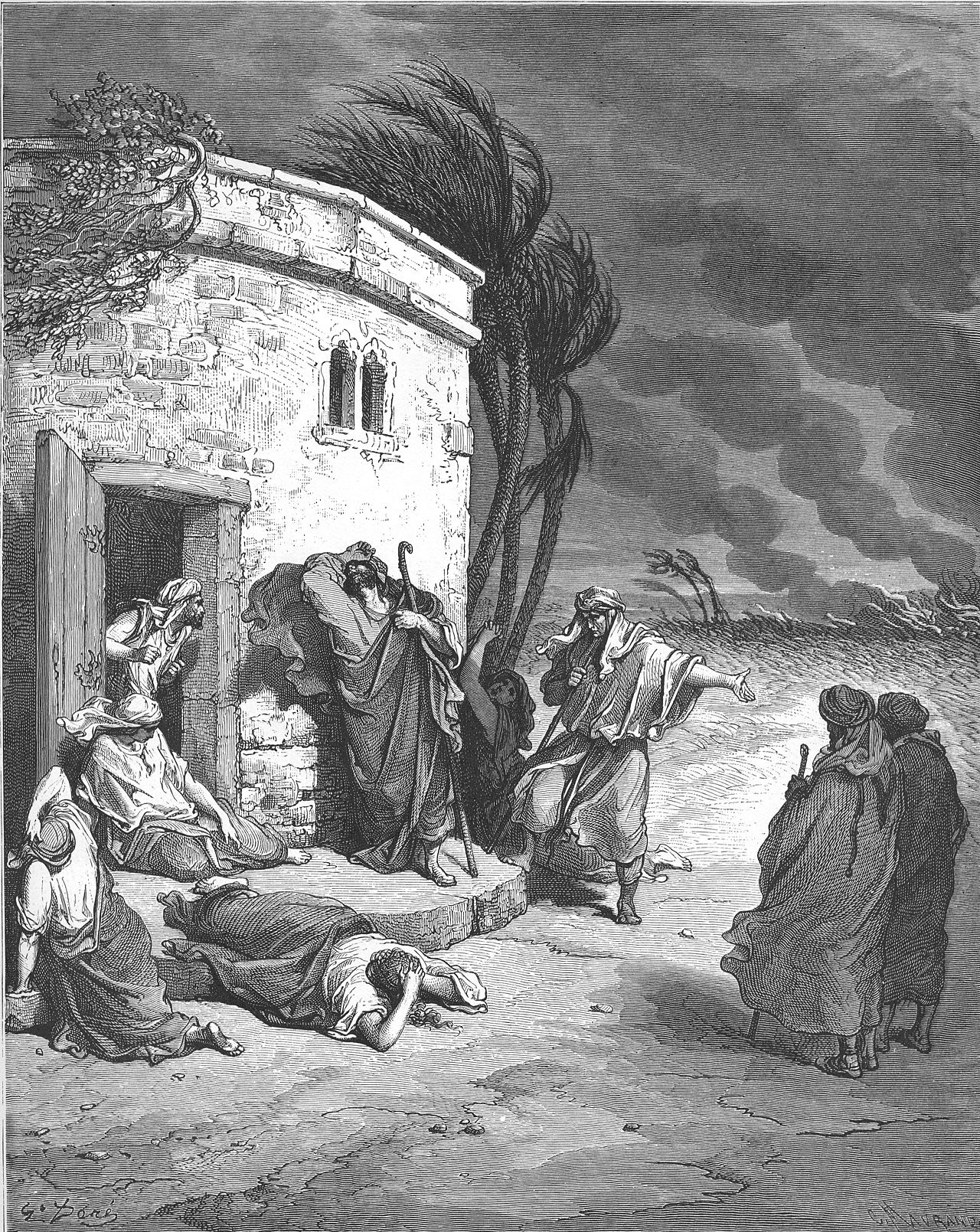
Jobchapter 22
30 verses · unknown · 10th century BC · Wisdom and poetry
Will you stay on the ancient path that wicked men have trod?
Introduction
unknown, Wisdom and poetry, Job Overview.
Eliphaz opens the third round, and this is the last time he speaks. Having found no sin in Job to point to, he now names particular crimes. His hearers knew the duties a wealthy man owed the poor of his village, and the law codes of their world all claimed to protect the widow and the orphan. Listen for which duties Eliphaz accuses Job of failing. Then listen to the gentle call to return that closes the speech. The reader will hear Job's own account of his life in chapter 31.
Context
- Who
- Hearers who knew the duties a wealthy man owed the poor of his village
- What
- Eliphaz's third speech, a list of charges against Job and a closing call for him to return to God and be restored.
- Where
- The ash heap outside Job's town.
- When
- The opening of the third and shortest round of speeches.
- Why
- To bring Job to repentance by naming the sins his suffering was assumed to prove.
Historical context
Eliphaz finally does what the friends have been circling for twenty chapters: he invents specific charges. And the charges he picks are a checklist of the recognised social crimes of the ancient Near East, the exact list a wealthy landholder would be measured against.
Show the rest of the historical context, 3 more paragraphs
Taking a pledge from a brother for nothing means seizing security on a loan from a man who owed little, and stripping the naked of their clothing points at the commonest pledge of all, the outer cloak, which was also a poor man's only blanket at night. Withholding water from the weary and bread from the hungry violated the most basic law of hospitality in a desert country, where refusing water could kill. Sending widows away empty and breaking the arms of the fatherless names the two groups every ancient law code, from Hammurabi's to Israel's, claimed to protect.
Eliphaz then attributes to Job an argument Job never made: 'Is not God in the height of heaven? and behold the height of the stars, how high they are! And thou sayest, How doth God know? can he judge through the dark cloud?' That is the ancient version of saying the high God is too far away to notice, a real position in that world, and a slander here.
His warning example is the old world destroyed by the flood: wicked men cut down out of time, whose foundation was overflown with a flood. And his closing appeal is genuinely tender, acquaint now thyself with him and be at peace; lay up gold as dust and the gold of Ophir as the stones of the brooks, and the Almighty shall be thy treasure. Ophir was a real gold source reached by sea trade, and its gold was the byword for the finest.
Significance
The chapter shows what a system does when the facts will not fit it: it manufactures facts. Eliphaz has no evidence and needs Job guilty, so he supplies the crimes.
Show the rest of the significance, 1 more paragraph
First hearers, who had heard Job's own account of his life and would hear it again in chapter 31, were watching a good man's reputation destroyed by a theology that could not afford for him to be innocent.
This chapter in Jewish lifeWhat this chapter is in Jewish life and reading.
What is done
This chapter has no place in the synagogue year. The site's own table in src/lib/hebraic/readings.ts printed parashot total 0 and haftarah uses total 0 for the book of Job, and no festival reading. The same probe printed 54 weekly portions and 6 festival readings in the table as a whole.
The corpus joins it to the study of the Torah portions through the Midrash arranged by them. Under the twelfth verse it carries Midrash Tanchuma, Bereshit 5:5. Under the seventeenth verse it carries Midrash Tanchuma, Noach 18:4. Under the thirtieth verse it carries Midrash Tanchuma Buber, Noach 14:1. Under the thirtieth verse it carries Midrash Tanchuma, Noach 9:3.
How it is read
The corpus carries the English of two commentators on this chapter. Rashi is quoted from The Judaica Press complete Tanach with Rashi, translated by A. J. Rosenberg, and Malbim from Malbim's Job, trans. Jeremy I. Pfeffer. Ktav, 2003. Sefaria reports both as CC-BY. Malbim sets the chapter in the round of speeches as the fourteenth oration, the speech of Eliphaz in the third round (Malbim on Job 22:1:1).
Rashi reads the opening question as Eliphaz asking whether a man serves the need of the Creator when he teaches people knowledge and wisdom (Rashi on Job 22:2:1). He gives the repeated verb two senses, benefit and teaching, and then allows that the first may also mean teaching (Rashi on Job 22:2:1). In the third verse Eliphaz asks what concern God has in Job's righteousness, that Job should summon Him to contest his words (Rashi on Job 22:3:1). Rashi calls the eighth verse a question, whether Job's strength entitled him to inherit the earth (Rashi on Job 22:8:1).
Rashi joins the eleventh verse to the three after it. Job is warned against trusting in strength and saying that God sits too high to lower Himself to see (Rashi on Job 22:11:1, Rashi on Job 22:12:1). The same thought runs on, that God knows nothing of what happens in the dark and that thick clouds hide the world from Him (Rashi on Job 22:13:1, Rashi on Job 22:14:1). Malbim reads the ninth verse as God hearing the cries of the widows and orphans the wicked have oppressed, and the note beside it points to Exodus 22:22 (Malbim on Job 22:9:1).
Malbim answers Eliphaz's picture with the truly righteous, who are unmoved by such arguments. "They worship God for His own sake, and interpret any apparent deficiencies in this world as evidence of the existence of another perfect world" (Malbim on Job 22:19:1). He calls that world the Hereafter, where all wrongs will be righted (Malbim on Job 22:19:1).
Malbim reads Eliphaz urging Job to repent, to take God's instruction over his own intellect, and to make his mind master over his body (Malbim on Job 22:22:1). Rashi reads the twenty-first verse as a call to be wholehearted with God (Rashi on Job 22:21:1). By returning to Him, Job will establish strength and fortifications on the earth (Rashi on Job 22:24:1). A numbered note in the same Malbim entry calls this a moment of great irony, since God had called Job upright and was angry with Eliphaz at the end (Malbim on Job 22:22:1).
The corpus carries six further notes on this chapter without an English text, each marked linked because Sefaria holds no English version of the ref. They stand cited by ref and unquoted. Six stand at Metzudat David on Job 22:6:1, 22:7:1, 22:10:1, 22:17:1, 22:18:1 and 22:23:1.
What the rabbis say
The corpus carries forty rabbinic locators on this chapter and the text of none, so each is cited and linked here rather than quoted. On the second verse it holds Aggadat Bereshit 22:2. On the eighth verse it holds Ein Yaakov (Glick Edition), Sanhedrin 7:5, Ein Yaakov, Sanhedrin 7:9, Midrash Lekach Tov, Numbers 6:26:1 and Sanhedrin 58b:22. On the twelfth verse it holds Aggadat Bereshit 56:1, Bamidbar Rabbah 9:1, Bamidbar Rabbah 9:45 and Midrash Tanchuma, Bereshit 5:5. On the thirteenth verse it holds Shemot Rabbah 33:4.
On the fourteenth verse it holds Aggadat Bereshit 1:3, Bamidbar Rabbah 12:3, Bereshit Rabbah 36:1 and Bereshit Rabbah 4:5. On the fifteenth verse it holds Chagigah 14a:2 and Midrash Sekhel Tov, Bereshit 34:30:6. On the sixteenth verse it holds Chagigah 13b:14, Ein Yaakov (Glick Edition), Khagigah 2:15, Ein Yaakov, Khagigah 2:8 and Shemot Rabbah 15:7. On the seventeenth verse it holds Midrash Tanchuma, Noach 18:4 and Yalkut Shimoni on Torah 243:1. On the eighteenth verse it holds Pirkei DeRabbi Eliezer 47:1 and Pirkei DeRabbi Eliezer 47:4.
On the nineteenth verse it holds Midrash Lekach Tov on Esther 3:5:1, Sifrei Aggadah on Esther, Midrash Abba Guryon 3:6 and Yalkut Shimoni on Torah 765:10. On the twentieth verse it holds Aggadat Bereshit 4:3, Bereshit Rabbah 28:7 and Midrash Aggadah, Deuteronomy 1:41:1. On the twenty-fifth verse it holds Berakhot 63a:20, Ein Yaakov (Glick Edition), Berakhot 9:16 and Pesikta Rabbati 6:1. On the twenty-sixth verse it holds Midrash Tannaim on Deuteronomy 5:15:9. On the twenty-eighth verse it holds Avot DeRabbi Natan 8:5, Bamidbar Rabbah 14:4 and Bamidbar Rabbah 18:12.
On the thirtieth verse it holds Bereshit Rabbah 29:1, Midrash Tanchuma Buber, Noach 14:1 and Midrash Tanchuma, Noach 9:3. What each of them teaches is a saying of the rabbis, and is reported as theirs wherever this site quotes one. The quotations wait on a fetch that carries the text.
Sources: Malbim, Malbim on Job 22:1:1 to 22:22:1, Malbim's Job, trans. Jeremy I. Pfeffer. Ktav, 2003, reported CC-BY; Rashi, Rashi on Job 22:2:1 to 22:24:1, The Judaica Press complete Tanach with Rashi, translated by A. J. Rosenberg, reported CC-BY; Metzudat David, Metzudat David on Job 22:6:1, 22:7:1, 22:10:1, 22:17:1, 22:18:1 and 22:23:1, cited by ref because the corpus carries no English text; The Sefaria corpus, scripts/data/sources/sefaria/job/22.json, the 40 Talmud and Midrash locators of this chapter; The site's own files, src/lib/hebraic/readings.ts, printing no portion, no Haftarah and no festival reading for this book.
The heads below are this chapter's scenes. The numbered points under each are its verses.
Eliphaz: Is Not Thy Wickedness Great?
Job 22:1-3
Eliphaz the Temanite replied: Eliphaz opens with a premise that removes any divine self-interest: "Can a man be of use to God". So God needs nothing from Job, which clears the way for Eliphaz's conclusion that the suffering traces to Job's guilt. Chapters 1 and 2 have shown another cause of the suffering.
Job 22:1
“Then Eliphaz the Temanite answered and said. As Eliphaz was the first that entered the discussion with Job, being perhaps the oldest man, and might be reckoned the wisest, so he gives the lead in every course of disputation; and here, instead of replying to Job's arguments and instances, at which he was very angry, betakes himself to calumny and reproach, and to draw invidious consequences, instead of making use of solid reasons for conviction and confutation.”
Eliphaz answers Job with a question about God. Barnes explains that Eliphaz supposes Job claims God's favor as if his righteous life were of use to God. Clarke puts it plainly: a man may benefit a man, and no man can benefit God.
Job 22:2
“Can a man be profitable unto God?.... Eliphaz imagined that Job thought so, by his insisting so much on his integrity, and complaining of his afflictions; and that God was beholden to him for his holiness and righteousness, and that instead of afflicting him, should have heaped honours and happiness upon him; whereas there is not anything a man can do, or does, by which God can be profiled; which is a very great truth, though misapplied to Job through a wrong construction of his words and meaning.”
Does it delight the Almighty that you are righteous?: Verse 3 presses the thought of verse 2: the Almighty gains no profit when a man is righteous or his ways blameless. Wesley adds that God needs no man's service. Clarke says God can neither gain nor lose by the righteous.
Job 22:3
“Is it any profit to the Almighty that thou art righteous? or is it gain to Him, that thou makest thy ways perfect? For in all that we do well, we are doing good to ourselves and not to God. And hence by the Psalmist it is said, O my soul, thou hast said unto the Lord, Thou art my God, seeing that Thou needest not my goods.”
Gregory the Dialogist · written before 604 · Morals on the Book of Job, Book XVIpatristic
Job 22:4-5
Is it for your reverence that He rebukes you: Eliphaz moves from a question straight to an outright charge: "Is not your wickedness great". Nothing between verse 4 and verse 5 supplies evidence for the leap, and the accusation follows from the theology alone. Henry marks this as the turn where Eliphaz names Job as a great sinner.
Job 22:4
“Is the punishment inflicted on thee from fear of thee, in order to disarm thee? as Job had implied (see on Job 7:12; Job 7:20; and Job 10:17). will he enter . . . into judgment?--Job had desired this (Job 13:3, 21).”
Jamieson, Fausset & Brown · Commentary Critical and Explanatory on the Whole Bible (1871)reformed
Is not your wickedness great?: Here Eliphaz makes a direct charge for the first time, as Barnes notes: Job is a great sinner. Wesley sets out the logic behind it, that Job's calamities must match his sins in measure. Clarke hears endless iniquities as sins without end.
Job 22:5
“Is not thy wickedness great? - That is, “Is it not utter presumption and folly for a man, whose wickedness is undoubtedly so great, to presume to enter into a litigation with God?” Eliphaz here “assumes” it as an undeniable proposition, that Job was a great sinner. This charge had not been directly made before.”
Job 22:6-7
needlessly demanded security from your brothers: Eliphaz's charges begin here: "you needlessly demanded security from your brothers", and "You gave no water to the weary". The word behind "needlessly" is the Hebrew hinnam, the word the accuser used of Job at 1:9. The narrator's account in chapters 1 and 2 gives the charge no support.
Job 22:6
“For thou hast taken a pledge from thy brother for nought,.... It can hardly be thought that it was for nothing at all, on no consideration whatever, or that nothing was lent, for which the pledge was taken; but that it was a small trifling sum, and comparatively nothing, not to be spoken of; or it was borrowed for so short a time, that there needed not any pledge it; and it was unkind to take it, especially of a brother, whether in nature, or in religion, whether a near kinsman, or friend, or neighbour.”
You gave no water to the weary: Barnes explains that to give no water to the weary was to refuse hospitality, one of the gravest charges in the East. Henry adds that the charge includes food withheld from the famished. The list of charges runs through verse 9.
Job 22:7
“Thou hast not given water to the weary - That is, thou hast withheld the rites of hospitality - one of the most grievous offences which could be charged on an Arabian; compare the notes at Isa 21:14. In all the Oriental world, hospitality was regarded, and is still, as a duty of the highest obligation.”
1 more voice on this verse
Job 22:7
All these things are accusations, and certainly very reproachful ones. But they are not true with regard to Job and are unjustly pronounced against him. These things happen in times of hardship. Sometimes, when one has only a piece of bread, even though he does not have an entire loaf, we take it away from him by saying, "You are in debt."
Origen of Alexandria · written before 253 · Fragments on Job 16.22-23patristic
Job 22:8-9
the land belonged to a mighty man: The indictment continues with the powerful man who holds the land. Job later describes himself as the opponent of this figure at 29:15 and 16. Clarke reads the charges as a stock picture of the oppressor drawn from the wisdom tradition and attached to Job without ground in his conduct.
Job 22:8
“But as for the mighty man, he had the earth - איש זרוע ish zeroa, the man of arm. Finger, hand, and arm, are all emblems of strength and power. The man of arm is not only the strong man, but the man of power and influence, the man of rapine and plunder. The honorable man - Literally, the man whose face is accepted, the respectable man, the man of wealth. Thou wert an enemy to the poor and needy, but thou didst favor and flatter the rich and great.”
Adam Clarke · Commentary on the Bible (1810-1826)evangelical
You sent widows away empty-handed: Jamieson, Fausset and Brown read empty-handed as sent away with needs unmet, and note that the law of Moses guarded the widow and the fatherless. Clarke reads the crushed strength as whatever the fatherless had, taken from them. Eliphaz charges cruelty to the weak.
Job 22:9
“Thou hast sent widows away empty - That is, without regarding their needs, and without doing anything to mitigate their sorrows. The oppression of the widow and the fatherless is, in the Scriptures, every where regarded as a crime of special magnitude; see the notes at Isa 1:17. The arms of the fatherless have been broken - Thou hast taken away all that they relied on. Thou hast oppressed them and taken advantage of their weak and defenseless condition to enrich yourself. This charge was evidently gratuitous and unjust.”
Job 22:10-11
snares surround you: Eliphaz reasons backward from Job's condition to the charges just made. The suffering is offered as proof of the sin, while the sin has no evidence apart from the suffering it is meant to explain. Barnes notes that the book's opening frame has already shown this reasoning false.
Job 22:10
“Therefore snares are round about thee - “Snares” were used for catching wild animals and birds, and the word then came to denote any sudden calamity; see Job 18:8-10. Eliphaz here says, that it “must be” that these calamities came upon Job in consequence of such sins as he had specified. About that he took it for granted there could be no dispute. And sudden fear - The calamities of Job came upon him suddenly Job 1. It was to this, doubtless, that Eliphaz alluded.”
3 more voices on this verse
Job 22:10
“Therefore snares are round about thee; and sudden fear troubleth thee. That man 'sudden fear doth trouble,' who neglects to consider what there is hanging over his head from the severity of the Judge, when He comes. Therefore, whereas heretics look upon the faithful people as borne down by sins of misbelief, they make it a charge that 'snares are round about them.' And because they believe that it does not foresee the future, they suppose this people under the smiting to be 'troubled with sudden fear.'”
Gregory the Dialogist · written before 604 · Morals on the Book of Job, Book XVIpatristic
Job 22:10
“No sin makes a louder cry there than unmercifulness; and, accordingly, sudden fear troubles thee; and, though thou wilt not own it, it is guilt of this kind that creates thee all this terror." Zophar had insinuated this, ch. xx.”
Matthew Henry · Commentary on the Whole Bible (1707-1721)puritan
Job 22:10
“Therefore snares - As thou hast dealt with others, so has God, in his retributive providence, dealt with thee. As thou hast spoiled, so art thou spoiled. Thou art taken in a net from which thou canst not escape. There is an allusion here to the hunting of the elephant: he is driven into an inclosure in the woods, passing from strait to strait, till brought into a narrow point, from which he cannot escape; and then his consternation is great, and his roaring terrible. God hath hunted thee down, as men hunt down those wild and dangerous beasts.”
Adam Clarke · Commentary on the Bible (1810-1826)evangelical
it is so dark you cannot see: Barnes reads the darkness and the flood of water as emblems of calamity, citing Psalm 69. Wesley takes the waters as many afflictions. With the snares of verse 10, they are what Eliphaz says the wickedness of verse 5 has brought.
Job 22:11
Or darkness, that thou canst not see - The sense of this passage, in the connection that the particle or gives it with the preceding verse, is not easy to be ascertained. To me it seems very probable that a letter has been lost from the first word; and that או o which we translate Or, was originally אור or Light. The copy used by the Septuagint had certainly this reading; and therefore they translate the verse thus: Το φως σοι εις σκοτος απεβη; Thy Light is changed into darkness; that is, Thy prosperity is turned into adversity.
Adam Clarke · Commentary on the Bible (1810-1826)evangelical
Eliphaz: Thou Sayest, What Doth God Know Through the Dark Cloud?
Job 22:12-14
Is not God as high as the heavens?: Eliphaz next puts in Job's mouth a God too remote to see: "What does God know". Job has said nothing of the kind, and at 21:22 he affirmed the opposite. The same pattern of a charge without ground runs through the whole speech.
Job 22:12
“Is not God in the height of heaven? - It appears, from this and the following verses, that Eliphaz was attributing infidel and blasphemous speeches or sentiments to Job. As if he had said: “Thou allowest that there is a God, but thou sayest that he is infinitely exalted above the heavens and the stars, and that there is so much dense ether and thick cloud between his throne and the earth, that he can neither see it nor its inhabitants.””
Adam Clarke · Commentary on the Bible (1810-1826)evangelical
1 more voice on this verse
Job 22:12
“Eliphaz says this to prove that God can from His height behold all things; gratuitously inferring that Job denied it, because he denied that the wicked are punished here. height--Hebrew, "head of the stars"; that is, "elevation" (Job 11:8).”
Jamieson, Fausset & Brown · Commentary Critical and Explanatory on the Whole Bible (1871)reformed
Barnes notes that Eliphaz charges Job with an opinion inferred from his words, arguing as if Job actually held it. Henry reads the suspicion as a God too high in heaven to see the earth. Job had said the wicked prosper.
Job 22:13
“And thou sayest, How doth God know? - That is, it “follows” from what you have said; or the opinion which you have advanced is “the same” as if you had affirmed this. How common it is to charge a man with holding what we “infer,” from something which he has advanced, he must hold, and then to proceed to argue “as if” he actually held that. The philosophy of this is plain.”
Thick clouds veil Him: Eliphaz puts these words in the mouth of the man he accuses, as Barnes notes: thick clouds veil God from seeing men below. Wesley calls it the opinion of many heathen philosophers, a God content with heaven. Henry calls it gross impiety.
Job 22:14
“This is gross absurdity, as well as gross impiety, which Eliphaz here fathers upon Job; for it supposes that the administration of government is a burden and disparagement to the supreme governor and that the acts of justice and mercy are a toil to a mind infinitely wise, holy, and good.”
Matthew Henry · Commentary on the Whole Bible (1707-1721)puritan
Job 22:15-18
the ancient path that wicked men have trod?: Eliphaz points to the ancient path of men who "were snatched away before their time, and their foundations were swept away by a flood". Henry and Gill tie it to Genesis 7. The words "Depart from us" render the same Hebrew as the defiance Job cited at 21:14.
Job 22:15
“Hast thou marked the old way which wicked men have trodden? - Hast thou seen what has happened in former times to wicked people? Job had maintained that God did not deal with people in this world according to their character. To meet this, Eliphaz now appeals to ancient facts, and especially refers to the deluge, when the wicked were cut off by a flood for their sins.”
2 more voices on this verse
Job 22:15
“Note, There is an old way which wicked men have trodden. Religion had but newly entered when sin immediately followed it. But though it is an old way, a broad way, a tracked way, it is a dangerous way and it leads to destruction; and it is good for us to mark it, that we may not dare to walk in it.”
Matthew Henry · Commentary on the Whole Bible (1707-1721)puritan
Job 22:15
“Antiquity is, moreover, no excuse for sin. It may be that men have long transgressed, but use in rebellion will not mitigate the treason before the eternal Throne. If you know better, it will not stand you in any place that God winked at the ignorance of others in former ages. If you have had more light than they, you shall have severer judgment than they—therefore plead not the antiquity of any evil custom as an excuse for sin.”
They were snatched away before their time: Jamieson, Fausset and Brown see the flood of Noah here, the solid earth becoming a flood beneath the wicked, citing Genesis 7:11. Barnes also reads a sudden destruction by a flood. The ancient path of verse 15 ended in water.
Barnes hears Eliphaz quoting Job's own words from Job 21:14, where the prosperous wicked tell God to depart. Eliphaz turns them to the generation of the flood. Henry notes that calling God the Almighty answers their question.
Job 22:17
“Which said unto God, Depart from us - Notes, Job 21:14. A very correct description of the old world. They had no wish to retain God in their knowledge. Probably Eliphaz here refers to what Job had said, Job 21:14-15. He had remarked, in describing the wicked, that they said unto God, “Depart from us,” and yet they lived prosperously. “But see,” says Eliphaz,’” a case” where they did this.”
so I stay far from the counsel of the wicked: Eliphaz repeats Job's line from Job 21:16 word for word, and Barnes and Clarke both call it sarcasm. Barnes hears him mocking Job's claim that such men prospered. Henry notes that houses full of goods can hide hearts empty of grace.
Job 22:18
“Yet He has filled their houses with good things. The Lord 'filleth the houses of the wicked with good things,' in that even to the unthankful He refuses not His gifts, that either they may blush at the loving-kindness of their Creator and be brought back to goodness, or altogether despising to return thereto, may from the same cause be there worse punished, that here they rendered an evil return for God's more bounteous good, so that severer woes should there chastise those whose wickedness here not even gifts overcame.”
Gregory the Dialogist · written before 604 · Morals on the Book of Job, Book XVIpatristic
1 more voice on this verse
Job 22:18
But the counsel of the wicked is far from me - Sarcastically quoting Job’s words, Job 21:14, Job 21:16. Job, having in the preceding chapter described the wicked, who said unto the Almighty, “Depart from us,” etc., adds, But the counsel of the wicked is far from me. Eliphaz here, having described the impious, among whom he evidently ranks Job, makes use of the same expression, as if he had said, “Thank God, I have no connection with you nor your companions, nor is my mind contaminated by your creed.”
Adam Clarke · Commentary on the Bible (1810-1826)evangelical
Job 22:19-20
The righteous see it and are glad: Eliphaz pictures the righteous watching the downfall of the wicked with approval: "The righteous see it and are glad". Watson notes the irony, since Eliphaz places himself among the righteous who see and are glad. Yet at 42:7 he stands under God's rebuke for the very speech he is giving.
Job 22:19
“The righteous shall see it and be glad; and the innocent one shall laugh them to scorn. The righteous when they see the unrighteous erring here cannot be glad for the error of persons ruining themselves. For if they rejoice in errings, they cease to be righteous. Again, if in the feeling of triumph they be glad, for this that they are not such as they see others are, they are altogether full of pride.”
Gregory the Dialogist · written before 604 · Morals on the Book of Job, Book XVIpatristic
1 more voice on this verse
Job 22:19
“Nay, they shall laugh them to scorn, that is, they justly might do it, they shall do it, as God does it, in a holy manner, Ps. ii. They shall take occasion thence to expose the folly of sinners and show how ridiculous their principles are, though they call themselves wits. Lo, this is the man that made not God his strength; and see what comes of it, Ps. lii.”
Matthew Henry · Commentary on the Whole Bible (1707-1721)puritan
The righteous and the innocent of verse 19 speak these words, the glad cry of the pious in Jamieson, Fausset and Brown. Henry reads the fire as the judgment on Sodom, set beside the flood of verse 16. Both destroyed the wicked.
Job 22:20
“Whereas our substance is not cut down - We, who fear the Lord, still continue in health and peace; whereas they who have departed from him are destroyed even to their very remnant. Mr. Good thinks that קימנו kimanu, which we translate our substance, is the same as the Arabic (Arabic) our people or tribe; and hence he translates the clause thus: “For our tribe is not cut off; while even the remnant of these a conflagration consumed.” The reference here is supposed to be to the destruction of the men of Sodom and Gomorrah.”
Adam Clarke · Commentary on the Bible (1810-1826)evangelical
1 more voice on this verse
Job 22:20
“The triumphant speech of the pious. If "substance" be retained, translate, rather as the Septuagint, "Has not their substance been taken away, and . . . ?" But the Hebrew is rather, "Truly our adversary is cut down" [GESENIUS].”
Jamieson, Fausset & Brown · Commentary Critical and Explanatory on the Whole Bible (1871)reformed
Eliphaz: Acquaint Now Thyself With Him, and Be at Peace
Reconcile now and be at peace with Him: This single verse holds the book's most quoted wrong counsel: "Reconcile now and be at peace with Him; thereby good will come to you". The words are sound counsel for a man estranged from God by sin, a description the opening chapters of the book deny to Job.
Job 22:21
“Acquaint now thyself with him - Margin, that is, “with God.” Eliphaz takes it for granted now, that Job was a sinner wholly unreconciled to God, and unacquainted with him. This fact, he supposes, was the source of all his calamities. As long as he remained thus unreconciled to God, he must be miserable. He proceeds, therefore, in a most beautiful manner, to exhort him to be at peace with God, and portrays the benefits which would result from such a reconciliation.”
1 more voice on this verse
Job 22:21
“It is our honour, that we are made capable of this acquaintance, our misery that by sin we have lost it; our privilege, that through Christ we may return to it; and our unspeakable advantage, to renew and cultivate it.”
John Wesley · Explanatory Notes upon the Old Testament (1765)evangelical
Job 22:22-23
Receive instruction from His mouth: Eliphaz calls for repentance, "If you return to the Almighty, you will be restored", language that presumes a departure from God the narrative never records. Barnes notes the call to return makes sense only once the underlying charge is granted, and the whole speech has offered the charge without evidence.
Job 22:22
“This is what he means, in my opinion: "Confess your sins; receive from God's mouth his support after your confession; and take his words into your heart." Certainly Eliphaz said these things, as he believed, by making himself equal to Job.… However, he pronounces a correct dogma here. He, in fact, thinks that Job suffers his adversities because of his sins but also so that he will be purified through the endurance of his afflictions. Once he is purified, he will be delivered from any extraneous element and freed from any involvement with iniquity.”
Origen of Alexandria · written before 253 · Fragments on Job 16.61, 69patristic
1 more voice on this verse
Job 22:22
“Though, in Job's time, we do not know that there was any written word, yet there was a revelation of God's will to be received. Eliphaz looked upon Job as a wicked man, and was pressing him to repent and reform. Herein consists the conversion of a sinner--his receiving the law from God's mouth and no longer from the world and the flesh.”
Matthew Henry · Commentary on the Whole Bible (1707-1721)puritan
If you return to the Almighty, you will be restored: Clarke reads restored as built up again, with servants and children in the house once more. Wesley sees a promise of both inward reform and outward good. Henry applies the call to remove injustice from the tents to the whole house.
Job 22:23
“If thou return to the Almighty - Assuming that he was an impenitent sinner, and wholly unreconciled to him. Thou shalt be built up - A figure taken from building up a house, in contradistinction from pulling one down, and denoting that he would be prospered and happy. Thou shalt put away iniquity - Rosenmuller, Good, Noyes, and Wemyss, suppose correctly, as it seems to me, that the word “if” is to be understood here to complete the sense - “if thou shalt put away iniquity.” From thy tabernacle - From thy tent, or dwelling.”
1 more voice on this verse
Job 22:23
“Thou shalt - It is either, 1. a spiritual promise, if thou dost sincerely repent, God will give the grace effectually to reform thyself and family: or, 2. a temporal promise, thou shalt put away iniquity, or the punishment of thy sins; as iniquity is very often used: far from thy tabernacles; from all thy dwellings, and tents, and possessions.”
John Wesley · Explanatory Notes upon the Old Testament (1765)evangelical
Job 22:24-25
consign your gold to the dust: Eliphaz attaches a promise to the call: "consign your gold to the dust and the gold of Ophir to the stones of the ravines". The promise that follows is "then the Almighty will be your gold and the finest silver for you".
Job 22:24
“Then shalt thou lay up gold as dust - The original is not fairly rendered in this translation, ושית על עפר בצר veshith al aphar batser, which Montanus renders: Et pone super pulverem munitionem, “And fix a tower upon the dust;” ובצור נחלים אופיר ubetsur nechalim Ophir, et in petra torrentes Ophir, “and in the rock, the torrents of Ophir.””
Adam Clarke · Commentary on the Bible (1810-1826)evangelical
1 more voice on this verse
Job 22:24
“Ophir--derived from a Hebrew word "dust," namely, gold dust. HEEREN thinks it a general name for the rich countries of the South, on the African, Indian, and especially the Arabian coast (where was the port Aphar. El Ophir, too, a city of Oman, was formerly the center of Arabian commerce).”
Jamieson, Fausset & Brown · Commentary Critical and Explanatory on the Whole Bible (1871)reformed
the Almighty will be your gold: Barnes and Jamieson, Fausset and Brown prefer gold to defense in the first line, so the Almighty stands in the place of riches. Clarke sums up Eliphaz's doctrine: those God loves best receive the most earthly good. The exchange is gold for gold.
Job 22:25
“Yea, the Almighty shall be - Or, rather, “then the Almighty shall be” - והיה yehâyâh. The meaning is, that if he would return to God, and cast off his anxiety for gold, “then” the Almighty would be his real treasure, and would impart to him solid happiness. Thy defense - Margin, “gold.” The margin is the more correct translation.”
1 more voice on this verse
Job 22:25
“Yea--rather, Then shall the Almighty be, &c. defence--rather, as the same Hebrew means in Job 22:24 (see on Job 22:24) --Thy precious metals; God will be to thee in the place of riches. plenty of silver--rather, "And shall be to thee in the place of laboriously-obtained treasures of silver" [GESENIUS].”
Jamieson, Fausset & Brown · Commentary Critical and Explanatory on the Whole Bible (1871)reformed
Job 22:26-28
delight in the Almighty: Eliphaz describes restored fellowship in devotional language: "You will pray to Him, and He will hear you, and you will fulfill your vows". Davidson notes the passage reads almost as a forecast of chapter 42, prayer heard and a word carried out, though spoken on the wrong occasion.
Job 22:26
“THE Lord said to Eliphaz and his friends, "you have not spoken of Me the thing that is right, as My servant Job has." And, therefore, we must always regard what they said with careful discrimination. They were wise men according to their light, but they were quite at sea in their judgment of Job. However, in this particular verse, Eliphaz declared that which is taught in many other parts of Holy Scripture and we may profit by his utterance. God grant that by His Spirit we may fully experience the joys described in the words before us.”
You will pray to Him, and He will hear you: Henry and Wesley note that the word pray speaks of prayers multiplied. Jamieson, Fausset and Brown read the vows as made in prayer and fulfilled when God hears. Eliphaz ties the promise to a return to the Almighty.
Job 22:27
“Thou shalt make thy prayer unto Him, and He shall hear thee. For they make their prayer to God, but never obtain to be listened to, who set at nought the precepts of the Lord, when He enjoins them. Whence it is written, He that turneth away his ear from hearing the law, even his prayer shall be abomination. So long then as Eliphaz believed that blessed Job was not heard, he determined that that person had surely done wrong in his practice. And hence he adds further, And thou shalt pay thy vows.”
Gregory the Dialogist · written before 604 · Morals on the Book of Job, Book XVIpatristic
light will shine on your ways: Barnes explains that every decision will be carried out, and light on the ways stands for prosperity. Henry reads it through Proverbs 16: the man who commits his works to the Lord finds his thoughts established. Clarke credits God's strength.
Job 22:28
“Thou shalt also decree a thing, and it shall be established unto thee - Thou shalt form a purpose or plan, and it shall not be frustrated. It shall not be opposed by the events of divine Providence, but whatever you undertake shall prosper. And the light shall shine upon thy ways - Thou shalt be prospered in all things, instead of being overtaken with calamity.”
3 more voices on this verse
Job 22:28
“Thou shalt commit thy works unto the Lord by faith and prayer, and then thy thoughts shall be established; thou shalt be easy and pleased, whatever occurs, Prov. xvi. This the grace of God shall work in thee; nay, sometimes the providence of God shall give thee the very thing thou didst desire and pray for, and give it thee in thy own way, and manner, and time.”
Matthew Henry · Commentary on the Whole Bible (1707-1721)puritan
Job 22:28
“Thou shalt also decree a thing, and it shall be established unto thee.”
Gregory the Dialogist · written before 604 · Morals on the Book of Job, Book XVIpatristic
Job 22:28
“Thou shalt also decree a thing - Whatsoever thou purposest in his strength, thou shalt be enabled to accomplish.”
Adam Clarke · Commentary on the Bible (1810-1826)evangelical
Job 22:29-30
When men are brought low: The chapter's closing line carries a disputed Hebrew text. Gill and Delitzsch both note the widely discussed alternate rendering, he shall deliver him that is not innocent, by the pureness of thine hands. Eliphaz promises a deliverance he does not know he will need.
Job 22:29
“When men are cast down - The meaning of this is, probably, when people are usually cast down, or in the times of trial and calamity, which prostrate others, you shall find support. You shall then be enabled to say, “there is lifting up, or there is support.” Or, more probably still, it may mean, “in times when others are cast down and afflicted, thou shalt be able to raise them up, or to aid them. Thou shalt be able to go to them and say, ‘Be of good cheer. Do not be cast down.”
2 more voices on this verse
Job 22:29
“For he that has been abased shall be in glory, and he that has bent down his eyes, the same shall be saved. Which same sentence is not at variance with the mouth of 'Truth,' when It says, For whosoever exalteth himself shall be abased, and he that humbleth himself shall be exalted. And hence it is said by Solomon, Before destruction the heart of man is haughty, and before honour is humility.”
Gregory the Dialogist · written before 604 · Morals on the Book of Job, Book XVIpatristic
Job 22:29
“Therefore it is better, I think, to take the first clause as referred to by "God resisteth the proud." When (men) are cast down, thou shalt say (behold the effects of) pride. Eliphaz hereby justifies himself for attributing Job's calamities to his pride. "Giveth grace to the humble," answers to the second clause.”
Jamieson, Fausset & Brown · Commentary Critical and Explanatory on the Whole Bible (1871)reformed
He will deliver even one who is not innocent: Henry and Wesley read it that God will deliver even the guilty through the clean hands and prayers of a good man. Jamieson, Fausset and Brown note the irony: Eliphaz and his companions were themselves delivered at last through Job's prayer in Job 42:7 and 8. Eliphaz foretells his rescue.
Job 22:30
“He shall deliver the island of the innocent - The word אי ai, which we translate island, is most probably the Arabic particle (Arabic) whosoever, whatsoever, any, whosoever he may be, as (Arabic) ai rajuli, whatsoever man he may be. And it is most probable that both words are Arabic, (Arabic) or (Arabic) any innocent, chaste, pure, or holy person; for the word has the same meaning both in Hebrew and Arabic.”
Adam Clarke · Commentary on the Bible (1810-1826)evangelical
1 more voice on this verse
Job 22:30
“The irony is strikingly exhibited in Eliphaz unconsciously uttering words which exactly answer to what happened at last: he and the other two were "delivered" by God accepting the intercession of Job for them (Job 42:7, 8).”
Jamieson, Fausset & Brown · Commentary Critical and Explanatory on the Whole Bible (1871)reformed
Keep studying
Sources for this chapter
The summary
Jamieson, Fausset & Brown, Commentary Critical and Explanatory; John Wesley, Notes on the Old Testament and Matthew Henry, Complete Commentary.
The exposition
A. B. Davidson, The Book of Job, Cambridge Bible; Adam Clarke, Commentary on the Bible; Albert Barnes; Franz Delitzsch, Biblical Commentary on the Book of Job; Jamieson, Fausset & Brown, Commentary Critical and Explanatory on the Whole Bible; Jamieson, Fausset and Brown, Commentary Critical and Explanatory on the Whole Bible; John Gill, Exposition of the Old Testament; John Wesley, Explanatory Notes upon the Old Testament; Matthew Henry, Commentary on the Whole Bible and R. A. Watson, The Book of Job, Expositor's Bible.