
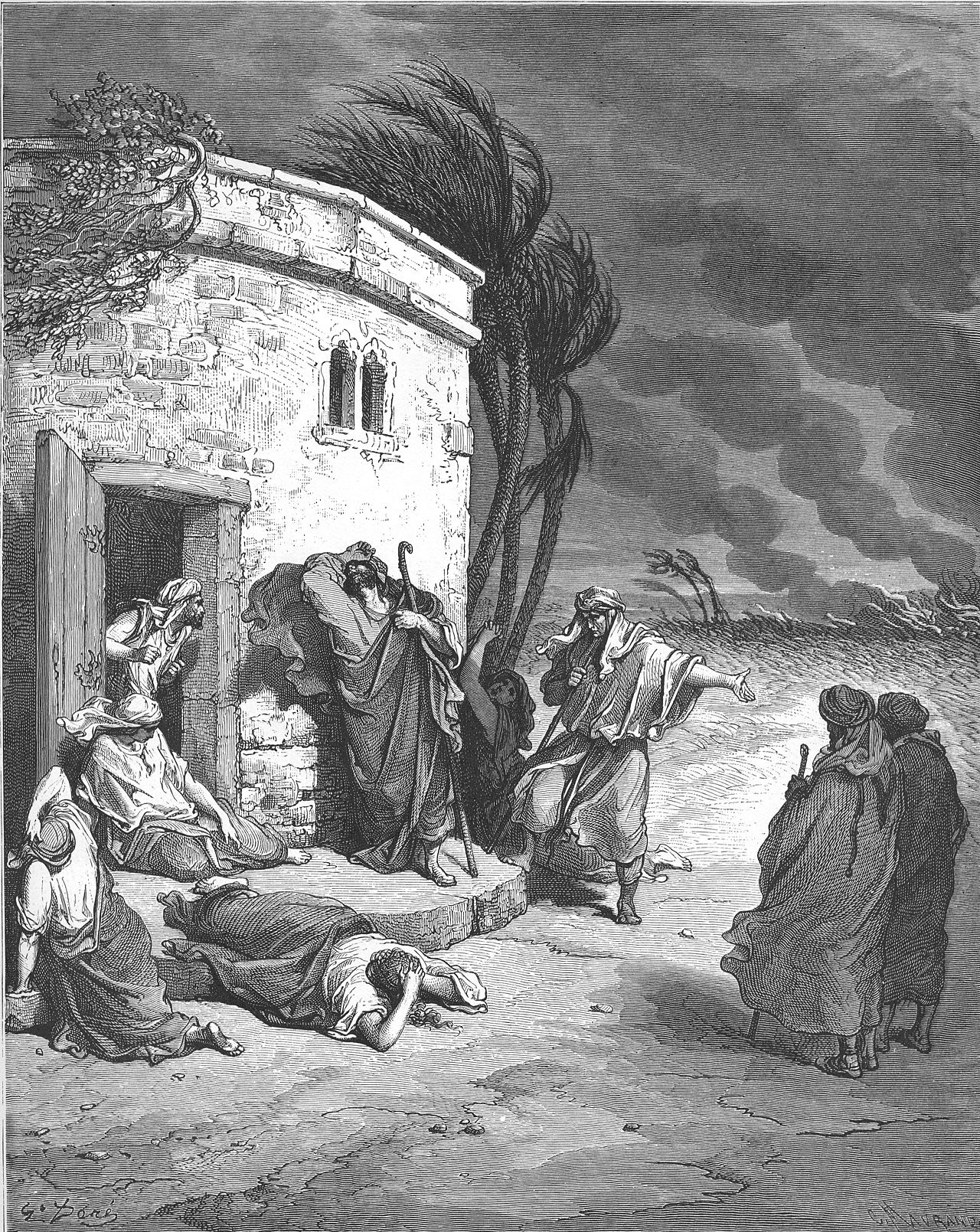
Jobchapter 21
34 verses · unknown · 10th century BC · Wisdom and poetry
Is my complaint against a man? Then why should I not be impatient?
Introduction
unknown, Wisdom and poetry, Job Overview.
Job answers Zophar and closes the second round of the debate. He stops defending himself and asks the friends to look at the world around them. His hearers measured a blessed life by fertile herds, many children, music at feasts and an honoured burial. Listen for how each of those marks of blessing appears in this chapter. Listen also for what Job says the wicked say to God. The chapter asks whether the friends' rule matches what any farmer could see from his own door.
Context
- Who
- Hearers who had seen unjust men die rich and old
- What
- Job's reply to Zophar, a report that the wicked often live long, prosper and die in peace.
- Where
- The ash heap outside Job's town, with Job pointing to the world beyond it.
- When
- The close of the second round of speeches.
- Why
- To show from plain observation that the friends' rule of swift punishment for the wicked does not hold.
Historical context
Job stops arguing about himself and starts producing evidence. He asks the friends to look at the wicked men they all know: they live, grow old, and are mighty in power; their descendants are established in their sight; their houses are safe from fear; the rod of God is not on them.
Show the rest of the historical context, 3 more paragraphs
The details of that prosperity are agricultural and domestic, and every one of them is a marker of blessing in that world. Their bull breeds and does not fail and their cow calves without miscarrying, herd fertility was the single clearest measure of a man's standing. Their children go out like a flock and dance. They take the timbrel and harp and rejoice at the sound of the pipe, the hand-drum, lyre, and reed pipe of village celebration.
Then the hardest observation: they spend their days in wealth, and in a moment go down to the grave. No long decline, no ruin, no reckoning. Job's summary of their theology is blunt, they say to God, depart from us, we do not desire the knowledge of thy ways.
He finishes with the funeral, because in that culture the funeral was the verdict. The wicked man is brought to the grave and 'shall remain in the tomb'; watch is kept over his mound; the clods of the valley are sweet to him, and every man follows in the procession as innumerable others went before. A well-attended burial and an honoured tomb were the last proof that a life had been blessed, and Job points out that the wicked get that too.
Significance
This chapter is the book's appeal to plain observation, and it settles the second cycle. The friends' rule does not survive contact with the world any competent farmer could see out his own door.
Show the rest of the significance, 1 more paragraph
For first hearers the value was permission to notice. Faith does not require pretending that the accounts balance in this life. It requires trusting the judge who has not finished.
This chapter in Jewish lifeWhat this chapter is in Jewish life and reading.
What is done
Like the rest of Job, this chapter has no weekly portion, no Haftarah and no festival reading in the site's table. Probed for this lane, src/lib/hebraic/readings.ts printed parashot total 0 and haftarah uses total 0 for the book.
Midrash Tanchuma on the portion Noach carries three of the corpus's locators on this chapter, at Noach 7:3 under the eighth verse and at Noach 10:7 and 14:3 under the thirteenth. Midrash Tanchuma Buber stands at Metzora 11:1 under the ninth verse and at Tzav 3:1 under the fifteenth. The Talmud locators sit in Sanhedrin 109a under the thirty-second verse, and in the Jerusalem Talmud at Moed Katan under the eighth and Terumot under the tenth.
How it is read
Malbim, in Malbim's Job, translated by Jeremy I. Pfeffer (Ktav, 2003), which Sefaria reports as CC-BY, heads the chapter "The Thirteenth Oration - Job’s Reply to Zophar’s Second Speech" (Malbim on Job 21:1:1).
Rashi, quoted here from The Judaica Press complete Tanach with Rashi, translated by A. J. Rosenberg, which Sefaria reports as CC-BY, hears Job ask only to be heard. If the friends keep their peace and listen, "this will be my consolation from you" (Rashi on Job 21:2:1). Job complains to God, and not to a man like himself, so he may well be short of breath (Rashi on Job 21:4:1). At the sixth verse Rashi names the question the chapter turns on, which is why the wicked live (Rashi on Job 21:6:1).
At the seventeenth he ties the cry back to the seventh verse. He reads it as a plea to know how long God will lengthen the lifetime of the wicked, and then as a curse on them (Rashi on Job 21:17:1).
Rashi pictures the wicked at ease. Demons had no power over them (Rashi on Job 21:9:1). At the eleventh verse he sets two accounts from two named sources side by side. In Haggadath Bereishith the newborn dances at once and battles any demon he meets, and his mother asks him to bring scissors so she can cut his umbilical cord. In Gen. Rabbah (36:1) the mother asks him instead to go and light a candle for her (Rashi on Job 21:11:1). The sources agree on the child's strength at birth and differ on the errand his mother gives him.
At the twelfth verse Rashi reads the flute as a word for sensual laughter and marks the reading as one he received. "So I heard" (Rashi on Job 21:12:1). When the wicked man's day came he died in a moment, "easily, without suffering" (Rashi on Job 21:13:1). At the fifteenth the wicked say they gain nothing by prayer, since they do not need God for rain, and Rashi draws the thought from Genesis 2:6 (Rashi on Job 21:15:1).
At the nineteenth verse Rashi hears Job ask whether it is just that a man should sin all his life and die in peace. He asks too whether it is just that the Holy One, blessed be He, lays his wickedness away to punish his sons (Rashi on Job 21:19:1). At the twentieth he admits the limit of his evidence for one word. "I cannot find a comparison in the Bible." He reads it as ruin from the context. A note in parentheses in the entry takes it as the word for ruin with one letter exchanged for another (Rashi on Job 21:20:1).
At the twenty-first verse the wicked man does not care about his house after him, because his months are cut off before the promised evil comes. Rashi points to the limit of a hundred and twenty years in Genesis 6:3 (Rashi on Job 21:21:1). At the twenty-second he asks who among the friends stands in the place of God to teach the standard of His judgment (Rashi on Job 21:22:1).
The corpus carries four further notes on this chapter without an English text, each marked linked because Sefaria holds no English version of the ref. They stand cited and unquoted at Ibn Ezra on Job 21:7:1, and at Metzudat David on Job 21:8:1, 21:14:1 and 21:18:1.
What the rabbis say
The corpus carries forty rabbinic locators on this chapter and the text of none, so each is cited and linked here by ref alone. On the seventh verse it holds Yalkut Shimoni on Torah 537:12. On the eighth it holds Jerusalem Talmud Moed Katan 3:7:18, Kohelet Rabbah 7:3:1 and Midrash Tanchuma, Noach 7:3. On the ninth it holds Bamidbar Rabbah 9:24, Ein Yaakov (Glick Edition), Sanhedrin 11:113, Midrash Lekach Tov, Deuteronomy 7:12:1 and Midrash Tanchuma Buber, Metzora 11:1. On the tenth it holds Jerusalem Talmud Terumot 10:6:10, Kohelet Rabbah 2:2:1, Mekhilta DeRabbi Yishmael, Tractate Shirah 2:4 and Midrash Aggadah, Genesis 31:38:1.
On the eleventh verse the corpus holds Bereshit Rabbah 36:1, the passage Rashi names as Gen. Rabbah (36:1), with Aggadat Bereshit 10:1, Midrash Lekach Tov, Deuteronomy 32:15:1 and Otzar Midrashim, The Order of Arakim 1:7. On the twelfth it holds Ein Yaakov (Glick Edition), Sotah 3:4. On the thirteenth it holds Avot DeRabbi Natan 32:2 and Midrash Tanchuma, Noach 10:7 and 14:3. On the fourteenth it holds Aggadat Bereshit 7:2 and 78:1, Avot DeRabbi Natan 32:3 and Bereshit Rabbati, Parashat Bereshit 50.
On the fifteenth verse it holds Bereshit Rabbah 38:6, Kohelet Rabbah 5:2:1 and Midrash Tanchuma Buber, Tzav 3:1. On the sixteenth it holds Pirkei DeRabbi Eliezer 47:4, and on the eighteenth Pesikta Rabbati 10:1. On the twenty-first it holds Introductions to Amoraic Literature, Part II (Notes and Interpretations for Chapters of the Talmud), Baba Batra, Chapter I 5, and on the twenty-eighth Ein Yaakov (Glick Edition), Shabbat 2:14.
On the thirty-second verse it holds Ein Yaakov (Glick Edition), Sanhedrin 11:122, Midrash Aggadah, Genesis 4:21:1 and Sanhedrin 109a:15. On the thirty-third it holds Bereshit Rabbah 17:8, Bereshit Rabbati, Parashat Bereshit 22 and Kohelet Rabbah 12:6:1. On the thirty-fourth it holds Pesikta DeRav Kahana 16:8 and Pesikta Rabbati 29:1 and 29:19. What each of them teaches is a saying of the rabbis, and is reported as theirs wherever this site quotes one. The quotations wait on a fetch that carries the text.
Sources: Rashi, Rashi on Job 21:2:1 to 21:22:1, The Judaica Press complete Tanach with Rashi, translated by A. J. Rosenberg, reported CC-BY; Malbim, Malbim on Job 21:1:1, Malbim's Job, trans. Jeremy I. Pfeffer, Ktav, 2003, reported CC-BY; Ibn Ezra, Ibn Ezra on Job 21:7:1, cited by ref because the corpus carries no English text; Metzudat David, Metzudat David on Job 21:8:1, 21:14:1 and 21:18:1, cited by ref because the corpus carries no English text; The Sefaria corpus, scripts/data/sources/sefaria/job/21.json, the 40 Talmud and Midrash locators of this chapter; The site's own files, src/lib/hebraic/readings.ts, printing no portion, no Haftarah and no festival reading for this book.
The heads below are this chapter's scenes. The numbered points under each are its verses.
Job: Wherefore Do the Wicked Live and Grow Mighty?
Job 21:1-3
Then Job answered: Job asks for one thing the friends have not given him, a hearing, and says "let this be your consolation to me". Gill notes that the request is modest, the courtesy their silence at 2:13 once offered and their reproaches in chapter 19 have since withdrawn.
Job 21:1
“But Job answered and said. In reply to what Zophar had asserted, concerning the prosperity of the wicked being only for a short time, Job 20:5; the contrary to which he most clearly proves, and that in many instances their prosperity continues as long as they live; that they die in it, and it is enjoyed by their posterity after them.”
1 more voice on this verseWhat preachers and commentators have said about this verse, in their own words.
Job 21:1
“What is it that Job here asserts? Two things:-- (1.) That impenitent sinners will certainly be punished in the other world, and, usually, their punishment is put off until then. (2.) That therefore we are not to think it strange if they prosper greatly in this world and fall under no visible token of God's wrath.”
Matthew Henry · Commentary on the Whole Bible (1707-1721)puritan
Barnes explains the Hebrew as hearing hear, a call to listen carefully to Job's words. The friends had offered comfort with empty words, and Job asks that their listening be his consolation. Clarke notes the word can also mean to repent.
Job 21:2
“Let this be your consolations - ותהי זאת תנחומתיכם uthehi zoth tanchumotheychem may be translated, “And let this be your retractations.” Let what I am about to say induce you to retract what you have said, and to recall your false judgments. נחם nacham signifies, not only to comfort, but to change one’s mind, to repent; hence the Vulgate translates et agite paenitentiam, “and repent,” which Coverdale follows in his version, and amende yourselves. Some suppose the verse to be understood ironically: I am now about to give you consolations for those you have given me.”
Adam Clarke · Commentary on the Bible (1810-1826)evangelical
1 more voice on this verse
Job 21:2
"After I have spoken you may go on with what you have to say, and I will not hinder you, no, though you go on to mock me." Those that engage in controversy must reckon upon having hard words given them, and resolve to bear reproach patiently; for, generally, those that mock will mock on, whatever is said to them.
Matthew Henry · Commentary on the Whole Bible (1707-1721)puritan
Bear with me while I speak: Job asks to finish without interruption, and Henry recalls that Zophar had broken in upon him. Barnes reads the words you may go on mocking as leave to resume their reproaches once he is done. The request is modest.
Job 21:3
“Suffer me that I may speak - Allow me to speak without interruption, or bear with me while I freely express my sentiments - it is all that I now ask. And after that I have spoken, mock on - Resume your reproaches, if you will, when I am done. I ask only the privilege of expressing my thoughts on a very important point, and when that is done, I will allow you to resume your remarks as you have done before, and you may utter your sentiments without interruption.”
Job 21:4-6
Is my complaint against a man?: Job asks, "Is my complaint against a man", and since his complaint is with God, he asks "why should I not be impatient". Barnes reads "When I remember, terror takes hold" as Job admitting that the case troubles him as much as it will trouble them.
Job 21:4
“As for me - האנכי heanochi, “Alas for me!” Is it not with a man that I speak? And, if this be the case, why should not my spirit be troubled? I do not reply against my Maker: I suffer much from God and man; why then may I not have the privilege of complaining to creatures like myself?”
Adam Clarke · Commentary on the Bible (1810-1826)evangelical
1 more voice on this verse
Job 21:4
Job's difficulty was not as to man, but as to God, why He so afflicted him, as if he were the guilty hypocrite which the friends alleged him to be. Vulgate translates it, "my disputation." if it were--rather, "since this is the case."
Jamieson, Fausset & Brown · Commentary Critical and Explanatory on the Whole Bible (1871)reformed
put your hand over your mouth: Barnes hears Job calling the friends to look at his sufferings and ask whether he deserves their mockery. A hand over the mouth is the sign of silence, as Jamieson, Fausset and Brown explain from Proverbs 30:32. Wesley holds that what follows should appall them.
Job 21:5
“Mark me - Margin, “look unto.” Literally, “Look upon me. That is, attentively look on me, on my sufferings, on my disease, and my losses. See if I am a proper object of repreach and mockery - see if I have not abundant reason to be in deep distress when God has afflicted me in a manner so unusual and mysterious. And be astonished - Silent astonishment should be evinced instead of censure.”
1 more voice on this verse
Job 21:5
"It is true," says Job, "remarkable judgments are sometimes brought upon notorious sinners, but not always; for we have many instances of the great and long prosperity of those that are openly and avowedly wicked; though they are hardened in their wickedness by their prosperity, yet they are still suffered to prosper." I.
Matthew Henry · Commentary on the Whole Bible (1707-1721)puritan
When I remember, terror takes hold: Barnes reads the terror as Job's shudder at recalling his own sufferings, and notes that some join it to the verse that follows. On that reading the horror is the question of verse 7, why the wicked live on. Chrysostom hears Job giving the reason for hard words to come.
Job 21:6
“Can you wonder that I broke out into complaints, when the struggle was not with men, but with the Almighty? Reconcile, if you can, the ceaseless woes of the innocent with the divine justice! Is it not enough to make one tremble? [UMBREIT].”
Jamieson, Fausset & Brown · Commentary Critical and Explanatory on the Whole Bible (1871)reformed
Job 21:7-9
Why do the wicked live on: Job sets plain observation against the doctrine Zophar has just stated at 20:5: "Why do the wicked live on, growing old and increasing in power". The line "Their homes are safe from fear; no rod of punishment from God is upon them" answers Zophar's catalogue of ruin point for point.
Job 21:7
“Wherefore do the wicked live? - Job comes now to the main design of his argument in this chapter, to show that it is a fact, that the wicked often have great prosperity; that they are not treated in this life according to their character; and that it is not a fact that men of eminent wickedness, as his friends maintained, would meet, in this life, with proportionate sufferings.”
Their descendants are established around them: Barnes notes that the friends had held the children of the wicked would be cut off, citing Job 18:19 and 20:28. Job answers that the wicked see their descendants established before their eyes. Clarke adds their grandchildren.
Job 21:8
“Their seed is established - They see their own children grow up, and become settled in the land; and behold their children’s children also; so that their generations are not cut off. Even the posterity of the wicked continue.”
Adam Clarke · Commentary on the Bible (1810-1826)evangelical
Their homes are safe from fear: Jamieson, Fausset and Brown render the line as peace from fear, the wicked man's home being peace itself. The friends had said the wicked man lives in dread, as at Job 15:21 to 24. Barnes notes that Job says the opposite: "no rod of punishment from God is upon them".
Job 21:9
“Their houses are safe from fear - Margin, “peace from.” The friends of Job had maintained just the contrary; see Job 20:27-28; Job 15:21-24. Their idea was, that the wicked man would never be free from alarms. Job says, that they lived in security and peace, and that their houses are preserved from the intrusions of evil-minded people. Neither is the rod of God upon them - The “rod” is an emblem of punishment. The idea is, that they were free from the chastisements which their sins deserved.”
Job 21:10-11
Their bulls breed without fail: The picture turns to increase without loss: "Their bulls breed without fail; their cows bear calves and do not miscarry". Gill reads the verses as chosen because they mirror the picture of Job's house in chapter 1, now enjoyed by men his friends call wicked.
Job 21:10
“Their bull gendereth - עבר ibbar, passes over, i.e., on the cow, referring to the actions of the bull when coupling with the female. Their flocks multiply greatly, they bring forth in time, and none of them is barren.”
Adam Clarke · Commentary on the Bible (1810-1826)evangelical
They send forth their little ones like a flock: Barnes calls it an image of prosperity, children as many as a flock around a man's dwelling. Jamieson, Fausset and Brown picture lambs sent out to pasture and skipping in play. The children of the wicked are safe.
Job 21:11
“They send forth their little ones - Their numerous and happy children they send forth to plays and pastimes. Like a flock - In great numbers. This is an exquisitely beautiful image of prosperity. What can be more so than a group of happy children around a man’s dwelling? And their children dance - Dance for joy. They are playful and sportive, like the lambs of the flock.”
2 more voices on this verse
Job 21:11
"And their children play before them, taking up the psaltery and harp." Our children take up the psaltery and the harp, praising and glorifying God. But "their [the heretics'] children," who are foolish in themselves, also "play taking up the psaltery and the harp." Every time they usurp the words of the Old Testament, they play and mock the oracles of the Law and the Prophets. By taking up the harmonies that were once the psaltery of the law and the prophetic harp, they play with them.
Origen of Alexandria · written before 253 · Fragments on Job 15.25patristic
Job 21:11
“Here is none of that care taken of their children which Abraham took of his, to teach them the way of the Lord, Gen. xviii. Their children do not pray, or say their catechism, but dance, and sing, and rejoice at the sound of the organ. Sensual pleasures are all the delights of carnal people, and as men are themselves so they breed their children.”
Matthew Henry · Commentary on the Whole Bible (1707-1721)puritan
Job 21:12-13
the tambourine and lyre: The end is quiet, "They spend their days in prosperity and go down to Sheol in peace", against Zophar's picture in chapter 20 of terror. Ease in life and a peaceful death together are the observation Job asks the friends to explain.
Job 21:12
“They take the timbrel and harp - ישאו yisu, they rise up or lift themselves up, probably alluding to the rural exercise of dancing. תף toph, which we translate timbrel, means a sort of drum, such as the tom-tom of the Asiatics. כנור kinnor may mean something of the harp kind. עוגב ugab, organ, means nothing like the instrument now called the organ, though thus translated both by the Septuagint and Vulgate; it probably means the syrinx, composed of several unequal pipes, close at the bottom, which when blown into at the top, gives a very shrill and lively sound.”
Adam Clarke · Commentary on the Bible (1810-1826)evangelical
go down to Sheol in peace: Henry reads the peace as a quick death without agony after days spent in prosperity. Barnes renders the first line literally: they wear out their days in good. The friends had promised the wicked terrors.
Job 21:13
“They spend their days in wealth - Margin, or, “mirth.” Literally, “they wear out their days in good” - בטוב baṭôb. Vulgate “in bonis.” Septuagint, ἐν ἀγαθοῖς en agathois - “in good things;” in the enjoyment of good. They are not oppressed with the evils of poverty and want, but they have abundance of “the good things” of life. And in a moment go down to the grave - Hebrew to שׁאול she'ôl - but here meaning evidently the grave.”
1 more voice on this verse
Job 21:13
They spend their days in wealth,.... Or "in good" (p); not in the performance of good works, or in the exercise of that which is spiritually good; or in seeking after spiritual good things, or eternal happiness; but in earthly good, in the enjoyment of the temporal good things of this life, and which to enjoy in a moderate and becoming manner is not criminal, but commendable; but these men, and such as they, seek no other good but worldly good; their language is, "who will show us any good?"
Job 21:14-16
Job reports the wicked saying to God, "Leave us alone", the words Eliphaz will use of wicked men at 22:17. Job reports it and refuses it, "so I stay far from the counsel of the wicked". Delitzsch notes that the line keeps his observation apart from his conviction.
Job 21:14
“Therefore--rather, "And yet they are such as say," &c., that is, say, not in so many words, but virtually, by their conduct (so the Gergesenes, Mt 8:34).”
Jamieson, Fausset & Brown · Commentary Critical and Explanatory on the Whole Bible (1871)reformed
Who is the Almighty, that we should serve Him: Barnes compares Exodus 5:2 and Proverbs 30:9, where men likewise refuse to serve God. The wicked ask what they would gain if they pray, and Jamieson, Fausset and Brown observe that sinners ask only what is for self. Henry answers that prayer gains nothing for those who ask amiss.
Job 21:15
“What is the Almighty, that we should serve him? - compare for similar expressions, Exo 5:2; Pro 30:9. The meaning here is, “What claim has the Almighty, or who is he, that we should be bound to obey and worship him? What authority has he over us? Why should we yield our will to his, and why submit to his claims?” This is the language of the human heart everywhere. Man seeks to deny the authority of God over him, and to feel that he has no claim to his service. He desires to be independent.”
their prosperity is not in their own hands: Wesley and Jamieson, Fausset and Brown read it plainly: the prosperity of the wicked rests in God's hand, and Job keeps far from their counsel. Barnes, following Schultens and Rosenmuller, takes the line as irony quoting the friends. The reading is disputed.
Job 21:16
“Lo - But wicked men have no reason to reject God, because of their prosperity, for their wealth, is not in their hand; neither obtained, nor kept by their own might, but only by God's power and favour.”
John Wesley · Explanatory Notes upon the Old Testament (1765)evangelical
1 more voice on this verse
Job 21:16
“Their good is not in their hand - With all their boasting and self-dependence, God only lends them his bounty; and though it appears to be their own, yet it is at his disposal. Some of the wicked he permits to live and die in affluence, provided it be acquired in the ordinary way of his providence, by trade, commerce, etc. Others he permits to possess it for a while only, and then strips them of their illegally procured property.”
Adam Clarke · Commentary on the Bible (1810-1826)evangelical
Job: One Dieth in Full Strength, Another in Bitterness of Soul
Job 21:17-18
the lamp of the wicked put out?: Job turns the friends' own image into a question, "How often is the lamp of the wicked put out". The form grants it happens while denying that it happens as a rule. Clarke reads "How often" as the hinge of the speech, turning a supposed universal into an exception.
Job 21:17
“How oft is the candle of the wicked put out? - Margin, “lamp.” A light, or a lamp, was an image of prosperity. There is, probably, an allusion here to what had been maintained by Bildad, Job 18:5-6, that the light of the wicked would be extinguished, and their dwellings made dark; see the notes at those verses. Job replies to this by asking how often it occurred. He inquires whether it was a frequent thing. By this, he implies that it was not universal; that it was a less frequent occurrence than they supposed.”
1 more voice on this verse
Job 21:17
“Job in this whole passage down to Job 21:21 quotes the assertion of the friends, as to the short continuance of the sinner's prosperity, not his own sentiments.”
Jamieson, Fausset & Brown · Commentary Critical and Explanatory on the Whole Bible (1871)reformed
like chaff swept away by a storm?: Barnes reads this as the question begun in verse 17: how often are the wicked made like straw? Job asks it against the friends, who hold that God always deals with men according to their characters. Clarke sets other Scriptures on chaff beside it.
Job 21:18
“They are light and worthless, and of no account either with God or with wise and good men. They are fitted to destruction, and continually lie exposed to it, and in the height of their pomp and power there is but a step between them and ruin.”
Matthew Henry · Commentary on the Whole Bible (1707-1721)puritan
Job 21:19-21
God lays up one’s punishment for his children: Job states the friends' fallback, "It is said that God lays up one’s punishment for his children". He answers it directly: "Let God repay the man himself, so he will know it". He presses the point from the other side, since a dead man has no stake in his sons.
Job 21:19
“Equally questionable is the friends' assertion that if the godless himself is not punished, the children are (Job 18:19; 20:10); and that God rewardeth him here for his iniquity, and that he shall know it to his cost.”
Jamieson, Fausset & Brown · Commentary Critical and Explanatory on the Whole Bible (1871)reformed
Let his eyes see his own destruction: The Berean renders it as Job's wish that the wicked man bear his own punishment, answering the saying of verse 19. Barnes reads the line as the friends' position, which Job sets out in order to meet it. Clarke hears the cup of God's wrath.
Job 21:20
“The eyes that have been wilfully shut against the grace of God shall be opened to see his destruction. He shall drink of the wrath of the Almighty; that shall be the portion of his cup. The misery of damned sinners is here set forth in a few words, but very terrible ones.”
Matthew Henry · Commentary on the Whole Bible (1707-1721)puritan
1 more voice on this verse
Job 21:20
“His eyes shall see his destruction - He shall perceive its approach, and have the double punishment of fearing and feeling; feeling a Thousand deaths in fearing One. He shall drink of the wrath - The cup of God’s wrath, the cup of trembling, etc., is frequently expressed or referred to in the sacred writings, Deu 32:33; Isa 51:17-22; Jer 25:15; Rev 14:8. It appears to be a metaphor taken from those cups of poison which certain criminals were obliged to drink.”
Adam Clarke · Commentary on the Bible (1810-1826)evangelical
when the number of his months has run out?: Clarke explains that the dead man neither knows nor cares what happens to his posterity. So punishment laid up for his children never reaches him, and Jamieson, Fausset and Brown conclude that his own eyes must see it. The months are his allotted span.
Job 21:21
“It is therefore necessary that "his eyes should see his and their destruction" (see Job 14:21). cut off--rather, when the number of his allotted months is fulfilled (Job 14:5). From an Arabic word, "arrow," which was used to draw lots with.”
Jamieson, Fausset & Brown · Commentary Critical and Explanatory on the Whole Bible (1871)reformed
2 more voices on this verse
Job 21:21
“Our Saviour has let us know how little pleasure the rich man in hell had in his house after him, when the remembrance of the good things he had received in his life-time would not cool his tongue, but added much to his misery, as did also the sorrow he was in lest his five brethren, whom he left in his house after him, should follow him to that place of torment, Luke xvi.”
Matthew Henry · Commentary on the Whole Bible (1707-1721)puritan
Job 21:21
“For what pleasure hath he ... - That is, what happiness shall he have in his family? This, it seems to me, is designed to be a reference to their sentiments, or a statement by Job of what “they” maintained. They held, that a man who was wicked, could have none of the comfort which he anticipated in his children, for he would himself be cut off in the midst of life, and taken away.”
Can anyone teach knowledge to God: The verse keeps the argument from becoming its own arrogance: "Can anyone teach knowledge to God, since He judges those on high". It checks Job from claiming he could correct the divine government. Davidson reads it as a limit Job sets on himself, describing what happens without prescribing what must.
Job 21:22
“Shall any teach God knowledge? - Who among the sons of men can pretend to teach God how to govern the world, who himself teaches those that are high - the heavenly inhabitants, that excel us infinitely both in knowledge and wisdom? Neither angels nor men can comprehend the reasons of the Divine providence. It is a depth known only to God.”
Adam Clarke · Commentary on the Bible (1810-1826)evangelical
1 more voice on this verse
Job 21:22
“Teach - How to govern the world? For so you do, while you tell him that he must not afflict the godly, nor give the wicked prosperity. That he must invariably punish the wicked, and reward the righteous in this world.”
John Wesley · Explanatory Notes upon the Old Testament (1765)evangelical
Job 21:23-24
One man dies full of vigor: r, completely secure and at ease", a quick death where the friends' doctrine predicts wasting for a guilty life. Gill reads "his bones are rich with marrow" as a body still full of strength at death. The portrait names this man neither righteous nor wicked.
Job 21:23
“One dieth in his full strength - Margin, “very perfection,” or, “in the strength of his perfection.” The meaning is, that he dies in the very prime and vigor of life, surrounded with everything that can contribute to comfort. Of the truth of this position, no one can doubt; and the wonder is, that the friends of Job had not seen or admitted it. Being wholly at ease and quiet - That is, having everything to make them happy, so far as external circumstances are concerned.”
his bones are rich with marrow: Clarke and Barnes discuss a rare Hebrew word in the first line, which Clarke says occurs nowhere else in the Bible. Henry reads the picture as health and vigor. This man dies at ease, while the man of verse 25 dies in bitterness.
Job 21:24
“His breasts are full of milk - The word עטיניו atinaiv, which occurs nowhere else in the Hebrew Bible, is most likely an Arabic term, but probably so provincial as to be now lost. (Arabic) atana signifies to macerate hides so as to take off the hair: hence Mr. Good thinks it means here, that sleekness of skin which is the effect of fatness both in man and beast. But as the radical idea signifies to stink, as leather does which is thus macerated, I cannot see how this meaning can apply here.”
Adam Clarke · Commentary on the Bible (1810-1826)evangelical
Job 21:25-26
bitterness of his soul: Job sets a second death beside the first. The line "But together they lie down in the dust, and worms cover them both" states the leveling flatly, since the grave receives both men. The pairing is Job's closing evidence against reading moral worth from outward circumstance.
Job 21:25
“Another - Another wicked man. So there is a great variety of God's dispensations; he distributes great prosperity to one, and great afflictions to another, according to his wise but secret counsel.”
John Wesley · Explanatory Notes upon the Old Testament (1765)evangelical
together they lie down in the dust: The man of verse 23, dying at ease, and the man of verse 25, dying in bitterness, lie down together in the dust. Barnes lays the weight on together: both die alike, so death tells nothing of a man's character. Wesley draws the same lesson.
Job 21:26
“They shall lie down alike in the dust - Death levels all distinctions, and the grave makes all equal. There may be a difference in the grave itself; but the human corpse is the same in all. Splendid monuments enshrine corruption; but the sod must lie close and heavy upon the putrefying carcass, to prevent it from becoming the bane of the living.”
Adam Clarke · Commentary on the Bible (1810-1826)evangelical
1 more voice on this verse
Job 21:26
“Alike - All these worldly differences are ended by death, and they lie in the grave without any distinction. So that no man can tell who is good, and who is bad by events which befall them in this life.”
John Wesley · Explanatory Notes upon the Old Testament (1765)evangelical
Job 21:27-28
I know your thoughts: Job names what stands behind the friends' approach, "I know your thoughts full well". He accuses them of taking his ruined estate as evidence, the logic the reader knows from chapters 1 and 2 to be false. The charge is aimed at their method as well as their conclusion.
Job 21:27
“Behold, I know your thoughts - That is, “I see that you are not satisfied, and that you are disposed still to maintain your former position. You will be ready to ask, Where “are” the proofs of the prosperity of the wicked? Where “are” the palaces of the mighty? Where “are” the dwelling places of ungodly men!” And the devices which ye wrongfully imagine against me - The course of sophistical argument which you pursue, the tendency and design of which is to prove that I am a wicked man.”
Job quotes the friends' argument. Barnes takes the nobleman as a wicked ruler, and Clarke hears them asking where the tyrant's house now stands. Henry notes that Job appeals from them to the judgment of all mankind.
Job 21:28
“For ye say, Where is the house of the prince? - In order to prove your point, ye ask, Where is the house of the tyrant and oppressor? Are they not overthrown and destroyed? And is not this a proof that God does not permit the wicked to enjoy prosperity?”
Adam Clarke · Commentary on the Bible (1810-1826)evangelical
Job 21:29-31
asked those who travel the roads?: Job appeals past his friends, "Have you never asked those who travel the roads", ordinary travelers whose reports he sets against the friends' closed circle. He asks, "Who denounces his behavior to his face", pressing the point that no one confronts such a man with his guilt while he lives.
Job 21:29
“Have ye not asked them that go by the way? - Travelers, who have passed into other countries, and who have had an opportunity of making observations, and of learning the opinions of those residing there. The idea of Job is, that they might have learned from such travelers that such people were “reserved” for future destruction, and that calamity did not immediately overtake them. Information was obtained in ancient times by careful observation, and by traveling, and they who had gone into other countries would be highly regarded concerning point like this.”
1 more voice on this verse
Job 21:29
“Job, seeing that the friends will not admit him as an impartial judge, as they consider his calamities prove his guilt, begs them to ask the opinion of travellers (La 1:12), who have the experience drawn from observation, and who are no way connected with him.”
Jamieson, Fausset & Brown · Commentary Critical and Explanatory on the Whole Bible (1871)reformed
the evil man is spared from the day of calamity: Barnes and Jamieson, Fausset and Brown read the wicked as kept for a day of destruction, and Clarke places that day in the next world. The Berean wording has him spared from calamity. Either way the report of travelers undoes the friends' claim.
Job 21:30
“That the wicked is reserved to the day of destruction? - Though every one can tell that he has seen the wicked in prosperity, and even spend a long life in it; yet this is no proof that God loves him, or that he shall enjoy a prosperous lot in the next world. There, he shall meet with the day of wrath. There, the wicked shall be punished, and the just rewarded.”
Adam Clarke · Commentary on the Bible (1810-1826)evangelical
1 more voice on this verse
Job 21:30
“Their testimony (referring perhaps to those who had visited the region where Abraham who enjoyed a revelation then lived) is that "the wicked is (now) spared (reserved) against the day of destruction (hereafter)." The Hebrew does not so well agree with [UMBREIT] "in the day of destruction." Job does not deny sinners' future punishment, but their punishment in this life.”
Jamieson, Fausset & Brown · Commentary Critical and Explanatory on the Whole Bible (1871)reformed
Who denounces his behavior to his face?: Barnes explains that no one dares charge a wicked man in high station to his face, so his punishment waits for a later day. Henry compares the great flies that break through the cobwebs of law, which hold only the little ones. He goes unpunished in this life.
Job 21:31
“Who shall declare his way to his face? - That is, the face of the wicked. Who shall dare to rise up and openly charge him with his guilt? The idea is, that none would dare to do it, and that, therefore, the wicked man was not punished according to his character here, and was reserved to a day of future wrath. And who shall repay him what he hath done? - The meaning is, that many wicked people lived without being punished for their sins.”
1 more voice on this verse
Job 21:31
“Those are marked for destruction that are let alone in sin, Hos. iv. And, if none dares declare his way to his face, much less dare any repay him what he has done and make him refund what he has obtained by injustice. He is one of those great flies which break through the cobwebs of the law, that hold only the little ones.”
Matthew Henry · Commentary on the Whole Bible (1707-1721)puritan
Job 21:32-34
He is carried to the grave: Job closes with a wicked man honored in death. He turns on their counsel, and "your answers remain full of falsehood" is the sharpest word he has used. Watson notes that in chapter 22 Eliphaz stops refining the doctrine and names specific sins Job is nowhere shown to have committed.
Job 21:32
“Yet shall he be brought to the grave - He shall die like other men; and the corruption of the grave shall prey upon him. Mr. Carlyle, in his specimens of Arabic poetry, Translations, p. 16, quotes this verse, which he translates and paraphrases, והוא לקברות יובל “He shall be brought to the grave,” ועל גדוש ישקוד And shall watch upon the high-raised heap.” It was the opinion of the pagan Arabs, that upon the death of any person, a bird, by them called Manah, issued from the brain, and haunted the sepulcher of the deceased, uttering a lamentable scream.”
Adam Clarke · Commentary on the Bible (1810-1826)evangelical
1 more voice on this verse
Job 21:32
“He shall remain in the tomb with a Hic jacet--Here lies, over him, and a large encomium. Perhaps it is meant of the embalming of his body to preserve it, which was a piece of honour anciently done by the Egyptians to their great men. He shall watch in the tomb (so the word is), shall abide solitary and quiet there, as a watchman in his tower.”
Matthew Henry · Commentary on the Whole Bible (1707-1721)puritan
The clods of the valley are sweet to him: Wesley reads the valley as the grave, sweet to him as a place of rest. Jamieson, Fausset and Brown cite the saying that the earth lies light on him; everyone follows him to the same end. Watch is kept over his tomb.
Job 21:33
“The clods of the valley shall be sweet unto him - That is, he shall lie as calmly as others in the grave. The language here is taken from that delusion of which we all partake when we reflect on death. We think of “ourselves” in the grave, and it is almost impossible to divest our minds of the idea, that we shall be conscious there, and be capable of understanding our condition.”
1 more voice on this verse
Job 21:33
“As the classic saying has it, "The earth is light upon him." His repose shall be "sweet." draw--follow. He shall share the common lot of mortals; no worse off than they (Heb 9:27). UMBREIT not so well (for it is not true of "every man").”
Jamieson, Fausset & Brown · Commentary Critical and Explanatory on the Whole Bible (1871)reformed
how can you comfort me with empty words?: Henry explains why the comfort is empty: the friends promised Job prosperity if he turned to God, assuming that piety always brings prosperity. Jamieson, Fausset and Brown note that falsehood literally means transgression. Their answers remain false.
Job 21:34
"There is nothing left of your answers but emptiness," that is, you, he says, have brought me suffering and torments instead of consolation; and what I gain from speaking a great deal is only emptiness. Your answers, he says, are vanity to me.
Ishodad of Merv · written before 850 · Commentary on Job 21:34patristic
2 more voices on this verse
Job 21:34
“How then comfort ye me in vain - Mr. Good translates: “How vainly then would ye make me retract!” See the note on Job 21:2. I cannot retract any thing I have said, as I have proved by fact and testimony that your positions are false and unfounded. Your pretensions to comfort me are as hollow as the arguments you bring in support of your exceptionable doctrines. This chapter may be called Job’s triumph over the insinuated calumnies, and specious but false doctrines, of his opponents.”
Adam Clarke · Commentary on the Bible (1810-1826)evangelical
Job 21:34
“How - Why then do you seek to comfort me with vain hopes of recovering my prosperity, seeing your grounds are false, and experience shews, that good men are often in great tribulation, while the vilest of men prosper.”
John Wesley · Explanatory Notes upon the Old Testament (1765)evangelical
Keep studying
Studies1
People and groups1
Sources for this chapter
The summary
Jamieson, Fausset & Brown, Commentary Critical and Explanatory; John Wesley, Notes on the Old Testament and Matthew Henry, Complete Commentary.
The exposition
A. B. Davidson, The Book of Job, Cambridge Bible; Adam Clarke, Commentary on the Bible; Albert Barnes; Franz Delitzsch, Biblical Commentary on the Book of Job; Jamieson, Fausset & Brown, Commentary Critical and Explanatory on the Whole Bible; Jamieson, Fausset and Brown, Commentary Critical and Explanatory on the Whole Bible; John Chrysostom, Commentary on Job; John Gill, Exposition of the Old Testament; John Wesley, Explanatory Notes upon the Old Testament; Matthew Henry, Commentary on the Whole Bible and R. A. Watson, The Book of Job, Expositor's Bible.