
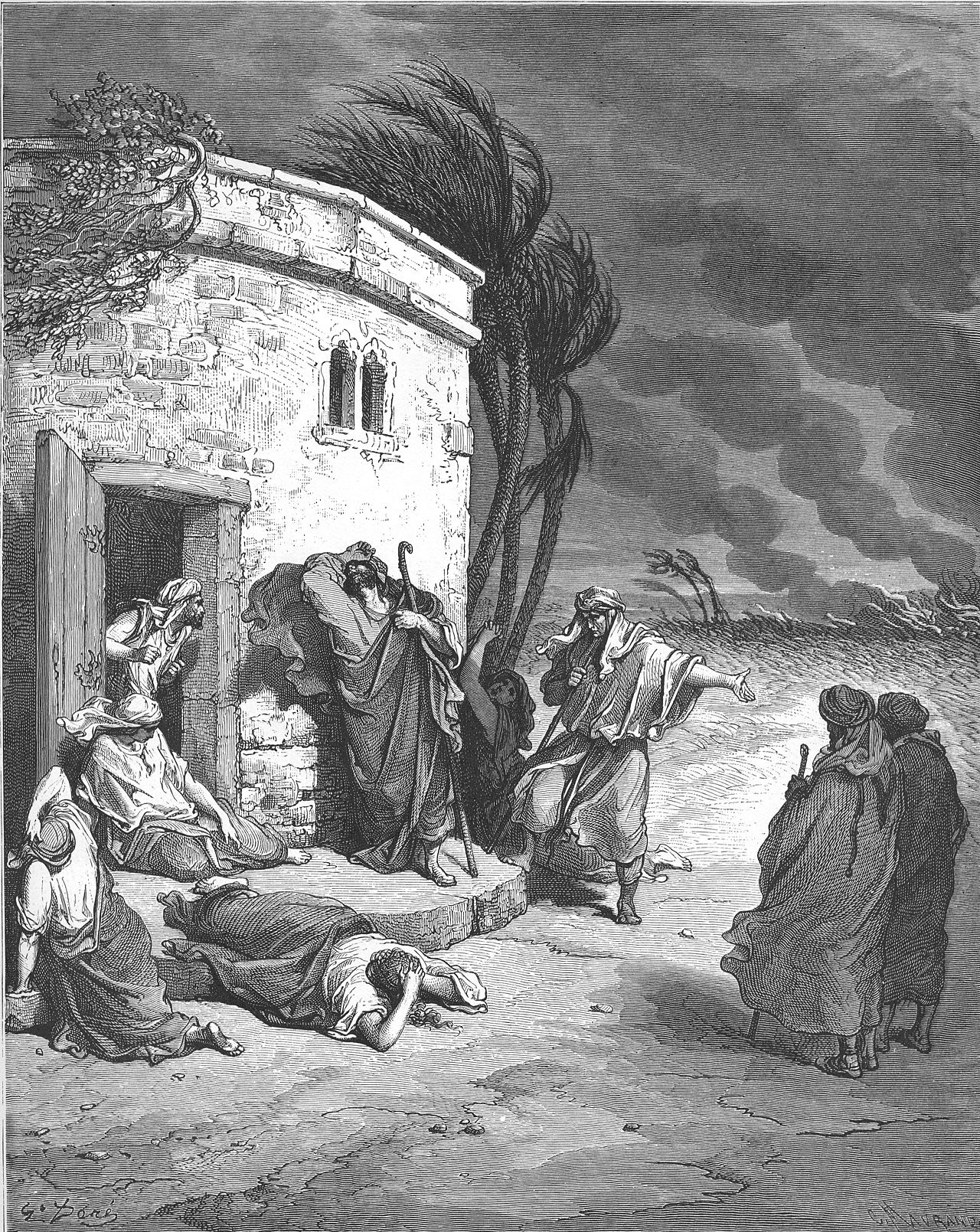
Jobchapter 12
25 verses · unknown · 10th century BC · Wisdom and poetry
Does not the ear test words as the tongue tastes its food?
Introduction
unknown, Wisdom and poetry, Job Overview.
Job begins his answer to the whole first round in this chapter, speaking to all three friends at once. He has heard a vision, the voice of tradition and a lecture on the wisdom of God, and he now claims that he knows all of it already. His hearers had seen kingdoms rise and fall in their own lifetimes and had watched rulers led away as captives. Listen for his sarcasm at the start. Then listen for his call to learn from the animals, and for the long list of powerful people God brings down. The chapter shows Job arguing from God's greatness as strongly as his friends do.
Context
- Who
- Hearers who had seen empires rise and rulers fall in their own lifetimes
- What
- The opening of Job's reply to all three friends, answering their wisdom with scorn and describing God's power over nature and over rulers.
- Where
- The ash heap outside Job's town, with the three friends answered together.
- When
- After Zophar's speech, as the reply that closes the first round.
- Why
- To show that Job knows God's power as well as the friends do, and that God's power alone leaves his suffering unexplained.
Historical context
Job opens with the sharpest sarcasm in the book: no doubt you are the people, and wisdom shall die with you. He tells them he is not inferior to them and that what they have said is common knowledge, who does not know such things as these?
Show the rest of the historical context, 3 more paragraphs
His answer is to send them to school with the animals. Ask the beasts, the birds, the earth, the fish, even they know that the hand of the LORD has done this. It is a deliberate insult to men who had just cited visions and ancestral tradition: creation itself teaches what you needed a night-terror to learn.
The hymn that follows is the reverse of the friends' God. Job describes a God who overthrows the arrangements men trust: he looses the bond of kings and ties a rope around their waists, leads priests away stripped, overthrows the mighty, takes away the speech of trusted counsellors and the judgment of elders, pours contempt on princes, and weakens the strong. Every line in that list is what a conquering army did to a captured city's leadership, the officials stripped and roped in a line, the priests marched off, the elders silenced. Anyone in the ancient Near East had seen it or heard of it.
He also names deceiver and deceived as both belonging to God, and says he enlarges nations and destroys them. This is not comfort. It is Job saying that God's power is not in doubt and is not the question; the question is what he is doing with it.
Significance
The friends had used God's greatness to shut Job up. Job uses the same greatness to open the case wider: a God who topples kings is not a God whose ways can be read off a simple rule about the righteous prospering.
Show the rest of the significance, 1 more paragraph
For hearers who had watched nations disappear, this was recognisable and unsettling. Job is not less orthodox than his friends. He is more, and it is costing him more.
This chapter in Jewish lifeWhat this chapter is in Jewish life and reading.
What is done
The synagogue year does not read this chapter on the site's table. The probe of src/lib/hebraic/readings.ts printed parashot total 0 and haftarah uses total 0 for Job, with no festival reading.
The corpus ties several verses to the Torah portions through the Tanchuma. It carries Midrash Tanchuma, Pinchas 12:1 under the seventh verse and Midrash Tanchuma, Vayikra 7:1 under the twenty-second. It carries Midrash Tanchuma Buber, Kedoshim 15:1 under the fourteenth and Vayechi 9:1 under the twentieth. Under the eighth verse it carries Sifrei Devarim 306:1. From the Talmud it carries Chagigah 5b:21 under the fourth verse and Jerusalem Talmud Taanit 3:4:5 under the sixth.
How it is read
Malbim is cited here from Malbim's Job, translated by Jeremy I. Pfeffer (Ktav, 2003), which Sefaria reports as CC-BY. His one note in English on this chapter counts it as the seventh oration, Job's reply to Zophar's first speech (Malbim on Job 12:1:1).
Rashi is quoted from The Judaica Press complete Tanach with Rashi, translated by A. J. Rosenberg, which Sefaria reports as CC-BY. He reads Job answering with irony. When the friends die, all wisdom will die with them, "but I too have intelligence like you" (Rashi on Job 12:2:1). Everyone knows that the Holy One, blessed be He, has power to do His will and to let the wicked rest in peace. "You are only mocking me" (Rashi on Job 12:3:1). At the fourth verse the righteous man calls to God about the pain of the friends' provocation, and God answers by giving the righteous laughter (Rashi on Job 12:4:1).
Rashi then turns to the prosperous. The fire of Gehinnom stands ready for the one who is at ease in his thoughts and tells himself he will have peace (Rashi on Job 12:5:1).
The rest of the chapter Rashi reads as God's rule over nations and men. The waters are His agents, as in the generation of Enosh, when He flooded a third of the world (Rashi on Job 12:15:1). He removed the yoke from Nebuchadnezzar and dethroned him (Rashi on Job 12:18:1). Even the lips of trusty men become confused, and Rashi gives Abraham as the example, who believed and later asked how he would know (Rashi on Job 12:20:1).
At the twenty-third verse Rashi weighs two readings. Some say it tells of the Egyptians at Baal-zephon, misled by God so that they would drown. Rashi sets that aside because the word would then carry a different dot on its letter. His main reading takes the word as making great. God makes the nations prosper and their heart grows proud, "so that [the fact] that they prosper is their destruction" (Rashi on Job 12:23:1). The first reading ties the verse to one event, and the second makes it a rule of history.
The corpus carries seven further notes on this chapter without an English text, each marked linked because Sefaria holds no English version of the ref. They stand cited and unquoted at Metzudat David on Job 12:7:1, 12:8:1, 12:9:1, 12:10:1, 12:13:1, 12:14:1 and 12:22:1.
What the rabbis say
The corpus carries forty rabbinic locators on this chapter and the text of none, so each is cited here by ref alone. On the second verse it holds Bereshit Rabbah 99:5, Mekhilta DeRabbi Shimon Ben Yochai 18:26 and Mekhilta DeRabbi Yishmael, Tractate Amalek 4:27. On the third it holds Aggadat Bereshit 11:2 and Midrash Mishlei 1:1. On the fourth it holds Chagigah 5b:21, Ein Yaakov (Glick Edition), Khagigah 1:16 and Ein Yaakov, Khagigah 1:10.
On the fifth verse the corpus holds Bereshit Rabbah 30:7, Mekhilta DeRabbi Yishmael, Tractate Shirah 2:7 and Midrash Aggadah, Genesis 7:6:1. On the sixth it holds Bamidbar Rabbah 9:24, Ein Yaakov, Sukkah 5:13 and Jerusalem Talmud Taanit 3:4:5. On the seventh it holds Bamidbar Rabbah 21:18 and Midrash Tanchuma, Pinchas 12:1. On the eighth it holds Sifrei Devarim 306:1 and Yalkut Shimoni on Torah 941:8. On the tenth it holds Bamidbar Rabbah 12:11 and Devarim Rabbah 11:10.
On the eleventh verse the corpus holds Ein Yaakov (Glick Edition), Shabbat 23:8 and Midrash Sekhel Tov, Bereshit 27:4:2. On the twelfth it holds Ein Yaakov, Shabbat 23:11 and Mekhilta DeRabbi Shimon Ben Yochai 19:19. On the thirteenth it holds Bereshit Rabbah 16:1 and Mekhilta DeRabbi Shimon Ben Yochai 15:1. On the fourteenth it holds Bereshit Rabbah 91:1 and Midrash Tanchuma Buber, Kedoshim 15:1. On the fifteenth it holds Bereshit Rabbah 5:2 and Mekhilta DeRabbi Shimon Ben Yochai 19:16.
On the sixteenth verse the corpus holds Midrash Tehillim 7:2 and Otzar Midrashim, Midrash Yitbarach ('May He Be Blessed') 1:5. On the eighteenth it holds Bereshit Rabbah 53:9 and Eikhah Rabbah 2:17. On the twentieth it holds Ein Yaakov, Kinnim 3:1 and Midrash Tanchuma Buber, Vayechi 9:1. On the twenty-second it holds Midrash Tanchuma, Vayikra 7:1. On the twenty-third it holds Bamidbar Rabbah 20:9 and Esther Rabbah 7:2, and on the twenty-fifth Midrash Sekhel Tov, Bereshit 31:29:3. What each of them teaches is a saying of the rabbis, and is reported as theirs wherever this site quotes one. The quotations wait on a fetch that carries the text.
Sources: Malbim, Malbim on Job 12:1:1, Malbim's Job, trans. Jeremy I. Pfeffer, Ktav, 2003, reported CC-BY; Rashi, Rashi on Job 12:2:1 to 12:24:1, The Judaica Press complete Tanach with Rashi, translated by A. J. Rosenberg, reported CC-BY; Metzudat David, Metzudat David on Job 12:7:1, 12:8:1, 12:9:1, 12:10:1, 12:13:1, 12:14:1 and 12:22:1, cited by ref because the corpus carries no English text; The Sefaria corpus, scripts/data/sources/sefaria/job/12.json, the 40 Talmud and Midrash locators of this chapter; The site's own files, src/lib/hebraic/readings.ts, printing no portion, no Haftarah and no festival reading for this book.
The heads below are this chapter's scenes. The numbered points under each are its verses.
Job: No Doubt Ye Are the People, and Wisdom Shall Die With You
Job 12:1-3
Then Job answered: Job answers all three friends with "Truly then you are the people with whom wisdom itself will die", the book's sharpest irony. The sarcasm is plain, since he at once claims, "I am not inferior to you". The friends have told him nothing new.
Job 12:1
“And Job answered and said. In reply to Zophar, and in defence of himself; what is recorded in this and the two following chapters.”
wisdom itself will die!: Job answers his friends with irony. Clarke and Barnes read the line as sarcasm: the friends speak as the only wise people on earth, and wisdom itself would die with them. Matthew Henry hears Job answer the wild donkey of Job 11:12.
Job 12:2
“No doubt but ye are the people - Doubtless ye are the wisest men in the world; all wisdom is concentrated in you; and when ye die, there will no more be found on the face of the earth! This is a strong irony.”
Adam Clarke · Commentary on the Bible (1810-1826)evangelical
2 more voices on this verse
Job 12:2
“No doubt but ye are the only men, and wisdom shall die with you. Now Zophar would have said this aright, if blessed Job had not proclaimed it all more fully even by living accordingly.”
Gregory the Dialogist · written before 604 · Morals on the Book of Job, Book Xpatristic
Job 12:2
“When wise men and good men die it is a comfort to think that wisdom and goodness shall not die with them. Some think Job here reflects upon Zophar's comparing him (as he thought) and others to the wild ass's colt, ch. xi. "Yes," says he, "we must be asses; you are the only men." 2.”
Matthew Henry · Commentary on the Whole Bible (1707-1721)puritan
I also have a mind: Barnes notes that the Hebrew says heart, the usual word in Scripture for the mind and understanding. Job claims an understanding equal to his friends', and Clarke hears him dismiss their wisdom as proverbs found in every mouth. Everyone knows such things, Job says.
Job 12:3
“Such things - The truth is, neither you nor I have any reason to be puffed up with our knowledge of these things: for the most barbarous nations know that God is infinite in wisdom, and power, and justice. But this is not the question between you and me.”
John Wesley · Explanatory Notes upon the Old Testament (1765)evangelical
1 more voice on this verse
Job 12:3
“But I have understanding as well as you - Margin, as in the Hebrew “an heart.” The word “heart” in the Scriptures is often used to denote the understanding or mind. It seems to have been regarded as the source of that which was called life or soul. Indeed, I do not recollect a single instance in the Scriptures in which the word “head” is used, as with us, as the seat of the intellect, or where the distinction is adverted to that is so common with us, between the head and the heart.”
Job 12:4-6
I am a laughingstock to my friends: Job, a righteous man who "called on God, and He answered", is "a laughingstock to my friends", a fact the friends refuse to reckon with. "The tents of robbers are safe, and those who provoke God are secure" states in brief the problem their theology cannot answer.
Job 12:4
“I am as one mocked of his neighbor - Though I am invoking God for help and salvation, yet my friends mock me in this most solemn and sacred work. But God answereth me. The just upright man is laughed to scorn - This is a very difficult verse, on which no two critics seem to be agreed. Mr. Good translates the fourth and fifth verses thus: - “Thus brother is become a laughing-stock to his companions, While calling upon God that he would succor him.”
Adam Clarke · Commentary on the Bible (1810-1826)evangelical
1 more voice on this verse
Job 12:4
“Upon God - Even by my religious neighbours, by those who call upon God, and not in vain; whose prayers therefore I covet, not their reproaches. The just - I, who, notwithstanding all their hard censures dare still own it, that through God's grace I am an upright man.”
John Wesley · Explanatory Notes upon the Old Testament (1765)evangelical
The one at ease scorns misfortune: Job describes how the comfortable look on the fallen. Barnes explains slipping feet picture a man in adversity, as at Psalm 73:2, and Henry notes even the upright man under a cloud is scorned. The friends sit at ease while Job suffers.
Job 12:5
“He that is ready to slip with his feet - The man whose feet waver or totter; that is, the man in adversity; see Pro 25:19. A man in prosperity is represented as standing firm; one in adversity as wavering, or falling; see Psa 73:2. But as for me, my feet were almost gone; My steps had well nigh slipped. There is much difficulty in this passage, and it has by no means been removed by the labor of critics. The reader may consult Rosenmuller, Good, and Schultens, on the verse, for a more full attempt to illustrate its meaning.”
1 more voice on this verse
Job 12:5
“Rather, "a torch" (lamp) is an object of contempt in the thoughts of him who rests securely (is at ease), though it was prepared for the falterings of the feet [UMBREIT] (Pr 25:19).”
Jamieson, Fausset & Brown · Commentary Critical and Explanatory on the Whole Bible (1871)reformed
The tents of robbers are safe: Zophar had said at Job 11:20 that the eyes of the wicked will fail. Job answers that robbers live safe and those who provoke God live secure, which Barnes calls Job's settled position in the whole debate. Matthew Henry adds that great sinners may live in great ease.
Job 12:6
“The tabernacles of robbers have plenty, and they provoke God with boldness; when He hath given all into their hand. It is easy for a man, at the time, to despise riches, when he has them, but it is hard to hold them worthless, when he lacks them. Hence it is clearly shewn, how great a contempt of earthly things was lodged in the breast of blessed Job, who then declares that all is nought which the lost enjoy in plenty, at the time when he had lost every thing.”
Gregory the Dialogist · written before 604 · Morals on the Book of Job, Book XIpatristic
2 more voices on this verse
Job 12:6
“The tabernacles of robbers prosper - Those who live by the plunder of their neighbors are often found in great secular prosperity; and they that provoke God by impiety and blasphemy live in a state of security and affluence. These are administrations of Providence which cannot be accounted for; yet the Judge of all the earth does right. Therefore prosperity and adversity are no evidences of a man’s spiritual state, nor of the place he holds in the approbation or disapprobation of God.”
Adam Clarke · Commentary on the Bible (1810-1826)evangelical
Job 12:6
“Are secure - Job's friends had all supposed, that wicked men cannot prosper long in the world. This Job opposes, and maintains, that God herein acts as sovereign, and reserves that exact distribution of rewards and punishments for the other world.”
John Wesley · Explanatory Notes upon the Old Testament (1765)evangelical
Job 12:7-9
ask the animals, and they will instruct you: The call to "ask the animals, and they will instruct you" looks ahead to the whirlwind's method, turning the reader toward creation as a witness. Verse 9, "the hand of the LORD has done this", is the one verse of the human debate to carry the covenant name.
Job 12:7
“But ask now the beasts - Rosenmuller supposes that this appeal to the inferior creation should be regarded as connected with Job 12:3, and that the intermediate verses are parenthetical. Zophar had spoken with considerable parade of the wisdom of God. He had said (Job 11:7 ff) that the knowledge of God was higher than the heavens, and had professed Job 12:6 to have himself exalted views of the Most High. In reply to this, Job says that the views which Zophar had expressed, were the most commonplace imaginable.”
let the fish of the sea inform you: Job sends his friends to the animals, the birds, the earth and the fish to learn. Matthew Henry hears them tell that they serve wicked owners, so the living things of earth and sea speak of the ease of the wicked. Barnes finds the same lesson in the earth.
Job 12:8
“Or speak to the earth, and it shall teach thee,.... Or ask "a sprig of the earth" (n), any shrub, or tree, or whatsoever grows out of it, and they will all unite in this doctrine, that they are raised and preserved by the power of God, and are so many instances of his wisdom, power, and goodness: and the fishes of the sea shall declare unto thee; as mute as they are, they will proclaim this truth, that God is the mighty Maker and wise Disposer of them. (n) שיח לארץ "virgultum terrae", Pagninus, Schmidt; so Drusius and Michaelis.”
the hand of the LORD has done this?: Every creature, Job says, knows that the hand of the LORD is behind all these things. Barnes reads it as a lesson plain enough for the beasts to teach, and Gregory hears Job saying the dull and learned alike know it. The friends have told Job nothing new.
Job 12:9
“Who knoweth not in all these that the hand of the Lord hath wrought this? As if he said in plain terms; 'Whether you ask the dull of understanding, or persons full of the loftiest subjects, or those devoted to earthly ways, or the men busied with investigations that belong to this world, all of them acknowledge God to be the Creator of all things, and with one consent agree about His Power, though they do not with one consent live in submission to it.”
Gregory the Dialogist · written before 604 · Morals on the Book of Job, Book XIpatristic
1 more voice on this verse
Job 12:9
“Who knoweth not in all these - Who cannot see in all these the proofs of the same divine and sovereign agency? Who cannot see the hand of the same God and the same great principles of administration? The meaning of Job is, that the position which he defends is so plain, that it may be learned from the very earth and the lowest orders of animals which God has made. That the hand of the Lord hath wrought this - In this place the original word is יהוה yehovâh.”
Job 12:10-11
The life of every living thing: g is in His hand, as well as the breath of all mankind" carries verse 9 to its widest reach. The faculty that judges food also judges argument, and Job claims it to weigh the friends' speeches and find them wanting.
Job 12:10
“In whose hand is the soul of every living thing - נפש כל חי nephesh col chai, “the soul of all life.” And the breath of all mankind - ורוח כל בשר veruach col besar, “and the spirit or breath of all flesh.” Does not the first refer to the immortal soul, the principle of all intellectual life; and the latter to the breath, respiration, the grand means by which animal existence is continued? See Job 10:1.”
Adam Clarke · Commentary on the Bible (1810-1826)evangelical
the ear test words: The ear tests words as the tongue tastes food, and Job invites his friends to weigh their own sayings. Matthew Henry draws the lesson that every doctrine must be tried before it is received. Clarke hears Job calling their speeches commonplace.
Job 12:11
“Note, The ear must try words before it receives them so as to subscribe to them. As by the taste we judge what food is wholesome to the body and what not, so by the spirit of discerning we must judge what doctrine is sound, and savoury, and wholesome, and what not, 1 Cor. x. 12 With the ancient is wisdom; and in length of days understanding.”
Matthew Henry · Commentary on the Whole Bible (1707-1721)puritan
4 more voices on this verse
Job 12:11
“The ear trieth words, and the mouth of the eater savour. There is scarce a person that is ignorant that the five senses of our body, viz. of seeing, hearing, tasting, smelling, and touching, in all their operations of perceiving and discriminating derive the power of perception and discrimination from the brain.”
Gregory the Dialogist · written before 604 · Morals on the Book of Job, Book XIpatristic
Job 12:11
“Doth not the ear try words? - All these are common-place sayings. Ye have advanced nothing new; ye have cast no light upon the dispensations of Providence.”
Adam Clarke · Commentary on the Bible (1810-1826)evangelical
Job 12:11
“Doth not the ear try words? - The literal meaning of this, which is evidently a proverbial expression, is plain; but about its bearing here there is more difficulty. The literal sense is, that it is the office of the ear to mark the distinction of sounds, and to convey the sense to the soul. But in regard to the exact bearing of this proverb on the case in hand, commentators have not been agreed.”
Job 12:11
“Doth not the ear try words?....”
Job 12:12-13
Wisdom is found with the elderly: y, and understanding comes with long life" concedes a proverb the friends have leaned on, that age carries authority. "Wisdom and strength belong to God; counsel and understanding are His" caps the concession, moving the seat of wisdom from human elders to God.
Job 12:12
“With the ancient is wisdom, and in length of days understanding. For these sayings are set fast in the root of wisdom, which by continuance in living, are also made strong by the practice of deeds. But because there are many to whom at once longer life is given, and yet no grace of wisdom vouchsafed, it is further shewn with propriety on whose decision the gifts themselves depend.”
Gregory the Dialogist · written before 604 · Morals on the Book of Job, Book XIpatristic
2 more voices on this verse
Job 12:12
“But it is to be found only with some few, with the ancient, and those who are blessed with length of days, who get it by long experience and constant experience; and, when they have got the wisdom, they have lost their strength and are unable to execute the results of their wisdom.”
Matthew Henry · Commentary on the Whole Bible (1707-1721)puritan
Job 12:12
“With the ancient is wisdom - Men who have lived in those primitive times, when the great facts of nature were recent, such as the creation, fall, flood, confusion of tongues, migration of families, and consequent settlement of nations, had much knowledge from those facts; and their length of days - the many hundreds of years to which they lived, gave them such an opportunity of accumulating wisdom by experience, that they are deservedly considered as oracles.”
Adam Clarke · Commentary on the Bible (1810-1826)evangelical
Job: With God Is Wisdom: He Poureth Contempt Upon Princes
Wisdom and strength belong to God: Verse 13 answers verse 12. Matthew Henry sets the wisdom of elderly men beside the wisdom of the Ancient of Days, who has all power. Gregory reads the verse of Christ, called the power and the wisdom of God at 1 Corinthians 1:24.
Job 12:13
“With Him is wisdom and strength: He hath counsel and understanding. We not unfitly interpret these words of the Only begotten Son of the Supreme Father, so as to understand Him to be Himself 'the Wisdom and Strength of God.' For Paul also bears testimony to our interpretation, in the words, Christ the Power of God and the Wisdom of God. Who is ever 'with Him,' in that, In the Beginning was the Word, and the Word was with God, and the Word was God.”
Gregory the Dialogist · written before 604 · Morals on the Book of Job, Book XIpatristic
3 more voices on this verse
Job 12:13
“In contrast to, "with the ancient is wisdom" (Job 12:12), Job quotes a saying of the ancients which suits his argument, "with Him (God) is (the true) wisdom" (Pr 8:14); and by that "wisdom and strength" "He breaketh down," &c., as an absolute Sovereign, not allowing man to penetrate His mysteries; man's part is to bow to His unchangeable decrees (Job 1:21).”
Jamieson, Fausset & Brown · Commentary Critical and Explanatory on the Whole Bible (1871)reformed
Job 12:13
“What is the wisdom of ancient men compared with the wisdom of the ancient of days! It is but little that we know, and less that we can do; but God can do every thing, and no thought can be withheld from him. Happy are those who have this God for their God, for they have infinite wisdom and strength engaged for them.”
Matthew Henry · Commentary on the Whole Bible (1707-1721)puritan
Job 12:13
“With him is wisdom - Margin, correctly, “God.” However much wisdom there may seem to be with aged men, yes the true wisdom - that which was supreme and worthy of the name - was to be found in God alone. The object of Job was to lead the thoughts up to God, and to bring his friends to a contemplation of the wisdom which he manifests in his works.”
Job 12:14-16
What He tears down cannot be rebuilt: t" opens a survey of providence at work by unmaking what stands. Verse 15 pairs drought and flood as two faces of one governing hand. At verse 16, "The deceived and the deceiver are His" extends God's rule over deception itself.
Job 12:14
“He breaketh down - He alone can create, and he alone can destroy. Nothing can be annihilated but by the same Power that created it. This is a most remarkable fact. No power, skill, or cunning of man can annihilate the smallest particle of matter. Man, by chemical agency, may change its form; but to reduce it to nothing belongs to God alone. In the course of his providence God breaks down, so that it cannot be built up again.”
Adam Clarke · Commentary on the Bible (1810-1826)evangelical
1 more voice on this verse
Job 12:14
“If He break down, there is none that can build again: if He shut up a man, there is none that can open. Almighty God 'breaks down' the heart of man, when He forsakes it; He 'builds it up,' when He fills it. For He does not destroy man's soul by consummation of war, but by withdrawing Himself from it; in that when it is left to itself, it wants nothing to its own ruin.”
Gregory the Dialogist · written before 604 · Morals on the Book of Job, Book XIpatristic
If He holds back the waters, they dry up: Job shows the power of God in drought and flood. Matthew Henry reads both as judgments on the land, when the waters are held back and when they overwhelm. Clarke hears an echo of Genesis 1:9, when God gathered the waters and the dry land appeared.
Job 12:15
“He withholdeth the waters - From the clouds and springs. He has control over the rains and the fountains; and when these are withheld, rivers and lakes become dry. The Syriac renders this, - “if he rebuke the waters,” supposing that there might perhaps be an allusion to the drying up of the Red Sea, or the formation of a passage for the Israelites.”
2 more voices on this verse
Job 12:15
“Great droughts are sometimes great judgments: He withholds the waters, and they dry up; if the heaven be as brass, the earth is as iron; if the rain be denied, fountains dry up and their streams are wanted, fields are parched and their fruits are wanted, Amos iv. Great wet is sometimes a great judgment.”
Matthew Henry · Commentary on the Whole Bible (1707-1721)puritan
Job 12:15
“The waters - Which are reserved its the clouds, that they may not fall upon the earth. They - The waters upon the earth, springs, and brooks, and rivers. As at the time of the general deluge, to which here is a manifest allusion.”
John Wesley · Explanatory Notes upon the Old Testament (1765)evangelical
The deceived and the deceiver are His: Matthew Henry names two cases: Jacob deceived his father, and Ahab was deceived by false prophets, and in both the counsel of God stood. The deceived and the deceiver are in His hand. Job credits God with true wisdom and power over both.
Job 12:16
“With him is strength and wisdom - עז ותושיה oz vethushiyah, strength and sufficiency. Strength or power, springing from an exhaustless and infinite source of potency. In the thirteenth verse it is said, With him is wisdom and strength; but the expressions are not the same, חכמה וגבורה chochmah ugeburah, intelligence and fortitude, or strength in action, the wisdom ever guiding the exertions of power; but here is strength or power in essence, and an eternal potentiality. With him is every excellence, in potentia and in esse. He borrows nothing, he derives nothing.”
Adam Clarke · Commentary on the Bible (1810-1826)evangelical
2 more voices on this verse
Job 12:16
“When Jacob by a fraud got the blessing the design of God's grace was served; when Ahab was drawn by a false prophecy into an expedition that was his ruin the design of God's justice was served; and in both the deceived and the deceiver were at his disposal.”
Matthew Henry · Commentary on the Whole Bible (1707-1721)puritan
Job 12:16
“He governs the deceiver and sets bounds to his deceits, how far they shall extend; he also over-rules all this to his own glory, and the accomplishment of his righteous designs of trying the good, and punishing wicked men, by giving them up to believe lies. Yet God is not the author of any error or sin, but only the wise and holy governor of it.”
John Wesley · Explanatory Notes upon the Old Testament (1765)evangelical
Job 12:17-19
He leads counselors away barefoot: t and makes fools of judges" begins a list of the offices society trusts, each brought low in turn. Priests and "the established" fall, no office too high to reach, an answer to the friends' confidence that God's rule follows a ladder of reward.
Job 12:17
“He leadeth counsellors away spoiled - Plundered or captive. That is, the counsels of wise and great men do not avail against God. Statesmen who promised themselves victory as the result of their plans he disappoints, and leads away into captivity. The object of this is to show that God is superior over all, and also that people are not dealt with in exact accordance with their character and rank. God is a sovereign, and he shows his sovereignty when defeating the counsels and purposes of the wisest of men, and overturning the plans of the mighty.”
1 more voice on this verse
Job 12:17
“The counsel of Ahithophel, one in whom this scripture was remarkably fulfilled, became foolishness, and he, according to his name, the brother of a fool. 13 , The princes of Zoan have become fools; they have seduced Egypt, even those that are the stay of the tribes thereof.”
Matthew Henry · Commentary on the Whole Bible (1707-1721)puritan
He loosens the bonds placed by kings: Barnes reads the bonds as royal power over others. God loosens that power and binds the kings themselves, leading them away as prisoners with a cord at the waist. Jamieson, Fausset and Brown set that cord beside the royal belt the kings once wore.
Job 12:18
“He looseth the bond of kings--He looseth the authority of kings--the "bond" with which they bind their subjects (Isa 45:1; Da 2:21). a girdle--the cord, with which they are bound as captives, instead of the royal "girdle" they once wore (Isa 22:21), and the bond they once bound others with.”
Jamieson, Fausset & Brown · Commentary Critical and Explanatory on the Whole Bible (1871)reformed
1 more voice on this verse
Job 12:18
“Girdeth - He reduces them to a mean and servile condition; which is thus expressed, because servants did use to gird up their garments (that after the manner of those parts were loose and long) that they might be fitter for attendance upon their masters: he not only deposes them from their thrones, but brings them into slavery.”
John Wesley · Explanatory Notes upon the Old Testament (1765)evangelical
He leads priests away barefoot: Barnes notes that the Hebrew word here usually means priests, as the Berean renders it, though some ancient interpreters took it as princes. Job's list moves through counselors, judges, kings and priests, and God humbles each in turn. The established fall with them.
Job 12:19
“He leadeth princes away spoiled - That is, plundered. The word here rendered “princes” כהנים kôhênı̂ym means properly priests, and it is usually so rendered in the Scriptures. The ancient Hebrew interpreters suppose that the word sometimes also means prince. The Chaldee paraphrasist has not unfrequently so rendered it, using the word רבא to express it; Gen 41:45; Psa 110:4. In this place, the Vulgate renders it, “sacerdotes;” and the Septuagint, ἱερεῖς hiereis, “priests.” So Luther renders it, “Priester.” So Castellio.”
1 more voice on this verse
Job 12:19
“He leadeth the priests inglorious, and overthroweth the mighty. The great glory of the priest is the righteousness of those that are subject to him. Whence the excellent preacher saith well to his disciples; For what is our hope, or joy, or crown of rejoicing? Are not even ye in the presence of our Lord? But when the priests neglect the lives of their charge, and bring no fruit from their advancement before the presence of the Lord, what else is this but that they are called 'inglorious?'”
Gregory the Dialogist · written before 604 · Morals on the Book of Job, Book XIpatristic
Job 12:20-22
He deprives the trusted of speech: h and takes away the discernment of elders" carries the survey to the men a household relies on for counsel. Verse 22, "He reveals the deep things of darkness", pairs the humbling of the mighty with God's mastery over what is hidden.
Job 12:20
“He removeth away the speech of the trusty - The faithful counsellor and the eloquent orator avail nothing: Quos Deus vult perdere, prius dementat; “God infatuates those whom he is determined to destroy.” The writer might have had his eyes on Isa 3:1-3, which the reader will do well to consult. The understanding of the aged - זקנים zekenim signifies the same here as our word elders or elder-men; which includes in itself the two ideas of seniority, or considerably advanced age, and official authority.”
Adam Clarke · Commentary on the Bible (1810-1826)evangelical
1 more voice on this verse
Job 12:20
“Who changeth the lip of the truthful, and taketh away the instruction of the aged. When the priest does not do the good that he tells, even the very word of his lips is withdrawn from him, that he may not dare to speak what he does not practise; as where it is said by the Prophet, But unto the wicked God saith, 'What hast thou to do, to declare My statutes, or that thou takest My covenant in thy mouth? Whence also he beseeches, saying, And take not the word of truth utterly out of my mouth.”
Gregory the Dialogist · written before 604 · Morals on the Book of Job, Book XIpatristic
He pours out contempt on nobles: Psalm 107:40 takes up this line together with verse 24, as Jamieson, Fausset and Brown note. The Hebrew of the second half speaks of loosening the belt of the mighty, who girded their long robes for strength, in Barnes's reading. God disarms the mighty.
Job 12:21
“He poureth contempt upon princes,.... Not on good princes, such as rule in righteousness, and decree judgment and govern their subjects according to good laws, in a mild and gentle manner, and answer to their name of free, liberal, beneficent and munificent.”
1 more voice on this verse
Job 12:21
“Ps 107:40 quotes, in its first clause, this verse and, in its second, Job 12:24. weakeneth the strength--literally, "looseth the girdle"; Orientals wear flowing garments; when active strength is to be put forth, they gird up their garments with a girdle.”
Jamieson, Fausset & Brown · Commentary Critical and Explanatory on the Whole Bible (1871)reformed
He reveals the deep things of darkness: Barnes reads the line as God bringing into light truths deep beyond the reach of man. Clarke adds that the deep things of darkness may be the schemes of the wicked, laid in shadow and then revealed. Nothing stays hidden from God.
Job 12:22
“Who discovereth deep things out of darkness, and bringeth out to light the shadow of death. For when the several mystical truths are recognised in the secret words of the Prophets by them that believe, what else is it, than that 'deep things are discovered out of darkness?' Whence too 'Truth' Himself, speaking in parables to the disciples, saith, What I tell you in darkness, that speak ye in light. For when by explaining we unravel the mystical knots of allegories, then we as it were 'speak in light, what we have heard in darkness.'”
Gregory the Dialogist · written before 604 · Morals on the Book of Job, Book XIpatristic
1 more voice on this verse
Job 12:22
“He discovereth deep things out of darkness - This may refer either to God’s works in the great deep, or to the plots and stratagems of wicked men, conspiracies that were deeply laid, well digested, and about to be produced into existence, when death, whose shadow had hitherto concealed them, is to glut himself with carnage.”
Adam Clarke · Commentary on the Bible (1810-1826)evangelical
Job 12:23-25
He makes nations great and destroys them: m" closes the survey at its largest scale, whole peoples rising and falling by the hand that unseated kings. "He makes them stagger like drunkards" answers the friends' confident order with a providence that unsettles the very men who claim to understand it.
Job 12:23
“He increaseth the nations, and destroyeth them,.... As he did before the flood, when the earth was tilled, and all over peopled with them, but at the flood he destroyed them at once.”
1 more voice on this verse
Job 12:23
“He increaseth the nations, and destroyeth them - He has entire control over them. The sources of prosperity are in his hand, and at his pleasure he can visit them with famine, pestilence, or war, and diminish their numbers and arrest their prosperity. Dr. Good renders this very improperly, “He letteth the nations grow licentious;” but the word שׂגא śâgâ' never has this sense. It means, to make great; to multiply; to increase. And straiteneth them again - Margin, “leadeth in.” So the word נחה nâchâh means.”
makes them wander in a trackless wasteland: Clarke reads the verse as God taking courage from leaders, so that armies panic and counsels fail. Psalm 107:40 borrows this picture of rulers lost in a trackless wasteland. The leaders of the earth lose their reason.
Job 12:24
“He taketh away the heart of the chief - Suddenly deprives the leaders of great counsels, or mighty armies of courage; so that, panic-struck, they flee when none pursueth, or are confounded when about to enter on the accomplishment of important designs. And causeth them to wander in a wilderness - A plain allusion to the journeyings of the Israelites in the deserts of Arabia, on their way to the promised land.”
Adam Clarke · Commentary on the Bible (1810-1826)evangelical
1 more voice on this verse
Job 12:24
“Who changeth the heart of the chief of the people of the earth, and deceiveth them, that they wander in vain where there is no way, they shall grope in the dark without any light, and He shall make them to stagger like a drunken man. For 'the heart of the chief of the earth was changed,' when the chief priests and elders of the people in Judaea set themselves to withstand Him by their counsels, Whom they beforehand proclaimed, that He was to come.”
Gregory the Dialogist · written before 604 · Morals on the Book of Job, Book XIpatristic
He makes them stagger like drunkards: Clarke hears in this line the curse of Deuteronomy 28:28-29, where the disobedient grope at noon like the blind. Barnes compares the reeling counsels of leaders to the steps of a drunken man, as at Isaiah 19:14. God brings the cleverest minds to their wits' end.
Job 12:25
“Note, God can soon nonplus the deepest politicians and bring the greatest wits to their wits' end, to show that wherein they deal proudly he is above them. Thus are the revolutions of kingdoms wonderfully brought about by an overruling Providence. Heaven and earth are shaken, but the Lord sits King for ever, and with him we look for a kingdom that cannot be shaken.”
Matthew Henry · Commentary on the Whole Bible (1707-1721)puritan
Keep studying
Studies1
People and groups1
Sources for this chapter
The summary
Jamieson, Fausset & Brown, Commentary Critical and Explanatory; John Wesley, Notes on the Old Testament and Matthew Henry, Complete Commentary.
The exposition
Adam Clarke, Commentary on the Bible; Albert Barnes; Franz Delitzsch, Biblical Commentary on the Book of Job; Gregory the Dialogist, Morals on the Book of Job; Jamieson, Fausset & Brown, Commentary Critical and Explanatory on the Whole Bible; John Gill, Exposition of the Old Testament and Matthew Henry, Commentary on the Whole Bible.