
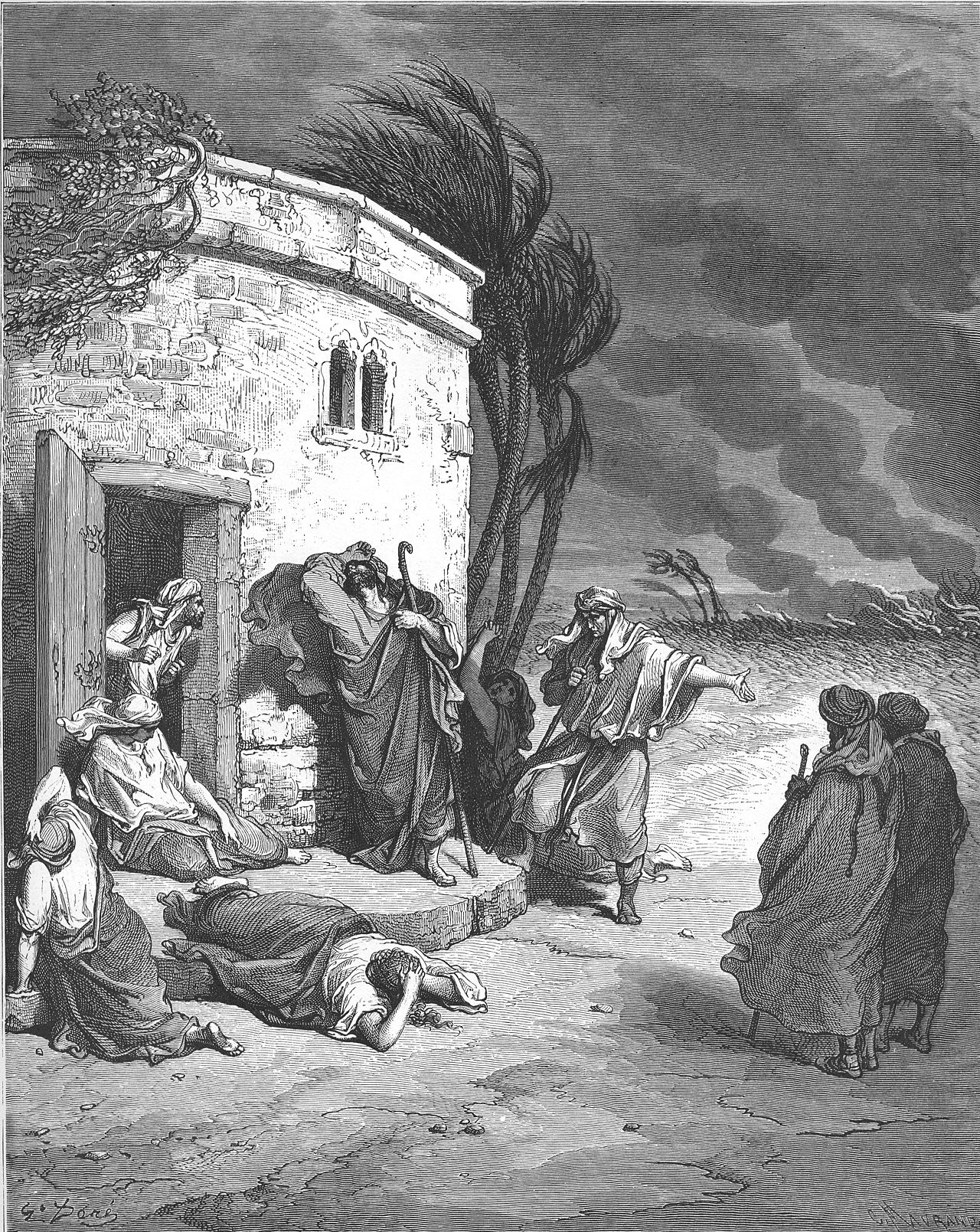
Jobchapter 11
20 verses · unknown · 10th century BC · Wisdom and poetry
You have said, ‘My doctrine is sound, and I am pure in Your sight.’
Introduction
unknown, Wisdom and poetry, Job Overview.
Zophar, the third friend, speaks for the first time in this chapter and closes the opening round of the debate. He is the bluntest of the three and the least patient. He speaks to a world that believed hidden wisdom was guarded in heaven and seen by very few. Listen for his measure of God, taken in four directions. Listen for the harsh judgment he passes on Job near the start, and then for the bright promise he holds out at the end. Ask whether the promise can still be heard after the judgment.
Context
- Who
- Hearers who had met the counsellor with no patience left
- What
- Zophar's first speech, rebuking Job's many words, extolling the depth of God's wisdom, and promising restoration if Job puts away his sin.
- Where
- The ash heap outside Job's town; Zophar is a Naamathite.
- When
- The third speech of the first round, after Job's reply to Bildad.
- Why
- To finish the friends' first case, this time by an appeal to the hidden wisdom of God.
Historical context
Zophar the Naamathite is the bluntest of the three and the shortest-tempered. He opens by asking whether a flood of words should go unanswered and whether Job's talk should make men hold their peace, the accusation that Job is simply talking his way out.
Show the rest of the historical context, 3 more paragraphs
His claim is that wisdom has two sides, and that God could show Job the hidden half. Secret or double knowledge was a live idea in the ancient Near East: temple experts guarded lists, omen collections, and technical lore that ordinary people never saw, and 'the secrets of wisdom' would have sounded to hearers like a claim to inside information from the divine council.
He then measures God with the only measuring frame available: higher than heaven, deeper than Sheol, longer than the earth and broader than the sea. These are the four directions of the ancient cosmos, and the point is that a man standing at the centre of them cannot audit the one who set them.
His closing offer is the standard promise of security in that world, item by item: a face lifted without spot, fear gone, misery forgotten like water that has run past, life brighter than noon, lying down with none to make afraid, and many making suit to you. Set against it is the fate of the wicked, eyes that fail, no escape route, and hope that is the giving up of the ghost.
Significance
Zophar's charge is the cruellest of the three: God is exacting of you less than your guilt deserves. He tells a ruined man he is getting off lightly.
Show the rest of the significance, 1 more paragraph
By the end of the first round the hearers have watched three respectable men, using a vision, the ancestors, and pure logic, arrive at the same wrong answer. The book is dismantling a whole way of counselling, one speaker at a time.
This chapter in Jewish lifeWhat this chapter is in Jewish life and reading.
What is done
This chapter is read in no synagogue service on the site's table. The probe of src/lib/hebraic/readings.ts printed parashot total 0 and haftarah uses total 0 for Job, and no festival reading.
The corpus carries the chapter into the Talmud and the Torah portions. Under the fourteenth verse it holds Ketubot 19a:12, 19b:2 and 19b:4, and under the thirteenth Jerusalem Talmud Ketubot 2:3:5. Under the ninth it holds Eruvin 21a:14, and under the twelfth Bava Batra 12b:7. Under the eleventh it holds Midrash Tanchuma at Nasso 4:1, Shemot 20:1 and Vayetzei 5:1, with Midrash Tanchuma Buber, Nasso 6:1. Under the fifth it holds the Kedoshim 15:1 passage in both editions of the Tanchuma.
How it is read
Malbim is quoted here from Malbim's Job, translated by Jeremy I. Pfeffer (Ktav, 2003), which Sefaria reports as CC-BY. He counts the chapter as the sixth oration, Zophar's first speech (Malbim on Job 11:1:1). He sets Zophar apart from the two friends before him. Eliphaz and Bildad had accepted Job's premise that no righteous person would perish if God watches over human affairs, and each challenged only whether a truly righteous person had perished (Malbim on Job 11:1:2).
Zophar, in Malbim's reading, rejects the major premise itself. He argues that "it is conceivable that even though God governs, a righteous person may nevertheless suffer" (Malbim on Job 11:1:2). Malbim adds that no injustice need follow from it, and he rests the approach on the philosophical finding that perception has two aspects. The corpus text stops before it names them.
Rashi is quoted from The Judaica Press complete Tanach with Rashi, translated by A. J. Rosenberg, which Sefaria reports as CC-BY. He reads Zophar asking whether a man of so many words should not be answered by others (Rashi on Job 11:2:1). Zophar reminds Job that he told the Holy One, blessed be He, that his doctrine was pure and he was clean (Rashi on Job 11:4:1).
The double wisdom of the sixth verse Rashi names as "the Torah that you did not fulfill" (Rashi on Job 11:6:1), and Job cannot find out the mystery of God (Rashi on Job 11:7:1). God sees iniquity, Rashi reads, and seems for days and years not to consider it "because He is slow to anger" (Rashi on Job 11:11:1).
At the seventeenth verse Rashi sets two readings side by side. In the first the word is luck and time, and he sets a psalm beside it. In the other the light of Job's rust shall rise, so that his darkest place shines more than midday. Rashi then adds, "I heard this, but the first [explanation] does not please me" (Rashi on Job 11:17:1), a remark the corpus marks as not found in some editions. The two differ on the word itself, one reading fortune and the other reading the dark turned to light.
The corpus carries five further notes on this chapter without an English text, each marked linked because Sefaria holds no English version of the ref. They stand cited and unquoted at Ibn Ezra on Job 11:2:1 and 11:18:1, and at Metzudat David on Job 11:4:1, 11:5:1 and 11:19:1.
What the rabbis say
The corpus carries forty rabbinic locators on this chapter and the text of none, so each is cited here by ref alone. On the first verse it holds Avot DeRabbi Natan 37:13, and on the second Shemot Rabbah 15:15. On the fifth it holds Midrash Tanchuma Buber, Kedoshim 15:1 and Midrash Tanchuma, Kedoshim 15:1, and on the sixth Shemot Rabbah 46:1. On the seventh it holds Bereshit Rabbati at Parashat Vayera 42 and Parashat Vayeshev 24, Midrash Tehillim 106:2 and 139:1, and Otzar Midrashim, Maayan HaChochmah, Maayan HaChochmah (Version 2) 6.
The ninth verse draws seven. The corpus holds Bereshit Rabbah 10:1 and 98:12, Bereshit Rabbati, Parashat Bereshit 18 and Eikhah Rabbah, Petichta 8. With them stand Eruvin 21a:14, Ein Yaakov, Eiruvin 2:7 and Midrash Aggadah, Deuteronomy 1:1:7. On the tenth it holds Midrash Lekach Tov on Lamentations 3:34:1.
On the eleventh verse the corpus holds Aggadat Bereshit 1:3 and Jerusalem Talmud Rosh Hashanah 1:3:4, with the four Tanchuma passages named above. On the twelfth it holds Bava Batra 12b:7, Ein Yaakov, Bava Batra 1:26, Midrash Lekach Tov, Exodus 27:5:2 and Midrash Sekhel Tov, Shemot 3:2:2. On the thirteenth it holds Jerusalem Talmud Ketubot 2:3:5, and on the fourteenth Ketubot 19a:12, 19b:2 and 19b:4.
On the fifteenth verse the corpus holds Yalkut Shimoni on Torah 863:4, and on the nineteenth Aggadat Bereshit 69:2. On the twentieth it holds Aggadat Bereshit 20:3, Ein Yaakov (Glick Edition), Rosh Hashanah 4:3 and Ein Yaakov, Rosh Hashanah 4:3. Kohelet Rabbah 7:15:1, Midrash Tanchuma Buber, Vayera 43:1 and Midrash Tehillim 68:1 stand with them. What each of them teaches is a saying of the rabbis, and is reported as theirs wherever this site quotes one. The quotations wait on a fetch that carries the text.
Sources: Malbim, Malbim on Job 11:1:1 and 11:1:2, Malbim's Job, trans. Jeremy I. Pfeffer, Ktav, 2003, reported CC-BY; Rashi, Rashi on Job 11:2:1 to 11:20:1, The Judaica Press complete Tanach with Rashi, translated by A. J. Rosenberg, reported CC-BY; Ibn Ezra, Ibn Ezra on Job 11:2:1 and 11:18:1, cited by ref because the corpus carries no English text; Metzudat David, Metzudat David on Job 11:4:1, 11:5:1 and 11:19:1, cited by ref because the corpus carries no English text; The Sefaria corpus, scripts/data/sources/sefaria/job/11.json, the 40 Talmud and Midrash locators of this chapter; The site's own files, src/lib/hebraic/readings.ts, printing no portion, no Haftarah and no festival reading for this book.
The heads below are this chapter's scenes. The numbered points under each are its verses.
Zophar: Canst Thou by Searching Find Out God?
Job 11:1-4
Zophar the Naamathite replied: Zophar the Naamathite opens the harshest of the three friends' speeches. He alone skips the softening opening that Eliphaz and Bildad each give before they accuse. He meets Job's claim, "My doctrine is sound, and I am pure in Your sight", with open scorn.
Job 11:1
“Zophar the Naamathite - Of this man and his friends, see Job 2:11. He is the most inveterate of Job’s accusers, and generally speaks without feeling or pity. In sour godliness he excelled all the rest. This chapter and the twentieth comprehends all that he said. He was too crooked to speak much in measured verse.”
Adam Clarke · Commentary on the Bible (1810-1826)evangelical
1 more voice on this verseWhat preachers and commentators have said about this verse, in their own words.
Job 11:1
“Then answered - How hard is it, to preserve calmness, in the heat of disputation! Eliphaz began modestly: Bildad was a little rougher: But Zophar falls upon Job without mercy.”
John Wesley · Explanatory Notes upon the Old Testament (1765)evangelical
Barnes and Clarke give the Hebrew behind such a speaker as a man of lips, all talk. Jamieson, Fausset and Brown hear a rebuke of the other two friends as well. The rebuke of Job 42:7 falls on these speakers.
Job 11:2
“Should not the multitude of words be answered? - Some translate, “To multiply words profiteth nothing.” And should a man full of talk be justified - איש שפתים ish sephathayim, “a man of lips,” a proper appellation for a great talker: he is “a man of lips,” i.e., his lips are the only active parts of his system.”
Adam Clarke · Commentary on the Bible (1810-1826)evangelical
1 more voice on this verse
Job 11:2
“Zophar assails Job for his empty words, and indirectly, the two friends, for their weak reply. Taciturnity is highly prized among Orientals (Pr 10:8, 19).”
Jamieson, Fausset & Brown · Commentary Critical and Explanatory on the Whole Bible (1871)reformed
Should your babbling put others to silence?: Zophar calls Job's words babbling and his complaint a scoff. Clarke judges the rebuke severe and unfair to words spoken with solemn awe. Gregory hears in Zophar a mind that takes every sound word as a scoff at itself.
Job 11:3
“Should thy lies - Margin, “devices.” Rosenmuller renders this, “should men bear thy boastings with silence?” Dr. Good, “before thee would man-kind keep silence?” Vulgate, “tibi soli tacebunt homines?” “Shall men be silent before thee alone? The Septuagint tenders the whole passage, “he who speaketh much should also hear in turn; else the fine speaker (εὔλαλος eulalos) thinketh himself just. - Blessed be the short-lived offspring of woman.”
1 more voice on this verse
Job 11:3
“Lies - Both concerning thy own innocency, and concerning the counsels and ways of God. Mockest - Our friendly and faithful counsels, chap. vi, 14, 15, 25, 26.”
John Wesley · Explanatory Notes upon the Old Testament (1765)evangelical
Zophar puts words in Job's mouth. Barnes gives the Hebrew word for doctrine as persuasive speech, and Clarke as the principles a man takes to be sound. Job had said he was pure of the wicked deeds his friends suspected, and Gregory calls this charge falsely fastened on his words.
Job 11:4
“For Thou hast said, My speech is pure, and I am clean in Thine eyes. Whoso remembers the words of blessed Job, knows how falsely this charge is fastened upon his voice.”
Gregory the Dialogist · written before 604 · Morals on the Book of Job, Book Xpatristic
2 more voices on this verse
Job 11:4
“My doctrine is pure - לקחי likchi, “my assumptions.” What I assume or take as right, and just, and true, are so; the precepts which I have formed, and the practice which I have founded on them, are all correct and perfect.”
Adam Clarke · Commentary on the Bible (1810-1826)evangelical
Job 11:4
“Clean - I am innocent before God; I have not sinned either by my former actions, or by my present expressions. But Zophar perverts Job's words, for he did not deny that he was a sinner, but only that he was an hypocrite.”
John Wesley · Explanatory Notes upon the Old Testament (1765)evangelical
Job 11:5-6
if only God would speak: Zophar wishes that God would "speak and open His lips against you", sure that the verdict would go against Job. Verse 6 ends with the harshest sentence any of the three friends speaks to Job's face, "God exacts from you less than your iniquity deserves".
Job 11:5
“But oh that God would speak with thee, and open His lips unto thee! For man by himself speaks to himself when in all that he thinks he is not withdrawn by the Spirit of the Divine Being from the sense of carnal wisdom; when the flesh puts forth a sense, and inviting the mind as it were to the understanding of it, sends it forth abroad. And hence 'Truth' saith to Peter, who was still full of earthly notions, For thou savourest not the things that be of God, but the things that be of men.”
Gregory the Dialogist · written before 604 · Morals on the Book of Job, Book Xpatristic
1 more voice on this verse
Job 11:5
“Speak - Plead with thee according to thy desire: he would soon put thee to silence. We are commonly ready with great assurance to interest God in our quarrels. But they are not always in the right, who are most forward, to appeal to his judgment, and prejudge it against their antagonists.”
John Wesley · Explanatory Notes upon the Old Testament (1765)evangelical
true wisdom has two sides: Zophar claims that God's hidden wisdom would show Job a guilt he cannot see. Clarke takes two sides as double, the depths of God's counsel, and Henry reads the last line as God remitting part of the debt. The LORD's rebuke at Job 42:7 falls on this confidence.
Job 11:6
“The secrets of wisdom - All the depths of his own counsels; the heights, lengths, and breadths, of holiness. That they are double to that which is, תושיה tushiyah, which we translate that which is, is a word frequent in Job and in the Book of Proverbs, and is one of the evidences brought in favor of Solomon as the author of this book.”
Adam Clarke · Commentary on the Bible (1810-1826)evangelical
Job 11:7-9
the deep things of God: Zophar asks, "Can you fathom the deep things of God or discover the limits of the Almighty?", a true doctrine of God's greatness. The whirlwind speeches later ask harder questions of the same kind to open Job up, so the difference lies in Zophar's use of the truth.
Job 11:7
“His judgments are a great deep. Paul attributes such immeasurable dimensions to the divine love as Zophar here attributes to the divine wisdom, and yet recommends it to our acquaintance. 18, 19 , That you may know the breadth, and length, and depth, and height, of the love of Christ.”
Matthew Henry · Commentary on the Whole Bible (1707-1721)puritan
Zophar measures God's wisdom on four sides: height, depth, length and breadth. Matthew Henry notes that Paul gives the same four dimensions to the love of Christ at Ephesians 3:18 and still commends it to be known. Sheol is the deep place of the dead.
Job 11:8
“He is higher than heaven, what canst thou do? Deeper than hell, what canst thou know? His measure is longer than the earth, and broader than the sea. In that God is set forth as 'higher than heaven,' 'deeper than hell,' 'longer than the earth,' and 'broader than the sea,' this must be understood in a spiritual sense, inasmuch as it is impious to conceive any thing concerning Him after the proportions of body. Now He is 'higher than heaven,' in that He transcends all things by the Incomprehensibility of His spiritual Nature.”
Gregory the Dialogist · written before 604 · Morals on the Book of Job, Book Xpatristic
2 more voices on this verse
Job 11:8
“It is as high as heaven - High as the heavens, what canst thou work? Deep below sheol, (the invisible world), what canst thou know? Long beyond the earth, and broad beyond the sea, is its measure. These are instances in the immensity of created things, and all out of the reach of human power and knowledge; and if these things are so, how incomprehensible must he be, who designed, created, preserves, and governs the whole! We find the same thought in Milton: - “These are thy glorious works, Parent of good! Almighty! Thine this universal frame: How wondrous fair!”
Adam Clarke · Commentary on the Bible (1810-1826)evangelical
Job 11:8
“It--the "wisdom" of God (Job 11:6). The abruptness of the Hebrew is forcible: "The heights of heaven! What canst thou do" (as to attaining to them with thy gaze, Ps 139:8)? know--namely, of His perfections.”
Jamieson, Fausset & Brown · Commentary Critical and Explanatory on the Whole Bible (1871)reformed
longer than the earth and wider than the sea: The earth and the sea were the longest measures an ancient reader knew, as Barnes observes. Chrysostom draws the lesson that a creature so small stands as far from God as heaven from earth. Job replies at Job 12:3 that everyone knows such things.
Job 11:9
“The measure thereof is longer than the earth - The measure of the knowledge of God. The extent of the earth would be one of the longest measures known to the ancients. Yet it is now impossible to ascertain what ideas were attached, in the time of Job, to the extent of the earth - and it is not necessary to know this in order to understand this expression. It is morally certain that the prevailing ideas were very limited, and that a small part of the earth was then known.”
Job 11:10-12
who can stop Him?: The question "who can stop Him?" states God's freedom to act with no creature able to call Him to account, a doctrine every speaker accepts. Zophar turns at once to accusation, "Surely He knows the deceit of men", assuming that Job's suffering shows God has already judged him.
Job 11:10
“If he cut off - As he is unlimited and almighty, he cannot be controlled. He will do whatsoever he pleases; and he is pleased with nothing but what is right. Who then will dare to find fault? Perhaps Zophar may refer to Job’s former state, his losses and afflictions. If he cut off, as he has done, thy children; if he shut up, as he has done, thyself by this sore disease; or gather together hostile bands to invade thy territories and carry away thy property; who can hinder him?”
Adam Clarke · Commentary on the Bible (1810-1826)evangelical
Surely He knows the deceit of men: Zophar holds that God sees sin a man cannot see in himself. Jamieson, Fausset and Brown tie the verse to verse 6, where wisdom detects guilt, and Barnes gives the Hebrew behind deceit as emptiness or falsehood. Zophar assumes that Job is such a man.
Job 11:11
“For he knoweth vain men - He is intimately acquainted with the heart; he knows human beings altogether. The word “vain” here (שׁוא shâv'), means properly vanity, emptiness, falsehood, a lie, iniquity. “Men of vanity,” here may mean people whose opinions are valueless, or it may mean people of deceit, falsehood, hypocrisy. Most probably it means the latter, and the indirect reference may be to such men as Job. The sense is, that God is intimately acquainted with such men. They cannot deceive him, and their wickedness will be found out.”
1 more voice on this verse
Job 11:11
“For He knoweth the vanity of men; when He seeth wickedness also, doth He not consider it? As if he were subjoining in explaining the things premised, saying, 'Because He sees that by suffering them evil habits gain growth, by judging He brings to nought His gifts.' Now the right order is observed in the account, in that vanity is first described to be known, and afterwards iniquity to be considered. For all iniquity is vanity, but not all vanity, iniquity. For we do vain things as often as we give heed to what is transitory.”
Gregory the Dialogist · written before 604 · Morals on the Book of Job, Book Xpatristic
the colt of a wild donkey: Barnes traces the Hebrew for witless to a root meaning hollow, like a pipe bored through. Zophar's proverb sets the empty man beside the wild donkey's colt, and it aims at Job. Chrysostom likens human complaint against God to a donkey braying.
Job 11:12
“For vain man would be wise - The original is difficult and uncertain, ואיש נבוב ילבב veish nabub yillabeb, “And shall the hollow man assume courage,” or “pride himself?” Or, as Mr. Good rather paraphrases it, Will he then accept the hollow-hearted person? The Chaldee gives two renderings: An eloquent man shall become wiser in his heart, and the colt of the wild ass is born as the son of man. Or, The wise man shall ponder it; and the refractory youth, who at last becomes prudent, shall make a great man.”
Adam Clarke · Commentary on the Bible (1810-1826)evangelical
1 more voice on this verse
Job 11:12
“He is a foolish creature, has become like the beasts that perish ( Ps. xlix. 22 ), an idiot, born like an ass, the most stupid animal, an ass's colt, not yet brought to any service. If ever he come to be good for any thing, it is owing to the grace of Christ, who once, in the day of his triumph, served himself by an ass's colt.”
Matthew Henry · Commentary on the Whole Bible (1707-1721)puritan
Zophar: Set Thy Heart Aright and Forget Thy Misery
Job 11:13-15
if you direct your heart: Zophar's call to repentance, "if you direct your heart and lift up your hands to Him", rests on a charge Job has denied. The clause "if you put away the iniquity in your hand" assumes the guilt the friends have yet to prove.
Job 11:13
“If thou prepare thine heart - Zophar now proceeds to state that if Job even yet would return to God, he might hope for acceptance. Though he had sinned, and though he was now, as he supposed, a hollow-hearted and an insincere man, yet, if he would repent, he might expect the divine favor. In this he accords with the sentiment of Eliphaz, and he concludes his speech in a manner not a little resembling his; see Job 5:17-27. And stretch out thine hands toward him - In the attitude of supplication.”
if you put away the iniquity in your hand: Zophar's counsel assumes the iniquity he has yet to prove. Barnes reads iniquity in your hand as goods wrongly gained, to be put away before a man lifts his hands to God. Jamieson, Fausset and Brown point to Zacchaeus at Luke 19:8.
Job 11:14
“If the iniquity which is in thine hand thou put far from thee, and wickedness dwell not in thy tabernacle, then shalt thou lift up thy face without spot, yea thou shalt be stedfast, and shalt not fear. Every sin is either committed in thought alone, or it is done in thought and deed together. Therefore 'iniquity in the hand' is offence in deed; but 'wickedness in the tabernacle,' is iniquity in the heart; for our heart is not unfitly called a tabernacle, wherein we are buried within ourselves, when we do not shew ourselves outwardly in act.”
Gregory the Dialogist · written before 604 · Morals on the Book of Job, Book Xpatristic
lift up your face without shame: At Job 10:15 Job said even righteous he cannot lift his head, and Zophar turns those words around. Jamieson, Fausset and Brown note the echo, and Chrysostom judges Zophar's counsel sound in itself and wrong to charge Job's misery to his sin. Zophar holds that Job would stand firm again.
Job 11:15
“For then shalt thou lift up thy face without spot - That is, thy face shall be bright, clear, and cheerful. Thus, we speak of a bright and happy countenance. Zophar undoubtedly designs to show what his appearance would be, contrasted with what it then was. Now his countenance was dejected and sad. It was disfigured by tears, and terror, and long continued anguish. But if he would put away iniquity, and return to God, his face would be cheerful again, and he would be a happy man.”
2 more voices on this verse
Job 11:15
“If we are looked upon in the face of the anointed, our faces, that were dejected, may be lifted up--that were polluted, being washed with the blood of Christ, may be lifted up without spot. We may draw near in full assurance of faith when we are sprinkled from an evil conscience, Heb. x.”
Matthew Henry · Commentary on the Whole Bible (1707-1721)puritan
Job 11:15
“Zophar refers to Job's own words (Job 10:15), "yet will I not lift up my head," even though righteous. Zophar declares, if Job will follow his advice, he may "lift up his face." spot-- (De 32:5). steadfast--literally, "run fast together," like metals which become firm and hard by fusion. The sinner on the contrary is wavering.”
Jamieson, Fausset & Brown · Commentary Critical and Explanatory on the Whole Bible (1871)reformed
Job 11:16-19
you will forget your misery: Zophar's restoration, "you will forget your misery" and a life "brighter than noonday", repeats each friend's offer: a bright future in exchange for repentance. It rests on sins the friends assume, and the book's last chapter uses the same restoration language of Job with no such condition.
Job 11:16
“Because thou shalt forget thy misery - Thou shalt have such long and complete rest, that thou shalt scarcely remember thy labor. As waters that pass away - Like as the mountain floods, which sweep every thing before them, houses, tents, cattle, and the produce of the field, and are speedily absorbed by the sandy plains over which they run, so shalt thou remember thy sufferings: they were wasting and ruinous for the time, but were soon over and gone.”
Adam Clarke · Commentary on the Bible (1810-1826)evangelical
1 more voice on this verse
Job 11:16
“JOB'S misery was extreme and it seemed as if he could never forget it. He never did forget the fact of it, but he did forget the pain of it. That he had been utterly miserable would always remain recorded upon the tablets of his memory, but the wretchedness itself would not remain. It would be so entirely removed that it should be as a thing that has been altogether forgotten.”
Charles Spurgeon · written before 1892 · The Metropolitan Tabernacle Pulpit, Sermon No. 2676: “Comfort From the Future” (lightly modernized text, CCEL edition)Particular Baptist
brighter than noonday: Zophar promises a life brighter than noonday, with its darkness turned to morning. Barnes takes life here as Job's remaining days, and Matthew Henry applies the picture to all who turn their hearts to God. Job 42:12 records a blessing that followed Job's prayer.
Job 11:17
“Note, Those that truly turn to God then begin to shine forth; their path is as the shining light which increases, the period of their day will be the perfection of it, and their evening to this world will be their morning to a better.”
Matthew Henry · Commentary on the Whole Bible (1707-1721)puritan
because there is hope: Jamieson, Fausset and Brown note that the verb behind look around can mean to dig, as for wells. They read the verse as a man able to lie down in safety. Gregory hears the pull toward despair that trials bring, which hope restrains.
Job 11:18
“And thou shalt be secure - Thou shalt not fear any farther evils to disturb thy prosperity, for thou shalt have a well-grounded hope and confidence that thou shalt no more be visited by adversity. Yea, thou shalt dig - I believe this neither refers to digging his grave, nor to curiously investigating surrounding circumstances; but to the custom of digging for water in the places where they pitched their tents.”
Adam Clarke · Commentary on the Bible (1810-1826)evangelical
many will court your favor: Barnes reads the promise as honour restored, with many men coming to court Job's favor and seek his counsel. Job remembers those days at Job 29:21-25. Matthew Henry notes the turn: the man now scorned would lie down without fear and be sought again.
Job 11:19
“Many shall make suit unto thee - Many shall come in a suppliant manner to ask counsel and advice. The meaning is, that he would be a man of distinction, to whom many would look for counsel. This was evidently an honor highly valued in the East, and one on which Job had formerly pridcd himself; see Job 29:7-13.”
the eyes of the wicked will fail: Zophar closes his first speech with a warning, "the eyes of the wicked will fail", the fate he leaves hanging over Job. The line "they will hope for their last breath" sets the death of the wicked against the brightness promised the repentant.
Job 11:20
“The eyes of the wicked shall fail - They shall be continually looking out for help and deliverance; but their expectation shall be cut off. And they shall not escape - They shall receive the punishment due to their deserts; for God has his eye continually upon them. מנהם ומנוס אבד umanos abad minnehem, literally, “And escape perishes from them.” Flight from impending destruction is impossible. And their hope shall be as the giving up of the ghost - ותקותם מפח נפש vethikratham mappach naphesh, “And their hope an exhalation of breath,” or a mere wish of the mind.”
Adam Clarke · Commentary on the Bible (1810-1826)evangelical
2 more voices on this verse
Job 11:20
“But the eyes of the wicked shall fail and refuge shall perish from them, and their hope shall be the abomination of the soul. That by the designation of 'eyes' the energy of the intention is set forth to us, 'Truth' testifies in the Gospel, saying, If thine eye shall be single, thy whole body shall be full of light. Forasmuch as if a pure intention have preceded our action, howsoever it may seem otherwise to men, yet to the eyes of our interior Judge, the body of the deed that follows after is presented pure.”
Gregory the Dialogist · written before 604 · Morals on the Book of Job, Book Xpatristic
Job 11:20
“The wicked--that is, obdurate sinners. eyes . . . fail--that is, in vain look for relief (De 28:65). Zophar implies Job's only hope of relief is in a change of heart. they shall not escape--literally, "every refuge shall vanish from them." giving up of the ghost--Their hope shall leave them as the breath does the body (Pr 11:7).”
Jamieson, Fausset & Brown · Commentary Critical and Explanatory on the Whole Bible (1871)reformed
Keep studying
Sources for this chapter
The summary
Jamieson, Fausset & Brown, Commentary Critical and Explanatory; John Wesley, Notes on the Old Testament and Matthew Henry, Complete Commentary.
The exposition
Adam Clarke, Commentary on the Bible; Albert Barnes; Franz Delitzsch, Biblical Commentary on the Book of Job; Gregory the Dialogist, Morals on the Book of Job; Jamieson, Fausset & Brown, Commentary Critical and Explanatory on the Whole Bible; John Chrysostom, Commentary on Job; John Gill, Exposition of the Old Testament and Matthew Henry, Commentary on the Whole Bible.