
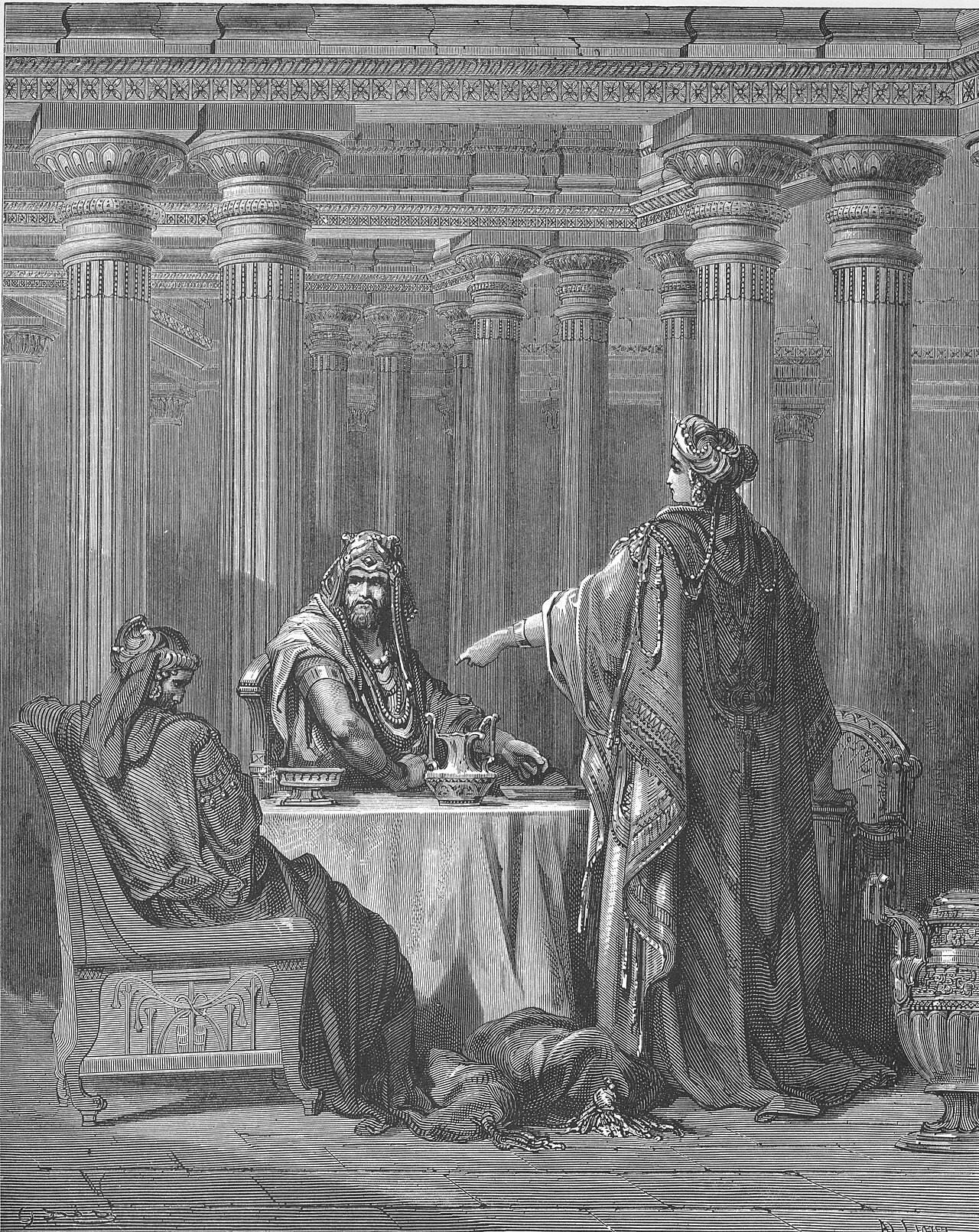
Estherchapter 7
10 verses · unknown · 5th century BC · History
In his fury, the king arose from drinking his wine and went to the palace garden, while Haman stayed behind to beg Queen Esther for his life, for he realized that the king was planning a terrible fate for him.
Introduction
unknown, History, Esther Overview.
This chapter was written for Jews who had watched accusers prosper and wondered whether it ever ends. It is the shortest scene of reversal in the book and the most exact. The queen at last names her people and her enemy in the king's presence. The chapter moves fast, and the king's servants read their master faster still. Listen for the words Esther borrows from the decree itself. Notice that the danger to the Jews is still standing when the chapter closes, which is why the book goes on.
Context
- Who
- Jews who had watched accusers prosper and wanted to know whether that ever ends
- What
- At her second banquet Esther reveals Haman's plot against her people, and the king has Haman hanged on the gallows he built for Mordecai.
- Where
- A banquet room in the palace at Susa, with the king's garden beside it.
- When
- The day of Mordecai's honour, in the twelfth year of Ahasuerus, about 474 BC.
- Why
- To show the enemy brought down by the means he had prepared for another.
Historical context
Diners at a Persian banquet reclined on couches rather than sitting on chairs, propped on the left elbow with the food low in front of them. That single fact explains the chapter's most violent misunderstanding: when Haman throws himself onto the couch where Esther is reclining to beg for his life, the king walks back in and sees a man lying across his wife.
Show the rest of the historical context, 3 more paragraphs
Esther's request is put in the language of the slave market on purpose. She says that if her people had merely been sold as slaves she would have kept quiet, the loss would not have been worth troubling the king. The word Haman used in his decree was not 'sell' but 'destroy', and she throws his own word back across the table.
Covering a condemned man's face was a recognised gesture in the ancient world, done the moment sentence was passed and before the man was taken out. In this scene the servants do it as soon as the king speaks, without waiting for a formal order, a court reads its master fast.
Harbona, one of the eunuchs, then supplies the last detail: the stake already standing at Haman's own house. Persian officials survived by knowing which way to jump, and volunteering that particular piece of information at that particular moment is a small masterpiece of self-preservation.
Significance
The reversal is total and it is exact. The man who built the stake dies on it; the man he wanted humiliated already wore the king's robe that morning. Hearers who had prayed the psalms about the wicked falling into the pit they dug would have recognised the shape immediately.
Show the rest of the significance, 1 more paragraph
But the chapter does not end the danger. Haman is dead and the decree is still sealed and running. That gap is where the next chapter has to work, and it is the honest note in the story, because getting the accuser is not the same as getting the people out.
This chapter in Jewish lifeWhat this chapter is in Jewish life and reading.
What is done
This chapter is heard inside the whole scroll at Purim, and Haman falls in it. The site's own table in src/lib/hebraic/readings.ts records that the scroll is read twice, in the evening and again the next morning, from a handwritten roll. It records that in Ashkenazi practice the room answers Haman's name with noisemakers after the reader has said it, while Sephardi and Mizrahi communities keep the day with much less noise or none. The table cites Mishnah Megillah 2, Babylonian Talmud Megillah 18a and the Rema's gloss to Shulchan Aruch, Orach Chayim 690:17.
The corpus sets Tractate Soferim 14:6 under the ninth verse. The site's table cites the same tractate, at 14:3 and 14:16, for the five scrolls and their occasions.
How it is read
Rashi is the one commentator on this chapter whose English the corpus carries, quoted here from The Metsudah Five Megillot, Lakewood, N.J., 2001, which Sefaria reports as CC-BY. The edition prints its own numbered notes inside his words, and a note is named here as the edition's. Esther's request is read as two requests. She asks for her own life, that she not be killed on the thirteenth of Adar (Rashi on Esther 7:3:1). She asks for her people, and if the king asks what that is to her, her answer stands in the next chapter (Rashi on Esther 7:3:2).
Her case against Haman is read as an argument about the king's own loss. Had Haman sought the king's good, Rashi says, he would have said to sell them as slaves and take the money, or to keep them as the king's slaves (Rashi on Esther 7:4:1). The king's double speech in the next verse is read by a rule of the Midrash. Wherever a verse says "and he said" twice, it is to be expounded. Before, he spoke to her through a go-between. Now that he knew she was of a royal family, he spoke to her himself (Rashi on Esther 7:5:1).
Haman's fall on the couch is read with the Rabbis. "The angel pushed him" (Rashi on Esther 7:8:1). The edition's note adds that he kept trying to rise and was pushed down again. The couch itself Rashi explains from custom. They reclined on their sides on couches at a meal, as the book's first chapter shows (Rashi on Esther 7:8:2). The king's cry he reads as an expression of wonder (Rashi on Esther 7:8:3). The gallows is the last charge. Haman had built it to hang the king's friend, the man who saved the king from poison (Rashi on Esther 7:9:1).
The corpus carries fourteen further notes on this chapter without an English text, each marked linked because Sefaria holds no English version of the ref. Eight stand cited and unquoted at Malbim on Esther 7:2:1, 7:3:1, 7:4:1, 7:5:1, 7:6:1, 7:7:1, 7:8:1 and 7:9:1. Six stand at Ibn Ezra on Esther 7:3:1, 7:4:1, 7:5:1, 7:7:1, 7:8:1 and 7:9:1.
What the rabbis say
The corpus carries forty rabbinic locators on this chapter and the text of none, so each is cited and linked here rather than quoted. Twenty-eight are Midrash and twelve are Talmud, the most Talmud of the first eight chapters. On the first verse it holds Midrash Tanchuma Buber, Vayechi 15:3 and Midrash Tanchuma, Vayechi 14:10. On the third it holds Bamidbar Rabbah 9:10 and Esther Rabbah 10:8. On the fourth it holds Esther Rabbah, Petichta 3, Megillah 16a:17, Shemot Rabbah 38:4 and Vayikra Rabbah 13:5.
The king's question draws the heaviest run. On the fifth verse the corpus holds Eikhah Rabbah 1:41, Esther Rabbah 7:13, Megillah 16a:18 and Midrash Shmuel 24:8. Midrash Tanchuma Buber, Emor 5:1, Midrash Tanchuma, Emor 3:1, Sifrei Aggadah on Esther, Midrash Panim Acherim, Version II 6:11, Vayikra Rabbah 26:8 and Yalkut Shimoni on Torah 626:7 stand with them. On the sixth it holds Eikhah Rabbah 2:8 and 3:11, Megillah 12a:18 and 16a:19, Shir HaShirim Rabbah 7:8:1 and Vayikra Rabbah 32:6.
The fall carries the rest. On the seventh verse the corpus holds Esther Rabbah 10:9 and Megillah 16a:20. On the eighth it holds Jerusalem Talmud Pesachim 10:1:2, Megillah 16a:21, Pesachim 100a:8 and Sanhedrin 105a:17. On the ninth it holds Megillah 16a:22, Version II at 6:12, and Tractate Soferim 14:6. On the tenth it holds Bamidbar Rabbah 14:12, Bereshit Rabbah 65:13, Bereshit Rabbati, Parashat Vayechi 32, Ein Yaakov, Zevakhim 14:1, Esther Rabbah 3:15 and 7:1, Kohelet Rabbah 4:9:1 and Megillah 12b:11. What each of them teaches is a saying of the rabbis, and is reported as theirs wherever this site quotes one.
Sources: Rashi, Rashi on Esther 7:3:1 to 7:9:1, The Metsudah Five Megillot, Lakewood, N.J., 2001, reported CC-BY; Malbim, Malbim on Esther 7:2:1, 7:3:1, 7:4:1, 7:5:1, 7:6:1, 7:7:1, 7:8:1 and 7:9:1, cited by ref because the corpus carries no English text; Ibn Ezra, Ibn Ezra on Esther 7:3:1, 7:4:1, 7:5:1, 7:7:1, 7:8:1 and 7:9:1, cited by ref because the corpus carries no English text; The Sefaria corpus, scripts/data/sources/sefaria/esther/7.json, the 40 Talmud and Midrash locators of this chapter; The site's own files, src/lib/hebraic/readings.ts, the FESTIVAL_READINGS entry for esther at Purim, and the entry for ruth citing Tractate Soferim 14:3 and 14:16 on the five scrolls and their occasions.
The heads below are this chapter's scenes. The numbered points under each are its verses.
The adversary and enemy is this wicked Haman
Esther 7:1-2
to dine with Esther the queen: The second banquet opens on the same formula, "Even up to half the kingdom," and Esther is finally asked the petition she has twice deferred. Two banquets and one sleepless night stand between this verse and 5:8, and the narrator has let the reader watch what filled the space.
Esther 7:1
“So the king and Haman came to banquet with Esther the queen. Or, "to drink with her" (e), that is, wine; for in the next verse it is called a banquet of wine; so they did according to the invitation the queen had given them, Est 5:8. (e) לשתות "ut biberent", V. L. Tigurine version; "ad bibendum", Pagninus, Montanus, Drusius, Vatablus.”
and as they drank their wine: The king asked Esther for her petition again at the second banquet, before she had to raise it. Henry counts this the third time the king has promised up to half the kingdom, and the promise now binds him. Clarke cites the Vulgate: the wine had warmed him.
Esther 7:2
“At the banquet of wine - Postquam vino incaluerat, after he had been heated with wine, says the Vulgate. In such a state the king was more likely to come into the measures of the queen.”
Adam Clarke · Commentary on the Bible (1810-1826)evangelical
1 more voice on this verse
Esther 7:2
“If the king had now forgotten that Esther had an errand to him, and had not again asked what it was, she could scarcely have known how to renew it herself; but he was mindful of it, and now was bound with the threefold cord of a promise thrice made to favour her.”
Matthew Henry · Commentary on the Whole Bible (1707-1721)puritan
Esther 7:3-4
grant me my life: Esther names the price Haman set at 3:9: "my people and I have been sold out to destruction, death, and annihilation," his exact bargain. Her aside, that mere slavery she would have borne in silence, marks how far past ordinary loss the decree reaches.
Esther 7:3
“Let my life be given me - This was very artfully, as well as very honestly, managed; and was highly calculated to work on the feelings of the king. What! is the life of the queen, whom I most tenderly love, in any kind of danger?”
Adam Clarke · Commentary on the Bible (1810-1826)evangelical
For my people and I have been sold: Destruction, death and annihilation are the three words of Haman's own decree at 3:13, as Adam Clarke notes. The closing clause is read two ways. The Berean reads a trouble too small, and Barnes and Clarke read Haman's silver as unable to repay the king for a whole people lost.
Esther 7:4
“To be destroyed, to be slain - She here repeats the words which Haman put into the decree. See Est 3:13. Could not countervail the king’s damage - Even the ten thousand talents of silver could not be considered as a compensation to the state for the loss of a whole nation of people throughout all their generations.”
Adam Clarke · Commentary on the Bible (1810-1826)evangelical
Esther 7:5-6
Then King Xerxes spoke up: The king's question gives Esther the opening she has waited for since 4:16, and she answers, "The adversary and enemy is this wicked man". Haman sits at the same table where he has twice been the sole guest of honor and is named to the king's face.
Esther 7:5
“Who is he, and where is he - There is a wonderful abruptness and confusion in the original words, highly expressive of the state of mind in which the king then was: מי הוא זה ואי זה הוא אשר מלאו לבו לעשות כן mi hu zeh veey zeh hu asher melao libbo laasoth ken. “Who? He? This one? And where? This one? He? Who hath filled his heart to do thus?” He was at once struck with the horrible nature of a conspiracy so cruel and diabolic.”
Adam Clarke · Commentary on the Bible (1810-1826)evangelical
Esther replied, “The adversary and enemy: Henry sets the scene as a trial. The queen accuses, the king judges, and Haman's own conscience stood as the witness against him. The morning had already gone against Haman when he had to honor Mordecai, and terror now met him at the queen's banquet.
Esther 7:6
“Haman is soon apprehensive of his danger: He was afraid before the king and queen; and it was time for him to fear when the queen was his prosecutor, the king his judge, and his own conscience a witness against him; and the surprising operations of Providence against him that same morning could not but increase his fear.”
Matthew Henry · Commentary on the Whole Bible (1707-1721)puritan
Falling on the queen's couch, and hanged on his own gallows
went to the palace garden: The king leaves in wrath for the palace garden, and Haman turns to beg his life from the very person he meant to have killed. The scene inverts every posture the book has shown: the man who could not bear one seated commoner kneels before the queen he plotted against.
Esther 7:7
“When we are angry we should pause awhile before we come to any resolution, as those that have a rule over our own spirits and are governed by reason. Haman becomes a humble petitioner to the queen for his life. He might easily perceived by the king's hastily flying out of the room that there was evil determined against him.”
Matthew Henry · Commentary on the Whole Bible (1707-1721)puritan
1 more voice on this verse
Esther 7:7
“Went - As disdaining the company and sight of so audacious a person: to cool and allay his troubled and inflamed spirits, and to consider what punishment was fit to be inflicted upon him.”
John Wesley · Explanatory Notes upon the Old Testament (1765)evangelical
Just as the king returned: The king returns to find Haman fallen upon the couch where Esther reclines, a suppliant's posture the king reads as an assault. The misreading seals him; as the word left the king's mouth they covered Haman's face, the customary sign that a man stands already condemned.
Esther 7:8
“Will he force the queen - On the king’s return he found him at the queen’s knees; and, professing to think that he intended to do violence to her honor, used the above expressions; though he must have known that, in such circumstances, the thought of perpetrating an act of this kind could not possibly exist. They covered Haman’s face - This was a sign of his being devoted to death: for the attendants saw that the king was determined on his destruction.”
Adam Clarke · Commentary on the Bible (1810-1826)evangelical
1 more voice on this verse
Esther 7:8
“Haman was fallen upon the bed whereon Esther was--We do not know the precise form of the couches on which the Persians reclined at table. But it is probable that they were not very different from those used by the Greeks and Romans.”
Jamieson, Fausset & Brown · Commentary Critical and Explanatory on the Whole Bible (1871)reformed
Then Harbonah, one of the eunuchs: Harbonah, one of the eunuchs, supplies "a gallows fifty cubits high at Haman’s house," built "for Mordecai, who gave the report that saved the king". The king's answer is four words, "Hang him on it!" The instrument built for another closes on its builder first.
Esther 7:9
“The information he now volunteered, as well it may be from abhorrence of Haman's cold-blooded conspiracy as from sympathy with his amiable mistress, involved with her people in imminent peril.”
Jamieson, Fausset & Brown · Commentary Critical and Explanatory on the Whole Bible (1871)reformed
So they hanged Haman: n on the gallows he had prepared for Mordecai." Commentators set Psalm 7:15-16 beside it, where the man who digs a pit falls into the pit of his own making. The same law of retribution completes itself in the palace at Susa.
Esther 7:10
“So they hanged Haman on the gallows that he had prepared for Mordecai--He has not been the only plotter of mischief whose feet have been taken in the net which they hid (Ps 9:15). But never was condemnation more just, and retribution more merited, than the execution of that gigantic criminal.”
Jamieson, Fausset & Brown · Commentary Critical and Explanatory on the Whole Bible (1871)reformed
1 more voice on this verse
Esther 7:10
“The enemies of God's church have often been thus taken in their own craftiness. In the morning Haman was designing himself for the robes and Mordecai for the gallows; but the tables are turned: Mordecai has the crown, Haman the cross. The Lord is known by such judgments.”
Matthew Henry · Commentary on the Whole Bible (1707-1721)puritan
Keep studying
Studies4
Sources for this chapter
The summary
Jamieson, Fausset & Brown, Commentary Critical and Explanatory; John Wesley, Notes on the Old Testament and Matthew Henry, Complete Commentary.
The context
Matthew Henry, Commentary on the Whole Bible and W. F. Adeney, Ezra, Nehemiah and Esther (Expositor's Bible).
The exposition
Adam Clarke, Commentary on the Bible; Albert Barnes, Notes, Explanatory and Practical, on the Old and New Testaments (1832-1869); Jamieson Fausset and Brown, Commentary Critical and Explanatory on the Whole Bible; John Gill, Exposition of the Old Testament; John Wesley, Explanatory Notes upon the Old Testament; Keil, The Books of Ezra, Nehemiah, and Esther; Matthew Henry, Commentary on the Whole Bible and W. F. Adeney, Ezra, Nehemiah and Esther (Expositor's Bible).