
A tale of faith · probably written c. 150-100 BC
Judith
A widow walks into the enemy camp carrying nothing but her wits, her prayers, and a bag of her own food.
- 16Chapters
- 339Verses
- c. 150-100 BCEWritten
Original language: Hebrew (likely; preserved in Greek)
King James Version Apocrypha (1769 standardized text) · public domain
Read Judith
King James Version + Apocrypha (standardized 1769 text), eBible.org USFX edition of the Crosswire/eBible KJV — Public Domain
Featured studies on this book
— the deep dives, each its own page

Plain answers first
What this book is
A great king (the book calls him Nebuchadnezzar and seats him in Nineveh over the Assyrians) sends his general Holofernes west to punish every nation that refused to help him fight. Town after town surrenders. Israel, newly back from exile, digs in above the plain and holds the mountain passes.
The town of Bethulia sits on the pass. Achior, an Ammonite officer, tells Holofernes the plain truth: this people cannot be beaten unless they sin against their God. For saying it he is tied to a tree outside the Israelite town and left there. Holofernes seizes the springs instead, and after thirty-four days the town is dying of thirst. The elders promise the people they will surrender in five days if God has not acted.
Judith is a rich, beautiful, devout widow who has fasted for years. She sends for the elders and rebukes them for putting God on a deadline (chapter 8). Then she prays (chapter 9), dresses to be looked at (chapter 10), and walks out to the Assyrian camp with one maid and her own food.
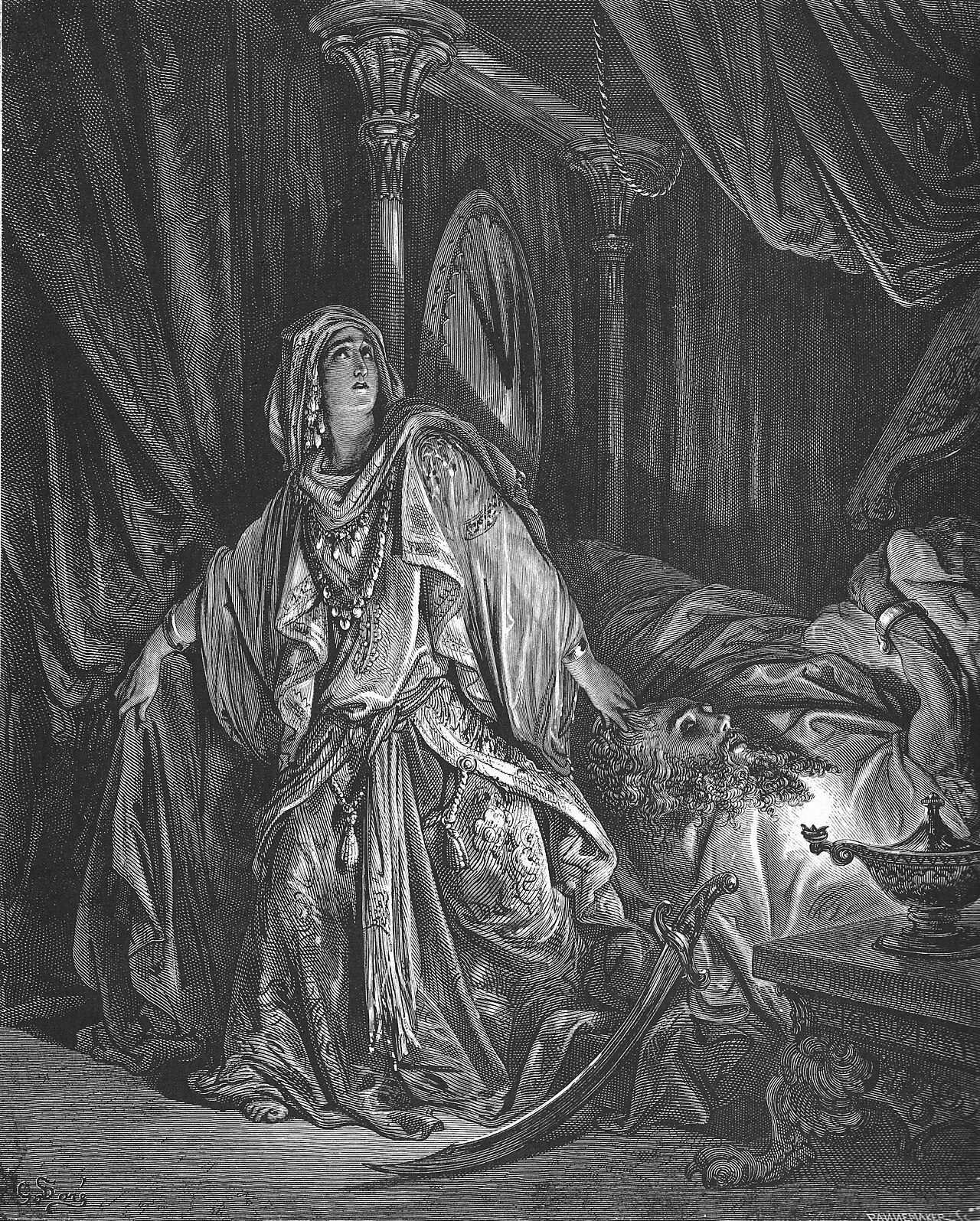
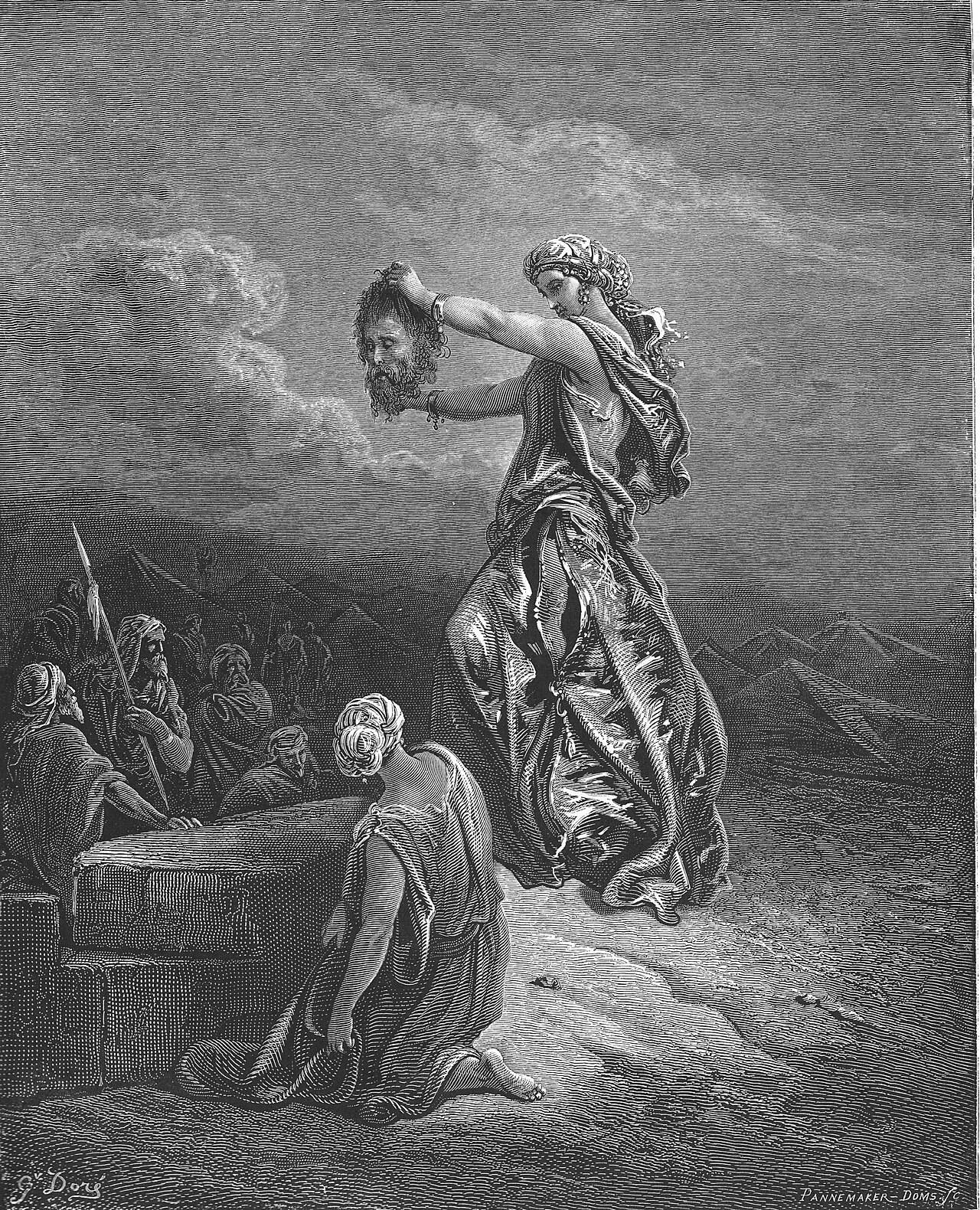
Holofernes is captivated. Her answers to him are true sentences aimed to mislead (chapter 11). On the fourth night he throws a banquet, meaning to have her, and drinks more wine than he had ever drunk in one day (12:20). Left alone with him, she prays twice, takes his own sword down from the bedpost, and strikes off his head (13:8). She carries it home in the food bag. The army wakes to a headless commander and scatters, and Achior sees the head and believes in the God of Israel (14:10).
It was written in Hebrew, most likely in the Hasmonean period, roughly 150 to 100 BC. The history in it cannot be straightened out: Nebuchadnezzar ruled Babylon, not Assyria, Nineveh had already fallen by his day, and no one has ever located Bethulia. Most scholars read that as deliberate: the book signals from its first line that it is a story with a point rather than a chronicle.
Why a student of the 66 should still open it
Why read it: and how
Judith stands in a long biblical line of women who bring down a warlord: Jael with the tent peg in Judges 4-5, the woman of Thebez with a millstone in Judges 9:53, and reading her makes those chapters land harder. Her victory song in chapter 16 sings the theme Hannah sings and Mary sings after her: God brings down the strong and lifts the small. When the elders bless her, "blessed art thou above all the women upon the earth" (13:18), the words come very near Elizabeth's greeting to Mary in Luke 1:42; that is a shared Jewish way of blessing rather than a quotation, but readers have heard the echo since the early church. The book is also honest evidence of how Jews under Greek pressure thought about faith, fasting, and resistance, and its ethics have troubled readers since the Fathers, because Judith deceives, seduces, and assassinates, and the book praises her for it.
Read chapters 1 through 7 quickly; their whole job is to tighten the squeeze. Then slow down at chapter 8, where Judith's speech to the elders is the theological center of the book: you do not put the Almighty on a five-day clock. As you read the second half, keep asking what the author wants you to admire, and weigh that against the whole of Scripture rather than assuming the story approves of everything Judith does.
The canon question, honestly
Why it stands outside the 66
Judith was not in the Hebrew Bible. Jerome noted that the Jews read it among the apocrypha, and though he translated it he set books like it apart as good for edifying the people rather than for settling doctrine; the tangled history in it did not help its standing. Protestants followed Jerome and printed it in the Apocrypha section, which is where the King James of 1611 has it, between the Testaments. Trent declared it canonical for Roman Catholics in 1546, and the Eastern churches keep it as well. What is striking is how long Christians have honored the book without agreeing on its rank: Clement of Rome praised Judith by name before the first century was out (1 Clement 55).
Doors into the text
Key moments
An Ammonite officer warns Holofernes that Israel is unbeatable unless they sin.
Thirty-four days without water, and the elders give God five more days.
The heart of the book: no one sets a deadline for God and calls it faith.
She asks for the strength of a widow's hand against an army.
Two prayers, his own sword off the bedpost, and a head in the food bag.
The victory hymn, then a long quiet old age and no second marriage.
Plainly told
The story it tells
A king who will not be defied
Nebuchadnezzar, called king of the Assyrians and ruling from Nineveh, goes to war against Media. When the nations of the west refuse to send him troops, he swears revenge on all of them and sends his general Holofernes to punish every people who would not bow to him.
The siege of Bethulia
Holofernes sweeps west with a massive army and lays siege to the small Jewish town of Bethulia, cutting off its water supply. Within days the town's elders, led by Uzziah, are ready to surrender: they set God a deadline and tell him to save them by it, or they will give up.
Judith stands up
Judith is a wealthy, beautiful widow known for her devotion. She rebukes the elders for testing God with an ultimatum, then announces she has a plan of her own, and tells no one, not even them, what it is.
Into the enemy camp
Judith prays, dresses in her finest clothes, and walks out to the Assyrian camp with her maid, telling Holofernes she will show him how to take the town without a fight. He is captivated by her beauty and invites her to a banquet in his tent.
The sword and the head
On the fourth night, Holofernes drinks himself unconscious. Alone with him, Judith prays once more, takes his own sword, and beheads him. She carries the head back to Bethulia in her food bag.
The rout and the song
The head is hung on the town wall. When the Assyrian army discovers their general dead, panic breaks the siege and the Jewish forces rout them. Judith leads the women in a victory song echoing Miriam's and Deborah's, and lives out her days honored by the whole town.
Dates hedged where scholarship hedges
Where it sits in history
- Setting: the Assyrian era (fictionalized)
The book stages its story under “Nebuchadnezzar, king of the Assyrians, reigning in Nineveh”: a deliberate historical impossibility (Nebuchadnezzar ruled Babylon; Nineveh had already fallen), a signal to the ancient reader that this is a costume, not a chronicle.
- c. 150–63 BC
The broad scholarly range for composition, most commonly narrowed to the late Hasmonean period: internal details (the high priest holding military and civil power, a governing gerousia) match Hasmonean-era institutions, not Persian-era ones.
- c. AD 407
Jerome translates Judith into Latin from an Aramaic (“Chaldee”) copy, by his own account in a single night's work, translating sense for sense rather than word for word.
- 393 and 397
The North African councils of Hippo and Carthage include Judith in their scriptural lists; Popes Innocent I and Gelasius receive it as canonical.
- 1546
The Council of Trent affirms Judith as canonical, one of the seven deuterocanonical books.
The disagreement is old: here it is plainly
Where the traditions stand
Judith was never part of the Hebrew Bible. It is absent from the Dead Sea Scrolls at Qumran and is never discussed in rabbinic literature: a striking silence, given how popular a story this clearly was in its own day and long after.
Jerome, translating it into Latin, reported that among the Jews of his time “the Book of Judith is found among the Hagiographa, the authority of which toward confirming those which have come into contention is judged less appropriate”: good reading, not settled authority. He proceeded to translate it anyway, saying he did so because “this book is found by the Nicene Council to have been counted among the number of the Sacred Scriptures”: a claim about Nicaea's reception of it that historians treat as Jerome citing a tradition of his own time rather than a verifiable conciliar ruling, since the surviving Nicene canons do not themselves list biblical books.
The Reformers followed the Hebrew list and set Judith among the apocrypha; Luther placed it in his appendix of books “not held equal to Scripture, but useful and good to read.” The Council of Trent, in 1546, went the other way and affirmed Judith as canonical Scripture, one of the seven deuterocanonical books read at Mass in the Roman Catholic lectionary to this day. Eastern Orthodox churches read it as part of their wider Old Testament as well.
So the disagreement here is old and, on both sides, argued in good faith: whether a much-loved story that the Hebrew tradition itself classed as good reading rather than binding Scripture should be received as the latter once the church took it up.
| Tradition | Where this book stands |
|---|---|
| jewish | not canonical; Hebrew original lost, but Hanukkah-season readings of Judith are attested in medieval Jewish communities |
| anglican | apocryphal — read for example of life and instruction of manners |
| catholic | canonical (deuterocanonical) |
| protestant | non-canonical; Luther praised its literary quality |
| eastern orthodox | canonical (anagignoskomena) |
| oriental orthodox | canonical |
2 threads into the 66
Its connections into Scripture
Judith's victory hymn (ch 16) thanks God for overthrowing the mighty by the hand of a woman. Mary's Magnificat (Luke 1:46-55) echoes the same theological structure: "he has brought down the mighty from their thrones and exalted those of humble estate." The literary lineage runs Hannah (1 Sam 2) → Judith 16 → Mary's Magnificat, with Luke drawing on all three.
Judith's decisive blow against the invading Assyrian general — a widow with a sword, prevailing by God's enablement — became a template for later Christian theologies of divine victory through unlikely means. Patristic exegesis read Judith typologically as a figure of the church and of Mary crushing the serpent (Genesis 3:15). The thematic pattern — weak person delivers God's people by head-crushing blow — resonates with Jael (Judges 4), David against Goliath (1 Sam 17), and ultimately Christ's victory on the cross.
Reception history, never our confession
What the church has made of it
The church fathers who used Judith held her up chiefly as an example of courage and chastity under threat. Jerome commends her explicitly on both counts, saying her strength surpassed what many men could accomplish.
In the Catholic and Orthodox traditions Judith has long stood alongside Esther as one of Scripture's deliverer-heroines, a pairing that shows up in devotional writing and art for centuries.
The beheading scene became one of the most painted moments to come out of the wider biblical corpus, canonical or not: Donatello, Caravaggio, Artemisia Gentileschi, and Gustav Klimt all returned to it, each finding something different in the same instant.
English Bibles printed Judith in the Apocrypha section from the King James Version of 1611 onward, until nineteenth-century Bible societies began dropping the Apocrypha from standard English printings altogether.
The voices
What the teachers have said
“Because this book is found by the Nicene Council to have been counted among the number of the Sacred Scriptures, I have acquiesced to your request.”
Every claim above rests on these
Where this comes from
- Bruce M. Metzger, An Introduction to the Apocrypha (1957)
- Carey A. Moore, Judith (Anchor Bible, 1985)
- David A. deSilva, Introducing the Apocrypha (2nd ed., 2018)
- R. H. Charles, ed., The Apocrypha and Pseudepigrapha of the Old Testament, vol. 1 (1913)
- The book of Judith itself (KJV Apocrypha)