
Psalm 97
12 verses · Psalm of the LORD's kingship
Fire goes before Him and consumes His foes on every side.
Introduction
Author unstated, the King in Cloud and Fire, Book 4: The LORD reigns, Poetry, Psalms Overview.
This psalm names no writer and carries no title in the Hebrew. It is one of the psalms that proclaim the LORD as King, and it describes His coming the way Israel remembered God coming down on Mount Sinai, with cloud, fire and a shaking earth. It was sung by worshippers in Jerusalem who lived among nations that bowed to carved images. Listen for the one event that brings shame to some and gladness to others, and for the charge at the close to the people who love God, to hate what He hates.
Context
- Who
- Worshippers in Zion, and the peoples who served images and are named in verse 7
- What
- A hymn to the LORD as King that describes His appearing in cloud and fire and what it does to idol worshippers and to Zion.
- Where
- Judah and the towns around Zion, addressed together with the distant shores
- When
- Undated and untitled in the Hebrew.
- Why
- To put trust in images to shame and to give the righteous light and gladness under God's rule.
Historical context
The weather of verses 2 to 5 is the weather of Sinai, where Exodus 20:21 puts God in the thick darkness while the people stand at a distance. The distant shores of verse 1 translate a word for the coastlands and islands of the Mediterranean, the far edge of the known world to someone living inland in Judah. In a land of limestone hills a mountain was what did not move, and verse 5 has the mountains melt. Verse 8 names Zion and the towns of Judah together, the city and its dependent villages. The images of verse 7 were carved and overlaid objects in neighbouring temples, and their shame was the public shame of a god that fails in front of witnesses.
Significance
The psalm told worshippers that the same event reaches two audiences and divides them, shame for those who trusted images and gladness for Zion. For a people who could not see God, verse 2 held together what they needed. Clouds and darkness surround Him, and righteousness and justice are the foundation of His throne, so what could not be seen was still what could be relied on.
This chapter in Jewish lifeWhat this chapter is in Jewish life and reading.
How it is read
The psalm stands in the group this site calls the enthronement psalms, Psalms 93 and 95 to 99 (src/components/book/dossier-content/psalms-structure.ts). That is a statement about the collection rather than about any service, and it is given here as one.
Rashi reads the whole psalm as a description of the last war and the kingdom that follows it. The reign of verse 1 begins "when He takes the kingdom from Amalek and from his descendants", and the earth exulting is the word of Ezekiel 35:14, which Rashi says was prophesied concerning Amalek (Rashi on Psalms 97:1:1 and 97:1:2, Rashi on Psalms, The Judaica Press complete Tanach with Rashi, translated by A. J. Rosenberg, CC-BY).
The fire of verse 3 he places "in the war of Gog and Magog", citing Ezekiel 38:22, and he reads the quaking of verse 4 and the melting mountains of verse 5 from the same chapter of Ezekiel (Rashi on Psalms 97:3:1, 97:4:2 and 97:5:1, same edition). The shame of the idol worshippers in verse 7 he reads with Isaiah 2:18, on the idols passing away (Rashi on Psalms 97:7:1).
A Christian reader meets the difference at this point. The site holds that the kingdom named here is the kingdom of Christ, and Rashi's reading places the same kingdom after a war yet to come with no Messiah named in it. Both readings take the psalm as a prophecy of a reign, and they part over who reigns.
Rashi's last note in the corpus reads verse 11 as a real sowing prepared to grow for the righteous (Rashi on Psalms 97:11:1). Ibn Ezra, Radak and Metzudat David carry fourteen comments for which Sefaria holds no English version, and they are cited by reference (Ibn Ezra on Psalms 97:2:1 and the thirteen references beside it).
What the rabbis say
The corpus records forty places where the Midrash and the Talmud cite this psalm, thirty eight under Midrash and two under Talmud, and it carries the locator for each one with no text. The Jerusalem Talmud cites verse 2 at Peah 1:1:19 and verse 7 at Avodah Zarah 4:7:3.
Verse 11, on the light sown for the righteous, is the verse the rabbis return to most often here, and the corpus carries twenty locators on it. Among them are Bereshit Rabbah 1:6 and 42:3, Bamidbar Rabbah 17:5, the two openings of Esther Rabbah at Petichta 10 and Petichta 11, and eight places in Midrash Tanchuma and its Buber recension. The site reports where the rabbis cite the verse and reports no saying, because the locator carries none.
Sources: MannaFest, the enthronement psalms, at src/components/book/dossier-content/psalms-structure.ts, 2026; Rashi, Rashi on Psalms 97, in The Judaica Press complete Tanach with Rashi, translated by A. J. Rosenberg, CC-BY; Ibn Ezra, Radak and Metzudat David, their comments on Psalms 97, cited by reference; Sefaria holds no English version; The Midrash and the Talmud, the forty locators on Psalms 97 in scripts/data/sources/sefaria/psalms/97.json.
Psalms 97:1-3
let the distant shores be glad: The LORD reigns, and the gladness reaches the distant shores. Clouds and darkness around Him is the language of Sinai, where Exodus 20:21 puts God in the thick darkness. Fire goes before Him there, and righteousness and justice hold the throne up.
Clouds and darkness surround Him: What cannot be seen and what can be relied on stand in one verse. Clouds and darkness hide Him, and His throne rests on righteousness and justice. Psalm 89:14 names the same foundation for His throne.
Psalms 97:2
“Clouds and darkness are round about him. So the Lord revealed himself at Sinai, so must he ever surround his essential Deity when he shows himself to the sons of men, or his excessive glory would destroy them. Every revelation of God must also be an obvelation; there must be a veiling of his infinite splendour if anything is to be seen by finite beings. It is often thus with the Lord in providence; when working out designs of unmingled love he conceals the purpose of his grace that it may be the more clearly discovered at the end.”
Charles Spurgeon · The Treasury of David, Vol. 4 (1874)Particular Baptist
1 more voice on this verseWhat preachers and commentators have said about this verse, in their own words.
Psalms 97:2
"Cloud and darkness are round about him." No one doubts that this is of the Lord Savior, round about whom was cloud and darkness — the flesh which he deigned to assume; although he is said to have appeared, in the Gospel of John. "And he appeared to us." He appeared indeed to the apostles, but from the Jews he was concealed.
Jerome · written before 420 · Homily 73, on Psalm 96 (Alternate Series)patristic
Fire goes before Him: Fire goes ahead of Him like a herald before a king. It consumes His foes on every side, so no enemy can come at Him from the flank. Deuteronomy 4:24 calls the LORD a consuming fire.
Psalms 97:3
“A fire goeth before him. Like an advance guard clearing the way. So was it at Sinai, so must it be: the very Being of God is power, consuming all opposition; omnipotence is a devouring flame which burneth up his enemies round about. God is longsuffering, but when he comes forth to judgment he will make short work with the unrighteous, they will be as chaff before the flame.”
Charles Spurgeon · The Treasury of David, Vol. 4 (1874)Particular Baptist
Psalms 97:4-6
His lightning illuminates the world: His lightning lights the world, and the earth sees and shakes. The mountains melt like wax before Him, the steadiest things in the land giving way. Then the heavens proclaim His righteousness and the peoples see His glory.
Psalms 97:4
“His lightnings enlightened the world. In times of tempest the whole of nature is lighted up with a lurid glare, even the light of the sun itself seems dim compared with the blaze of lightning. If such are the common lights of nature what must be the glories of the Godhead itself? When God draws aside the curtain for a moment how astonished are the nations, the light compels them to cover their eyes and bow their heads in solemn awe.”
Charles Spurgeon · The Treasury of David, Vol. 4 (1874)Particular Baptist
The mountains melt like wax: Wax melts at a fire's warmth without being struck. The mountains give way at His presence alone. The title Lord of all the earth, used also at Joshua 3:11, claims every land for Him.
Psalms 97:5
“The hills melted like wax at the presence of the Lord. Inanimate nature knows its Creator, and worships him in its own fashion. States and kingdoms which stand out upon the world like mountains are utterly dissolved when he decrees their end. Systems as ancient and firmly rooted as the hills pass away when he does but look upon them. In the Pentecostal era, and its subsequent age, this was seen on all hands, heathenism yielded at the glance of Jehovah Jesus, and the tyrannies based upon it dissolved like melted wax.”
Charles Spurgeon · The Treasury of David, Vol. 4 (1874)Particular Baptist
2 more voices on this verse
Psalms 97:5
“When our God appears as a consuming fire even rocks will be wax before him. The most resolute and daring opposition will be baffled at the presence of the Lord. His very presence is enough to shame and sink it, for he is the Lord of the whole earth, by whom all the children of men are manageable and to whom they are accountable.”
Matthew Henry · Commentary on the Whole Bible (1707-1721)puritan
Psalms 97:5
“The mountains flowed away like wax. To me these mountains seem to be the powers of the demons. Or certainly the mountains are proud men, whoever they be. This fire does not consume the humble, but whoever are mountainous. And indeed, whenever a lightning-bolt is sent forth, it strikes with difficulty those who are in the valley, but always those who are on the mountain.”
Jerome · written before 420 · Homily 24, on Psalm 96patristic
The heavens proclaim His righteousness: The sky becomes a herald, and Psalm 50:6 uses the same words. What it proclaims is His righteousness, His justice in what He does. What the heavens announce, all the peoples see.
Psalms 97:6
"The heavens announced his justice, and all peoples saw his glory." In these two little verses two things are signified: the heavens announce the justice of the Lord, and all peoples see his glory. For unless someone has become heaven, he cannot announce the justice of the Lord. For if to the sinner it is said, "You are earth, and into earth you shall go," why should it not be said to the just one, "You are heaven, and into heaven you shall go"?
Jerome · written before 420 · Homily 73, on Psalm 96 (Alternate Series)patristic
1 more voice on this verse
Psalms 97:6
“The heavens declare his righteousness. It is as conspicuous as if written across the skies, both the celestial and the terrestrial globes shine in its light. It is the manner of the inspired poets to picture the whole creation as in sympathy with the glory of God, and indeed it is not mere poetry, for a great truth underlies it, the whole creation has been made to groan through man's sin, and it is yet to share in the joy of his restoration. And all the people see his glory.”
Charles Spurgeon · The Treasury of David, Vol. 4 (1874)Particular Baptist
Psalms 97:7-9
Worship Him, all you gods!: Those who boast in idols are put to shame, and the command Worship Him, all you gods goes to the beings the nations bowed to. Zion hears and rejoices, and Judah's towns exult at His judgments. He is Most High over all the earth.
Psalms 97:7
“Confounded be all they that serve graven images, that boast themselves of idols. They shall be so; shame shall cover their faces, they shall blush to think of their former besotted boastings. When a man gravely worships what has been engraved by a man's hand, and puts his trust in a mere nothing and nonentity, he is indeed brutish, and when he is converted from such absurdity, he may well be ashamed. A man who worships an image is but the image of a man, his senses must have left him.”
Charles Spurgeon · The Treasury of David, Vol. 4 (1874)Particular Baptist
2 more voices on this verse
Psalms 97:7
"Let all be confounded who worship graven images." If the prophet is blessed, being blessed he never knew how to curse; and therefore in that which he says, "Let them be confounded," it is not against them, but for them: for he prays that they may be confounded in their error, and be converted to the true and only God, the Creator.
Jerome · written before 420 · Homily 73, on Psalm 96 (Alternate Series)patristic
Psalms 97:7
“Let those be ashamed that serve graven images. (1.) This is a prayer for the conversion of the Gentiles, that those who have been so long serving dumb idols may be convinced of their error, ashamed of their folly, and may, by the power of Christ's gospel, be brought to serve the only living and true God, and may be as much ashamed of their idols as ever they were proud of them.”
Matthew Henry · Commentary on the Whole Bible (1707-1721)puritan
Zion hears and rejoices: The judgments that shame the idol worshippers of verse 7 bring gladness to Zion. Zion is the city and the towns of Judah are its villages, so the whole people rejoice together. His judgments put things right.
Psalms 97:8
"The daughters of Judea rejoiced because of your judgments, O Lord." What does this sense intend, "The daughters of Judea rejoiced," and not "the sons"? Let us understand first what "Judea" is interpreted to mean: and when we have known the interpretation, let us see what are the daughters of the interpretation. "Judea," then, is interpreted "confession." Whatever soul confesses God is a daughter of Judea. Therefore we call all the souls of believers the daughters of Judea, which rejoice at the judgments of God.
Jerome · written before 420 · Homily 73, on Psalm 96 (Alternate Series)patristic
2 more voices on this verse
Psalms 97:8
“Zion heard, and was glad. While the heathen are confounded the people of God are made to triumph, for they love to see their God exalted. The day shall come when the literal Zion, so long forsaken, shall joy in the common salvation. It did so at the first when the apostles dwelt at Jerusalem, and the good days will come back again. And the daughters of Judah rejoiced.”
Charles Spurgeon · The Treasury of David, Vol. 4 (1874)Particular Baptist
Psalms 97:8
“Zion - Thy people dwelling in Zion or Jerusalem, to whom Christ came. Heard - The fame of thy judgments, and the setting up the kingdom of the Messiah.”
John Wesley · Explanatory Notes upon the Old Testament (1765)evangelical
exalted far above all gods: Most High is the name Melchizedek uses of God at Genesis 14:19 and 20. The verse sets Him over all the earth and far above all gods. Verse 7 told the gods to bow.
Psalms 97:9
“For thou, Lord, art high above all the earth. And therefore do we rejoice to see the idols abolished and to see all mankind bending at thy throne. There is but one God, there cannot be another, and he is and ever must be over all. Thou art exalted far above all gods. As much as all is exalted above nothing, and perfection above folly.”
Charles Spurgeon · The Treasury of David, Vol. 4 (1874)Particular Baptist
1 more voice on this verse
Psalms 97:9
“The exaltation of Christ, and the advancement of God's glory among men thereby, are the rejoicing of all the saints. Because care is taken for their safety. Those that pay allegiance to Christ as a King shall be sure of his protection.”
Matthew Henry · Commentary on the Whole Bible (1707-1721)puritan
Psalms 97:10-12
Hate evil, O you who love the LORD!: Love for the LORD comes with a command to hate evil, and He keeps His saints from the hand of the wicked. The Hebrew verb in verse 11 is zarua, sown, so the light for the righteous is planted and comes up in season. The righteous are told to rejoice.
Psalms 97:10
“Ye that love the Lord, hate evil. For He hates it, his fire consumes it, his lightnings blast it, his presence shakes it out of its place, and his glory confounds all the lovers of it. We cannot love God without hating that which he hates. We are not only to avoid evil, and to refuse to countenance it, but we must be in arms against it, and bear towards it a hearty indignation. He preserveth the souls of his saints. Therefore they need not be afraid of proclaiming war with the party which favours sin.”
Charles Spurgeon · The Treasury of David, Vol. 4 (1874)Particular Baptist
2 more voices on this verse
Psalms 97:10
"The Lord guards the souls of his saints." A most beautiful order: he who loves good and hates evil, what does he deserve from the Lord, except that he be guarded by him? "He will free them from the hand of the sinner." Here a question arises: If the Lord guards the souls of his saints, and frees them from the hand of the sinner, how are the martyrs crushed in persecution? how did the impious Nero, with sentence given, condemn Peter and Paul to death on one day, if the Lord guards the souls of his saints?
Jerome · written before 420 · Homily 73, on Psalm 96 (Alternate Series)patristic
Psalms 97:10
“He will preserve the souls of his saints from sin, from apostasy, and despair, under their greatest trials; he will deliver them out of the hands of the wicked one that seeks to devour them; he will preserve them safely to his heavenly kingdom, 2 Tim. iv. They have therefore reason to be glad, being thus safe. Because provision is made for their comfort.”
Matthew Henry · Commentary on the Whole Bible (1707-1721)puritan
Light shines on the righteous: Light and gladness are paired, the one given to the righteous and the other to the upright in heart. Light stands for favour and rescue, as at Psalm 27:1. The promise follows character.
Psalms 97:11
“Light is sown for the righteous. All along their pathway it is strewn. Their night is almost over, their day is coming, the morning already advancing with rosy steps is sowing the earth with orient pearls. The full harvest of delight is not yet ours, but it is sown for us; it is springing, it will yet appear in fulness. This is only for those who are light before the Lord in his own righteousness, for all others the blackness of darkness is reserved. And gladness for the upright in heart.”
Charles Spurgeon · The Treasury of David, Vol. 4 (1874)Particular Baptist
1 more voice on this verse
Psalms 97:11
“Let gratitude for the blessings of providence and grace incite saints (Ps 4:3) to holy living. Spiritual blessings are in store, represented by light (Ps 27:1) and gladness.”
Jamieson, Fausset & Brown · Commentary Critical and Explanatory on the Whole Bible (1871)reformed
praise His holy name: The psalm closes on the rejoicing it opened with, now asked of the righteous ones. The Hebrew of praise His holy name reads give thanks to the memory of His holiness. Psalm 30:4 uses the same words.
Psalms 97:12
“Rejoice in the Lord, ye righteous. The psalmist had bidden the earth rejoice, and here he turns to the excellent of the earth and bids them lead the song. If all others fail to praise the Lord, the godly must not. To them God is peculiarly revealed, by them he should be specially adored. And give thanks at the remembrance of his holiness—which is the harmony of all his attributes, the superlative wholeness of his character. This is a terror to the wicked, and a cause of thankfulness to the gracious.”
Charles Spurgeon · The Treasury of David, Vol. 4 (1874)Particular Baptist
1 more voice on this verse
Psalms 97:12
“We must be ever mindful of his holy covenant, which he has confirmed with an oath by his holiness. (2.) We ought to give thanks at the remembrance of his holiness, not only give him the glory of it as it is an honour to him, but give him thanks for it as it is a favour to us; and an unspeakable favour it will be if, through grace, we are partakers of his holiness.”
Matthew Henry · Commentary on the Whole Bible (1707-1721)puritan
How this psalm is built
The form: A psalm whose watchword is Jehovah reigns, which is also the essence of the gospel proclamation and the foundation of the gospel kingdom, as Spurgeon classes it.
The patterns in this chapter
| Device | What it does | Where to see it |
|---|---|---|
| The storm brought in piece by piece | Verses 2 to 5 name clouds, darkness, fire, lightning and melting mountains one after another rather than calling it a storm. Spurgeon reads the fire of verse 3 as an advance guard clearing the way, so the list is an arrival rather than a description of weather.Charles Spurgeon, The Treasury of David, Vol. 4, 1874, on Psalm 97:3. | Psalm 97:2, Psalm 97:3, Psalm 97:4, Psalm 97:5 |
| The two audiences | Verse 7 puts the worshippers of images to shame and verse 8 has Zion hear the same news and rejoice. One event reaches two hearers and divides them. Spurgeon reads the pair together, that while the heathen are confounded the people of God are made to triumph.Charles Spurgeon, The Treasury of David, Vol. 4, 1874, on Psalm 97:8. | Psalm 97:7, Psalm 97:8 |
| Light sown for the righteous | The Hebrew verb in verse 11 is zarua, sown, so the light for the righteous is planted rather than shone. The picture makes the gladness of the second half of the verse a crop that comes up in its season rather than a mood.Albert Barnes, Notes, Explanatory and Practical, on the Old and New Testaments, 1832 to 1869, on Psalm 97:11. | Psalm 97:11 |
| The mountains that melt | Verse 5 melts the mountains like wax, and the steadiest things in the land are chosen for the comparison. Jerome reads the mountains as the lofty powers and the proud, and Spurgeon reads the verse plainly, that when God appears as a consuming fire even rocks are wax before Him.Jerome, Homily 24, on Psalm 96, c. 420. | Psalm 97:5 |
In the New Testament
9 more paragraphs on the patterns
Verse 7 is quoted at Hebrews 1:6, where the command that all the gods worship Him is applied to the Son as He is brought into the world. Jamieson, Fausset and Brown note what the quotation assumes, that the words used of the LORD in the Old Testament theophany belong to the second person of the Godhead, and they add the argument from the lesser: if angels must worship Him, how much more those who worshipped them.
Where it comes from
The weather of verses 2 to 5 is the weather of Sinai. Exodus 20:21 puts God in the thick darkness while the people stand at a distance, and Deuteronomy 4:11 describes the mountain burning with fire to the heart of heaven. The psalm takes the mountain scene and makes it the scene of a reign rather than of a covenant.
The debated point
Verse 7 says worship Him, all you gods, and who is addressed is the contested question. Jamieson, Fausset and Brown read the Hebrew as all ye angels and take the line as spoken of the Lord Jehovah of the Old Testament appearances. Matthew Henry reads the first half of the verse as a prayer for the conversion of the Gentiles, that idolaters may be as ashamed of their idols as they were once proud of them, and Jerome says the same of the prophet, that in asking they be confounded he asks for their conversion rather than their ruin. Ambrose uses the second half in a doctrinal argument, that the angels worship His flesh as well as His Godhead. The site carries the angelic reading as the one Hebrews follows and keeps the others beside it.
In the Psalter
The psalm stands third in the run of psalms that open with the LORD reigns, after Psalm 93 and Psalm 96:10 and before Psalm 99. Its own contribution to the run is the storm and the division it causes.
The door
Christophany carries the question of who appears in the Old Testament theophanies, which verse 7 and its use in Hebrews raise directly.
Keep studying
Words10
Subjects1
Sources for this chapter
The summary
Jamieson, Fausset & Brown, Commentary Critical and Explanatory; John Calvin, Commentaries; John Wesley, Notes on the Old Testament and Matthew Henry, Complete Commentary.
The form and classifications
Charles Spurgeon, The Treasury of David, Vol. 4, 1874, on Psalm 97:1; Jerome, Homily 24, on Psalm 96, c. 420 and Matthew Henry, Commentary on the Whole Bible, 1710, on Psalm 97:1.
The exposition
Albert Barnes, Notes on the Book of Psalms; Charles Spurgeon, The Treasury of David; Franz Delitzsch, Biblical Commentary on the Psalms; John Gill, Exposition of the Old Testament and Matthew Henry, Commentary on the Whole Bible.
The painting
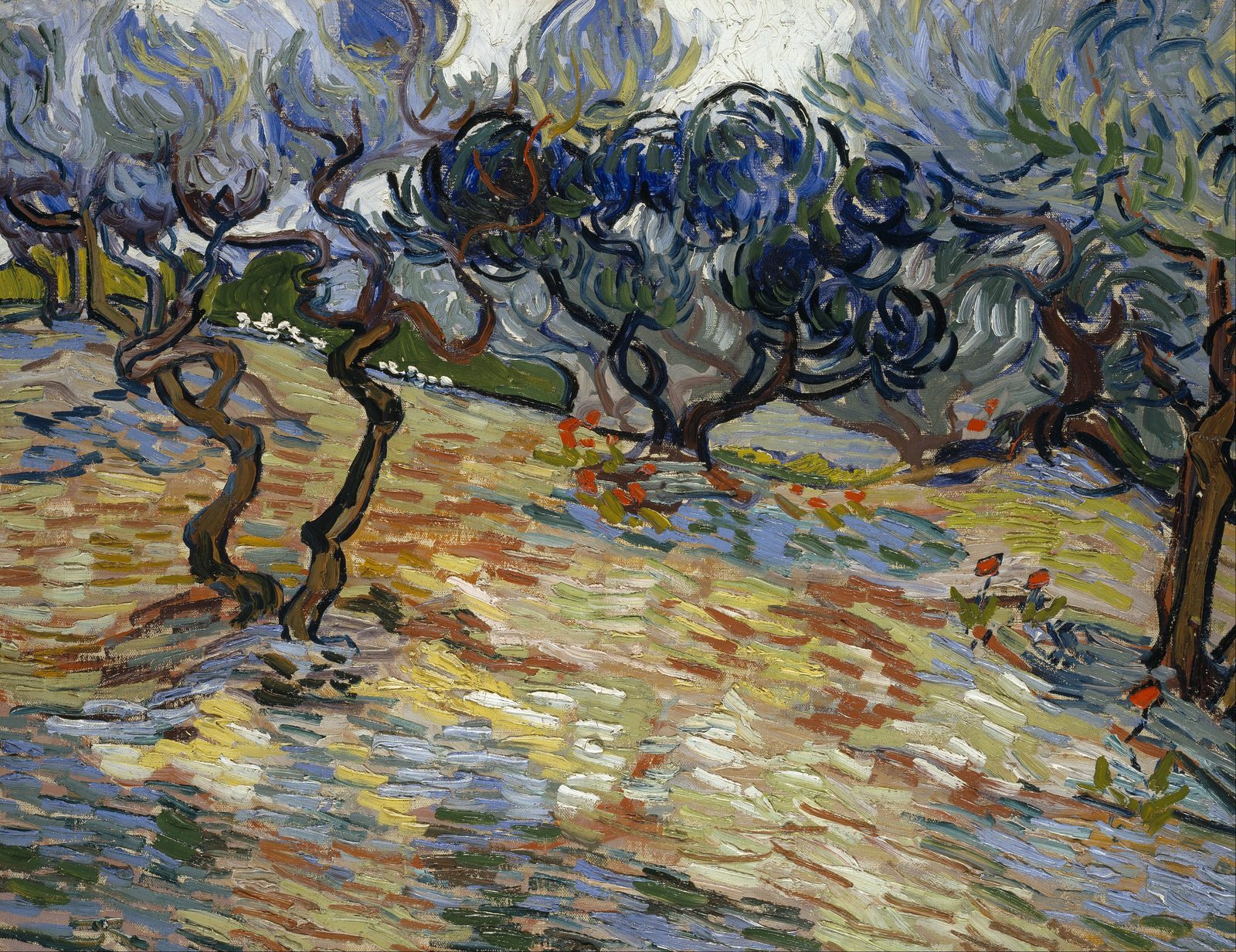
Olive Trees. Vincent van Gogh, Saint-Rémy-de-Provence, November 1889. Wikimedia Commons. Public domain.