
Psalm 64
10 verses · Lament
Hear, O God, my voice of complaint; preserve my life from dread of the enemy.
Introduction
David, the Hidden Arrows, Book 2: The Elohistic Psalter, Poetry, Psalms Overview.
David wrote this psalm while men were ruining him with words, and he handed it to the choirmaster, so a private injury became a public song. In Israel an accusation needed witnesses, and a false witness bore the penalty he sought, so a whisper was the safer weapon for an enemy. The psalm gives a man with no court to go to a Judge who needs no witnesses. Listen for the weapons of the hunter and the soldier in the first half, and for the same weapons turned around in the second.
Context
- Who
- People ruined by rumour, with no court that would hear them
- What
- A lament against enemies who attack with secret plots and lying words.
- Where
- The sanctuary, sung by a man being destroyed by a whispering campaign
- When
- The monarchy, in Israel's public worship. Date unstated; attributed to David, c. 1000 BC
- Why
- To bring a person wronged by rumour before God as Judge, and to teach that God brings into the open what was done in secret.
Historical context
The heading gives the psalm to David and sets it for the choirmaster, so a private injury was handed to the public singers. The whole psalm is built out of hunting and warfare gear. Composite bows of horn, wood and sinew were the serious weapon of the age, and a bowman shot from cover at a man who never saw him. Bird catchers set a net on a light frame and pulled a cord from a hide, so hidden snares worked because the animal could not see the trap until it was inside it. Enemies used gossip rather than a court for a reason, since Israelite law required two witnesses for an accusation and a witness proved false received the penalty he had tried to impose. In the second half their own tongues are turned against them, and God's arrow finds them suddenly.
Significance
For a man whose name was being taken apart in the market, with no lawful way to answer, this song handed the case to a Judge who needed no witnesses. The end of it mattered as much as the start, because what had been said in secret became the thing everyone discussed, and the subject of the talk was God.
This chapter in Jewish lifeWhat this chapter is in Jewish life and reading.
How it is read
The classical reading of this psalm sends it forward in time. Rashi reports that "The authors of Aggadoth Tehillim (Mid. Ps.) interpreted this psalm as referring to Daniel, who was cast into the lions' den" (Rashi on Psalms 64:2:1). He says the language of the psalm fits that reading very well, and explains how a psalm of David could be about a later man. "David foresaw with the holy spirit all that would happen to him [Daniel], and prayed for him, because Daniel was his descendant" (Rashi on Psalms 64:2:1). The whole psalm is then read through the sixth chapter of Daniel. The enemy is the satraps who sought a pretext (Rashi on Psalms 64:2:2). The gathering of workers of iniquity is their assembly before the king (Rashi on Psalms 64:3:1). The hidden snares are the thirty-day decree that no one pray to any god but the king, put to Darius while the king himself did not know why (Rashi on Psalms 64:6:1). The casting down of verse 8 is the casting of the accusers into the den (Rashi on Psalms 64:8:1). The righteous man who rejoices at the end is named outright, "This is Daniel" (Rashi on Psalms 64:11:1). A Christian reader should see what this shows. The synagogue's classical reading of a psalm is often a reading of the whole history of Israel, with the psalm treated as prophecy of a later rescue. Sefaria holds no English version of Ibn Ezra, Radak or Malbim on this psalm, so their comments stand by reference alone. Rashi is quoted here from the Judaica Press complete Tanach with Rashi, translated by A. J. Rosenberg, under CC-BY.
What the rabbis say
The corpus records six places where the Midrash draws on this psalm, a small number beside the forty of the psalms around it, and it holds no Talmud locator for the chapter. Midrash Tehillim treats the psalm at 64:1 and cites its verses again at 17:15. The rest are Midrash Lekach Tov, Deuteronomy 33:7:1 on verse 2, Aggadat Bereshit 10:1 on verse 4, Ein Yaakov (Glick Edition), Berakhot 9:22 on verse 8, and Bereshit Rabbati, Parashat Vayechi 17 on verse 11.
Sources: Rashi, Rashi on Psalms 64:2 to 64:11, the Judaica Press complete Tanach with Rashi, translated by A. J. Rosenberg, CC-BY, 1040 to 1105; Midrash Tehillim, 64:1 and 17:15, cited by reference; Midrash Lekach Tov, Deuteronomy 33:7:1, cited by reference; Aggadat Bereshit, 10:1, cited by reference; The Sefaria corpus, scripts/data/sources/sefaria/psalms/64.json, fetched 2026-09-19, 2026.
Psalms 64:1-2
my voice of complaint: The harm named is dread of the enemy. He asks to be hidden from the scheming of the wicked and from the mob of workers of iniquity. Barnes reads the danger as a plot he cannot see.
Psalms 64:1
“In singing this psalm we must observe the effect of the old enmity that is in the seed of the woman against the seed of the serpent, and assure ourselves that the serpent's head will be broken, at last, to the honour and joy of the holy seed. Malice of David's Enemies. 1 Hear my voice, O God, in my prayer: preserve my life from fear of the enemy.”
Matthew Henry · Commentary on the Whole Bible (1707-1721)puritan
1 more voice on this verseWhat preachers and commentators have said about this verse, in their own words.
Psalms 64:1
“Hear my voice, O God, in my prayer. It often helps devotion if we are able to use the voice and speak audibly; but even mental prayer has a voice with God which he will hear. We do not read that Moses had spoken with his lips at the Red Sea, and yet the Lord said to him, "Why criest thou unto me?" Prayers which are unheard on earth may be among the best heard in heaven.”
Charles Spurgeon · The Treasury of David, Vol. 3 (1872)Particular Baptist
Hide me from the scheming: Charles Spurgeon hears the scheming of the wicked as a secret plan, and the mob as that plan breaking out in open tumult. The prayer is to be hidden from both.
Psalms 64:2
“Hide me from the secret counsel of the wicked. From their hidden snares hide me. Circumvent their counsel; let their secrets be met by thy secret providence, their counsels of malice by thy counsels of love. From the insurrection of the workers of iniquity. When their secret counsels break forth into clamorous tumults, be thou still my preserver.”
Charles Spurgeon · The Treasury of David, Vol. 3 (1872)Particular Baptist
Psalms 64:3-6
sharpen their tongues like swords: Their speech is the weapon. They sharpen the tongue to a sword, shoot the bitter word like an arrow, and ambush the innocent in seclusion, asking who will see them. Gill takes the deep heart of verse 6 as a plan no one outside the man can trace.
Psalms 64:3
“Who whet their tongue like a sword. Slander has ever been the master weapon of the good man's enemies, and great is the care of the malicious to use it effectively. As warriors grind their swords, to give them an edge which will cut deep and wound desperately, so do the unscrupulous invent falsehoods which shall be calculated to inflict pain, to stab the reputation, to kill the honour of the righteous. What is there which an evil tongue will not say? What misery will it not labour to inflict?”
Charles Spurgeon · The Treasury of David, Vol. 3 (1872)Particular Baptist
ambushing the innocent in seclusion: Augustine of Hippo sets the arrow against the sword. The swordsman fights in the open, while the archer strikes before his arrow is seen, and so the innocent are shot suddenly from seclusion.
Psalms 64:4
“That they may shoot in secret at the perfect,.... Meaning himself, who though not without sin, and far from perfection in himself, in the sight of God and with respect to his righteous law, which was exceeding broad; and therefore he saw an end of all perfection, and desired that God would not enter into judgment with him; but yet, in the case of Saul, he was quite clear and innocent, and without fault.”
1 more voice on this verse
Psalms 64:4
“That they may shoot in secret at the perfect. They lie in ambush, with bows ready bent to aim a coward's shaft at the upright man. Sincere and upright conduct will not secure us from the assaults of slander. The devil shot at our Lord himself, and we may rest assured he has a fiery dart in reserve for us; He was absolutely perfect, we are only so in a relative sense, hence in us there is fuel for fiery darts to kindle on.”
Charles Spurgeon · The Treasury of David, Vol. 3 (1872)Particular Baptist
they speak of hiding their snares: Charles Spurgeon sets the wicked beside the good. The good often discourage one another, while those who hold fast to an evil purpose keep each other's spirits up and speak of their snares.
Psalms 64:5
“They encourage themselves in an evil matter. Good men are frequently discouraged, and not infrequently discourage one another, but the children of darkness are wise in their generation and keep their spirits up, and each one has a cheering word to say to his fellow villain. Anything by which they can strengthen each other's hands in their one common design they resort to; their hearts are thoroughly in their black work. They commune of laying snares privily. Laying their heads together they count and recount their various devices, so as to come at some new and masterly device.”
Charles Spurgeon · The Treasury of David, Vol. 3 (1872)Particular Baptist
1 more voice on this verse
Psalms 64:5
“It is the office of conscience to discourage men in an evil matter, but, when that is baffled, the case is desperate. (2.) They consult with themselves and one another how to do the most mischief and most effectually: They commune of laying snares privily. All their communion is in sin and all their communication is how to sin securely.”
Matthew Henry · Commentary on the Whole Bible (1707-1721)puritan
Augustine of Hippo traces the plan to a darkened heart. A soul that does not see God thinks God does not see it, and so the wicked ask who will see them.
Psalms 64:6
“They search out iniquities. Diligently they consider, invent, devise, and seek for wicked plans to wreak their malice. These are no common villains, but explorers in iniquity, inventors and concoctors of evil. Sad indeed it is that to ruin a good man the evil disposed will often show as much avidity as if they were searching after treasure. The Inquisition could display instruments of torture, revealing as much skill as the machinery of our modern exhibitions.”
Charles Spurgeon · The Treasury of David, Vol. 3 (1872)Particular Baptist
Psalms 64:7-8
God will shoot them with arrows: God shoots them with arrows. It is the weapon they made of their words, and the suddenness of verse 4 now falls on them. Their own tongues are turned against them, and those who see shake their heads.
Psalms 64:7
“But God shall shoot at them with an arrow. They shot, and shall be shot. A greater archer than they are shall take sure aim at their hearts. One of his arrows shall be enough, for he never misses his aim. The Lord turns the tables on his adversaries, and defeats them at their own weapons. Suddenly shall they be wounded. They were looking to surprise the saint, but, lo! they are taken at unawares themselves; they desired to inflict deadly wounds, and are smitten themselves with wounds which none can heal.”
Charles Spurgeon · The Treasury of David, Vol. 3 (1872)Particular Baptist
1 more voice on this verse
Psalms 64:7
“But God shall shoot at them with an arrow,.... With one or other of his four judgments; famine, pestilence, sword, and wild beasts, Eze 14:21; which he brings upon wicked men; and may be compared to arrows, as they are, Eze 5:16; because they move swiftly.”
their own tongues turned against them: Albert Barnes keeps the picture of verse 3, where men sharpen the tongue like a sword. Here that tongue turns against its owners. The wound they aimed at others falls on them.
Psalms 64:8
“When God deals with men according to the desert of their tongue-sins, and brings those mischiefs upon them which they have passionately and maliciously imprecated upon others, then he makes their own tongues to fall upon them; and it is weight enough to sink a man to the lowest hell, like a talent of lead.”
Matthew Henry · Commentary on the Whole Bible (1707-1721)puritan
Psalms 64:9-10
all mankind will fear: The plot of verse 5 asked who would see it, and verse 9 has all mankind seeing and saying it aloud. What was hidden becomes the work of God that men proclaim. Verse 10 hands the psalm to the righteous, told to rejoice and take refuge.
Psalms 64:9
“And all men shall fear. They shall be filled with awe by the just judgments of God, as the Canaanites were by the overthrow of Pharaoh at the Red Sea. Those who might have been bold in sin shall be made to tremble and to stand in awe of the righteous Judge. And shall declare the work of God. It shall become the subject of general conversation. So strange, so pointed, so terrible shall be the Lord's overthrow of the malicious, that it shall be spoken of in all companies.”
Charles Spurgeon · The Treasury of David, Vol. 3 (1872)Particular Baptist
1 more voice on this verse
Psalms 64:9
“They shall speak to one another and to all about them of the justice of God in punishing persecutors. What we wisely consider ourselves we should wisely declare to others, for their edification and the glory of God. This is the finger of God.”
Matthew Henry · Commentary on the Whole Bible (1707-1721)puritan
take refuge in Him: John Gill says the righteous rejoice at the judgment that falls on the wicked in verses 7 and 8. Their joy centers in the Lord and His justice.
Psalms 64:10
“The righteous shall be glad in the Lord. Admiring his justice and fully acquiescing in its displays, they shall also rejoice at the rescue of injured innocence yet, their joy shall not be selfish or sensual, but altogether in reference to the Lord. And shall trust in him. Their observation of providence shall increase their faith; since he who fulfils his threatenings will not forget his promises. And all the upright in heart shall glory.”
Charles Spurgeon · The Treasury of David, Vol. 3 (1872)Particular Baptist
How this psalm is built
The form: A lament against enemies whose weapon is speech, spoken to God in the second person, as Gunkel classes it.
A A prayer to be hidden from the scheming of the wicked
Psalm 64:1-2
B Tongues sharpened like swords, bitter words aimed like arrows
Psalm 64:3-4
X Who will see them, they say, of the plan they call perfected
Psalm 64:5-6
B′ God shoots them with arrows and their own tongues are turned against them
Psalm 64:7-8
A′ The righteous told to rejoice and take refuge in the LORD
Psalm 64:10
The patterns in this chapter
| Device | What it does | Where to see it |
|---|---|---|
| The tongue made a sword and a bow | Verse 3 sharpens tongues like swords and aims bitter words like arrows, and verses 7 and 8 give God the same two weapons back. Spurgeon reads the sharpening as the care of the malicious, who grind their swords to give them an edge that will cut deep and wound desperately.Charles Spurgeon, The Treasury of David, Vol. 3, 1872, on Psalm 64:3. | Psalm 64:3, Psalm 64:7, Psalm 64:8 |
| The hidden plot and the open verdict | The psalm turns on one question. The plotters ask at verse 5 who will see them, and verse 9 has all mankind seeing and proclaiming the work of God. Every part of the first half meets its answer in the second half, and the shooting of verse 4 meets the shooting of verse 7.Charles Spurgeon, The Treasury of David, Vol. 3, 1872, on Psalm 64:9. | Psalm 64:2, Psalm 64:5, Psalm 64:7, Psalm 64:9 |
| The suddenness moved from them to God | Verse 4 has the plotters shooting suddenly and without fear, and verse 7 has them suddenly wounded. Henry reads the return as God dealing with men according to the desert of their tongue sins, so that their own tongues fall upon them with the weight of a talent of lead.Matthew Henry, Commentary on the Whole Bible, 1710, on Psalm 64:8. | Psalm 64:4, Psalm 64:7 |
In the New Testament
5 more paragraphs on the patterns
Psalm 64 is not quoted in the New Testament. Its subject runs on into James 3, where the tongue is called a small member that boasts great things. Henry makes the connection on verses 3 and 4 and calls the tongue a dangerous weapon.
Inside the psalm
The pattern is exact repayment, stated without any rejoicing over the men themselves. They shoot suddenly, and they are suddenly wounded. They ambush in seclusion, and they are made to stumble in the open. They ask who will see, and all who see shake their heads. Spurgeon puts it in four words on verse 7: they shot, and shall be shot.
Where it stands in the Psalter
The psalm belongs with Psalm 62, which also weighs speech, and with Psalm 63, whose last verse shuts the mouths of liars. All three stand in the second Davidic collection of Book II. All three end with the righteous secure rather than with the enemy punished.
Keep studying
Sources for this chapter
The summary
Jamieson, Fausset & Brown, Commentary Critical and Explanatory; John Calvin, Commentaries; John Wesley, Notes on the Old Testament and Matthew Henry, Complete Commentary.
The form and classifications
Charles Spurgeon, The Treasury of David, Vol. 3, 1872, on Psalm 64:3; Hermann Gunkel, Einleitung in die Psalmen, 1933, as set out for students in C. Hassell Bullock, Encountering the Book of Psalms, 2001; the type this site publishes for Psalm 64 and Matthew Henry, Commentary on the Whole Bible, 1710, on Psalm 64:1.
The exposition
Albert Barnes; Augustine of Hippo, Exposition on Psalm 64; Charles Spurgeon; Franz Delitzsch, Biblical Commentary on the Psalms; John Gill and Matthew Henry, Commentary on the Whole Bible.
The painting
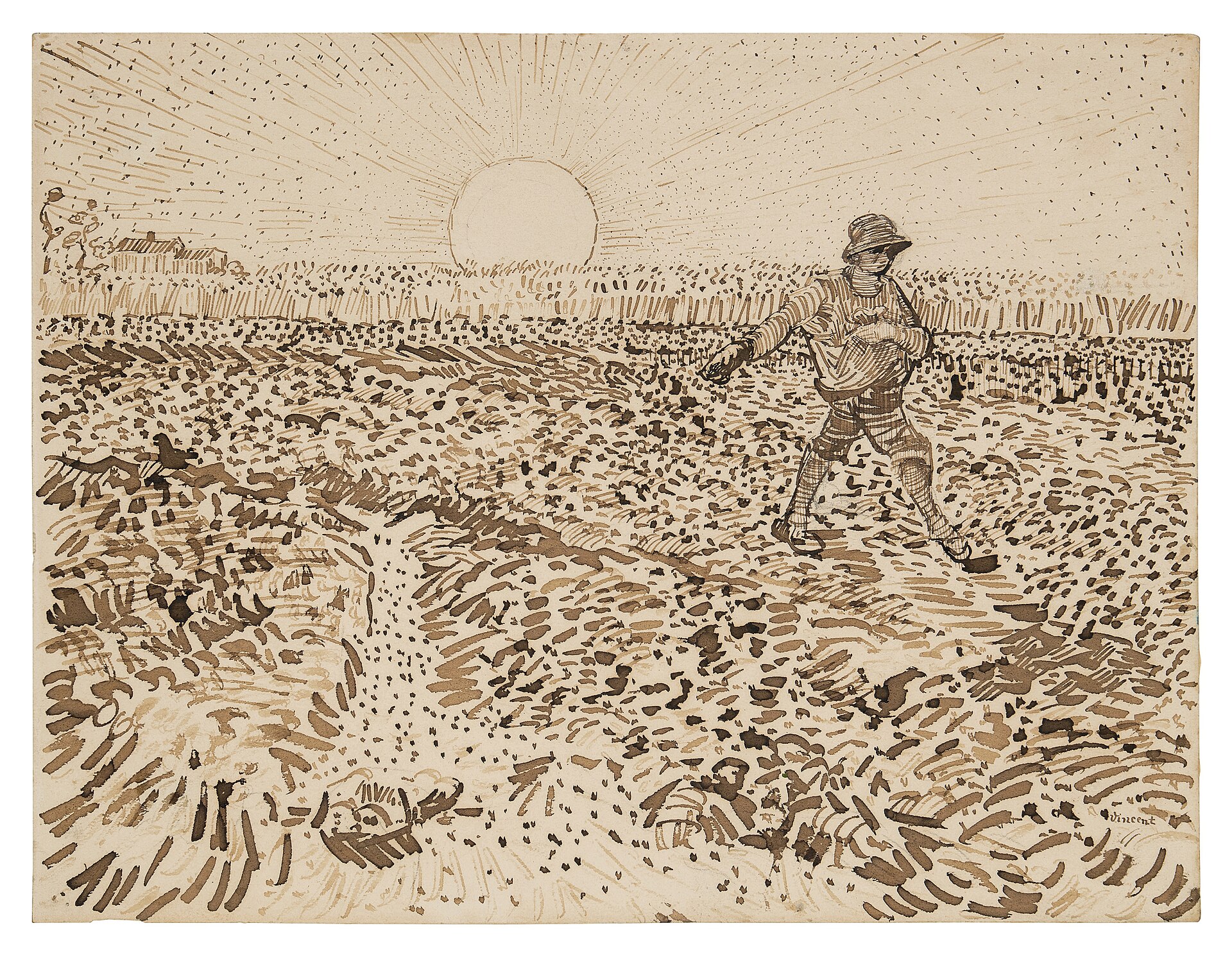
Sower with Setting Sun. Vincent van Gogh, mid July 1888. Sotheby's, New York, 18 November 2025, lot 4. Public domain.