
Psalm 57
11 verses · Psalm of lament
Have mercy on me, O God, have mercy, for in You my soul takes refuge. In the shadow of Your wings I will take shelter until the danger has passed.
Introduction
David, the Cave, Book 2: The Elohistic Psalter, Poetry, Psalms Overview.
David wrote this while hiding from Saul in a cave in the Judean hills. He was the anointed heir to the throne living as an outlaw, with the king's army searching the rocks for him. The psalm is for anyone hiding from a power he cannot fight. Listen for the refrain that divides it into two halves, the first spoken in the middle of danger and the second in praise. Listen too for the picture of a bird sheltering its young, and for the singer who means to be up before the sun.
Context
- Who
- Worshippers hiding from power they could not fight
- What
- A prayer from a cave while Saul hunted David, turning twice to the refrain that God be exalted above the heavens.
- Where
- A cave in the Judean limestone, either Adullam in the western foothills or the caves above the springs of En-gedi
- When
- David's years as a fugitive from Saul. About 1014 BC, from the event the heading names
- Why
- To teach a person in hiding to praise God before the rescue comes.
Historical context
The heading gives the psalm to David and names the occasion, his flight from Saul into a cave. The limestone spine of Judah is full of caves, and two cave episodes stand in David's story, the stronghold at Adullam and the caves above En-gedi. A cave gave shelter and a mouth that could be defended, and it had one way out. The phrase in the heading meaning destroy not stands over several psalms and is probably a tune name. Lions still lived in the thickets along the Jordan in this period, and hunters dug pits along game trails and covered them with brush. Waking the harp before dawn at verse 8 describes a practice the temple later formalised.
Significance
A man in a hole in the ground sings twice over that God should be exalted above the heavens. For the first hearers that was the lesson, that praise is how a man survives until the rescue comes.
This chapter in Jewish lifeWhat this chapter is in Jewish life and reading.
What is done
The best known tradition attached to this psalm is about how David rose to study at night, and Rashi carries it on the ninth line:
awaken [me], lyre and harp Awaken me, you lyre and harp hanging on my bed, open to the north side. And as soon as midnight arrived, the north wind would blow on it, and David would get up and engage in Torah. (Rashi on Psalms 57:9:2)
He reads the line before it as David refusing the late rising of other kings, at Rashi on Psalms 57:9:1. The rabbis teach it, and this site reports it as their teaching rather than as a statement of the psalm.
How it is read
Rashi explains the psalm's title from the state David was in when he made it:
For the conductor, al tashcheth David called this psalm by this name because he was near death, and he established this psalm, saying, “Do not destroy me, O Lord.” (Rashi on Psalms 57:1:1)
He reads the lions of the fifth line as two of Saul's own commanders who stood by and said nothing, at Rashi on Psalms 57:5:1, and the men who burn as the Ziphites who carried word of David's hiding place, at Rashi on Psalms 57:5:2. On the call for God to be exalted above the heavens he writes:
Be exalted above the heavens Withdraw from the earthlings, who are unworthy of having Your Shechinah rest among them, and on the earth You shall be honored by this. (Rashi on Psalms 57:6:1)
The second half of this psalm was set again as the first half of Psalm 108, and this site carries the join in the feature page it owes on the psalms re-set. Ibn Ezra stands on this chapter at Ibn Ezra on Psalms 57:1:1, 57:3:1, 57:4:1, 57:6:1, 57:8:1, 57:10:1 and 57:11:1, Radak at Radak on Psalms 57:3:1, 57:10:1, 57:11:1 and 57:12:1 and Metzudat David at Metzudat David on Psalms 57:12:1. Sefaria holds no English version of those references, so this card cites them without quotation.
What the rabbis say
The corpus records 40 places where the rabbinic literature takes up a line of this psalm, 31 of them in the Midrash. The Midrash on the Psalms treats it at Midrash Tehillim 57:1, 9:5 and 7:8, Bamidbar Rabbah at Bamidbar Rabbah 8:4, 19:2 and 15:16 and Midrash Tanchuma Buber at Midrash Tanchuma Buber, Vayetzei 5:1, Chukat 7:1 and Metzora 4:1. The Talmud takes up lines of the psalm at Berakhot 10a:8, Introductions to Amoraic Literature, Part II (Notes and Interpretations for Chapters of the Talmud), Baba Batra, Chapter I 231, Jerusalem Talmud Ketubot 1:2:7, Jerusalem Talmud Kiddushin 4:1:8, Jerusalem Talmud Nedarim 6:8:15, Jerusalem Talmud Sanhedrin 1:2:35, Introductions to Amoraic Literature, Part II (Notes and Interpretations for Chapters of the Talmud), Baba Batra, Chapter II 3, Berakhot 4a:3 and Avot DeRabbi Natan, Recension B 8:2. Each is a locator, so the saying stands at its reference and is read there.
Sources: Rashi, Rashi on Psalms, in The Judaica Press complete Tanach with Rashi, translated by A. J. Rosenberg, under a CC-BY licence; Ibn Ezra, Ibn Ezra on Psalms, cited at Ibn Ezra on Psalms 57:1:1, 57:3:1, 57:4:1, 57:6:1, 57:8:1, 57:10:1 and 57:11:1; Radak, Radak on Psalms, cited at Radak on Psalms 57:3:1, 57:10:1, 57:11:1 and 57:12:1; Metzudat David, Metzudat David on Psalms, cited at Metzudat David on Psalms 57:12:1; Midrash Tehillim, the Midrash on the Psalms, cited at Midrash Tehillim 57:1, 9:5 and 7:8; The Talmud, cited at Berakhot 10a:8, Introductions to Amoraic Literature, Part II (Notes and Interpretations for Chapters of the Talmud), Baba Batra, Chapter I 231, Jerusalem Talmud Ketubot 1:2:7, Jerusalem Talmud Kiddushin 4:1:8, Jerusalem Talmud Nedarim 6:8:15, Jerusalem Talmud Sanhedrin 1:2:35, Introductions to Amoraic Literature, Part II (Notes and Interpretations for Chapters of the Talmud), Baba Batra, Chapter II 3, Berakhot 4a:3 and Avot DeRabbi Natan, Recension B 8:2; MannaFest, the psalms re-set, Psalms 57, 60 and 108, in the feature pages owed at docs/lanes/FEATURE-PAGES-OWED.md, 2026; MannaFest, the Sefaria corpus at scripts/data/sources/sefaria/psalms/57.json, fetched 2026-09-19, 2026.
Psalms 57:1-2
In the shadow of Your wings: Mercy is asked twice, and then shelter in the shadow of God's wings until the danger has passed. The same wings cover a person at Ruth 2:12 and Psalm 91:4, where the image is a bird over its young. Verse 2 calls Him God Most High, who fulfills His purpose.
Psalms 57:1
“Be merciful unto me, O God, be merciful unto me. Urgent need suggests the repetition of the cry, for thus intense urgency of desire is expressed. If 'he gives twice who gives quickly, 'so he who would receive quickly must ask twice. For mercy the psalmist pleads at first, and he feels he cannot improve upon his plea, and therefore returns to it. God is the God of mercy, and the Father of mercies, it is most fit therefore that in distress he should seek mercy from him in whom it dwells. For my soul trusteth in thee.”
Charles Spurgeon · The Treasury of David, Vol. 3 (1872)Particular Baptist
God who fulfills His purpose for me: Most High is the name Melchizedek used at Genesis 14:19, God above every power on earth. The verb for fulfills means to bring to an end or complete, and the same verb returns at Psalm 138:8. The man in the cave leaves the outcome with God.
Psalms 57:3-5
He reaches down from heaven and saves me: God reaches down from heaven and sends out His loving devotion and truth, the way light and truth are sent out at Psalm 43:3. Verse 4 names the weapon: teeth that are spears and arrows, tongues that are sharp swords. Verse 5 lifts the prayer over the danger.
Psalms 57:3
“He shall send from heaven. If there be no fit instruments on earth, heaven shall yield up its legions of angels for the succour of the saints. We may in times of great straits expect mercies of a remarkable kind; like the Israelites in the wilderness, we shall have our bread hot from heaven, new every morning; and for the overthrow of our enemies God shall open his celestial batteries, and put them to utter confusion. Wherever the battle is more fierce than ordinary, there shall come succours from headquarters, for the Commander in chief sees all.”
Charles Spurgeon · The Treasury of David, Vol. 3 (1872)Particular Baptist
My soul is among the lions: The lions are men, and the verse turns them into weapons, teeth as spears and tongues as swords. John Gill took the lions as Saul's three thousand men. Charles Spurgeon pictured the cave as a lion's den, where faith still let David lie down.
Psalms 57:4
“My soul is among lions. He was a very Daniel. Howled at, hunted, wounded, but not slain. His place was in itself one of extreme peril, and yet faith made him feel himself secure, so that he could lie down. The cave may have reminded him of a lion's den, and Saul and his band shouting and yelling in their disappointment at missing him, were the lions; yet beneath the divine shelter he finds himself safe. And I lie even among them that are set on fire.”
Charles Spurgeon · The Treasury of David, Vol. 3 (1872)Particular Baptist
2 more voices on this verse
Psalms 57:4
“My soul is among lions,.... Not literally understood; though such there might be in the wildernesses where he sometimes was; but figuratively, men comparable to lions, for their stoutness, courage, strength, fierceness, and cruelty; meaning not his own men, as some think, who were fierce, and of keen resentment against Saul, and would fain have killed him when he was in the cave, had they not been restrained by David, 1Sa 24:4; but Saul, and those with him, who were three thousand chosen men, stout, courageous, fierce, and furious.”
Psalms 57:4
“The mingled figures of wild beasts (Ps 10:9; 17:12) and weapons of war (Ps 11:2) heighten the picture of danger. whose . . . tongue--or slanders.”
Jamieson, Fausset & Brown · Commentary Critical and Explanatory on the Whole Bible (1871)reformed
Be exalted, O God, above the heavens: The prayer breaks off in the middle of danger to praise. Charles Spurgeon called the line the chorus of the psalm, sung from the lion's den. Matthew Henry marked how suddenly the tune alters, the complaint turned to thanksgiving.
Psalms 57:5
“Be thou exalted, O God, above the heavens. This is the chorus of the Psalm. Before he has quite concluded his prayer the good man interjects a verse of praise; and glorious praise too, seeing it comes from the lion's den and from amid the coals of fire. Higher than the heavens is the Most High, and so high ought our praises to rise. Above even the power of cherubim and seraphim to express it, the glory of God is revealed and is to be acknowledged by us. Let thy glory be above all the earth.”
Charles Spurgeon · The Treasury of David, Vol. 3 (1872)Particular Baptist
2 more voices on this verse
Psalms 57:5
“11 Be thou exalted, O God, above the heavens: let thy glory be above all the earth. How strangely is the tune altered here! David's prayers and complaints, by the lively actings of faith, are here, all of a sudden, turned into praises and thanksgivings; his sackcloth is loosed, he is girded with gladness, and his hallelujahs are as fervent as his hosannas.”
Matthew Henry · Commentary on the Whole Bible (1707-1721)puritan
Psalms 57:5
“Be thou exalted, O God, above the heavens,.... That is, show thyself to be God, that sittest in the heavens, and art higher than they, by saving me, and disappointing mine enemies; that I, and those that are with me, may magnify the Lord and exalt his name together.”
Psalms 57:6-8
They spread a net for my feet: They spread a net and dug a pit, and verse 6 says they fell into it themselves. Psalm 9:15 gives the same net and the same pit, and Psalm 7:15 the digger falling in. A steadfast heart wakes the harp and the lyre.
Psalms 57:6
“It is indeed some disturbance to David: My soul is bowed down. It made him droop, and hang the head, to think that there should be those that bore him so much ill-will. It was destruction to themselves; they dug a pit for David, into the midst whereof they have fallen.”
Matthew Henry · Commentary on the Whole Bible (1707-1721)puritan
2 more voices on this verse
Psalms 57:6
“They have prepared a net for my steps. The enemies of the godly spare no pains, but go about their wicked work with the coolest deliberation. As for each sort of fish, or bird, or beast, a fitting net is needed, so do the ungodly suit their net to their victim's circumstances and character with a careful craftiness of malice. Whatever David might do, and whichever way he might turn, his enemies were ready to entrap him in some way or other. My soul is bowed down.”
Charles Spurgeon · The Treasury of David, Vol. 3 (1872)Particular Baptist
Psalms 57:6
“They have prepared a net for my steps,.... They laid snares for him, as the fowler does for the bird, in order to take him.”
My heart is steadfast, O God: Steadfast means fixed and ready, and it is said twice. Charles Spurgeon expected the man in the cave to say his heart was fluttered, and heard him say it was fixed. John Gill read the fixed heart as one settled in trust for its salvation.
Psalms 57:7
“My heart is fixed, O God,.... Firm and sure, trusting in the Lord, believing that he should be saved by him out of his troubles; see Psa 101:1. So, in a spiritual sense, a heart fixed and established, or that is firm and sure, is one that is assured of its salvation by Christ, rooted and grounded in the love of God, firmly built on the foundation, Christ, and has its affections set on him; and is unmoved, from the hope of the Gospel, and the doctrines of it, by whatsoever it meets with in the world.”
1 more voice on this verse
Psalms 57:7
“My heart is fixed. One would have thought he would have said, "My heart is fluttered; "but no, he is calm, firm, happy, resolute, established. When the central axle is secure, the whole wheel is right. If our great bower anchor holds, the ship cannot drive. O God, my heart is fixed. I am resolved to trust thee, to serve thee, and to praise thee. Twice does he declare this to the glory of God who thus comforts the souls of his servants.”
Charles Spurgeon · The Treasury of David, Vol. 3 (1872)Particular Baptist
Awake, my glory!: My glory names the part of the man that praises. John Wesley took it as the tongue, and Jamieson, Fausset and Brown note the last line keeps the literal Hebrew, I will awaken the dawn. The singer rises before the sun.
Psalms 57:8
“Awake up, my glory. Let the noblest powers of my nature bestir themselves: the intellect which conceives thought, the tongue which expresses it, and the inspired imagination which beautifies it—let all be on the alert now that the hour for praise has come. Awake, psaltery and harp. Let all the music with which I am familiar be well attuned for the hallowed service of praise. I myself will awake early. I will awake the dawn with my joyous notes. No sleepy verses and weary notes shall be heard from me; I will thoroughly arouse myself for this high employ.”
Charles Spurgeon · The Treasury of David, Vol. 3 (1872)Particular Baptist
2 more voices on this verse
Psalms 57:8
“My glory - My tongue, the instrument of singing. Awake - I will employ all the powers of my soul and body.”
John Wesley · Explanatory Notes upon the Old Testament (1765)evangelical
Psalms 57:8
“Hence--he addresses his glory, or tongue (Ps 16:9; 30:12), and his psaltery, or lute, and harp. I myself . . . early--literally, "I will awaken dawn," poetically expressing his zeal and diligence.”
Jamieson, Fausset & Brown · Commentary Critical and Explanatory on the Whole Bible (1871)reformed
Psalms 57:9-11
I will praise You, O Lord, among the nations: The praise goes out among the nations, and verse 10 has the loving devotion reaching to the heavens and the faithfulness to the clouds. Verse 11 repeats verse 5 word for word. Psalm 108:1 to 5 takes up verses 7 to 11 of this psalm almost unchanged.
Psalms 57:9
“I will praise thee, O Lord, among the people. Gentiles shall hear my praise. Here is an instance of the way in which the truly devout evangelic spirit overleaps the boundaries which bigotry sets up. The ordinary Jew would never wish the Gentile dogs to hear Jehovah's name, except to tremble at it; but this grace taught psalmist has a missionary spirit, and would spread the praise and fame of his God. I will sing unto thee among the nations. However far off they may be, I would make them hear of thee through my glad psalmody.”
Charles Spurgeon · The Treasury of David, Vol. 3 (1872)Particular Baptist
1 more voice on this verse
Psalms 57:9
“When David was driven out into heathen lands he would not only not worship their gods, but he would openly avow his veneration for the God of Israel, would take his religion along with him wherever he went, would endeavour to bring others in love with it, and leave the sweet savour of it behind him.”
Matthew Henry · Commentary on the Whole Bible (1707-1721)puritan
Your loving devotion reaches to the heavens: The measure of God's love is the height of the sky. Charles Spurgeon pictured David at the cave's mouth looking up at the firmament. Faithfulness here and truth at verse 3 render the same Hebrew word, emet.
Psalms 57:10
“For thy mercy is great unto the heavens. Right up from man's lowliness to heaven's loftiness mercy reaches. Imagination fails to guess the height of heaven, and even thus the riches of mercy exceed our highest thoughts. The psalmist, as he sits at the cave's mouth and looks up to the firmament, rejoices that God's goodness is more vast and more sublime than even the vaulted skies. And thy truth unto the clouds.”
Charles Spurgeon · The Treasury of David, Vol. 3 (1872)Particular Baptist
may Your glory cover all the earth: Verse 11 repeats verse 5 word for word, and the refrain now closes the psalm. John Gill read the repetition as the strength of David's desire. Charles Spurgeon called it a grand chorus for angels and men together.
Psalms 57:11
“Be thou exalted, O God, above the heavens,.... As Christ now is at the Father's right hand, and who is God over all, blessed for ever; let thy glory be above all the earth; as it is above all the men on earth and angels in heaven. This is repeated from Psa 57:5; See Gill on Psa 57:5, and shows the vehemency of his desire after these things, and how much his heart was set upon them.”
1 more voice on this verse
Psalms 57:11
“Be thou exalted, O God, above the heavens. A grand chorus. Take it up, ye angels and ye spirits made perfect, and join in it, ye sons of men below, as ye say, Let thy glory be above all the earth.”
Charles Spurgeon · The Treasury of David, Vol. 3 (1872)Particular Baptist
How this psalm is built
The form: A lament that turns into a song of praise, framed by one repeated line, as Spurgeon classes it.
The patterns in this chapter
| Device | What it does | Where to see it |
|---|---|---|
| Be exalted, O God | Verse 5 and verse 11 are the same sentence word for word, asking that God be exalted above the heavens and that His glory cover all the earth. The first stands in the middle of the danger and the second at the end of the praise, so the psalm's two halves close alike.Franz Delitzsch, Biblical Commentary on the Psalms, cited in this site's exposition note on Psalm 57:9 to 11. | Psalm 57:5, Psalm 57:11 |
| The doubled cry | Verse 1 asks for mercy twice in one line. Spurgeon reads the repetition as the mark of urgent need, since a man who would receive quickly must ask twice, and Henry notes that the same words are the tax collector's prayer at Luke 18:13.Charles Spurgeon, The Treasury of David, Vol. 2, 1870, on Psalm 57:1. | Psalm 57:1 |
| The heart said twice | Verse 7 says my heart is steadfast and then says it again in the same line. Spurgeon reads the repetition as calm rather than agitation, and Clarke reads it as a heart prepared to do and to suffer God's will.Charles Spurgeon, The Treasury of David, Vol. 2, 1870, on Psalm 57:7. | Psalm 57:7 |
| Teeth and tongues as weapons | Verse 4 keeps two pictures in one sentence. The men are ravenous beasts among whom he lies down, and their teeth are spears and arrows while their tongues are sharp swords. The animal and the armoury are the same men.Albert Barnes, Notes, Explanatory and Practical, on the Old and New Testaments, 1832 to 1869, on Psalm 57:4. | Psalm 57:4 |
The pattern is a reversal inside one verse. They spread a net and dug a pit at verse 6, and the same verse has them falling into it themselves.
8 more paragraphs on the patterns
Where it points
The psalm's pictures are used elsewhere in the Psalter and the site's exposition notes record the places. The shadow of God's wings at verse 1 covers a person at Ruth 2:12 and Psalm 91:4, where the image is a bird over its young. The loving devotion and truth sent out at verse 3 are sent in the same way at Psalm 43:3. The net and the pit of verse 6 stand at Psalm 9:15, and the digger who falls into his own pit at Psalm 7:15.
The structure carried into another psalm
Verses 7 to 11 stand again, almost unchanged, at Psalm 108:1 to 5, where they are joined to the second half of Psalm 60. That makes this psalm one half of a later composition, and it is one of the clearest pieces of evidence in the Psalter that Israel's songs were re-set and re-joined for new occasions.
The New Testament's use
The psalm is not quoted in the New Testament. The doubled plea of verse 1 is the prayer the tax collector prays at Luke 18:13. Henry marks the connection and the warning that goes with it, that the words should not be used lightly.
Where it stands
It belongs with the psalms of David's years as a fugitive, and it pairs with Psalm 56, which was written in the same years and reaches its confidence by the same route.
Keep studying
Sources for this chapter
The summary
Jamieson, Fausset & Brown, Commentary Critical and Explanatory; John Calvin, Commentaries; John Wesley, Notes on the Old Testament and Matthew Henry, Complete Commentary.
The form and classifications
Charles Spurgeon.
The exposition
Albert Barnes, Notes on the Book of Psalms; Charles Spurgeon, The Treasury of David; Francis Brown, S. R. Driver and Charles Briggs, A Hebrew and English Lexicon of the Old Testament; Franz Delitzsch, Biblical Commentary on the Psalms; Jamieson, Fausset and Brown, Commentary Critical and Explanatory on the Whole Bible; John Gill, Exposition of the Old Testament; John Wesley, Explanatory Notes upon the Old Testament and Matthew Henry, Commentary on the Whole Bible.
The painting
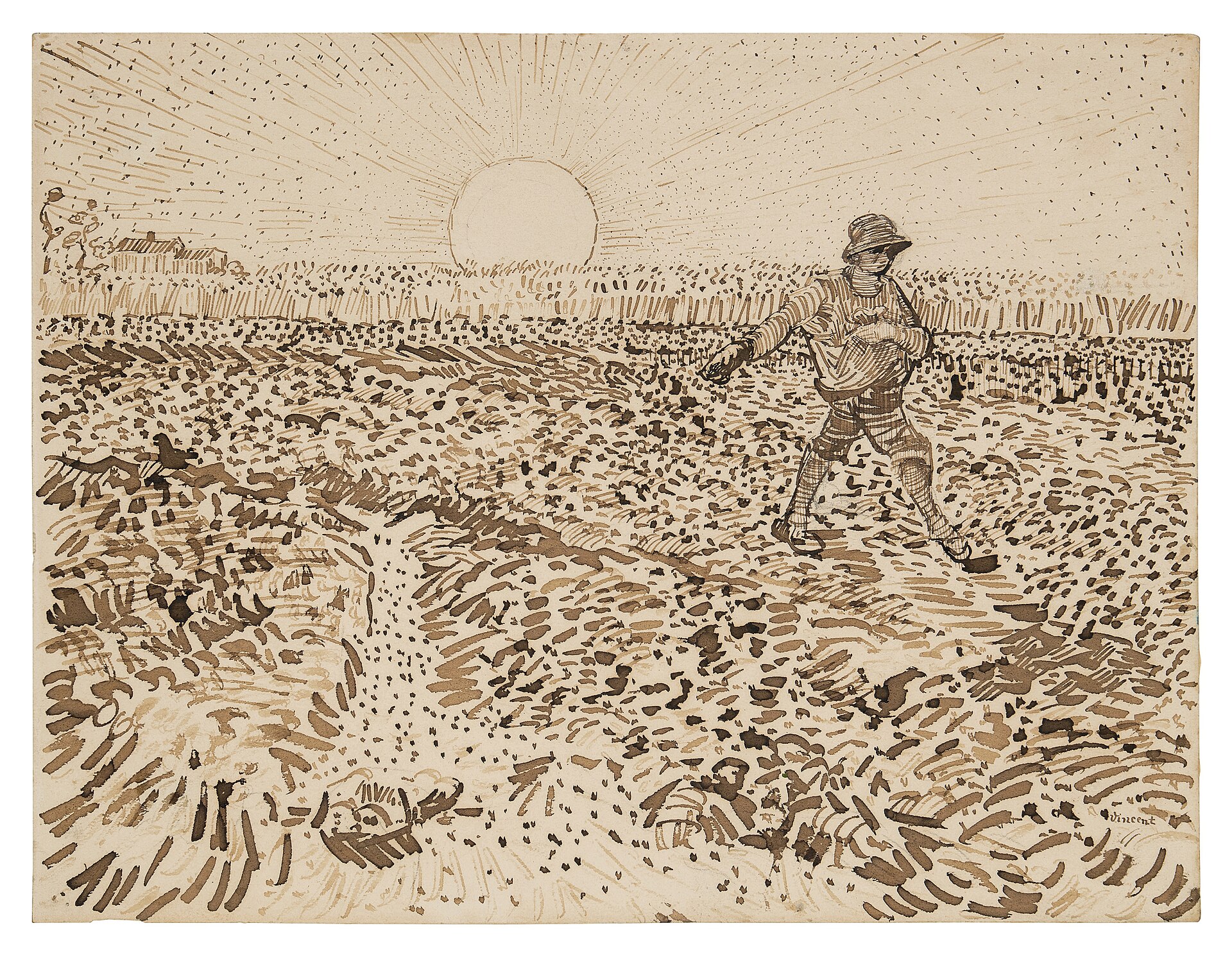
Sower with Setting Sun. Vincent van Gogh, mid July 1888. Sotheby's, New York, 18 November 2025, lot 4. Public domain.