
Psalm 56
13 verses · Psalm of lament
When I am afraid, I put my trust in You.
Introduction
David, the Counted Tears, Book 2: The Elohistic Psalter, Poetry, Psalms Overview.
David wrote this after the Philistines caught him in Gath, Goliath's town, where he escaped only by pretending to be mad. He was alone among enemies and far from the land he had been promised. The psalm is for people surrounded by stronger neighbours. Listen for the refrain that comes twice, a line of trust answering a line of fear, and for the picture of tears kept and counted. It ends with a vow to be paid, spoken as if the danger were already past.
Context
- Who
- Israelites hemmed in by stronger neighbours
- What
- The prayer of a fugitive seized by the Philistines, built on a refrain of trust in God's word.
- Where
- Gath, one of the five Philistine cities, on the coastal plain west of Judah
- When
- David's years as a fugitive from Saul. About 1014 BC, from the event the heading names
- Why
- To give a frightened person a way to say his fear and his trust in the same breath.
Historical context
The heading gives the psalm to David and names the occasion, the day the Philistines seized him in Gath. Gath was Goliath's home town, and to get out alive he acted as a madman until the king threw him out as a nuisance. The phrase in the heading about a silent dove far away is almost certainly a tune name. Liquids were carried in leather skins and small clay flasks, and the bottle of verse 8 claims that the tears are collected and counted and written in a book. When the psalm says he will praise God's word, the word in view is a promise, the anointing Samuel had poured on him years earlier. At that moment it looked like the least likely thing in the world to come true.
Significance
The refrain was what a small nation needed: What can man do to me, sung by people whose neighbours had more chariots, more iron and more men. The psalm also admits fear out loud, which gave a frightened worshipper a sentence he could say honestly.
This chapter in Jewish lifeWhat this chapter is in Jewish life and reading.
How it is read
Rashi reads the strange words of this psalm's heading as David's description of himself among the Philistines, and he sets the whole psalm in that week of his life:
He said this concerning himself, for he was with Achish, far from the land of Israel, and Goliath’s brothers were requesting permission from Achish to kill him, as it is said (I Sam. 21:12): “Is this not David, the king of the land?” (Rashi on Psalms 56:1:1)
The pursuers of the psalm he takes as men of Israel rather than as foreigners, which is why David had fled to a Philistine king at all, at Rashi on Psalms 56:7:1. On the line about the tears he writes:
place my tears in Your flask Place my tears in Your flask, and let them be preserved before You. (Rashi on Psalms 56:9:2)
He reads the two divine names of the fifth and eleventh lines as the two standards God deals by, justice and mercy, and has the psalmist praising him under both:
With God I will praise a word; with the Lord I will praise For the Divine standard of justice and for the Divine standard of mercy I will praise. (Rashi on Psalms 56:11:1)
The light of life in the last line he reads as the land of Israel, at Rashi on Psalms 56:14:1, where a Christian reader hears eternal life. Ibn Ezra stands on this chapter at Ibn Ezra on Psalms 56:1:1, 56:3:1, 56:4:1, 56:5:1, 56:6:1, 56:10:1, 56:12:1 and 56:13:1 and Radak at Radak on Psalms 56:4:1 and 56:10:1, and Sefaria holds no English version of those references, so this card cites them without quotation.
What the rabbis say
The corpus records 33 places where the rabbinic literature takes up a line of this psalm, 29 of them in the Midrash. The Midrash on the Psalms treats it at Midrash Tehillim 56:1, 34:1, 101:1, 100:3 and 56:2, Bereshit Rabbah at Bereshit Rabbah 64:7, 38:1, 53:13 and 53:14 and Vayikra Rabbah at Vayikra Rabbah 24:2, 27:12 and 9:7. The Talmud takes up lines of the psalm at Sotah 10b:5, Shabbat 105b:10, Berakhot 60b:9 and Jerusalem Talmud Berakhot 9:5:4. Each is a locator, so the saying stands at its reference and is read there.
Sources: Rashi, Rashi on Psalms, in The Judaica Press complete Tanach with Rashi, translated by A. J. Rosenberg, under a CC-BY licence; Ibn Ezra, Ibn Ezra on Psalms, cited at Ibn Ezra on Psalms 56:1:1, 56:3:1, 56:4:1, 56:5:1, 56:6:1, 56:10:1, 56:12:1 and 56:13:1; Radak, Radak on Psalms, cited at Radak on Psalms 56:4:1 and 56:10:1; Midrash Tehillim, the Midrash on the Psalms, cited at Midrash Tehillim 56:1, 34:1, 101:1, 100:3 and 56:2; The Talmud, cited at Sotah 10b:5, Shabbat 105b:10, Berakhot 60b:9 and Jerusalem Talmud Berakhot 9:5:4; MannaFest, the Sefaria corpus at scripts/data/sources/sefaria/psalms/56.json, fetched 2026-09-19, 2026.
Psalms 56:1-2
all day they press their attack: Be merciful is the whole of the request, and all day is the whole of the trouble. The men are counted twice, men in verse 1 and many in verse 2, and both verses press and pursue him all day. All day long comes a third time at verse 5.
Psalms 56:1
“He prays that he might find mercy with God, for with men he could find no mercy. When he fled from the cruel hands of Saul he fell into the cruel hands of the Philistines. "Lord" (says he), "be thou merciful to me now, or I am undone." The mercy of God is what we may flee to and trust to, and in faith pray for, when we are surrounded on all sides with difficulties and dangers.”
Matthew Henry · Commentary on the Whole Bible (1707-1721)puritan
2 more voices on this verseWhat preachers and commentators have said about this verse, in their own words.
Psalms 56:1
“Be merciful unto me, O God. In my deep distress my soul turns to thee, my God. Man has no mercy on me, therefore double thy mercy to me. If thy justice has let loose my enemies, let thy mercy shorten their chain. It is sweet to see how the tender dove like spirit of the psalmist flies to the most tender attribute for succour in the hour of peril. For man would swallow me up.”
Charles Spurgeon · The Treasury of David, Vol. 3 (1872)Particular Baptist
Psalms 56:1
“I have adhered to the common translation of lchm, lacham, though it also signifies to eat up, which might consist better with the metaphor already used in the preceding part of the verse. It is found, however, in the sense to fight against, and I was unwilling to depart from the received rendering.”
John Calvin · Commentaries (1554)reformed
for many proudly assail me: The enemies are many and they never let up. Charles Spurgeon observed that persecutors hunt in packs. Matthew Henry notes that wild beasts do not prey on their own kind, yet these men would devour a man like themselves.
Psalms 56:2
“Mine enemies would daily swallow me up. Their appetite for blood never fails them. With them there is no truce or armistice. They are many, but one mind animates them. Nothing I can do can make them relent. Unless they can quite devour me they will never be content. The ogres of nursery tales exist in reality in the enemies of the church, who would crush the bones of the godly, and make a mouthful of them if they could. For they be many that fight against me. Sinners are gregarious creatures. Persecutors hunt in packs.”
Charles Spurgeon · The Treasury of David, Vol. 3 (1872)Particular Baptist
1 more voice on this verse
Psalms 56:2
“Man would swallow him up, those of his own kind, from whom he might have expected humanity. The ravenous beasts prey not upon those of their own species; yet a bad man would devour a good man if he could. "They are men, weak and frail; make them to know that they are so," Ps. ix.”
Matthew Henry · Commentary on the Whole Bible (1707-1721)puritan
Psalms 56:3-4
When I am afraid: Verse 3 puts fear and trust in one sentence. The trust has a ground, God's word, which verse 4 names in the refrain, in God whose word I praise. The closing question, what can man do to me, returns word for word at verse 11.
Psalms 56:3
“In the day that I was afraid, etc. In the Hebrew, the words run in the future tense, but they must be resolved into the praeterite. He acknowledges his weakness, in so far as he was sensible of fear, but denies having yielded to it.”
John Calvin · Commentaries (1554)reformed
1 more voice on this verse
Psalms 56:3
“What time I am afraid. David was no braggart, he does not claim never to be afraid, and he was no brutish Stoic free from fear because of the lack of tenderness. David's intelligence deprived him of the stupid heedlessness of ignorance, he saw the imminence of his peril, and was afraid. We are men, and therefore liable to overthrow; we are feeble, and therefore unable to prevent it; we are sinful men, and therefore deserving it, and for all these reasons we are afraid.”
Charles Spurgeon · The Treasury of David, Vol. 3 (1872)Particular Baptist
In God, whose word I praise—: The word praised is God's promise, praised before it is kept. John Wesley reads it as the promises of protection made to God's people. The Hebrew of the last line says flesh, which Wesley took as frail and mortal men.
Psalms 56:4
“In God I will praise his word. Faith brings forth praise. He who can trust will soon sing. God's promise, when fulfilled, is a noble subject for praise, and even before fulfilment it should be the theme of song. It is in or through God that we are able to praise. We praise as well as pray in the Spirit. Or we may read it—in extolling the Lord one of the main points for thanksgiving is his revealed will in the Scriptures, and the fidelity with which he keeps his word of promise. In God I have put my trust.”
Charles Spurgeon · The Treasury of David, Vol. 3 (1872)Particular Baptist
1 more voice on this verse
Psalms 56:4
“Will praise - I will praise the Lord for his word, for his promises of protection and deliverance, made to his people. Flesh - Infirm and mortal men, called flesh by way of contempt, as chap. lxxviii, 39 Isaiah xxxi, 3.”
John Wesley · Explanatory Notes upon the Old Testament (1765)evangelical
Psalms 56:5-6
All day long they twist my words: They twist my words, says verse 5, and the wrong is done with speech. Verse 6 adds four verbs, conspire, lurk, watch and wait. Verse 8 answers that watching with a watch of God's own, an account taken of every wandering.
Psalms 56:5
“Every day they wrest my words. This is a common mode of warfare among the ungodly. They put our language on the rack, they extort meanings from it which it cannot be made fairly to contain. Thus our Saviour's prophecy concerning the temple of his body, and countless accusations against his servants, were founded on wilful perversions. They who do this every day become great adepts in the art. A wolf can always find in a lamb's discourse a reason for eating him. Prayers are blasphemies if you choose to read them the wrong way upwards.”
Charles Spurgeon · The Treasury of David, Vol. 3 (1872)Particular Baptist
1 more voice on this verse
Psalms 56:5
“Such as this is the enmity of Satan and his agents against the kingdom of Christ and the interests of his holy religion, which if we cordially espouse, we must not think it strange to meet with such treatment as this, as though some strange thing happened to us.”
Matthew Henry · Commentary on the Whole Bible (1707-1721)puritan
they watch my steps: Four verbs describe men who work by ambush. Charles Spurgeon read the gathering and hiding as cowardice, men who wait until the odds are heavy before they strike. Their patience serves the aim named last, his life.
Psalms 56:6
“They gather themselves together. Firebrands burn the fiercer for being pushed together. They are afraid to meet the good man till their numbers place terrible odds against him. Come out, ye cowards, man to man, and fight the old hero! No, ye wait till ye are assembled like thieves in bands, and even then ye waylay the man. There in nothing brave about you. They hide themselves. In ambuscade they wait their opportunity. Men of malice are men of cowardice. He who dares not meet his man on the king's highway, writes himself down a villain.”
Charles Spurgeon · The Treasury of David, Vol. 3 (1872)Particular Baptist
Psalms 56:7-9
In Your anger, O God, cast down the nations: David asks whether they will escape in spite of such sin, and asks God to cast down the nations. Verse 8 turns to his own wanderings and tears, put in God's bottle and held in His book. The plea rests on one line, God is on my side.
Psalms 56:7
“Shall they escape by iniquity? Will such wickedness as this stand them in good stead? Can it be that this conduct shall enable them to avoid the sentence of earthly punishment? They slander the good man to screen themselves—will this avail them? They have cunningly managed hitherto, but will there not be an end to their games? In thine anger cast down the people, O God. Trip them up in their tricks. Hurl them from the Tarpeian rock. A persecuted man finds a friend even in an angry God, how much more in the God of love!”
Charles Spurgeon · The Treasury of David, Vol. 3 (1872)Particular Baptist
Put my tears in Your bottle—: Matthew Henry held that God keeps a bottle and a book for His people's tears, for sin and for affliction alike. John Gill took the wanderings as his flights from Saul. Jamieson, Fausset and Brown suggest a custom in some Eastern nations of bottling mourners' tears.
Psalms 56:8
“Thou tellest my wanderings. Every step which the fugitive had taken when pursued by his enemies, was not only observed but thought worthy of counting and recording. We perhaps are so confused after a long course of trouble, that we hardly know where we have or where we have not been; but the omniscient and considerate Father of our spirits remembers all in detail; for he has counted them over as men count their gold, for even the trial of our faith is precious in his sight. Put thou my tears into thy bottle.”
Charles Spurgeon · The Treasury of David, Vol. 3 (1872)Particular Baptist
4 more voices on this verse
Psalms 56:8
“Of all the impressions thus made upon his spirit. When he was wandering he was often weeping, and therefore prays, " Put thou my tears into thy bottle, to be preserved and looked upon; nay, I know they are in thy book, the book of thy remembrance." God has a bottle and a book for his people's tears, both those for their sins and those for their afflictions.”
Matthew Henry · Commentary on the Whole Bible (1707-1721)puritan
Psalms 56:8
“Thou tellest my wanderings,.... Not his sins; though these are aberrations or wanderings from the ways of God's commandments; yet these are not told by the Lord: he takes no account of them; the number of them is not kept by him; they are blotted out, cast behind his back, and into the depths of the sea; though sometimes his people think they are told and numbered by him, Job 14:16; but David's moves and flights from place to place are meant, through Saul's pursuit of him, as a partridge on the mountains. Some writers reckon twelve of these moves.”
Psalms 56:8
“Wanderings - How I have been hunted from place to place. Put - Regard and pity them. Are they not - But why do I pray to God to do that which he hath already done?”
John Wesley · Explanatory Notes upon the Old Testament (1765)evangelical
Psalms 56:8
“God is mindful of his exile and remembers his tears. The custom of bottling the tears of mourners as a memorial, which has existed in some Eastern nations, may explain the figure.”
Jamieson, Fausset & Brown · Commentary Critical and Explanatory on the Whole Bible (1871)reformed
By this I will know that God is on my side: The day of the cry and the day of the retreat are the same day. Charles Spurgeon called prayer an artillery that wins the battle as soon as its report is heard. The retreat is his proof that God is for him.
Psalms 56:9
“When I cry unto thee, then shall mine enemies turn back. So soon as I pray they shall fly. So surely as I cry they shall be put to the rout. The machinery of prayer is not always visible, but it is most efficient. God inclines us to pray, we cry in anguish of heart, he hears, he acts, the enemy is turned back. What irresistible artillery is this which wins the battle as soon as its report is heard!”
Charles Spurgeon · The Treasury of David, Vol. 3 (1872)Particular Baptist
Psalms 56:10-11
in the LORD, whose word I praise: Verse 10 praises God's word twice in one line, in God and in the LORD, one claim under two names. Verse 11 then repeats verse 4, the trust and the question, what can man do to me. The psalm ends each half in the same place.
Psalms 56:10
“In God will I praise his word. Now comes the thanksgiving. He is a wretch who, having obtained help, forgets to return a grateful acknowledgment. The least we can do is to praise him from whom we receive such distinguished favours. Does David here mean "by God's grace I will praise him"? If so, he shows us that all our emotions towards God must be in God, produced by him and presented as such. Or does he mean, "that which in God is most the object of my praise is his word, and the faithfulness with which he keeps it"?”
Charles Spurgeon · The Treasury of David, Vol. 3 (1872)Particular Baptist
What can man do to me?: Verse 11 repeats verse 4, and Charles Spurgeon took the two as the chorus of the psalm. Verse 4 says flesh in Hebrew, and this verse says man. John Gill records a Jewish reading by Arama, that flesh means the Philistines and man means Saul and his army.
Psalms 56:11
“In God have I put my trust,.... See Gill on Psa 56:4; I will not be afraid what man can do unto me; the same with flesh in Psa 56:4, and is opposed to God, in whom he trusted; and it suggests that he was not, and would not, be afraid of the greatest of men, as well as of the meanest; See Gill on Psa 56:4; Arama distinguishes between "flesh" and "man"; the former, he says, means the Philistines, and the latter Saul and his army.”
1 more voice on this verse
Psalms 56:11
“In God have I put my trust. This and the former verse are evidently the chorus of the Psalm. We cannot be too careful of our faith, or see too sedulously that it is grounded on the Lord alone. I will not be afraid what man can do unto me. Faith has banished fear. He views his foes in their most forcible character, calling them not flesh, but indicating them as man, yet he dreads them not; though the whole race were his enemies he would not be afraid now that his trust is stayed on God.”
Charles Spurgeon · The Treasury of David, Vol. 3 (1872)Particular Baptist
Psalms 56:12-13
Your vows are upon me, O God: Verse 12 treats the vows as a debt now due, paid in thank offerings. Verse 13 gives the ground in the past tense: God has delivered his soul from death and his feet from stumbling. The purpose is to walk before God in the light.
Psalms 56:12
“Thy vows are upon me, O God. Vows made in his trouble he does not lightly forget, nor should we. We voluntarily made them, let us cheerfully keep them. All professed Christians are men under vows, but especially those who in hours of dire distress have rededicated themselves unto the Lord. I will render praises unto thee. With heart, and voice, and gift, we should cheerfully extol the God of our salvation.”
Charles Spurgeon · The Treasury of David, Vol. 3 (1872)Particular Baptist
2 more voices on this verse
Psalms 56:12
“This is part of the performance of his vows; for vows of thankfulness properly accompany prayers for mercy, and when the mercy is received must be made good. When we study what we shall render this is the least we can resolve upon, to render praises to God--poor returns for rich receivings!”
Matthew Henry · Commentary on the Whole Bible (1707-1721)puritan
Psalms 56:12
“For before the eyes of God the hand is never empty of a gift, if the treasury of the heart has been filled with good will. Hence the Psalmist says: In me, O God, are your vows which I shall pay, praises to you. As if he were saying openly: Even if outwardly I do not have gifts to offer, yet within myself I find what I may place upon the altar of your praise, because you who are not fed by our giving are better pleased by the offering of the heart.”
Gregory the Dialogist · written before 604 · Forty Gospel Homilies, Homily 5patristic
that I may walk before God in the light of life: A life saved from death is spent before God. Charles Spurgeon read one mercy as a plea for the next, since a life spared means little if the man falls in character. The light of life stands against the darkness of death, as at Job 33:30.
Psalms 56:13
“For thou hast delivered my soul from death. His enemies were defeated in their attempts upon his life, and therefore he vowed to devote his life to God. Wilt not thou deliver my feet from falling? One mercy is a plea for another, for indeed it may happen that the second is the necessary complement of the first. It little boots that we live, if we are made to fall in character by the thrusts of our enemies. As lief not be, as live to be bereft of honour, and fallen prostrate before my enemies.”
Charles Spurgeon · The Treasury of David, Vol. 3 (1872)Particular Baptist
How this psalm is built
The form: A lament built on a refrain, in which fear is admitted and trust is stated in the same sentence, as Spurgeon classes it.
The patterns in this chapter
| Device | What it does | Where to see it |
|---|---|---|
| What can man do to me | Verse 4 and verse 11 carry the same two sentences, that in God he trusts and will not be afraid, and the question about what man can do. The refrain closes each half of the psalm, so the two movements end in the same place.Franz Delitzsch, Biblical Commentary on the Psalms, cited in this site's exposition note on Psalm 56:3 to 4. | Psalm 56:4, Psalm 56:11 |
| All day long, said three times | Verse 1 has men pressing the attack all day, verse 2 has enemies pursuing all day long, and verse 5 has them twisting his words all day long. The phrase measures the trouble by its duration rather than by its force.Albert Barnes, Notes, Explanatory and Practical, on the Old and New Testaments, 1832 to 1869, on Psalm 56:1. | Psalm 56:1, Psalm 56:2, Psalm 56:5 |
| Their watching and God's | Verse 6 has four verbs of surveillance, that they conspire, lurk, watch his steps and wait to take his life. Verse 8 answers with a record God keeps, an account of every wandering, tears in a bottle and a name in a book. Spurgeon reads the counting as the point, since every step a fugitive took was thought worth recording.Charles Spurgeon, The Treasury of David, Vol. 2, 1870, on Psalm 56:8. | Psalm 56:6, Psalm 56:8 |
| The word praised under both names | Verse 10 praises God's word twice in one line, once in God and once in the LORD, which makes one claim under two names. The site's exposition note for verse 10 records the doubling, and the word in view is the promise the psalm rests on.John Gill, Exposition of the Old Testament, 1748 to 1763, on Psalm 56:10. | Psalm 56:4, Psalm 56:10 |
The pattern of the psalm is one of counting. The enemies are counted twice in the first two verses, the days are counted three times, and then God counts the wanderings and the tears.
6 more paragraphs on the patterns
The New Testament's use
The question of verses 4 and 11 is taken up in the letter to the Hebrews. There the writer sets a line of Psalm 118 in the same shape, that the Lord is my helper and I will not be afraid of what man can do to me. The two psalms ask one question, and the church has answered it from both.
The insight
The bottle of verse 8 is a household object rather than a figure with no floor under it. Jamieson, Fausset and Brown note the custom in some Eastern nations of bottling the tears of mourners as a memorial, and take it as the explanation of the picture. Wesley reads the verse with its own answer attached, since the psalm asks God to do what the second half of the verse says He has already done.
Where it stands
It belongs with the psalms of David's years as a fugitive, Psalms 52, 54, 57, 59 and 60. Its nearest pair is Psalm 34, whose heading names the same episode at Gath from the other side, the escape rather than the danger.
Keep studying
Sources for this chapter
The summary
Jamieson, Fausset & Brown, Commentary Critical and Explanatory; John Calvin, Commentaries; John Wesley, Notes on the Old Testament and Matthew Henry, Complete Commentary.
The form and classifications
Charles Spurgeon, The Treasury of David, Vol. 2, 1870, on Psalm 56:3 and John Gill, Exposition of the Old Testament, 1748 to 1763, on Psalm 56:10.
The exposition
Albert Barnes, Notes on the Book of Psalms; Alexander Maclaren, The Psalms, Expositor's Bible; Charles Spurgeon, The Treasury of David; Franz Delitzsch, Biblical Commentary on the Psalms; Jamieson, Fausset and Brown, Commentary Critical and Explanatory on the Whole Bible; John Gill, Exposition of the Old Testament; John Wesley, Explanatory Notes upon the Old Testament and Matthew Henry, Commentary on the Whole Bible.
The painting
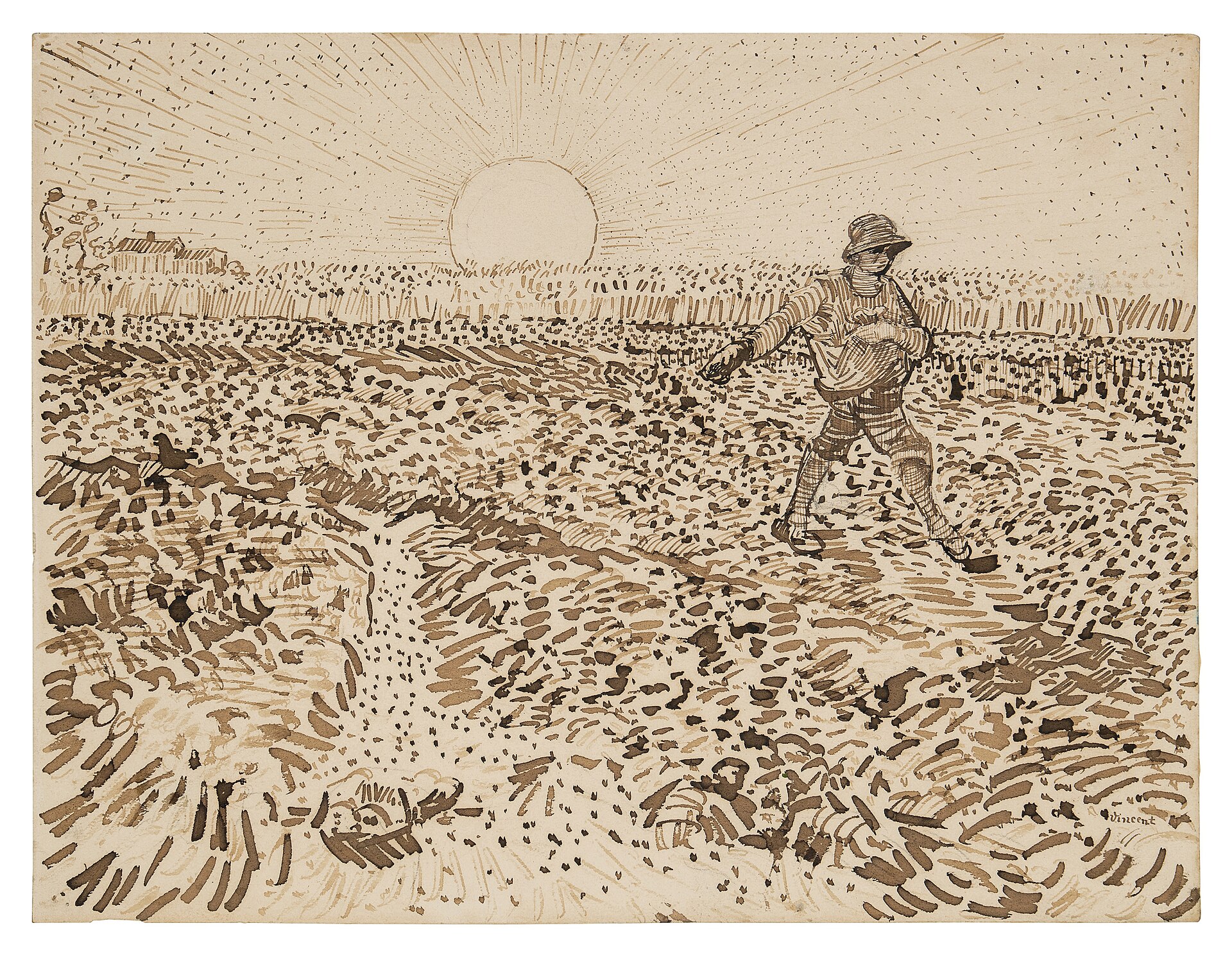
Sower with Setting Sun. Vincent van Gogh, mid July 1888. Sotheby's, New York, 18 November 2025, lot 4. Public domain.