
Psalm 47
9 verses · Hymn of praise
God reigns over the nations; God is seated on His holy throne.
Introduction
The sons of Korah, the Enthronement Song, Book 2: The Elohistic Psalter, Poetry, Psalms Overview.
The sons of Korah wrote this for a festival crowd at the temple in Jerusalem. It is a coronation song, with the ram's horn blowing and the people shouting as they did when a new king was crowned. Here the king is the LORD, and the whole world is told to join the celebration. Israel sang it as a small nation among great powers. Listen for the procession going up, and for the rulers of the nations gathered at the end beside the people of Abraham.
Context
- Who
- Israelites gathered at a national feast, with the surrounding nations addressed by name
- What
- An enthronement song that calls every nation to acclaim God as King over all the earth.
- Where
- The temple mount in Jerusalem during a feast, with horns sounding and a crowd shouting
- When
- The monarchy, at one of Israel's great feasts, with the date unstated.
- Why
- To celebrate the LORD's reign with the shouts and horns of a coronation.
Historical context
The heading gives the psalm to the sons of Korah, who sang at the sanctuary, and it stands between two other psalms of the same guild. No occasion and no date are stated, and the world it assumes is the monarchy, when Israel kept pilgrim feasts at the temple. What the psalm describes in verse 5 is a coronation. When a king was enthroned in Israel the people blew the ram's horn and shouted, and Solomon's crowning is reported as making so much noise that the ground rang with it. The people clapped and called out for the king when Joash was crowned in the temple courts, so a first hearer understood the command of verse 1 as the crowd's own part in an enthronement. A shield stood for a ruler and his armed power, so verse 9 pictures the chiefs of the world assembling to be counted among Abraham's people.
Significance
Israel sang this as a small kingdom among large ones, and told every nation on earth to clap for a King enthroned on a hill in Judah. Verse 4 kept the claim on the ground. He chooses our inheritance for us, and the land they were standing on was the evidence.
This chapter in Jewish lifeWhat this chapter is in Jewish life and reading.
What is done
This is the psalm of the shofar in this range, and the corpus shows where its use is settled. The line about God going up with the sound of the horn is tied to the tractate that governs the New Year at Rosh Hashanah 32b:9 and at Jerusalem Talmud Rosh Hashanah 4:7:3, and the line about clapping hands is tied to the liturgical tractate at Tractate Soferim 19:2. The corpus carries each as a locator, so the ruling itself stands at its reference. Rashi writes the sounding into his comment on the fifth line, where the trumpet blast and the sound of the shofar go up before God over the offerings:
He shall choose...for us and restore us to its midst. Then He will be exalted with the trumpet blast and the sound of the shofar that we will sound before Him over the burnt offerings and the peace offerings, and we will say, “Sing to God, etc.” (Rashi on Psalms 47:5:1)
How it is read
This chapter is one of the few in the range where the corpus carries an English text of more than one commentator. Rashi reads the clapping of the second line as a crowd gathering its voice:
clap hands Join together with one another to shout to God with a voice of praise. (Rashi on Psalms 47:2:1)
He reads the nations under Israel's feet as a ransom paid in their stead, citing Isaiah 43:3, at Rashi on Psalms 47:4:1, and the volunteers of the tenth line as those who gave themselves to be killed for the holiness of the name, at Rashi on Psalms 47:10:1. Of Abraham he says that he was the first of them, and the first of the proselytes, at Rashi on Psalms 47:10:2. Ibn Ezra takes the going up of the sixth line two ways, and the second is about the nations:
And some say the meaning: that God will set the peoples below us, and at that time we shall shout over them with trumpets and the sound of the shofar, God will be gone up from us [יעלה ממנו], and so He is called Elyon [עליון]. (Ibn Ezra on Psalms 47:6:1)
Malbim, writing much later, reads the same going up as a change in how God deals with the world, at Malbim on Psalms 47:6:1, and he explains it by the two names God rules under:
For the habit of God at this time will be sometimes by means of the name Elohim, which is at the times that He rules by the habits of nature. (Malbim on Psalms 47:6:1)
That is where a Christian reader sees the two traditions run close. Both hold that the nations will one day acknowledge the God of Israel, and they part over who gathers them. Ibn Ezra also stands at Ibn Ezra on Psalms 47:1:1, 47:2:1, 47:3:1, 47:4:1, 47:5:1, 47:7:1 and 47:8:1, Radak at Radak on Psalms 47:1:1, 47:2:1, 47:3:1, 47:4:1 and 47:7:1, Metzudat David at Metzudat David on Psalms 47:3:1 and 47:8:1 and Malbim at Malbim on Psalms 47:1:1, and Sefaria holds no English version of those references, so this card cites them without quotation.
What the rabbis say
The corpus records 40 places where the rabbinic literature takes up a line of this psalm, 32 of them in the Midrash. The Midrash on the Psalms treats it at Midrash Tehillim 18:3, 2:14, 47:1, 66:1, 44:1, 30:5, 47:2 and 67:1, and it weighs on this chapter more than on most, with eight of its passages hanging on the psalm's first five lines. Midrash Tanchuma takes it up at Midrash Tanchuma, Vayechi 8:5 and Vayikra 7:1 and Bamidbar Rabbah at Bamidbar Rabbah 12:11 and 15:13. The Talmud takes up lines of the psalm at Taanit 24b:9, Tractate Soferim 19:2, Makkot 11a:2, Shabbat 63a:19, Jerusalem Talmud Rosh Hashanah 4:7:3, Rosh Hashanah 32b:9, Jerusalem Talmud Berakhot 9:1:12 and Chagigah 3a:13.
Sources: Rashi, Rashi on Psalms, in The Judaica Press complete Tanach with Rashi, translated by A. J. Rosenberg, under a CC-BY licence; Ibn Ezra, Ibn Ezra on Psalms 47:6:1, quoted under the licence the corpus records for it; Malbim, Malbim on Psalms 47:6:1, quoted under the licence the corpus records for it; Radak, Radak on Psalms, cited at Radak on Psalms 47:1:1, 47:2:1, 47:3:1, 47:4:1 and 47:7:1; Metzudat David, Metzudat David on Psalms, cited at Metzudat David on Psalms 47:3:1 and 47:8:1; The Talmud, cited at Taanit 24b:9, Tractate Soferim 19:2, Makkot 11a:2, Shabbat 63a:19, Jerusalem Talmud Rosh Hashanah 4:7:3, Rosh Hashanah 32b:9, Jerusalem Talmud Berakhot 9:1:12 and Chagigah 3a:13; Tractate Soferim, Tractate Soferim 19:2, cited as the corpus records it; MannaFest, the Sefaria corpus at scripts/data/sources/sefaria/psalms/47.json, fetched 2026-09-19, 2026.
Psalms 47:1-2
Clap your hands, all you peoples: puts the call to every nation on earth. The reason comes at once: He is the LORD Most High, and the great King over all the earth. The shout is a voice of triumph.
Psalms 47:1
“O clap your hands. The most natural and most enthusiastic tokens of exultation are to be used in view of the victories of the Lord, and his universal reign. Our joy in God may be demonstrative, and yet he will not censure it. All ye people. The joy is to extend to all nations; Israel may lead the van, but all the Gentiles are to follow in the march of triumph, for they have an equal share in that kingdom where there is neither Greek nor Jew, but Christ is all and in all.”
Charles Spurgeon · The Treasury of David, Vol. 2 (1870)Particular Baptist
1 more voice on this verseWhat preachers and commentators have said about this verse, in their own words.
Psalms 47:1
“O clap your hands, all ye people, Meaning the Gentiles more especially; see Psa 117:1 compared with Rom 15:9; who had reason to rejoice and be glad, since the ascended Lord and King here spoken of was given to be their Saviour, was the propitiation for their sins, and had given himself a ransom price for them; and now the Gospel was preached among them, by an order from him after his resurrection; and upon his ascension gifts were bestowed on his apostles, qualifying them for it; when many of them were converted by it, and were made partakers of…”
How awesome is the LORD: Barnes read the Hebrew behind awesome as the word for the reverence given to God in worship. Spurgeon held that the power of the LORD Most High, which crushes His enemies, protects His people. Calvin applied the great King to Christ.
Psalms 47:2
“For the Lord most high is terrible,.... Christ is not only the Son of the Highest, but he himself is the most high God, God over all, blessed for ever. He is higher than the highest, than the angels in heaven, or any of the sons of men on earth. He is the high and lofty One, that dwells in the high and lofty place. And even this character agrees with him as the ascended Lord and King in his human nature; he is ascended on high, is set down on the right hand of the Majesty on high.”
3 more voices on this verse
Psalms 47:2
“He became manifest in the events themselves, by which he routed those harassing the godly and proved superior to their scheme, fearsome to the enemy and, in short, king like no other on earth, since he is also Lord of all.”
Diodorus of Tarsus · written before 390 · Commentary on Psalm 47patristic
Psalms 47:2
“We may, however, easily gather from the connection of the words the truth of what I have suggested, that when God is called a terrible and great King over all the earth, this prophecy applies to the kingdom of Christ.”
John Calvin · Commentaries (1554)reformed
Psalms 47:2
“For the Lord, or Jehovah, the self existent and only God; Most high, most great in power, lofty in dominion, eminent in wisdom, elevated in glory. Is terrible, none can resist his power or stand before his vengeance; yet as these terrors are wielded on the behalf of his subjects, they are fit reasons for rejoicing. Omnipotence, which is terrible to crush, is almighty to protect.”
Charles Spurgeon · The Treasury of David, Vol. 2 (1870)Particular Baptist
Psalms 47:3-4
He subdues nations beneath us: puts the conquest in God's own hands. What He chooses is an inheritance, the pride of Jacob, whom He loves, and Henry read the land as the gift of that choosing love. Selah closes the stanza.
Psalms 47:3
“But this looks forward to the kingdom of the Messiah, which was to be set over all the earth, and not confined to the Jewish nation. Jesus Christ shall subdue the Gentiles; he shall bring them in as sheep into the fold (so the word signifies), not for slaughter, but for preservation.”
Matthew Henry · Commentary on the Whole Bible (1707-1721)puritan
1 more voice on this verse
Psalms 47:3
“He, with whom is infinite power, shall subdue the people under us. The battle is not ours but the Lord's. He will take his own time, but he will certainly achieve victory for his church. Truth and righteousness shall through grace climb to the ascendant. We wage no doubtful warfare. Hearts the most rebellious, and wills the most stubborn, shall submit to all conquering grace.”
Charles Spurgeon · The Treasury of David, Vol. 2 (1870)Particular Baptist
the pride of Jacob: Barnes noted that the Septuagint gives the pride of Jacob as his beauty. Augustine read whom He loves through the choice of Jacob over Esau in Genesis 25:23. Spurgeon would leave God to choose his whole inheritance.
Psalms 47:4
“While as yet we see not all things put under him, we are glad to put ourselves and our fortunes at his disposal. He shall choose our inheritance for us. We feel his reign to be so gracious that we even now ask to be in the fullest degree the subjects of it. We submit our will, our choice, our desire, wholly to him. Our heritage here and hereafter we leave to him, let him do with us as seemeth him good. The excellency of Jacob whom he loved.”
Charles Spurgeon · The Treasury of David, Vol. 2 (1870)Particular Baptist
2 more voices on this verse
Psalms 47:4
“Inheritance - The presence and worship, and blessing of God. This God had chosen for the Israelites and resolved to chuse or set apart for the Gentiles. Of Jacob - Of the people of Jacob or Israel, who are frequently called Jacob, for these did actually enjoy the presence of God in his sanctuary.”
John Wesley · Explanatory Notes upon the Old Testament (1765)evangelical
Psalms 47:4
“But what does it profit me, if the seed of Abraham, "which is Christ," should possess "the cities of his enemies for an inheritance" and should not possess my city? If in my city, that is, in my soul, which is "the city of the great king," neither his laws nor his ordinances should be observed?”
Origen of Alexandria · written before 253 · Homilies on Psalms 9:3patristic
Psalms 47:5-6
God has ascended amid shouts: , and the sound of the horn goes up with Him. The older writers read it two ways, the ark carried up to Zion in procession, and the ascension of Christ. Sing praises stands four times in verse 6.
Psalms 47:5
“God is gone up with a shout. Faith hears the people already shouting. The command of the first verse is here regarded as a fact. The fight is over, the conqueror ascends to his triumphant chariot, and rides up to the gates of the city which is made resplendent with the joy of his return. The words are fully applicable to the ascension of the Redeemer. We doubt not that angels and glorified spirits welcomed him with acclamations. He came not without song, shall we imagine that he returned in silence? The Lord with the sound of a trumpet.”
Charles Spurgeon · The Treasury of David, Vol. 2 (1870)Particular Baptist
3 more voices on this verse
Psalms 47:5
“He went up as a Mediator, typified by the ark and the mercy-seat over it, and was brought as the ark was into the most holy place, into heaven itself; see Heb. ix. We read not of a shout, or of the sound of a trumpet, at the ascension of Christ, but they were the inhabitants of the upper world, those sons of God, that then shouted for joy, Job xxxviii.”
Matthew Henry · Commentary on the Whole Bible (1707-1721)puritan
Psalms 47:5
For on account of this very lifting up of our flesh, blessed Job figuratively calls the Lord a bird. For since he saw that Judea would not understand the mystery of His Ascension, he pronounced sentence on their unbelief, saying, "The bird knew not the path." For the Lord was rightly called a bird, because He raised His fleshly body to the heavens. Whoever did not believe that He ascended to heaven did not know the path of this bird. Concerning this solemnity it is said through the Psalmist, "Your magnificence is exalted above the heavens."
Gregory the Dialogist · written before 604 · Forty Gospel Homilies, Homily 29patristic
Psalms 47:5
“God - This is meant literally of the ark: but mystically of Christ's ascension into heaven, as may be gathered by comparing this with Eph. iv, 8, where the like words uttered concerning the ark upon the same occasion, chap. lxviii, 18, are directly applied to Christ's ascension.”
John Wesley · Explanatory Notes upon the Old Testament (1765)evangelical
Sing praises to God: The call to sing praises follows God's ascent amid shouts and the sound of the horn. Barnes heard in the repetition a heart full of joy, and Clarke found in it the earnestness and happiness of the people. Henry welcomed the repetition when it is sung with new affection.
Psalms 47:7-9
God is King of all the earth: is the psalm's own summary, and verse 8 seats Him on His holy throne over the nations. The nobles of the nations assemble as Abraham's own people. The shields of the earth belong to Him, and He is highly exalted.
Psalms 47:7
“For God is the King of all the earth. The Jews of our Saviour's time resented this truth, but had their hearts been right they would have rejoiced in it. They would have kept their God to themselves, and not even have allowed the Gentile dogs to eat the crumbs from under his table. Alas! how selfishness turns honey into wormwood. Jehovah is not the God of the Jews only, all the nations of the earth are, through the Messiah, yet to own him Lord. Meanwhile his providential throne governs all events beneath the sky. Sing praises with understanding.”
Charles Spurgeon · The Treasury of David, Vol. 2 (1870)Particular Baptist
2 more voices on this verse
Psalms 47:7
“The king - Not only ours, but of all the nations of the world. Sing - Not formally and carelessly, but seriously, considering the greatness of this king whom you praise, and what abundant cause you have to praise him.”
John Wesley · Explanatory Notes upon the Old Testament (1765)evangelical
Psalms 47:7
“Of the kingdom of the Messiah. Jesus Christ, who is God, and whose throne is for ever and ever reigns over the heathen; not only he is entrusted with the administration of the providential kingdom, but he shall set up the kingdom of his grace in the Gentile world, and rule in the hearts of multitudes that were bred up in heathenism, Eph. ii.”
Matthew Henry · Commentary on the Whole Bible (1707-1721)puritan
God reigns over the nations: Augustine noted that God once was King over one nation, and he heard a promise here of His reign over all the nations. Barnes took the holy throne as a government set in justice. Spurgeon called His rule over the idol worshippers of the earth a secret one.
Psalms 47:8
“The throne - Heaven is often called God's throne, whence God is said to behold and to rule all nations; of which general dominion of God, he here speaks. And Christ sits at his father's right-hand, for that purpose.”
John Wesley · Explanatory Notes upon the Old Testament (1765)evangelical
1 more voice on this verse
Psalms 47:8
“Now at this moment, over the most debased idolaters, God holds a secret rule; here is work for faith. How we ought to long for the day when this truth shall be changed in its aspect, and the rule now unrecognised shall be delighted in! The great truth that God reigneth in providence is the guarantee that in a gracious gospel sense his promises shall be fulfilled, and his kingdom shall come. He sitteth upon the throne of his holiness. Unmoved he occupies an undisputed throne, whose decrees, acts, and commands are holiness itself. What other throne is like this?”
Charles Spurgeon · The Treasury of David, Vol. 2 (1870)Particular Baptist
the shields of the earth: Wesley took the shields of the earth as rulers, as at Hosea 4:18, who belong to God. Barnes traced the Hebrew for nobles from willing to noble birth. Henry saw the nations join the people of the God of Abraham, as Abraham was promised to be father of many nations.
Psalms 47:9
“It may be applied to the calling of the Gentiles into the church of Christ, and taken as a prophecy that in the days of the Messiah the kings of the earth and their people should join themselves to the church, and bring their glory and power into the New Jerusalem, that they should all become the people of the God of Abraham, to whom it was promised that he should be the father of many nations.”
Matthew Henry · Commentary on the Whole Bible (1707-1721)puritan
2 more voices on this verse
Psalms 47:9
“The princes of the people are gathered together. The prophetic eye of the psalmist sees the willing subjects of the great King assembled to celebrate his glory. Not only the poor and the men of low estate are there, but nobles bow their willing necks to his sway. "All kings shall bow down before him." No people shall be unrepresented; their great men shall be good men, their royal ones regenerate ones. How august will be the parliament where the Lord Jesus shall open the court, and princes shall rise up to do him honour!”
Charles Spurgeon · The Treasury of David, Vol. 2 (1870)Particular Baptist
Psalms 47:9
“The Shields - The princes or rulers, who are called shields, Hosea iv, 18, because by their office they are the common prosecutors of all their people. These are the Lord's, at his disposal, or subject to his dominion, both as to their hearts and kingdoms.”
John Wesley · Explanatory Notes upon the Old Testament (1765)evangelical
How this psalm is built
The form: An enthronement song, sung as a coronation is sung, with the shout and the horn, as Spurgeon classes it.
The patterns in this chapter
| Device | What it does | Where to see it |
|---|---|---|
| The call to the nations | The psalm opens by speaking to all the peoples rather than to Israel, and tells them to clap their hands and shout with a voice of triumph. Augustine takes the address at its word, since the people of the Jews were not all the nations, and reads the psalm as spoken to the Gentiles who would come in.Augustine of Hippo, Exposition on Psalm 47, c. 430. | Psalm 47:1, Psalm 47:9 |
| Sing praises, four times over | Verse 6 says sing praises four times in one verse, twice to God and twice to our King, and verse 7 adds the reason and the manner. The site's exposition note for verses 5 and 6 records the count, and the repetition is the psalm's way of carrying the shout of verse 5 into the singing.Charles Spurgeon, The Treasury of David, Vol. 2, 1870, on Psalm 47:6. | Psalm 47:6, Psalm 47:7 |
| King, said of the same God five times | The psalm states the kingship in stages rather than once. Verse 2 has the great King over all the earth, verse 6 has our King, verse 7 has God as King of all the earth. Verse 8 has Him reigning over the nations and seated on His holy throne, and verse 9 has the nobles of the nations assembled under Him. Henry takes verse 7 as the psalm's own summary of itself.Matthew Henry, Commentary on the Whole Bible, 1710, on Psalm 47:7. | Psalm 47:2, Psalm 47:6, Psalm 47:7, Psalm 47:8, Psalm 47:9 |
The psalm's argument runs from the particular to the whole world and back. God subdues nations beneath us in verse 3 and chooses our inheritance in verse 4, which is Israel's own history. By verse 7 the same God is King of all the earth, and by verse 9 the nobles of the nations have assembled as the people of the God of Abraham.
6 more paragraphs on the patterns
The New Testament's use
The psalm is not quoted directly in the New Testament, and its fifth verse stands very close to the language that is. Wesley reads verse 5 with Ephesians 4:8 and Psalm 68:18, where a line about the ark going up is applied to Christ's ascension. Clarke records that verse 5 is generally understood as a prophecy of the ascension while its first sense is the lifting of the ark. Henry follows the same road and notes that no shout or trumpet is recorded at the ascension itself, so the shouting belongs to the upper world. Calvin holds that the title of great King over all the earth makes the whole psalm a prophecy of the kingdom of Christ.
The debate
How much of verse 5 is about the ark and how much about the ascension is the psalm's open question, and the commentators divide on it. Clarke and Wesley give the ark the first sense and the ascension the second. Calvin reads the psalm as a prophecy of Christ's kingdom throughout. The text says only that God has ascended amid shouts, and the site keeps both readings.
Where it stands
Inside the Psalter the psalm is the middle of the Korahite group. Psalm 46 ends with God exalted among the nations, Psalm 47 has the nations clapping, and Psalm 48 has their kings assembling at the city and fleeing from it. Henry reads verse 9 as a prophecy of the calling of the Gentiles, and Wesley reads the shields of the same verse as the princes and rulers, taking Hosea 4:18 for the usage.
Keep studying
Studies2
Sources for this chapter
The summary
Jamieson, Fausset & Brown, Commentary Critical and Explanatory; John Calvin, Commentaries; John Wesley, Notes on the Old Testament and Matthew Henry, Complete Commentary.
The form and classifications
Charles Spurgeon, The Treasury of David, Vol. 2, 1870, on Psalm 47:5.
The exposition
Adam Clarke, Commentary on the Bible; Albert Barnes; Augustine of Hippo, Exposition on Psalm 47; Charles Spurgeon, The Treasury of David; Franz Delitzsch, Biblical Commentary on the Psalms; John Calvin, Commentaries; John Gill, Exposition of the Old Testament; John Wesley, Explanatory Notes upon the Old Testament and Matthew Henry, Commentary on the Whole Bible.
The painting
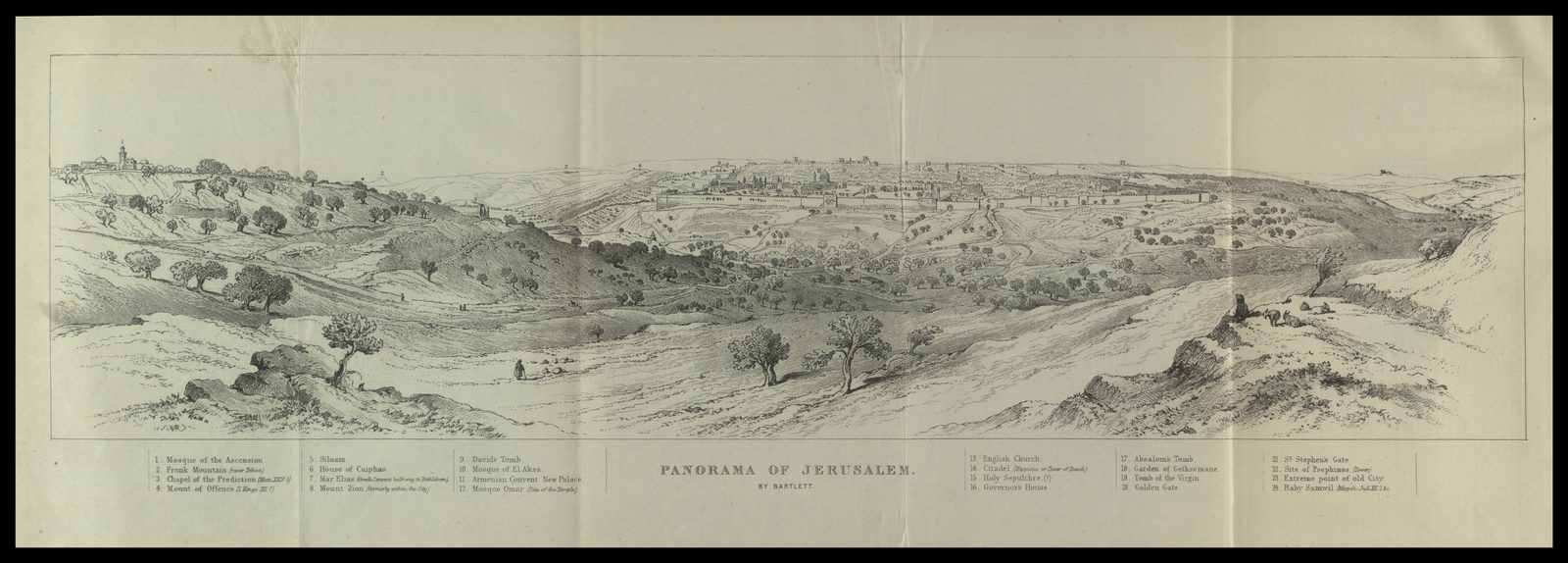
Panorama of Jerusalem. William Henry Bartlett, not stated on the file page. Wikimedia Commons. Public domain.