
Psalm 3
8 verses · Psalm of lament
I lie down and sleep; I wake again, for the LORD sustains me.
Introduction
David, the King in Flight, Book 1: The book of David, Poetry, Psalms Overview.
David wrote this as a king driven out of his own capital by his own son. It is the first psalm in the book with a heading, and the heading ties it to a day in 2 Samuel 15 that any Israelite could retell. It is a prayer said by a man who has lost the city, the army and his good name at once. Listen for the count he makes of the danger, and then for the ordinary thing he does between two mornings. It teaches a hunted person how to rest.
Context
- Who
- Israelites who knew the story of a king driven out of his own capital by his own son
- Where
- The flight east out of Jerusalem, down the Kidron ravine and up the Mount of Olives toward the wilderness
- When
- The reign of David, during Absalom's rebellion. c. 975 BC, on the superscription, which Young's Literal Translation renders A Psalm of David, in his fleeing from the face of Absalom his son
Historical context
David was the reigning king when he wrote this, and he wrote it as a fugitive. His son Absalom had spent years at the city gate taking the loyalty of the nation a case at a time. When the revolt broke, David left Jerusalem on foot rather than have the city fought over. The road out ran down into the Kidron ravine and up the Mount of Olives. In 2 Samuel 15 the king climbs it weeping, barefoot and with his head covered, which was the public posture of mourning. A king's fortunes were taken for his god's verdict on him, so the taunt of verse 2 was political reading as much as cruelty. A fugitive party in open country slept in shifts with sentries posted, and a hunted man stays awake, which is why the sleep of verse 5 stands out.
Significance
Sung in Israel's worship long after Absalom was dead, the psalm gave every outnumbered believer a script. It counts the enemy honestly in myriads and answers the count with a shield rather than with a better count. It also kept in the songbook something a court could have buried, that the king said out loud he was beaten in the field and slept anyway.
This chapter in Jewish lifeWhat this chapter is in Jewish life and reading.
How it is read
The heading of this psalm names the flight from Absalom, and the commentators take it at its word. Radak is quoted here from the Finch translation of 1919, which is public domain. He reports that the rabbis set the psalm on the ascent of the Mount of Olives, where the record says David wept as he went up (Radak on Psalms 3:1:1). He then puts the question the rabbis put: "If weeping, why singing, and if singing, why weeping?" The answer he carries is a father's relief. When Nathan told David that evil would rise out of his own house, David feared a slave or a man of illicit birth, "who has no pity on me". When he saw that it was his son, he thought that his son would surely have pity, and he said, a Psalm. Rashi carries the same tradition in almost the same words (Rashi on Psalms 3:1:1, the Judaica Press Tanach with Rashi).
Radak then records a second saying that a Christian reader will find striking. David set himself beside two earlier fugitives, Jacob and Moses, and said, "I am a fugitive as they were". The conclusion Radak reports is that "exile atoneth for iniquity", so that David's flight carried away the guilt he had feared to die for. Radak names the Talmudic places for it, and the corpus holds the flight tradition's locator at Berakhot 7b:11 and 10a:8 under this psalm. He adds a rule about the book itself. The psalms were not named at the time of the event, "but because they were sung in the Sanctuary", and the psalms about the exile became psalms on the return of the exiles.
Ibn Ezra reads the chapter as prophecy rather than report. He is quoted here from the Sefaria Community Translation. David "prophesied he would be victorious" before the answer came from the holy mountain (Ibn Ezra on Psalms 3:1:1). He also uses this psalm to break the assumption that the book runs in time order. The prayer from the cave stands in the fifth book although the event came before Absalom, so he warns the reader against forcing a chain. On the second verse he divides the rebellion into three groups. They are the foes of Benjamin, the attackers who were David's son and his kinsmen, and the party that said he had fallen (Ibn Ezra on Psalms 3:2:1). Radak adds that the repetition of the verse is justified because David's own son and his sister's son were among them (Radak on Psalms 3:2:1). Rashi reads the greatness of the adversaries as a list, "great in Torah, great in wisdom, great in wealth, tall in stature", and names Saul, Doeg and Ahitophel (Rashi on Psalms 3:2:1).
The sharpest line in the chapter is Rashi's gloss on the taunt of the third verse. The mockers say there is no salvation for David in God, and Rashi gives their reason in five words: "Because he was intimate with a married woman" (Rashi on Psalms 3:3:2). The sin with Bathsheba is what the enemy is holding up, and the psalm answers it by calling God a shield. Ibn Ezra takes that shield to mean that David "did not enter into battle" at all, and reads the fifth verse as prayer in the place of fighting (Ibn Ezra on Psalms 3:4:2 and 3:5:1). He explains the holy mountain by the Ark that David had brought to Zion, and notes that this stands before the purchase from Araunah (Ibn Ezra on Psalms 3:5:2). Rashi reads the sleeping of the sixth verse as exhaustion rather than peace: "My heart was clogged from worry and fear" (Rashi on Psalms 3:6:1). The waking is trust, "because I trusted that the Lord would support me" (Rashi on Psalms 3:6:2).
At the eighth verse Rashi records two readings of the blow on the cheek. The plain one is a disgraceful blow, and the midrashic one he reports is a sickness of the mouth, which he ties to the death of Ahithophel (Rashi on Psalms 3:8:1). The psalm ends with a mutual obligation in Rashi's hands. "It is incumbent upon Him to save His servants and His people, and it is incumbent upon His people to bless Him and thank Him forever" (Rashi on Psalms 3:9:1). Radak reads the ninth verse as the vow of a man already sure of the outcome, that "without Him man shall not be saved" (Radak on Psalms 3:9:1).
What the rabbis say
The corpus carries forty locators on this psalm and the text of none, so each is cited and linked here rather than quoted. The Talmudic ones are few. They stand at Berakhot 7b:11 and 10a:8 on the heading, and at Berakhot 54b:5 on the eighth verse. Three more stand in the Jerusalem Talmud, at Eruvin 10:11:6 and Shabbat 6:2:16 on the second verse, and Sanhedrin 10:2:20 on the fourth.
The midrashic locators are many, and Midrash Tehillim carries the largest share. It is anchored on the second verse at 3:4, on the fifth at 3:6 and 11:4, on the sixth at 3:7 and 55:1, and on the seventh at 3:8 and 4:16. Four entries of Midrash Tanchuma on Ki Tisa stand on the third and fourth verses, at 4:1, 4:2 and 4:3, with Midrash Tanchuma Buber, Ki Tisa 3:1 and Pekudei 2:8 beside them. On the fifth verse the corpus carries Shemot Rabbah 2:2, Pirkei DeRabbi Eliezer 12:6, Midrash Tanchuma Buber, Shemot 10:1 and Midrash Sekhel Tov on Genesis 33:20:2. On the eighth verse it carries Bereshit Rabbah 75:1 and Bamidbar Rabbah 3:4, with three entries of Ein Yaakov in the Glick Edition at Berakhot 9:1, Megillah 1:33 and Sotah 1:42. On the ninth it carries Shemot Rabbah 30:24, Bamidbar Rabbah 19:33, Sifrei Bamidbar 117:1 and Midrash Lekach Tov on Exodus 14:30:1. What each of them teaches is a saying of the rabbis, and is reported as theirs wherever this site quotes one. The quotations wait on a fetch that carries the text.
Sources: Rashi, Rashi on Psalms 3:1:1 to 3:9:1, the Judaica Press complete Tanach with Rashi, translated by A. J. Rosenberg; Ibn Ezra, Ibn Ezra on Psalms 3:1:1 to 3:7:1, the Sefaria Community Translation; Radak, Radak on Psalms 3:1:1 to 3:9:1, R. David Kimhi on the first book of Psalms, translated by R. G. Finch, London, 1919; The Sefaria corpus, scripts/data/sources/sefaria/psalms/3.json, the 6 Talmud and 34 Midrash locators of this chapter.
Psalms 3:1-2
how my foes have increased!: The foes have increased, and the many say of the man who prays that God will not deliver him. Spurgeon read that taunt as the bitterest drop of David's distress, aimed at his hope in God. Selah closes the taunt.
Psalms 3:1
“Lord, how are they increased that trouble me?.... David's enemies increased in the conspiracy against him, 2Sa 15:12; the hearts of the men of Israel were after Absalom, and against him. Christ's enemies increased when Judas with a multitude came to take him; when the body of the common people cried out, Crucify him; when the assembly of the wicked enclosed him, and pierced his hands and his feet.”
1 more voice on this verseWhat preachers and commentators have said about this verse, in their own words.
Psalms 3:1
“The poor broken-hearted father complains of the multitude of his enemies: and if you turn to 2 Samuel 15:12, you will find it written that "the conspiracy was strong; for the people increased continually with Absalom, " while the troops of David constantly diminished! "Lord how are they increased that trouble me!" Here is a note of exclamation to express the wonder of woe which amazed and perplexed the fugitive father. Alas! I see no limit to my misery, for my troubles are enlarged! There was enough at first to sink me very low; but lo! my enemies multiply.”
Charles Spurgeon · The Treasury of David, Vol. 1 (1869)Particular Baptist
Deliver renders yeshuah, the Hebrew noun for salvation. Albert Barnes gave that sense, and the same word returns in verse 8, where salvation belongs to the LORD. The last verse answers the many who say God will not deliver him.
Psalms 3:2
“Many there be which say of my soul,.... Or "to my soul" (u), the following cutting words, which touched to the quick, reached his very heart, and like a sword pierced through it: there is no help for him in God; or "no salvation" (w): neither in this world, nor in that which is to come, as Kimchi explains it. David's enemies looked upon his case to be desperate; that it was impossible he should ever extricate himself from it; yea, that God himself either could not or would not save him.”
3 more voices on this verse
Psalms 3:2
“David complains before his loving God of the worst weapon of his enemies' attacks, and the bitterest drop of his distresses. "Oh!" saith David, "many there be that say of my soul, There is no help for him in God." Some of his distrustful friends said this sorrowfully, but his enemies exultingly boasted of it, and longed to see their words proved by his total destruction. This was the unkindest cut of all, when they declared that his God had forsaken him.”
Charles Spurgeon · The Treasury of David, Vol. 1 (1869)Particular Baptist
Psalms 3:2
“No help for him in God - These were some of the reproaches of his enemies, Shimei and others: “He is now down, and he shall never be able to rise. God alone can save him from these his enemies; but God has visibly east him off.” These reproaches deeply affected his heart; and he mentions them with that note which so frequently occurs in the Psalms, and which occurs here for the first time, סלה selah. Much has been said on the meaning of this word; and we have nothing but conjecture to guide us.”
Adam Clarke · Commentary on the Bible (1810-1826)evangelical
Psalms 3:2
“Selah - This word is no where used but in this poetical book, and in the song of Habakkuk. Probably it was a musical note, directing the singer either to lift up his voice, to make a pause, or to lengthen the tune. But withal, it is generally placed at some remarkable passage; which gives occasion to think that it served also to quicken the attention of the singer and hearer.”
John Wesley · Explanatory Notes upon the Old Testament (1765)evangelical
Psalms 3:3-4
a shield around me: The LORD is a shield around him, his glory, and the One who lifts his head. The answer to his cry comes from the holy mountain, which Matthew Henry read as Zion, where the ark of the covenant stood. The answer meets the taunt of verse 2.
Psalms 3:3
Here David avows his confidence in God. "Thou, O Lord, art a shield for me." The word in the original signifies more than a shield; it means a buckler round about, a protection which shall surround a man entirely, a shield above, beneath, around, without and within. Oh! what a shield is God for his people! He wards off the fiery darts of Satan from beneath, and the storms of trials from above, while, at the same instant, he speaks peace to the tempest within the breast. Thou art "my glory."
Charles Spurgeon · The Treasury of David, Vol. 1 (1869)Particular Baptist
3 more voices on this verse
Psalms 3:3
“Certainly, people place their glory in various places, some in their country, some in family line, some in beauty, some in the strength of their bodies and in their skill of competing in the contest, being very elated they have overcome these people or those by their physical struggling. And why is it necessary to recount all the things through which those unknown gods are glorified, "whose glory is in their shame," as the apostle said?”
Origen of Alexandria · written before 253 · Selections from the Psalms 3:4patristic
Psalms 3:3
“The ark of the covenant was in Mount Zion, and all the answers to our prayers come from the promises of that covenant. Christ was set King upon the holy hill of Zion ( Ps. ii. 6 ), and it is through him, whom the Father hears always, that our prayers are heard.”
Matthew Henry · Commentary on the Whole Bible (1707-1721)puritan
Psalms 3:3
“But--literally, "and" (Ps 2:6). He repels the reproach by avowing his continued trust. shield--a favorite and often-used figure for protection. my glory--its source. lifter up of mine head--one who raises me from despondency.”
Jamieson, Fausset & Brown · Commentary Critical and Explanatory on the Whole Bible (1871)reformed
To the LORD I cry aloud: In Hebrew the cry is made with the voice, a prayer spoken aloud. David had sent the ark back to Jerusalem when he fled, at 2 Samuel 15:25. The LORD still answers from that holy mountain.
Psalms 3:4
“The preceding psalm calls to mind this mountain when it says, "I have installed my king on mount Zion, my holy mountain." Christ was the one he was speaking of, and now David bears witness that he must be heard plainly by Christ from his holy mountain. Further, he says who is going to hear him except the Lord who has been installed as king upon Zion his holy mountain? Through this statement he [David], now alone, believed that he would be forgiven, that his glory would return and that his head would be lifted up.”
Eusebius of Caesarea · written before 339 · Commentary on Psalms 3:5patristic
2 more voices on this verse
Psalms 3:4
"I cried unto the Lord with my voice." Why doth he say, "with my voice?" Surely, silent prayers are heard. Yes, but good men often find that, even in secret, they pray better aloud than they do when they utter no vocal sound. Perhaps, moreover, David would think thus:—"My cruel enemies clamour against me; they lift up their voices, and, behold, I lift up mine, and my cry outsoars them all.
Charles Spurgeon · The Treasury of David, Vol. 1 (1869)Particular Baptist
Psalms 3:4
“I cried unto the Lord with my voice,.... The experience which the psalmist had of being heard in prayer, was what gave great encouragement to his faith, as to his interest in God and salvation by him, when his enemies were so increased about him; for crying here is to be understood of prayer, as it is often used in this book of Psalms: and so the Targum renders it, "I prayed"; and this designs vocal prayer.”
Psalms 3:5-6
I lie down and sleep: He lies down, he sleeps, he wakes, and the LORD sustains him. Spurgeon marked what that takes, a man surrounded by foes able to lie down and sleep. Verse 6 names the myriads on every side after the sleep.
Psalms 3:5
“As in the previous psalm so here the future is prophesied.… "I lie down, and I sleep" is spoken prophetically, namely, I will lie down, I will sleep, I will rise up, because you, Oh Lord, are my sustainer, my glory and the lifter of my head.… For "sleep" indicates death, concerning which the future is prophesied for us.”
Eusebius of Caesarea · written before 339 · Commentary on Psalms 3:6patristic
2 more voices on this verse
Psalms 3:5
“David's faith enabled him to lie down; anxiety would certainly have kept him on tiptoe, watching for an enemy. Yea, he was able to sleep, to sleep in the midst of trouble, surrounded by foes. "So he giveth his beloved sleep." There is a sleep of presumption; God deliver us from it! There is a sleep of holy confidence; God help us so to close our eyes! But David says he awaked also.”
Charles Spurgeon · The Treasury of David, Vol. 1 (1869)Particular Baptist
Psalms 3:5
“It is a great mercy when we are in trouble to have our minds stayed upon God, so as never either to eat or sleep with trembling and astonishment. (3.) Some of the ancients apply it to the resurrection of Christ.”
Matthew Henry · Commentary on the Whole Bible (1707-1721)puritan
I will not fear the myriads: Myriads translates a Hebrew word for ten thousands, from the same root as increased and many in verses 1 and 2. The count of enemies has grown. The fear has fallen away after the sleep of verse 5.
Psalms 3:6
“Buckling on his harness for the day's battle, our hero sings, "I will not be afraid of ten thousands of people, that have set themselves against me round about." Observe that he does not attempt to under- estimate the number or wisdom of his enemies. He reckons them at tens of thousands, and he views them as cunning huntsmen chasing him with cruel skill. Yet he trembles not, but looking his foeman in the face he is ready for the battle.”
Charles Spurgeon · The Treasury of David, Vol. 1 (1869)Particular Baptist
1 more voice on this verse
Psalms 3:6
“The verse clearly teaches that the one who comes to the greatest virtue, to very great security, comes on account of faith in God.… The Savior, recognizing that thousands of the people of the circumcision were going to demand that he be crucified and knowing his own spirit of fearlessness (I say these things speaking in terms of the flesh), is able to say even these words.”
Origen of Alexandria · written before 253 · Selections from the Psalms 3:7patristic
Psalms 3:7-8
all my enemies on the jaw: The psalm asks the LORD to arise and save, with the enemies struck on the jaw and the teeth of the wicked broken. A struck jaw silences the mouths that said God would not deliver him. Salvation belongs to the LORD.
Psalms 3:7
“Arise, O Lord--God is figuratively represented as asleep to denote His apparent indifference (Ps 7:6). The use of "cheekbone" and "teeth" represents his enemies as fierce, like wild beasts ready to devour (Ps 27:2), and smiting their cheekbone (1Ki 22:24) denotes violence and insult. thou hast broken--God took his part, utterly depriving the enemy of power to injure.”
Jamieson, Fausset & Brown · Commentary Critical and Explanatory on the Whole Bible (1871)reformed
3 more voices on this verse
Psalms 3:7
“Saul and the Philistines, who were sometimes ready to swallow him up, could not effect what they designed. The teeth that are gnashed or sharpened against God's people shall be broken. When, at any time, the power of the church's enemies seems threatening, it is good to remember how often God has broken it; and we are sure that his arm is not shortened.”
Matthew Henry · Commentary on the Whole Bible (1707-1721)puritan
Psalms 3:7
“When he foresees his deliverance after death, he has faith that he has been saved by grace and that kindness has been granted. He is certain that this faith of some in the resurrection of the Savior is able to come to him, and consequently he prays that the resurrection of the Lord be hastened so that through it he himself will experience salvation.… Now, he says, you have broken the teeth of sinners; that is, their conversations and blasphemous words hurled against me you have stripped away.”
Eusebius of Caesarea · written before 339 · Commentary on Psalms 3:8patristic
Psalms 3:7
“Arise, O Lord - This is a common mode of calling upon God in the Scriptures, as if he had been sitting still, or had been inactive. It is, of course, language taken from human conceptions, for in the intervals of active effort, in labor or in battle, we sit or lie down, and when we engage in toil we arise from our sitting or recumbent posture. So the mind accustoms itself to think of God. The idea is simply that David now calls upon God to interpose in his behalf and to deliver him.”
may Your blessing be on Your people: Jonah 2:9 closes his prayer with nearly the same words. The last line turns from the salvation of one man to a blessing on Your people. Many of them had followed Absalom at 2 Samuel 15:13, and the king still asks the LORD to bless them.
Psalms 3:8
“This verse contains the sum and substance of Calvinistic doctrine. Search Scripture through, and you must, if you read it with a candid mind, be persuaded that the doctrine of salvation by grace alone is the great doctrine of the word of God: "Salvation belongeth unto the Lord." This is a point concerning which we are daily fighting.”
Charles Spurgeon · The Treasury of David, Vol. 1 (1869)Particular Baptist
1 more voice on this verse
Psalms 3:8
“Two great truths he here builds his confidence upon and fetches comfort from. (1.) That salvation belongeth unto the Lord; he has power to save, be the danger ever so great; it is his prerogative to save, when all other helps and succours fail; it is his pleasure, it is his property, it is his promise to those that are his, whose salvation is not of themselves, but of the Lord.”
Matthew Henry · Commentary on the Whole Bible (1707-1721)puritan
How this psalm is built
The form: A morning psalm of trust, sung by a man surrounded and able to lie down, as Spurgeon classes it.
The patterns in this chapter
| Device | What it does | Where to see it |
|---|---|---|
| The superscription that dates the psalm | The psalm carries a heading, which Young's Literal Translation renders A Psalm of David, in his fleeing from the face of Absalom his son. Charles Spurgeon reads the first verse against 2 Samuel 15:12, where the conspiracy grew strong and the people with Absalom increased while David's troops fell away. John Gill takes the same verse as the moment the hearts of the men of Israel went after Absalom.Charles Spurgeon, The Treasury of David, Vol. 1, 1869, on Psalm 3:1. | Psalm 3:1 |
| Selah, three times | The word stands at the end of verse 2, verse 4 and verse 8, and it marks the three places where the psalm has just said something it wants a reader to stop on, the taunt, the answer from the holy mountain, and salvation belonging to the LORD. John Wesley takes it for a musical note directing the singer to lift the voice, to pause or to lengthen the tune, and observes that it is generally set at a matter worth remark.John Wesley, Explanatory Notes upon the Old Testament, 1765, on Psalm 3:2. | Psalm 3:2, Psalm 3:4, Psalm 3:8 |
| The taunt and its answer | Verse 2 reports what many say of him, that God will not deliver him, and verse 3 opens with But You, O LORD. Charles Spurgeon calls that taunt the bitterest drop of David's distress, since it strikes at his hope in God. Jamieson, Fausset and Brown read verse 3 as the repelling of the reproach by an avowal of trust, with the shield as the figure of protection and the LORD as the source of his glory.Charles Spurgeon, The Treasury of David, Vol. 1, 1869, on Psalm 3:2. | Psalm 3:2, Psalm 3:3 |
| Three things God is to him | Verse 3 names them in a row, a shield around him, his glory, and the One who lifts his head. Charles Spurgeon notes that the Hebrew word carries more than a shield, a buckler round about that covers a man above, beneath and on every side. The lifted head answers the covered head of a man who had gone up the Mount of Olives weeping.Charles Spurgeon, The Treasury of David, Vol. 1, 1869, on Psalm 3:3. | Psalm 3:3 |
The historical value
7 more paragraphs on the patterns
The psalm's background is told in 2 Samuel 15 to 17, and the two accounts fit at the joints. The conspiracy growing strong at 2 Samuel 15:12 stands behind verse 1, the counsel that David be struck while weary stands behind verse 6, and the ascent of the Mount of Olives with a covered head stands behind the lifted head of verse 3.
Where it sits in the Psalter
Inside the Psalter, Psalm 3 and Psalm 4 are read as a pair, the morning psalm and the evening psalm, since verse 5 lies down and wakes and Psalm 4:8 lies down and sleeps in peace. Both psalms answer men who are saying something against the psalmist, and both end on what the LORD alone can give.
The line with the widest reach
The last line has the widest reach. Salvation belongs to the LORD is the sentence Charles Spurgeon called the sum and substance of the doctrine of salvation by grace, and the psalm puts it in the mouth of a king who had lost his capital and kept his God.
The debated concept: what the sleep of verse 5 is
The sleep at the centre of the psalm is read in two ways, and both readings are old. Charles Spurgeon reads it as a night's sleep taken in the open, since faith enabled David to lie down where anxiety would have kept him on tiptoe watching for an enemy (The Treasury of David, Vol. 1, 1869). Eusebius of Caesarea reads the same words as prophecy spoken in advance, I will lie down, I will sleep, I will rise up, and takes the sleep for the death of Christ and the waking for His rising (Commentary on Psalms 3.6, 339). Matthew Henry records that some of the ancients applied the verse to the resurrection of Christ and himself holds the plain sense, that it is a great mercy in trouble to have the mind stayed on God (Commentary on the Whole Bible, 1710). John Gill reads the whole psalm on both levels at once, since the enemies increased against David at the conspiracy of 2 Samuel 15:12 and against Christ when Judas came with a multitude to take Him (Exposition of the Old Testament, 1748 to 1763).
Keep studying
Sources for this chapter
The summary
Jamieson, Fausset & Brown, Commentary Critical and Explanatory; John Calvin, Commentaries; John Wesley, Notes on the Old Testament and Matthew Henry, Complete Commentary.
The form and classifications
Charles Spurgeon, The Treasury of David, Vol. 1, 1869, on Psalm 3:5; Jamieson, Fausset and Brown, Commentary Critical and Explanatory on the Whole Bible, 1871, on Psalm 3:3 and Jerome, Brief Commentary on Psalm 3, 420.
The exposition
Albert Barnes, Notes on the Book of Psalms; Charles Spurgeon, The Treasury of David; Franz Delitzsch, Biblical Commentary on the Psalms; Jamieson Fausset and Brown, Commentary Critical and Explanatory on the Whole Bible; John Gill, Exposition of the Old Testament and Matthew Henry, Commentary on the Whole Bible.
The painting
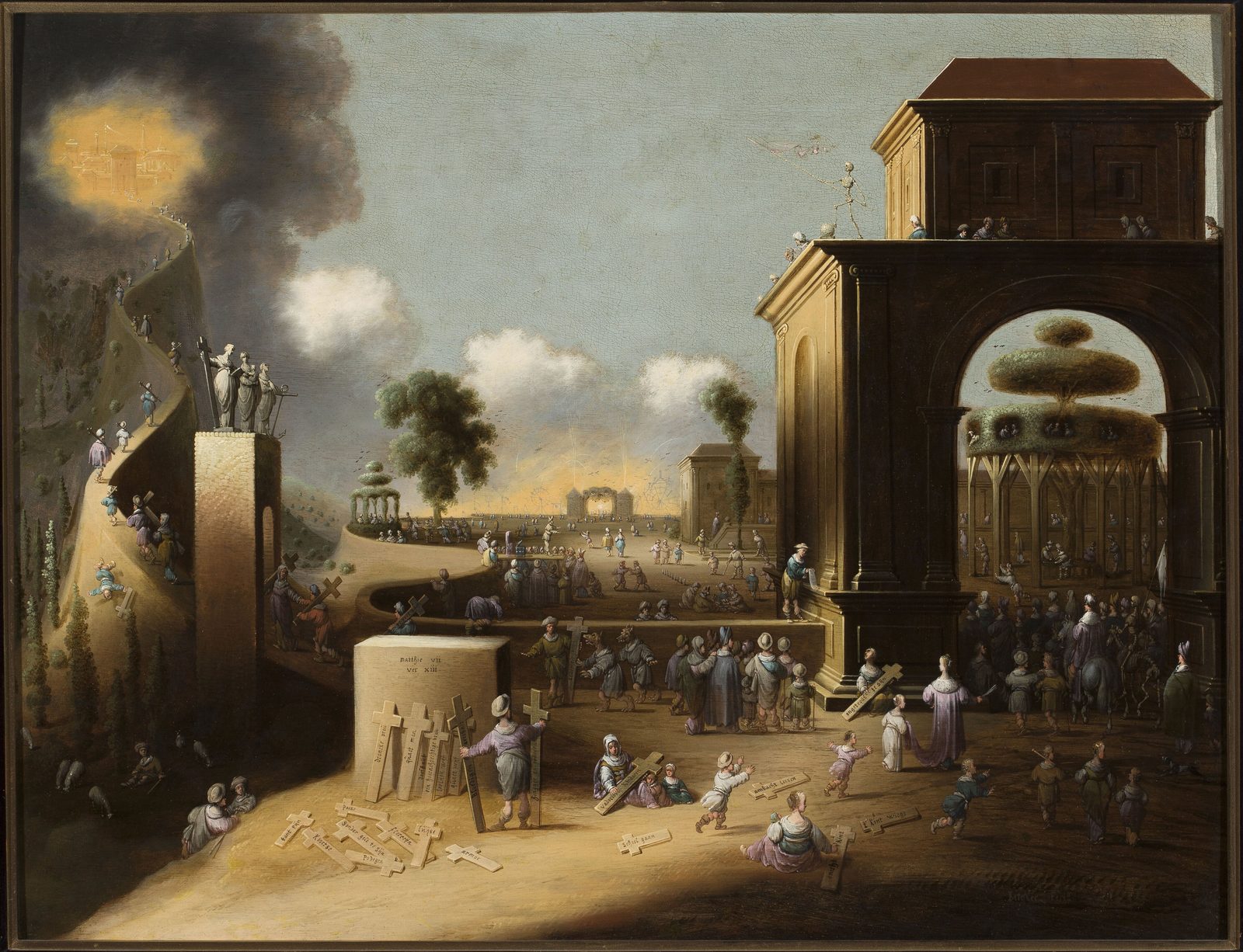
Narrow Road of Virtue and Wide Road of Sin. Jan Micker, not stated on the file page. National Museum in Warsaw. Public domain.