
Psalm 37
40 verses · Acrostic psalm of wisdom
Be still before the LORD and wait patiently for Him; do not fret when men prosper in their ways, when they carry out wicked schemes.
Introduction
David, the Inheritance, Book 1: The book of David, Poetry, Psalms Overview.
David wrote this psalm as an old man, and it rests on a lifetime of watching how things turn out. It was written for Israelites who saw dishonest neighbours grow rich while their own families lost ground and land. The psalm grants that the cheats are doing well and answers by lengthening the time frame. It gives its commands first and spends the rest of its length on the reasons. It runs the Hebrew alphabet in order, about two verses to a letter. Listen for the promise about the land that returns five times, and for the old man's own testimony near the middle.
Context
- Who
- Israelites watching dishonest neighbours prosper and their own families lose ground
- What
- An alphabetic wisdom psalm on why cheats prosper, spoken by a man who is now old.
- Where
- Judah's farmland and the courts where land changed hands, in a generation when men were getting rich by fraud
- When
- Late in the reign of David, about 970 BC, by the superscription and by the writer's word at verse 25 that he is now old.
- Why
- To steady honest families watching the dishonest do well, by lengthening the time frame and giving plain commands.
Historical context
The psalm is David's by its title, and it supplies its own date from the inside. At verse 25 the speaker says he was young and is now old, and the whole argument rests on that length of observation. Five times the psalm promises that one kind of man will inherit the land, at verses 9, 11, 22, 29 and 34. In Israel a family's land was its inheritance from the conquest, held under law and not meant to be sold away permanently. A neighbour who acquired land by fraud was taking what a family could not replace. Verse 2 gives the wicked the lifespan of grass. In that climate the spring grass comes up green and is burnt off within weeks, so the comparison is to something a hearer watched happen every year. The psalm runs the Hebrew alphabet in order with about two verses to a letter.
Significance
For the first hearers the psalm answered the oldest complaint in Israel, that the men who cheat are doing well, and it answered by changing the time frame. It granted the prosperity and granted that the righteous man falls. What it asked of them was a set of actions: stop fretting, trust, do good, delight, commit the way, be still and wait. The commands come in that order in verses 1 to 7 and the rest of the psalm is the reason for them.
This chapter in Jewish lifeWhat this chapter is in Jewish life and reading.
How it is read
This psalm runs as an alphabetic acrostic, and this site carries the form at /featured/the-acrostic-psalms. Rashi reads its subject as the reproof of Israel over the success of the wicked:
Do not compete with the evildoers He reproves Israel that they should not compete with the success of the evildoers to do as their deeds, as (in Jer. 12:5): “how will you compete (תתחרה) with horses,” to run as they run, a atir in Old French, to compete. (Rashi on Psalms 37:1:1)
He turns the trust of the third line into a matter of daily money:
Trust in the Lord and do not say, “If I do not rob and steal,” or “If I give charity to a poor man, how will I sustain myself?” (Rashi on Psalms 37:3:1)
On the waiting of the seventh line he weighs two readings, his own of waiting for salvation against the reading of Menachem and Dunash that takes the word as silence, at Rashi on Psalms 37:7:1. The comment that carries the most weight for a Christian reader is the one on the borrower and the lender, where Rashi takes the righteous one of the line to be God himself:
A wicked man borrows and does not pay, but the Righteous is gracious and gives The Holy One, blessed be He, Who is the Righteous One of the world, is gracious with His own and gives it to the one who lent what he [the borrower] stole from him. (Rashi on Psalms 37:21:1)
He reads the inheritance of the land in the same way, as the portion of those blessed by the Righteous One of the world, at Rashi on Psalms 37:22:1. Ibn Ezra stands on this chapter at Ibn Ezra on Psalms 37:6:1, 37:11:1, 37:13:1, 37:15:1, 37:17:1 and 37:19:1, and Sefaria holds no English version of those references, so this card cites them without quotation.
What the rabbis say
The corpus records 40 places where the rabbinic literature takes up a line of this psalm, 30 of them in the Midrash. The Midrash on the Psalms treats it at Midrash Tehillim 37:2, 22:18, 109:1, 1:5 and 5:8. Aggadat Bereshit takes it up at Aggadat Bereshit 10:3, 10:1 and 49:1, Bamidbar Rabbah at Bamidbar Rabbah 19:27, 19:30 and 13:2 and the Fathers according to Rabbi Nathan at Avot DeRabbi Natan 21:1 and 14:5. The Talmud takes up lines of the psalm at Berakhot 7b:16, Avot DeRabbi Natan 21:1, Avot DeRabbi Natan, Recension B 24:2, Jerusalem Talmud Kiddushin 1:7:3, Avot DeRabbi Natan, Recension B 35:15, Bava Metzia 106a:13, Avot DeRabbi Natan 14:5, Chullin 7b:15, Berakhot 7b:21 and Jerusalem Talmud Avodah Zarah 3:1:4. Each is a locator in this corpus, so the saying stands at its reference.
Sources: Rashi, Rashi on Psalms, in The Judaica Press complete Tanach with Rashi, translated by A. J. Rosenberg, under a CC-BY licence; Ibn Ezra, Ibn Ezra on Psalms, cited at Ibn Ezra on Psalms 37:6:1, 37:11:1, 37:13:1, 37:15:1, 37:17:1 and 37:19:1; Midrash Tehillim, the Midrash on the Psalms, cited at Midrash Tehillim 37:2, 22:18, 109:1, 1:5 and 5:8; The Talmud, cited at Berakhot 7b:16, Avot DeRabbi Natan 21:1, Avot DeRabbi Natan, Recension B 24:2, Jerusalem Talmud Kiddushin 1:7:3, Avot DeRabbi Natan, Recension B 35:15, Bava Metzia 106a:13, Avot DeRabbi Natan 14:5, Chullin 7b:15, Berakhot 7b:21 and Jerusalem Talmud Avodah Zarah 3:1:4; MannaFest, the acrostic psalms, at /featured/the-acrostic-psalms, 2026; MannaFest, the Sefaria corpus at scripts/data/sources/sefaria/psalms/37.json, fetched 2026-09-19, 2026.
Psalms 37:1-2
Do not fret over: Fretting and envy are both forbidden. The Hebrew behind fret means to glow or grow warm, the heat that blazes up into anger. Verse 2 answers with grass and tender plants that wither quickly, the whole span of the wicked man's flourishing.
Psalms 37:1
“The Psalm opens with the first precept. It is alas! too common for believers in their hours of adversity to think themselves harshly dealt with when they see persons utterly destitute of religion and honesty, rejoicing in abundant prosperity. Much needed is the command, Fret not thyself because of evildoers. To fret is to worry, to have the heartburn, to fume, to become vexed.”
Charles Spurgeon · The Treasury of David, Vol. 2 (1870)Particular Baptist
3 more voices on this verseWhat preachers and commentators have said about this verse, in their own words.
Psalms 37:1
“Fretfulness and envy are sins that are their own punishments; they are the uneasiness of the spirit and the rottenness of the bones; it is therefore in kindness to ourselves that we are warned against them.”
Matthew Henry · Commentary on the Whole Bible (1707-1721)puritan
Psalms 37:1
“Not infrequently good people, seeing others arrive at riches and honors by fraud and trickery, become green with jealousy and want to imitate them. They, too, are tempted to attain riches and fame by similar tricks and malpractices.… Do not be an imitator of wrongdoing and fraud. Rather, be an imitator of apostolic doctrine, of prophetic grace and of the virtue of the saints. Then you will bear fruit and reap the harvest of your good deeds.”
Ambrose of Milan · written before 397 · Commentary on Twelve Psalms 37:11patristic
Psalms 37:1
“That hit home with me because I was doing a lot of fretting and it wasn't helping my spiritual life.”
R. C. Sproul · A Letter to a Discouraged PastorReformed
they wither quickly like grass: Albert Barnes read the Hebrew word behind quickly as haste. It marks how fast the end comes once it begins, as grass falls before the mower's scythe. John Gill set the image beside Psalm 90:5, grass green in the morning and cut down by evening.
Psalms 37:2
“For they shall soon be cut down like the grass. The scythe of death is sharpening. Green grows the grass, but quick comes the scythe. The destruction of the ungodly will be speedy, sudden, sure, overwhelming, irretrievable. The grass cannot resist or escape the mower. And wither as the green herb. The beauty of the herb dries up at once in the heat of the sun, and so all the glory of the wicked shall disappear at the hour of death. Death kills the ungodly man like grass, and wrath withers him like hay; he dies, and his name rots.”
Charles Spurgeon · The Treasury of David, Vol. 2 (1870)Particular Baptist
Psalms 37:3-6
Trust in the LORD: Trust is joined to doing good and dwelling in the land. The Hebrew verb behind commit your way is the word for roll, a burden rolled onto one able to carry it. The man who delights in the LORD is given the desires of his heart.
Psalms 37:3
“Trust in the Lord. Here is the second precept, and one appropriate to the occasion. Faith cures fretting. Sight is cross-eyed, and views things only as they seem, hence her envy: faith has clearer optics to behold things as they really are, hence her peace. And do good. True faith is actively obedient. Doing good is a fine remedy for fretting. There is a joy in holy activity which drives away the rust of discontent. So shalt thou dwell in the land. In "the land" which floweth with milk and honey; the Canaan of the covenant.”
Charles Spurgeon · The Treasury of David, Vol. 2 (1870)Particular Baptist
1 more voice on this verse
Psalms 37:3
“He has not promised to gratify all the appetites of the body and the humours of the fancy, but to grant all the desires of the heart, all the cravings of the renewed sanctified soul. What is the desire of the heart of a good man? It is this, to know, and love, and live to God, to please him and to be pleased in him.”
Matthew Henry · Commentary on the Whole Bible (1707-1721)puritan
Delight yourself in the LORD: Charles Spurgeon heard a third precept here, rising above trust. The word behind desires means petitions, the askings of the heart, as Adam Clarke and Albert Barnes both read it. Clarke drew the rule that a godly man keeps no desire he cannot turn into a prayer.
Psalms 37:4
“There is an ascent in this third precept. He who was first bidden not to fret, was then commanded actively to trust, and now is told with holy desire to delight in God. Delight thyself also in the Lord. Make Jehovah the joy and rejoicing of thy spirit. Bad men delight in carnal objects; do not envy them if they are allowed to take their fill in such vain idols; look thou to thy better delight, and fill thyself to the full with thy more sublime portion.”
Charles Spurgeon · The Treasury of David, Vol. 2 (1870)Particular Baptist
Commit your way to the LORD: Adam Clarke thought the image probably came from a camel lying down while its load is rolled onto its back. He rendered the closing verb He will work, so the outcome is God's own doing. Albert Barnes sent the reader on to 1 Peter 5:7.
Psalms 37:5
“Commit thy way unto the Lord. Roll the whole burden of life upon the Lord. Leave with Jehovah not thy present fretfulness merely, but all thy cares; in fact, submit the whole tenor of thy way to him. Cast away anxiety, resign thy will, submit thy judgment, leave all with the God of all. What a medicine is this for expelling envy! What a high attainment does this fourth precept indicate! How blessed must he be who lives every day in obedience to it! Trust also in him; and he shall bring it to pass.”
Charles Spurgeon · The Treasury of David, Vol. 2 (1870)Particular Baptist
your justice like the noonday sun: Albert Barnes and Matthew Henry read the verse as God clearing a slandered name. Augustine saw a rise from dawn to full noon, the light of sunrise growing to its full clearness. Guard the conscience, Henry wrote, and God guards the name.
Psalms 37:6
“And he shall bring forth thy righteousness as the light. In the matter of personal reputation we may especially be content to be quiet, and leave our vindication with the Judge of all the earth. The more we fret in this case the worse for us. Our strength is to sit still. The Lord will clear the slandered. If we look to his honour, he will see to ours. It is wonderful how, when faith learns to endure calumny with composure, the filth does not defile her, but falls off like snowballs from a wall of granite.”
Charles Spurgeon · The Treasury of David, Vol. 2 (1870)Particular Baptist
1 more voice on this verse
Psalms 37:6
“Secondly, It is promised that God will, in due time, roll away the reproach they are under, clear up their innocency, and bring forth their righteousness, to their honour, perhaps in this world, at furthest in the great day, Matt. xiii. Note, If we take care to keep a good conscience, we may leave it to God to take care of our good name. Exhortations and Promises.”
Matthew Henry · Commentary on the Whole Bible (1707-1721)puritan
Psalms 37:7-9
Be still before the LORD: The command to be still before the LORD carries the waiting with it. Anger and wrath are to be dropped, and the fretting forbidden a third time yields only harm to the man who frets. Evildoers are cut off, and those who hope inherit the land.
Psalms 37:7
“Rest in the Lord. This fifth is a most divine precept, and requires much grace to carry it out. To hush the spirit, to be silent before the Lord, to wait in holy patience the time for clearing up the difficulties of Providence—that is what every gracious heart should aim at. "Aaron held his peace:" "I opened not my mouth, because thou didst it." A silent tongue in many cases not only shows a wise head, but a holy heart. And wait patiently for him. Time is nothing to him; let it be nothing to thee.”
Charles Spurgeon · The Treasury of David, Vol. 2 (1870)Particular Baptist
Refrain from anger and abandon wrath: Augustine traced where this anger leads: to the thought that God is unjust for letting the wicked prosper. Ambrose warned that anger destroys even the wise, so the feeling must be dropped before it drags a man into sin. For Spurgeon, fretfulness lies on the verge of great sin.
Psalms 37:8
“Cease from anger and forsake wrath. Especially anger against the arrangements of Providence, and jealousies of the temporary pleasures of those who are so soon to be banished from all comfort. Anger anywhere is madness, here it is aggravate insanity. Yet since anger will try to keep us company, we must resolvedly forsake it. Fret not thyself in any wise to do evil. By no reasonings and under no circumstances be led into such a course. Fretfulness lies upon the verge of great sin.”
Charles Spurgeon · The Treasury of David, Vol. 2 (1870)Particular Baptist
1 more voice on this verse
Psalms 37:8
“Anger destroys not just the ordinary run of people, but even the wise. David warns the wise, saying to them, "Cease from anger," for once that fire is set alight it will not cease until its flames have consumed you. "Leave aside," he says, "your rage." Here is his meaning: nature catches hold of you, it stirs up your feelings, you get excited about some fault, some slight that has offended you, you begin to rage but not to the point where you cannot stop. Drop it. Put an end to it, or it will drag you into sin.”
Ambrose of Milan · written before 397 · Commentary on Twelve Psalms 37:18patristic
those who hope in the LORD will inherit the land: Adam Clarke held that the Hebrew word here means the land of Judea, with a promise of return to it. Augustine read the land as the heavenly Jerusalem. Jamieson, Fausset and Brown took inheriting the land as the whole covenant blessing, as at Psalm 25:13.
Psalms 37:9
“For evil doers shall be cut off. Their death shall be a penal judgment; not a gentle removal to a better state, but an execution in which the axe of justice will be used. But those that wait upon the Lord —those who in patient faith expect their portion in another life— they shall inherit the earth. Even in this life they have the most of real enjoyment, and in the ages to come theirs shall be the glory and the triumph.”
Charles Spurgeon · The Treasury of David, Vol. 2 (1870)Particular Baptist
Psalms 37:10-11
Yet a little while: A little while is all the wicked have, and then the search for him turns up nothing. The meek inherit the land, and Jesus gives the same promise at Matthew 5:5, blessed are the meek, for they will inherit the earth. The abundant prosperity is the land enjoyed.
Psalms 37:10
“For yet a little while, and the wicked shall not be. When bad men reach to greatness, the judgments of God frequently sweep them away; their riches melt, their power decays, their happiness turns to wretchedness; they themselves cease any longer to be numbered with the living. The shortness of life makes us see that the glitter of the wicked great is not true gold. O wherefore, tried believer, dost thou envy one who in a little while will lie lower than the dust? Yea, thou shalt diligently consider his place, and it shall not be.”
Charles Spurgeon · The Treasury of David, Vol. 2 (1870)Particular Baptist
the meek will inherit the land: The word behind meek first meant the afflicted and poor, then the gentle, as Albert Barnes explained it. Adam Clarke applied it to the poor Jewish captives. Spurgeon and Matthew Henry read the abundant prosperity as peace, inward and with God, worth more than gold.
Psalms 37:11
“But the meek shall inherit the earth. Above all others they shall enjoy life. Even if they suffer, their consolations shall overtop their tribulations. By inheriting the land is meant obtaining covenant privileges and the salvation of God. Such as are truly humble shall take their lot with the rest of the heirs of grace, to whom all good things come by a sacred birthright. And shall delight themselves in the abundance of peace. Peace they love and peace they shall have. If they find not abundance of gold, abundance of peace will serve their turn far better.”
Charles Spurgeon · The Treasury of David, Vol. 2 (1870)Particular Baptist
Psalms 37:12-15
scheme against the righteous: The scheming comes with gnashing teeth, and the drawn sword and bent bow are aimed at the poor and needy. The Lord laughs over them, the same laughter He gives the conspiring kings at Psalm 2:4, and He sees their day coming. Their own swords turn back into their hearts.
Psalms 37:12
“The wicked plotteth against the just. Why can he not let the good man alone? Because there is enmity between the serpent's seed and the seed of the woman. Why not attack him fairly? Why plot and scheme? Because it is according to the serpent's nature to be very subtle. Plain sailing does not suit those who are on board of "The Apollyon." And gnashed upon him with his teeth. The wicked show by their gestures what they would do if they could; if they cannot gnaw they will gnash; if they may not bite they will at least bark.”
Charles Spurgeon · The Treasury of David, Vol. 2 (1870)Particular Baptist
1 more voice on this verse
Psalms 37:12
“It is true the wicked plotteth against the just; there is a rooted enmity in the seed of the wicked one against the righteous seed; their aim is, if they can, to destroy their righteousness, or, if that fail, then to destroy them.”
Matthew Henry · Commentary on the Whole Bible (1707-1721)puritan
the Lord laughs: Albert Barnes took the laughter as God's judgment that the plots are empty and hold nothing to fear. Augustine identified their day with the day of wrath in Romans 2:5. The schemer cannot see that day; the Lord already does.
Psalms 37:13
“The Lord shall laugh at him. The godly man needs not trouble himself, but leave well deserved vengeance to be dealt out by the Lord, who will utterly deride the malice of the good man's enemies. Let the proud scorner gnash his teeth and foam at the mouth; he has one to deal with who will look down upon him and his ravings with serene contempt. For he seeth that his day is coming.”
Charles Spurgeon · The Treasury of David, Vol. 2 (1870)Particular Baptist
bent the bow: The Hebrew for bent the bow is literally trod the bow, the foot set on it to draw the string back, as Albert Barnes explained. Augustine read the drawn sword as open hostility and the bent bow as hidden plots.
Psalms 37:14
“The wicked have drawn out the sword. They hold their weapon out of its sheath, and watch for a time to use it. And have bent their bow. One weapon is not enough, they carry another ready for action. They carry so strong a bow that they have trodden upon it to bend it—they will lose nothing for want of force or readiness. To cast down the poor and needy. These are their game, the objects of their accursed malice.”
Charles Spurgeon · The Treasury of David, Vol. 2 (1870)Particular Baptist
1 more voice on this verse
Psalms 37:14
“The wicked have drawn out the sword,.... That is, out of the scabbard; they drew upon the righteous, in order to sheath it in them; or they sharpened the sword, as Aben Ezra observes some interpret the word; it may be literally rendered, "opened the sword" (q), which before lay hid in the scabbard: and have bent their bow; having put the arrow in it, in order to shoot.”
their bows will be broken: Spurgeon and John Gill both pointed to Saul, who fell on his own sword, and Spurgeon added Haman on the gallows he built for Mordecai. Augustine drew a contrast. The persecutor's sword reached only the martyrs' bodies, while his own heart took the wound.
Psalms 37:15
“Their sword shall enter into their own heart,.... As Saul's did into his, 1Sa 31:4; and their bows shall be broken; the meaning is, that their efforts shall be fruitless, and their attempts in vain; the mischief they have contrived and designed for others shall fall upon themselves; see Psa 7:15; and therefore the saints should not be fretful and envious.”
1 more voice on this verse
Psalms 37:15
“Their sword shall enter into their own heart. Like Haman they shall be hanged upon the gallows built by themselves for Mordecai. Hundreds of times has this been the case. Saul, who sought to slay David, fell on his own sword; and the bow, his favourite weapon, the use of which he taught the children of Israel, was not able to deliver him on Gilboa. And their bows shall be broken. Their inventions of evil shall be rendered useless. Malice outwits itself.”
Charles Spurgeon · The Treasury of David, Vol. 2 (1870)Particular Baptist
Psalms 37:16-20
Better is the little: The little of the righteous outweighs the abundance of many wicked men. Verse 17 sets broken arms against the LORD holding the righteous up, and verse 19 carries the promise into famine, where they are satisfied. The wicked fade like the glory of the fields, like smoke.
Psalms 37:16
“A little that a righteous man hath is better than the riches of many wicked. This is a fine proverb. The little of one good man is contrasted with the riches of many wicked, and so the expression is rendered the more forcible. There is more happiness in the godly dinner of herbs than in the stalled ox of profane rioters.”
Charles Spurgeon · The Treasury of David, Vol. 2 (1870)Particular Baptist
1 more voice on this verse
Psalms 37:16
“When evil-doers are cut off the righteous sometimes inherit what they gathered. The wealth of the sinner is laid up for the just, Job xxvii. This promise is here made, 1.”
Matthew Henry · Commentary on the Whole Bible (1707-1721)puritan
the arms of the wicked will be broken: The broken arms answer the broken bows of verse 15. Jamieson, Fausset and Brown observed that even the limbs needed to hold a weapon are destroyed. Albert Barnes took the arm as the instrument of every purpose, so its breaking means the plans fail.
Psalms 37:17
“For the arms of the wicked shall be broken. Their power to do mischief shall be effectually taken away, for the arms which they lifted up against God shall be crushed even to the bone. God often makes implacable men incapable men. What is a more contemptible sight than toothless malice, armless malevolence! But the Lord upholdeth the righteous. Their cause and course shall be safe, for they are in good keeping. The sword of two edges smites the wicked and defends the just.”
Charles Spurgeon · The Treasury of David, Vol. 2 (1870)Particular Baptist
The LORD knows the days of the blameless: Diodorus of Tarsus read knows as makes His own, the same sense as Psalm 1:6. Matthew Henry said He knows their bright days and their dark. Spurgeon joined it to verse 13, where the same foreknowledge laughs at the proud and here sees a brighter future for the upright.
Psalms 37:18
“He knows their bright days, and has pleasure in their prosperity; he knows their cloudy and dark days, the days of their affliction, and as the day is so shall the strength be. Fourthly, That their inheritance shall be for ever; not their inheritance in the earth, but that incorruptible indefeasible one which is laid up for them in heaven.”
Matthew Henry · Commentary on the Whole Bible (1707-1721)puritan
1 more voice on this verse
Psalms 37:18
“The Lord knoweth the days of the upright. His foreknowledge made him laugh at the proud, but in the case of the upright he sees a brighter future, and treats them as heirs of salvation. Ever is this our comfort, that all events are known to our God, and that nothing in our future can take him at unawares. No arrow can pierce us by accident, no danger smite us by stealth; neither in time nor eternity can any unforeseen ill occur to us.”
Charles Spurgeon · The Treasury of David, Vol. 2 (1870)Particular Baptist
In the time of evil they will not be ashamed: To be ashamed is to be disappointed, as Albert Barnes explained from Job 6:20, like a traveller who reaches a stream and finds it dry. Augustine said hope set on God is never put to shame. Shame belongs to the man whose hope deceives him.
Psalms 37:19
“They shall not be ashamed in the evil time,.... Of affliction and persecution, or of old age, or in the day of judgment, when it will go ill with others; see 1Jn 2:28; and in the days of famine they shall be satisfied: whether it is understood figuratively of a famine of hearing the word, or literally of a proper famine of bread and water: these God will provide for them, as he did for Elijah, and they shall be sure unto them, and therefore let them not fret nor envy.”
1 more voice on this verse
Psalms 37:19
“They shall not be ashamed in the evil time. Calamities will come, but deliverances will come also. As the righteous never reckoned upon immunity from trouble, they will not be disappointed when they are called to take their share of it, but the rather they will cast themselves anew upon their God, and prove again his faithfulness and love. God is not a friend in the sunshine only, he is a friend indeed and a friend in need. And in the days of famine they shall be satisfied.”
Charles Spurgeon · The Treasury of David, Vol. 2 (1870)Particular Baptist
like the glory of the fields: Where the Berean reads the glory of the fields, Adam Clarke followed a Hebrew reading of sacrificial fat burned away on the altar. Augustine watched smoke swell as it rises and thin as it swells. Its very size, he said, is what dissolves it.
Psalms 37:20
“But the wicked shall perish. Whatever phantom light may mock their present, their future is black with dark, substantial night. Judgment has been given against them, they are but reserved for execution. Let them flaunt their scarlet and fine linen, and fare sumptuously every day; the sword of Damocles is above their heads, and if their wits were a little more awake, their mirth would turn to misery. The enemies of the Lord shall be as the fat of lambs.”
Charles Spurgeon · The Treasury of David, Vol. 2 (1870)Particular Baptist
1 more voice on this verse
Psalms 37:20
“The day of God's vengeance on the wicked is represented as a sacrifice of the fat of the kidneys of rams ( Isa. xxxiv. 6 ); for he will be honoured by the ruin of his enemies, as he was by the sacrifices. Damned sinners are sacrifices, Mark ix.”
Matthew Henry · Commentary on the Whole Bible (1707-1721)puritan
Psalms 37:21-26
The wicked borrow: and leave the debt, and the righteous are gracious and giving. The LORD orders a man's steps and delights in the way he goes, and the hand holding him keeps a fall from throwing him down. The psalmist, grown old, had never seen the righteous abandoned.
Psalms 37:21
“The wicked borroweth, and payeth not again. Partly because he will not, but mainly because he cannot. Want follows upon waste, and debt remains undischarged. Often are the wicked thus impoverished in this life. Their wanton extravagance brings them down to the usurer's door and to the bankrupt's suit. But the righteous sheweth mercy, and giveth, Mercy has given to him, and therefore he gives in mercy. He is generous and prosperous. He is not a borrower, but a giver.”
Charles Spurgeon · The Treasury of David, Vol. 2 (1870)Particular Baptist
1 more voice on this verse
Psalms 37:21
“He is ever merciful, or every day, or all the day, merciful, and lends, and sometimes there is as true charity in lending as in giving; and giving and lending are acceptable to God when they proceed from a merciful disposition in the heart, which, if it be sincere, will be constant, and will keep us from being weary of well-doing. he that is truly merciful will be ever merciful.”
Matthew Henry · Commentary on the Whole Bible (1707-1721)puritan
those He blesses will inherit the land: Albert Barnes saw the psalm's thought advance here. The end of both lives turns on the favour of the LORD, as the blessing and the curse show. Adam Clarke added that a wicked Jew meets the same end as a wicked Babylonian.
Psalms 37:22
“For such as be blessed of him shall inherit the earth. God's benediction is true wealth after all. True happiness, such as the covenant secures to all the chosen of heaven, lies wrapped up in the divine favour. And they that be cursed of him shall be cut off. His frown is death; nay, more, It is hell.”
Charles Spurgeon · The Treasury of David, Vol. 2 (1870)Particular Baptist
The steps of a man are ordered by the LORD: The Hebrew word for man here is geber, a strong man. Adam Clarke took it to show that even the powerful must be upheld by the LORD. Matthew Henry pictured God leading a man step by step, as a child is led.
Psalms 37:23
“The steps of a good man are ordered by the Lord. All his course of life is graciously ordained, and in lovingkindness all is fixed, settled, and maintained. No reckless fate, no fickle chance rules us; our every step is the subject of divine decree. He delighteth in his way. As parents are pleased with the tottering footsteps of their babes. All that concerns a saint is interesting to his heavenly Father. God loves to view the holy strivings of a soul pressing forward to the skies.”
Charles Spurgeon · The Treasury of David, Vol. 2 (1870)Particular Baptist
Though he falls, he will not be overwhelmed: Adam Clarke and Albert Barnes read the fall as trouble and reverses, while Matthew Henry allowed it to include a fault from which grace restores. Barnes gave overwhelmed the sense of thrown down at full length. Spurgeon pictured a man brought to his knees and never flat on his face.
I once was young and now am old: Adam Clarke, grey-headed himself, believed it literally true and knew no exception. Spurgeon had relieved the children of good men who begged, and held that David spoke under a more outward dispensation. Ambrose judged the plain reading hard to credit.
Psalms 37:25
“This was David's observation, I have been young, and now am old; yet have I not seen the righteous forsaken, nor his seed begging bread. It is not my observation just as it stands, for I have relieved the children of undoubtedly good men, who have appealed to me as common mendicants. But this does not cast a doubt upon the observation of David. He lived under a dispensation more outward, and more of this world than the present rule of personal faith. Never are the righteous forsaken; that is a rule without exception.”
Charles Spurgeon · The Treasury of David, Vol. 2 (1870)Particular Baptist
1 more voice on this verse
Psalms 37:25
“If you take it at face value, the meaning is obvious: in his own lifetime, David never saw the just forsaken. But a lifespan is brief, and the statement is moreover incredible. We have seen plenty of just people in this world who have been forsaken by people as soon as those just ones are persecuted by people in power. No one dares to go near them so long as they are subject to fear and injury.”
Ambrose of Milan · written before 397 · Commentary on Twelve Psalms 37:8patristic
quick to lend: The Hebrew behind ever is all the day, a settled habit, as Adam Clarke and Albert Barnes both noted. The lender answers the wicked borrower of verse 21. Clarke tied the blessed children to verse 25: they are the reason no child of his begs bread.
Psalms 37:26
“He is ever merciful, and lendeth. The righteous are constantly under generous impulses; they do not prosper through parsimony, but through bounty. Like the bounteous giver of all good, of whom they are the beloved sons, they delight in doing good. How stingy covetous professors can hope for salvation is a marvel to those who read such verses as this in the Bible. And his seed is blessed. God pays back with interest in the next generation.”
Charles Spurgeon · The Treasury of David, Vol. 2 (1870)Particular Baptist
Psalms 37:27-33
Turn away from evil: The command is to turn away from evil and do good, with abiding forever attached to it as the promise. The law of his God sits in his heart. The LORD loves justice and does not leave the righteous in the power of those who lie in wait for them.
Psalms 37:27
“Depart from evil, and do good. We must not envy the doers of evil, but depart altogether from their spirit and example. As Lot left Sodom without casting a look behind, so must we leave sin. No truce or parley is to be held with sin, we must turn away from it without hesitation, and set ourselves practically to work in the opposite direction. He who neglects to do good will soon fall into evil. And dwell for evermore. Obtain an abiding and quiet inheritance.”
Charles Spurgeon · The Treasury of David, Vol. 2 (1870)Particular Baptist
They are preserved forever: Adam Clarke read the Hebrew for saints as the merciful ones, the same people who give and lend in verse 26. Augustine likened suffering saints to trees in winter. Their life is hidden in the root until He appears, and then it shows in fruit.
Psalms 37:28
“For the Lord loves justice, and will not forsake his saints: they will be preserved forever. But the wicked will be punished, and the seed of the wicked will perish. The righteous will inherit the land, and dwell forever upon it. Do not think that your sins go unnoticed by God; for many fall in this way. He himself sees and condemns all things, and exterminates the seed of the wicked; indeed, the seed is not of physical generation, but of internal mind and succession of impiety (Job 1:1).”
Ambrose of Milan · written before 397 · Commentaries on the Twelve Davidic Psalmspatristic
2 more voices on this verse
Psalms 37:28
“For the Lord loveth judgment. The awarding of honour to whom honour is due is God's delight, especially when the upright man has been traduced by his fellow men. It must be a divine pleasure to right wrongs, and to defeat the machinations of the unjust. The great Arbiter of human destinies is sure to deal out righteous measure both to rich and poor, to good and evil, for such judgment is his delight. And forsaketh not his saints. This would not be right, and, therefore, shall never be done.”
Charles Spurgeon · The Treasury of David, Vol. 2 (1870)Particular Baptist
Psalms 37:28
“Those shall not be tossed that make God their rest and are at home in him. But on this earth there is no dwelling for ever, no continuing city; it is in heaven only, that city which has foundations, that the righteous shall dwell for ever; that will be their everlasting habitation.”
Matthew Henry · Commentary on the Whole Bible (1707-1721)puritan
dwell in it forever: Albert Barnes observed that inherit makes the righteous heirs, treated by God as His children. Spurgeon set this holding against every earthly tenure: the heirs keep it forever and live forever to enjoy it. The psalm now promises the land for the fourth time.
Psalms 37:29
“The righteous shall inherit the land. As heirs with Jesus Christ, the Canaan above, which is the antitype of "the land, " shall be theirs with all covenant blessing. And dwell therein for ever. Tenures differ, but none can match the holding which believers have of heaven. Paradise is theirs for ever by inheritance, and they shall live for ever to enjoy it. Who would not be a saint on such terms? Who would fret concerning the fleeting treasures of the godless?”
Charles Spurgeon · The Treasury of David, Vol. 2 (1870)Particular Baptist
his tongue speaks justice: Spurgeon read this verse as the test by which the righteous can be known, since the mouth betrays the heart. Matthew Henry heard in justice the word and providence of God. Augustine pictured the righteous man turning wisdom over in his mouth, like bread he feeds on.
Psalms 37:30
“The mouth of the righteous speaketh wisdom. Where the whole Psalm is dedicated to a description of the different fates of the just and the wicked, it was meet to give a test by which they could be known. A man's tongue is no ill index of his character. The mouth betrays the heart. Good men, as a rule, speak that which is to edifying, sound speech, religious conversation, consistent with the divine illumination which they have received. Righteousness is wisdom in action, hence all good men are practically wise men, and well may the speech be wise.”
Charles Spurgeon · The Treasury of David, Vol. 2 (1870)Particular Baptist
2 more voices on this verse
Psalms 37:30
“His tongue talks not of things idle and impertinent, but of judgment, that is, of the word and providence of God and the rules of wisdom for the right ordering of the conversation. Out of the abundance of a good heart will the mouth speak that which is good and to the use of edifying.”
Matthew Henry · Commentary on the Whole Bible (1707-1721)puritan
Psalms 37:30
“Let us speak the Lord Jesus, for he is wisdom. He is the Word, the very Word of God. Does not Scripture say, "Open your mouth to the word of God"? Echo his speech, meditate his words, and you will breathe Jesus. When we speak of wisdom, it is he.… When we speak of truth and life and redemption, it is he.”
Ambrose of Milan · written before 397 · Commentary on Twelve Psalms 37:65patristic
his steps do not falter: Verse 30 gave the speech, and verse 31 gives its source in the heart. Spurgeon traced the good talk to a well-stored heart. Adam Clarke saw here the new covenant promise that God would write His laws on the heart.
Psalms 37:31
“The law of his God is in his heart; none of his steps shall slide. The best thing in the best place, producing the best results. Well might the man's talk be so admirable when his heart was so well stored. To love holiness, to have the motives and desires sanctified, to be in one's inmost nature obedient to the Lord—this is the surest method of making the whole run of our life efficient for its great ends, and even for securing the details of it, our steps from any serious mistake.”
Charles Spurgeon · The Treasury of David, Vol. 2 (1870)Particular Baptist
the wicked lie in wait for the righteous: Adam Clarke tied this to the plotting of verse 12. John Gill noted that some read the watcher as the devil of 1 Peter 5:8. Spurgeon recalled that Jesus was watched by enemies thirsting for His blood, and that His disciples should expect the same.
Psalms 37:32
“The wicked watcheth the righteous,.... All his motions and steps, his works and actions; he watches for his halting, and to take all opportunities and advantages against him; see Jer 20:10; and seeketh to slay him; murder his reputation, destroy his substance, and take away his life: some understand it of the devil, who watches the saints, observes their failings, accuses then, before the throne, and seeks to devour them, 1Pe 5:8.”
1 more voice on this verse
Psalms 37:32
“The wicked watcheth the righteous, and seeketh to slay him. If it were not for the laws of the land, we should soon see a massacre of the righteous. Jesus was watched by his enemies, who were thirsting for his blood: his disciples must not look for favour where their Master found hatred and death.”
Charles Spurgeon · The Treasury of David, Vol. 2 (1870)Particular Baptist
let them be condemned under judgment: Augustine pressed the hard case: the martyrs, and Christ Himself, were handed over to the ungodly. Spurgeon answered that time reverses a hasty verdict, or else eternity clears it. Albert Barnes called it the general rule, with exceptions.
Psalms 37:33
“The Lord will not leave him in his hand. God often appears to deliver his servants, and when he does not do so in this life as to their bodies, he gives their souls such joy and peace that they triumphantly rise beyond their tormentors' power. We may be in the enemy's hand for awhile, as Job was, but we cannot be left there. Nor condemn him when he is judged. Time shall reverse the verdict of haste, or else eternity shall clear away the condemnation of time. In due season just men will be justified.”
Charles Spurgeon · The Treasury of David, Vol. 2 (1870)Particular Baptist
Psalms 37:34-40
Wait for the LORD: The waiting is joined to keeping His way, and the land comes to the man who does both. The ruthless man flourishing like a well-rooted tree is gone by the next verse, searched for and not found. Salvation comes from the LORD, a stronghold in time of trouble.
Psalms 37:34
“Wait on the Lord,.... In the way of his appointments and ordinances; where may be learned the design of his providences, and of the prosperity of the wicked, and their end, Psa 73:16; and in a providential way, for the performance of his promises, in which he never fails; and patiently bear whatever he is pleased to lay upon them; waiting for a deliverance out of every affliction, which will be in his own time.”
1 more voice on this verse
Psalms 37:34
“Wait on the Lord. We have here the eighth precept, and it is a lofty eminence to attain to. Tarry the Lord's leisure. Wait in obedience as a servant, in hope as an heir, in expectation as a believer. This little word "wait" is easy to say, but hard to carry out, yet faith must do it. And keep his way. Continue in the narrow path; let no haste for riches or ease cause unholy action. Let your motto be, "On, on, on." Never flag, or dream of turning aside.”
Charles Spurgeon · The Treasury of David, Vol. 2 (1870)Particular Baptist
a wicked, ruthless man: This is the second time the psalmist appeals to what he has seen, as Spurgeon noted, the first being verse 25. Albert Barnes gave ruthless its root sense, one who inspires terror. Adam Clarke and Jerome both set the tree beside Nebuchadnezzar's vision in Daniel 4.
Psalms 37:35
“A second time David turns to his diary, and this time in poetic imagery tells us of what he had observed. It were well if we too took notes of divine providences. I have seen the wicked in great power. The man was terrible to others, ruling with much authority, and carrying things with a high hand, a Caesar in might, a Croesus in wealth. And spreading himself like a green bay tree. Adding house to house and field to field, rising higher and higher in the state.”
Charles Spurgeon · The Treasury of David, Vol. 2 (1870)Particular Baptist
1 more voice on this verse
Psalms 37:35
You see a cedar raised to a great height on the loftiest peak, yet it can be shattered by the wind; it can be burned down by fire; it can grow old and decay. Such are the rich in this world. They make a grand display and shine, with a worldly sort of splendor, like Mount Lebanon. They are propped up by the powers of this world and positively exult in their money and their riches. To you the rich person seems to be something, that is, until you are able to say, "Passing over, I shall see."
Ambrose of Milan · written before 397 · Commentary on Twelve Psalms 37:77patristic
though I searched, he could not be found: Albert Barnes noted that the grammar lets he passed away refer to the tree or the man, and took it of the man. Augustine said this end is seen only by one who has gone past envying such prosperity. Adam Clarke saw in it Belshazzar and the fall of Babylon.
Psalms 37:36
“Yet he passed away. Tree and man both gone, the son of man as surely as the child of the forest. What clean sweeps death makes! And, lo, he was not. To the surprise of all men the great man was gone, his estates sold, his business bankrupt, his house alienated, his name forgotten, and all in a few months. Yea, I sought him, but he could not be found. Moved by curiosity, if we enquire for the ungodly, they have left no trace; like birds of ill omen none desire to remember them.”
Charles Spurgeon · The Treasury of David, Vol. 2 (1870)Particular Baptist
posterity awaits the man of peace: Spurgeon and Albert Barnes read the last word of this verse as a peaceful end to the upright man's life. Adam Clarke reported that almost all the versions read a numerous posterity. Jamieson, Fausset and Brown took it as reward, as in Proverbs 23:18.
Psalms 37:37
“Mark the perfect man, and behold the upright. After having watched with surprise the downfall of the wicked, give your attention to the sincerely godly man, and observe the blessed contrast. Good men are men of mark, and are worth our study. Upright men are marvels of grace, and worth beholding. For the end of that man is peace. The man of peace has an end of peace. Peace without end comes in the end to the man of God. His way may be rough, but it leads home.”
Charles Spurgeon · The Treasury of David, Vol. 2 (1870)Particular Baptist
2 more voices on this verse
Psalms 37:37
“Mark the perfect man,.... None are so in themselves, not the most holy man upon earth; for though all grace is implanted at once in regeneration, the seed of grace of every kind is cast into the heart at once; yet it opens and spreads, and gradually increases; nor is any grace in its exercise perfect; not faith, nor hope, nor love: sin is in the best of men, and all stand in need of fresh supplies of grace.”
Psalms 37:37
“Sometimes the latter end of his days proves more comfortable to him than the beginning was; the storms blow over, and he is comforted again, after the time that he was afflicted.”
Matthew Henry · Commentary on the Whole Bible (1707-1721)puritan
the future of the wicked will be cut off: Jamieson, Fausset and Brown read this verse as the direct contrast to the end promised in verse 37. Matthew Henry observed that in this life God makes an example of one sinner here and another there. At the judgment all are destroyed together.
Psalms 37:38
“But the transgressors shall be destroyed together. A common ruin awaits those who are joined in common rebellion. The end of the wicked shall be cut off. Their time shall be shortened, their happiness shall be ended, their hopes for ever blasted, their execution hastened on. Their present is shortened by their sins; they shall not live out half their days. They have no future worth having, while the righteous count their future as their true heritage.”
Charles Spurgeon · The Treasury of David, Vol. 2 (1870)Particular Baptist
2 more voices on this verse
Psalms 37:38
“But the unjust will perish together; the remnants of the wicked will be destroyed. The remnants of the righteous are virtues; the remnants of the wicked are wickedness and the sin of treachery. They will be wiped away, so that they will not exist.”
Ambrose of Milan · written before 397 · Commentaries on the Twelve Davidic Psalmspatristic
Psalms 37:38
“In this world God singles out here one sinner and there another, out of many, to be made an example in terrorem--as a warning; but in the day of judgment there will be a general destruction of all the transgressors, and not one shall escape. Those that have sinned together shall be damned together.”
Matthew Henry · Commentary on the Whole Bible (1707-1721)puritan
The salvation of the righteous is from the LORD: Spurgeon took salvation here as deliverance of every kind, the small rescues along the way as well as the last. Albert Barnes stressed the source: the LORD keeps them. The same trouble that overthrows the wicked drives the righteous to their Helper, Spurgeon added.
Psalms 37:39
“But the salvation of the righteous is of the Lord. Sound doctrine this. The very marrow of the gospel of free grace. By salvation is meant deliverance of every kind; not only the salvation which finally lands us in glory, but all the minor rescues of the way; these are all to be ascribed unto the Lord, and to him alone. Let him have glory from those to whom he grants salvation. He is their strength in the time of trouble. While trouble overthrows the wicked, it only drives the righteous to their strong Helper, who rejoices to uphold them.”
Charles Spurgeon · The Treasury of David, Vol. 2 (1870)Particular Baptist
1 more voice on this verse
Psalms 37:39
“The salvation of the righteous is from the Lord; not from the world, not from an element. Heaven and earth will pass away. I do not entrust my salvation to heaven; because it too will pass away, for it is said of many heavens: They will perish, but you will remain.”
Ambrose of Milan · written before 397 · Commentaries on the Twelve Davidic Psalmspatristic
because they take refuge in Him: Albert Barnes read this verse as the summing up of the psalm, the final answer to the fretting forbidden in verse 1. Cassiodorus fixed on the reason given. They are rescued because they placed their hope in the Lord's compassion, whatever their sins.
Psalms 37:40
“And the Lord shall help them. In all future time Jehovah will stand up for his chosen. Our Great Ally will bring up his forces in the heat of the battle. He shall deliver them from the wicked. As he rescued Daniel from the lions, so will he preserve his beloved from their enemies; they need not therefore fret, nor be discouraged. And save them, because they trust in him. Faith shall ensure they safety of the elect. It is the mark of the sheep by which they shall be separated from the goats.”
Charles Spurgeon · The Treasury of David, Vol. 2 (1870)Particular Baptist
How this psalm is built
The form: A psalm given over throughout to the different ends of the just and the wicked, as Spurgeon classes it.
The patterns in this chapter
| Device | What it does | Where to see it |
|---|---|---|
| The alphabet, about two lines to a letter | The psalm runs through the Hebrew alphabet in order, giving most letters two verses. The pattern is not perfect and the imperfections are the interesting part: no line of the psalm opens with ayin, and the taw line at verse 39 opens with its letter standing under a waw of conjunction. | Psalm 37:1, Psalm 37:29, Psalm 37:39 |
| The land, said again and again | Five times the psalm promises the land to one kind of man: to those who hope in the LORD, to the meek, to those He blesses, to the righteous, and to the man who waits and keeps His way. Spurgeon reads the inheritance as the covenant privileges and the salvation of God rather than as a plot of ground.Charles Spurgeon, The Treasury of David, Vol. 2, 1870, on Psalm 37:11. | Psalm 37:9, Psalm 37:11, Psalm 37:22, Psalm 37:29, Psalm 37:34 |
| The two men, set against each other line by line | Most of the psalm is built of pairs in which one half describes the righteous and the other the wicked, and the pair is the argument. Spurgeon notes that a psalm given over to the different ends of the two needed a test by which they could be told apart, which is what verse 30 supplies.Charles Spurgeon, The Treasury of David, Vol. 2, 1870, on Psalm 37:30. | Psalm 37:16, Psalm 37:21, Psalm 37:37 |
| The four commands the psalm opens with | The psalm speaks to one man and tells him what to do in order: cease from fretting at verse 1, trust and do good at verse 3, delight in the LORD at verse 4, commit the way at verse 5, and be still at verse 7. Spurgeon preached the sequence as a ladder the Lord takes His servant up.Charles Spurgeon, The Metropolitan Tabernacle Pulpit, Sermon No. 1333, 1877. | Psalm 37:1, Psalm 37:3, Psalm 37:5, Psalm 37:7 |
The best known line of the psalm is at verse 11, where the meek inherit the land. Jesus takes the same promise into the Beatitudes at Matthew 5:5, and a reader who knows the psalm hears the Beatitude as a quotation of a promise already old.
2 more paragraphs on the patterns
The promise of the land is the psalm's refrain and it stands five times: at verse 9 to those who hope in the LORD, at verse 11 to the meek, at verse 22 to those He blesses, at verse 29 to the righteous, and at verse 34 to the man who waits and keeps His way. Spurgeon reads the land as the covenant privileges and the salvation of God, which is how the promise travels from the territory of Israel into the New Testament without changing its sense.
The imagery holds together across the psalm as well. Verse 2 gives the wicked the lifespan of grass, verse 20 gives them the glory of the fields and then smoke, and verse 35 gives one of them a well rooted native tree before he is gone. The righteous get no such pictures of speed. Their arc is the slow one: dwelling, abiding, inheriting, enduring forever.
Key words
The words this chapter repeats, each one a lemma of the store’s tagged Hebrew however the chapter inflects it, with the verses it stands in. The grammar words are struck out, and the eight terms the psalm says the word of God by stand in the figure above the patterns rather than here. Every row opens that word’s own page.
| Word | Said | No.Strong’s | Meaning | Where it stands |
|---|---|---|---|---|
| רָשָׁע | râshâʻ | H7563 | wicked | 10, 12, 14, 16, 17, 20 and 7 more |
| צַדִּיק | tsaddîyq | H6662 | righteous | 12, 16, 17, 21, 25, 29 and 3 more |
| יָרַשׁ | yârash | H3423 | to possess | 9, 11, 22, 29, 34 |
| חָרָה | chârâh | H2734 | to be incensed | 1, 7, 8 |
| כָּרַת | kârath | H3772 | to cut | 9, 22, 28, 34, 38 |
| עָזַב | ʻâzab | H5800 | to leave | 8, 25, 28, 33 |
Show the next 11 words
| Word | Said | No.Strong’s | Meaning | Where it stands |
|---|---|---|---|---|
| בָּקַשׁ | bâqash | H1245 | to seek | 25, 32, 36 |
| זֶרַע | zeraʻ | H2233 | seed | 25, 26, 28 |
| דֶּרֶךְ | derek | H1870 | way | 5, 7, 14, 23, 34 |
| יְהֹוָה | Yᵉhôvâh | H3068 | LORD | 3, 4, 5, 7, 9, 17 and 9 more |
| רָאָה | râʼâh | H7200 | to see | 13, 25, 34, 35, 37 |
| טוֹב | ṭôwb | H2896 | pleasant | 3, 16, 27 |
| לֵב | lêb | H3820 | heart | 4, 15, 31 |
| אֶרֶץ | ʼerets | H776 | land | 3, 9, 11, 22, 29, 34 |
| אַיִן | ʼayin | H369 | nothing | 10, 36 |
| עָשָׂה | ʻâsâh | H6213 | to make | 1, 3, 5, 7, 27 |
| יוֹם | yôwm | H3117 | day | 13, 18, 19, 26 |
Keep studying
Studies7
Sources for this chapter
The summary
Jamieson, Fausset & Brown, Commentary Critical and Explanatory; John Calvin, Commentaries; John Wesley, Notes on the Old Testament and Matthew Henry, Complete Commentary.
The form and classifications
Ambrose of Milan, Commentary on Twelve Psalms 37:11, 397; Charles Spurgeon and Matthew Henry, Commentary on the Whole Bible, 1710, on Psalm 37:1 and 2.
The exposition
Adam Clarke, Commentary on the Bible; Albert Barnes; Alexander Maclaren, The Psalms, Expositor's Bible; Ambrose of Milan, Commentaries on the Twelve Davidic Psalms; Augustine of Hippo; Cassiodorus, Explanation of the Psalms; Charles Spurgeon, The Treasury of David; Diodorus of Tarsus, Commentary on Psalm 37; Franz Delitzsch, Biblical Commentary on the Psalms; Jamieson, Fausset & Brown, Commentary Critical and Explanatory on the Whole Bible; Jerome, Commentary on Daniel; John Gill, Exposition of the Old Testament; John Wesley, Explanatory Notes upon the Old Testament and Matthew Henry, Commentary on the Whole Bible.
The painting
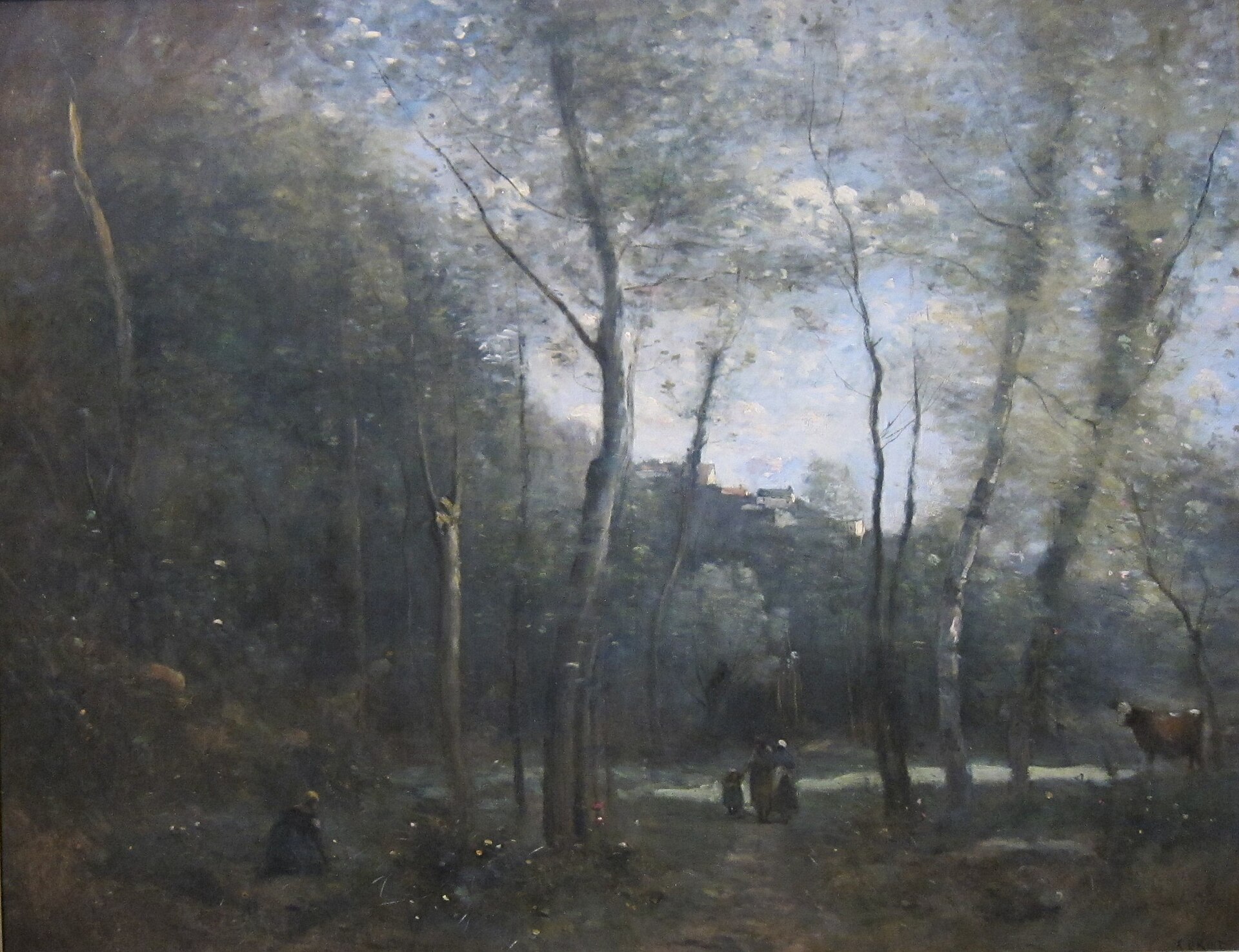
Souvenir of a Meadow at Brunoy. Jean-Baptiste Camille Corot, between circa 1855 and circa 1865. Wikimedia Commons. Public domain.