
Psalm 133
3 verses · Song of Ascents
It is like the dew of Hermon falling on the mountains of Zion. For there the LORD has bestowed the blessing of life forevermore.
Introduction
David, Brothers in Unity, Book 5: The return and the great Hallelujah, Poetry, Psalms Overview.
David wrote this short song for the pilgrim feasts, when families from every tribe crowded into one small city for a week. He had held twelve quarrelsome tribes together as one kingdom and knew what it cost. The song praises one thing, people living at peace with each other, and it does so with two pictures from worship and from farming. Listen for how both pictures move downward, from a head and from a mountain, and for the place the blessing comes to rest at the end.
Context
- Who
- Israelites from rival tribes and quarrelling families camped side by side for a week
- Where
- Jerusalem at a festival, packed with families from every tribe living on top of each other
- When
- The Songs of Ascents, brothers at the feast. Headed a song of ascents of David, which places it c. 1010 to 970 BC
Historical context
The heading assigns this psalm to David, who held twelve tribes together as one kingdom and knew what it cost. Brothers dwelling together had a legal meaning before it had a warm one. When a father died, sons could divide the family land or keep it undivided and work it together, which kept the farm viable and meant sharing a courtyard with the brother you argued with. The first picture is the anointing of the high priest, where the holy oil was poured on Aaron's head and ran down over the beard to the collar of his robes. The second picture is dew. Mount Hermon in the far north holds snow into the summer, and Judah's summers had no rain for months, so Hermon's dew falling on Zion is water arriving where it does not naturally come. Both images describe something poured out from the top that runs all the way down.
Significance
At the feasts the whole nation crowded into one small city, and old tribal grudges, property disputes and family feuds were all in the same streets for a week. The song says that when they manage to live together it is the same kind of thing as being anointed, and that Zion is where God commands the blessing of life forevermore.
This chapter in Jewish lifeWhat this chapter is in Jewish life and reading.
What is done
Psalm 133 is the fourteenth of the fifteen Songs of Ascents and the fourth of them to carry David's name. It is sung within the collection, whose setting this site records at /featured/psalms-of-ascent from Mishnah Middot 2:5 and Mishnah Sukkah 5:4. Its three verses praise brothers dwelling together, and the classical reading of them runs through the anointing of Aaron, so the psalm carries the priesthood as well as the household.
How it is read
Rashi reads the brothers as Israel with God in the Temple. When God dwells in the Temple with Israel, "who are called brothers and friends", He is together with them there (Rashi on Psalms 133:1:1, the Judaica Press complete Tanach with Rashi, translated by A. J. Rosenberg, CC-BY). He reads the oil as the oil with which Aaron was anointed, running from his head to his beard and to the mouth of his tunic, and sets the dew of Hermon beside it as a parallel: as the anointing oil is for greatness, so the dew of Zion is for glory and distinction for Israel. He then names the rabbinic reading and says where it sits. The rabbis explained the brothers dwelling together as Moses and Aaron, on the question of unlawful use of the anointing oil, in tractate Horayot 12a, and Rashi holds that reading to be allegory while "the primary meaning of the song of ascents is that it was said regarding the Temple" (Rashi on Psalms 133:2:2). Malbim reads the dew of Hermon as a blessing that reaches its destination through an intermediary, coming down for the sake of Zion and travelling by way of Hermon, and takes the tribes of Zebulun and Issachar as the same pattern. Metzudat David reads the same verse of the king and the people, saying that the inflow comes to Zion and "rests first on the king who rules there, and from there it is poured out on the rest of the people" (Metzudat David on Psalms 133:3:2, translated by Rabbi Mike Feuer, Jerusalem Anthology, CC-BY). Ibn Ezra and Radak comment on all three verses and stand as citations, at Ibn Ezra on Psalms 133:1:1 and Radak on Psalms 133:1:1.
What the rabbis say
The corpus records forty locators on this chapter, thirty-three Midrash and seven Talmud. The brothers of the first verse are taken up at Midrash Tehillim 133:1, Bamidbar Rabbah 18:9, Midrash Tanchuma, Korach 6:1, Sifra, Shemini, Mekhilta DeMiluim II 37, Horayot 12a:8 and Keritot 5b:26. The oil running down Aaron's beard is taken up at Shir HaShirim Rabbah 1:10:1, Kohelet Rabbah 7:1:1, Sifra, Tzav, Mekhilta DeMiluim I 10, Sifrei Bamidbar 117:2, Horayot 12a:7 and Keritot 5b:24. The dew of Hermon is taken up at Bereshit Rabbah 65:23, 66:3 and 97:3, Bamidbar Rabbah 8:9 and Keritot 5b:25. Each is a locator without text in the corpus.
Sources: Rashi, Rashi on Psalms 133:1:1, 133:2:1 and 133:2:2, the Judaica Press complete Tanach with Rashi, translated by A. J. Rosenberg, CC-BY; Malbim, Malbim on Psalms 133:3:1, translated by Rabbi Mike Feuer, Jerusalem Anthology, CC-BY; Metzudat David, Metzudat David on Psalms 133:3:1 and 133:3:2, Feuer translation, Jerusalem Anthology, CC-BY; Ibn Ezra, Ibn Ezra on Psalms 133:1:1, cited only, no English version in the corpus; Radak, Radak on Psalms 133:1:1, cited only; Babylonian Talmud, Horayot 12a, as Rashi cites it; Horayot 12a:7 and 12a:8, Keritot 5b:24, 5b:25 and 5b:26, Yoma 47a:10; Midrash, Midrash Tehillim 133:1, Bamidbar Rabbah 18:9 and 8:9, Midrash Tanchuma, Korach 6:1, Shir HaShirim Rabbah 1:10:1, Kohelet Rabbah 7:1:1, Sifra, Shemini, Mekhilta DeMiluim II 37, Sifra, Tzav, Mekhilta DeMiluim I 10, Sifrei Bamidbar 117:2, Bereshit Rabbah 65:23, 66:3 and 97:3; Mishnah, Middot 2:5 and Sukkah 5:4, as /featured/psalms-of-ascent records them; MannaFest, the Songs of Ascents, at /featured/psalms-of-ascent, 2026.
brothers live together in harmony!: The verse calls it good and pleasant that brothers live together, and the Hebrew says how twice. Spurgeon marked that doubling and called the thing a wonder seldom seen. The word behind harmony is yachad, together.
Psalms 133:1
“Behold how good and how pleasant it is for brethren to dwell together in unity. He says two things: good and pleasant. Martyrdom is good, but it is not pleasant: for it has its tortures and punishments, and there is always pain in torments, and certainly in pain there is no pleasantness. Behold how good and how pleasant. Again, pleasure is pleasant. For example, to eat sweet foods seems to be pleasant: for it drives one to lust.”
Jerome · written before 420 · Homily 45, on Psalm 132patristic
1 more voice on this verseWhat preachers and commentators have said about this verse, in their own words.
Psalms 133:1
“They are blessed of God, and therefore blessed indeed: There, where brethren dwell together in unity, the Lord commands the blessing, a complicated blessing, including all blessings. It is God's prerogative to command the blessing, man can but beg a blessing. Blessings according to the promise are commanded blessings, for he has commanded his covenant for ever.”
Matthew Henry · Commentary on the Whole Bible (1707-1721)puritan
Psalms 133:2-3
fine oil on the head: The oil is the anointing oil of Exodus 30:30, poured on Aaron, and it runs from the head to the collar. Dew off Hermon settles on the mountains of Zion, and the Hebrew verb behind bestowed is the one for command. What is given there is life forevermore.
Psalms 133:2
“Like ointment upon the head, which runs down upon the beard, the beard of Aaron. Oh, if there were time for us to discuss each detail, a day could not suffice us. We read in Exodus how the priestly ointment is prepared; then we read how there was another ointment, with which the kings were anointed. There was also another ointment with which the prophets were anointed. And why do I say more? All the ointments had their own distinctions and mysteries. Do we marvel about holy persons?”
Jerome · written before 420 · Homily 45, on Psalm 132patristic
2 more voices on this verse
Psalms 133:2
“It is like the precious ointment upon the head. In order that we may the better behold brotherly unity David gives us a resemblance, so that as in a glass we may perceive its blessedness. It has a sweet perfume about it, comparable to that precious ointment with which the first High Priest was anointed at his ordination. It is a holy thing, and so again is like the oil of consecration which was to be used only in the Lord's service.”
Charles Spurgeon · The Treasury of David, Vol. 7 (1885)Particular Baptist
Psalms 133:2
“Ointment - It is no less grateful and refreshing than that oil which was poured forth upon Aaron's head at the time of his consecration to the priestly office. Skirts - Not to the lower skirt or bottom of his sacerdotal garment, but to the upper skirt of it, or the mouth of it, as the Hebrew word properly signifies.”
John Wesley · Explanatory Notes upon the Old Testament (1765)evangelical
the dew of Hermon falling: Hermon is the high snow peak of the far north, and its dew falling on the mountains of Zion is a blessing brought far south. Like the oil running down Aaron's beard, the dew comes down from above. There is Zion, the home the LORD chose at Psalm 132:13.
Psalms 133:3
“As the dew of Hermon, and as the dew that descended upon the mountains of Zion. From the loftier mountains the moisture appears to be wafted to the lesser hills: the dews of Hermon fall on Zion. The Alpine Lebanon ministers to the minor elevation of the city of David; and so does brotherly love descend from the higher to the lower, refreshing and enlivening in its course. Holy concord is as dew, mysteriously blessed, full of life and growth for all plants of grace.”
Charles Spurgeon · The Treasury of David, Vol. 7 (1885)Particular Baptist
2 more voices on this verse
Psalms 133:3
“Like the dew of Hermon, which runs down upon Mount Zion. The dew of Hermon. We read a certain apocryphal book, that at the time when the sons of God descended to the daughters of men, they descended upon Mount Hermon, and there entered into a covenant, how they might come to the daughters of men, and join them to themselves. It is a most manifest book, and it is reckoned among the apocrypha, and the ancient interpreters have said some things about it: but we say this, not for authority, but for remembrance.”
Jerome · written before 420 · Homily 45, on Psalm 132patristic
Psalms 133:3
“As the dew of Hermon, and as the dew that descended upon the mountains of Zion,.... Hermon was a very high hill beyond Jordan; the Sidonians called it Sirion, and the Amorites Shenir, Deu 3:8; hence Shenir and Hermon are mentioned together, Son 4:8; and sometimes Sion or Seon, Deu 4:48; and is the Zion here intended; for the dew of Hermon could never descend on the mountain of Zion near Jerusalem, which was a hundred miles distant; besides Zion was but one mountain, these many.”
How this psalm is built
The form: A song of the ascents of David in which one statement is carried by two pictures and nothing else, as Spurgeon classes it.
The patterns in this chapter
| Device | What it does | Where to see it |
|---|---|---|
| How, twice in the first line | The Hebrew of verse 1 says how twice, once over good and once over pleasant. Charles Spurgeon marked that doubling and called the thing described a wonder seldom seen. The word behind harmony is yachad, together.Charles Spurgeon, The Treasury of David, Vol. 7, 1885, on Psalm 133:1. | Psalm 133:1 |
| The oil running down | Verse 2 says running down twice and follows the oil from the head to the beard to the collar of the robes. The Hebrew calls that collar the mouth of the robe. This is the sacred anointing oil of Exodus 30:30, poured on Aaron and his sons, so the picture is consecration rather than hospitality.Franz Delitzsch, Biblical Commentary on the Psalms, on Psalm 133:2. | Psalm 133:2 |
| Hermon falling on Zion | Verse 3 brings dew off Hermon in the far north down onto the mountains of Zion in the south, which is a distance of well over a hundred miles. The two ends of the country are put in one sentence, which is itself the unity the psalm is describing.Albert Barnes, Notes, Explanatory and Practical, on the Old and New Testaments (1832 to 1869), on Psalm 133:3. | Psalm 133:3 |
The structure
10 more paragraphs on the patterns
Three verses: a statement, then two pictures for it, and a final clause naming what Zion gives. The Hebrew of verse 1 says how twice, once over good and once over pleasant, and the word behind harmony is yachad, together.
Verse 2 says running down twice and follows the oil the whole length of the priest. Verse 3 brings the dew across the length of the country. Both pictures are about something that travels further than it should.
Across the canon
The oil of verse 2 is the anointing oil of Exodus 30:30, so the psalm reads the unity of brothers as something holy rather than merely pleasant.
The dew of verse 3 falls on the mountains of Zion, which is where the blessing of Psalm 128:5 and Psalm 134:3 comes from. Three psalms of the collection make Zion the source of what is given.
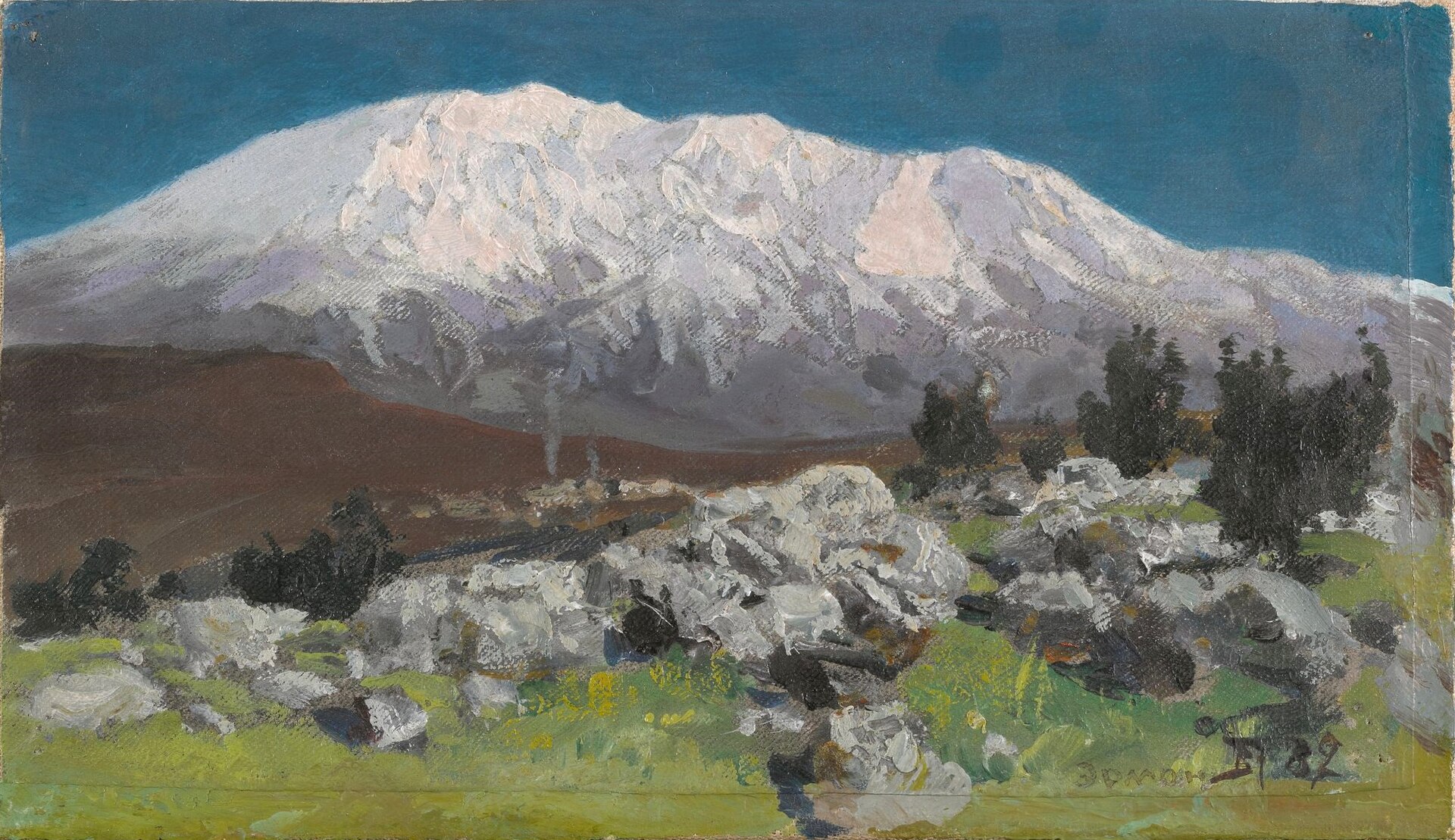
The banner the site carries for this psalm and for Psalm 121 is the same view of Mount Hermon, since both psalms take their picture from the hills a traveller in that country could see.
In the New Testament
No New Testament writer quotes this psalm. John 17:21 is the prayer of Jesus that those who believe may be one, which is the theme of verse 1 in the New Testament. The site's feature page on the prayer for unity holds it.
What is debated
What the brothers of verse 1 are is read two ways. One takes them as the tribes of Israel gathered at a feast, which the pilgrim setting supports and which makes the psalm political as well as domestic. The other takes them as brothers in one household who have not divided the family land, which was a live question in a country where an inheritance split between sons could ruin a farm. The Hebrew phrase covers both, and the two pictures that follow, a priesthood and a whole country, pull toward the wider reading.
Keep studying
Sources for this chapter
The summary
Jamieson, Fausset & Brown, Commentary Critical and Explanatory; John Calvin, Commentaries; John Wesley, Notes on the Old Testament and Matthew Henry, Complete Commentary.
The form and classifications
Charles Spurgeon, The Treasury of David, Vol. 7, 1885, on Psalm 133:1; Franz Delitzsch, Biblical Commentary on the Psalms, on Psalm 133:2 and Matthew Henry, Commentary on the Whole Bible, 1710, on Psalm 133:1.
The exposition
Albert Barnes, Notes on the Book of Psalms; Charles Spurgeon, The Treasury of David; Franz Delitzsch, Biblical Commentary on the Psalms and Matthew Henry, Commentary on the Whole Bible.
The painting
At the Foot of Mount Hermon. Vasily Polenov, 1882. Wikimedia Commons. Public domain.