
Psalm 101
8 verses · Royal psalm
I will ponder the way that is blameless— when will You come to me? I will walk in my house with integrity of heart.
Introduction
David, the King's Vow, Book 4: The LORD reigns, Poetry, Psalms Overview.
This psalm is a ruler's promise about the kind of house he will keep. The heading gives it to David, and the promises are those of a man with the power to choose his servants and to judge his city. He binds himself before he binds anyone else, starting with his own eyes and heart and only then turning to the people around him. Listen for the order of the promises, which moves outward from the heart to the household to the whole city, and for the one question he puts to God in the middle of them.
Context
- Who
- The king himself first, since every clause after verse 1 is a promise he makes about his own conduct
- What
- A king's vow about how he will rule his own heart, his household and his city.
- Where
- The royal house in Jerusalem, the city the psalm calls the city of the LORD.
- When
- The reign of David, about 1010 to 970 BC by the superscription.
- Why
- To set the terms of a just court, starting with the ruler's own conduct.
Historical context
Every clause after the first verse is I will or my eyes or my house, so the man binding himself is the man who will enforce the standard. Verses 6 and 7 describe appointments, since a king chose who would live in his household and who would minister to him, and the psalm makes integrity the qualification in a court where places were given for loyalty and family. The secret slanderer of verse 5 was a real danger to a man in office, because a court ran on private reports and a king who acted on them could destroy a household on one man's word. The morning of verse 8 is plural in the Hebrew, morning after morning, and 2 Samuel 15:2 and Jeremiah 21:12 show judgment given early in the day. The city of the LORD is Jerusalem, the king's residence and the place of the sanctuary at once, so cleansing it was a religious duty as well as a civil one.
Significance
For a people under a king, the psalm stated the terms they could expect, and the terms begin with the king's own eyes before they reach anyone else's conduct. The question inside verse 2, when will You come to me, told a hearer that the man making these promises was still waiting on God.
This chapter in Jewish lifeWhat this chapter is in Jewish life and reading.
What is done
Rashi reads the first verse of this psalm as the two blessings a Jew says over what comes to him. When God bestows kindness the blessing is "Blessed be He Who is good and does good", and when God performs judgment the blessing is "Blessed be the true Judge", and either way the singing is to the Lord (Rashi on Psalms 101:1:1, Rashi on Psalms, The Judaica Press complete Tanach with Rashi, translated by A. J. Rosenberg, CC-BY). The Babylonian Talmud is cited on this verse at Berakhot 60b:8, in the corpus of locators for the chapter.
How it is read
The psalm is read as a rule of life for a house rather than as a prayer of complaint. Rashi glosses the resolve of verse 2 as directing the thoughts to the way of integrity, and takes the walking within the house to mean walking with an upright heart "in private as well as in public" (Rashi on Psalms 101:2:1 and 101:2:2, same edition).
The refusals of verses 3 to 5 are then read as the choice of company. On the man of verse 5 Rashi writes that the psalmist cannot tolerate him "that he should be my friend, lest I learn from his deeds", which turns a king's policy into a rule any household can keep (Rashi on Psalms 101:5:1, same edition). Verse 8 he reads of the daily work of a king in Israel, cutting down the wicked little by little, those who are condemned to death (Rashi on Psalms 101:8:1).
Ibn Ezra, Radak and Metzudat David carry seventeen comments on this chapter for which Sefaria holds no English version, and they are cited by reference (Ibn Ezra on Psalms 101:1:1, Radak on Psalms 101:1:1 and the fifteen references beside them).
What the rabbis say
The corpus records forty places where the Midrash and the Talmud cite this psalm, thirty two under Midrash and eight under Talmud, and it carries the locator for each one with no text. Verse 5, on the man who slanders his neighbour in secret, draws the Babylonian Talmud four times over two pages of one tractate, at Arakhin 15b:7, 15b:12, 15b:13 and 16a:6, which is the tractate on the laws of the tongue.
The Talmud also reads the first verse at Berakhot 60b:8 and verse 7 at Chagigah 14b:8, and the Jerusalem Talmud cites verse 1 at Berakhot 9:5:3 and verse 2 at Taanit 3:11:4. Midrash Tehillim treats the psalm at 101:1 and 101:2, Vayikra Rabbah reads verse 1 at 24:2, and Bamidbar Rabbah reads verse 3 at 1:12 and 7:2 and verse 6 at 3:3 and 6:2. The site reports where the rabbis cite the verse and reports no saying, because the locator carries none.
Sources: Rashi, Rashi on Psalms 101, in The Judaica Press complete Tanach with Rashi, translated by A. J. Rosenberg, CC-BY; Ibn Ezra, Radak and Metzudat David, their comments on Psalms 101, cited by reference; Sefaria holds no English version; The Midrash and the Talmud, the forty locators on Psalms 101 in scripts/data/sources/sefaria/psalms/101.json.
Psalms 101:1-2
loving devotion and justice: The song takes in the LORD's loving devotion and His justice. The singer then breaks off to ask when the LORD will come to him. The vow he makes in the meantime covers his own house first, that he will walk there with integrity of heart.
Psalms 101:1
“I will sing of mercy and judgment. He would extol both the love and the severity, the sweets and the bitters, which the Lord had mingled in Iris experience; he would admire the justice and the goodness of the Lord. Such a song would fitly lead up to godly resolutions as to his own conduct, for that which we admire in our superiors we naturally endeavour to imitate. Mercy and judgment would temper the administration of David, because he had adoringly perceived them in the dispensations of his God.”
Charles Spurgeon · The Treasury of David, Vol. 4 (1874)Particular Baptist
1 more voice on this verseWhat preachers and commentators have said about this verse, in their own words.
Psalms 101:1
Mercy and judgment I will sing to you, O Lord. Let sinners hear of mercy, those who despair of their salvation, those who are doing penance; let those who scorn hear of judgment, who say: "The Lord is merciful, let us sin, he pardons us."
Jerome · written before 420 · Homily 27, on Psalm 100patristic
the way that is blameless—: Ponder translates a Hebrew verb for giving heed and acting wisely. Blameless is tamim, the word the LORD used at Genesis 17:1 when He told Abram to walk before Him and be blameless. Verse 6 asks the same way of every servant in the king's house.
Psalms 101:2
“Note, We must all resolve to walk by the rules of Christian prudence in the ways of Christian piety. We must never turn aside out of the perfect way, under pretence of behaving ourselves wisely; but, while we keep to the good way, we must be wise as serpents. A good prayer: O when wilt thou come unto me?”
Matthew Henry · Commentary on the Whole Bible (1707-1721)puritan
2 more voices on this verse
Psalms 101:2
“I will behave myself wisely in a perfect way. To be holy is to be wise; a perfect way is a wise way. David's resolve was excellent, but his practice did not fully tally with it. Alas! he was not always wise or perfect, but it was well that it was in his heart. A king had need be both sage and pure, and, if he be not so in intent, when he comes to the throne, his after conduct will be a sad example to his people.”
Charles Spurgeon · The Treasury of David, Vol. 4 (1874)Particular Baptist
Psalms 101:2
“I will - I will manage all my affairs with wisdom and integrity. When - God is often said in scripture to come to men, when he fulfills a promise to them.”
John Wesley · Explanatory Notes upon the Old Testament (1765)evangelical
Psalms 101:3-5
no worthless thing before my eyes: He begins with his eyes and what he sets before them. A perverse heart is sent away next, and evil is something he refuses to learn. Other men come last, the neighbor who slanders in secret and the man whose eyes are haughty and whose heart is proud.
Psalms 101:3
“I will set no wicked thing before mine eyes. I will neither delight in it, aim at it or endure it. If I have wickedness brought before me by others I will turn away from it, I will not gaze upon it with pleasure.”
Charles Spurgeon · The Treasury of David, Vol. 4 (1874)Particular Baptist
1 more voice on this verse
Psalms 101:3
“I set no unjust thing before my eyes. I put nothing before the Lord, nor did I consent to iniquity; but I was wholly turned to God. I have hated those who commit transgressions. Whether it was my father, or my mother, or brother, or sister, or friend: nevertheless, if he had turned aside from the fear of the Lord, I held him in hatred, and I did not approach him at all. I did not set kinship or friendship before devotion to God.”
Jerome · written before 420 · Homily 27, on Psalm 100patristic
A perverse heart shall depart: Perverse translates iqqesh, a word for something crooked or twisted. Proverbs 11:20 uses the same phrase for the heart the LORD detests. To know evil here is to keep company with it, and the king refuses that acquaintance.
Psalms 101:4
“A depraved heart did not cling to me. There was in me nothing difficult or anything perverse, but fairness and justice. As the malignant one turned aside from me, I did not know him: that is, if he was a friend to me or a neighbor, whether a bishop or a presbyter, or one established in any rank whatever: nevertheless, if he perverted his ways, I so fled from him that I made no mention of him at all.”
Jerome · written before 420 · Homily 27, on Psalm 100patristic
1 more voice on this verse
Psalms 101:4
“A froward heart shall depart from me. He refers both to himself and to those round about him; he would neither be crooked in heart himself, nor employ persons of evil character in his house; if he found such in his court he would chase them away. He who begins with his own heart begins at the fountain head, and is not likely to tolerate evil compamons. We cannot turn out of our family all whose hearts are evil, but we can keep them out of our confidence, and let them see that we do not approve of their ways.”
Charles Spurgeon · The Treasury of David, Vol. 4 (1874)Particular Baptist
Whoever slanders his neighbor in secret: The Hebrew verb for put to silence also means cut off. Slander was forbidden among the people at Leviticus 19:16, and here the king enforces that law against the whisperer. Haughty eyes head the list of things the LORD hates at Proverbs 6:17.
Psalms 101:5
“And Jezebel was able to injure the most religious Naboth by her false accusations; but then it was the wicked and apostate Ahab who listened to her. But the most holy David, whose example you ought to follow, as all pray that you may, does not favor such people but was apt to turn away from them and avoid them, as raging dogs. He says, "Whoever secretly slanders his neighbor, him will I destroy." For he kept the commandment that says, "You shall not receive a false report." And false are the reports of these people in your sight.”
Athanasius of Alexandria · written before 373 · Defense Before Constantius 20patristic
1 more voice on this verse
Psalms 101:5
“Whose privily slandereth his neighbor, him will I cut off. He had known so bitterly the miseries caused by slanderers that he intended to deal severely with such vipers when he came into power, not to revenge his own ills, but to prevent others from suffering as he had done.”
Charles Spurgeon · The Treasury of David, Vol. 4 (1874)Particular Baptist
Psalms 101:6-7
faithful of the land: The eyes that turned from worthless things now pick out the faithful of the land. They are given a place in his house, and the man who walks in integrity is given work in his service. The deceiver and the liar are kept out.
Psalms 101:6
“Mine eyes shall be upon the faithful of the land, that they may dwell with me. He would seek them out, engage their services, take care of them, and promote them to honour: this is a noble occupation for a king, and one which will repay him infinitely better than listening to the soft nothings of flatterers. It would be greatly for the profit of us all if we chose our servants rather by their piety than by their cleverness; he who gets a faithful servant gets a treasure, and he ought to do anything sooner than part with him.”
Charles Spurgeon · The Treasury of David, Vol. 4 (1874)Particular Baptist
2 more voices on this verse
Psalms 101:6
“My eyes were upon the faithful of the earth, that they might sit with me. He did not say the rich, or emperors, or bishops, or presbyters, or deacons, but the faithful: with these I sat. A bishop, a holy man, can also say this: that I did not ordain as presbyter the man who was obsequious to me, or my kinsman, but the one whom I knew to be faithful. And again the same man can say: that I held all my clerics and laity to be faithful.”
Jerome · written before 420 · Homily 27, on Psalm 100patristic
Psalms 101:6
“He that walks in a perfect way, that makes conscience of what he says and does, shall serve me. The kingdom must be searched for honest men to make courtiers of; and, if any man is better than another, he must be preferred. This was a good resolution of David's; but either he did not keep to it or else his judgment was imposed upon when he made Ahithophel his right hand.”
Matthew Henry · Commentary on the Whole Bible (1707-1721)puritan
shall stand in my presence: Dwell repeats the word of verse 6, where the faithful are brought to dwell with the king. To stand before a king was to serve at his court, like servants who stood before Solomon at 1 Kings 10:8. Psalm 15:1 to 2 sets the same rule for the LORD's tent.
Psalms 101:7
“He that worketh deceit shall not dwell within my house,.... Flatterers, sycophants, tricking and fraudulent persons, who seek to supplant others, and get into their places; these should lose the favour they had, when detected. So hypocritical persons, that have only a form of godliness, a mask of religion, and false teachers that lie in wait to deceive; and antichrist, whose coming was with all deceivableness of unrighteousness; who has seduced men by his miracles, doctrines, and sorceries; these shall have no place, neither in Christ's house below nor above.”
2 more voices on this verse
Psalms 101:7
“He that worketh deceit shall not dwell within my house. He had power to choose his courtiers, and he meant to exercise it. Deceit among most orientals is reckoned to be a virtue, and is only censured when it is not sufficiently cunning, and therefore comes to be found out; it was therefore all the more remarkable that David should have so determinedly set his face against it.”
Charles Spurgeon · The Treasury of David, Vol. 4 (1874)Particular Baptist
Psalms 101:7
“Herein David was a man after God's own heart, for a proud look and a lying tongue are things which God hates; and he was also a type of Christ, who will, in the great day, banish from his presence all that love and make a lie, Rev. xxii.”
Matthew Henry · Commentary on the Whole Bible (1707-1721)puritan
Every morning I will remove: The vow now reaches the city of the LORD. What he promised inside his own house he promises for the whole land, that every evildoer will be cut off from the city. The word for morning is plural in the Hebrew, morning after morning.
Psalms 101:8
“I will early destroy all the wicked of the land, Of the land of Israel, signifying that he would make a general reformation throughout the kingdom; that as soon as wicked men were discovered in any part of the land, he would cut them off, would take the first opportunity of punishing them as the law directs: or he would do it "in morning" (s), as in the Hebrew text; that is, every morning, constantly and continually; (s) לבקרים "in matutinis", Montanus, Vatablus, Junius & Tremellius, Piscator, Cocceius; so Ainsworth.”
2 more voices on this verse
Psalms 101:8
“That I may cut off all wicked doers from the city of the Lord. As the kingdom of David was only a faint image of the kingdom of Christ, we ought to set Christ before our view; who, although he may bear with many hypocrites, yet as he will be the judge of the world, will at length call them all to on account, and separate the sheep from the goats.”
Charles Spurgeon · The Treasury of David, Vol. 4 (1874)Particular Baptist
Psalms 101:8
“That which he aimed at was not only the securing of his own government and the peace of the country, but the honour of God in the purity of his church, That I may cut off all wicked doers from the city of the Lord. Not Jerusalem only, but the whole land, was the city of the Lord; so is the gospel-church.”
Matthew Henry · Commentary on the Whole Bible (1707-1721)puritan
How this psalm is built
The form: A vow of mercy and justice, in which a king engages himself and his household to walk by the rule of it, as Henry classes it.
The patterns in this chapter
| Device | What it does | Where to see it |
|---|---|---|
| The vow spoken in the first person throughout | Every clause of the psalm after verse 1 is I will or I hate or my eyes, and no one else speaks. Matthew Henry reads the form as a self binding rather than a proclamation, since the singer engages himself and his household to walk by the rule of it.Matthew Henry, Commentary on the Whole Bible, 1710, on Psalm 101:8. | Psalm 101:2, Psalm 101:3, Psalm 101:6, Psalm 101:8 |
| The circles that widen | The vow moves outward one ring at a time: his eyes at verse 3, his heart at verse 4, his neighbours at verse 5, his household at verses 6 and 7, and the city of the LORD at verse 8. Spurgeon reads the last ring as the reason for the first, since the cleansing had to begin where the king himself stood.Charles Spurgeon, The Treasury of David, Vol. 4, 1874, on Psalm 101:8. | Psalm 101:3, Psalm 101:4, Psalm 101:6, Psalm 101:8 |
| The morning that is plural | The word for morning in verse 8 is plural in the Hebrew, morning after morning, so the vow is a routine rather than a single day's purge. Spurgeon notes from 2 Samuel 15:2 and Jeremiah 21:12 that judges in Israel ordinarily held their sessions in the morning, which is the custom the plural is describing.Charles Spurgeon, The Treasury of David, Vol. 4, 1874, on Psalm 101:8. | Psalm 101:8 |
| The break in the middle of the vow | Verse 2 stops the resolutions for one clause and asks when will You come to me, which is the only question in the psalm. The vow resumes in the same verse, so the question stands inside the promise rather than before it.John Wesley, Explanatory Notes upon the Old Testament, 1765, on Psalm 101:2. | Psalm 101:2 |
Its historical value
9 more paragraphs on the patterns
The psalm describes a working court. Verse 6 has the king choosing who will live with him and who will minister to him, and verse 7 keeps the liar out of his presence, which is the language of appointments rather than of morals in general. Spurgeon reads the morning of verse 8 through 2 Samuel 15:2, where Absalom stands beside the gate in the morning to intercept those coming for judgment, and Jeremiah 21:12, where the house of David is told to administer justice every morning. The picture is of a king hearing cases at the start of the day.
The debated point
Whether the psalm is a standard David met or a standard he failed is read both ways by the same commentators. Matthew Henry says that in this David was a man after God's own heart, since a proud look and a lying tongue are things God hates, and in the same place calls him a type of Christ who will banish all that offend. Spurgeon puts the other half plainly, that the kingdom of David was only a faint image of the kingdom of Christ, so the psalm is read as a standard no son of David reached. The two readings are held together in the site's presentation rather than set against each other.
The prophecy
No New Testament writer quotes this psalm. What it carries instead is the pattern the New Testament fills: a king whose house is clean, who chooses the faithful of the land to dwell with him, and who removes the wicked from the city. Spurgeon draws the line himself, that Christ bears with the wicked now and will not always.
In the Psalter
Psalm 101 stands between the doxology of Psalm 100 and the lament of Psalm 102, and it is the first psalm since Psalm 86 to be about a man rather than about the reign of God. Its subject returns at Psalm 132, where the promises to David's house are set out.
The door
The Davidic covenant carries the house this vow is made for, and The king carries the standard the psalm sets.
Keep studying
Studies1
Sources for this chapter
The summary
Jamieson, Fausset & Brown, Commentary Critical and Explanatory; John Calvin, Commentaries; John Wesley, Notes on the Old Testament and Matthew Henry, Complete Commentary.
The form and classifications
Charles Spurgeon, The Treasury of David, Vol. 4, 1874, on Psalm 101:8; John Wesley, Explanatory Notes upon the Old Testament, 1765, on Psalm 101:1 and Matthew Henry, Commentary on the Whole Bible, 1710, on Psalm 101:8.
The exposition
Albert Barnes, Notes on the Book of Psalms; Charles Spurgeon, The Treasury of David; Jamieson, Fausset & Brown, Commentary Critical and Explanatory on the Whole Bible; John Gill, Exposition of the Old Testament and Matthew Henry, Commentary on the Whole Bible.
The painting
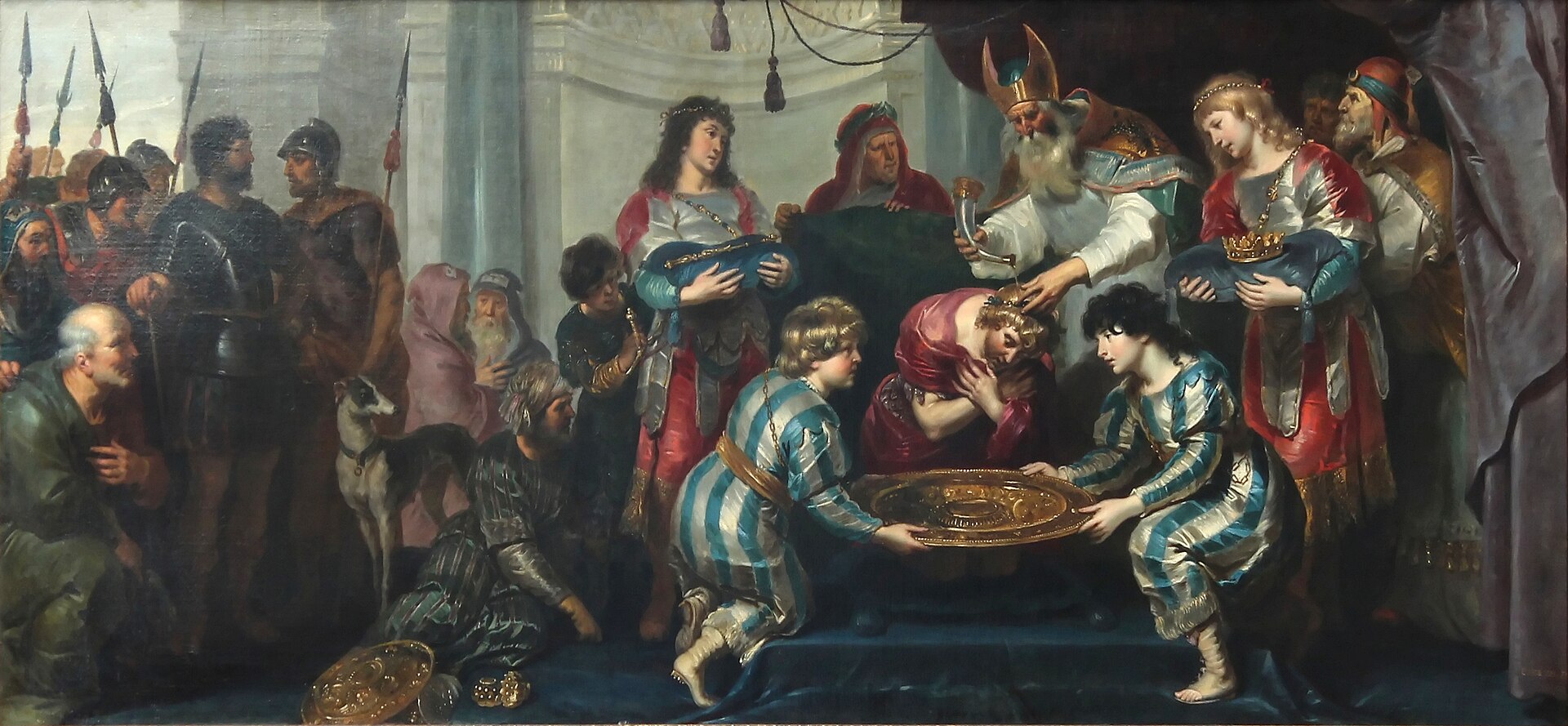
The anointing of Solomon. Cornelis de Vos, 17th century. Wikimedia Commons. Public domain.