
Psalm 100
5 verses · Hymn of thanksgiving
Make a joyful noise to the LORD, all the earth.
Introduction
Author unstated, the Psalm of Thanksgiving, Book 4: The LORD reigns, Poetry, Psalms Overview.
This short psalm is headed as a psalm for thanksgiving, and it names no writer. It closes the group of psalms that proclaim the LORD as King, and it turns their announcement into an invitation. The whole earth is asked to come and worship, as Israel came up through the temple gates. It gives one reason for coming: the people belong to the God who made them. Listen for the commands that crowd its first lines, and for the promise at the end that reaches people not yet born. The church has sung it for centuries as a hymn of entrance.
Context
- Who
- All the earth, addressed in the first line, and the people who are the sheep of His pasture
- What
- A short hymn of thanksgiving inviting the whole earth to enter God's courts with praise.
- Where
- The approach to the temple in Jerusalem, through its gates and into its courts.
- When
- Undated; its Hebrew title calls it a psalm for thanksgiving.
- Why
- To give every worshipper the reason for coming: the LORD made His people, and they belong to Him.
Historical context
The psalm describes a route. Verse 4 puts thanksgiving at the gates and praise in the courts, which is the order a worshipper met them in when he came up to the temple, the outer entrance first and the inner space after it. The sheep of His pasture in verse 3 needed no explaining in Judah's hills, which were grazed by flocks under the care of one man who led them out and brought them back. Know that the LORD is God restates the confession of Deuteronomy 4:35, that the LORD is God and there is no other besides Him. Verse 3 carries a difference between the Hebrew as written and the Hebrew as read, and the English versions divide on it.
Significance
The psalm gave a congregation the shortest account of why they were there: they had been made by the God they were coming to, and they belonged to Him. Its last clause reached past the people singing it, because faithfulness to all generations was a promise made about people not yet born.
This chapter in Jewish lifeWhat this chapter is in Jewish life and reading.
What is done
The title of this psalm names an offering, and Rashi reads it as the psalm said over that offering. He writes that it is a song "for thanksgiving, to recite it over thanksgiving offerings" (Rashi on Psalms 100:1:1, Rashi on Psalms, The Judaica Press complete Tanach with Rashi, translated by A. J. Rosenberg, CC-BY). The use he records belongs to the temple, where the offering was brought.
How it is read
Rashi reads the command of verse 2 as a command with a reason attached, and he draws the difference between Israel and the nations out of it. Israel serves with joy because God "recompenses you with reward for your work", where the heathens have no reason for joy in their worship because their deities give them no reward (Rashi on Psalms 100:2:1, same edition). The line is polemical in its own setting, and this site reports it as Rashi wrote it rather than smoothing it.
On verse 3 he reads the making of the people back to a point before they existed, glossing the words that He made us and we are His with the phrase "when we were not in the world" (Rashi on Psalms 100:3:1). On verse 5 he takes the faithfulness of God as the keeping of a promise, and holds that every expression of truth and faith means the realization of a promise (Rashi on Psalms 100:5:1).
This chapter carries the fullest bench of untranslated commentary in these thirty psalms after Psalm 98. Ibn Ezra, Malbim, Metzudat David, Radak and one further comment of Rashi give twenty entries for which Sefaria holds no English version, and all five commentators are present on every verse from 1 to 5. They are cited by reference (Ibn Ezra on Psalms 100:1:1, Malbim on Psalms 100:1:1, Metzudat David on Psalms 100:1:1, Radak on Psalms 100:1:1 and the references beside them).
What the rabbis say
The corpus records thirteen places where the Midrash and the Talmud cite this psalm, ten under Midrash and three under Talmud, which is the smallest count in these thirty chapters. It carries the locator for each one with no text.
The Babylonian Talmud cites the first verse at Sanhedrin 43a:26, the Jerusalem Talmud cites it at Shevuot 1:5:2, and Tractate Soferim reads verse 3 at 6:6. Midrash Tehillim treats the psalm at 100:1, 100:2 and 100:3, and reads its verses from two other psalms at 66:1 and 89:1. Bereshit Rabbah reads verse 3 at 100:1, and Midrash Tanchuma reads the first two verses at Noach 19:2 and 19:3. The site reports where the rabbis cite the verse and reports no saying, because the locator carries none.
Sources: Rashi, Rashi on Psalms 100, in The Judaica Press complete Tanach with Rashi, translated by A. J. Rosenberg, CC-BY; Ibn Ezra, Malbim, Metzudat David and Radak, their comments on Psalms 100, cited by reference; Sefaria holds no English version; The Midrash and the Talmud, the thirteen locators on Psalms 100 in scripts/data/sources/sefaria/psalms/100.json.
Psalms 100:1-2
Make a joyful noise to the LORD: The order to make a joyful noise, all the earth, stands here as it stands at Psalm 98:4. Serving the LORD is done with gladness, and the worshiper walks into His presence with a song. Worship here is an approach to a person.
Psalms 100:1
“Make a joyful noise unto the Lord, all ye lands. This is a repetition of Ps 98:4. The original word signifies a glad shout, such as loyal subjects give when their king appears among them. Our happy God should be worshipped by a happy people; a cheerful spirit is in keeping with his nature, his acts, and the gratitude which we should cherish for his mercies. In every land Jehovah's goodness is seen, therefore in every land should be be praised. Nearer will the world be in its proper condition till with one unanimous shout it adores the only God.”
Charles Spurgeon · The Treasury of David, Vol. 4 (1874)Particular Baptist
1 more voice on this verseWhat preachers and commentators have said about this verse, in their own words.
Psalms 100:1
“But, if we take the foregoing psalm to be (as we have opened it) a call to the Jewish church to rejoice in the administration of God's kingdom, which they were under (as the four psalms before it were calculated for the days of the Messiah), this psalm, perhaps, was intended for proselytes, that came over out of all lands to the Jews' religion.”
Matthew Henry · Commentary on the Whole Bible (1707-1721)puritan
Serve the LORD with gladness: Serve is the word for a servant's work and also for worship at the sanctuary. The service asked for is done gladly, with joyful songs. Coming into His presence is a walk into the temple courts, singing.
Psalms 100:2
“Serve the Lord with gladness. "Glad homage pay with awful mirth." He is our Lord, and therefore he is to be served; he is our gracious Lord, and therefore to be served with joy. The invitation to worship here given is not a melancholy one, as though adoration were a funeral solemnity, but a cheery gladsome exhortation, as though we were bidden to a marriage feast. Come before his presence with singing. We ought in worship to realise the presence of God, and by an effort of the mind to approach him.”
Charles Spurgeon · The Treasury of David, Vol. 4 (1874)Particular Baptist
1 more voice on this verse
Psalms 100:2
"Serve the Lord with gladness," for the kingship of our God and Savior has nothing of the harsh tyranny of the devil; rather, his lordship is mild and loving.
Theodoret of Cyrus · written before 458 · Commentary on the Psalms 100:1patristic
Know that the LORD is God: is the confession of Deuteronomy 4:35. The verse grounds it in ownership: He made this people, and the people belong to Him. Sheep of His pasture puts the LORD in the shepherd's place, as at Psalm 23:1 and Psalm 80:1.
Psalms 100:3
“Know ye that the Lord, he is God. Our worship must be intelligent. We ought to know whom we worship and why. "Man, know thyself, "is a wise aphorism, yet to know our God is truer wisdom; and it is very questionable whether a man can know himself until he knows his God. Jehovah is God in the fullest, most absolute, and most exclusive sense, he is God alone; to know him in that character and prove our knowledge by obedience, trust, submission, zeal, and love is an attainment which only grace can bestow.”
Charles Spurgeon · The Treasury of David, Vol. 4 (1874)Particular Baptist
Psalms 100:4-5
Enter His gates with thanksgiving: Gates first, then courts, so the verse walks the worshiper in from the outside, thanksgiving at the gate and praise further in. Verse 5 gives the reason in three clauses: the LORD is good, He keeps His loving devotion forever, and His faithfulness holds for every generation.
Psalms 100:4
“Enter into his gates with thanksgiving. To the occurrence of the word thanksgiving in this place the Psalm probably owes its Title — In all our public service the rendering of thanks must abound; it is like the incense of the temple, which filled the whole house with smoke. Expiatory sacrifices are ended, but those of gratitude will never be out of date. So long as we are receivers of mercy we must be givers of thanks. Mercy permits us to enter his gates; let us praise that mercy.”
Charles Spurgeon · The Treasury of David, Vol. 4 (1874)Particular Baptist
His loving devotion endures forever: Goodness comes first, and from it the LORD's loving devotion, hesed in Hebrew, which lasts forever. His faithfulness continues to all generations, those not yet born. Israel sang this line again at Psalm 106:1 and 107:1.
Psalms 100:5
“For the Lord is good. This sums up his character and contains a mass of reasons for praise. He is good, gracious, kind, bountiful, loving; yea, God is love. He who does not praise the good is not good himself. The kind of praise inculcated in the Psalm, viz., that of joy and gladness, is most fitly urged upon us by an argument from the goodness of God. His mercy is everlasting. God is not mere justice, stern and cold; he has bowels of compassion, and wills not the sinner's death.”
Charles Spurgeon · The Treasury of David, Vol. 4 (1874)Particular Baptist
How this psalm is built
The form: A psalm of confession, in which the whole earth is exhorted to jubilate to the Lord, as Hippo classes it.
The patterns in this chapter
| Device | What it does | Where to see it |
|---|---|---|
| Seven commands and one statement | Make a joyful noise, serve, come, know, enter, give thanks and bless are all imperatives, and the only sentence in the psalm that is not a command is verse 3, that the LORD is God and made us. The psalm is built so that the one statement carries all seven orders.Matthew Henry, Commentary on the Whole Bible, 1710, on Psalm 100:3. | Psalm 100:1, Psalm 100:2, Psalm 100:3, Psalm 100:4 |
| Gates first, then courts | Verse 4 walks the worshipper in from the outside, thanksgiving at the gate and praise further in. The two nouns are the two stages of an approach to the temple, so the verse describes a route rather than repeating itself.Jamieson, Fausset and Brown, Commentary Critical and Explanatory on the Whole Bible, 1871, on Psalm 100:4. | Psalm 100:4 |
| The three clauses of the reason | Verse 5 gives the ground in three clauses that widen as they go: the LORD is good, His loving devotion endures forever, and His faithfulness continues to all generations. The last clause reaches the generations still to come, so the psalm ends past its own singers.Matthew Henry, Commentary on the Whole Bible, 1710, on Psalm 100:5. | Psalm 100:5 |
Where it comes from
7 more paragraphs on the patterns
Know that the LORD is God is the confession of Deuteronomy 4:35, where Israel is told that the LORD is God and there is no other besides Him. Sheep of His pasture puts the LORD in the shepherd's place as Psalm 23:1 and Psalm 80:1 do, and Psalm 95:7 uses the same words three psalms earlier.
In the Psalter
The psalm closes the run that began at Psalm 93 and it is the shortest of them. Matthew Henry reads Psalm 99 as a call to the Jewish church to rejoice in the kingdom it was under, and this psalm as the wider call that follows it. Its first line repeats the first line of Psalm 98:4, which is how the group ends where it has been.
The debated point
Verse 3 carries a known difference between the Hebrew text as written and the Hebrew as read. The King James and the Darby in this store read it is he that hath made us, and not we ourselves. The American Standard, Young's Literal and the Berean Standard Bible read it is He who made us, and we are His. The difference is one Hebrew word that sounds the same under either spelling. Both readings say the same thing about who made the people, and they differ over what the second half adds, so the site carries the store's reading and names the other rather than deciding between them.
The door
The good shepherd carries the picture verse 3 ends on, and The fear of the LORD carries the knowing that verse 3 commands.
Keep studying
Sources for this chapter
The summary
Jamieson, Fausset & Brown, Commentary Critical and Explanatory; John Calvin, Commentaries; John Wesley, Notes on the Old Testament and Matthew Henry, Complete Commentary.
The form and classifications
Adam Clarke, Commentary on the Bible, 1832, on Psalm 100:1; Augustine of Hippo, Exposition on Psalm 100, c. 430 and Matthew Henry, Commentary on the Whole Bible, 1710, on Psalm 100:2.
The exposition
Albert Barnes, Notes on the Book of Psalms; Charles Spurgeon, The Treasury of David; Franz Delitzsch, Biblical Commentary on the Psalms; John Gill, Exposition of the Old Testament; John Wesley, Explanatory Notes upon the Old Testament and Matthew Henry, Commentary on the Whole Bible.
The painting
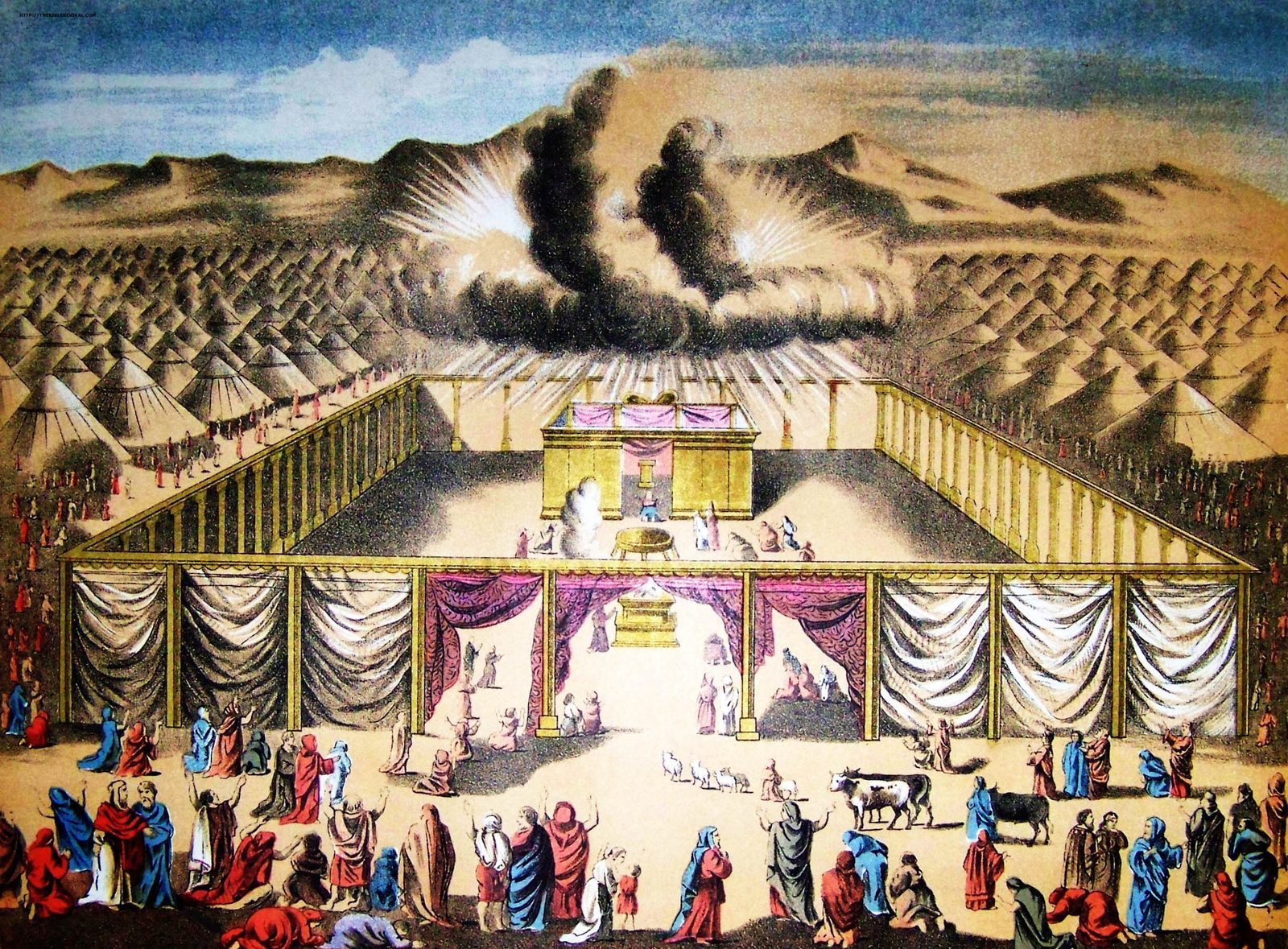
The Tabernacle in the Wilderness. illustrators of the 1890 Holman Bible, 1890. Wikimedia Commons. Public domain.