
Proverbschapter 16
33 verses · Solomon and others · 10th to 5th century BC · Wisdom and poetry
He who is slow to anger is better than a warrior, and he who controls his temper is greater than one who captures a city.
Introduction
Solomon and others, Wisdom and poetry, Proverbs Overview.
This chapter comes from the long run of two-line sayings the book gives to Solomon, and it was shaped for men who served a king or stood before one. Its opening verses name the LORD in nearly every line, and the later verses turn to the court, the market and the street. Each saying stands on its own, so the hearer takes one at a time and weighs it. Listen for the steady pairing of a man's plans with God's purposes, and for the sayings about kings set beside them. The chapter asks who really decides how a day's work turns out.
Context
- Who
- Men who served the king or came before him
- What
- Two-line sayings from Solomon's collection on the LORD's rule over human plans, on kings, on pride and on speech.
- Where
- The royal court in Jerusalem, where verdicts were given and lots were cast.
- When
- The reign of Solomon, about 970 to 931 BC; the book names him at Proverbs 10:1.
- Why
- To teach those who plan and govern that the LORD weighs their motives and decides the outcome.
Historical context
"The lot is cast into the lap; but the whole disposing thereof is of the LORD." Casting lots was normal Israelite procedure, not gambling. Land was divided by lot, priestly duties were assigned by lot, and the high priest carried the Urim and Thummim in the breastpiece for exactly this purpose. The lot was thrown into the fold of a garment so nobody could see or steer it, and this proverb says God steers it.
Show the rest of the historical context, 3 more paragraphs
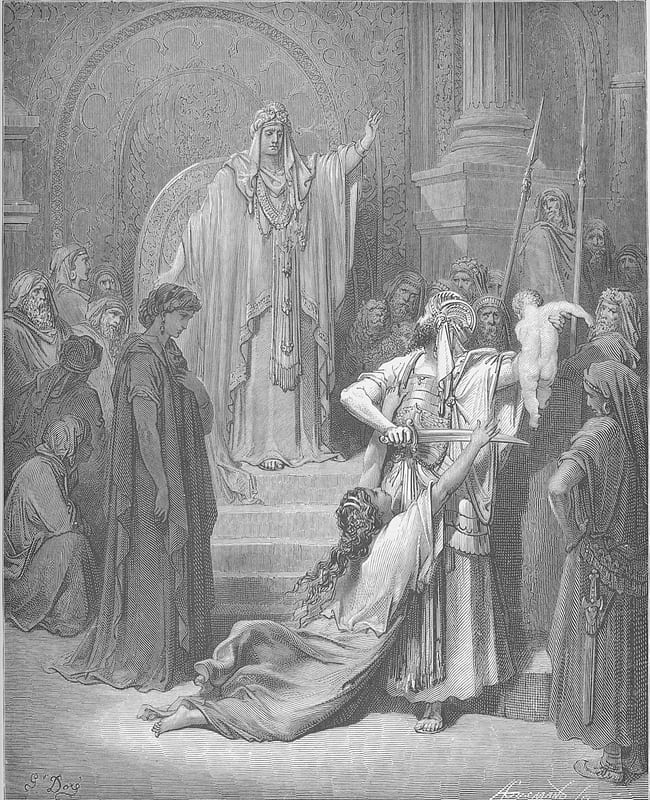
"A divine sentence is in the lips of the king: his mouth transgresseth not in judgment" describes the king as the final court of appeal. Israel's king was expected to render decisions no lower court could, the scene of Solomon and the two women and one living child is exactly this office in action. The line is a statement of the ideal, and the chapter immediately fences it: "it is an abomination to kings to commit wickedness."
"All the weights of the bag are his work" ties the marketplace back to God. The standard weights that a trader carried were, in principle, set by royal or sanctuary standard, and the proverb says behind that standard stands the LORD himself.
"The hoary head is a crown of glory, if it be found in the way of righteousness." Life expectancy was short and old age was rare; a white-headed man in the gate carried authority simply by having survived. The proverb adds one condition to the honour.
Significance
Courtiers heard "a man's heart deviseth his way: but the LORD directeth his steps" in a palace where careers were made and unmade by planning and positioning. It relocated the decisive vote.
Show the rest of the significance, 1 more paragraph
And "pride goeth before destruction, and an haughty spirit before a fall" was, in that setting, professional advice as much as spiritual. Officials who rose fast in an ancient court usually fell the same way.
This chapter in Jewish lifeWhat this chapter is in Jewish life and reading.
What is done
No public reading in the synagogue is drawn from this chapter. The site's own table in src/lib/hebraic/readings.ts was probed for this lane over Proverbs 16 to 31. It printed parashot total 0, haftarah uses total 0 and 0 chapters with a synagogue reading. It printed null for a festival reading of the book. The same probe printed 54 weekly portions and 6 festival readings in the table as a whole. The corpus ties no custom of the home or the synagogue to this chapter, so this part records the absence.
The chapter is met in the study of the Midrash and the Talmud instead. The corpus links it to twenty-two collections. The two it cites most often here are Bereshit Rabbah and Bamidbar Rabbah.
How it is read
Rashi is quoted here from The Judaica Press complete Tanach with Rashi, translated by A. J. Rosenberg, which Sefaria reports as CC-BY. Every quotation is held to fifty words or fewer because the translation is modern. Rashi reads the opening verses as the line between what a person plans and what the LORD weighs. A man "arranges his counsel and his words in his heart" (Rashi on Proverbs 16:1:1). The Lord "counts the spirits and counts the hearts; who is the good one, and who is the bad one" (Rashi on Proverbs 16:2:1). On the third verse he gives two readings. The first is "Roll and cast your necessities upon Him, and your plans will be established", and the second is "pray to Him for all your necessities" (Rashi on Proverbs 16:3:1). On the fourth he gives two senses of the Hebrew, that God made everything for His praise and that "His work testifies concerning Him". He names his source for both as the Aggadah of Psalms, Midrash Tehillim 19:1 (Rashi on Proverbs 16:4:1).
The kings of the chapter are read as judges and as God. The king of the tenth verse is "a wise man sitting in judgment" (Rashi on Proverbs 16:10:1), and for the kings of the twelfth, who are judges, wickedness "is not proper" (Rashi on Proverbs 16:12:1). The balance and scales of the eleventh verse belong to God "to requite a person according to his deed" (Rashi on Proverbs 16:11:1). The King of the fifteenth verse is God, and Rashi draws the lesson in one line: "Therefore, a person must straighten his way before Him" (Rashi on Proverbs 16:15:1). Humility he reads as company kept: "It is better to join the lowly and to be of humble spirit with them than to divide spoils with the haughty" (Rashi on Proverbs 16:19:1).
The corpus carries five further notes on this chapter without an English text, each marked linked because Sefaria holds no English version of the ref. They are cited by ref alone: Ibn Ezra on Proverbs 16:8:1, 16:17:1 and 16:18:1 and Metzudat David on Proverbs 16:13:1 and 16:16:1.
What the rabbis say
The corpus carries forty rabbinic locators on this chapter, thirty-three filed as Midrash and seven as Talmud, and the text of none, so each is cited here by its ref and never quoted or paraphrased. At verse 1 it holds Bereshit Rabbati, Parashat Bereshit 23, with Kohelet Rabbah 1:16:1. At verse 4 it holds Bereshit Rabbati, Parashat Bereshit 61, with Ein Yaakov (Glick Edition), Nedarim 3:3. At verse 5 it holds Bamidbar Rabbah 13:17 and Devarim Rabbah 4:2. At verse 6 it holds Berakhot 5b:2, with Ein Yaakov (Glick Edition), Berakhot 1:18. At verse 7 it holds Bereshit Rabbah 53:15 and Bereshit Rabbah 54:1. At verse 8 it holds Midrash Lekach Tov, Deuteronomy 16:18:1, with Yalkut Shimoni on Torah 82:14. At verse 9 it holds Midrash Lekach Tov on Esther 1:19:2. At verse 10 it holds Chagigah 14a:10, with Ein Yaakov (Glick Edition), Khagigah 2:17. At verse 11 it holds Bereshit Rabbah 84:7 and Jerusalem Talmud Horayot 3:5:11. At verse 12 it holds Tractate Kallah Rabbati 8:17. At verse 14 it holds Bamidbar Rabbah 20:25 and Bamidbar Rabbah 23:6. At verse 15 it holds Bamidbar Rabbah 15:9 and Bamidbar Rabbah 2:25. At verse 16 it holds Devarim Rabbah 2:26 and Jerusalem Talmud Horayot 3:5:9. At verse 17 it holds Vayikra Rabbah 21:5. At verse 18 it holds Megillah 15b:16, with Midrash Aggadah, Numbers 25:1:1. At verse 19 it holds Midrash Tehillim 28:3 and Midrash Tehillim 28:4. At verse 20 it holds Midrash Lekach Tov, Genesis 37:1:1. At verse 22 it holds Midrash Sekhel Tov, Bereshit 21:21:17, with Midrash Sekhel Tov, Bereshit 44:17:44. At verse 23 it holds Midrash Tanchuma Buber, Re'eh 2:1, with Midrash Tanchuma, Re'eh 1:1. At verse 26 it holds Bereshit Rabbah 79:5, with Bereshit Rabbati, Parashat Miketz 12. At verse 28 it holds Bereshit Rabbah 20:2. At verse 31 it holds Aggadat Bereshit 34:2. At verse 32 it holds Avot DeRabbi Natan 23:1. At verse 33 it holds Bereshit Rabbah 98:2. What each of them teaches is a saying of the rabbis, and it is reported as theirs wherever this site quotes one.
Sources: Rashi, Rashi on Proverbs 16:1:1 to 16:24:1, The Judaica Press complete Tanach with Rashi, translated by A. J. Rosenberg, reported CC-BY; Ibn Ezra, Ibn Ezra on Proverbs 16:8:1, 16:17:1 and 16:18:1, cited by ref because the corpus carries no English text; Metzudat David, Metzudat David on Proverbs 16:13:1 and 16:16:1, cited by ref because the corpus carries no English text; The Sefaria corpus, scripts/data/sources/sefaria/proverbs/16.json, the 40 Talmud and Midrash locators of this chapter; The site's own files, src/lib/hebraic/readings.ts, printing no portion, no Haftarah and no festival reading for this book.
The heads below are this chapter's scenes. The numbered points under each are its verses.
Man Deviseth His Way, but Jehovah Directeth His Steps
Proverbs 16:1-2
The plans of the heart belong to man: “The plans of the heart belong to man, but the reply of the tongue is from the LORD” opens the cluster on the LORD. “All a man’s ways are pure in his own eyes,” the verdict every man reaches, “but his motives are weighed out by the LORD.”
Proverbs 16:1
“The proverbs in Pro 16:1-7 have, more than any other group, an especially religious character impressed upon them. The name of Yahweh as Giver, Guide, Ruler, or Judge, meets us in each of them. Pro 16:1 Better, The plans of the heart belong to man, but the utterance of the tongue is from Yahweh. Thoughts come and go, as it were, spontaneously; but true, well ordered speech is the gift of God. Compare Pro 16:9.”
his motives are weighed out by the LORD: A man counts his own ways pure and stays blind to his own faults. Albert Barnes notes that the LORD tries the spirits as well as the ways, and he names that weighing as the true remedy for self-deceit. The scale reaches the motive.
Proverbs 16:2
“We are blind to our own faults, do not see ourselves as others see us. There is One who tries not the “ways” only, but the “spirits” Heb 4:12: this is the true remedy against self-deceit.”
Proverbs 16:3-4
Commit your works to the LORD: Verse 4 is a hard line, for “The LORD has made everything for His purpose,” “even the wicked”. Some read God's purpose reaching into judgment, others a wicked man kept for a day of reckoning. Delitzsch reads the Hebrew as bearing the first sense without making God author of evil.
Proverbs 16:3
“Commit - literally, as in the margin, as a man transfers a burden from his own back to one stronger and better able to bear it. Compare the margin reference. Thy thoughts - i. e., The plans or counsels out of which the works spring.”
Adam Clarke reads the first line as everything the LORD has made showing His wisdom, power, goodness and truth. John Cassian reads it as the LORD acting for His own goodness, giving good to the worthy and the unworthy alike. His purpose reaches the day of disaster too.
Proverbs 16:4
“The Lord hath made all things for himself - He has so framed and executed every part of his creation, that it manifests his wisdom, power, goodness, and truth. Even the wicked for the day of evil - וגם רשע ליום רעה vegam rasha leyom raah.”
Adam Clarke · Commentary on the Bible (1810-1826)evangelical
1 more voice on this verse
Proverbs 16:4
“Only God does what is good, acting from love of goodness for its own sake and not moved by fear or hope of reward. As Solomon says, "The Lord has done all things for his own sake." For the sake of his own goodness he bestows an abundance of goodness upon the worthy and the unworthy, because he can neither be wearied by wrongdoing nor provoked to painful emotion by human wickedness. He always remains what he is, perfect in goodness and unchanging in nature.”
John Cassian · written before 435 · CONFERENCE 11:6patristic
Proverbs 16:5-7
Everyone who is proud in heart is detestable to the LORD: “Everyone who is proud in heart is detestable to the LORD,” and the warning is total: “be assured that he will not go unpunished”. Verse 7 adds a promise: “When a man’s ways please the LORD, He makes even the man’s enemies live at peace with him”.
Proverbs 16:5
“Though hand join in hand, he shall not be unpunished - The day of wrath shall come on the wicked, whatever means he may take to avoid it. See Pro 11:21.”
Adam Clarke · Commentary on the Bible (1810-1826)evangelical
iniquity is atoned for: Clarke reads loving devotion and faithfulness as the LORD's, shown when He sent His Son to atone, and warns against a man atoning for himself. Cyprian applies the verse to alms and faith. By the fear of the LORD a man then turns aside from evil.
Proverbs 16:6
“By mercy and truth iniquity is purged - This may be misunderstood, as if a man, by showing mercy and acting according to truth, could atone for his own iniquity. The Hebrew text is not ambiguous: בחסד ואמת יכפר עון bechesed veemeth yechapper avon; “By mercy and truth he shall atone for iniquity.” He - God, by his mercy, in sending his son Jesus into the world, - “shall make an atonement for iniquity” according to his truth - the word which he declared by his holy prophets since the world began.”
Adam Clarke · Commentary on the Bible (1810-1826)evangelical
1 more voice on this verse
Proverbs 16:6
“The Holy Spirit speaks in the Scriptures, saying, "By alms and by faith sins are cleansed." Surely not those sins which had been contracted before, for they are purged by the blood and sanctification of Christ. Likewise again he says, "As water quenches fire, so do alms quench sin." Here also it is shown and proved that just as with laver of the waters of salvation the fire of Gehenna is extinguished, so by almsgiving and good works the flame of sin is quenched.”
Cyprian · written before 258 · Treatise VIII. On Works and Alms 2patristic
enemies live at peace with him: The man's standing with the LORD is named as the cause of peace with his enemies. John Gill reads the promise in the pattern of Israel's history, where obedience repeatedly turned hostile neighbors quiet. The LORD makes the peace.
Proverbs 16:7
“When a man’s ways please the Lord - God is the guardian and defense of all that fear and love him; and it is truly astonishing to see how wondrously God works in their behalf, raising them up friends, and turning their enemies into friends.”
Adam Clarke · Commentary on the Bible (1810-1826)evangelical
1 more voice on this verse
Proverbs 16:7
“Goodness has power to charm and win even enemies to itself.”
Proverbs 16:8-9
Better a little with righteousness: “Better a little with righteousness than great gain with injustice” closes the cluster the way it opened. “A man’s heart plans his course, but the LORD determines his steps.” So the planning stays the man's own work while the walking belongs finally to a will larger than his.
the LORD determines his steps: A man thinks out his course with anxious care, Albert Barnes explains, and the LORD alone directs the steps. Barnes ties the verse to verse 1, where the plans of the heart also belong to man. The planning is human and the outcome is His.
Proverbs 16:9
“Deviseth his way - i. e., Thinks it out with anxious care; yet it is the Lord and He only who directs the steps. Compare Pro 16:1.”
Pride Goeth Before Destruction
Proverbs 16:10-12
A divine verdict is on the lips of a king: “A divine verdict is on the lips of a king,” and “his mouth must not betray justice.” “Honest scales and balances are from the LORD,” so honest trade answers to the same standard as royal judgment. “Wicked behavior is detestable to kings, for a throne is established through righteousness”.
Proverbs 16:10
“A divine sentence is in the lips of the king,.... Or "divination" (f), as the word signifies; or what is like to divination, as Aben Ezra and Gersom interpret it (g). What be says is as an oracle, and should be strictly true. Some understand it of the sagacity and penetration of kings, as was in Solomon, and appeared in his judging the two harlots; but such is not to be found in kings in common: rather therefore this expresses and designs what should be, and not what is, in kings.”
1 more voice on this verse
Proverbs 16:10
“A divine sentence - קסם kesem, “divination,” as the margin has it. Is the meaning as follows? Though divination were applied to a righteous king’s lips, to induce him to punish the innocent and spare the guilty, yet would not his lips transgress in judgment; so firmly attached is he to God, and so much is he under the Divine care and influence. Whatever judgment such a one pronounces, it may be considered as a decision from God.”
Adam Clarke · Commentary on the Bible (1810-1826)evangelical
all the weights in the bag: The weights in the bag were stones of different sizes kept in a pouch, John Gill explains, and he ties their honesty to Leviticus 19:35. Albert Barnes draws the lesson that trade stands inside the divine law. Honest scales belong to the LORD.
Proverbs 16:11
“A just weight and balance are the Lord's,.... These are of his devising; what he has put into the heart, of men to contrive and make use of, for the benefit of mankind, for the keeping and maintaining truth and justice in commercial affairs; these are of his appointing, commanding, and approving, Lev 19:35; all the weights of the bag are his work; or, "all the stones" (h); greater or smaller, which were formerly used in weighing, and were kept in a bag for that purpose; these are by the Lord's appointment and order.”
1 more voice on this verse
Proverbs 16:11
“See Pro 11:1 note. People are not to think that trade lies outside the divine law. God has commanded there also all that belongs to truth and right.”
a throne is established through righteousness: The verse follows the claim of verse 10 that a divine verdict rests on the lips of a king. The older writers read these royal proverbs as a picture of what a king under God's law ought to be. His throne stands on righteousness.
Proverbs 16:12
“Rulers are rightly expected, by their position, to hate evil; for their power is sustained by righteousness.”
Jamieson, Fausset & Brown · Commentary Critical and Explanatory on the Whole Bible (1871)reformed
1 more voice on this verse
Proverbs 16:12
“It is an abomination to kings, etc. - In all these verses the wise man refers to monarchical government rightly administered. And the proverbs on this subject are all plain.”
Adam Clarke · Commentary on the Bible (1810-1826)evangelical
Proverbs 16:13-15
Righteous lips are a king’s delight: “Righteous lips are a king’s delight, and he who speaks honestly is beloved,” a courtier's proverb that measures royal favor by honesty over flattery. When the king's face brightens there is life, and “his favor is like a rain cloud in spring,” the rain tied to a good harvest.
a messenger of death: The Targum renders the phrase angels of death, John Gill notes, and he reads the plural as one messenger sent after another. Albert Barnes sets the swift punishment of eastern courts against the king as he ought to be. A wise man will pacify it.
Proverbs 16:14
“The wrath of a king is as messengers of death,.... Or, "angels of death", as the Targum. As the wrath of Ahasuerus was to Haman; when it is either discovered in the countenance of a king, or expressed by his words, or signified by a messenger; it sometimes has been immediate death to a person, and often as terrible as if a messenger brought the sentence of death; yea, it is as if one messenger after another was sent on such an errand, and therefore the word is in the plural number.”
1 more voice on this verse
Proverbs 16:14
“While Pro 16:13 depicts the king as he ought to be, this verse reminds us of the terrible rapidity with which, in the despotic monarchies of the East, punishment, even death, follows royal displeasure.”
like a rain cloud in spring: The spring rain fell in March or April, just before the harvest, Albert Barnes explains. The cloud that brought it screened people from the scorching sun and brought plenty, a fit picture of the highest favor. When the face of a king brightens, there is life.
Proverbs 16:15
“The “latter rain” is that which falls in March or April just before the harvest. The “cloud” which brings it, immediately screening people from the scorching sun, and bringing plenty and blessing, is a fit type of the highest favor.”
Proverbs 16:16-17
How much better to acquire wisdom than gold!: “How much better to acquire wisdom than gold!” restates the comparison chapter 8 made at length, now in the shorter form of the sayings. “The highway of the upright leads away from evil,” a road to keep to, and “he who guards his way protects his life”.
Proverbs 16:16
“How much better - to get wisdom than gold? - Who believes this, though spoken by the wisest of men, under Divine inspiration?”
Adam Clarke · Commentary on the Bible (1810-1826)evangelical
1 more voice on this verse
Proverbs 16:16
“How much better is it to get wisdom than gold?....”
The highway of the upright: The upright man's way is pictured as a built highway, a road a man keeps to day after day. John Gill reads the verse as holiness protecting the life of the man who guards his way. Staying on the road keeps him safe.
Proverbs 16:17
“The highway of the upright - The upright man is ever departing from evil; this is his common road: and by keeping on in this way, his soul is preserved.”
Adam Clarke · Commentary on the Bible (1810-1826)evangelical
1 more voice on this verse
Proverbs 16:17
The highway--A common, plain road represents the habitual course of the righteous in departing from evil. keepeth--observes. Haughtiness and pride imply self-confidence which produces carelessness, and hence a fall--literally, "sliding."
Jamieson, Fausset & Brown · Commentary Critical and Explanatory on the Whole Bible (1871)reformed
Proverbs 16:18-19
Pride goes before destruction: “Pride goes before destruction, and a haughty spirit before a fall” is one of the book's most quoted lines. Verse 19 follows at once: “It is better to be lowly in spirit among the humble than to divide the spoil with the proud.”
Proverbs 16:18
“Pride goeth before destruction - Here pride is personified: it walks along, and has destruction in its train. And a haughty spirit before a fall - Another personification. A haughty spirit marches on, and ruin comes after. In this verse we find the following Masoretic note in most Hebrew Bibles. חצי הספר chatsi hassepher: “the middle of the book.” This verse is the middle verse; and the first clause makes the middle of the words of the book of Proverbs.”
Adam Clarke · Commentary on the Bible (1810-1826)evangelical
better to be lowly in spirit: The verse follows the warning that pride goes before destruction. It ranks the company of the humble above a share of the spoil, even when the proud have truly won it. Charles Bridges reads the pair as pride measured by what it costs.
Proverbs 16:20-21
Whoever heeds instruction will find success: “Whoever heeds instruction will find success, and blessed is he who trusts in the LORD,” naming the two as if the second explains the first. “The wise in heart are called discerning,” and “pleasant speech promotes instruction,” since a pleasant teacher keeps students a harsh one would lose.
Proverbs 16:20
“Good as it is to “handle a matter wisely,” it is far better to “trust in the Lord.” The former is really impossible except through the latter.”
The wise in heart are called discerning: The wise in heart earn the name discerning from those who watch them. A pleasant teacher keeps students a harsh one would lose, and Henry reads verses 20 and 21 as wisdom in manner as well as knowledge. Pleasant speech promotes instruction.
Proverbs 16:21
“Quaint expressions please the ear, and humour the fancy, but it is learning in the lips that must convince the judgment, and sway that, to which wisdom in the heart is necessary. 24 Pleasant words are as an honeycomb, sweet to the soul, and health to the bones.”
Matthew Henry · Commentary on the Whole Bible (1707-1721)puritan
1 more voice on this verse
Proverbs 16:21
“The words point to the conditions of all true growth in wisdom; and he who has the gift of uttering it in winning speech increases it in himself and others.”
Proverbs 16:22-24
Understanding is a fountain of life: “Understanding is a fountain of life to its possessor, but the discipline of fools is folly.” “The heart of the wise man instructs his mouth,” training his speech, “and adds persuasiveness to his lips”. “Pleasant words are a honeycomb, sweet to the soul and healing to the bones.”
Proverbs 16:22
“Understanding is a well-spring of life - מקור חיים mekor chaiyim; another allusion to the artery that carries the blood from the heart to distribute it to all the extremities of the body.”
Adam Clarke · Commentary on the Bible (1810-1826)evangelical
The Lot Is Cast, but the Whole Disposing Is of Jehovah
instructs his mouth and adds persuasiveness: The speech of the wise man is trained from within before a word is spoken. His lips gain persuasiveness over time. Verse 24 then names what that training yields, pleasant words that heal the bones.
Proverbs 16:23
“The heart of the wise teacheth his mouth - He has a wise heart; he speaks as it dictates; and therefore his speeches are all speeches of wisdom.”
Adam Clarke · Commentary on the Bible (1810-1826)evangelical
Pleasant words are a honeycomb: Adam Clarke notes that honey still in the honeycomb is sweeter than honey pressed out of it. Pleasant words follow the wise heart of verse 23 and come to the lips fresh from it. They sweeten the soul and heal the bones.
Proverbs 16:24
“Pleasant words are as a honey-comb - The honey of which is sweeter than that which has been expressed from it, and has a much finer flavour before it has come in contact with the atmospheric air.”
Adam Clarke · Commentary on the Bible (1810-1826)evangelical
There is a way that seems right to a man: “There is a way that seems right to a man, but its end is the way of death” repeats 14:12 word for word. Franz Delitzsch notes that the collection allows such repeats on purpose, since sayings meant to be memorized gain by returning to their hardest lessons.
Proverbs 16:25
“There is a way that seemeth right unto a man, but the end thereof are the ways of death. The same is said in Pro 14:12, and is here repeated because of the excellence, importance, and usefulness of the observation, and to excite an attention to it; that men may be more diligent to look into their ways, and be more cautious where and how they walk, and be more considerate and thoughtful of the issue of them. See Gill on Pro 14:12.”
Proverbs 16:26-27
A worker’s appetite works for him: “A worker’s appetite works for him because his hunger drives him onward,” a plain observation about the honest motive behind ordinary labor. “A worthless man digs up evil” from the same drive, “and his speech is like a scorching fire” that burns whoever stands near it.
Proverbs 16:26
“He that laboreth - literally, as in the margin, i. e., “The desire of the laborer labors for him” (or, helps him in his work), “for his mouth urges him on.” Hunger of some kind is the spring of all hearty labor. Without that the man would sit down and take his ease. So also, unless there is a hunger in the soul, craving to be fed, there can be no true labor after righteousness and wisdom (compare Mat 5:6).”
A worthless man digs up evil: Albert Barnes names the worthless man as the man of Belial, a name that heads verses 27 to 30 as one portrait. He digs an evil pit for others to fall into, Barnes explains, comparing Psalm 7:15. His speech burns like a scorching fire.
Proverbs 16:27
“The four verses speak of the same thing, and the well-known opprobrious name, the “man of Belial,” stands at the head as stigmatizing the man who delights in causing the mischief of which they treat. Diggeth up evil - i. e., Digs an evil pit for others to fall into. Compare Psa 7:15. Pro 16:30 The physiognomy of the man of Belial, the half-closed eyes that never look you straight in the face, the restlessness or cunning of which biting the lips is the surest indication. Compare Pro 6:13.”
Proverbs 16:28-30
A perverse man spreads dissension: “A perverse man spreads dissension, and a gossip divides close friends,” the damage the talebearer does elsewhere in the book, done here to whole relationships. “A violent man entices his neighbor and leads him down a path that is not good,” corruption pictured as an invitation.
A violent man entices his neighbor: The violent man works by persuasion, enticing his neighbor before he leads him astray. Corruption comes here as an invitation. Verses 28 to 30 draw one portrait of a man who spreads harm among neighbors and close friends.
Proverbs 16:29
“A wicked man coaxes his friend, etc. It can also be understood about the heretic and every doer of evil. For the sinner is praised in the desires of his soul, and he who does iniquity is blessed (James I).”
Bede · written before 735 · Commentary on Proverbspatristic
He who winks his eye devises perversity: John Gill offers two readings of the closed eye, a man shutting out distraction to plot, or shutting his eyes against the light of Scripture. The pursed lips finish the picture. Each gesture shows a man bent on evil.
Proverbs 16:30
“He shutteth his eyes to devise froward things,.... Or "perverse" or "contrary things" (r); he shuts his eyes, that his thoughts might not be disturbed and distracted by visible objects, but might be more free and composed, and intent upon the things he is meditating and devising; or he shuts his eyes against light, against Scripture evidence, which he does not care to come to, lest his principles and practices should be reproved; he shuts his eyes, and will not look into the Scriptures, that he may form and devise schemes of doctrine and worship contrary to them.”
Gray hair is a crown of glory: The hoary head is a crown of glory, but the verse qualifies its own praise: if it be found in the way of righteousness. Age by itself earns nothing in the book's own accounting. Henry reads the verse as a correction to any culture that honours old age automatically.
He who is slow to anger is better than a warrior: “He who is slow to anger is better than a warrior, and he who controls his temper is greater than one who captures a city.” Even a conqueror's achievement measures smaller than the self-control an ordinary man can practice. The verse makes a man's own spirit the first battlefield.
Proverbs 16:32
“If you are angry, be angry with yourselves, because you are roused, and you will not sin. For he who is angry with himself, because he has been so easily roused, ceases to be angry with another. But he who wishes to prove his anger is righteous only gets the more inflamed and quickly falls into sin. "Better is he," as Solomon says, "that restrains his anger than he that takes a city," for anger leads astray even brave men.”
Ambrose of Milan · written before 397 · On the Duties of the Clergy 1.21.96patristic
1 more voice on this verse
Proverbs 16:32
“He that ruleth his spirit, than he that taketh a city - It is much easier to subdue an enemy without than one within. There have been many kings who had conquered nations, and yet were slaves to their own passions. Alexander, who conquered the world, was a slave to intemperate anger, and in a fit of it slew Clytus, the best and most intimate of all his friends, and one whom he loved beyond all others. The spirit of this maxim is so self-evident, that most nations have formed similar proverbs.”
Adam Clarke · Commentary on the Bible (1810-1826)evangelical
The lot is cast into the lap: “The lot is cast into the lap, but its every decision is from the LORD” closes the chapter on the claim that opened it. The book of Esther enacts this providence without naming God, as Haman's own lot, the pur, falls on a day that became Israel's deliverance.
Proverbs 16:33
“Disposing - Better, the judgment or sentence which depends upon the lot. The lots were thrown into the gathered folds of a robe, and then drawn out. Where everything seemed the merest chance, there the faithful Israelite teacher recognized the guidance of a higher will. Compare the case of Achan Jos 7:18, and of Jonathan 1Sa 14:37-42. The process here described would seem to have been employed ordinarily in trials where the judges could not decide on the facts before them (compare Pro 18:18).”
Keep studying
Studies12
Sources for this chapter
The summary
Jamieson, Fausset & Brown, Commentary Critical and Explanatory and Matthew Henry, Complete Commentary.
The exposition
Adam Clarke, Commentary on the Bible; Albert Barnes, Notes, Explanatory and Practical, on the Old and New Testaments (1832-1869); Charles Bridges, An Exposition of the Book of Proverbs; Cyprian, Treatise VIII. On Works and Alms 2; Franz Delitzsch, Biblical Commentary on the Proverbs of Solomon; John Cassian, CONFERENCE 11:6; John Gill and Matthew Henry, Commentary on the Whole Bible.