
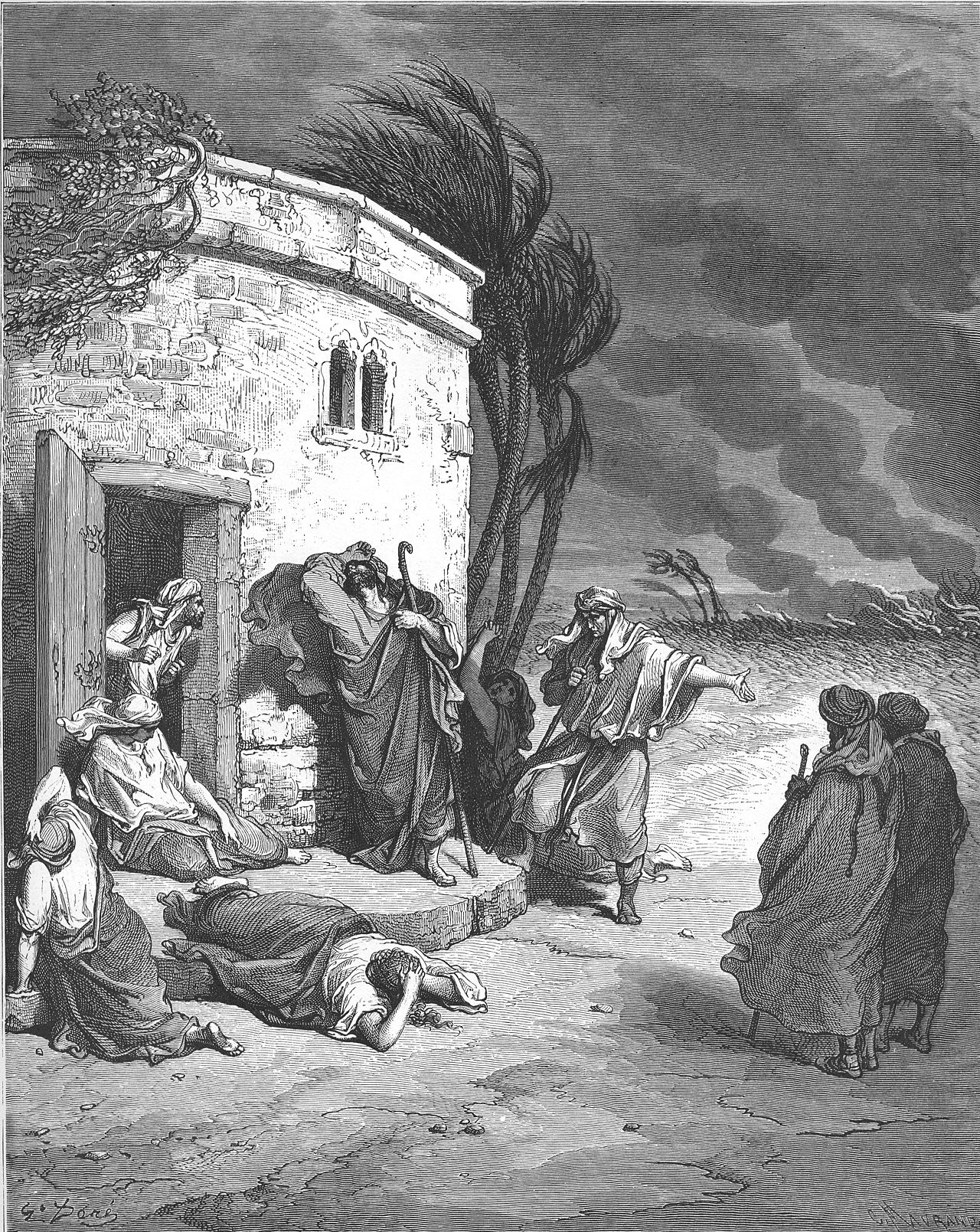
Jobchapter 28
28 verses · unknown · 10th century BC · Wisdom and poetry
Neither gold nor crystal can compare to it, nor jewels of fine gold be exchanged for it.
Introduction
unknown, Wisdom and poetry, Job Overview.
This chapter is a poem that stands between the debate with the friends and Job's closing speeches. It names no speaker, and readers differ on whether Job speaks it or the book's writer sets it there as a pause. Its hearers knew mines dug far from any town, and the trade routes that carried gold, gems and coral. Listen for how far a man will go to find what is buried. Then listen for the one treasure that cannot be found or bought that way. The last line brings the reader back to the book's first chapter.
Context
- Who
- Hearers who wore no jewels but knew what men would do to get them
- What
- A poem that praises the skill of miners and then asks where wisdom is found, answering that God alone knows its place.
- Where
- The mine shafts far from settlements and the trade routes of the ancient world, set against the heights and depths of creation.
- When
- A pause after the third round of speeches and before Job's closing speeches in chapters 29 to 31.
- Why
- To show that wisdom is God's gift, received in the fear of the Lord, and that it cannot be dug up or bought.
Historical context
The first half of this chapter is the best description of ancient mining in any literature, and it is accurate. There is a vein for silver and a place for gold where they refine it; iron is taken out of the earth and copper is melted out of stone. Men set an end to darkness and search out the farthest limit of the ore in the black rock, that is, they carry lamps into the shaft and follow the seam to its end.
Show the rest of the historical context, 3 more paragraphs
The details are technical. He 'breaketh open a shaft away from where men sojourn', mines were sunk far from habitation, where the ore was. Miners are 'forgotten of the foot' and hang and swing away from men, which describes descending on ropes down a vertical shaft. Fire is set under the rock to crack it, the oldest hard-rock mining method there was, used before iron tools could do the job. Channels are cut among the rocks, and the seeping water is dammed so the workings stay dry. Ancient copper mines in the Arabah south of the Dead Sea and Egyptian turquoise workings in Sinai show exactly this kind of engineering.
Above ground, none of it is visible. The earth grows bread on the surface while underneath it is turned up as by fire. The path is one no bird of prey knows and no falcon's eye has seen; the proud lion has not passed by it. Man alone goes there.
The second half asks where wisdom's mine is, and prices it against everything the trade routes carried: gold of Ophir, onyx, sapphire, crystal, coral, pearls, and the topaz of Ethiopia. It cannot be bought with any of them. The deep says it is not in me; the sea says it is not with me; destruction and death say only that they have heard a rumour of it. God alone knows the way, because he was there when he made a weight for the wind, measured out the waters, made a decree for the rain, and a path for the lightning of thunder. And the last line brings it home to the ash heap: the fear of the Lord, that is wisdom; and to depart from evil is understanding.
Significance
After twenty-seven chapters of men mining each other's arguments for an answer, this poem says the answer is not in that seam. Human beings can find anything buried in the earth and cannot find this.
Show the rest of the significance, 1 more paragraph
For the first hearers the conclusion was the whole point of Israel's wisdom teaching: the search ends not in a discovery but in a posture. Fear God, turn from evil, which is precisely what the book said about Job in its opening sentence.
This chapter in Jewish lifeWhat this chapter is in Jewish life and reading.
What is done
This chapter has no place in the synagogue year. The site's own table in src/lib/hebraic/readings.ts printed parashot total 0 and haftarah uses total 0 for the book of Job, and no festival reading.
The corpus joins it to the study of the Torah portions through the Midrash arranged by them. Under the fifth verse it carries Midrash Tanchuma Buber, Beshalach 20:2. Under the twentieth verse it carries Midrash Tanchuma Buber, Shemot 22:3.
How it is read
Rashi is the one commentator on this chapter whose English the corpus carries, quoted here from The Judaica Press complete Tanach with Rashi, translated by A. J. Rosenberg, which Sefaria reports as CC-BY. He reads the chapter as Job's argument carried on from the chapter before. The chapter gives a further reason for Job's claim in the sixth verse of the chapter before that he has kept his righteousness (Rashi on Job 28:1:1).
Rashi sets out Job's reasoning. Silver and gold each have a source and an end, but Job asks where wisdom comes from, and it is the most precious of all. Job draws the conclusion for his own life. "Therefore, all my life, I set my heart on studying it" (Rashi on Job 28:1:1). Everything has a beginning and an end, and the whole world will end with all that is in it (Rashi on Job 28:2:1). The Omnipresent made an end for the time when darkness comes, and He fathoms the end of everything (Rashi on Job 28:3:1).
Rashi reads the next verses as the overthrow of Sodom and Gomorrah by streams of fire and brimstone (Rashi on Job 28:4:1). At the tenth verse he returns to the rule that everything has a source. God split the rocks for the rivers, as He struck a rock for Israel and water flowed (Rashi on Job 28:10:1).
Wisdom in the twelfth verse is the Torah (Rashi on Job 28:12:1). It is found with one who puts himself to death with toil and hunger, and missed by one who enlivens himself (Rashi on Job 28:13:1). Those who dive for pearls say it is not in them, because they are not versed in halachic instruction (Rashi on Job 28:14:1). A Christian reader should hear this reading of wisdom as the Torah as the tradition's own.
The verses on gold and stones draw close glosses. Closed gold is fine gold, so named because when it is open all the gold establishments close (Rashi on Job 28:15:1). On the jewelry of the nineteenth verse Rashi rejects the reading that takes the word as a crown, because no verb from that root is found (Rashi on Job 28:19:1).
At the twenty-second verse he gives two readings. In the first, those who destroy themselves over the Torah heard that it stays with the one who toils in it. In the second, he reports an Aggadah that Satan asked the Omnipresent where the Torah was (Rashi on Job 28:22:1). God knew its place and created the world with its letters in order and by their weight, as in the secret of Sefer Yetzirah (Rashi on Job 28:23:1).
The corpus carries one further note on this chapter without an English text, marked linked because Sefaria holds no English version of the ref. It stands cited by ref and unquoted. One stands at Metzudat David on Job 28:20:1.
What the rabbis say
The corpus carries forty rabbinic locators on this chapter and the text of none, so each is cited and linked here rather than quoted. On the first verse it holds Bereshit Rabbah 91:9 and Kohelet Rabbah 5:11:4. On the third verse it holds Bereshit Rabbah 89:1 and Midrash Lekach Tov, Genesis 40:23:1. On the fourth verse it holds Bamidbar Rabbah 9:24 and Ein Yaakov (Glick Edition), Sanhedrin 11:121. On the fifth verse it holds Midrash Sekhel Tov, Bereshit 19:35:29 and Midrash Tanchuma Buber, Beshalach 20:2. On the sixth verse it holds Chullin 88b:7 and Ein Yaakov, Khullin 6:5.
On the seventh verse it holds Chullin 63b:5 and Pirkei DeRabbi Eliezer 39:9. On the eighth verse it holds Avot DeRabbi Natan 39:2 and Ein Yaakov, Sanhedrin 11:28. On the ninth verse it holds Aggadat Bereshit 8:3 and Avot DeRabbi Natan, Recension B 12:3. On the tenth verse it holds Bamidbar Rabbah 19:6 and Bereshit Rabbah 42:5. On the eleventh verse it holds Avot DeRabbi Natan 6:2 and Bereshit Rabbah 36:1. On the twelfth verse it holds Avot DeRabbi Natan 12:5 and Bamidbar Rabbah 3:1.
On the thirteenth verse it holds Ein Yaakov (Glick Edition), Sanhedrin 11:133 and Midrash Aggadah, Leviticus 27:2:2. On the fourteenth verse it holds Shabbat 89a:3. On the sixteenth verse it holds Midrash Lekach Tov on Lamentations 4:2:1. On the seventeenth verse it holds Avot DeRabbi Natan 24:5 and Avot DeRabbi Natan, Recension B 31:11. On the eighteenth verse it holds Yalkut Shimoni on Torah 27:1. On the twentieth verse it holds Ein Yaakov, Sotah 1:59 and Midrash Tanchuma Buber, Shemot 22:3. On the twenty-first verse it holds Devarim Rabbah 8:2 and Devarim Rabbah 8:7.
On the twenty-third verse it holds Ein Yaakov (Glick Edition), Gittin 2:1 and Ein Yaakov (Glick Edition), Pesakhim 8:7. On the twenty-fourth verse it holds Ein Yaakov (Glick Edition), Shabbat 9:16. On the twenty-fifth verse it holds Bamidbar Rabbah 21:2. On the twenty-sixth verse it holds Midrash Aggadah, Leviticus 1:1:3. On the twenty-seventh verse it holds Bamidbar Rabbah 12:4. On the twenty-eighth verse it holds Bamidbar Rabbah 10:1. What each of them teaches is a saying of the rabbis, and is reported as theirs wherever this site quotes one. The quotations wait on a fetch that carries the text.
Sources: Rashi, Rashi on Job 28:1:1 to 28:24:1, The Judaica Press complete Tanach with Rashi, translated by A. J. Rosenberg, reported CC-BY; Metzudat David, Metzudat David on Job 28:20:1, cited by ref because the corpus carries no English text; The Sefaria corpus, scripts/data/sources/sefaria/job/28.json, the 40 Talmud and Midrash locators of this chapter; The site's own files, src/lib/hebraic/readings.ts, printing no portion, no Haftarah and no festival reading for this book.
The heads below are this chapter's scenes. The numbered points under each are its verses.
Miners Cut Shafts in the Rock for Silver and Gold
Job 28:1-3
"Surely there is a mine for silver" opens the fullest account of mining in the ancient world. Delitzsch notes how advanced mining already was in the patriarchal world. Clarke reads the miner who "probes the farthest recesses" as reaching every corner of the working.
Job 28:1
“Surely there is a vein for silver - Margin, “mine” Coverdale renders this, “There are places where silver is molten.” Prof. Lee renders it, “There is an outlet for the silver,” and supposes it means the coming out or separation of the silver from the earthy particles by which it is surrounded in the ore, not the coming out from the mine.”
Iron is taken from the earth: Jamieson, Fausset and Brown note that the Hebrew rendered brass in older versions means copper, which man used long before iron. Henry calls iron a greater kindness to man than gold. The search for wisdom starts among the silver, gold, iron and copper man takes from the earth.
Job 28:2
“Iron is taken out of the earth - This most useful metal is hidden under the earth, and men have found out the method of separating it from its ore. Brass is molten out of the stone - As brass is a factitious metal, copper must be the meaning of the Hebrew word נחושה nechusah: literally, the stone is poured out for brass.”
Adam Clarke · Commentary on the Bible (1810-1826)evangelical
1 more voice on this verse
Job 28:2
“Iron is taken out of the earth,.... Very easily, and in great plenty, and is more common, being in most countries, is nearer the surface of the earth, and here said to be taken "out of the dust" (x); which, being melted in a furnace, produces iron, a metal very serviceable for various rises, and without which there is scarce any thing to be done, and therefore was with brass of early invention.”
Man puts an end to the darkness: Barnes reads the verse as mining: man goes to the farthest limits of darkness and penetrates everywhere. Jamieson, Fausset and Brown picture torches carried into the deepest gloom. Wesley takes the ore of darkness as precious stones hidden where no living thing can dwell.
Job 28:3
“He setteth an end to darkness - That is, man does. The reference here is undoubtedly to the operations of mining, and the idea is, that man delves into the darkest regions; he goes even to the outer limits of darkness; he penetrates everywhere. Probably the allusion is derived from the custom of carrying torches into mines. And searcheth out all perfection - Makes a complete search; examines everything; carries the matter to the utmost.”
1 more voice on this verse
Job 28:3
"Man makes an end of darkness," by exploring the darkest depths (with torches). all perfection--rather, carries out his search to the utmost perfection; most thoroughly searches the stones of darkness and of the shadow of death (thickest gloom); that is, the stones, whatever they be, embedded in the darkest bowels of the earth [UMBREIT] (Job 26:10).
Jamieson, Fausset & Brown · Commentary Critical and Explanatory on the Whole Bible (1871)reformed
Job 28:4-6
Far from human habitation he cuts a shaft: The miner cuts a shaft "in places forgotten by the foot of man", far from where people live, and "he dangles and sways". "Food may come from the earth, but from below it is transformed as by fire", the miner's world hidden under the field's ordinary produce.
Job 28:4
"Forgotten (unsupported) by the foot they hang," namely, by ropes, in descending. In the Hebrew, "Lo there" precedes this clause, graphically placing it as if before the eyes. "The waters" is inserted by English Version.
Jamieson, Fausset & Brown · Commentary Critical and Explanatory on the Whole Bible (1871)reformed
1 more voice on this verse
Job 28:4
“The flood breaketh out from the inhabitant - This passage is very difficult. Some think it refers to mining; others to navigation.”
Adam Clarke · Commentary on the Bible (1810-1826)evangelical
Food may come from the earth: The earth grows bread on its surface while its depths are turned over as by fire. Umbreit, cited by Jamieson, Fausset and Brown, takes the fire as the miner's fire, and they prefer precious stones that glow like fire. Henry reminds man that he is of the earth.
Job 28:5
“As for the earth, out of it cometh bread - That is, it produces food, or the materials for bread. The idea of Job seems to be, that it was proof of great wisdom and skill on the part of man that he had carried the arts of agriculture so far. The earth in producing grain, and the arts of husbandry, were illustrative of wisdom and skill, but they did not impart the wisdom about the government of God which was desired. That was reserved to be imparted more directly by God himself, Job 28:23 ff.”
1 more voice on this verse
Job 28:5
"Fire" was used in mining [UMBREIT]. English Version is simpler, which means precious stones which glow like fire; and so Job 28:6 follows naturally (Eze 28:14).
Jamieson, Fausset & Brown · Commentary Critical and Explanatory on the Whole Bible (1871)reformed
Its rocks are the source of sapphires: Wesley takes the sapphire as standing for all precious stones. Jamieson, Fausset and Brown distinguish the clear blue sapphire from lapis lazuli, whose flecks look like gold. Henry reads such treasure under the foot of man as a warning against setting the heart on it.
Job 28:6
“The real, of transparent blue: 2. That improperly so called, opaque, with gold spots; that is, lapis lazuli. To the latter, looking like gold dust, UMBREIT refers "dust of gold." English Version better, "The stones of the earth are, &c., and the clods of it (Vulgate) are gold"; the parallel clauses are thus neater.”
Jamieson, Fausset & Brown · Commentary Critical and Explanatory on the Whole Bible (1871)reformed
Job 28:7-9
No bird of prey knows that path: h; no falcon’s eye has seen it", so the shaft runs where the sharpest-eyed hunter has never looked. "Proud beasts have never trodden it; no lion has ever prowled over it", and the boldest predator of the region becomes a second witness.
Job 28:7
“IN this chapter Job is speaking of the hidden treasures that are to be found deep down in the bowels of the earth. The keen eyes of the vultures, though they see their prey afar off, have never seen the gold, silver and other precious metals which lie in the dark places of the earth.”
Charles Spurgeon · written before 1892 · The Metropolitan Tabernacle Pulpit, Sermon No. 2862: “The Way of Wisdom” (lightly modernized text, CCEL edition)Particular Baptist
no lion has ever prowled over it: The miner goes where the fiercest beasts never tread. Jamieson, Fausset and Brown render the proud beasts as sons of pride and hear the lion's proud gait in the verb. Barnes notes that the lion, hunting in dangerous places, never dared go where man goes for gold.
Job 28:8
“Lion - Which rangeth all places for prey. The birds and beasts have often led men to such places as otherwise they should never have found out; but they could not lead them to these mines, the finding out of them is a special gift of God.”
John Wesley · Explanatory Notes upon the Old Testament (1765)evangelical
2 more voices on this verse
Job 28:8
“The children of the dealers have not trodden it, nor hath the lioness passed through it. In all the Latin copies we find the word 'Instructors' put down, but in the Greek we find 'traders,' whereby it may be inferred that in this passage the several copyists from being ignorant put 'instructors' instead of 'dealers.' For we call traders 'institores' on this account, that they are 'instant in plying work.'”
Gregory the Dialogist · written before 604 · Morals on the Book of Job, Book XVIIIpatristic
Job 28:8
“The lion’s whelps - The lion that ventures into the most dangerous places in pursuit of prey, has not dared to go where man has gone in pursuit of precious stones and gold. On the words used here to designate the lion, see Bochart Hieroz P. 1. Lib. iii. c. 1.”
he overturns mountains at their base: Barnes notes that the Hebrew for flint is the word of Deuteronomy 8:15. Clarke still hears mining: the miner strikes the rock and overturns mountains to reach the metal and ore. Henry sees such labour as a check on pomp and luxury.
Job 28:9
“He putteth forth his hand - That is, the miner in securing the precious metals and gems. Upon the rock - Margin, “flint.” The word used here (חלמישׁ challâmı̂ysh) occurs also in Psa 104:8. Deu 8:15; Deu 32:13. It means “flint, silex;” and the idea is, that the miner approaches the hardest substances. He penetrates even the flint in searching for precious stones. Dr. Good renders it, “Sparry ore.” Michaelis renders the same word in Deu 7:15, porphyry, or red granite.”
Job 28:10-11
He hews out channels in the rocks: "He stops up the sources of the streams to bring what is hidden to light", and that line states the work of the whole passage. Every buried thing man can reach by labor is set against the one thing labor cannot reach, which verse 12 names.
Job 28:10
“He cutteth out rivers among the rocks - He cuts canals, adits, etc., in the rocks, and drives levels under ground, in order to discover loads or veins of ore. These are often continued a great way under ground; and may be poetically compared to rivers, channels, or canals. His eye seeth every precious thing - He sinks those shafts, and drives those levels, in order to discover where the precious minerals lie, of which he is in pursuit.”
Adam Clarke · Commentary on the Bible (1810-1826)evangelical
1 more voice on this verse
Job 28:10
“Seeth - Even those which no human art or industry was ever able to discover. That wisdom - Man hath one kind of wisdom, to discover the works of nature, and to perform the operations of art; but as for that sublime wisdom which consists in the knowledge of God and ourselves, no man can discover this, but by the special gift of God.”
John Wesley · Explanatory Notes upon the Old Testament (1765)evangelical
He stops up the sources of the streams: Barnes notes that the Hebrew reads from weeping, the water that trickles down the miner's shaft. Clarke pictures the miner damming springs and turning streams to bring hidden ore to light. Henry sets all this labour beside the question of verse 12.
Job 28:11
“He bindeth the floods from overflowing - Margin, Weeping The Hebrew also is “from weeping” מבכי mı̂bekı̂y; referring to the water which trickles down the shaft of the mine. The idea is, that even the large streams which break out in such mines, the fountains and springs which the miner encounters in his operations, he so effectually restrains that they do not even trickle down or “weep” on the sides of the shaft, but it is left perfectly dry. This is necessary in opening mines of coal or minerals, and in making tunnels or other excavations.”
1 more voice on this verse
Job 28:11
“How much easier and safer! Yet gold is sought for, but grace neglected. Will the hopes of precious things out of the earth (so they call them, though really they are paltry and perishing) be such a spur to industry, and shall not the certain prospect of truly precious things in heaven be much more so?”
Matthew Henry · Commentary on the Whole Bible (1707-1721)puritan
But Where Shall Wisdom Be Found?
But where can wisdom be found: d, and where does understanding dwell?" is the turn on which the whole poem hangs. The rest of the chapter answers the question by ruling out every place labor can map, and the final verse answers it directly.
Job 28:12
“But where shall wisdom be found? - It is most evident that the terms wisdom and understanding are used here in a widely different sense from all those arts and sciences which have their relation to man in his animal and social state, and from all that reason and intellect by which man is distinguished from all other animals. Now as these terms חכמה chochmah, wisdom, and בינה binah, understanding or discernment, are often applied in the sacred writings in their common acceptations, we must have recourse to what Job says of them, to know their meaning in this place.”
Adam Clarke · Commentary on the Bible (1810-1826)evangelical
2 more voices on this verse
Job 28:12
“This is a question we should all put. While the most of men are asking, "Where shall money be found?" we should ask, Where may wisdom be found? that we may seek it and find it, not vain philosophy, or carnal policy, but true religion; for that is the only true wisdom, that is it which best improves our faculties and best secures our spiritual and eternal welfare.”
Matthew Henry · Commentary on the Whole Bible (1707-1721)puritan
Job 28:12
“Can man discover the Divine Wisdom by which the world is governed, as he can the treasures hidden in the earth? Divine Wisdom is conceived as a person (Job 28:12-27) distinct from God (Job 28:23; also in Pr 8:23, 27). The Almighty Word, Jesus Christ, we know now, is that Wisdom.”
Jamieson, Fausset & Brown · Commentary Critical and Explanatory on the Whole Bible (1871)reformed
Job 28:13-14
No man can know its value: e, nor is it found in the land of the living", which rules out every human market. Barnes notes the poem building its case by elimination, each place man has searched for buried treasure now speaking for itself.
Job 28:13
“The cock in the fable knew not the value of the precious stone he found in the dunghill, and therefore would rather have lighted on a barley-corn. Men know not the worth of grace, and therefore will take no pains to get it.”
Matthew Henry · Commentary on the Whole Bible (1707-1721)puritan
1 more voice on this verse
Job 28:13
“Man can fix no price upon it, as it is nowhere to be found in man's abode (Isa 38:11). Job implies both its valuable worth, and the impossibility of buying it at any price.”
Jamieson, Fausset & Brown · Commentary Critical and Explanatory on the Whole Bible (1871)reformed
The ocean depths say: Barnes calls the verse a personification and reads its aim: wisdom lies beyond the deepest places man can reach and must come from God. Henry adds that no trade by sea can buy it. Clarke says the deep yields gold and gems, which give no true happiness.
Job 28:14
“The depth saith, It is not in me - Men may dig into the bowels of the earth, and there find gold, silver, and precious stones; but these will not give them true happiness. The sea saith, It is not with me - Men may explore foreign countries, and by navigation connect as it were the most distant parts of the earth, and multiply the comforts and luxuries of life; but every voyage and every enjoyment proclaim, True happiness is not here.”
Adam Clarke · Commentary on the Bible (1810-1826)evangelical
Job 28:15-17
It cannot be bought with gold: d, nor can its price be weighed out in silver" begins the list of prices. "It cannot be valued in the gold of Ophir", the most prized gold of the ancient world. Clarke reads the list as cumulative, each named treasure raising the bar.
Job 28:15
“It cannot be gotten for gold - Margin, “fine gold shall not be given for it.” The word which is here rendered “gold.” and in the margin “fine gold” (סגור segôr), is not the common word used to denote this metal. It is derived from סגר sâgar, to “shut,” to “close,” and means properly that which is “shut up” or “enclosed;” and hence, Gesenius supposes it means pure gold, or the most precious gold, as that which is shut up or enclosed with care. Dr. Good renders it “solid gold,” supposing it means that which is condensed, or beaten.”
2 more voices on this verse
Job 28:15
“These may give a man some advantage in seeking wisdom, as they did to Solomon, but there is no purchasing wisdom with these. It is a gift of the Holy Ghost, which cannot be bought with money, Acts viii. As it does not run in the blood, and so come to us by descent, so it cannot be got for money, nor does it come to us by purchase.”
Matthew Henry · Commentary on the Whole Bible (1707-1721)puritan
Job 28:15
“Not the usual word for "gold"; from a Hebrew root, "to shut up" with care; that is, purest gold (1Ki 6:20, Margin). weighed--The precious metals were weighed out before coining was known (Ge 23:16).”
Jamieson, Fausset & Brown · Commentary Critical and Explanatory on the Whole Bible (1871)reformed
It cannot be valued in the gold of Ophir: Barnes notes that the gold of Ophir is always named as the most precious gold, as at Job 22:24. Clarke counts five mentions of gold in verses 16 to 19, four of them in different Hebrew words. Every treasure of verses 1 to 11 falls short of wisdom.
Job 28:16
“The gold of Ophir - Gold is five times mentioned in this and Job 28:17 and Job 28:19, and four of the times in different words. I shall consider them all at once. 1. סגור Segor, from סגר sagar, to shut up. Gold. in the mine, or shut up in the ore; native gold washed by the streams out of the mountains, etc.; unwrought gold. Job 28:16 2. כתם Kethem, from כתם catham, to sign or stamp: gold made current by being coined, or stamped with its weight or value; what we would call standard or sterling gold.”
Adam Clarke · Commentary on the Bible (1810-1826)evangelical
1 more voice on this verse
Job 28:16
“More valued formerly than now. The term is Greek, meaning "thumb nail," from some resemblance in color. The Arabic denotes, of two colors, white preponderating.”
Jamieson, Fausset & Brown · Commentary Critical and Explanatory on the Whole Bible (1871)reformed
Neither gold nor crystal can compare to it: Gill notes that crystal came from an island of the Red Sea near Arabia, and so may have been known to Job. Barnes describes crystal as a clear stone of regular form. The poem prices wisdom beyond crystal, jewels and fine gold.
Job 28:17
“The gold and the crystal cannot equal it,.... Crystal was found in an island of the Red sea, situated before Arabia, called Neron, and in another, which from a gem found in it bears the name of Topazion, and may be thought therefore to be well known by Job; and though it is not now of so much account, it formerly was very valuable.”
1 more voice on this verse
Job 28:17
“The gold and the crystal - A crystal, in chemistry, is an inorganic body which, by the operation of affinity, has assumed the form of a regular solid, terminated by a number of plane and smooth surfaces. It is round in various forms and sizes, and is composed of a great variety of substances. The common “rock crystal” is a general name for all the transparent crystals of quartz, particularly of limpid or colorless quartz. “Webster.” The word used here (זכוּכית zekûkı̂yth) occurs nowhere else in the Bible.”
Job 28:18-19
Coral and quartz are unworthy of mention: "Topaz from Cush cannot compare to it", a gem from the farthest source of precious stone the ancient trade routes named, beyond Egypt's own borders. The list ranges from Ophir to Cush, and so exhausts the known world's wealth before the question of verse 12 is answered.
Job 28:18
“No mention shall be made of coral - That is, as a price by which to purchase wisdom, or in comparison with wisdom. The margin here is, “Ramoth” - retaining the Hebrew word ראמה râ'mâh. Jerome renders it, “excelsa” - exalted or valuable things. So the Septuagint, Μετέωρα Meteōra - exalted or sublime things; as if the word were from רום, to be exalted.”
2 more voices on this verse
Job 28:18
“No mention shall be made of coral, or of pearls,.... Coral is a marine plant, is as hard as a stone, and of such value as to be reckoned among precious stones; See Gill on Eze 27:16. In Arabia Felix, on the shore of the Red sea, is a place called Coralia (n); it may be from coral found there.”
Job 28:18
“The Urim and Thummim, the means of consulting God by the twelve stones on the high priest's breastplate, "the stones of the sanctuary" (La 4:1), have their counterpart in this chapter; the precious stones symbolizing the "light" and "perfection" of the divine wisdom.”
Jamieson, Fausset & Brown · Commentary Critical and Explanatory on the Whole Bible (1871)reformed
Topaz from Cush cannot compare to it: Gill and Clarke place Cush in Arabia near the Red Sea, where Diodorus Siculus reports the topaz in abundance. Barnes describes the stone's colours of yellow, green, blue and red. The list of treasures ends with pure gold.
Job 28:19
“The topaz of Ethiopia shall not equal it,.... Not Ethiopia Abyssinia, or that which lies beyond Egypt in Africa; for, as Ludolphus (x) says, there are no gems found there, or very rarely; but Cush, as the word is, or Arabia Chusaea, the same with the country of Midian, and the parts adjacent; see Hab 3:7; hence Zipporah, the wife of Moses, who was of that country, is called an Ethiopian woman, Num 12:1; and this was near Job's country, who knew the produce of it; and here the topaz is found, as many writers observe.”
1 more voice on this verse
Job 28:19
“The topaz - The topaz is a precious stone, whose colors are yellow, green, blue, and red. Its natural place is in various primitive rocks, such as the topaz-rock, gneiss, and clay-slate. It is found in the granite and gneiss districts of Mar and Cairnaorta, in Cornwall, in Brazil, and in various other places. The most valuable stones of this kind now known are those which are found in Brazil. This gem is much prized by jewelers, and is considered as one of the more beautiful ornamental stones.”
Job 28:20-22
From where then does wisdom come: e, and where does understanding dwell?" repeats the question of verse 12 almost word for word, framing the list of prices. "Abaddon and Death say" they have only heard a rumor of it, the poem's farthest reach before it turns to God.
Job 28:20
“Whence then cometh wisdom? and where is the place of understanding? Seeing that it is hid from the eyes of all living. It deserves to be especially considered, that it is asked by the holy man, whence Wisdom cometh. For It 'comes' from Him from Whom It sprung. Now because It is born of the Invisible and Coeternal Father, the way thereof is hidden. Whence too it is said by the Prophet, And who shall declare His generations?”
Gregory the Dialogist · written before 604 · Morals on the Book of Job, Book XVIIIpatristic
It is hidden from the eyes of every living thing: Barnes reads every living thing as all people and all animals: man's keenest discoveries and the sharpest eyes of beast and bird have missed it. Jamieson, Fausset and Brown note that the heathen credited birds with divination. The falcon of verse 7 is blind here too.
Job 28:21
“None can tell whence or where, seeing it, &c. fowls--The gift of divination was assigned by the heathen especially to birds. Their rapid flight heavenwards and keen sight originated the superstition.”
Jamieson, Fausset & Brown · Commentary Critical and Explanatory on the Whole Bible (1871)reformed
1 more voice on this verse
Job 28:21
"Have a little patience," says Death to the inquisitive soul: "I will fetch thee shortly to a place where even this wisdom will be found." When the mystery of God shall be finished it will be laid open, and we shall know as we are known; when the veil of flesh is rent, and the interposing clouds are scattered, we shall know what God does, though we know not now, John xiii.
Matthew Henry · Commentary on the Whole Bible (1707-1721)puritan
Abaddon and Death say: Wesley reads Death as the grave, speaking as the depths and the sea spoke in verse 14. Jamieson, Fausset and Brown note that the living see wisdom at work while the dead have only heard of her. Clarke links Abaddon to the destroyer of Revelation 9:11.
Job 28:22
“Destruction and death say, We have heard the fame thereof - אבדון ומות Abaddon vamaveth, the destroyer, and his offspring death. This is the very name that is given to the devil in Greek letters Αβαδδων, Rev 9:11, and is rendered by the Greek word Απολλυων, Apollyon, a word exactly of the same meaning.”
Adam Clarke · Commentary on the Bible (1810-1826)evangelical
1 more voice on this verse
Job 28:22
“We have [only] heard--the report of her. In the land of the living (Job 28:13) the workings of Wisdom are seen, though not herself. In the regions of the dead she is only heard of, her actings on nature not being seen (Ec 9:10).”
Jamieson, Fausset & Brown · Commentary Critical and Explanatory on the Whole Bible (1871)reformed
God Understandeth the Way Thereof: the Fear of the Lord Is Wisdom
Job 28:23-27
But God understands its way: y, and He knows its place" answers the chapter's question: wisdom belongs to God. "He looks to the ends of the earth and sees everything under the heavens", a sight no mine or sea could claim.
Job 28:23
“God understandeth the way thereof; and He knoweth the place thereof. This Wisdom coeternal with God has 'a way' in one sense, and in another sense 'a place;' but only a 'place,' if a person understand it a place not local. For God is not capable of being held close after the manner of a body. But as has been said, a place not local is meant. The 'place' of 'Wisdom' is the Father, 'the place' of the Father is 'Wisdom,' as, Wisdom Herself bearing testimony, it is said, I am in the Father, and the Father in Me.”
Gregory the Dialogist · written before 604 · Morals on the Book of Job, Book XIXpatristic
1 more voice on this verse
Job 28:23
“God understandeth the way thereof - These are doubtless the words of Job. The meaning is, that the reason of the divine dispensations could be known only to God himself. He had given no clew by which man could discover this. He might carry his investigations far into the regions of science; he could penetrate the earth, and look on the stars, but still all his investigations fell short of disclosing the reasons of the divine dispensations. The secret was lodged in his bosom, and he only could communicate it where and when he pleased.”
He looks to the ends of the earth: Verse 23 says God knows the place of wisdom, and this verse gives the ground: nothing escapes His sight. Barnes contrasts man, who sees few things dimly. Henry adds that God's view reaches distant ages as well as distant regions.
Job 28:24
“He that governs the world is, [1.] Omniscient; for he looks to the ends of the earth, both in place and time; distant ages, distant regions, are under his view. We do not understand our own way, much less can we understand God's way, because we are short-sighted.”
Matthew Henry · Commentary on the Whole Bible (1707-1721)puritan
measured out the waters: Barnes notes that the wind and the waters seem the hardest things to weigh or measure, yet God made all by measure and rule. Wesley reads weight and measure as the perfect wisdom by which God governs the world. Creation is where God saw wisdom, as verse 27 says.
Job 28:25
“A great and constant communication there is between clouds and seas, the waters above the firmament and those under it. Vapours go up, rains come down, air is condensed into water, water rarefied into air; but the great God keeps an exact account of all the stock with which this trade is carried on for the public benefit and sees that none of it be lost.”
Matthew Henry · Commentary on the Whole Bible (1707-1721)puritan
when He set a limit for the rain: Barnes reads the limit as a statute by which God rules the rain under settled laws, never sent by chance. Clarke traces the rain from the sun's heat and rising vapour. Then, verse 27 says, He looked at wisdom.
Job 28:26
“When He made a decree for the rain, and a way for the sounding tempests, then did He see it and declare it; He prepared it, yea, and searched it out. By 'rain' the sayings of those that preach are used to be denoted. Whence it is said by Moses; Let my doctrine be waited for as the rain; whose words, that is to say, when they gently persuade are 'rain,' but when they thunder out terrible things touching the Judgment to come, they are 'sounding tempests.'”
Gregory the Dialogist · written before 604 · Morals on the Book of Job, Book XIXpatristic
1 more voice on this verse
Job 28:26
“Some make Job to speak of wisdom here as a person, and translate it, Then he saw her and showed her, &c., and then it is parallel with that of Solomon concerning the essential wisdom of the Father, the eternal Word, Prov. viii. Before the earth was, then was I by him, John i.”
Matthew Henry · Commentary on the Whole Bible (1707-1721)puritan
then He looked at wisdom and appraised it: Barnes places the moment in creation, when God set laws for the rain and the thunderbolt and so looked at the principles of wisdom. Jamieson, Fausset and Brown read established as setting wisdom to govern the world, as in Proverbs 8:22-31. Wesley takes searched as a figure of speech.
Job 28:27
“So it is a speech of God after the manner of men. Searched - Not properly; for so searching implies ignorance, and requires time and industry, all which is repugnant to the Divine perfections; but figuratively, he did, and doth, all things with that absolute and perfect wisdom, so exactly, and perfectly, as if he had bestowed a long time in searching, to find them out.”
John Wesley · Explanatory Notes upon the Old Testament (1765)evangelical
1 more voice on this verse
Job 28:27
“Then did he see it - That is, then did he see wisdom. When in the work of creation he gave laws to the rain and the thunder storm; when he weighed out the winds and measured out the waters, then he saw and understood the principles of true wisdom.”
And He said to man: The poem closes when God speaks to man: "the fear of the Lord, that is wisdom, and to turn away from evil is understanding". Delitzsch notes that the wisdom books repeat this formula afterward, at Psalm 111:10 and Proverbs 1:7 and 9:10.
Job 28:28
“And unto man He said, 'Behold, the fear of the Lord, that is Wisdom; and to depart from evil is understanding.' As though it were spoken in plain speech; 'Man, turn back to thine own self; sift thoroughly the secrets of thine own heart. If thou findest out that thou dost fear God, surely it is plain that of this Wisdom thou art full. Which same if thou art not able to learn what in herself She is, meanwhile thou henceforth findest what She is in thyself.”
Gregory the Dialogist · written before 604 · Morals on the Book of Job, Book XIXpatristic
3 more voices on this verse
Job 28:28
“Unto man he said - לאדם laadam, unto man, he said: This probably refers to the revelation of his will which God gave to Adam after his fall. He had before sought for wisdom in a forbidden way. When he and Eve saw that the tree was pleasant to the eyes, and a tree to be desired to make one wise, they took and did eat, Gen 3:6. Thus they lost all the wisdom that they had, by not setting the fear of the Lord before their eyes; and became foolish, wicked, and miserable.”
Adam Clarke · Commentary on the Bible (1810-1826)evangelical
Job 28:28
“Unto man he said, not, "Go up to heaven, to fetch happiness thence;" or, "Go down to the deep, to draw it up thence." No, the word is nigh thee, Deut. xxx. He hath shown thee, O man! not what is great, but what is good, not what the Lord thy God designs to do with thee, but what he requires of thee, Mic. vi.”
Matthew Henry · Commentary on the Whole Bible (1707-1721)puritan
Job 28:28
“Rather, "But unto man," &c. My wisdom is that whereby all things are governed; Thy wisdom is in fearing God and shunning evil, and in feeling assured that My wisdom always acts aright, though thou dost not understand the principle which regulates it; for example, in afflicting the godly (Joh 7:17).”
Jamieson, Fausset & Brown · Commentary Critical and Explanatory on the Whole Bible (1871)reformed
Keep studying
Sources for this chapter
The summary
Jamieson, Fausset & Brown, Commentary Critical and Explanatory; John Wesley, Notes on the Old Testament and Matthew Henry, Complete Commentary.
The context
Charles Bridges, An Exposition of the Book of Proverbs and Franz Delitzsch, Biblical Commentary on the Book of Job.
The exposition
A. B. Davidson, The Book of Job, Cambridge Bible; Adam Clarke, Commentary on the Bible; Albert Barnes; Franz Delitzsch, Biblical Commentary on the Book of Job; Jamieson, Fausset & Brown, Commentary Critical and Explanatory on the Whole Bible; John Gill, Exposition of the Old Testament; John Wesley, Explanatory Notes upon the Old Testament and Matthew Henry, Commentary on the Whole Bible.