
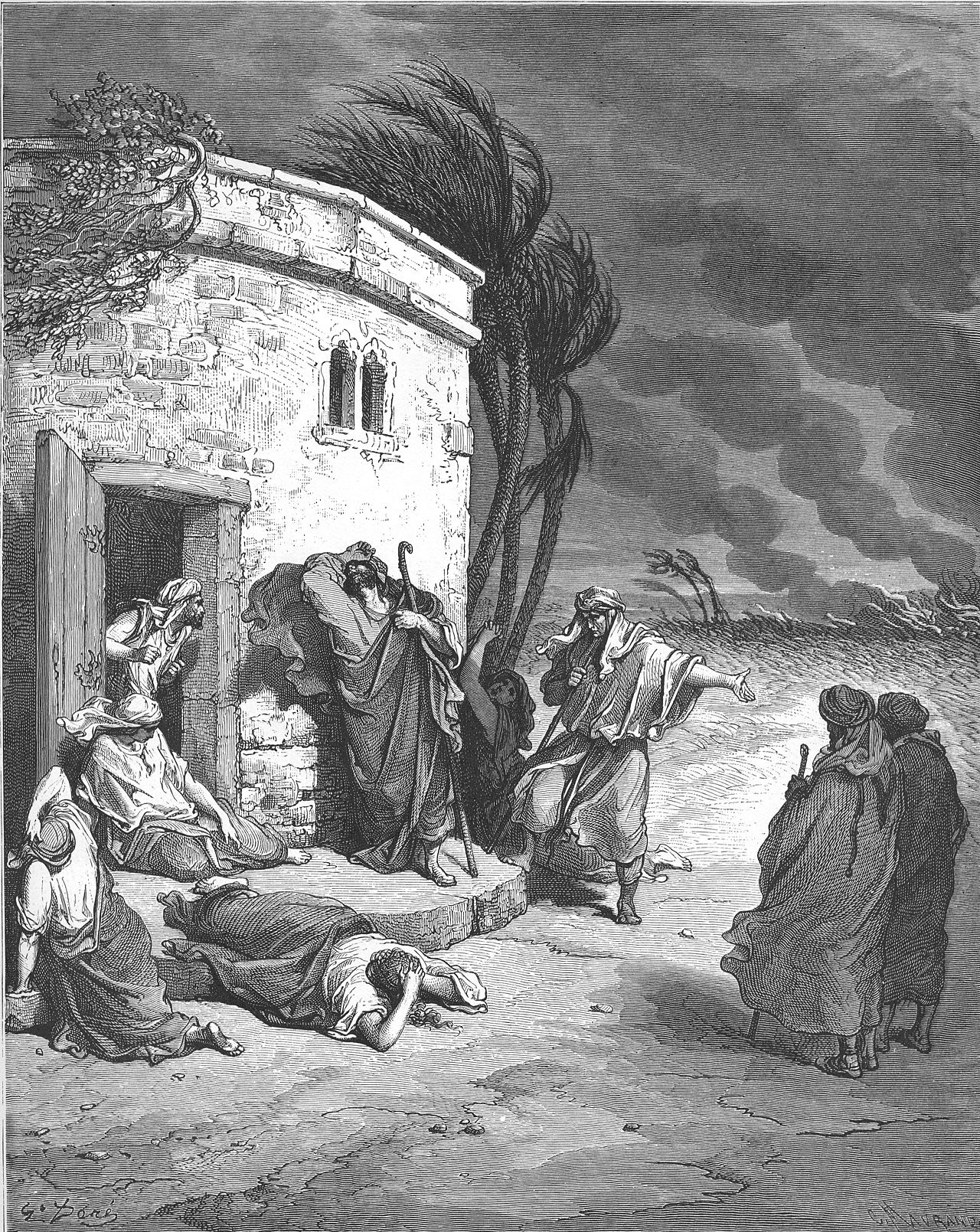
Jobchapter 27
23 verses · unknown · 10th century BC · Wisdom and poetry
“As surely as God lives, who has deprived me of justice—the Almighty, who has embittered my soul—
Introduction
unknown, Wisdom and poetry, Job Overview.
Job speaks again without waiting for Zophar, whose third turn never comes. He begins with an oath, the most binding form of speech his world knew. His hearers swore by the life of God only when they were ready to answer to God for their words. Listen for what Job swears he will never do. Then listen to his description of the wicked man's hope and end. Some readers hear the voice change in the second half, and the chapter raises the question of who is speaking there.
Context
- Who
- Hearers who knew that a false oath brought its own judgment down on the man who swore it
- What
- Job's oath that he will hold fast his integrity, followed by a description of the hopeless end of the godless man.
- Where
- The ash heap outside Job's town, with the friends now silent.
- When
- The close of the third round of speeches, after Bildad's last words.
- Why
- To show Job refusing to buy relief by confessing sins he did not commit, while agreeing that God judges the wicked.
Historical context
Job opens with an oath in the strongest form his world had: 'As God liveth, who hath taken away my judgment.' Swearing by the life of God bound a man to the truth on pain of divine reckoning, and Job uses it to swear he will not say what everyone wants him to say, till I die I will not remove mine integrity from me.
Show the rest of the historical context, 3 more paragraphs
He then describes the hypocrite's real position, and it is the friends' own doctrine handed back with an edge. What is the hope of the hypocrite when God takes away his soul? Will God hear his cry when trouble comes? Will he delight himself in the Almighty and call on God at all times? The hypocrite's problem, Job says, is not his circumstances but that he does not want God, which is exactly the opposite of everything Job has been doing for twenty-five chapters.
The pictures of the wicked man's estate are drawn from building and farming. He builds his house as a moth, the flimsy case a clothes-moth larva spins, and as a booth that the keeper makes: the temporary shelter of branches thrown up in a vineyard for the few weeks of harvest and abandoned after. Both are structures nobody expects to last a season.
The wealth images are just as concrete. Though he heap up silver as the dust and prepare clothing as the clay, the just shall put it on and the innocent divide the silver, fine garments were a major form of stored wealth, and this is a picture of a man's wardrobe worn by someone else. Then the east wind carries him away in the night and hurls him out of his place, and men clap their hands at him and hiss him out.
Significance
Job agrees with his friends about the fate of the truly wicked. What he refuses to do is buy relief by confessing to crimes he did not commit, and he swears an oath to make the refusal binding.
Show the rest of the significance, 1 more paragraph
That is the integrity the book has been testing since chapter 1. He will not curse God, and he will not lie about God either, even when lying would end the argument and might end the suffering.
This chapter in Jewish lifeWhat this chapter is in Jewish life and reading.
What is done
This chapter has no place in the synagogue year. The site's own table in src/lib/hebraic/readings.ts printed parashot total 0 and haftarah uses total 0 for the book of Job, and no festival reading.
The corpus joins it to the study of the Torah portions through the Midrash arranged by them. Under the twenty-third verse it carries Midrash Tanchuma, Pinchas 14:1.
How it is read
Rashi is the one commentator on this chapter whose English the corpus carries, quoted here from The Judaica Press complete Tanach with Rashi, translated by A. J. Rosenberg, which Sefaria reports as CC-BY. He explains why Job speaks again without a friend answering first. The friends had stopped replying, as the thirty-second chapter says they did when Elihu reprimanded them (Rashi on Job 27:1:1).
Job opens with an oath, swearing that God took away his right (Rashi on Job 27:2:1). Rashi reports that Rabbi Joshua derived from this verse that Job served the Omnipresent out of love. He gives the ground of that reading. "No one swears by the king’s life unless he loves the king" (Rashi on Job 27:2:1). The reading belongs to Rabbi Joshua, and Rashi reports it as his.
Job then refuses to give way. He will not say that the friends are right in condemning him (Rashi on Job 27:5:1). He holds to saying that he is righteous (Rashi on Job 27:6:1). Rashi hears the eighth verse as Job asking why he should be a wicked man and a robber, and what end awaits one who takes money by force (Rashi on Job 27:8:1).
At the tenth verse Rashi stops for grammar. He sets out the pattern of the double question, the first part opening with one particle and the second with another, and cites Amos and an earlier verse of Job (Rashi on Job 27:10:1). The question asks whether a wicked man can rely on God's salvation and call to Him in trouble (Rashi on Job 27:10:1). Rashi ties the eleventh verse to Job's earlier words that God knows the way that is with him (Rashi on Job 27:11:1).
From the twelfth verse Job describes the portion of the wicked man, which the friends have all seen (Rashi on Job 27:12:1). His sons increase only for the sword, and they die amid suffering until his widows are glad at their death (Rashi on Job 27:14:1). The Holy One gives his money to an innocent man (Rashi on Job 27:17:1). He builds like a moth whose hole does not last, or like a watchman's booth that is not permanent (Rashi on Job 27:18:1). Rashi adds a second reading of the booth that he heard, and the translation marks it absent in certain editions (Rashi on Job 27:18:1).
The end comes quickly. The wicked man dies with his riches but is sometimes left unburied (Rashi on Job 27:19:1). Rashi reads the terrors of the twentieth verse as demons (Rashi on Job 27:20:1). Those who knew him long ago clap their hands at his ruin (Rashi on Job 27:23:1).
The corpus carries nine further notes on this chapter without an English text, each marked linked because Sefaria holds no English version of the ref. They stand cited by ref and unquoted. Six stand at Metzudat David on Job 27:1:1, 27:3:1, 27:7:1, 27:9:1, 27:13:1 and 27:16:1. Two stand at Ibn Ezra on Job 27:4:1 and 27:21:1. One stands at Rashi on Job 27:15:1.
What the rabbis say
The corpus carries twenty-nine rabbinic locators on this chapter and the text of none, so each is cited and linked here rather than quoted. On the first verse it holds Midrash Lekach Tov on Ecclesiastes 12:9:1. On the second verse it holds Jerusalem Talmud Sotah 5:5:2. On the fifth verse it holds Ein Yaakov (Glick Edition), Sotah 5:3, Ein Yaakov, Sotah 5:2, Jerusalem Talmud Sotah 5:5:1 and Sotah 27b:13. On the eighth verse it holds Bava Kamma 119a:9, Ein Yaakov, Bava Kamma 10:3 and Tractate Semachot 2:1.
On the twelfth verse it holds Bava Batra 15b:5, Bava Batra 15b:9, Bereshit Rabbah 57:4, Ein Yaakov (Glick Edition), Bava Batra 1:31 and Ein Yaakov, Bava Batra 1:33. It also holds Ein Yaakov, Bava Batra 1:34, Jerusalem Talmud Sotah 5:6:2 and Yalkut Shimoni on Torah 102:5. On the sixteenth verse it holds Midrash Sekhel Tov, Shemot 8:10:1. On the seventeenth verse it holds Bava Kamma 119a:7, Bava Metzia 61b:14, Ein Yaakov, Bava Metzia 5:3, Jerusalem Talmud Bava Kamma 10:1:2 and Pesachim 49b:13. On the nineteenth verse it holds Midrash Lekach Tov, Leviticus 1:1:1.
On the twenty-second verse it holds Aggadat Bereshit 47:2, Ein Yaakov (Glick Edition), Megillah 1:37 and Megillah 16a:22. On the twenty-third verse it holds Bamidbar Rabbah 21:22 and Midrash Tanchuma, Pinchas 14:1. What each of them teaches is a saying of the rabbis, and is reported as theirs wherever this site quotes one. The quotations wait on a fetch that carries the text.
Sources: Rashi, Rashi on Job 27:1:1 to 27:23:1, The Judaica Press complete Tanach with Rashi, translated by A. J. Rosenberg, reported CC-BY; Metzudat David, Metzudat David on Job 27:1:1, 27:3:1, 27:7:1, 27:9:1, 27:13:1 and 27:16:1, cited by ref because the corpus carries no English text; Ibn Ezra, Ibn Ezra on Job 27:4:1 and 27:21:1, cited by ref because the corpus carries no English text; Rashi, Rashi on Job 27:15:1, cited by ref because the corpus carries no English text; The Sefaria corpus, scripts/data/sources/sefaria/job/27.json, the 29 Talmud and Midrash locators of this chapter; The site's own files, src/lib/hebraic/readings.ts, printing no portion, no Haftarah and no festival reading for this book.
The heads below are this chapter's scenes. The numbered points under each are its verses.
Job: Till I Die I Will Not Put Away Mine Integrity
Job 27:1-2
Job continued his discourse: His oath, "As surely as God lives, who has deprived me of justice", is sworn by the very God Job charges with wronging him. The same breath names "the Almighty, who has embittered my soul", so the God Job serves and the God he accuses stand in one sentence.
Barnes hears a solemn oath by the living God, as at Ezekiel 33:11. Job swears by the very God who has deprived him of justice and embittered his soul. Henry notes that Elihu rebukes the word about justice at Job 34:5.
Job 27:2
“THE word, "who," was put into this verse by the translators, but it is not needed. It is better as I have read it to you, "The Almighty has vexed my soul." The marginal reading is, perhaps, a more exact translation of the original—"The Almighty has embittered my soul." From this we learn that a good man may have his soul vexed. He may not be able to preserve the serenity of his mind. We think and think rightly, that a Christian man should "glory in tribulations, also," and rise superior to all outward afflictions.”
Charles Spurgeon · written before 1892 · The Metropolitan Tabernacle Pulpit, Sermon No. 2557: “A Vexed Soul Comforted” (lightly modernized text, CCEL edition)Particular Baptist
2 more voices on this verseWhat preachers and commentators have said about this verse, in their own words.
Job 27:2
“Elihu reproved him for this word ( ch. xxxiv. 5 ); for God is righteous in all his ways, and takes away no man's judgment. But see how apt we are to despair of favour if it be not shown us immediately, so poor-spirited are we and so soon weary of waiting God's time.”
Matthew Henry · Commentary on the Whole Bible (1707-1721)puritan
Job 27:2
“Who hath taken away my judgment - Who has turned aside my cause, and has not permitted it to come to a hearing, where I might have justice done to me, but has abandoned me to the harsh and uncharitable judgment of my enemies? There appears to be a great want of reverence in these words of Job; he speaks with a degree of irritation, if not bitterness, which cannot be justified. No man should speak thus of his Maker.”
Adam Clarke · Commentary on the Bible (1810-1826)evangelical
Job 27:3-4
as long as my breath is still within me: Job ties his honesty to the breath God gave him, an echo of Genesis 2:7. He pledges that "my lips will not speak wickedness, and my tongue will not utter deceit", under his suffering. Clarke notes the oath's scope, which binds Job's speech for as long as his life lasts.
Job 27:3
“All the while my breath is in me, and the Spirit of God is in my nostrils, my lips shall not speak iniquity, nor my tongue meditate falsehood. What he first calls 'iniquity,' this repeating afterwards he calls 'falsehood.' For both all 'falsehood' is 'iniquity,' and all 'iniquity' 'falsehood,' because, whatever thing is at variance with truth is surely at odds with equity. But between this which he expresses, 'to speak' and that which he adds afterwards, to 'meditate,' there is a wide difference. For sometimes it is a worse thing to 'meditate' falsehood than to speak it.”
Gregory the Dialogist · written before 604 · Morals on the Book of Job, Book XVIIIpatristic
1 more voice on this verse
Job 27:3
“Implying Job's knowledge of the fact that the living soul was breathed into man by God (Ge 2:7). "All the while." But MAURER, "As yet all my breath is in me" (notwithstanding my trials): the reason why I can speak so boldly.”
Jamieson, Fausset & Brown · Commentary Critical and Explanatory on the Whole Bible (1871)reformed
my lips will not speak wickedness: The oath of verses 2 and 3 binds Job's lips and tongue as long as his breath lasts. Barnes hears an assurance that might have eased the friends' suspicion of wickedness in him. Clarke hears a promise of conscience kept before God.
Job 27:4
“My lips shall not speak wickedness - This solemn profession made on oath might have done something to allay the suspicions of his friends in regard to him, and to show that they had been mistaken in his character. It is a solemn assurance that he did not mean to vindicate the cause of wickedness, or to say one word in its favor; and that as long as he lived he would never be found advocating it.”
1 more voice on this verse
Job 27:4
“My lips shall not speak wickedness - As I have hitherto lived in all good conscience before God, as he knoweth, so will I continue to live.”
Adam Clarke · Commentary on the Bible (1810-1826)evangelical
Job 27:5-6
I will never say that you are right: t" refuses the one settlement the friends have pressed, that Job confess a guilt he does not have. "I will maintain my integrity until I die" holds to the integrity of chapters 1 and 2 in Job's own words.
Job 27:5
“God forbid that I should justify you; till I die, I will not depart from mine innocency. For he would 'depart from his innocency,' if he reckoned good things of bad persons; as Solomon bears witness, who saith, He that justifieth the wicked, and he that condemneth the just, even they both are abomination to the Lord. For there are persons, who, whilst they extol with commendation deeds of men ill done, heighten that which they ought to have rebuked.”
Gregory the Dialogist · written before 604 · Morals on the Book of Job, Book XVIIIpatristic
2 more voices on this verse
Job 27:5
“God forbid - לי חלילה châlı̂ylâh lı̂y. “Far be it from me.” Literally, “Profane be it to me;” that is, I should regard it as unholy and profane; I cannot do it. That I should justify you - That I should admit the correctness of your positions, and should concede that I am an hypocrite. He was conscious of integrity and sincerity, and nothing could induce him to abandon that conviction, or to admit the correctness of the reasoning which they had pursued in regard to him.”
Job 27:5
“It is God that justifies. To resolve that our hearts shall not reproach us when we give them cause to do so is to affront God, whose deputy conscience is, and to wrong ourselves; for it is a good thing, when a man has sinned, to have a heart within him to smite him for it, 2 Sam. xxiv.”
Matthew Henry · Commentary on the Whole Bible (1707-1721)puritan
I will cling to my righteousness and never let go: Barnes takes the righteousness Job clings to as his sense of integrity, the one comfort left when property and health were gone. Maurer, cited by Jamieson, Fausset and Brown, reads a conscience that will accuse none of his days. The integrity of verse 5 is the same claim.
Job 27:6
“My righteousness I hold fast - I stand firmly on this ground; I have endeavored to live an upright life, and my afflictions are not the consequence of my sins. My heart shall not reproach me - I shall take care so to live that I shall have a conscience void of offense before God and man. “Beloved, if our heart condemn us not, then have we confidence toward God;” 1Jn 3:21. This seems to be Job’s meaning.”
Adam Clarke · Commentary on the Bible (1810-1826)evangelical
1 more voice on this verse
Job 27:6
“Rather, my "heart" (conscience) reproaches "not one of my days," that is, I do not repent of any of my days since I came into existence [MAURER].”
Jamieson, Fausset & Brown · Commentary Critical and Explanatory on the Whole Bible (1871)reformed
Job 27:7-10
May my enemy be like the wicked: Job asks the friends' own question, what "the hope of the godless" is "when he is cut off, when God takes away his life". Verses 9 and 10 press toward prayer, since the godless man cries out only in distress while Job has called on God through the book.
Job 27:7
“Let mine enemy be like the ungodly, and he that riseth up against me as the unrighteous. In Holy Writ, the words 'like as' and 'as if' are sometimes put not for a likeness, but for the reality. Whence we have that; And we beheld His glory, the glory as of the only-begotten of the Father. And thus here also 'like,' and 'as' seem to be said rather for the sake of affirmation than similitude.”
Gregory the Dialogist · written before 604 · Morals on the Book of Job, Book XVIIIpatristic
1 more voice on this verse
Job 27:7
“Let mine enemy be as the wicked - This is probably said that he might show that it was not his intention to justify the wicked, and that in all that he had said it was no part of his purpose to express approbation of their course. His friends had charged him with this; but he now solemnly disclaims it, and says that he had no such design.”
what is the hope of the godless: Barnes notes that Bildad and Zophar had said the same at Job 8:13 and Job 20:5, and Job now agrees with them. Clarke says the Hebrew word names a defiled and dishonest man more than a pretender. His hope ends when God takes his life.
Job 27:8
“For what is the hope of the hypocrite, if he seize with covetousness, and God free not his soul? Will God hear his cry, when trouble cometh upon him? The hypocrite, who in the Latin language is termed pretender, aims not to be but to appear just, and therefore he is a covetous robber, because whereas while doing wickedly he desires to be revered for sanctity, he seizes on the praise of a life not his own.”
Gregory the Dialogist · written before 604 · Morals on the Book of Job, Book XVIIIpatristic
2 more voices on this verse
Job 27:8
“What is the hope of the hypocrite - The word חנף chaneph, which we translate, most improperly, hypocrite, means a wicked fellow, a defiled, polluted wretch, a rascal, a knave, a man who sticks at nothing in order to gain his ends. In this verse it means a dishonest man, a rogue, who by overreaching, cheating, etc., has amassed a fortune. When God taketh away his soul? - Could he have had any well grounded hope of eternal blessedness when he was acquiring earthly property by guilt and deceit?”
Adam Clarke · Commentary on the Bible (1810-1826)evangelical
Job 27:8
“Jehu gained a kingdom by his hypocrisy and the Pharisees many a widow's house. Upon this gain he builds his hope, such as it is. He hopes he is in good circumstances for another world, because he finds he is so for this, and he blesses himself in his own way.”
Matthew Henry · Commentary on the Whole Bible (1707-1721)puritan
Will God hear his cry: The godless man of verse 8 turns to God only when distress comes. Henry says those who slighted God in prosperity, or prayed coldly, will pray earnestly in trouble. Verse 10 asks whether such prayer lasts.
Job 27:9
“Will God hear his cry when trouble cometh upon him? - Coverdale has rendered this Job 27:8-9 so as to make excellent sense, though not strictly in accordance with the original. “What hope hath the hypocrite though he have great good, and though God give him riches after his heart’s desire? Doth God hear him the sooner, when he crieth unto him in his necessity?” The object of the verse is to show the miserable condition of a wicked man or a hypocrite.”
1 more voice on this verse
Job 27:9
“The judgment of the great day will come; fearfulness will surprise the hypocrites, Isa. xxxiii. (2.) Then he will cry to God, will pray, and pray earnestly. Those who in prosperity slighted God, either prayed not at all or were cold and careless in prayer, when trouble comes will make their application to him and cry as men in earnest.”
Matthew Henry · Commentary on the Whole Bible (1707-1721)puritan
Will he delight in the Almighty?: Wesley answers the question: the godless man delights in the world, and those who find no delight in God will soon stop calling on Him. Barnes sets against him the godly man, whose chief joy is found in God. Job draws this line between himself and the godless.
Job 27:10
“Will he delight himself in the Almighty? - A truly pious man will delight himself in the Almighty. His supreme happiness will be found in God. He has pleasure in the contemplation of his existence, his perfections, his law, and his government. Coverdale renders this, “Hath he such pleasure and delight in the Almighty that he dare alway call upon God?” The idea of Job is that a hypocrite has not his delight in the Almighty; and, therefore, his condition is not such as he would defend or choose.”
Job 27:11-12
I will instruct you in the power of God: d" turns Job from defense to teaching. "Surely all of you have seen it for yourselves" gives the friends only the view Job has. The verse opens the section where Job describes the wicked man's end in the friends' own terms.
Job 27:11
“What he would teach them: " That which is with the Almighty, " that is, "the counsels and purposes of God concerning wicked people, which are hidden with him, and which you cannot hastily judge of; and the usual methods of his providence concerning them." This, says Job, will I not conceal.”
Matthew Henry · Commentary on the Whole Bible (1707-1721)puritan
2 more voices on this verse
Job 27:11
“I will teach you by the hand of God - Margin, “or, being in.” Coverdale, “In the name of God.” So Tindal, Noyes, “Concerning the hand of God.” Good, “Concerning the dealings of God.” The Chaldee renders it אלהא בנביאת - “By the prophecy of God.” Luther, “I will teach you by the hand of God.” The idea evidently is, that Job would instruct them by what God had done.”
Job 27:11
“The fact is, it is probable that Job tacitly, by giving, in the twenty-eighth chapter, only a general answer, implies, that in spite of the wicked often dying, as he said, in prosperity, he does not mean to deny that the wicked are in the main dealt with according to right, and that God herein vindicates His moral government even here.”
Jamieson, Fausset & Brown · Commentary Critical and Explanatory on the Whole Bible (1871)reformed
Why then do you keep up this empty talk?: Barnes turns what the friends have seen against them: the ways of God they observed should have taught them that suffering proves no guilt. Clarke notes the emphatic Hebrew, hebel tehbalu. Jamieson, Fausset and Brown hear Job asking why their empty talk makes him wicked.
Job 27:12
“Ye yourselves have seen it - Your own experience and observation have shown you that the righteous are frequently in affliction, and the wicked in affluence. Why then are ye thus altogether vain? - The original is very emphatical: הבל תהבלו hebel tehbalu, and well expressed by Mr. Good: “Why then should ye thus babble babblings!” It our language would allow it, we might say vanitize vanity.”
Adam Clarke · Commentary on the Bible (1810-1826)evangelical
1 more voice on this verse
Job 27:12
"Ye yourselves see" that the wicked often are afflicted (though often the reverse, Job 21:33). But do you "vainly" make this an argument to prove from my afflictions that I am wicked?
Jamieson, Fausset & Brown · Commentary Critical and Explanatory on the Whole Bible (1871)reformed
Job: The Portion of a Wicked Man With God
Job 27:13-15
"This is the wicked man’s portion from God" opens a list that reads like the friends' doctrine. Readers divide over whether Job concedes the wicked meet a bad end or rehearses the friends' creed to expose its thinness. Some modern critics give part of it to Zophar's missing third speech.
Job 27:13
“This is the portion of a wicked man with God,.... Not to be punished in this life, but after death. This is what Job undertook to teach his friends, and is the purport of what follows in this chapter.”
2 more voices on this verse
Job 27:13
“This is the portion of a wicked man with God - There has been much diversity of view in regard to the remainder of this chapter. The difficulty is, that Job seems here to state the same things which had been maintained by his friends, and against which he had all along contended. This difficulty has been felt to be very great, and is very great.”
Job 27:13
“They are above the control of any earthly power, it may be, but the Almighty can deal with them. He does it, by showing that wicked people may, in some instances, prosper, but that ruin follows them in those very instances; and that is their portion, that is their heritage, that is it which they must abide by.”
Matthew Henry · Commentary on the Whole Bible (1707-1721)puritan
Though his sons are many, they are destined for the sword: Barnes holds verses 13 to 23 recite the friends' doctrine of the wicked man's portion, and traces the offspring without food to Zophar at 20:10. Clarke takes it as Job's own teaching that many sons are no sure sign of blessing. The sword and hunger fall first on the family.
Job 27:14
“If his children be multiplied - As numerous families were supposed to be a proof of the benediction of the Almighty, Job shows that this is not always the case; for the offspring of the wicked shall be partly cut off by violent deaths, and partly reduced to great poverty.”
Adam Clarke · Commentary on the Bible (1810-1826)evangelical
1 more voice on this verse
Job 27:14
“You eat, but you have not enough, Hag. i. (3.) Those that remain shall be buried in death, that is, shall die of the plague, which is called death ( Rev. vi. 8 ), and be buried privately and in haste, as soon as they are dead, without any solemnity, buried with the burial of an ass; and even their widows shall not weep; they shall not have wherewithal to put them in mourning.”
Matthew Henry · Commentary on the Whole Bible (1707-1721)puritan
His survivors will be buried by the plague: Barnes renders the Hebrew as buried by death, as though the plague dug the grave, and Gill notes that the Hebrews called the plague death. Jamieson, Fausset and Brown read their widows, as the Berean does. The plague alone buries the survivors.
Job 27:15
“The plague of the Middle Ages was called "the black death." Buried by it implies that they would have none else but the death plague itself (poetically personified) to perform their funeral rites, that is, would have no one. his--rather, "their widows." Transitions from singular to plural are frequent.”
Jamieson, Fausset & Brown · Commentary Critical and Explanatory on the Whole Bible (1871)reformed
1 more voice on this verse
Job 27:15
“Those that remain of him - Those that survive him. Shall be buried in death - Hebrew “shall be buried BY death” (במות bamâveth), that is. “Death shall be the grave-digger” - or, they shall have no friends to bury them; they shall be unburied. The idea is highly poetical, and the expression is very tender. They would have no one to weep over them, and no one to prepare for them a grave; there would be no procession, no funeral dirge, no train of weeping attendants; even the members of their own family would not weep over them.”
Job 27:16-18
Though he heaps up silver like dust: The wicked man "heaps up silver like dust and piles up a wardrobe like clay". Yet "what he lays up, the righteous will wear, and his silver will be divided by the innocent". The effort is immense, and what it builds is never meant to last.
Job 27:16
“Though he heap up silver - Though he amass riches in the greatest abundance, he shall not enjoy them. Unsanctified wealth is a curse to its possessor. Money, of all earthly possessions, is the most dangerous, as it is the readiest agent to do good or evil. He that perverts it is doubly cursed, because it affords him the most immediate means of sinful gratification; and he can sin more in an hour through this, than he can in a day or week by any other kind of property.”
Adam Clarke · Commentary on the Bible (1810-1826)evangelical
1 more voice on this verse
Job 27:16
“The Egyptians' jewels were the Israelites' pay. Solomon observes ( Eccl. ii. 26 ) that God makes the sinners drudges to the righteous; for the sinner he gives travail to gather and heap up, that he may give to him that is good before God. [2.] They shall do good with it.”
Matthew Henry · Commentary on the Whole Bible (1707-1721)puritan
what he lays up, the righteous will wear: The heaps of verse 16 change hands. Barnes reads the verse as the wicked man dying before he can enjoy his gains. Clarke adds that silver belongs to God, who in His providence brings it back to its proper use.
Job 27:17
“The just shall put it on - The righteous shall wear it. It shall pass out of the hands of him who prepared it, into the hands of others. The meaning is, that the wicked, though they become rich, would not live to enjoy their ill-gotten gains.”
like a hut set up by a watchman: Jamieson, Fausset and Brown trace the moth from the clothing of verse 16, whose cocoon breaks when the garment is shaken. Wesley pictures the watchman's booth, raised in fruit time and pulled down as quickly. Both houses are quickly gone.
Job 27:18
“The transition is natural from "raiment" (Job 27:16) to the "house" of the "moth" in it, and of it, when in its larva state. The moth worm's house is broken whenever the "raiment" is shaken out, so frail is it. booth--a bough-formed hut which the guard of a vineyard raises for temporary shelter (Isa 1:8).”
Jamieson, Fausset & Brown · Commentary Critical and Explanatory on the Whole Bible (1871)reformed
1 more voice on this verse
Job 27:18
“He is very secure in it, as a moth, and has no apprehension of danger; but it will prove of as short continuance as a booth which the keeper makes, which will quickly be taken down and gone, and his place shall know him no more.”
Matthew Henry · Commentary on the Whole Bible (1707-1721)puritan
Job 27:19-21
He lies down wealthy, but will do so no more: The man "lies down wealthy, but will do so no more". "Terrors overtake him like a flood; a tempest sweeps him away in the night", which moves the list from slow loss to sudden ruin. "The east wind carries him away", the scorching desert wind acting with its own violence.
Job 27:19
“Not gathered - Instead of that honourable interment with his fathers, his carcase shall lie like dung upon the earth. One openeth his eyes - That is, while a man can open his eyes, in the twinkling of an eye. He is as if he had never been, dead and gone, and his family and name extinct with him.”
John Wesley · Explanatory Notes upon the Old Testament (1765)evangelical
2 more voices on this verse
Job 27:19
“When the rich man sleepeth, he shall take nothing away with him, he shall open his eyes and shall find nought. In harmony with which same sentence the Psalmist saith, All the foolish in heart are troubled, they have slept their sleep, and all the men of riches have found nothing in their hands. For in order that the rich after death may 'find something in their hand,' it is told to them before death, in whose hands they should place their riches.”
Gregory the Dialogist · written before 604 · Morals on the Book of Job, Book XVIIIpatristic
Job 27:19
“The rich man - That is, the rich man who is wicked. Shall lie down - Shalt die - for so the connection demands. But he shall not be gathered - In an honorable burial. The slain in battle are gathered together for burial; but he shall be unburied. The expressions “to be gathered,” “to be gathered to one’s fathers,” frequently occur in the Scriptures, and seem to be used to denote a peaceful and happy death and an honorable burial.”
Terrors overtake him like a flood: Barnes compares Job 18:14 and says the tempest comes as unexpectedly as a thief at night. Clarke adds that the darkness hides the danger and the way of escape. The wealth of verse 19 goes with him.
Job 27:20
“Want shall take hold of him like water; a tempest shall overwhelm him in the night. Let us look now at the want of the rich man as burning, whose abundance was so great as feasting. For he says, Father Abraham, have mercy on me, and send Lazarus that he may dip the tip of his finger in water, and cool my tongue for I am tormented in this flame.”
Gregory the Dialogist · written before 604 · Morals on the Book of Job, Book XVIIIpatristic
1 more voice on this verse
Job 27:20
“Death, to a godly man, is like a fair gale of wind to convey him to the heavenly country, but, to a wicked man, it is like an east wind, a storm, a tempest, that hurries him away in confusion and amazement, to destruction.”
Matthew Henry · Commentary on the Whole Bible (1707-1721)puritan
The east wind carries him away: Barnes notes that the severe storms of this book come from the east, as at Job 15:2. Wesley takes the wind as a terrible judgment that carries the man from the palace he meant to keep forever. Clarke compares the eastern storm of Acts 27:14.
Job 27:21
“The scorching wind shall carry him off, and take him away. And as a whirlwind shall carry him out of his place. Who is in this place called the 'scorching wind' but the evil spirit, who stirs up the flames of divers lusts in the heart, that he may drag it to an eternity of punishments? And so 'the scorching wind' is said to 'carry off' any bad men, because the plotter, the evil spirit, who inflames a man whilst living to evil, drags him when dying to torments.”
Gregory the Dialogist · written before 604 · Morals on the Book of Job, Book XVIIIpatristic
Job 27:22-23
It hurls itself against him without mercy: In the Berean the east wind of verse 21 is the subject. The speech ends in scorn where Job has begged for pity since chapter 19. Job pictures a fall met with the same scorn his own friends have shown him through the book.
Job 27:22
“For He shall let loose upon him, and not spare. Fleeing he shall flee out of His hand. God, as often as He chastens the sinner by smiting him, for this reason 'lets loose' the scourge, that He may 'spare.' But when by smiting He brings his life to an end whilst remaining in sin, He 'lets loose' the scourge, but never at all 'spares.' For the Same, Who 'let loose' the scourge that He might 'spare,' one day 'lets it loose' with this view that He may not spare.”
Gregory the Dialogist · written before 604 · Morals on the Book of Job, Book XVIIIpatristic
1 more voice on this verse
Job 27:22
“Cast - His darts or plagues one after another. Would flee - He earnestly desires to escape the judgments of God, but in vain. Those that will not be persuaded to fly to the arms of Divine grace, which are now stretched out to receive them, will not be able to flee from the arms of Divine wrath, which will shortly be stretched out to destroy them.”
John Wesley · Explanatory Notes upon the Old Testament (1765)evangelical
It claps its hands at him: Clarke reads the storm of verses 20 to 22 as the one that claps and hisses, and compares a man hissed out of public office. Barnes hears Job quoting Bildad at Job 18:18 in order to show it wrong. Wesley reads the claps as joy and scorn at his removal.
Job 27:23
“Men shall clap their hands at him - That is, they shall combine to drive him out of the world, and rejoice when he is gone. The same sentiment was also expressed by Bildad, Job 18:18: “He shall be driven fromm light into darkness, And chased out of the world.” There can be no doubt, I think, that Job alludes to that sentiment, and that his object in quoting it is to show its incorrectness.”
1 more voice on this verse
Job 27:23
“Clap - In token of their joy at the removal of such a publick pest, by way of astonishment: and in contempt and scorn, all which this gesture signifies in scripture use.”
John Wesley · Explanatory Notes upon the Old Testament (1765)evangelical
Keep studying
Studies2
People and groups1
Sources for this chapter
The summary
Jamieson, Fausset & Brown, Commentary Critical and Explanatory; John Wesley, Notes on the Old Testament and Matthew Henry, Complete Commentary.
The exposition
A. B. Davidson, The Book of Job, Cambridge Bible; Adam Clarke, Commentary on the Bible; Albert Barnes; Franz Delitzsch, Biblical Commentary on the Book of Job; Jamieson, Fausset & Brown, Commentary Critical and Explanatory on the Whole Bible; John Gill, Exposition of the Old Testament; John Wesley, Explanatory Notes upon the Old Testament; Matthew Henry, Commentary on the Whole Bible and R. A. Watson, The Book of Job, Expositor's Bible.