
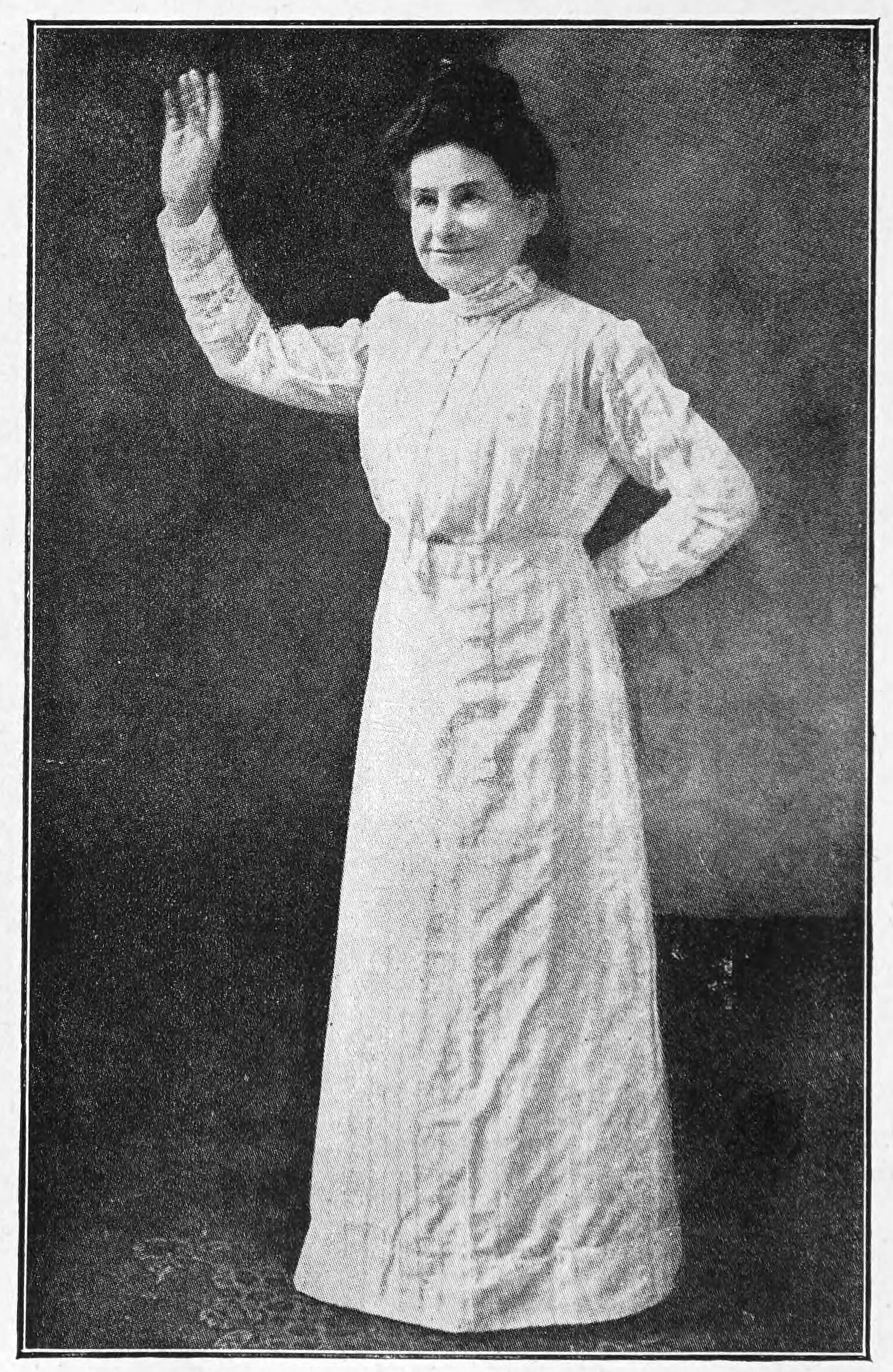
Maria Beulah Woodworth-Etter, from Signs and Wonders, 1916. Public domain.
Ohio to Indianapolis, 1844 to 1924 · Person · Featured Study
Maria Woodworth-Etter
She held meetings for forty years, from her first in Ohio to a tabernacle of her own in Indianapolis.
A drunkard's daughter who buried five children was told by ministers that she had a work no man could do.
And afterward, I will pour out My Spirit on all people. Your sons and daughters will prophesy, your old men will dream dreams, your young men will see visions.
And afterward, I will pour out My Spirit on all people. Your sons and daughters will prophesy, your old men will dream dreams, your young men will see visions.
- Born
- 22 July 1844 at New Lisbon, Ohio
- Died
- 1924
- Family
- father: Samuel Underwood; mother: Matilda Underwood; husband: P. H. Woodworth; husband: Samuel P. Etter; daughter: Lizzie
- Places
- New Lisbon, Hartford City, Oakland, St. Louis, Dallas, Indianapolis
Summary
Maria Woodworth-Etter was born in Ohio in 1844 and began to hold meetings after five of her six children died. Crowds of thousands came to her meetings in Indiana, California and Missouri. People fell at her meetings and lay in what she called trances. A physician called it hypnotism, and a court in Massachusetts tried her and acquitted her.
- Her own account of her life stands in her book Signs and Wonders.
- She preached that the Spirit was poured out on sons and daughters alike.
- She joined F. F. Bosworth at Dallas in 1912, among the early Pentecostals.
The Verse of Her Sermon on Women
Her sermon on the rights of women in the gospel opens with Pentecost and the promise in Joel.
Signs and Wonders prints a sermon she called Women's Rights in the Gospel. It sets the prophecy of Joel beside the day of Pentecost, where sons and daughters both prophesy.
She was told as a girl that women had no right to work for Jesus in public. The question of this life is how such a woman came to preach to tents of thousands, and why her meetings drew both a crowd and a charge.
‘In the last days, God says, I will pour out My Spirit on all people. Your sons and daughters will prophesy, your young men will see visions, your old men will dream dreams.Peter cites Joel on the day the Spirit fell.
The Life in Order
Her own book gives most of the steps, and a court, a physician and a library record give the rest.
She held meetings for over forty years after her children died.
- 1844She was born at New Lisbon in Columbiana County, OhioSigns and Wonders, page 19
- July 1855The family lost its fatherSigns and Wonders, page 20
- At thirteenHer conversionSigns and Wonders, page 21
- After her marriageFive of her six children died youngSigns and Wonders, pages 22 to 27
- April 1885She held packed meetings at Hartford City and Tipton, IndianaSigns and Wonders, pages 71 and 72
- 28 October 1889Her tent meetings began at Oakland, CaliforniaSigns and Wonders, page 108
- 1890A physician watched her tent at St. LouisDiller, The Medical News, 27 September 1890
- 1 January 1902Her second marriageSigns and Wonders, page 137
- August 1912She joined the Dallas meetingBosworth's report, in Signs and Wonders, page 159
- 18 August 1913Her arrest on a charge of fraudSigns and Wonders, page 309
- 19 May 1918The Woodworth-Etter Tabernacle openedMarvels and Miracles, page 353
- 1924She diedLibrary of Congress name record, after Warner (1986)
Each step of the life stands with its witness.
1890, 1 January 1902, August 1912, 18 August 1913, 19 May 1918, 1924
From the Farm to the Tent
She tells the first half herself, and a court and a physician tell parts of the second.
Maria Underwood was the fourth daughter of Samuel and Matilda Underwood. Her father drank, and when he died of sunstroke at the harvest her mother was left with eight children and almost nothing. She wrote in 1916 that she had never told the public before that she was a drunkard's daughter.
She went out to work as a girl and kept a book in the kitchen to learn verses. At thirteen she joined the Disciples, and as she went into the creek to be baptized, she says, a light came over her. Soon after, she heard a call to gather the lost, but the Disciples held that women had no right to such work.
Maria Woodworth-Etter married P. H. Woodworth, bore six children, and buried five of them. A little boy died first, then the baby Freddy, then Georgie of scrofula, then Gertie at four months, and then Willie at nearly seven. Only Lizzie, sixteen, was left.
She was ill for years and lay near death more than once. Ministers she did not know told her that God was calling her to preach.
Her first meeting was in a little town among her husband's people, and twenty claimed conversion. She told a court in 1913 that she had begun her ministry about thirty-five years before, with no training. By 1889 she was pitching a tent that held eight thousand.
Her meetings were known for one thing above all. People fell where they stood and lay for hours in what she called trances, and the newspapers sent reporters to watch. At Hartford City in April 1885 she counted fifteen or more entranced in one evening before about two thousand people.
From Oakland she went on to St. Louis, where a physician wrote against her meetings. On the first day of 1902 she married Samuel P. Etter.
In 1912 she preached in Dallas for F. F. Bosworth and became one of the bridges between the older holiness healing ministries and the new Pentecostal movement. The next year she stood trial in Massachusetts on a charge of fraud, and the judge found her not guilty.
In May 1918 she opened a hall at Indianapolis that bore her name. In her book of 1922 she wrote that she was past seventy-seven and still active in the work.
The Trial at Montwait
Police arrested her during a camp meeting near Framingham, and the trial ran for four days.
The meetings of August 1913 were held in the Coliseum on the chautauqua grounds at Montwait. The Boston papers sent reporters and photographers, and thousands attended, by her account.
On 18 August she and her co-workers Earl W. Clark and Cyrus B. Fockler were taken before the police court of Framingham. The charge was obtaining money under false pretences.
About thirty-five witnesses testified to their healings during four days of trial. On the stand she gave her age as sixty-nine and said that her first husband and every child but the oldest were dead. Her book reports that Judge Kingsbury found the three not guilty and dismissed the case.
In Their Own Words
Four sayings from Signs and Wonders, on her call, her weakness, Pentecost and Montwait.
Maria Woodworth-Etter (1844 to 1924)
Signs and Wonders God Wrought in the Ministry for Forty Years, chapter II, page 27
A work no man could do
“I said, ‘If I were a man I would love to work for Jesus.’ They told me I had a work to do which no man could do; the Lord was calling me to the West to labor for lost souls.”
Pentecostal
About this saying1 paragraph
She looks back here on the years before her first meeting, while her son Willie was still alive.
Maria Woodworth-Etter
Signs and Wonders God Wrought in the Ministry for Forty Years, chapter II, page 28
The worm and the mountain
“I knew that I was but a worm. God would have to take a worm to thresh a mountain.”
Pentecostal
About this saying1 paragraph
In the same chapter of Signs and Wonders, printed in 1916, she writes of the time when she asked God for the power given to the fishermen of Galilee.
Maria Woodworth-Etter
Signs and Wonders God Wrought in the Ministry for Forty Years, Sermon, Women's Rights in the Gospel, page 210
All preaching at once
“They saw these men and women, with their faces shining with the glory of God, all preaching at once; all anxious to tell what God had done for them and a dying world.”
Pentecostal
About this saying1 paragraph
Her sermon on the rights of women, printed in Signs and Wonders in 1916, describes the crowd at Pentecost.
Maria Woodworth-Etter
Signs and Wonders God Wrought in the Ministry for Forty Years, Woodworth-Etter Meeting at Montwait, Mass., August, 1913, page 305
The slain of the Lord
“One morning, as I left the meeting, I counted the slain of the Lord. There were fifty-eight men and women lying around like a great battlefield.”
Pentecostal
About this saying1 paragraph
She wrote this of the meetings in the Coliseum in August 1913, a few days before the police came.
The People Around Her
Her family, two husbands, her fellow workers and one hostile physician stand around her life.
She lost five children before she began to preach.
| Person | Tie to her | The witness |
|---|---|---|
| Samuel Underwood | A fine looking man, she says, who could not keep from drink in town. | Her book, chapter I |
| P. H. Woodworth | Her first husband opposed her preaching at first. | Her book, chapter II; Library of Congress name record |
| Georgie and Willie | Her daughter and son, whose last days she tells at length. | Her book, chapters I and II |
| Lizzie | Her oldest child was the one of six who lived. | Her book, chapter II |
| Samuel P. Etter | Her second husband came from Hot Springs, Arkansas. | Her book, chapter XXVI |
| F. F. Bosworth | His report praised the way she was used every night. | Her book, chapter XXX |
| Earl W. Clark and Cyrus B. Fockler | Her co-workers stood trial beside her. | Her book, the Montwait report |
| Theodore Diller | This physician interviewed her and wrote against her. | His paper in The Medical News |
Earl W. Clark and Cyrus B. Fockler, Theodore Diller
The Places of Her Life
Her tents ran from Ohio and Indiana to California, Missouri, Texas and Massachusetts.
She crossed the continent nearly twenty times, by her count.
| Place | What the witnesses say | The witness |
|---|---|---|
| New Lisbon, Ohio | Her birthplace, by her own account. | Her book, chapter I |
| Hartford City, Indiana | The Daniel's Band there arranged meetings in the opera house. | Her book, chapter XI |
| Oakland, California | Her tents went up in the rain of an unusual wet season. | Her book, chapter XXI |
| St. Louis, Missouri | Her tent held three or four thousand, and five thousand came one night. | Diller, 1890 |
| Dallas, Texas | Thousands stood in and around the tent one night, by Bosworth's report. | Her book, chapter XXX |
| Montwait, Massachusetts | It lay twenty miles from Boston, near Framingham. | Signs and Wonders, page 305 |
| Indianapolis, Indiana | She settled there and built a hall for her meetings. | Marvels and Miracles |
Daughters Who Prophesy
She read Pentecost as the warrant for a woman to preach, against the rule she was raised under.
Her sermon argues that Paul worked with women in the gospel more than any apostle did. She names Priscilla and Phebe, and she reads the word servant in Romans 16:1 as a minister of the church.
She answers the command that women keep silent in the churches by saying it is the law, and that believers are under grace. She held that the same Spirit who fell at Pentecost fell in her tents, on men and women alike.
Those who hold that Paul's command still binds the churches read those verses another way.
The Voices
Teachers on Joel 2:28, from Matthew Henry to Jamieson, Fausset and Brown.
Matthew Henry (1662 to 1714)
Commentary on the Whole Bible
The blessing promised is the pouring out of the Spirit
“That was the gift of the Spirit, which, according to this prediction, was to come, and we are not to look for any other, any more than for another accomplishment of the promise of the Messiah. The blessing itself here promised is the pouring out of the Spirit of God, his gifts, graces, and comforts, which the blessed Spirit is the author of.”
on Joel 2:28Puritan
John Wesley (1703 to 1791)
Explanatory Notes upon the Old Testament, on Joel 2:28
The promise reaches past the first days of the gospel
“This was in part fulfilled according to the letter in the first days of the gospel; but the promise means farther, by pouring out of the spirit on your sons and your daughters, they shall have as full a knowledge of the mysteries of God's law, as prophets before time had.”
Evangelical
Jamieson, Fausset & Brown (1802 to 1910)
Commentary Critical and Explanatory on the Whole Bible
Prophesying covers all speaking under the Spirit's light
“‘Prophesying’ in the New Testament is applied to all speaking under the enlightenment of the Holy Spirit, and not merely to foretelling events. All true Christians are ‘priests’ and ‘ministers’ of our God”
on Joel 2:28Reformed
The rest3 more paragraphs
(Isa 61:6),
and have the Spirit
(Eze 36:26, 27). Besides this, probably, a special gift of prophecy and miracle-working is to be given at or before Messiah's coming again.
What the Witnesses Leave Open
Readers differ on her birth year, on her children and on what happened to the people who fell.
The year of her birthMaria Woodworth-Etter; Theodore Diller
Her book of 1916 gives the twenty-second of July, 1844. Diller wrote in 1890 that she told him she was born in 1845.
How many children diedMaria Woodworth-Etter; Theodore Diller
Her book says six children were born and only Lizzie lived. Diller reported in 1890 that four of her five children had died in childhood.
Trance or hypnotismMaria Woodworth-Etter; the witnesses at Montwait; Theodore Diller
She held that the people who fell were under the power of the Holy Ghost, and witnesses at her trial in 1913 testified that they were healed. She wrote that when a sheriff came to arrest her, she told him she had no power to hurt a woman who had fallen, nor to take her out from under that power.
Diller watched the St. Louis tent with another doctor and called her a paranoic of a religious type. He wrote that her hearers fixed their eyes on the lights while a hymn was sung over and over, and that they passed into the stages of hypnosis, children among them.
Books to Read Next
Signs and Wonders God Wrought in the Ministry for Forty Years
Maria Woodworth-Etter · 1916
This is her own account of her life, with reports of her meetings and her sermons.
Read Signs and Wonders at the Internet ArchiveHypnotism in a Religious Meeting
Theodore Diller · 1890
A St. Louis physician gives the case against her meetings as he saw them.
Read Diller's paper free at the Internet ArchiveWhat Maria Woodworth-Etter Left
By her own count she published ten books, and she left a tabernacle in Indianapolis that the early Pentecostals visited.
Sources
Scripture is the Berean Standard Bible.
- The Holy Bible, Berean Standard Bible (read 2026)
- Maria Woodworth-Etter, Signs and Wonders God Wrought in the Ministry for Forty Years (Indianapolis: the author, 1916)
- Maria Woodworth-Etter, Marvels and Miracles God Wrought in the Ministry for Forty-Five Years (Indianapolis, 1922)
- Theodore Diller, Hypnotism in a Religious Meeting, reprinted from The Medical News, 27 September 1890.
- Library of Congress Name Authority File, Woodworth-Etter, Maria Beulah, 1844-1924, n85353084, citing Wayne E. Warner, The Woman Evangelist (1986)
- Matthew Henry, Commentary on the Whole Bible, on Joel 2:28.
- John Wesley, Explanatory Notes upon the Old Testament, on Joel 2:28.
- Jamieson, Fausset and Brown, Commentary Critical and Explanatory on the Whole Bible, on Joel 2:28.
Keep Studying
People and groups6
Doctrines2
Subjects1
Church history3
Go further2