
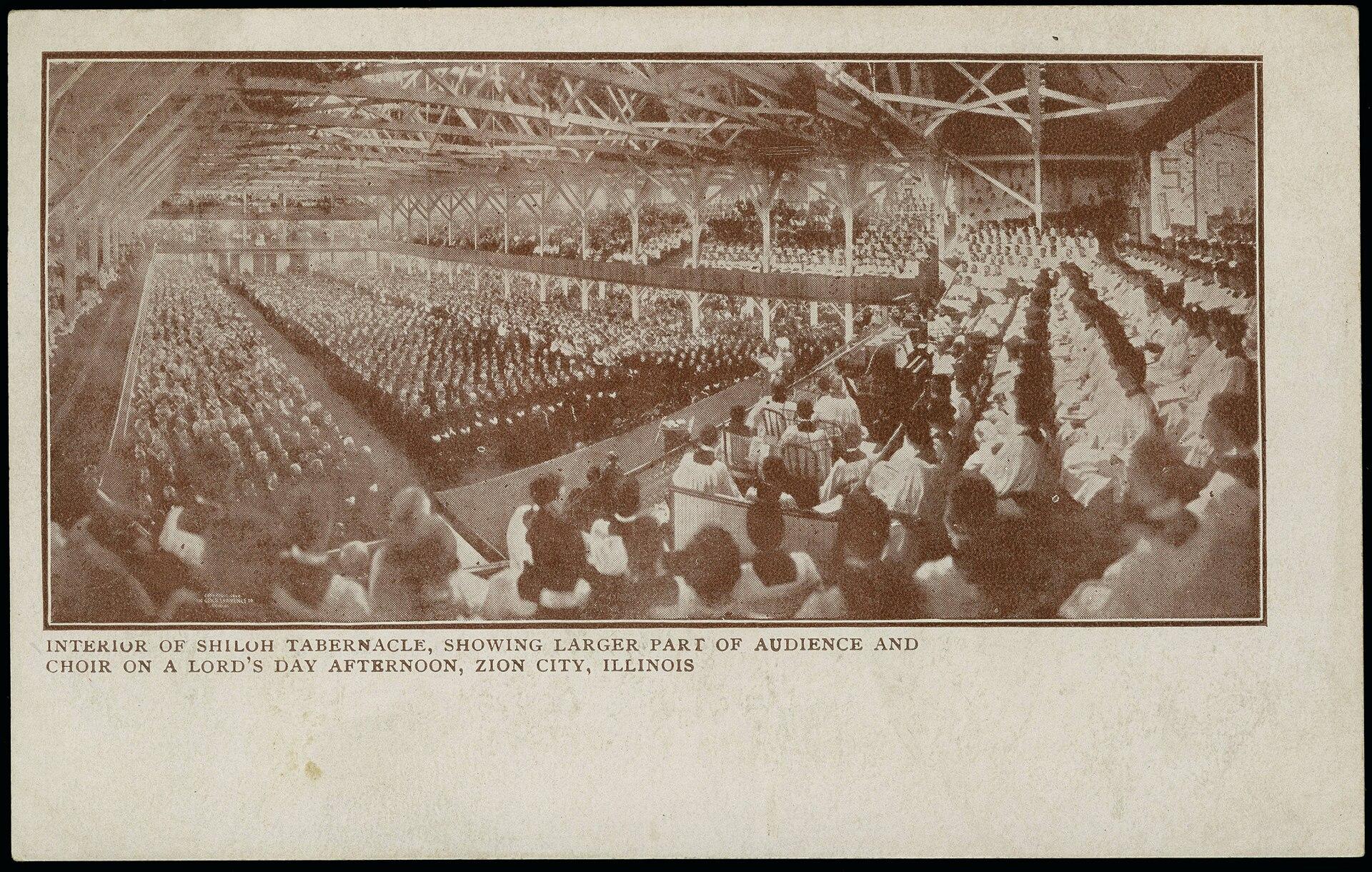
Interior of Shiloh Tabernacle, Zion City, Illinois, postcard, Newberry Library, public domain
Ontario to Johannesburg and Spokane, 1870 to 1935 · Person · Featured Study
John G. Lake
He was vice-president of the Apostolic Faith Mission in its first year, and later led a healing work at Spokane.
- Born
- 18 March 1870 at St. Mary's, Ontario
- Died
- 16 September 1935 at Spokane, Washington
- Family
- wife: Jennie Lake; wife: Florence Switzer
- Places
- St. Mary's, Chicago, Zion City, Johannesburg, Spokane
His own letters tell a man sent to Africa with his fares given and three dollars in his pocket, and a historian calls him a con man.
they will pick up snakes with their hands, and if they drink any deadly poison, it will not harm them; they will lay their hands on the sick, and they will be made well.”
Summary
John Graham Lake was born in Ontario in 1870 and joined Dowie's healing church. He sailed for Johannesburg with his family and a small party, and they founded a church there. His wife died later that year. After 1913 he preached healing in the American Northwest until his death in 1935.
- His own letters from Africa survive in the paper The Pentecost.
- The Mission's minutes record the separation of white and black believers from its first year.
- Barry Morton calls him a fraud, and Marius Nel answers him.
The Texts of Healing
The ending of Mark promises that believers will lay hands on the sick, and James tells the sick to call the elders.
Lake's party prayed for the sick from their first weeks in South Africa. That August Thomas Hezmalhalch wrote that he had just left a hospital for Africans after praying with twenty-one patients.
The question of this life is how a member of Dowie's Zion came to lead a church in Johannesburg, and how much of the story later told of him his own letters bear out.
Is any one of you sick? He should call the elders of the church to pray over him and anoint him with oil in the name of the Lord.The command to call the elders, which the healing churches practised.
The Life in Order
A thesis of 1989, the papers of his movement and a historian's charges give the steps.
His years in Africa were five of sixty-five.
- 18 March 1870His birth in OntarioDe Wet (1989), page 47
- October 1891Methodist ordination in ChicagoDe Wet, page 47
- February 1893His marriage to Jennie StevensDe Wet, page 47
- Late 1906He turned to Parham at Zion CityMorton (2012)
- About 1 April 1908The voyage to Africa beganThe Pentecost, August 1908, page 2
- 30 May 1908His letter from DoornfonteinThe Pentecost, August 1908, pages 6 and 7
- 17 September 1908The first minute of the Mission's trusteesDe Wet, after the minute book
- 23 December 1908Jennie Lake diedDe Wet, page 49
- February 1913He left Africa for goodNel (2015)
- Late 1913His second marriage and the move to SpokaneDe Wet, page 50, after Lindsay
- 8 November 1922A lecture on divine healing at Salem, OregonCapital Journal, Salem, page 5
- 16 September 1935His death at SpokaneDe Wet, page 50
Each step of the life stands with its witness.
17 September 1908, 23 December 1908, February 1913, Late 1913, 8 November 1922, 16 September 1935
From Zion to Johannesburg and Spokane
His letters tell the voyage, a thesis tells his family, and his critics tell the rest.
John Graham Lake was born at St. Mary's in Ontario and grew up at Sault Sainte Marie in Michigan. The Methodists ordained him in Chicago in 1891, and he turned down a call to a church in Wisconsin.
By his own testimony, as De Wet sets it down, sickness and death followed his family for thirty-two years, and the healings that ended it drew him to Dowie.
He became an elder of Dowie's church at Zion City. Late in 1906 he turned to Charles Parham there, and Morton reads a Waukegan paper of January 1907 as showing him speaking in tongues.
Before Africa he worked in business near Chicago, and how well he prospered is argued.
About the first of April 1908 he left Indianapolis for Johannesburg with Jennie, their children and a small party, thirteen in all.
The work he helped begin there became the Apostolic Faith Mission. The Mission's first officers named Thomas Hezmalhalch president and Lake vice-president. From its first year the minutes set black and white believers apart, and in July 1909 they decided on separate baptisms.
Jennie died that December, of a heart attack by De Wet's account. Lake left South Africa in February 1913 and never went back, and the sources do not say why.
Late that year he married Florence Switzer and moved to Spokane, Washington, where he led a healing ministry for years.
A Salem paper of 1922 announced a lecture on divine healing by Dr. John G. Lake of Portland. He died at Spokane in 1935.
Dowie's House of Healing
His family's healings in Chicago drew him into the church that built Zion City.
John Alexander Dowie ran a house of healing in Chicago, where the sick came for prayer with the laying on of hands. De Wet, writing from Lake's own testimony, says the family took a dying brother there and he was healed at once.
A sister with cancer was healed next, and then another sister who was dying. The turning point, De Wet writes, came when Lake prayed for his wife in her own sickness and she recovered.
De Wet adds that word of her healing spread through the town and the newspapers, and many came to Lake for prayer.
In Their Own Words
Four sayings from his letters printed in The Pentecost, on the fare, the station, the first church and the field.
John G. Lake (1870 to 1935)
Letter from Doornfontein, Johannesburg, 30 May 1908, The Pentecost 1:1, August 1908, page 6
The tickets and the fare
“You know the Lord gave us our tickets to Johannesburg before we left. I also had $3.50 in my pocket when I left Indianapolis.”
Pentecostal
About this saying1 paragraph
He wrote this from Doornfontein on 30 May 1908, weeks after landing.
John G. Lake
Letter from Doornfontein, Johannesburg, 30 May 1908, The Pentecost 1:1, August 1908, page 7
The woman at the station
“But to return: as we stepped off the train at Johannesburg a little bustling lady whom I at once recognized as an American stepped up to me and said: ‘Are you a missionary?’”
Pentecostal
About this saying1 paragraph
The same letter of 30 May 1908 tells how the family found a house on the day they arrived.
John G. Lake
Letter in The Pentecost
The first church
“My heart was drawn out toward the native work very intensely and the Lord at once opened a native tabernacle, the property of the Congregational American Mission where we have held services twice a day.”
Pentecostal
About this saying1 paragraph
Further on in that letter of 1908 he tells where the first services were held.
John G. Lake
A Call for Helpers, letter to Sister Smock, The Pentecost 1:4, December 1908, page 7
The greatest field
“Johannesburg is unquestionably the greatest field for missionary work in the known world.”
Pentecostal
About this saying1 paragraph
He wrote this to a Sister Smock in a letter headed A Call for Helpers, printed in December 1908.
The People Around Him
His two wives, the leaders he followed, his partners in Africa and the scholars who argue over him.
He followed Dowie, then Parham, and then led others himself.
| Person | Tie to Lake | The witness |
|---|---|---|
| Jennie Lake | Born Jennie Stevens of Newberry, Michigan, she sailed with him and died in Africa. | De Wet |
| Florence Switzer | His second wife, whom he married on his return. | De Wet, after Lindsay |
| John Alexander Dowie | He founded Zion, and Lake joined his church. | De Wet |
| Charles Parham | Lake turned to him at Zion City in 1906. | Morton (2012) |
| Thomas Hezmalhalch | His partner on the voyage and the Mission's first president. | The Pentecost; De Wet |
| Mrs. C. L. Goodenough | The American woman who gave the family a house, by De Wet's naming. | De Wet, after Lindsay |
| Pieter le Roux | The former Dutch Reformed missionary who joined the Mission and later led it. | Nel (2005) |
| Barry Morton | A historian who argues in 2012 and 2017 that Lake was a fraud. | African Historical Review; Studia Historiae Ecclesiasticae |
Pieter le Roux, Barry Morton
The Places of His Life
His life runs from Ontario and Chicago to the Rand and the American Northwest.
He crossed the world once and spent the rest of his life in North America.
| Place | What the witnesses say | The witness |
|---|---|---|
| St. Mary's, Ontario | His birthplace. | De Wet |
| Sault Sainte Marie, Michigan | The family moved there in his boyhood. | De Wet |
| Chicago | The family brought its sick there for prayer. | De Wet |
| Zion City, Illinois | Dowie's town, where Lake's loyalty passed to Parham. | Morton (2012) |
| Doornfontein, Johannesburg | His first letter is headed from 39 Van Beek Street. | The Pentecost, August 1908 |
| Spokane, Washington | He settled there after Africa and died there. | De Wet |
| Portland, Oregon | His home town in a notice of 1922. | Capital Journal, Salem |
Jesus the Healer
His teaching rested on the conviction that Jesus still heals, and his critics test each case.
In De Wet's judgment, Lake's stress on Jesus as Healer can only be understood from the sickness that ran through his family.
De Wet, an Apostolic Faith Mission scholar, allows that many reported healings of the early workers could be exaggerated and would not stand testing. He still judges their effect on the black community to have been great.
Morton starts from the view that no miracle claimed by Lake was real. Nel answers that some criticism of Lake is valid, but that a presupposition against miracles hampers the judgment.
The Voices
Two teachers on Mark 16:18.
Tertullian (died 220)
Scorpiace
Faith serves the believer as a defence against the beast
“We have faith for a defence, if we are not smitten with distrust itself also, in immediately making the sign and adjuring, and besmearing the heel with the beast.”
on Mark 16:18Patristic
John Wesley (1703 to 1791)
Explanatory Notes upon the New Testament
Every believer's faith still holds a hidden miraculous power
“Even at this day in every believer faith has a latent miraculous power; (every effect of prayer being really miraculous;) although in many, both because of their own littleness of faith, and because the world is unworthy, that power is not exerted. Miracles, in the beginning, were helps to faith; now also they are the object of it.”
on Mark 16:18Evangelical
What the Witnesses Leave Open
Readers differ on his money, on Azusa Street, on his healings and on whether he was honest.
How much he gave upThe Pentecost (1908); the later compilations; Barry Morton
The Pentecost of 1908 says only that he was making good money. Morton quotes later books by Liardon and Reidt that give him a hundred thousand dollars in the bank and a seat on the Board of Trade.
Barry Morton found him in the census of 1900 as a carpenter and later as an insurance agent at Waukegan. He found no Board of Trade record and no entry in the Chicago directories for 1905 to 1907.
Whether he went to Azusa StreetMarius Nel; Barry Morton
Nel places Lake at Azusa Street in 1907, and in an earlier paper he has both men there in 1906. Morton says Lake did not go to Azusa Street until 1909.
The count of healingsGordon Lindsay; C. R. de Wet; Barry Morton
Lindsay's life of Lake quotes a Dr. Ruthlidge as saying Lake's healing work made Spokane the healthiest city in the world. De Wet calls that statement probably grossly overinflated.
Morton writes that Lake claimed more than a hundred thousand healings in America, and that some of the people Lake named in 1918 cannot be found in any record.
Fraud or pioneerBarry Morton; C. R. de Wet; Marius Nel
Morton argues that fraud and deception spread the movement Lake led in southern Africa. Nel grants valid points of criticism and doubts about Lake's integrity, and holds that Morton's frame decides the case before the evidence.
Books to Read Next
The Apostolic Faith Mission in Africa 1908-1980
C. R. de Wet · 1989
De Wet wrote this doctoral thesis on the Mission's history, with a short life of Lake from the sources.
Read De Wet's thesis free at the University of Cape TownYes, John G Lake was a Con Man
Barry Morton · 2017
Morton makes the fullest form of the case against him.
In print: find it wherever books are sold.
John G. Lake as a Fraud, Con Man and False Prophet
Marius Nel · 2016
Nel, a Pentecostal scholar, wrote this answer to Morton.
In print: find it wherever books are sold.
What Lake Left
He left a mission that outlived his five years in it, and a name that both its friends and its accusers still argue over.
Sources
Scripture is the Berean Standard Bible.
- The Holy Bible, Berean Standard Bible (read 2026)
- C. R. de Wet, The Apostolic Faith Mission in Africa 1908-1980: A Search for Identity (PhD, University of Cape Town, 1989)
- The Pentecost (Indianapolis, edited by J. R. Flower), August 1908 and December 1908.
- Barry Morton, The Devil Who Heals, African Historical Review 44 (2012), 98 to 118; and Yes, John G Lake was a Con Man, Studia Historiae Ecclesiasticae 43 (2017)
- Marius Nel, PL le Roux, Studia Historiae Ecclesiasticae 31 (2005); Remembering and Commemorating the Theological Legacy of John G. Lake (2015); John G. Lake as a Fraud, Con Man and False Prophet, Studia Historiae Ecclesiasticae 42 (2016)
- Capital Journal (Salem, Oregon), 8 November 1922, page 5.
- Library of Congress Name Authority File, Lake, John G., n82011344.
- Tertullian, Scorpiace, on Mark 16:18.
- John Wesley, Explanatory Notes upon the New Testament, on Mark 16:18.
Keep Studying
People and groups6
Doctrines1
Subjects1
Go further2