
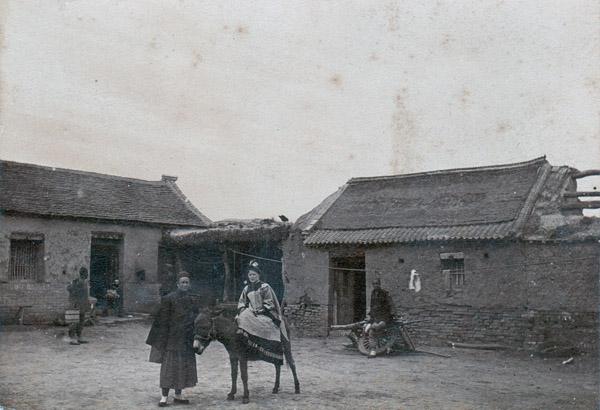
Lottie Moon and George S. Hayes, Tengchow, about 1875. Public domain.
Virginia and North China, 1840 to 1912 · Person · Featured Study
Lottie Moon
She was a Southern Baptist missionary in North China from 1873 until her death in 1912.
- Born
- December 1840
- Died
- 24 December 1912
- Family
- sister: Edmonia Moon
- Places
- Viewmont, Cartersville, Tengchow, Pingtu
In 1887 she asked the women of her church to give in the week before Christmas, and the offering was later named for her.
To the weak I became weak, to win the weak. I have become all things to all people so that by all possible means I might save some.
Summary
Lottie Moon was born in Virginia in December 1840 and went to North China as a missionary. In 1885 she moved inland to Pingtu, where she lived in a Chinese house and wore Chinese dress. Her letters home pleaded for more workers.
- Her sister Edmonia went to Tengchow first, in 1872.
- In the famine of her last year she gave away her savings and ate too little to live.
- She died at Kobe on 24 December, on the ship taking her home.
The Texts of Her Work
She quoted 2 Corinthians 8 in her appeal for giving, and her biographer read her life by 1 Corinthians 9.
The question of this life is how a single woman far inland in China moved the giving of a whole denomination. Una Roberts Lawrence wrote her life in 1927 from the letters printed in the mission journals, and her book is the witness here.
For you know the grace of our Lord Jesus Christ, that though He was rich, yet for your sakes He became poor, so that you through His poverty might become rich.She cited this verse in her appeal of 1887 for a Christmas offering.
The Life in Order
Each date stands in Lawrence's life, with its page.
Her years in China ended in the last week of her life.
- December 1840She was born Charlotte Diggs Moon and grew up at Viewmont in VirginiaLawrence (1927), page 21
- Spring 1859She was converted during a revival John A. Broadus held at her school in CharlottesvilleLawrence, page 45
- 1861She graduated among the first women in the South to receive the Master of ArtsLawrence, page 48
- June 1872Her sister Edmonia reached TengchowLawrence, page 59
- 7 July 1873The Foreign Mission Board appointed herLawrence, page 65
- 1 September 1873She sailed for ChinaLawrence, page 66
- Early December 1873She reached Tengchow by way of ChefooLawrence, page 71
- December 1885She moved to Pingtu, keeping her forty-fifth birthday on the wayLawrence, page 126
- December 1887Her article in the Foreign Mission Journal proposed an offering before ChristmasLawrence, page 152
- Christmas 1888Southern Baptist women gave the first Christmas offering for ChinaLawrence, pages 157 to 159
- 20 December 1912She sailed from Shanghai on the Manchuria with a nurseLawrence, page 310
- 24 December 1912She died aboard at anchor at KobeLawrence, page 310
Each step of the life stands with its witness.
Early December 1873, December 1885, December 1887, Christmas 1888, 20 December 1912, 24 December 1912
From Viewmont to Pingtu
She left a Virginia estate and a teaching post for a mission station on the coast, then for a city inland.
She grew up at Viewmont, a family estate in Virginia. At the Albemarle Female Institute in Charlottesville she resisted the prayers of the other girls during a revival in 1859, and then she came to faith. She graduated in 1861 with a Master of Arts.
Her younger sister Edmonia went to Tengchow in 1872, at a time of strong opposition to sending single women as missionaries. Lottie was teaching at a school in Cartersville, Georgia, when the pastor there preached in February 1873 on the fields white for harvest. The Board appointed her that July.
She landed at Shanghai on 7 October, and in December she reached Tengchow. She worked from Tengchow for twelve years before she went inland.
In October 1885 she travelled alone to Pingtu, a city seven days' travel inland. In December she settled there, in a house by the west gate rented from a man ruined by opium. She ate Chinese food and wore Chinese dress. She gave cookies to the children until their mothers came to her house to learn.
Her letters asked again and again for workers. In 1888 the new Woman's Missionary Union took up her idea of an offering at Christmas, and the women gave enough for two new missionaries.
In 1912 famine came to the country around Pingtu while the Board was in debt. She drew out all her savings for famine relief and ate less and less. In December her fellow missionaries found her starving and sent her home with a nurse. She died at Kobe on Christmas Eve, and her ashes were buried in Virginia.
The Christmas Offering
Her article in the Foreign Mission Journal asked for a week of prayer and giving and for the women to organize.
The Methodist women had begun a week of prayer in June 1887. She held them up as an example and asked why Southern Baptist women gave so little. Her answer was their lack of organization.
She proposed a week of prayer and offering for both Boards of the Convention, and she named the week before Christmas. She asked for organization under the Foreign Mission Board, which would keep the power to appoint and to spend.
Lawrence writes that Annie Armstrong, secretary of the new Woman's Missionary Union, asked H. A. Tupper of the Board whether the women could raise relief for Miss Moon by a Christmas offering, and he answered, "Try it!" After her death the women named the offering for her.
In Their Own Words
Four sayings as Lawrence printed them in 1927, from her conversion to her last year.
Lottie Moon (1840 to 1912)
Her testimony to a cousin, in Una Roberts Lawrence, Lottie Moon, page 45
The night of her conversion
“I went to the service to scoff, and returned to my room to pray all night.”
Southern Baptist missionary
About this saying1 paragraph
She said this to a cousin about the night of her conversion in the spring of 1859, and Lawrence prints it on page 45.
Lottie Moon
Article in the Foreign Mission Journal, December 1887, in Una Roberts Lawrence, Lottie Moon, pages 152 to 153
Why the week before Christmas
“Need it be said why the week before Christmas is chosen? Is it not the festive season, when families and friends exchange gifts in memory of the Gift laid on the altar of the world for the redemption of the human race, the most appropriate time to consecrate a portion from both abounding riches and scant poverty to send forth the good tidings of great joy into all the earth?”
Southern Baptist missionary
About this saying1 paragraph
She gave her reason for the date of the offering in the Foreign Mission Journal of December 1887, as Lawrence quotes it on pages 152 and 153.
Lottie Moon
Letter from Pingtu, Christmas 1888, in Una Roberts Lawrence, Lottie Moon, page 159
Send on the missionaries
“The hard pioneer work is done! We now need women to do the patient teaching in the city and village.”
Southern Baptist missionary
About this saying1 paragraph
She called for women teachers from Pingtu at Christmas 1888, in words that stand on page 159 of Lawrence's book.
Lottie Moon
Her bank pass book, August 1912, in Una Roberts Lawrence, Lottie Moon, page 306
In her bank book
“I pray that no missionary will ever be as lonely as I have been.”
Southern Baptist missionary
About this saying1 paragraph
In the famine year she wrote this across her bank pass book in August 1912, as Lawrence quotes it on page 306.
The People Around Her
Her sister, her pastor, her colleagues and the women at home each shaped her work.
The women at home answered the woman in China.
| Person | Tie to Lottie Moon | The witness |
|---|---|---|
| Edmonia Moon | Her sister, who ran three of the mission's schools before Lottie came | Lawrence, page 59 |
| John A. Broadus | The pastor whose revival at her school brought her to faith | Lawrence, page 45 |
| T. P. Crawford and Mrs. Crawford | Missionaries of Tengchow who met her at Shanghai and took her north | Lawrence, pages 70 to 71 |
| H. A. Tupper | Secretary of the Foreign Mission Board, to whom she wrote | Lawrence, pages 59 and 157 |
| Annie Armstrong | Secretary of the Woman's Missionary Union, who organized the first offering | Lawrence, pages 157 and 160 |
| Cynthia Miller | The nurse who sailed with her in December 1912 | Lawrence, page 310 |
The missions of her century are told on the era's own page.
The Places of Her Life
Her life ran from Virginia to the province of Shantung in North China.
She spent almost forty years in two cities of Shantung.
| Place | What the witnesses say | The witness |
|---|---|---|
| Viewmont, Virginia | Her childhood home | Lawrence, pages 13 and 21 |
| Charlottesville | Her school, the Albemarle Female Institute, and her conversion | Lawrence, pages 42 and 45 |
| Cartersville, Georgia | She taught there until she was appointed | Lawrence, pages 63 to 65 |
| Tengchow | The prefecture city on the coast where the mission stood | Lawrence, page 71 |
| Pingtu | The inland city where she lived from December 1885 | Lawrence, pages 124 to 128 |
| Kobe | Her ship lay at anchor there when she died | Lawrence, page 310 |
What Her Method Taught
She lived among the people she taught and asked the church at home to carry the cost.
At Pingtu she made few changes to the Chinese house she rented. Lawrence writes that she took Chinese dress "both as a matter of economy and policy", and that the women of the city accepted her.
She also held that the mission belonged to the whole church. Her article asked the women for "not power, but simply combination" in giving, under the Board.
How the Key Verse Was Taught
Ambrose, Matthew Henry and William Booth read Paul's rule of becoming all things to all people.
Ambrose of Milan (died 397)
Letter 37 (To Simplician)
Ambrose of Milan saw the rule first in Christ, who took the form of a servant.
“He who did not think it robbery to be equal with God took the nature of a slave. He became all things to all men to bring salvation to all. Paul, an imitator of him, lived as if outside the law while remaining accountable to the law. He spent his life for the advantage of those he wished to win. He willingly became weak for the weak in order to strengthen them. He ran the race to overtake them.”
on 1 Corinthians 9:22Patristic
Matthew Henry (1662 to 1714)
Commentary on the Whole Bible
Matthew Henry read it as Paul's self-denial for the sake of others.
“He denied himself for their sakes, that he might insinuate into their affections, and gain their souls. In short, he became all things to all men, that he might by all means (all lawful means) gain some. He would not sin against God to save the soul of his neighbour, but he would very cheerfully and readily deny himself.”
on 1 Corinthians 9:22Puritan
William Booth (1829 to 1912)
Letter of 27 August 1886, printed in Muktifauj, pages xvi to xvii
William Booth applied the verse in a letter of 1886 on the work in India.
“In order to conquer you must stoop, becoming with the Apostle all things to all men, in order that you may win them to your Master. This must mean, if anything at all, that to the Indians you must be Indians.”
Methodist
What the Record Leaves Open
Lawrence gives two causes for her last illness, and her appeal had to reassure the men of the Convention.
The causes of her hungerUna Roberts Lawrence; the Virginia papers, as Lawrence reports them
Lawrence writes that if her Pingtu Christians were starving, "then she would eat no more", and that she would not live on borrowed money while the Board was in debt. She adds that Virginia papers blamed the failure of Southern Baptists at home.
The same book records an abscess in the summer of 1912 and "a depression that she could not throw off". Lawrence also writes that her colleagues did not see what was happening until December.
Whether women should organizeLottie Moon
Her article of 1887 told the men of the Convention that the women wanted no plans "repugnant to the tastes of our brethren". She wrote that separate organization "is undesirable, and would do harm", and asked for organization "in subordination to the Board".
Books to Read Next
Lottie Moon
Una Roberts Lawrence · 1927
This life is built from her letters and quotes them at length.
Read Lawrence free at the Internet ArchiveWhat Lottie Moon Left
She left the believers of Pingtu, her letters and the offering that bears her name. The women of Virginia carved on her stone that she was faithful until death.
Sources
Scripture is the Berean Standard Bible.
- The Holy Bible, Berean Standard Bible (read 2026)
- Una Roberts Lawrence, Lottie Moon (Nashville: Sunday School Board of the Southern Baptist Convention, 1927)
- Ambrose of Milan, Letter 37, to Simplician, on 1 Corinthians 9:22.
- Matthew Henry, Commentary on the Whole Bible (1710), on 1 Corinthians 9:22.
- William Booth, letter of 27 August 1886, printed in Frederick Booth-Tucker, Muktifauj.