
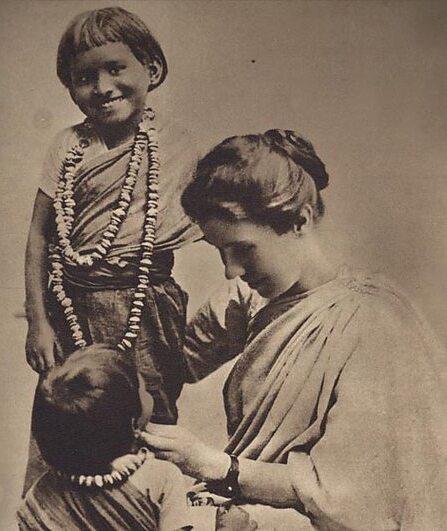
Unknown photographer, Amy Carmichael with children, date not recorded, public domain
Ulster, Japan and south India, 1867 to 1951 · Person · Featured Study
Amy Carmichael
She reached India in 1895 and stayed there, taking in children in danger at Dohnavur.
The woman who took in one runaway child in 1901 spent fifty years taking in others like her.
his workmanship will be evident, because the Day will bring it to light. It will be revealed with fire, and the fire will prove the quality of each man’s work.
- Born
- 16 December 1867 at Millisle in County Down
- Died
- 1951 at Dohnavur
- Family
- father: David Carmichael; mother: Catherine Fison
- Places
- Millisle, Belfast, Matsue, Dohnavur, Cape Comorin
Summary
Amy Carmichael was born at Millisle in 1867 and went to Japan as a Keswick missionary in 1893. After a breakdown she reached India in November 1895 and never went home on furlough. From the day a child who had fled a temple came into her care, she made a home at Dohnavur for children in danger. She wrote some thirty-six books and died at Dohnavur in 1951.
- Her book Things as They Are told England of the temple children in 1903.
- The Dohnavur Fellowship was registered in 1927.
- Her Lotus Buds of 1909 tells of the first children of Dohnavur.
The Fountain in Belfast
Words from 1 Corinthians 3 came to her in a Belfast street, and she named the first chapter of her history after them.
On a wet Sunday in Belfast she and her two brothers helped an old woman carry a heavy bundle past the people coming home from church. As they passed a new fountain, the words of 1 Corinthians 3:12 to 14 came to her, ending with the work that abides.
She writes in Gold Cord that from that day nothing could matter to her but the things that were eternal. The first chapter of that book bears the title Gold, Silver, Precious Stones.
If what he has built survives, he will receive a reward.The phrase ended with the work that abides, and she turned to see who had spoken.
The Life in Order
Her own books give the work in India, and a study of 2017 gives the dates from the records.
She lived in India fifty-five years without a furlough.
- 16 December 1867She was born at Millisle in County DownKommers, Triumphant Love
- 1 May 1893She reached Matsue in JapanKommers, Triumphant Love
- 1894Illness took her to Shanghai and Ceylon, then homeThe Keswick minute, in Kommers
- 9 November 1895She landed at MadrasKommers, Triumphant Love
- 6 March 1901The first of the temple children reached herCarmichael, Lotus Buds; Gold Cord
- April 1903Morgan and Scott published her account of TinnevellyCarmichael, Things as They Are
- November 1909Her book of photographs of the nursery came outCarmichael, Lotus Buds
- August 1912Thomas Walker diedKommers, Triumphant Love
- 1927The Dohnavur Fellowship was registeredKommers, Triumphant Love
- 1931The year of her accidentKommers, Triumphant Love
- 1951She was laid to rest at DohnavurKommers, Triumphant Love
Each step of the life stands with its witness.
November 1909, August 1912, 1927, 1931, 1951
From Millisle to Dohnavur
She tells the work herself, and the records of her mission give the dates.
She was born in County Down, the first child of David and Catherine Carmichael, in a strong Presbyterian family. Robert Wilson, the chairman of the Keswick Convention, took her as an adopted daughter.
She reached Matsue in Japan on 1 May 1893, to work with Barclay Buxton. A breakdown there sent her to Shanghai and to Ceylon, and then home. She went out again to India, where she stayed fifty-five years without a single furlough.
She worked in Tinnevelly with Thomas Walker of the Church Missionary Society. Her band went from village to village in Indian dress. She dyed her skin with dark coffee so that she could travel freely and enter places open only to Indian women.
On 6 March 1901 a girl of seven, who had fled the temple women of a village called Great Lake, came into her care. The child told her things that darkened the sunlight, and Carmichael began to gather the facts of a secret traffic in young children.
She began taking such children in at Dohnavur. In time she cared for hundreds of them, and the household became the Dohnavur Fellowship, registered in 1927.
An accident in 1931 ended her travels. She died at Dohnavur in 1951 and was buried there.
The Temple Children
She learned of the dedication of girls to temple service from a child, and she wrote what she found.
In Gold Cord she wrote that children were dedicated to the temple because of a vow or a family custom, among other reasons, and married to the god. In Lotus Buds she called it a traffic in little children, mere infants often, for wrong purposes.
She first learned the story of a life in a temple house from a child the next day, 7 March. She wrote that such a story ought to be impossible in a land ruled by a Christian power.
Within weeks of the first printing of Things as They Are, missionaries in other parts of India wrote to confirm it. Some in England doubted it, so a later edition added notes from South Indian missionaries.
In Their Own Words
Three sayings from Things as They Are and Lotus Buds, on her book, the first children and her comrades.
Amy Carmichael (1867 to 1951)
Things as They Are: Mission Work in Southern India, the Note
Even the blade of grass
“And now at His feet, who can use the least, we lay this book again; for ‘to the Mighty One,’ as the Tamil proverb says, ‘even the blade of grass is a weapon.’ May it be used for His Name's sake, to win more prayer for India […]”
Anglican missionary
About this saying1 paragraph
She wrote this note at Dohnavur for a later edition of Things as They Are, by 1905.
Amy Carmichael
Lotus Buds, chapter 24
The first children
“When the Elf came to us on March 6, 1901, and we began to know some of the secrets of the Temple, we tried to save several little children, but we failed.”
Anglican missionary
About this saying1 paragraph
She looks back in Lotus Buds, printed in 1909, on the first years after the Elf came.
Amy Carmichael
Lotus Buds, chapter 24
Comrades without reservations
“We want as comrades those who come to us without reservations.”
Anglican missionary
About this saying1 paragraph
In the same chapter of Lotus Buds, in 1909, she says what kind of worker the nursery needed.
The People Around Her
The witnesses name her family, the men who sent and taught her, and the Indian women who worked beside her.
The Fellowship grew from a household of Indian and European workers.
| Person | Tie to Carmichael | The witness |
|---|---|---|
| David Carmichael | Her father, of Millisle. | Kommers, Triumphant Love |
| Catherine Fison | Her mother, who married David Carmichael and settled at Millisle. | Kommers, Triumphant Love |
| Robert Wilson | He wrote to her week by week from March 1893, and his Bible came to her. | Carmichael, Gold Cord |
| Barclay Buxton | She worked with his mission band in Japan. | Stock, preface to Things as They Are |
| Thomas Walker | She worked with him in Tinnevelly until he died in 1912. | Stock, preface; Kommers |
| Ponnamal | An Indian worker who kept the household and made up the medicines. | Carmichael, Ponnamal (1918) |
| Preena, the Elf | She grew up to help teach the little ones of the nursery. | Carmichael, Lotus Buds |
The Places of Her Life
Her life runs from the Irish Sea to Japan and to the far south of India.
She settled at the foot of the Western Ghats and stayed.
| Place | What the witnesses say | The witness |
|---|---|---|
| Millisle | A seaport village in County Down, where she was born. | Kommers, Triumphant Love |
| Belfast | The street and the fountain where the words of 1 Corinthians came to her. | Carmichael, Gold Cord |
| Matsue | A town in western Japan, where she joined Barclay Buxton's band. | Kommers, Triumphant Love |
| Great Lake | The village of the temple the Elf fled. | Carmichael, Gold Cord |
| Dohnavur | A village where the Western Ghats come down to the sea, and her home. | Carmichael, Things as They Are |
| Cape Comorin | The Fellowship's house by the sea, built in 1926. | Kommers, Triumphant Love |
A Mother to the Children
The children called her Amma, and she asked her workers to give themselves without limit.
Amma is the Tamil word for mother, and the children of Dohnavur called her by it. Women there who had known her as children told Kommers of her love for them.
She wrote that nursery work had no clear ending and drifted on into the night when the babies were young. She said that no money would have drawn such workers and that only the love of a mother could carry it.
In Dohnavur the children were given Indian names, and the workers wore Indian dress.
The Voices
One teacher on 1 Corinthians 3:13.
Matthew Henry (1662 to 1714)
Commentary on the Whole Bible
Some read the day as the fall of the Jewish nation
“Though some understand it of the time when the Jewish nation was destroyed and their constitution thereby abolished, when the superstructure which judaizing teachers would have raised on the Christian foundation was manifested to be no better than hay and stubble, that would not bear the trial.”
on 1 Corinthians 3:13Puritan
What the Witnesses Leave Open
The witnesses leave open how her church is named, what the first child was called and what the accident of 1931 did to her.
Her churchHans Kommers
She was raised in a strong Presbyterian home and went out as a Keswick missionary. Kommers writes that she could go as a non-Anglican through the Church of England Zenana Missionary Society because that society had agreed to take Keswick missionaries as associates.
The first child's nameAmy Carmichael
In Lotus Buds she calls the child the Elf and names her Preena. In Gold Cord she tells the same flight from the temple and calls the child Pearleyes.
Her last twenty yearsHans Kommers
Kommers says that after the accident of 1931 she could no longer go to Cape Comorin. He names no injury, and no opened source tells how much of her last twenty years she spent in her room.
Books to Read Next
Things as They Are: Mission Work in Southern India
Amy Wilson-Carmichael · 1903
This is her first account of the villages of Tinnevelly and of the temple children.
Read Things as They Are free at Project GutenbergLotus Buds
Amy Wilson-Carmichael · 1909
This is her own account of the first Dohnavur children, with photographs.
Read Lotus Buds free at Project GutenbergTriumphant Love
J. (Hans) Kommers · 2017
Kommers studied her mission from the logbooks at Dohnavur, and the book is open to read.
Read Triumphant Love free at the Internet ArchiveWhat Carmichael Left
She left a fellowship that still cares for children at Dohnavur and books that told the church what she found.
Sources
Scripture is the Berean Standard Bible.
- The Holy Bible, Berean Standard Bible (read 2026)
- Amy Wilson-Carmichael, Things as They Are: Mission Work in Southern India, with a preface by Eugene Stock (London: Morgan and Scott, 1905; first printed April 1903)
- Amy Wilson-Carmichael, Lotus Buds (London: Morgan and Scott, 1909)
- Amy Carmichael, Ponnamal: Her Story (London, 1918)
- Amy Carmichael, Gold Cord: The Story of a Fellowship (London: SPCK, 1932), cited for facts only.
- J. (Hans) Kommers, Triumphant Love: The Contextual, Creative and Strategic Missionary Work of Amy Beatrice Carmichael in South India (Durbanville: AOSIS, 2017), CC BY-NC-SA 4.0, cited for facts only.
- Matthew Henry, Commentary on the Whole Bible, on 1 Corinthians 3:13.
Keep Studying
Studies1
Church history2
Go further1
Values1