
1 John 4:7 to 21 · Passage · Featured Study
God Is Love
Fifteen verses of John's first letter on the love that comes from God and the love it asks of those born of Him.
No one has ever seen God, John writes, yet His love is perfected in those who love one another.
- The passage
- 1 John 4:7 to 21
- Book
- 1 John
- When
- the last decade of the first century (probable)
- Hold in memory
- 1 John 4:8, 1 John 4:10, 1 John 4:19
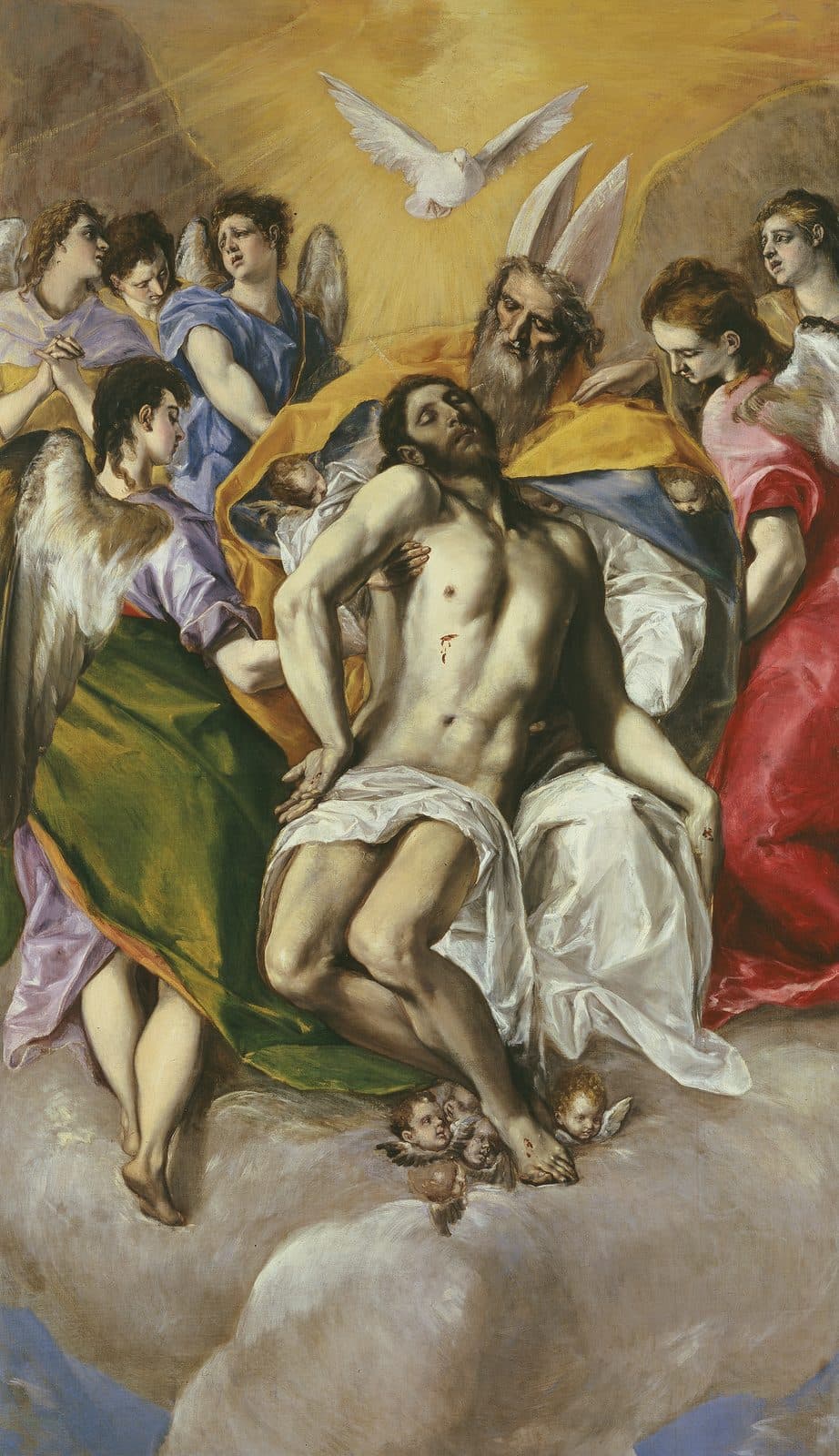
El Greco, The Holy Trinity, 1577 to 1579, Museo del Prado, Madrid. Public domain, via Wikimedia Commons.
THE ARTWORKEl Greco painted the Father holding the body of the Son after the cross, with the Spirit as a dove above them. John names all three in this passage: the Father who sent the Son and the Spirit He has given.
Summary
John writes twice in this passage that God is love, and he draws from it both the assurance of believers and their duty to one another.
- The passage follows the test of the spirits in 1 John 4:1 to 6.
- Love for one another was the mark by which John's readers could tell the church from the teachers who had left it.
- In John's account, assurance before God grows out of love that is lived among believers.
The Passage in Six Steps
John begins with what God is and ends with the command to love a brother.
Beloved, let us love one another, because love comes from God. Everyone who loves has been born of God and knows God. Whoever does not love does not know God, because God is love.John grounds the command in what God is.
This is how God’s love was revealed among us: God sent His one and only Son into the world, so that we might live through Him. And love consists in this: not that we loved God, but that He loved us and sent His Son as the atoning sacrifice for our sins.Here the passage turns from what God is to what He did in history.
Beloved, if God so loved us, we also ought to love one another. No one has ever seen God; but if we love one another, God remains in us, and His love is perfected in us.These verses turn God's act into the church's duty.
By this we know that we remain in Him, and He in us: He has given us of His Spirit. And we have seen and testify that the Father has sent His Son to be the Savior of the world. If anyone confesses that Jesus is the Son of God, God abides in him, and he in God. And we have come to know and believe the love that God has for us. God is love; whoever abides in love abides in God, and God in him.These verses answer how a believer knows that he abides in God.
In this way, love has been perfected among us, so that we may have confidence on the day of judgment; for in this world we are just like Him. There is no fear in love, but perfect love drives out fear, because fear involves punishment. The one who fears has not been perfected in love.These verses carry the passage from the church's life to the last day, and readers divide over the fear they name.
We love because He first loved us. If anyone says, “I love God,” but hates his brother, he is a liar. For anyone who does not love his brother, whom he has seen, cannot love God, whom he has not seen. And we have this commandment from Him: Whoever loves God must love his brother as well.These verses bring the passage back to the command it opened with.
Four Places Where John Says What God Is
John writes that God is Spirit in his Gospel, and that God is light and God is love in his first letter.
| God is | Where | Setting | What follows in the text |
|---|---|---|---|
| Spirit | John 4:24 | Jesus to the Samaritan woman at the well | His worshipers must worship Him in spirit and in truth |
| Light | 1 John 1:5 | The message that opens the letter | Fellowship with Him means walking in the light |
| Love | 1 John 4:8 | The call to love one another | Whoever does not love does not know God |
| Love | 1 John 4:16 | The believer's assurance of God's love | Whoever abides in love abides in God, and God in him |
- God is
- Spirit
- Where
- John 4:24
- Setting
- Jesus to the Samaritan woman at the well
- What follows in the text
- His worshipers must worship Him in spirit and in truth
- God is
- Light
- Where
- 1 John 1:5
- Setting
- The message that opens the letter
- What follows in the text
- Fellowship with Him means walking in the light
- God is
- Love
- Where
- 1 John 4:8
- Setting
- The call to love one another
- What follows in the text
- Whoever does not love does not know God
- God is
- Love
- Where
- 1 John 4:16
- Setting
- The believer's assurance of God's love
- What follows in the text
- Whoever abides in love abides in God, and God in him
What the Sentence Says
Readers have drawn more from the sentence than John wrote, and the passage and its teachers answer them.
The sentence can be turned round to read love is God. Jamieson, Fausset and Brown note that in the Greek the article stands on God and not on love, so God is the subject and love says what He is.
A reader may conclude that a God who is love will not judge. The same passage speaks of the day of judgment in 1 John 4:17.
Love, and do what you willAugustine, Ten Homilies on the First Epistle of John 7
Augustine's saying love, and do what you will can be read as leave to do anything. He wrote it about correcting others.
“This we have said in the case where the things done are similar. In the case where they are diverse, we find a man by charity made fierce; and by iniquity made winningly gentle. A father beats a boy, and a boy-stealer caresses. If thou name the two things, blows and caresses, who would not choose the caresses, and decline the blows? If thou mark the persons, it is charity that beats, iniquity that caresses. See what we are insisting upon; that the deeds of men are only discerned by the root of charity. For many things may be done that have a good appearance, and yet proceed not from the root of charity. For thorns also have flowers: some actions truly seem rough, seem savage; howbeit they are done for discipline at the bidding of charity. Once for all, then, a short precept is given thee: Love, and do what thou wilt: whether thou hold thy peace, through love hold thy peace; whether thou cry out, through love cry out; whether thou correct, through love correct; whether thou spare, through love do thou spare: let the root of love be within, of this root can nothing spring but what is good.”
Augustine of Hippo · Ten Homilies on 1 John 7 · on 1 John 4:10Patristic
Love is God, read of the Holy SpiritAugustine, Ten Homilies on the First Epistle of John 7; John Calvin, Commentaries on the Catholic Epistles
Augustine's Latin read love is God, and he took the words of the Holy Spirit, who is God from God as love is from God. Calvin answers that the ancients used the verse to prove the Spirit's deity, and he reads it to mean that God's nature is to love.
The Letter and Its Churches
Westcott dates the letter to the last decade of the first century.
Two earlier verses of the letter give its occasion. Westcott places its writing at Ephesus.
Irenaeus says John lived there until the reign of Trajan. He quotes this letter's words on the many antichrists as John's own.
He also reports a story he had from those who heard Polycarp. John left a bath-house at Ephesus without bathing because Cerinthus, a teacher he called the enemy of the truth, was inside. Irenaeus is the only ancient writer who tells this story.
Eusebius counts the first epistle of John among the books the churches accepted. He adds that Papias quoted it.
They went out from us, but they did not belong to us. For if they had belonged to us, they would have remained with us. But their departure made it clear that none of them belonged to us.This verse shows that the letter was written after a split in the churches.
By this you will know the Spirit of God: Every spirit that confesses that Jesus Christ has come in the flesh is from God, and every spirit that does not confess Jesus is not from God. This is the spirit of the antichrist, which you have heard is coming and which is already in the world at this time.This is the test by which the churches were to know the teachers who had left.
What the Text Leaves Unsaid
John leaves three matters open in this passage.
John names none of the teachers who went out, and the letter gives no more of their teaching than the denial in 1 John 4:3.
The passage leaves open how the unseen God will be seen.
The love the passage commands is love for one another and for a brother, and it does not take up love for an enemy.
Beloved, we are now children of God, and what we will be has not yet been revealed. We know that when Christ appears, we will be like Him, for we will see Him as He is.John's answer to the question of sight stands a chapter earlier, at the appearing of Christ.
But I tell you, love your enemies and pray for those who persecute you,Jesus extends the command to enemies in the Sermon on the Mount.
Love Shown in the Sending of the Son
John defines love by an act of God in history.
The sending of the Son in 1 John 4:9 to 10 stands before the second God is love in 1 John 4:16, so that sentence is read through the cross.
Jamieson, Fausset and Brown observe that in this love everything came from God's side and nothing from ours.
Paul draws the same line in Romans 5:8, where Christ's death for sinners is the proof of God's love.
Three Voices on the Passage
Augustine, John Wesley and Kenneth Hagin each preached or wrote on this passage.
Praise enough of lovefifth century
“‘Beloved, let us love one another.’ Why? Because a man adviseth? ‘Because love is of God.’ Much hath he commended love, in that he hath said, ‘Is of God:’ but he is going to say more; let us eagerly hear. At present he hath said, ‘Love is of God; and every one that loveth is born of God, and knoweth God. He that loveth not knoweth not God.’ Why? ‘For God is love.’ What more could be said, brethren? If nothing were said in praise of love throughout the pages of this epistle, if nothing whatever throughout the other pages of the Scriptures, and this one only thing were all we were told by the voice of the Spirit of God, ‘For Love is God;’ nothing more ought we to require.”
Augustine of Hippo · Ten Homilies on 1 John 7 · on 1 John 4:7Patristic
The reigning attributeeighteenth century
“God is often styled holy, righteous, wise; but not holiness, righteousness, or wisdom in the abstract, as he is said to be love; intimating that this is his darling, his reigning attribute, the attribute that sheds an amiable glory on all his other perfections.”
John Wesley · Explanatory Notes upon the New Testament · on 1 John 4:8Evangelical
Love that growstwentieth century
“Thank God, we can grow and develop in love! Thank God, we can be perfected or matured in love.”
Kenneth Hagin · Love: The Way to Victory (excerpt: "Love Is a Fruit of the Spirit") · on 1 John 4:18Word of Faith
Where Readers Divide
Readers divide over what the atoning sacrifice achieves and over which fear love drives out.
The Greek noun behind atoning sacrifice is hilasmos, used in the New Testament only here and at 1 John 2:2. Abbott-Smith's Manual Greek Lexicon of the New Testament gives an appeasing and a means of appeasing, and in the Greek Old Testament forgiveness.
Older English versions render it propitiation.
Propitiation: God's anger at sin turned asideJohn Calvin, Commentaries on the Catholic Epistles · Reformed
John Calvin reads the word as the sacrifice by which God, pacified by Christ's death, receives sinners into favor. He meets the question why a God who already loved needed a sacrifice: God's love requires righteousness, and sinners cannot know they are loved until Christ absolves them from guilt.
“We are taught, secondly, that it is the beginning of our life, when God, having been pacified by the death of his Son, receives us unto favor: for propitiation properly refers to the sacrifice of his death.”
John Calvin · Commentaries on the Catholic Epistles, on 1 John 4:10 · on 1 John 4:10Reformed
The objection is Westcott's: the New Testament never speaks of propitiating God.
Expiation: the sin that separates taken awayBrooke Foss Westcott, The Epistles of St John · Anglican
Brooke Foss Westcott traces the word through the Greek Old Testament. He finds that it alters what stands between God and the sinner, while the love of God is the same throughout.
The objection is Calvin's: wherever sin appears God's wrath is to be reckoned with, until Christ by His death abolishes the sin.
Servile fear cast out, a pure fear keptAugustine, Ten Homilies on the First Epistle of John; John Wesley, Explanatory Notes upon the New Testament · Patristic and Evangelical
In 1 John 4:18 fear is phobos, punishment is kolasis, which the lexicon gives as penal infliction, and perfect is teleios, complete or full-grown.
Augustine sets 1 John 4:18 beside Psalm 19:9.
“What is the chaste fear? The fear lest thou lose the good things themselves. Mark! It is one thing to fear God lest He cast thee into hell with the devil, and another thing to fear God lest He forsake thee. The fear by which thou fearest lest thou be cast into hell with the devil, is not yet chaste; for it comes not from the love of God, but from the fear of punishment: but when thou fearest God lest His presence forsake thee, thou embracest Him, thou longest to enjoy God Himself.”
Augustine of Hippo · Ten Homilies on 1 John 9 · on 1 John 4:18Patristic
John Wesley reads the verse as a map of growth in the Christian life.
“There is no fear in love - No slavish fear can be where love reigns. But perfect, adult love casteth out slavish fear: because such fear hath torment - And so is inconsistent with the happiness of love. A natural man has neither fear nor love; one that is awakened, fear without love; a babe in Christ, love and fear; a father in Christ, love without fear.”
John Wesley · Explanatory Notes upon the New Testament · on 1 John 4:18Evangelical
The objection is Calvin's: the verse speaks to a troubled conscience.
The fear of the LORD is pure, enduring forever; the judgments of the LORD are true, being altogether righteous.Augustine's Latin read the psalm's word pure as chaste, the name he gives the fear that love keeps.
The conscience quieted by God's loveJohn Calvin, Commentaries on the Catholic Epistles · Reformed
Calvin sets the distinction between servile and filial fear aside for this verse, and he reads the love as God's love for us.
“the Apostle only teaches us, that when the love of God is by us seen and known by faith, peace is given to our consciences, so that they no longer tremble and fear.”
John Calvin · Commentaries on the Catholic Epistles, on 1 John 4:18 · on 1 John 4:18Reformed
The objection is Augustine's: Scripture also speaks of a fear of the LORD that endures forever, so the fear cast out must be one kind of fear.
Books on the Passage
Four works that treat 1 John and that a reader can open for free.
Ten Homilies on the First Epistle of John
Augustine of Hippo · early fifth century
Augustine preached through the letter in ten homilies, and the seventh, eighth and ninth take up this passage.
Read it at New AdventCommentaries on the Catholic Epistles
John Calvin · translated 1855
Calvin comments on the letter phrase by phrase, in John Owen's translation for the Calvin Translation Society.
Read it at CCELThe Epistles of St John
Brooke Foss Westcott · 1892, third edition
Westcott comments on the Greek text and adds a long note on the word for atoning sacrifice.
Read it at the Internet ArchiveExplanatory Notes upon the New Testament
John Wesley · 1755
Wesley gives a short note on every verse of the New Testament.
Read it at CCELWe Love Because He First Loved Us
The passage leaves its reader two things to do: confess that Jesus is the Son of God, and love one another.
Keep studying
Read it1
People1
Places1