
Psalm 67
7 verses · Hymn of blessing
May God be gracious to us and bless us, and cause His face to shine upon us, Selah
Introduction
Author unstated, the Blessing for the Nations, Book 2: The Elohistic Psalter, Poetry, Psalms Overview.
This short psalm names no writer and was sung at harvest, when the grain was in. Its opening takes up the blessing the priests spoke over Israel in the Law and hands it to the whole congregation to sing back. A small nation living among empires asks for God's favour so that other peoples will come to know Him. Listen for the refrain that comes round twice, calling the peoples to praise, and for how a good harvest becomes a message sent out to every nation.
Context
- Who
- A small nation between empires, singing about the nations
- What
- A short hymn asking God's blessing on Israel so that all nations will know Him and praise Him.
- Where
- The sanctuary at the end of a good year, with the increase of the land gathered in
- When
- The date is unstated, and the heading names no writer.
- Why
- To teach Israel that God blessed them so that the whole world would come to know Him.
Historical context
The heading names no author, calls the psalm a song and sets it for stringed instruments. Its opening line is the priestly blessing of Numbers 6 turned into a song, the words the priests spoke over Israel handed to the whole congregation to sing back in the plural. Two tiny rolled silver strips found in a burial cave at Ketef Hinnom, just outside Jerusalem's Old City, carry the words of that blessing and were made before the exile. In a rain fed country a full threshing floor was the visible answer to a year of prayer, and the psalm aims that blessing outward to all nations. Israel's founding promise to Abraham was that all the families of the earth would be blessed through him, and this psalm sings that promise at harvest time.
Significance
A small farming nation surrounded by empires sang that its own good year was a signal to everybody else. That changed what the blessing was for, because it became evidence to be shown rather than a possession to be guarded.
This chapter in Jewish lifeWhat this chapter is in Jewish life and reading.
How it is read
The psalm opens in the words of the priestly blessing of Numbers 6:24 to 26, and the rabbis read it there. Every one of the nine places the corpus records for verse 2 is a comment on that blessing. They include Sifrei Bamidbar 41:1, Sifrei Zuta 6:25:1, Bamidbar Rabbah 11:6, Midrash Lekach Tov, Numbers 6:25:2 and Midrash Tanchuma, Nasso 10:1. Rashi takes the shining face of verse 2 in the plainest way available, as weather. To show a shining countenance is "to give dew and rain" (Rashi on Psalms 67:2:1). The way of God made known on earth is then the trait of benefiting His people, and the kingdoms sing because they see it (Rashi on Psalms 67:3:1). The harvest of verse 7 is read in the same register, with the earth's produce and God's blessing held together (Rashi on Psalms 67:7:1). The fear of the ends of the earth in verse 8 comes of watching. Rashi puts the watchers' words in their mouths, "See these people, who feared the Lord, how He blessed them and magnified them" (Rashi on Psalms 67:8:1). Sefaria holds no English version of Ibn Ezra, Radak, Malbim or Metzudat David on this psalm, and all eighteen of their comments in the corpus are cited by reference alone. Rashi is quoted here from the Judaica Press complete Tanach with Rashi, translated by A. J. Rosenberg, under CC-BY.
What the rabbis say
The corpus records thirteen places where the Midrash draws on this psalm, and it holds no Talmud locator for the chapter. Ten of the thirteen anchor at verse 2, the verse nearest the priestly blessing, and they are named above with Midrash Aggadah, Numbers 6:25:2 and Yalkut Shimoni on Torah 710:12 and 796:1 beside them. Midrash Tehillim treats the psalm at 67:1. Devarim Rabbah 1:9 reads verse 2, and Sifrei Aggadah on Esther, Midrash Abba Guryon 5:1 reads verse 6.
Sources: Rashi, Rashi on Psalms 67:2 to 67:8, the Judaica Press complete Tanach with Rashi, translated by A. J. Rosenberg, CC-BY, 1040 to 1105; Sifrei Bamidbar, 41:1, cited by reference; Sifrei Zuta, 6:25:1, cited by reference; Bamidbar Rabbah, 11:6, cited by reference; Midrash Tehillim, 67:1, cited by reference; The Sefaria corpus, scripts/data/sources/sefaria/psalms/67.json, fetched 2026-09-19, 2026.
Psalms 67:1-3
cause His face to shine upon us: Verse 1 reworks the priestly blessing of Numbers 6:24 to 26. Aaron said it in the singular; this psalm asks it in the plural, for the whole congregation. Verse 2 gives the reason: God's ways known on earth and His salvation among all nations.
Psalms 67:1
“God be merciful unto us, and bless us; and cause his face to shine upon us. This is a fit refrain to the benediction of the High Priest in the name of the Lord, as recorded in Nu 6:24-25. "The Lord bless thee, and keep thee: the Lord make his face shine upon thee, and be gracious unto thee." It begins at the beginning with a cry for mercy. Forgiveness of sin is always the first link in the chain of mercies experienced by us. Mercy is a foundation attribute in our salvation.”
Charles Spurgeon · The Treasury of David, Vol. 3 (1872)Particular Baptist
1 more voice on this verseWhat preachers and commentators have said about this verse, in their own words.
Psalms 67:1
“May God have mercy on us and bless us. Let him not be our judge, but be merciful. May God have mercy on us. This is the voice of the apostles speaking to the people gathered from the nations: You have indeed believed at our voice; behold, this Church is gathered together in the name of God; therefore we say, May God have mercy on us and bless us, that by his blessing he may undo the first curse laid upon man. May he make his countenance shine upon us.”
Jerome · written before 420 · Homily 6, on Psalm 66patristic
Your salvation among all nations: The blessing and the shining face of verse 1 are asked so that God's ways may be known on earth. Charles Spurgeon compares the blessing to showers on the hills that run down into the valleys. Salvation reaches all nations.
Psalms 67:2
“That thy way may be known upon earth. As showers which first fall upon the hills afterwards run down in streams into the valleys, so the blessing of the Most High comes upon the world through the church. We are blessed for the sake of others as well as ourselves. God deals in a way of mercy with his saints, and then they make that way known far and wide, and the Lord's name is made famous in the earth.”
Charles Spurgeon · The Treasury of David, Vol. 3 (1872)Particular Baptist
1 more voice on this verse
Psalms 67:2
“Thy way - The way of truth, or the true religion; the same which in the next clause is called his saving health, and both together signify the way of salvation; deal so graciously with thy people, that thereby the Gentile-world may at last be allured to join with them.”
John Wesley · Explanatory Notes upon the Old Testament (1765)evangelical
let all the peoples praise You: The second line adds one word to the first: all. Augustine pressed that word against a heretic who claimed peoples in Africa, and he asked for the peoples of all nations on earth. The praise of all peoples answers the salvation known among all nations.
Psalms 67:3
“Let the peoples confess to you, O God, let the peoples confess to you. The Jews? No: all peoples. Just as all the nations, so also all peoples. Let the peoples confess to you, O God. What should they confess? Surely their sins — or at least let them confess that your image is in you: let them confess you in the Son, in him let them see you, in him let them adore you.”
Jerome · written before 420 · Homily 6, on Psalm 66patristic
Psalms 67:4-5
Let the nations be glad and sing for joy: The nations are told to be glad and sing for joy. The reason is that God judges the peoples justly, and the verb behind lead is nachah, which Gill reads as a shepherd leading the nations. Verse 5 repeats the call for all the peoples to praise God.
Psalms 67:4
“Let the nations be glad and rejoice. Because they have been freed from the captivity of the devil; because those who before were bent down to adore idols, wood and stones, now with upright face look upon the heavens. Because you judge the peoples in equity. Wherever there is equity and judgment, there is not gladness, but the dread of sinners. And how did he say, May God have mercy on us and bless us; and now he says, Let the nations be glad and rejoice, because you judge the peoples in equity? It seems to be contradictory.”
Jerome · written before 420 · Homily 6, on Psalm 66patristic
Let the peoples praise You: The refrain of verse 3 returns word for word, with the nations glad in verse 4 between the two. Albert Barnes takes the repetition as the psalm's principal thought. The praise of the peoples frames God judging them justly.
Psalms 67:5
“These words are no vain repetition, but are a chorus worthy to be sung again and again. The great theme of the psalm is the participation of the Gentiles in the worship of Jehovah; the psalmist is full of it, he hardly knows how to contain or express his joy.”
Charles Spurgeon · The Treasury of David, Vol. 3 (1872)Particular Baptist
Psalms 67:6-7
The earth has yielded its harvest: The verb in verse 6 is a Hebrew perfect, a completed action: the earth has already yielded its harvest. The blessing asked in verse 1 is reported as given, and verse 7 names its end, that the ends of the earth will fear Him. The psalm closes where it aimed.
Psalms 67:6
“What is this fruit? May God bless us, our God; may God bless us. God — the Father; our God — the Son. For he himself is our God. "And you shall call," he says, "his name Emmanuel" — that is, God with us. Our God. May God bless us — the Holy Spirit. See the mystery of the Trinity comprehended in one little verse, The earth has given its fruit with many; in this fruit the mystery of the Trinity is contained. May God bless us, our God.”
Jerome · written before 420 · Homily 6, on Psalm 66patristic
2 more voices on this verse
Psalms 67:6
“Then shall the earth yield her increase. Sin first laid a curse on the soil, and grace alone can remove it. Under tyrannical governments lands become unproductive; even the land which flowed with milk and honey is almost a wilderness under Turkish rule; but, when the principles of true religion shall have elevated mankind, and the dominion of Jesus shall be universally acknowledged, the science of tillage shall be perfected, men shall be encouraged to labour, industry shall banish penury, and the soil shall be restored to more than its highest condition of fertility.”
Charles Spurgeon · The Treasury of David, Vol. 3 (1872)Particular Baptist
Psalms 67:6
“Thus was the psalmist carried out by the spirit of prophecy to foretel the glorious estate of the Christian church, in which Jews and Gentiles should unite in one flock, the beginning of which blessed work ought to be the matter of our joy and praise, and the completing of it of our prayer and hope, in singing this psalm.”
Matthew Henry · Commentary on the Whole Bible (1707-1721)puritan
all the ends of the earth: Jerome noted that the ends of the earth are to fear Him, and he held that fear belongs to beginners and love to the perfect. Fear is where the ends of the earth begin.
Psalms 67:7
“And let all the ends of the earth fear him. He did not say, Let all the ends of the earth love him: "for perfect love casts out fear." To fear belongs to beginners, to love belongs to the perfect. He who still fears is placed at the start, he does not have perfect and full faith; but he who loves God, all things turn out to good for him. This little sentence seems brief and simple: but let us fan it out, and in these simple words we shall discover immense mysteries.”
Jerome · written before 420 · Homily 6, on Psalm 66patristic
1 more voice on this verse
Psalms 67:7
“God shall bless us. The prayer of the first verse is the song of the last. We have the same phrase twice, and truly the Lord's blessing is manifold; he blesses and blesses and blesses again. How many are his beatitudes! How choice his benedictions! They are the peculiar heritage of his chosen. He is the Saviour of all men, but specially of them that believe. In this verse we find a song for all future time.”
Charles Spurgeon · The Treasury of David, Vol. 3 (1872)Particular Baptist
How this psalm is built
The form: A hymn of praise that asks a blessing on Israel for the sake of the nations, as Gunkel classes it.
A A blessing asked, so that God's way is known on earth
Psalm 67:1-2
B Let the peoples praise You, O God, let all the peoples praise You
Psalm 67:3
X Let the nations be glad and sing for joy, for You judge the peoples justly
Psalm 67:4
B′ Let the peoples praise You, O God, let all the peoples praise You
Psalm 67:5
A′ The blessing reported as given, so that the ends of the earth fear Him
Psalm 67:6-7
The patterns in this chapter
| Device | What it does | Where to see it |
|---|---|---|
| The priestly blessing asked in the plural | Verse 1 takes the words Aaron was given to say over Israel in Numbers 6:24 to 26 and asks them for us rather than for you. Spurgeon calls the verse a fit refrain to the benediction of the high priest, and marks that it begins with a cry for mercy.Charles Spurgeon, The Treasury of David, Vol. 3, 1872, on Psalm 67:1. | Psalm 67:1 |
| The same two lines sung twice | Verses 3 and 5 are word for word the same, a call for the peoples and then all the peoples to praise God. Spurgeon holds that the repetition is a chorus worthy to be sung again and again rather than an accident of copying.Charles Spurgeon, The Treasury of David, Vol. 3, 1872, on Psalm 67:5. | Psalm 67:3, Psalm 67:5 |
| The mirror around the gladness of the nations | The two refrains stand on either side of verse 4, and the blessing asked at the opening is reported as given at the close. The psalm turns on the one verse that speaks of the nations being glad, because God judges the peoples justly and leads them as a shepherd leads a flock.Charles Spurgeon, The Treasury of David, Vol. 3, 1872, on Psalm 67:5 and 67:7. | Psalm 67:1, Psalm 67:3, Psalm 67:4, Psalm 67:5, Psalm 67:7 |
| The prayer of the first verse spoken as fact in the last | Verse 1 asks God to bless us, and verses 6 and 7 say three times that He does. Spurgeon states the turn in one line, that the prayer of the first verse is the song of the last, and Clarke and Spurgeon both read the harvest verb as an action already completed.Charles Spurgeon, The Treasury of David, Vol. 3, 1872, on Psalm 67:7. | Psalm 67:1, Psalm 67:6, Psalm 67:7 |
In the New Testament
5 more paragraphs on the patterns
Psalm 67 is not quoted in the New Testament. Its first verse reworks Numbers 6:24 to 26, and its reach toward the nations runs on into the apostolic mission. Jerome, reading it in the fifth century, already hears verse 1 as the voice of apostles speaking for a church gathered from the nations.
Inside the psalm
The blessing is passed on rather than kept. Spurgeon reads it as showers falling first on the hills and running down into the valleys, so that the world is blessed through the church. The prayer of verse 1 returns as the statement of verses 6 and 7, and Spurgeon states the turn in one line, that the prayer of the first verse is the song of the last.
Where it stands in the Psalter
Psalm 67 belongs with Psalm 65 and Psalm 66. All three run from Zion outward, all three end with the whole earth, and Psalm 65 and Psalm 67 both close on a harvest. The three are best read in one sitting.
Keep studying
Sources for this chapter
The summary
Jamieson, Fausset & Brown, Commentary Critical and Explanatory; John Calvin, Commentaries; John Wesley, Notes on the Old Testament and Matthew Henry, Complete Commentary.
The form and classifications
Charles Spurgeon, The Treasury of David, Vol. 3, 1872, on Psalm 67:5; Hermann Gunkel, Einleitung in die Psalmen, 1933, as set out for students in C. Hassell Bullock, Encountering the Book of Psalms, 2001; the type this site publishes for Psalm 67 and Matthew Henry, Commentary on the Whole Bible, 1710, on Psalm 67:6 and 67:7.
The exposition
Adam Clarke, Commentary on the Bible; Albert Barnes; Augustine of Hippo, On the Psalms, Psalm 67; Charles Spurgeon; Franz Delitzsch, Biblical Commentary on the Psalms; Jerome, Homily 6, on Psalm 66; John Gill, Exposition of the Old Testament and Matthew Henry, Commentary on the Whole Bible.
The painting
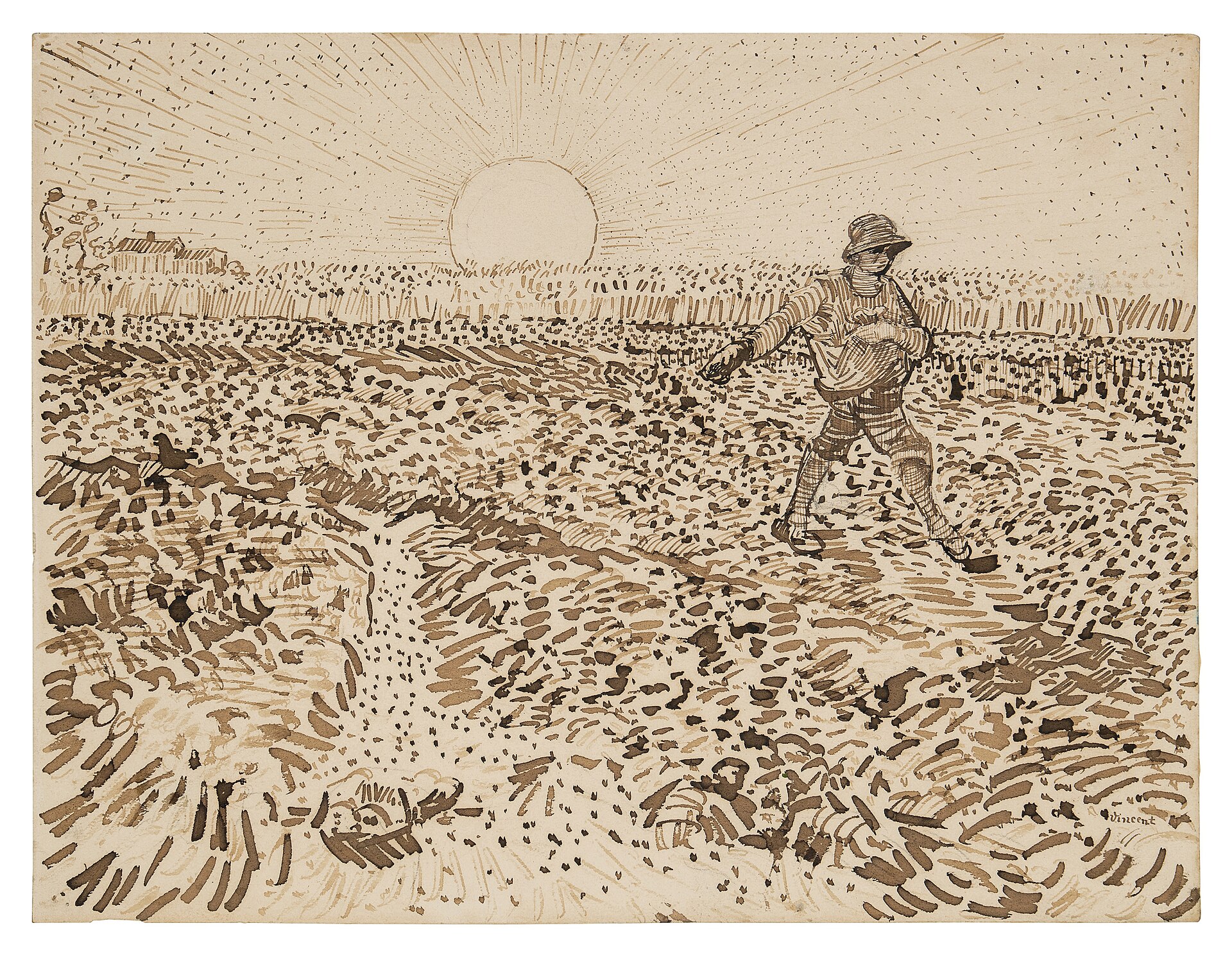
Sower with Setting Sun. Vincent van Gogh, mid July 1888. Sotheby's, New York, 18 November 2025, lot 4. Public domain.