
Psalm 63
11 verses · Psalm of longing
O God, You are my God. Earnestly I seek You; my soul thirsts for You. My body yearns for You in a dry and weary land without water.
Introduction
David, Thirst for God, Book 2: The Elohistic Psalter, Poetry, Psalms Overview.
The heading places David in the wilderness of Judah, the dry hill country east of Jerusalem that falls away toward the Dead Sea, and a closing line speaks of the king. So this is a king away from the sanctuary, keeping its hours in a place without water. He writes for people who knew thirst as a daily fact and knew the worth of a full meal. Listen for how his body carries the prayer, thirst, hunger, lips, hands and bed, and for the moment early on where longing turns to praise before anything around him has changed.
Context
- Who
- A people whose land was mostly dry and who knew what thirst was
- What
- A prayer of longing for God, written in a dry land, that turns into praise and confidence.
- Where
- The dry rain shadow country east of the Judean ridge, falling away toward the Dead Sea
- When
- David in the wilderness of Judah. Date unstated; the heading names the place, and the mention of the king points to the Absalom years, c. 979 BC
- Why
- To show that the desire for God can run deeper than thirst and hunger, and to keep a worshipper praising far from the sanctuary.
Historical context
The heading gives the psalm to David and names the country he was in, the wilderness of Judah, and verse 11 speaks of the king, which points to the years after he took the throne. That wilderness is a belt of chalky folded hills in the rain shadow east of the central ridge, dropping steeply to the lowest land on earth, with a few springs and no rivers. Water travelled with a man in skins, so the dry and weary land describes the ground under the writer's feet. Seeking God earnestly points to the hour of the morning sacrifice, so away from the sanctuary the worshipper keeps its clock. Fat portions were burned to God on the altar as the best of the animal, and lifting up the hands was the ordinary posture of prayer, arms raised and palms open.
Significance
Israel took a real thirst and made it the shape of wanting God, then said the hard thing outright, that His loving devotion is better than life. For hearers who measured wealth in water and grain, that was a ranking rather than a sentiment, because it put God above the thing they spent every day securing.
This chapter in Jewish lifeWhat this chapter is in Jewish life and reading.
How it is read
Rashi keeps the psalm where its heading puts it. The desert of Judah is where David stood "when he was fleeing from Saul" (Rashi on Psalms 63:1:1). The thirst of verse 2 is therefore a thirst for a building the fugitive cannot reach. Rashi says so plainly, "I thirst and long to come to You in Your house of prayer" (Rashi on Psalms 63:2:2). The sight of God in the sanctuary he places at Shiloh, and reads the verse as a memory the man in the desert is drawing on (Rashi on Psalms 63:3:1). The lifted hands of verse 5 he reads as the posture of prayer and praise (Rashi on Psalms 63:5:2). The night watches of verse 7 are where the singer lies on his couch and remembers God's love (Rashi on Psalms 63:7:1). The hard close of the psalm he keeps hard. The pursuers are dragged by the sword, and their dwellings are left so ruined that foxes walk in them (Rashi on Psalms 63:11:1 and 63:11:2). The king who rejoices at the end is David himself, Rashi says, "because he had already been anointed" (Rashi on Psalms 63:12:1). Ibn Ezra, Radak and Metzudat David stand in the corpus on this psalm by reference alone. The refs are Ibn Ezra on Psalms 63:1:1 and following, Radak on Psalms 63:4:1 and 63:8:1, and Metzudat David on Psalms 63:8:1. Rashi is quoted here from the Judaica Press complete Tanach with Rashi, translated by A. J. Rosenberg, under CC-BY.
What the rabbis say
The corpus records forty places where the Midrash and the Talmud draw on this psalm, cited here by reference. Midrash Tehillim treats it at 63:1, 63:2 and 63:3, and cites its verses again at 23:6. Verse 4, that God's lovingkindness is better than life, is the verse most used. It is carried into Bereshit Rabbah 63:12 and 92:2, into Pesikta DeRav Kahana 3:1, into Midrash Tanchuma at Ki Teitzei 4:1 and Toldot 3:2, and into Avot DeRabbi Natan at 34:11 and 41:15. Verse 5 stands in the Babylonian Talmud at Berakhot 16b:17. Verse 12 is drawn into the Babylonian Talmud at Shabbat 33b:1, into the Jerusalem Talmud at Berakhot 5:3:3 and Megillah 4:10:4, and into Mekhilta DeRabbi Yishmael, Tractate Kaspa 3:7. Verse 11 is read at Shemot Rabbah 1:9 and 22:1 and at Shir HaShirim Rabbah 2:15:1.
Sources: Rashi, Rashi on Psalms 63:1 to 63:12, the Judaica Press complete Tanach with Rashi, translated by A. J. Rosenberg, CC-BY, 1040 to 1105; Midrash Tehillim, 63:1 to 63:3 and 23:6, cited by reference; Babylonian Talmud, Berakhot 16b:17 and Shabbat 33b:1, cited by reference; Jerusalem Talmud, Berakhot 5:3:3 and Megillah 4:10:4, cited by reference; Bereshit Rabbah, 63:12 and 92:2, cited by reference; The Sefaria corpus, scripts/data/sources/sefaria/psalms/63.json, fetched 2026-09-19, 2026.
Psalms 63:1-2
my soul thirsts for You: The land is dry and weary without water, and the body's thirst becomes the shape of the prayer. Verse 2 looks back to the sanctuary, where he had seen God's power and glory. Memory stands in for the place he cannot reach.
Psalms 63:1
“O God, thou art my God; or, O God, thou art my Mighty One. The last Psalm left the echo of power ringing in the ear, and it is here remembered. Strong affiance bids the fugitive poet confess his allegiance to the only living God; and firm faith enables him to claim him as his own. He has no doubts about his possession of his God; and why should other believers have any? The straightforward, clear language of this opening sentence would be far more becoming in Christians than the timorous and doubtful expressions so usual among professors.”
Charles Spurgeon · The Treasury of David, Vol. 3 (1872)Particular Baptist
1 more voice on this verseWhat preachers and commentators have said about this verse, in their own words.
Psalms 63:1
“A devout and pious soul has little need of direction how to sing this psalm, so naturally does it speak its own genuine language; and an unsanctified soul, that is unacquainted and unaffected with divine things, is scarcely capable of singing it with understanding. A psalm of David, when he was in the wilderness of Judah.”
Matthew Henry · Commentary on the Whole Bible (1707-1721)puritan
beheld Your power and glory: John Calvin pictures David in a dry and weary land, where he beheld God's power and glory as he had in the sanctuary. The wilderness became his place of worship.
Psalms 63:2
“To see thy power and thy glory, so as I have seen thee in the sanctuary. He longed not so much to see the sanctuary as to see his God; he looked through the veil of ceremonies to the invisible One. Often had his heart been gladdened by communion with God in the outward ordinances, and for this great blessing he sighs again; as well he might, for it is the weightiest of all earth's sorrows for a Christian man to lose the conscious presence of his covenant God.”
Charles Spurgeon · The Treasury of David, Vol. 3 (1872)Particular Baptist
1 more voice on this verse
Psalms 63:2
“How soon are David's complaints and prayers turned into praises and thanksgivings! After two verses that express his desire in seeking God, here are some that express his joy and satisfaction in having found him. Faithful prayers may quickly be turned into joyful praises, if it be not our own fault.”
Matthew Henry · Commentary on the Whole Bible (1707-1721)puritan
Psalms 63:3-5
loving devotion is better than life: , so the lips answer with praise. Gill reads the lifted hands of verse 4 as the ordinary gesture of prayer, carried out of the temple into the wilderness. Verse 5 sets a full table in a place with no food.
Psalms 63:3
“Because thy lovingkindness is better than life. A reason for that which went before, as well as for that which follows. Life is dear, but God's love is dearer. To dwell with God is better than life at its best; life at ease, in a palace, in health, in honour, in wealth, in pleasure; yea, a thousand lives are not equal to the eternal life which abides in Jehovah's smile.”
Charles Spurgeon · The Treasury of David, Vol. 3 (1872)Particular Baptist
I will lift my hands: Adam Clarke notes that Jews in every land lifted their hands toward Jerusalem, where God had His temple. David, far away, lifts his hands in that name.
Psalms 63:4
“His constant regard to God upon all occasions, which should accompany his praises of him: I will lift up my hands in thy name. We must have an eye to God's name (to all that by which he has made himself known) in all our prayers and praises, which we are taught to begin with,-- Hallowed be thy name, and to conclude with,-- Thine is the glory.”
Matthew Henry · Commentary on the Whole Bible (1707-1721)puritan
My soul is satisfied: Charles Spurgeon notes that the Hebrews prized fat food above all, so richest of foods names the best of a royal banquet. Far from God's altar, the soul is still satisfied.
Psalms 63:5
“My soul shall be satisfied as with marrow and fatness. Though unable to feast on the sacrifice at thine altar, my soul shall even here be filled with spiritual joys, and shall possess a complete, a double contentment. There is in the love of God a richness, a sumptuousness, a fulness of soul filling joy, comparable to the richest food with which the body can be nourished.”
Charles Spurgeon · The Treasury of David, Vol. 3 (1872)Particular Baptist
1 more voice on this verse
Psalms 63:5
“Now let us turn our attention to the characteristic of fatness or richness of which David speaks intelligibly when he says, "Let my soul be filled as with marrow and fatness." Before that he had said, "And may your whole burnt offering be made fat." By this he means that the requirements for a sacrifice are that it be fat or rich, that it be glistening and that it be weighted with the sustenance inspired by faith and devotion and by the rich nourishment of the Word of God.”
Ambrose of Milan · written before 397 · On Cain and Abel, Book 2, Chapter Vpatristic
Psalms 63:6-8
remember You on my bed: Verse 6 puts the remembering in the watches of the night, the hours the psalm's dry land leaves empty. Verse 7 gives the ground of the singing, You are my help. Verse 8 sets two grips together, a soul that clings and a right hand that upholds.
Psalms 63:6
“When I remember thee upon my bed. Lying awake, the good man betook himself to meditation, and then began to sing. He had a feast in the night, and a song in the night. He turned his bedchamber into an oratory, he consecrated his pillow, his praise anticipated the place of which it is written, "There is no night there." Perhaps the wilderness helped to keep him awake, and if so, all the ages are debtors to it for this delightful hymn.”
Charles Spurgeon · The Treasury of David, Vol. 3 (1872)Particular Baptist
1 more voice on this verse
Psalms 63:6
“When I remember thee upon my bed,.... Or "beds" (q); seeing he lay in many, as Kimchi observes, being obliged to flee from place to place.”
in the shadow of Your wings: John Gill takes the help as part of what David would remember, and so he sings for joy under the shadow of God's wings. Memory feeds the song.
Psalms 63:7
“Because thou hast been my help. Meditation had refreshed his memory and recalled to him his past deliverances. It were well if we oftener read our own diaries, especially noting the hand of the Lord in helping us in suffering, want, labour, or dilemma. This is the grand use of memory, to furnish us with proofs of the Lord's faithfulness, and lead us onward to a growing confidence in him. Therefore in the shadow of thy wings will I rejoice. The very shade of God is sweet to a believer.”
Charles Spurgeon · The Treasury of David, Vol. 3 (1872)Particular Baptist
My soul clings to You: Albert Barnes explains the verb for cling as to be glued, the soul holding to God as two pieces of wood hold together. God's right hand upholds him in turn.
Psalms 63:8
“My soul followeth hard after thee, or is glued to thee. We follow close at the Lord's heels, because we are one with him. Who shall divide us from his love? If we cannot walk with him with equal footsteps, we will at least follow after with all the strength he lends us, earnestly panting to reach him and abide in his fellowship. When professors follow hard after the world, they will fall into the ditch; but none are ever too eager after communion with the Lord. Thy right hand upholdeth me.”
Charles Spurgeon · The Treasury of David, Vol. 3 (1872)Particular Baptist
Psalms 63:9-10
those who seek my life: The psalm turns from his thirst to the men hunting him. They go down into the depths of the earth, fall to the sword, and become a portion for foxes. Henry reads the foxes as the indignity of a body left unburied.
Psalms 63:9
“But those that seek my soul to destroy it,.... Meaning his life; for as for his soul, that was immaterial and immortal, and could never be destroyed by man: but as for his natural life, his enemies laid snares for that, and sought to take it away, and nothing less would satisfy them; shall go into the lower parts of the earth; not the grave, whither the righteous go as well as the wicked; besides, by their being the portion of foxes, as follows, it seems that they should have no burial; but hell is meant, the bottomless pit.”
2 more voices on this verse
Psalms 63:9
“As David earnestly sought for God, so there were men of another order who as eagerly sought after his blood; of these he speaks: But those that seek my soul, to destroy it. At his life they aimed, at his honour, his best welfare; and this they would not merely injure but utterly ruin. The devil is a destroyer, and all his seed are greedy to do the same mischief; and as he has ruined himself by his crafty devices, so also shall they. Destroyers shall be destroyed. Those who hunt souls shall be themselves the victims.”
Charles Spurgeon · The Treasury of David, Vol. 3 (1872)Particular Baptist
Psalms 63:9
“They shall die a violent death, Rev. xiii. This was fulfilled in Saul, who fell by the sword, his own sword; David foretold this, yet he would not execute it when it was in the power of his hand, once and again; for precepts, not prophecies, are our rule.”
Matthew Henry · Commentary on the Whole Bible (1707-1721)puritan
fall to the power of the sword: Matthew Henry sees the fall by the power of the sword in Saul's death by his own sword. David foretold that end. Yet he twice spared the king when Saul's life lay in his hand.
Psalms 63:10
“They shall fall by the sword. So David's enemies did. They that take the sword shall perish with the sword; bloody men shall feel their own life gushing forth from them, when their evil day shall at last come, and they shall be given up to feel in their own persons the horrors of death. They shall be a portion for foxes. Too mean to be fit food for the lions, the foxes shall sniff around their corpses, and the jackals shall hold carnival over their carcases. Unburied and unhonoured they shall be meat for the dogs of war.”
Charles Spurgeon · The Treasury of David, Vol. 3 (1872)Particular Baptist
the king will rejoice in God: The psalm ends on the king rejoicing in God. Everyone who swears by Him will exult, and the mouths of liars will be shut. Delitzsch reads those who swear by Him as the people who confess Him as God.
Psalms 63:11
“But the king shall rejoice in God. Usurpers shall fade, but he shall flourish; and his prosperity shall be publicly acknowledged as the gift of God. The Lord's anointed shall not fail to offer his joyful thanksgiving: his well established throne shall own the superior lordship of the King of kings; his rejoicing shall be alone in God. When his subjects sing, "Io triumphe, " he will bid them chant, "Te Deum." Every one that sweareth by him shall glory. His faithful followers shall have occasion for triumph; they shall never need to blush for the oath of their allegiance.”
Charles Spurgeon · The Treasury of David, Vol. 3 (1872)Particular Baptist
1 more voice on this verse
Psalms 63:11
“The king - I who am already anointed king. Everyone - That sweareth by the name of God, in truth, and judgment, and righteousness. Every sincere servant and worshipper of God.”
John Wesley · Explanatory Notes upon the Old Testament (1765)evangelical
How this psalm is built
The form: A lament from a dry land that turns almost at once into praise, spoken to God throughout, as Gunkel classes it.
The patterns in this chapter
| Device | What it does | Where to see it |
|---|---|---|
| The body made the measure of the prayer | Verse 1 sets soul and body in the same line, thirsting and yearning for God in a land without water. Wesley reads the second half as a desire of the soul so vehement that the body feels its effects. The dry country of the heading then becomes the psalm's own picture.John Wesley, Explanatory Notes upon the Old Testament, 1765, on Psalm 63:1. | Psalm 63:1, Psalm 63:5 |
| The full table set in a place with no food | Verse 5 answers the thirst of verse 1 with the richest of foods, in a wilderness where there is none. Spurgeon reads the satisfaction as spiritual rather than kept for the altar, a fulness of soul filling joy comparable to the richest food the body can be given.Charles Spurgeon, The Treasury of David, Vol. 3, 1872, on Psalm 63:5. | Psalm 63:1, Psalm 63:5 |
| The two grips held in one verse | Verse 8 puts a soul that clings beside a right hand that upholds. Spurgeon renders the first half as glued to thee and reads the following as close at the Lord's heels, done with whatever strength He lends.Charles Spurgeon, The Treasury of David, Vol. 3, 1872, on Psalm 63:8. | Psalm 63:8 |
| The turn from I to the king | The psalm speaks to God in the second person from verse 1 to verse 8. It turns to the hunters in the third person at verses 9 and 10, and ends with the king rejoicing. Delitzsch reads those who swear by Him as the people who confess Him as God.Franz Delitzsch, Biblical Commentary on the Psalms, 1871, on Psalm 63:11. | Psalm 63:9, Psalm 63:11 |
In the New Testament
5 more paragraphs on the patterns
Psalm 63 is not quoted in the New Testament. Its nearest relation is Psalm 42, where the deer pants for streams of water and the soul thirsts for the living God. Both psalms are written by men shut out of the sanctuary, and both answer the shutting out with appetite.
Inside the psalm
The pattern is a reversal carried through every verse. A dry land produces the richest of foods at verse 5. An empty night produces a song at verse 6. A man hunted to be destroyed ends the psalm with liars silenced. Henry marks how quickly the complaint turns, and says that faithful prayers may be turned into joyful praises unless it is our own fault.
Where it stands in the Psalter
Psalm 63 stands in the second Davidic collection of Book II. Its last verse names the king, the figure Psalm 61 prays for and Psalm 72 hands to Solomon at the close of the book. Read in order, Psalms 61, 62 and 63 pray from outside the sanctuary three times over.
Keep studying
Sources for this chapter
The summary
Jamieson, Fausset & Brown, Commentary Critical and Explanatory; John Calvin, Commentaries; John Wesley, Notes on the Old Testament and Matthew Henry, Complete Commentary.
The form and classifications
Charles Spurgeon, The Treasury of David, Vol. 3, 1872, on Psalm 63:1; Hermann Gunkel, Einleitung in die Psalmen, 1933, as set out for students in C. Hassell Bullock, Encountering the Book of Psalms, 2001; the type this site publishes for Psalm 63 and Matthew Henry, Commentary on the Whole Bible, 1710, on Psalm 63:1.
The exposition
Adam Clarke, Commentary on the Bible; Albert Barnes; Charles Spurgeon; Franz Delitzsch, Biblical Commentary on the Psalms; John Calvin, Commentaries; John Gill and Matthew Henry, Commentary on the Whole Bible.
The painting
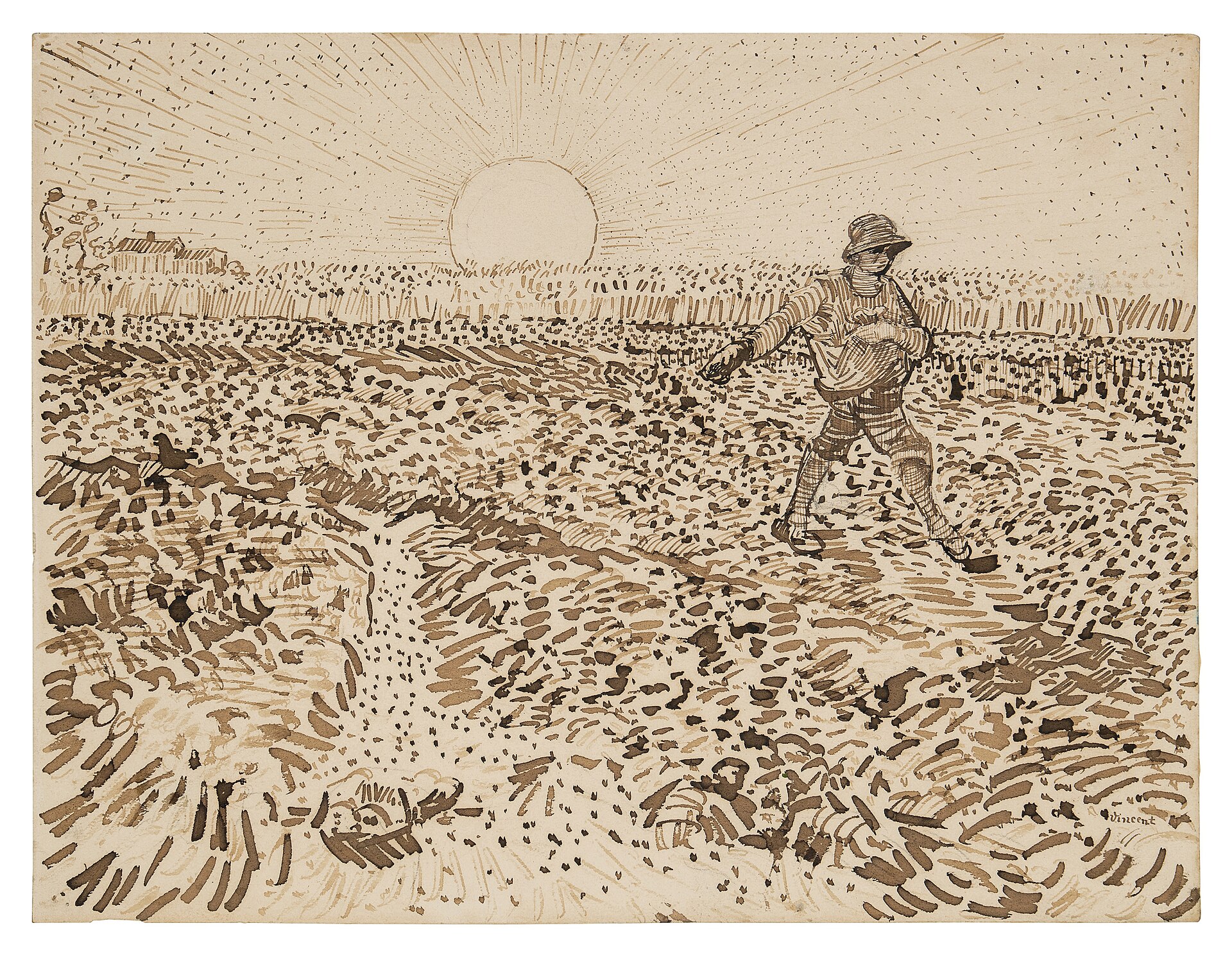
Sower with Setting Sun. Vincent van Gogh, mid July 1888. Sotheby's, New York, 18 November 2025, lot 4. Public domain.