
Psalm 61
8 verses · Lament
From the ends of the earth I call out to You whenever my heart is faint. Lead me to the rock that is higher than I.
Introduction
David, the King Far from Home, Book 2: The Elohistic Psalter, Poetry, Psalms Overview.
David wrote this prayer as a king far from home, cut off from the place where Israel met with God. It was handed to the temple singers and set for strings, so a private cry became a song the whole congregation could use. He asks for shelter, recalls what God has already given him, and then prays for the king, which is to say for himself and for the line God had promised to keep. Listen for the pictures of refuge that come one after another, and for the vow at the close that turns the prayer into a daily habit.
Context
- Who
- Worshippers cut off from the sanctuary and praying toward it
- What
- A king's prayer from far away, asking God for refuge and closing with a prayer for the king's long reign.
- Where
- The far edge of the territory, most likely east of the Jordan, with Jerusalem behind him
- When
- David's reign, from somewhere outside the capital. Date unstated; the psalm is given to David, and it is often placed during the flight from Absalom, c. 979 BC
- Why
- To give a worshipper cut off from God's house the words to ask for shelter and to hold on to God's promises.
Historical context
The heading gives the psalm to David and sets it for stringed instruments, so it was written by a king and sung by the temple choir. The one time the record places David across the Jordan is the Absalom revolt, when he crossed the river and made his base at Mahanaim, and since the psalm names no event that setting stays likely rather than certain. From the end of the earth means the far edge of the territory, which for a king of Israel was the Transjordan country, full of crags and flat topped outcrops with a single approach. The tent is the tabernacle on Zion where the ark stood, and the prayer for the king's years follows a court formula used across the ancient Near East, which in Israel had grown into a prayer about a dynasty God had promised to keep.
Significance
A king in exile prays for the king, which is the strange move in this psalm, because he prays for the promise rather than for his own comfort. For later worshippers singing it in the temple, the king in the song had outgrown any one man on the throne, and the vows paid day by day at the end of it were their own.
This chapter in Jewish lifeWhat this chapter is in Jewish life and reading.
How it is read
Psalm 61 stands in the second Davidic collection, Psalms 51 to 71, the run that closes Book II of the Psalter. Rashi reads the psalm as David's own prayer, sent up from a distance while his army fought. He writes this on the call from the end of the earth. "From the end of the earth although I am far from my men whom I send against my enemies in battle" (Rashi on Psalms 61:3:1). The rock that is higher than the man is what David asks to be led to when his heart grows faint (Rashi on Psalms 61:3:2). Where the psalm asks to dwell in God's tent for ever, Rashi hears a request for two worlds at once. "Grant me the privilege in this world and in the world to come" (Rashi on Psalms 61:5:1). The plea for the king's days he reads as a plea against an early death, that David's years reach seventy, "as the years of every generation" (Rashi on Psalms 61:7:1). Radak reads verse 4 as the ground of the calling, that God "has been a refuge for me many times" (Radak on Psalms 61:4:1). Sefaria holds no English version of Ibn Ezra, Malbim or Metzudat David on this psalm. Their comments stand in the corpus as references alone, at Ibn Ezra on Psalms 61:2:1 and following, Malbim on Psalms 61:1:1 and 61:2:1, and Metzudat David on Psalms 61:4:1 and 61:5:1. Rashi is quoted here from the Judaica Press complete Tanach with Rashi, translated by A. J. Rosenberg, under CC-BY. Radak is quoted from the Sefaria Community Translation under CC0.
What the rabbis say
The corpus records thirty-four places where the Midrash and the Talmud draw on this psalm. They are reported here by their references, because the corpus carries the locator alone. Midrash Tehillim treats the psalm at 61:1, 61:2 and 61:3, and cites its verses again at 1:5, 17:5, 30:3 and 92:5. Verse 5, the wish to dwell in God's tent for ever, is the verse the rabbis use most. It is drawn into the Babylonian Talmud at Bekhorot 31b:9 and Yevamot 96b:18, into the Jerusalem Talmud at Berakhot 2:1:17, Moed Katan 3:7:18 and Shekalim 2:5:5, and into Pesikta Rabbati 2:1 and Midrash Shmuel 19:4. Verse 6 is read at Pirkei DeRabbi Eliezer 19:8, Bereshit Rabbati, Parashat Vayishlach 25 and Midrash Tanchuma Buber, Vayishlach 25:1. Verse 8 is read at Shemot Rabbah 31:5, Midrash Tanchuma, Mishpatim 9:5 and, in the Babylonian Talmud, at Eruvin 86a:2. What each of those places makes of the verse stands in the place itself.
Sources: Rashi, Rashi on Psalms 61:3 to 61:9, the Judaica Press complete Tanach with Rashi, translated by A. J. Rosenberg, CC-BY, 1040 to 1105; Radak, Radak on Psalms 61:4:1, Sefaria Community Translation, CC0, 1160 to 1236; Midrash Tehillim, 61:1 to 61:3, cited by reference; Babylonian Talmud, Bekhorot 31b:9, Yevamot 96b:18 and Eruvin 86a:2, cited by reference; Jerusalem Talmud, Berakhot 2:1:17, Moed Katan 3:7:18 and Shekalim 2:5:5, cited by reference; The Sefaria corpus, scripts/data/sources/sefaria/psalms/61.json, fetched 2026-09-19, 2026; MannaFest, the shape of the Psalter, src/components/book/dossier-content/psalms-structure.ts, 2026.
Psalms 61:1-2
Hear my cry, O God: Barnes reads the ends of the earth as the far edge of the land, where David is cut off from the place of worship. From there he calls, and asks to be led up to the rock that is higher. Spurgeon reads that rock as above the man's own reach.
Psalms 61:1
“Hear my cry, O God. He was in terrible earnest; he shouted, he lifted up his voice on high. He is not however content with the expression of his need: to give his sorrows vent is not enough for him, he wants actual audience of heaven, and manifold succour as the result.”
Charles Spurgeon · The Treasury of David, Vol. 3 (1872)Particular Baptist
3 more voices on this verseWhat preachers and commentators have said about this verse, in their own words.
Psalms 61:1
“Hear my cry, O God,.... Being in distress; and which was vocally expressed with great fervency and importunity; attend unto my prayer; which psalm was made by him, and not for him; inwrought in his heart by the Spirit of God, and put up by him with a true heart and full assurance of faith, and related to his own case in particular.”
Psalms 61:1
“Hear my cry, O God - See the notes at Psa 5:2. The word rendered cry in this place sometimes denotes a joyful shout - a shout of triumph; but the connection makes it certain that it here refers to the voice of prayer. It is implied that it was audible prayer, or that the psalmist gave utterance to his desires in words. It is language such as would be produced by deep distress; when a sad and burdened heart gives vent to its feelings in a loud cry for mercy.”
Psalms 61:1
“Hear my cry, O God - In the midst of a long and painful captivity, oppressed with suffering, encompassed with cruel enemies and isolent masters, I address my humble prayer to Thee, O my God.”
Adam Clarke · Commentary on the Bible (1810-1826)evangelical
whenever my heart is faint: The call comes from a banished man. Charles Spurgeon reads his faint heart and his distance from God's house as a reason to cry louder, from the ends of the earth.
Psalms 61:2
“The particular petition he put up to God when his heart was overwhelmed and he was ready to sink: Lead me to the rock that is higher than I; that is, 1. "To the rock which is too high for me to get up to unless thou help me to it. Lord, give me such an assurance and satisfaction of my own safety as I can never attain to but by thy special grace working such a faith in me." 2.”
Matthew Henry · Commentary on the Whole Bible (1707-1721)puritan
1 more voice on this verse
Psalms 61:2
“From the end of the earth will I cry unto thee. He was banished from the spot which was the centre of his delight, and at the same time his mind was in a depressed and melancholy condition; both actually and figuratively he was an outcast, yet he does not therefore restrain prayer, but rather finds therein a reason for the louder and more importunate cries.”
Charles Spurgeon · The Treasury of David, Vol. 3 (1872)Particular Baptist
Psalms 61:3-4
You have been my refuge: The prayer turns to what God has already been, a refuge and a tower against the enemy. Delitzsch reads Your tent as the sanctuary, and David asks to dwell there forever and to hide in the shelter of Your wings. The picture is a bird under a wing.
Psalms 61:3
“For thou hast been a shelter for me. Observe how the psalmist rings the changes on, Thou hast, and I will, —Ps 61:3-6. Experience is the nurse of faith. From the past we gather arguments for present confidence. Many and many a time had the persecutions of Saul and the perils of battle imperilled David's life, and only by miracle had he escaped, yet was he still alive and unhurt; this he remembers, and he is full of hope. And a strong tower from the enemy. As in a fort impregnable, David had dwelt, because surrounded by omnipotence.”
Charles Spurgeon · The Treasury of David, Vol. 3 (1872)Particular Baptist
Let me dwell in Your tent: Matthew Henry reads the tent in two ways. The one who dwells in God's tent through a short life on earth will dwell in His house of glory forever.
Psalms 61:4
“Those that dwell in God's tabernacle, as it is a house of duty, during their short ever on earth, shall dwell in that tabernacle which is the house of glory during an endless ever. The grace of God and the covenant of grace shall be his constant comfort: I will make my refuge in the covert of his wings, as the chickens seek both warmth and safety under the wings of the hen.”
Matthew Henry · Commentary on the Whole Bible (1707-1721)puritan
1 more voice on this verse
Psalms 61:4
“I will abide in thy tabernacle for ever,.... Under the protection of the Lord, as in a shepherd's tent, or as in one belonging to a general of an army, where are fulness and safety; See Gill on Psa 27:5; or else the tabernacle of the congregation is meant; the house of God, the place of divine and public worship, where he desired and determined always to continue, Psa 23:6; or else the tabernacle which was prefigured by that below, where he knew he should dwell to all eternity.”
Psalms 61:5-8
You have heard my vows: God has heard his vows, and the psalm closes with the same vows paid day by day. Between them the prayer widens to the king, that his days be increased and his years span many generations in God's presence. Calvin reads those years as David's throne kept in Christ.
Psalms 61:5
“For thou, O God, hast heard my vows. Proofs of divine faithfulness are to be had in remembrance, and to be mentioned to the Lord's honour. The prayer of Ps 61:1 is certain of an answer because of the experience of Ps 61:5, since we deal with an immutable God. Vows may rightly be joined with prayers when they are lawful, well considered, and truly for God's glory. It is great mercy on God's part to take any notice of the vows and promises of such faithless and deceitful creatures as we are.”
Charles Spurgeon · The Treasury of David, Vol. 3 (1872)Particular Baptist
the days of the king’s life: Albert Barnes renders it days added to the king's days. The king had feared death in Absalom's revolt, and the prayer asks that his life be spared for many years.
Psalms 61:6
“Thou wilt prolong the king's life; or, better, "days to the days of the King thou wilt add." Death threatened, but God preserved his beloved. David, considering his many perils, enjoyed a long and prosperous reign. And his years as many generations. He lived to see generation after generation personally; in his descendants he lived as king through a very long period; his dynasty continued for many generations; and in Christ Jesus, his seed and son, spiritually David reigns on evermore.”
Charles Spurgeon · The Treasury of David, Vol. 3 (1872)Particular Baptist
1 more voice on this verse
Psalms 61:6
“Prolong - The years of my life and reign. Thus he speaks because his kingdom was not like Saul's, but established to him and his heirs; and because Christ, his son and heir, should actually, and in his own person possess the kingdom forever. Before God - Living and ruling as in God's presence, serving God and worshipping him in his tabernacle.”
John Wesley · Explanatory Notes upon the Old Testament (1765)evangelical
sit enthroned in God’s presence forever: Charles Spurgeon hears in the second line the cry of long live the king, raised for Christ enthroned in God's presence forever. Loving devotion and faithfulness stand as the guards.
Psalms 61:7
“He shall abide before God for ever. Though this is true of David in a modified sense, we prefer to view the Lord Jesus as here intended as the lineal descendant of David, and the representative of his royal race. Jesus is enthroned before God to eternity; here is our safety, dignity, and delight. We reign in him; in him we are made to sit together in the heavens. David's personal claim to sit enthroned for ever is but a foreshadowing of the revealed privilege of all true believers. O prepare mercy and truth, which may preserve him.”
Charles Spurgeon · The Treasury of David, Vol. 3 (1872)Particular Baptist
fulfill my vows day by day: The psalm opened with a cry and closes with praise. Matthew Henry ties the vows he will fulfill day by day to fresh mercies given every day.
Psalms 61:8
“So will I sing praise unto thy name for ever. Because my prayer is answered, my song shall be perpetual; because Jesus for ever sits at thy right hand, it shall be acceptable; because I am preserved in him, it shall be grateful. David had given vocal utterance to his prayer by a cry; he will now give expression to his praise by a song: there should be a parallel between our supplications and our thanksgivings. We ought not to leap in prayer, and limp in praise.”
Charles Spurgeon · The Treasury of David, Vol. 3 (1872)Particular Baptist
How this psalm is built
The form: A lament, prayer out of trouble spoken to God in the second person by a man who expects an answer, as Gunkel classes it.
The patterns in this chapter
| Device | What it does | Where to see it |
|---|---|---|
| The exchange of what God has been and what the man will do | Spurgeon marks the alternation that runs from verse 3 to verse 6, where the psalmist "rings the changes on, Thou hast, and I will". He reads experience as the nurse of faith, gathering arguments for present confidence out of the past.Charles Spurgeon, The Treasury of David, Vol. 3, 1872, on Psalm 61:3. | Psalm 61:3, Psalm 61:5, Psalm 61:8 |
| The cry at the opening and the song at the close | The psalm opens on a cry and ends on a song and a vow paid day by day. Spurgeon sets the two side by side and holds that there should be a parallel between our supplications and our thanksgivings.Charles Spurgeon, The Treasury of David, Vol. 3, 1872, on Psalm 61:8. | Psalm 61:1, Psalm 61:8 |
| The prayer that turns to speak of the king | Every line of the psalm is spoken to God, and verses 6 and 7 speak about the king in the third person. Wesley reads the king as the psalmist himself, asking for the years of his own life and reign, because his kingdom was established to him and his heirs.John Wesley, Explanatory Notes upon the Old Testament, 1765, on Psalm 61:6. | Psalm 61:6, Psalm 61:7 |
In the New Testament
5 more paragraphs on the patterns
Psalm 61 is not quoted in the New Testament. Its lines run instead through the rest of the Psalter. The rock and the fortress of verse 3 are the words of Psalm 18:2, where the LORD is called rock, fortress and stronghold. The shelter of verse 4 is the shelter of Psalm 27:5, where God hides a man in His tent and sets him high upon a rock.
Inside the psalm
Spurgeon marks the alternation of what God has been and what the man will do, running from verse 3 to verse 6. The cry of verse 1 and the song of verse 8 are the outer frame, and the vows sit inside it twice. Calvin, cited in this site's note on verses 5 to 8, reads the years asked for at verse 6 as David's throne kept in Christ.
Where it stands in the Psalter
The psalm stands in the second Davidic collection, Psalms 51 to 71, inside Book II. Psalm 62 follows it with the same confidence stated as silence before God, and Psalm 63 follows that with the same exile stated as thirst. The three are best read in order.
Keep studying
Studies1
Words7
Sources for this chapter
The summary
Jamieson, Fausset & Brown, Commentary Critical and Explanatory; John Calvin, Commentaries; John Wesley, Notes on the Old Testament and Matthew Henry, Complete Commentary.
The form and classifications
Charles Spurgeon, The Metropolitan Tabernacle Pulpit, Sermon No. 2728, "The High Rock", 1901, on Psalm 61:2; Hermann Gunkel, Einleitung in die Psalmen, 1933, as set out for students in C. Hassell Bullock, Encountering the Book of Psalms, 2001; the type this site publishes for Psalm 61 and John Wesley, Explanatory Notes upon the Old Testament, 1765, on Psalm 61:6.
The exposition
Albert Barnes; Charles Spurgeon; Franz Delitzsch, Biblical Commentary on the Psalms; John Calvin, Commentary on the Book of Psalms and Matthew Henry, Commentary on the Whole Bible.
The painting
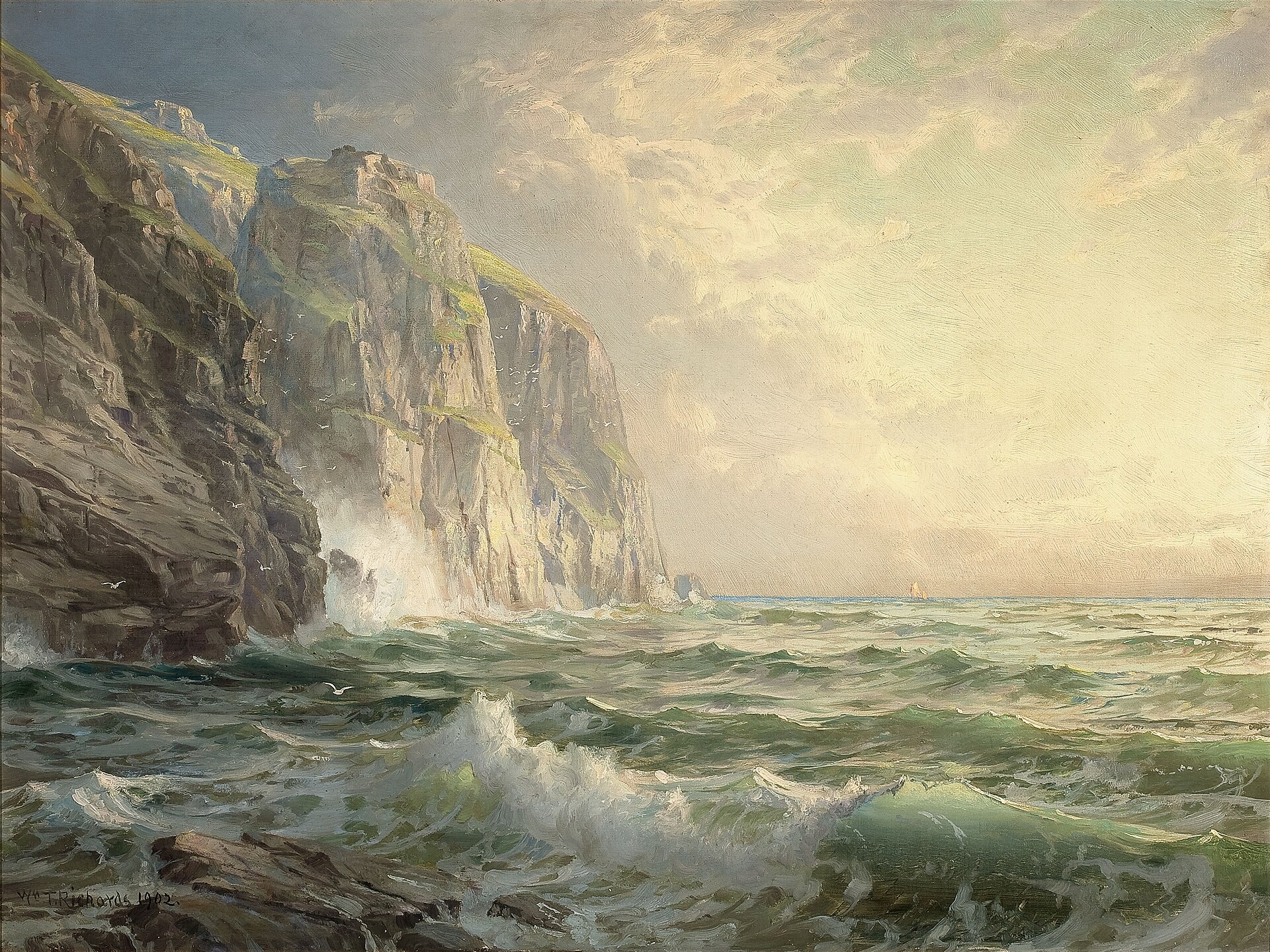
Rocky Cliff with Stormy Sea, Cornwall. William Trost Richards, 1902. Heritage Auctions. Public domain.