
Psalm 4
8 verses · Psalm of trust
Be angry, yet do not sin; on your bed, search your heart and be still. Selah
Introduction
David, the Evening Prayer, Book 1: The book of David, Poetry, Psalms Overview.
David wrote this for the music of the sanctuary, and it reads as a prayer for the end of a day. He speaks to God first, then turns to the men who have been slandering him, then speaks to God again. The people around him are restless, some because of the harvest and some because of their grudges. Listen for the advice he gives his opponents about how to spend the night, and for the contrast between two kinds of gladness. It closes as a man closes his eyes.
Context
- Who
- Israelites who prayed at the end of a working day, some of them tired of waiting on God
- Where
- An Israelite household at nightfall, with the harvest and the day's grievances both in the air
- When
- The reign of David, and the psalm was handed to the man who led the music. c. 1010 to 970 BC on the superscription, which Young's Literal Translation renders To the Overseer with Stringed Instruments, a Psalm of David
Historical context
The heading is a performance note, and the instruments it names are the plucked ones, the lyre and the harp. Israel's worship was scored and staffed, since Chronicles lists whole guilds of Levites appointed to play, and a psalm handed to the director entered the national repertoire. The counsel to search the heart on the bed at verse 4 fits the way people slept, a family together in a one-room house through a long dark night. Lamp oil was too dear to burn on a wakeful mind. The sacrifices of the righteous at verse 5 assume the whole altar system, and the psalm asks that the offering come out of a right life. Grain and new wine at verse 7 stand for the two harvests that decided whether a family ate.
Significance
This is an evening prayer for people under pressure from their neighbours, men turning the psalmist's honour into shame and chasing lies. It tells them that the settled thing at the end of a day is that the LORD has set apart the godly for Himself. Its last line was worth more than a harvest to a household that had just lost one, since the LORD alone makes a man dwell in safety.
This chapter in Jewish lifeWhat this chapter is in Jewish life and reading.
How it is read
The heading of this psalm is read as a direction to the Temple musicians, and the commentators divide over what the direction says. Rashi is quoted here from the Judaica Press Tanach with Rashi. He holds that "David established this psalm so that the Levites who conduct the melodies when singing on the platform should recite it" (Rashi on Psalms 4:1:1). Ibn Ezra is quoted from the Sefaria Community Translation. He reports that Rav Saadia Gaon read the word for the leader as perpetually, and that others read it as the officer set over the musicians. Ibn Ezra takes the second reading and calls it the correct one (Ibn Ezra on Psalms 4:1:1). On the word for the music he allows three senses, two melodies, a named instrument, or the many tunes he believes Israel sang to (Ibn Ezra on Psalms 4:1:2).
The body of the psalm is read against Saul rather than Absalom. Rashi takes the sons of man of the third verse as the sons of Abraham, Isaac and Jacob, and proves each name from the record (Rashi on Psalms 4:3:1). He then hears the taunt behind the verse in the phrase the court used for David, the son of Jesse, and gives David's complaint in four words: "I have no name" (Rashi on Psalms 4:3:2). The liars of the same verse he identifies with the Ziphites, who informed on David while showing him friendliness (Rashi on Psalms 4:3:3). Radak is quoted from the Finch translation of 1919, which is public domain. He reads the setting apart of the fourth verse as separation to an office, "He has separated me from all Israel to be king" (Radak on Psalms 4:4:1).
The fifth verse is where the commentators build a practice out of the words. Rashi reads the trembling as fear before God, and the lying on the bed as memory: bring back to your heart what God warned you of (Rashi on Psalms 4:5:1 and 4:5:2). Ibn Ezra takes the same verse and rejects a reading that would allow a false thought so long as the mouth stays shut. He holds that "the speech of the heart is the essential thing", and that the tongue is only an interpreter between the heart and the hearers (Ibn Ezra on Psalms 4:5:1). His own reading makes the verse a nightly discipline. A man thinks on his bed, where no other person is at hand, so that he will speak no falsehood in the day.
The sixth verse carries the point of contact a Christian reader should mark. Ibn Ezra takes the sacrifices of righteousness for the peace offerings, and distinguishes them from the guilt offering and the sin offering (Ibn Ezra on Psalms 4:6:1). Rashi reads the same phrase past the altar altogether: "Perform righteous deeds, and it will be as if you are offering up sacrifices" (Rashi on Psalms 4:6:1). That reading is one of the doors through which Judaism continued after the Temple fell, with deeds, prayer and study standing where the offerings had stood. Christian teaching holds instead that the offerings were answered once in the death of Christ, and the site sets the two side by side at this verse rather than flattening either. Rashi also hears the seventh verse as a complaint of Jews who see the nations in wealth and quiet, and who ask who will show them good (Rashi on Psalms 4:7:1). His answer is a comparison from the lesser to the greater, that those who do God's will are to receive more than those who anger him. Ibn Ezra records that Rabbi Yehuda ibn Balaam took the eighth verse to be inverted, and answers that "there is no need to invert words spoken by the Holy Spirit" (Ibn Ezra on Psalms 4:8:2). Rashi closes the psalm on the peace of the ninth verse, which he makes conditional on the peace of Israel with David (Rashi on Psalms 4:9:1).
What the rabbis say
The corpus carries forty locators on this psalm and the text of none, so each is cited and linked here rather than quoted. Midrash Tehillim carries by far the largest share, with eighteen entries spread across the chapter. They stand at 4:16 and 4:4 on the heading, at 4:1, 4:2, 4:3 and 4:5 on the second verse, and at 4:6 to 4:9 on the third. They continue at 4:10 and 4:11 on the fifth verse, 4:12 on the sixth, and 4:14 on the eighth, with 4:15 on the ninth. Three entries of the same midrash reach in from other psalms, at 10:10, 37:3 and 119:23, all anchored on the eighth verse.
The Talmudic locators are five. They stand at Pesachim 119a:3 on the heading, at Jerusalem Talmud Taanit 2:9:3 on the second verse, and at Berakhot 4b:27, Berakhot 5a:2 and Jerusalem Talmud Berakhot 1:1:29 on the fifth. Three entries of Ein Yaakov stand beside them on the fifth verse, at Berakhot 1:14 in the Glick Edition and at Berakhot 1:20 and 1:21. The remaining midrashic locators are scattered. On the third verse the corpus carries Pesikta DeRav Kahana 18:1, Midrash Tanchuma Buber, Behar 7:1 and Midrash Lekach Tov on Genesis 31:30:1. On the eighth it carries Vayikra Rabbah 21:7, Tanna DeBei Eliyahu Rabbah 18:5 and an entry of Otzar Midrashim on Psalm 118. What each of them teaches is a saying of the rabbis, and is reported as theirs wherever this site quotes one. The quotations wait on a fetch that carries the text.
Sources: Rashi, Rashi on Psalms 4:1:1 to 4:9:2, the Judaica Press complete Tanach with Rashi, translated by A. J. Rosenberg; Ibn Ezra, Ibn Ezra on Psalms 4:1:1 to 4:8:2, the Sefaria Community Translation; Radak, Radak on Psalms 4:4:1, R. David Kimhi on the first book of Psalms, translated by R. G. Finch, London, 1919; The Sefaria corpus, scripts/data/sources/sefaria/psalms/4.json, the 5 Talmud and 35 Midrash locators of this chapter.
Answer me when I call: God of my righteousness names the ground the prayer asks on. Behind relieved my distress stand the Hebrew words for a narrow place and for making wide. Spurgeon read it as David pleading past mercy for present favor.
Psalms 4:1
The one who calls on the Lord must have true righteousness. Since Christ is righteous, the just person, the partaker of righteousness, must be a partaker of Christ. Lest saying "God of my righteousness" should give birth to pride, we can say this also: He has been made wisdom and righteousness for us, and he is our Redeemer. Consequently, to say "God of my righteousness" would be as if you said, "God of my Lord."
Origen of Alexandria · written before 253 · Selections from the Psalms 4:1patristic
1 more voice on this verseWhat preachers and commentators have said about this verse, in their own words.
Psalms 4:1
“This is another instance of David's common habit of pleading past mercies as a ground for present favour. Here he reviews his Ebenezers and takes comfort from them. It is not to be imagined that he who has helped us in six troubles will leave us in the seventh. God does nothing by halves, and he will never cease to help us until we cease to need. The manna shall fall every morning until we cross the Jordan. Observe, that David speaks first to God and then to men.”
Charles Spurgeon · The Treasury of David, Vol. 1 (1869)Particular Baptist
Psalms 4:2-3
my honor be maligned?: Jamieson, Fausset and Brown read O men, in the Hebrew sons of a man, as men of note. They read the honor maligned as David's royal dignity. Verse 3 answers by naming the godly whom the LORD has set apart.
Psalms 4:2
“DAVID had many times been the subject of cruel mockery and, therefore, while writing this Psalm probably in the first place about himself, he also described in it one of the bitterest of our Savior's sufferings. What an illustration this is of the union which exists between Christ and His people in the matter of experience! He had a Cross to bear and so have they. He was "despised and rejected of men," and so are they.”
Charles Spurgeon · written before 1892 · The Metropolitan Tabernacle Pulpit, Sermon No. 3276: “Christ's Glory Turned to Shame” (lightly modernized text, CCEL edition)Particular Baptist
the LORD has set apart the godly: Godly translates chasid, a word tied to chesed, the LORD's loyal love. Set apart is the verb of Exodus 11:7, where the LORD makes a distinction between Egypt and Israel. The last line answers the prayer of verse 1.
Psalms 4:3
“Here is the great cry that reaches up to God. It is not that cry people make resulting from some intense release of air, but it is the pure and untouched outpouring of the words of the inner mind, which extend even to God.”
Origen of Alexandria · written before 253 · Selections from the Psalms 4:4patristic
Psalms 4:4-5
search your heart and be still: Be angry translates a Hebrew verb for quivering with violent feeling. Jamieson, Fausset and Brown trace it to the Septuagint, the old Greek version, and Ephesians 4:26 carries the same words. The anger goes to the bed, to the heart and to silence.
Psalms 4:4
"Tremble and sin not." How many reverse this counsel and sin but tremble not. O that men would take the advice of this verse and commune with their own hearts. Surely a want of thought must be one reason why men are so mad as to despite Christ and hate their own mercies. O that for once their passions would be quiet and let them be still, that so in solemn silence they might review the past, and meditate upon their inevitable doom.
Charles Spurgeon · The Treasury of David, Vol. 1 (1869)Particular Baptist
2 more voices on this verse
Psalms 4:4
“It is said that the greatest of the philosophers granted immunity from punishment to those crimes that had been committed through anger, but the divine Scripture says better: "Be angry, and sin not." It preferred rather to cut off sin than to excuse it. It is better to find praise for mercy in an occasion for indignation than to be incited by wrath toward vengeance.”
Ambrose of Milan · written before 397 · On the Death of Theodosius 14patristic
Psalms 4:4
“Stand in awe, and sin not - The Septuagint, which is copied by St. Paul, Eph 4:26, translate this clause, Οργιζεσθε, και μη ἁμαρτανετε; Be ye angry, and sin not. The Vulgate, Syriac, Ethiopic, and Arabic, give the same reading; and thus the original רגזו rigzu might be translated: If ye be angry, and if ye think ye have cause to be angry; do not let your disaffection carry you to acts of rebellion against both God and your king. Consider the subject deeply before you attempt to act.”
Adam Clarke · Commentary on the Bible (1810-1826)evangelical
Cross references
Psalms 4:4
- Quoted inEphesians 4:26“Be angry, yet do not sin.” Do not let the sun set upon your anger,
'Be ye angry, and sin not'
Connectionstopics/anger
Offer the sacrifices of the righteous: The command still speaks to the men of verse 2, who love vanity and seek after lies. Albert Barnes took these as sacrifices offered in a right spirit. Psalm 51:19 and Deuteronomy 33:19 use the same Hebrew phrase.
Psalms 4:5
“Offer the sacrifices of righteousness - Offer righteous sacrifices; that is, sacrifices prompted by right motives, and in accordance with the prescriptions in the law of God. This appears to be addressed also to those who in Psa 4:2 are called “sons of men;” that is, those who were arrayed against the psalmist. According to the common opinion this psalm was composed by David on occasion of his being driven from his throne and kingdom; and, of course, Zion, the ark, and the tabernacle, were in the hands of his enemies.”
2 more voices on this verse
Psalms 4:5
“If you wish to explain what it is to hope in everything, we are going to say that it is nothing other than to become an heir of the kingdom of heaven, to receive comfort, to be called the children of God, to see God, to be satisfied by the righteousness for which one hungers and thirsts, to enjoy his abundant mercy and to live in all the things which the true God and our Lord and Savior Jesus Christ promised.”
Origen of Alexandria · written before 253 · Selections from the Psalms 4:5patristic
Psalms 4:5
“Provided that the rebels had obeyed the voice of the last verse, they would now be crying, —"What shall we do to be saved?" And in the present verse, they are pointed to the sacrifice, and exhorted to trust in the Lord. When the Jew offered sacrifice righteously, that is, in a spiritual manner, he thereby set forth the Redeemer, the great sin-atoning Lamb; there is, therefore, the full gospel in this exhortation of the Psalmist.”
Charles Spurgeon · The Treasury of David, Vol. 1 (1869)Particular Baptist
Psalms 4:6-7
Shine the light of Your face: The answer to the crowd's question is a prayer for the light of God's face, as in Numbers 6:25. Verse 7 sets the joy of that face above the harvest of grain and new wine. Spurgeon set Christ in the heart above corn in the barn.
Psalms 4:6
Indeed, in the same way the rays of the sun touch the face of one who looks at it, and in fact it is impossible for one who stands near to the sun not to feel it, so also it must be understood that the individual who is fully a partaker of God is the one who has meditated on the law of the holy word and who has surrendered his mind to understanding God. Which, I believe, the prophet indicates in this place when he says, "The light of your countenance is manifested toward us, O Lord."
Origen of Alexandria · written before 253 · Selections from the Psalms 4:7patristic
2 more voices on this verse
Psalms 4:6
“Who will show us any good? - This is not a fair translation. The word any is not in the text, nor any thing equivalent to it; and not a few have quoted it, and preached upon the text, placing the principal emphasis on this illegitimate word. The place is sufficiently emphatic without this. There are multitudes who say, Who will show us good? Man wants good; he hates evil as evil, because he has pain, suffering, and death through it; and he wishes to find that supreme good which will content his heart, and save him from evil.”
Adam Clarke · Commentary on the Bible (1810-1826)evangelical
Psalms 4:6
We have now entered upon the third division of the Psalm, in which the faith of the afflicted one finds utterance in sweet expressions of contentment and peace. There were many, even among David's own followers, who wanted to see rather than to believe. Alas! this is the tendency of us all! Even the regenerate sometimes groan after the sense and sight of prosperity, and are sad when darkness covers all good from view. As for worldlings, this is their unceasing cry. "Who will shew us any good?"
Charles Spurgeon · The Treasury of David, Vol. 1 (1869)Particular Baptist
more joy than when grain and new wine abound: In Hebrew the grain and new wine are theirs, the harvest of the many who asked in verse 6 who could show them good. Their joy rises and falls with the crop. The joy of verse 7 is God's gift to the heart, and it stands whatever the harvest.
Psalms 4:7
“The meaning of this little verse is consistent with the verses that precede it. For what else is the light of the countenance of the Lord over his righteous ones than a heart full of joy? That very thing which we feel through the sensation of joy becomes a partaker of his divinity when it contemplates God.”
Origen of Alexandria · written before 253 · Selections from the Psalms 4:7patristic
2 more voices on this verse
Psalms 4:7
"It is better, " said one, "to feel God's favour one hour in our repenting souls, that to sit whole ages under the warmest sunshine that this world affordeth." Christ in the heart is better than corn in the barn, or wine in the vat. Corn and wine are but fruits of the world, but the light of God's countenance is the ripe fruit of heaven. "Thou art with me, " is a far more blessed cry than "Harvest home."
Charles Spurgeon · The Treasury of David, Vol. 1 (1869)Particular Baptist
Psalms 4:7
“This is gladness in the heart, inward, solid, substantial joy. The mirth of worldly people is but a flash, a shadow; even in laughter their heart is sorrowful, Prov. xiv. "Thou hast given gladness in my heart;" so the word is.”
Matthew Henry · Commentary on the Whole Bible (1707-1721)puritan
lie down and sleep in peace: Henry read this beside Psalm 3:5, where the same man lies down and sleeps, and he noted that David had no guards. Spurgeon wrote that a man with the wings of God above him needs no other curtain. The LORD alone makes him dwell in safety.
Psalms 4:8
“I will both lay me down in peace, and sleep - Most men lie down, and most sleep, daily, for without rest and steep life could not be preserved; but alas! how few lie down in peace! peace with their own consciences, and peace with God! David had then two great blessings, rest by sleep, and peace in his soul. He had a happy soul; and when he lay down on his bed, his body soon enjoyed its repose, as the conscience was in peace. And he had a third blessing, a confidence that he should sleep in safety.”
Adam Clarke · Commentary on the Bible (1810-1826)evangelical
1 more voice on this verse
Psalms 4:8
“Even if grief, calamities, temptations, disasters are not lacking to me in this present life, nevertheless there is a future time for me in which I will depart from the body and sleep in peace.”
Eusebius of Caesarea · written before 339 · Commentary on Psalms 4:9-10patristic
How this psalm is built
The form: A psalm in three parts, the prayer, the word to the sons of men, and the contentment of faith, as Spurgeon classes it.
The patterns in this chapter
| Device | What it does | Where to see it |
|---|---|---|
| The prayer turned on the men at verse 2 | The psalm opens toward God, turns at verse 2 to the sons of men who love vanity and seek lies, holds them through verse 5, and turns back to God at verse 6. Albert Barnes reads the call to offer the sacrifices of the righteous as spoken to the same men who are called sons of men at verse 2. Charles Spurgeon marks verse 6 as the start of the third part, where the faith of the afflicted man speaks in contentment.Charles Spurgeon, The Treasury of David, Vol. 1, 1869, on Psalm 4:6. | Psalm 4:1, Psalm 4:2, Psalm 4:6 |
| Selah at the two turns | The word stands at the end of verse 2 and at the end of verse 4, closing the charge against the men and closing the counsel given to them. Each time it falls where the psalm has finished saying something to the men and is about to say the next thing.John Wesley, Explanatory Notes upon the Old Testament, 1765, on Psalm 3:2. | Psalm 4:2, Psalm 4:4 |
| The crowd's question and the psalmist's | Many ask who can show us the good, and the psalm answers by asking God to shine the light of His face, which is the blessing Aaron was told to say over Israel at Numbers 6:25. Adam Clarke notes that the word any in the older English rendering of the crowd's question stands in no Hebrew text, and that the question is a wider one than it is often preached as.Adam Clarke, Commentary on the Bible, 1832, on Psalm 4:6. | Psalm 4:6 |
| The joy weighed against the harvest | Verse 7 sets the gladness God gives above the season when grain and new wine abound, which was the year's best news in an agricultural country. Charles Spurgeon puts the comparison in one line, that Christ in the heart is better than corn in the barn or wine in the vat. Matthew Henry reads the gladness as inward and solid, against a worldly mirth that is a flash.Charles Spurgeon, The Treasury of David, Vol. 1, 1869, on Psalm 4:7. | Psalm 4:7 |
Where it sits in the Psalter
9 more paragraphs on the patterns
Psalm 3 and Psalm 4 stand together as a morning and an evening. Psalm 3:5 lies down and sleeps and wakes because the LORD sustains him, and Psalm 4:8 lies down and sleeps in peace because the LORD alone makes him dwell in safety. Matthew Henry reads the two side by side and notes that David had no guard set over him either time.
In the New Testament
Verse 4 travels into the New Testament through the old Greek version. The Septuagint renders the Hebrew verb as be angry, and Ephesians 4:26 carries the same words, be angry and do not sin, which is why the verse is quoted in the letters as counsel about anger. Adam Clarke sets the versions out and Ambrose of Milan uses the line against the philosophers who excused crimes done in anger.
Where the words come from
The light of the face in verse 6 is the language of the priestly blessing. Numbers 6:25 asks the LORD to make His face shine on Israel, and the psalm turns that blessing into a request made while men are asking where any good is to be found.
The debated concept: what verse 4 tells the reader to do
The first word of verse 4 is read in two ways, and the weight of the versions is what decides a reader. Adam Clarke counts the versions that carry anger, since the Vulgate, the Syriac, the Ethiopic and the Arabic agree with the Septuagint there (Commentary on the Bible, 1832). Charles Spurgeon reads the Hebrew as awe, tremble and sin not, and turns the line on the reader who reverses the counsel by sinning without trembling (The Treasury of David, Vol. 1, 1869). The two readings meet in what the verse asks next, a search of the heart on the bed and silence after it, so a man who trembles and a man who is angry are given the same thing to do.
What the words of verse 6 hold
Adam Clarke marks a word that the old English versions added at verse 6, since the word rendered any stands in no Hebrew text and preachers have rested weight on it (Commentary on the Bible, 1832). The question as the psalm puts it asks who will show us good, and the answer asked for in the same verse is the light of God's face.
Keep studying
Sources for this chapter
The summary
Jamieson, Fausset & Brown, Commentary Critical and Explanatory; John Calvin, Commentaries; John Wesley, Notes on the Old Testament and Matthew Henry, Complete Commentary.
The form and classifications
Charles Spurgeon and Matthew Henry, Commentary on the Whole Bible, 1710, on Psalm 4:8.
The exposition
Albert Barnes, Notes on the Book of Psalms; Charles Spurgeon, The Treasury of David; Franz Delitzsch, Biblical Commentary on the Psalms; Jamieson Fausset and Brown, Commentary Critical and Explanatory on the Whole Bible; John Gill, Exposition of the Old Testament and Matthew Henry, Commentary on the Whole Bible.
The painting
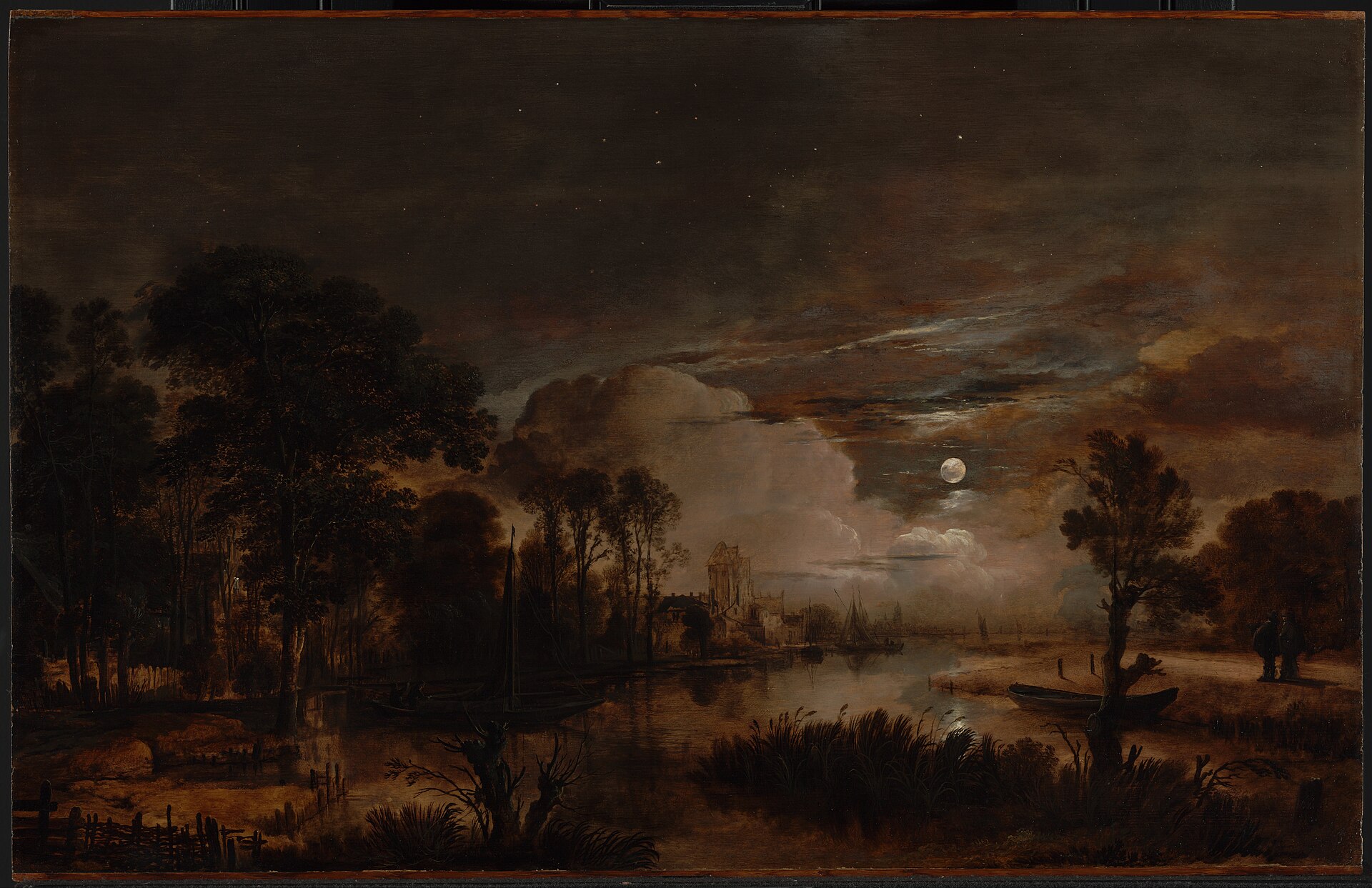
Moonlit Landscape with a View of the New Amstel River and Castle Kostverloren. Aert van der Neer, 1647. Wikimedia Commons. Public domain.