
Psalm 36
12 verses · Wisdom psalm and hymn
For with You is the fountain of life; in Your light we see light.
Introduction
David, the Fountain of Life, Book 1: The book of David, Poetry, Psalms Overview.
The title gives this psalm to David and calls him the servant of the LORD, a name set over no other psalm of his. It was written for Israelites who had watched a powerful man with no reverence for God do well, and who wanted God's measure set against him. The psalm answers in two panels. The first looks inside the wicked man, and the second measures God's love from the sky to the depths. Listen for the opening, which borrows the form of a prophet's oracle and gives it to the wrong speaker, and for the prayer that closes the psalm.
Context
- Who
- Israelites who had watched a man with no fear of God prosper and wanted the measure of God against him
- What
- A psalm in two panels that sets the inner life of a wicked man beside the measure of God's loving devotion.
- Where
- Israel under David's monarchy; the psalm names no place except the house of God at verse 8.
- When
- The reign of David, about 1010 to 970 BC by the superscription, which names no event.
- Why
- To answer the sight of a godless man doing well with the measure of God, and to ask that His mercy continue to those who know Him.
Historical context
The title ascribes the psalm to David the servant of the LORD, a description attached to no other psalm of his. Verse 1 begins with neum, the word that introduces a prophetic utterance from the LORD in the prophets, and then puts transgression in the speaker's place. Verse 4 puts the wicked man on his bed. The bed was where a household lay down together in one room, and the psalm puts the planning in the hour and the place where a hearer expected rest. The second half is built from a household and a watered garden. The shadow of God's wings at verse 7 is a bird covering its young, and the river of delights is drink. The Hebrew word behind delights is the plural of eden, so the picture is the garden.
Significance
For the first hearers the psalm answered a practical question with a measurement. It described the inside of a man who has no fear of God, and then measured God's loving devotion against the sky. The last three verses turned the panels into a prayer, asking that the mercy continue to those who know God, and stating the fall of the evildoers in the past tense before it had happened.
This chapter in Jewish lifeWhat this chapter is in Jewish life and reading.
How it is read
Rashi reads the opening of this psalm as a sentence turned about, and takes the transgression that speaks to the wicked man as the evil inclination working inside him, at Rashi on Psalms 36:2:1 and Rashi on Psalms 36:2:2. That reading governs the rest of his comment. On the flattery the transgression works he writes:
For it smoothed The transgression made smooth places appear to his eyes in order that the Holy One, blessed be He, find his iniquity to hate him. (Rashi on Psalms 36:3:1)
He holds the wicked man's choice to be his own, made in front of an open road:
he stands on a way that is not good The Holy One, blessed be He, placed before him the good way and the way of death, yet he chooses for himself a way that is not good. (Rashi on Psalms 36:5:1)
He reads the heights and the deep of the psalm as measures of God's dealing rather than as places, at Rashi on Psalms 36:7:1, and he puts it plainly on the second half of the line:
Your judgments are the vast deep Whomever You wish to judge, and wreak vengeance upon, You humble him to the vast deep. (Rashi on Psalms 36:7:2)
On the fall of the workers of iniquity he writes:
There the workers of iniquity have fallen There they will understand their downfall, and there they were thrust away and were unable to rise. (Rashi on Psalms 36:13:1)
Ibn Ezra stands on this chapter at Ibn Ezra on Psalms 36:1:1, 36:3:1, 36:4:1, 36:5:1, 36:6:1, 36:8:1, 36:9:1, 36:10:1 and 36:11:1 and Radak at Radak on Psalms 36:1:1, 36:9:1, 36:10:1 and 36:11:1. Sefaria holds no English version of those references, so this card cites them and quotes neither.
What the rabbis say
The corpus records 40 places where the rabbinic literature takes up a line of this psalm, 30 of them in the Midrash. Each is a locator, so the saying stands at its reference and is read there. The Midrash on the Psalms treats the psalm at Midrash Tehillim 36:1, 36:2, 36:3, 34:2 and 36:5. The Fathers according to Rabbi Nathan takes it up at Avot DeRabbi Natan 32:3 and 1:5, and Bereshit Rabbati at Bereshit Rabbati, Parashat Vayeshev 2, Parashat Vayetze 15, Parashat Bereshit 4 and Parashat Bereshit 9. The Talmud takes up lines of the psalm at Avot DeRabbi Natan 32:3, Berakhot 61b:2, Arakhin 8b:11, Jerusalem Talmud Megillah 3:6:3, Jerusalem Talmud Taanit 4:2:15, Chagigah 12b:12, Gittin 70a:19, Avot DeRabbi Natan 1:5, Avot DeRabbi Natan, Recension B 1:15 and Bava Metzia 59a:1.
Sources: Rashi, Rashi on Psalms, in The Judaica Press complete Tanach with Rashi, translated by A. J. Rosenberg, under a CC-BY licence; Ibn Ezra, Ibn Ezra on Psalms, cited at Ibn Ezra on Psalms 36:1:1, 36:3:1, 36:4:1, 36:5:1, 36:6:1, 36:8:1, 36:9:1, 36:10:1 and 36:11:1; Radak, Radak on Psalms, cited at Radak on Psalms 36:1:1, 36:9:1, 36:10:1 and 36:11:1; Midrash Tehillim, the Midrash on the Psalms, cited at Midrash Tehillim 36:1, 36:2, 36:3, 34:2 and 36:5; The Talmud, cited at Avot DeRabbi Natan 32:3, Berakhot 61b:2, Arakhin 8b:11, Jerusalem Talmud Megillah 3:6:3, Jerusalem Talmud Taanit 4:2:15, Chagigah 12b:12, Gittin 70a:19, Avot DeRabbi Natan 1:5, Avot DeRabbi Natan, Recension B 1:15 and Bava Metzia 59a:1; MannaFest, the Sefaria corpus at scripts/data/sources/sefaria/psalms/36.json, fetched 2026-09-19, 2026.
Psalms 36:1-2
no fear of God: What speaks here is the wicked man's transgression. An oracle is a word spoken from God, and sin speaks that way inside him, with no fear of God before his eyes. Henry reads the conceit as a cheat that holds until the man's own sin becomes hateful to him.
Psalms 36:1
“The transgression of the wicked. His daring and wanton sin; his breaking the bounds of law and justice. Saith within my heart, that there is no fear of God before his eyes. Men's sins have a voice to godly ears. They are the outer index of an inner evil. It is clear that men who dare to sin constantly and presumptuously cannot respect the great Judge of all. Despite the professions of unrighteous men, when we see their unhallowed actions our heart is driven to the conclusion that they have no religion whatever. Unholiness is clear evidence of ungodliness.”
Charles Spurgeon · The Treasury of David, Vol. 2 (1870)Particular Baptist
2 more voices on this verseWhat preachers and commentators have said about this verse, in their own words.
Psalms 36:1
“The wicked person speaks, and the inner conscience is mangled. Every word he utters is laden with malice and trickery. Who undergoes punishment greater than that which he inflicts on himself, when every word he says is piercing him through and through? The serpent pours out his poison into others; the unjust pours it into himself. Whatever he spills forth, he is spilling into his own self.”
Ambrose of Milan · written before 397 · Commentary on Twelve Psalms 36:6patristic
Psalms 36:1
“The general sense of this difficult verse is, "that the wicked have no fear of God." The first clause may be rendered, "Saith transgression in my heart, in respect to the wicked, there is no fear," &c., that is, such is my reflection on men's transgressions.”
Jamieson, Fausset & Brown · Commentary Critical and Explanatory on the Whole Bible (1871)reformed
Cross references
Psalms 36:1
- Quoted inRomans 3:18“There is no fear of God before their eyes.”
'There is no fear of God before their eyes' (close of the sin catena)
too full of conceit: Charles Spurgeon read the verse as the proof of verse 1, since people who fear God see their sins and grieve over them. Augustine described men who seek their sin while afraid to find it, because finding it would require them to leave it.
Psalms 36:2
“For it is written: There is no fear of God before his eyes: because he hath dealt deceitfully before him, that he might find his iniquity unto hatred. For what did he find? For every one that asketh, receiveth: and he that seeketh, findeth: and to him that knocketh, it shall be opened. But as commendable is he who finds the good he seeks, so elusive is he who labored to find the evil he sought; for our efforts should be directed towards good things, not towards wickedness and crime.”
Ambrose of Milan · written before 397 · Commentaries on the Twelve Davidic Psalmspatristic
1 more voice on this verse
Psalms 36:2
“Buy will the cheat last always? No; the day is coming when the sinner will be undeceived, when his iniquity shall be found to be hateful. Iniquity is a hateful thing; it is that abominable thing which the Lord hates, and which his pure and jealous eye cannot endure to look upon.”
Matthew Henry · Commentary on the Whole Bible (1707-1721)puritan
Psalms 36:3-4
wicked and deceitful: The corruption now comes out of his mouth, wicked and deceitful. Ceasing to be wise and well-doing marks a departure from a course the man once kept. The plotting happens on his bed, and the path he sets himself on he will not leave.
Psalms 36:3
“What shall I say about Judas the traitor, who sought after greed and found sacrilege, saying: What will you give me, and I will hand him over to you (Matt. XXVI, 15)? Not satisfied with looting the spoils of the poor, he reached the fullness of the gravest crimes by committing crimes, mixing the sacraments of charity with wicked acts, when he said: He whom I shall kiss, he is: hold him (Ibid., 48); so that there can be no doubt that what was said about him is true: The words of his mouth are wickedness and deceit.”
Ambrose of Milan · written before 397 · Commentaries on the Twelve Davidic Psalmspatristic
1 more voice on this verse
Psalms 36:3
“The words of his mouth are iniquity and deceit. This pair of hell dogs generally hunt together, and what one does not catch the other will; if iniquity cannot win by oppression, deceit will gain by chicanery. When the heart is so corrupt as to flatter itself, the tongue follows suit. The open sepulchre of the throat reveals the foulness of the inner nature.”
Charles Spurgeon · The Treasury of David, Vol. 2 (1870)Particular Baptist
Even on his bed he plots wickedness: Ambrose of Milan set this bed against Psalm 4, where the bed is the place to grieve over sin. Albert Barnes found the verb for sets himself in Psalm 2:2, and read it as a settled purpose. Jamieson, Fausset and Brown called the last clause the climax.
Psalms 36:4
“Moreover, he meditated wickedness in his bed, where he should have sought the truth. For in our beds, we should remorse our sins, not commit them by our very actions, as the Prophet says: "What you utter in your hearts, and in your beds you are remorseful" (Psalm IV, 5). He stood, he said, on a path that was not good: but he did not have hatred for wickedness. For it is not without reason that he contemplates injustice, who stands on the path of error and loves wickedness, which he ought to hate.”
Ambrose of Milan · written before 397 · Commentaries on the Twelve Davidic Psalmspatristic
1 more voice on this verse
Psalms 36:4
“He deviseth mischief upon his bed. His place of rest becomes the place for plotting. His bed is a hot bed for poisonous weeds. God fearing men meditate upon God and his service; but when men turn all their thoughts and inventive faculties towards evil, their godlessness is proved to a demonstration. He hath the devil for his bed fellow who lies abed and schemes how to sin. God is far from him. He setteth himself in a way that is not good. When he gets up he resolutely and persistently pursues the mischief which he planned.”
Charles Spurgeon · The Treasury of David, Vol. 2 (1870)Particular Baptist
Psalms 36:5-6
reaches to the heavens: God's loving devotion reaches to the heavens and His faithfulness to the clouds. His righteousness and judgments take the measure of the highest mountains and the deepest sea. Spurgeon read those judgments as fathomless, a deep no man sounds to the bottom.
Psalms 36:5
“Thy mercy, O Lord, is in the heavens. Like the ethereal blue, it encompasses the whole earth, smiling upon universal nature, acting as a canopy for all the creatures of earth, surmounting the loftiest peaks of human provocations, and rising high above the mists of mortal transgression. Clear sky is evermore above, and mercy calmly smiles above the din and smoke of this poor world. Darkness and clouds are but of earth's lower atmospheres: the heavens are evermore serene, and bright with innumerable stars.”
Charles Spurgeon · The Treasury of David, Vol. 2 (1870)Particular Baptist
2 more voices on this verse
Psalms 36:5
“Therefore, mercy must be sought from heaven, and the truth of God must be gathered from the oracles of the prophets, who, like clouds, cover the mysteries of divine knowledge. For God has placed darkness as His hiding place; so that you may first receive the rain of mystical fertility, and then, infused with heavenly dew, recognize the brightness of revealed light, so that you may say: From His fullness we have received.”
Ambrose of Milan · written before 397 · Commentaries on the Twelve Davidic Psalms, On Psalm 36, 18patristic
Psalms 36:5
“The climax is that he deliberately adopts and patronizes evil. The negative forms affirm more emphatically their contraries. 5, 6. mercy . . . and . . . faithfulness--as mercy and truth (Ps 25:10).”
Jamieson, Fausset & Brown · Commentary Critical and Explanatory on the Whole Bible (1871)reformed
Your judgments are like the deepest sea: The Hebrew reads mountains of God. Albert Barnes explained that the divine name marks what is greatest, as with the cedars of God in Psalm 80:10. Origen said ignorance of these judgments is why people complain when the wicked prosper.
Psalms 36:6
“Thy righteousness is like the great mountains. Firm and unmoved, lofty and sublime. As winds and hurricanes shake not an Alp, so the righteousness of God is never in any degree affected by circumstances; he is always just. Who can bribe the Judge of all the earth, or who can, by threatening, compel him to pervert judgment? Not even to save his elect would the Lord suffer his righteousness to be set aside.”
Charles Spurgeon · The Treasury of David, Vol. 2 (1870)Particular Baptist
1 more voice on this verse
Psalms 36:6
“You will save people and animals, O Lord; for you have multiplied your mercy, O God. What are people and animals? Some are rational, others irrational. Rational beings are subject to judgment, while irrational beings receive mercy. Some are ruled, others are nurtured.”
Ambrose of Milan · written before 397 · Commentaries on the Twelve Davidic Psalmspatristic
Psalms 36:7-9
in the shadow of Your wings!: The shadow of God's wings pictures a bird covering its young. Those who take refuge there feast from His house and drink from His river of delights. With God is the fountain of life, and light itself is seen in His light.
Psalms 36:7
“They are such as are allured by the excellency of God's loving-kindness to put their trust under the shadow of his wings. [1.] God's loving-kindness is precious to them.”
Matthew Henry · Commentary on the Whole Bible (1707-1721)puritan
2 more voices on this verse
Psalms 36:7
“But the sons of men will hope in the protection of your wings; that is, not the generation of vipers, but the sons of men who live in the image and likeness of God.”
Ambrose of Milan · written before 397 · Commentaries on the Twelve Davidic Psalmspatristic
Psalms 36:7
“How excellent is thy lovingkindness, O God. Here we enter into the Holy of Holies. Benevolence, and mercy, and justice, are everywhere, but the excellence of that mercy only those have known whose faith has lifted the veil and passed into the brighter presence of the Lord; these behold the excellency of the Lord's mercy. The word translated excellent may be rendered "precious; "no gem or pearl can ever equal in value a sense of the Lord's love. This is such a brilliant as angels wear.”
Charles Spurgeon · The Treasury of David, Vol. 2 (1870)Particular Baptist
Your river of delights: Adam Clarke heard Eden in the Hebrew for delights and saw the river of Genesis 2:10 behind the image. Albert Barnes said the verb behind feast means to drink one's fill, like ground after heavy rain. John Chrysostom contrasted it with drunkenness, which never satisfies.
Psalms 36:8
“They will be intoxicated with the abundance of your house, and you will give them to drink from the torrent of your pleasure. They are not placed in pastures, but in banquets: for some are in the place of pastures, others in the privilege of sacraments.”
Ambrose of Milan · written before 397 · Commentaries on the Twelve Davidic Psalmspatristic
2 more voices on this verse
Psalms 36:8
“They shall be abundantly satisfied with the fatness of thy house. Those who learn to put their trust in God shall be received into his house, and shall share in the provision laid up therein. The dwelling place of the Lord is not confined to any place, and hence reside where we may, we may regard our dwelling, if we be believers, as one room in the Lord's great house; and we shall, both in providence and grace, find a soul contenting store supplied to us as the result of living by faith in nearness to the Lord.”
Charles Spurgeon · The Treasury of David, Vol. 2 (1870)Particular Baptist
Psalms 36:8
“I have all, and abound, Phil. iv. The benefit of holy ordinances is the fatness of God's house, sweet to a sanctified soul and strengthening to the spiritual and divine life. With this they are abundantly satisfied; they desire nothing more in this world than to live a life of communion with God and to have the comfort of the promises.”
Matthew Henry · Commentary on the Whole Bible (1707-1721)puritan
in Your light we see light: Origen of Alexandria read the second line as seeing the Father in the Son, His word and wisdom. Theodoret of Cyrus joined the fountain to Jeremiah, where God gives Himself that name. Charles Spurgeon found it as deep as John 1.
Psalms 36:9
“The bishops [at the Council of Nicea], having detected the Arians' deceitfulness in this matter, collected from Scripture those passages that say of Christ that he is the glory, the fountain, the stream and the express image of the person; and they quoted the following words: "In your light we shall see light"; and likewise, "I and the Father are one." They, then, with still greater clearness, briefly declared that the Son is of one substance [homoousios] with the Father; for this, indeed, is the signification of the passages that have been quoted.”
Athanasius of Alexandria · written before 373 · Ecclesiastical History 1:7patristic
2 more voices on this verse
Psalms 36:9
For with thee is the fountain of life. This verse is made of simple words, but like the first chapter of John's Gospel, it is very deep. From the Lord, as from an independent self sufficient spring, all creature life proceeds, by him is sustained, through him alone can it be perfected. Life is in the creature, but the fountain of it is only in the Creator. Of spiritual life, this is true in the most emphatic sense; "it is the Spirit that quickeneth, ""and we are dead, and our life is hid with Christ in God."
Charles Spurgeon · The Treasury of David, Vol. 2 (1870)Particular Baptist
Psalms 36:9
“The God of grace is the fountain of spiritual life. All the strength and comfort of a sanctified soul, all its gracious principles, powers, and performances, are from God. He is the spring and author of all its sensations of divine things, and all its motions towards them: he quickens whom he will; and whosoever will may come, and take from him of the waters of life freely.”
Matthew Henry · Commentary on the Whole Bible (1707-1721)puritan
Psalms 36:10-12
Extend Your loving devotion: The psalm turns to petition, asking that the loving devotion just praised go on to those who know God. Against it stand the foot of the proud and the hand of the wicked. Verse 12 answers in advance, the evildoers fallen and unable to rise.
Psalms 36:10
“Those that are not upright with God do not know him as they should. (2.) The blessing he begs for them is God's loving-kindness (that is, the tokens of his favour towards them) and his righteousness (that is, the workings of his grace in them); or his loving-kindness and righteousness are his goodness according to promise; they are mercy and truth.”
Matthew Henry · Commentary on the Whole Bible (1707-1721)puritan
1 more voice on this verse
Psalms 36:10
“O continue thy lovingkindness unto them that know thee. We ask no more than a continuance of the past mercy. Lord, extend this grace of thine to all the days of all who have been taught to know thy faithful love, thy tenderness, thine immutability and omnipotence. As they have been taught of the Lord to know the Lord, so go on to instruct them and perfect them. This prayer is the heart of the believer asking precisely that which the heart of his God is prepared to grant.”
Charles Spurgeon · The Treasury of David, Vol. 2 (1870)Particular Baptist
Let not the foot of the proud come against me: Charles Spurgeon marked the turn here from a prayer for all who know God to a prayer for the psalmist himself. Albert Barnes pictured the foot as a conqueror trampling the fallen in battle. Augustine read it as a guard against pride after blessing.
Psalms 36:11
“Let not the foot of pride come against me,.... Meaning some proud enemy, such an one as Ahithophel, of whom R. Obadiah expounds, it, who lifted up his heel against him; and is applicable to any haughty enemy of Christ and his people, and particularly to antichrist, the man of sin, that exalts himself above all that is called God; and let not the hand of the wicked remove me; either from the house of God; or from his throne, that high station and dignity in which he was placed.”
2 more voices on this verse
Psalms 36:11
“Let not the foot of pride come against me. The general prayer is here turned into a particular and personal one for himself. Pride is the devil's sin. Good men may well be afraid of proud men, for the serpent's seed will never cease to bite the heel of the godly. Fain would proud scoffers spurn the saints or trample them under foot: against their malice prayer lifts up her voice. No foot shall come upon us, no hand shall prevail against us, while Jehovah is on our side. Let not the hand of the wicked remove me.”
Charles Spurgeon · The Treasury of David, Vol. 2 (1870)Particular Baptist
Psalms 36:11
“And because he had spoken of pride, he added: And let not the hand of sinners move me. For just as the limbs are of Christ, so the limbs are of the devil. Let not the hand of sinners move me, that is, let not their actions, which sin, move me from the station of justice. For often, when we see sinners abound in prosperous successes, we waver in our feelings, and as it were, we are torn away from the root of virtue by a kind of hand of sin.”
Ambrose of Milan · written before 397 · Commentaries on the Twelve Davidic Psalms, On Psalm 36, 27patristic
There the evildoers lie fallen: The word there has been read two ways. Adam Clarke reports that many of the fathers, Augustine among them, took it to mean by pride, the foot named in verse 11. Clarke himself read it as Babylon, and the verse as foretelling its fall to Cyrus.
Psalms 36:12
“There are the workers of iniquity fallen. Faith sees them scattered on the plain. There! before our very eyes sin, death, and hell, lie prostrate. Behold the vanquished foes! They are cast down. Providence and grace have dashed them from their vantage ground. Jesus has already thrown all the foes of his people upon their faces, and in due time all sinners shall find it so. And shall not be able to rise. The defeat of the ungodly and of the powers of evil is final, total, irretrievable.”
Charles Spurgeon · The Treasury of David, Vol. 2 (1870)Particular Baptist
1 more voice on this verse
Psalms 36:12
“It is true we are not to rejoice when any particular enemy of ours falls; but the final overthrow of all the workers of iniquity will be the everlasting triumph of glorified saints.”
Matthew Henry · Commentary on the Whole Bible (1707-1721)puritan
How this psalm is built
The form: A psalm in two panels, the oracle of transgression and the praise of the loving devotion that reaches the heavens, as Delitzsch classes it.
The patterns in this chapter
| Device | What it does | Where to see it |
|---|---|---|
| The oracle, with transgression as the speaker | Verse 1 opens with neum, the word that introduces a prophetic utterance from the LORD, and then puts transgression in the speaker's place. Sin is given the form of a revelation inside the wicked man's heart, and what it reveals is that there is no fear of God before his eyes.Franz Delitzsch, Biblical Commentary on the Psalms, on Psalm 36:1. | Psalm 36:1 |
| The four measures of the world, used for one attribute each | Verses 5 and 6 take the largest things there are and assign them: loving devotion to the heavens, faithfulness to the clouds, righteousness to the mountains of God, and judgments to the great deep. Spurgeon read the judgments as fathomless, a deep no man sounds to the bottom. The four together are the whole vertical extent of the world.Charles Spurgeon, The Treasury of David, Vol. 2, 1870, on Psalm 36:6. | Psalm 36:5, Psalm 36:6 |
| The wicked man's body against God's house | The first panel is made of a man's parts: his eyes at verse 1 and 2, his mouth at verse 3, his bed at verse 4, his feet and hands at verse 11. The second panel is made of God's: His wings at verse 7, His house and His river at verse 8, His fountain and His light at verse 9. The psalm sets a body against a household.Matthew Henry, Commentary on the Whole Bible, 1710, on Psalm 36:5 to 9. | Psalm 36:2, Psalm 36:4, Psalm 36:8, Psalm 36:9 |
| The bed where the plotting is done | Verse 4 puts the wicked man on his bed devising iniquity, and sets him on a path he refuses to leave. It is the psalm's one picture of a private moment, and it is placed where a reader expects rest. Henry reads the self-flattery of verse 2 as a cheat that holds only until the man's own sin becomes hateful to him.Matthew Henry, Commentary on the Whole Bible, 1710, on Psalm 36:1 to 4. | Psalm 36:2, Psalm 36:4 |
The New Testament's use
6 more paragraphs on the patterns
Paul quotes verse 1 at Romans 3:18. It is the last line of the chain of Old Testament texts he assembles to show that there is none righteous, and the phrase there is no fear of God before their eyes closes that chain, so the psalm's opening sentence carries the weight of Paul's whole argument.
The imagery of the second panel is drawn from a household and a watered garden. The shadow of God's wings at verse 7 pictures a bird covering its young, the fatness of His house at verse 8 is a meal, the river of His delights is drink, and the fountain of life at verse 9 is the source of both. Eden is behind the picture, and the word for delights is the plural of eden.
Verse 9 closes the panel with light: in Your light we see light. The verse is the psalm's densest line. It makes God the source of sight as well as its object, so the seeing and the thing seen come from the same place.
The last verse answers the first. The psalm opened with a man who had no fear of God before his eyes, and it ends with the evildoers fallen and unable to rise, stated in the past tense before it has happened.
The debated concept
Verse 1 is difficult in the Hebrew and the translations divide. The question is whose heart the oracle speaks in, and the manuscripts support both my heart and his heart. Franz Delitzsch takes the reading in which transgression speaks within the wicked man himself, which is what the Berean gives. Others follow the reading in which the utterance comes within the psalmist's own heart as an observation about the wicked. Paul's quotation at Romans 3:18 uses only the last clause, there is no fear of God before their eyes, so the apostle's use does not decide the question.
Keep studying
Sources for this chapter
The summary
Jamieson, Fausset & Brown, Commentary Critical and Explanatory; John Calvin, Commentaries; John Wesley, Notes on the Old Testament and Matthew Henry, Complete Commentary.
The form and classifications
Albert Barnes, Notes on the Book of Psalms, 1832 to 1869, on Psalm 36, title; Charles Spurgeon, The Treasury of David, Vol. 2, 1870, on Psalm 36; Franz Delitzsch, Biblical Commentary on the Psalms, on Psalm 36 and Matthew Henry, Commentary on the Whole Bible, 1710, on Psalm 36.
The exposition
Adam Clarke, Commentary on the Bible; Albert Barnes; Alexander Maclaren, The Psalms, Expositor's Bible; Ambrose of Milan, Commentaries on the Twelve Davidic Psalms; Augustine of Hippo, Exposition on Psalm 36; Charles Spurgeon, The Treasury of David; Franz Delitzsch, Biblical Commentary on the Psalms; Jamieson, Fausset & Brown, Commentary Critical and Explanatory on the Whole Bible; John Chrysostom, Homilies on Psalms; John Gill, Exposition of the Old Testament; Matthew Henry, Commentary on the Whole Bible; Origen of Alexandria and Theodoret of Cyrus, Commentary on the Psalms.
The painting
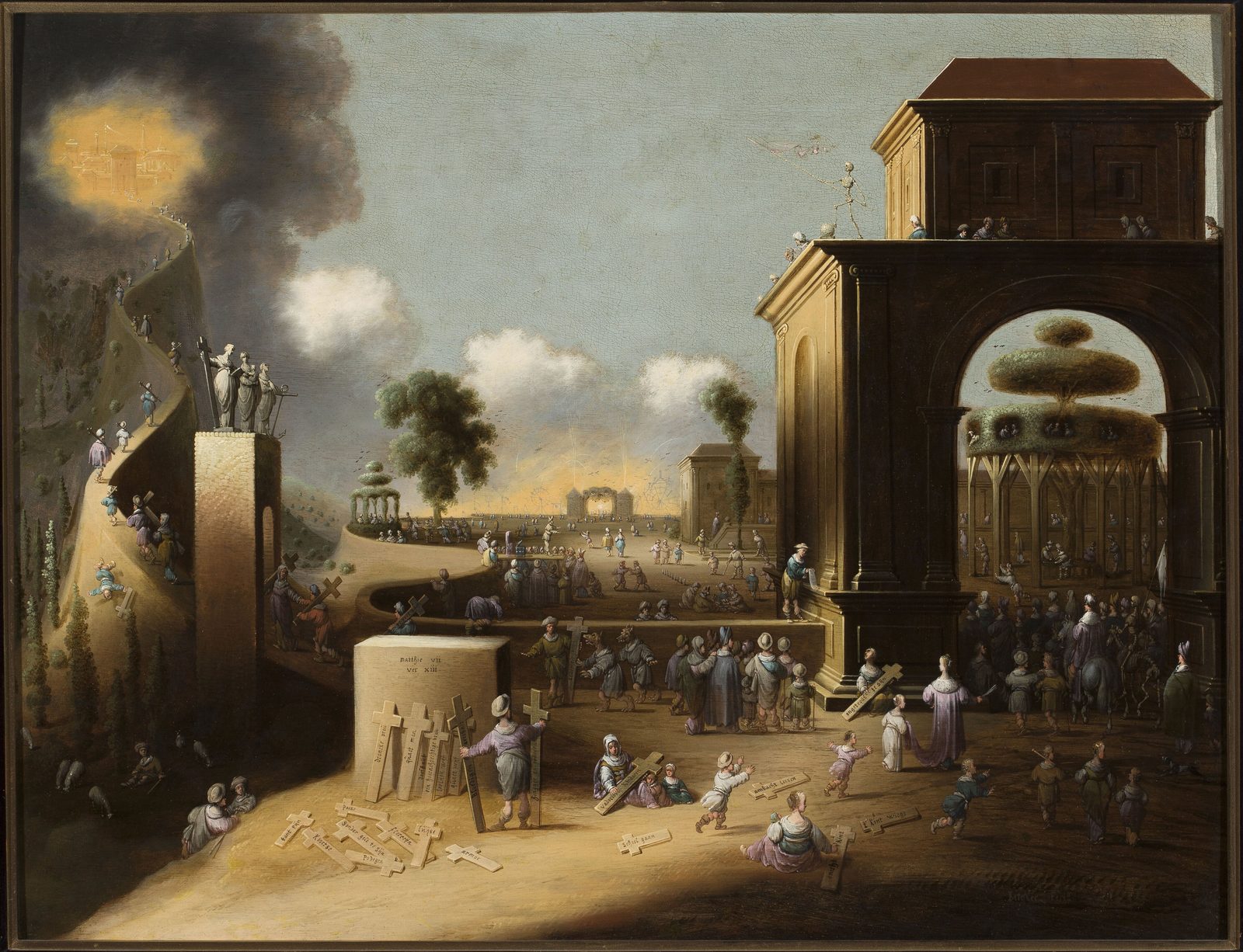
Narrow Road of Virtue and Wide Road of Sin. Jan Micker, not stated on the file page. National Museum in Warsaw. Public domain.