
Psalm 20
9 verses · Royal psalm
Some trust in chariots and others in horses, but we trust in the name of the LORD our God.
Introduction
David, the Prayer for the King, Book 1: The book of David, Poetry, Psalms Overview.
David wrote this psalm to be sung over the king on the day he went out to war. It is a royal psalm and a liturgy for more than one voice, since the people pray for the king, a single voice declares that God has heard, and the people answer together. It stands as a pair with Psalm 21, which gives thanks after the victory. Listen for the name of God, which the psalm returns to again and again as the thing Israel trusts, and for the contrast with the weapons other nations relied on. Read it as a prayer for those who lead.
Context
- Who
- Israelite soldiers and citizens praying for their king as he left for war
- What
- A liturgy sung over the king before battle, with the people's prayer and a voice of confidence.
- Where
- The sanctuary courtyard on the day an army musters, with offerings burning on the altar
- When
- The reign of David, about 1010 to 970 BC by the superscription.
- Why
- To teach Israel to trust the name of the LORD over the weapons of the nations.
Historical context
Before a campaign Israel's king offered sacrifice and sought the LORD, and Saul's ruin began when he refused to wait for Samuel and offered it himself. Verse 3 speaks to that ceremony, and the word behind look favorably means to find an offering fat, that is, to receive it as choice. The banner raised in verse 5 is the standard carried at the head of a formation, which identified a unit and gave troops something to rally to in the dust and the noise. A chariot was a light two-wheeled platform pulled by a trained pair and carrying a driver and an archer, fast and expensive and murderous on flat ground. Israel's law told her kings to keep their horses few, and for most of this era Israel fought on foot in hill country where chariots bogged down.
Significance
Israel's soldiers marched out having sung in public that the enemy's best equipment was the wrong thing to trust. The psalm grants the chariots their power and settles where the outcome comes from, since those who trust them collapse and fall, and those who call on the name of the LORD rise up and stand firm.
This chapter in Jewish lifeWhat this chapter is in Jewish life and reading.
How it is read
Rashi sets this psalm in a particular practice, and the practice is a king praying at home while his army fights. He is quoted here from the Judaica Press Tanach with Rashi. The psalm was composed "because he would send Joab and all Israel to war, and he would stand in Jerusalem and pray for them". He proves the arrangement from the men of Israel telling David that he was worth more to them from the city than in the field. His conclusion is blunt: "Were it not for David, Joab would not have succeeded in battle" (Rashi on Psalms 20:2:1). So the whole psalm is the words of those going out, spoken over the man who stays behind to pray.
The divine name in the second verse Rashi reads as a chosen name rather than a formula. It is the God of Jacob because God promised Jacob when he went to Haran and kept the promise, so the name itself recalls a kept word (Rashi on Psalms 20:2:2). The help of the third verse comes "from His Holy Temple, in which He dwells" (Rashi on Psalms 20:3:1).
The fourth verse carries the reading a Christian reader should mark. The psalm asks God to remember the offerings and accept the burnt sacrifice, and Rashi says what those offerings are. "They are the prayers that you pray in battle" (Rashi on Psalms 20:4:1). He then keeps the image rather than dropping it, and has God accept the prayers "willingly like fat burnt offering" (Rashi on Psalms 20:4:2). This is the second place in the first twenty psalms where a classical commentator reads an offering as a prayer. It shows how the language of the altar stayed in use after the altar was gone. Christian teaching makes the same move in a different direction, and reads the offerings as answered in the death of Christ. The site sets the two beside each other here and reports each in its own words.
The seventh verse turns to the moment the news arrives. Rashi reads it as the song sung after the victory, and puts the reason for David's joy in one clause: "their salvation is my salvation" (Rashi on Psalms 20:7:1). The contrast of the eighth verse he draws between the nations who trust in iron chariots or in horses and the people who pray, "because the salvation is His" (Rashi on Psalms 20:8:1). The rising of the ninth verse he takes as gaining strength (Rashi on Psalms 20:9:1). Ibn Ezra, Radak, Malbim and Metzudat David all comment on this chapter, and the corpus carries their refs without English text. Ibn Ezra stands here cited and unquoted at Ibn Ezra on Psalms 20:2:1 to 20:10:1, and Radak at Radak on Psalms 20:1:1, 20:3:1, 20:5:1 and 20:10:1. Two more stand at Malbim on Psalms 20:1:1 and Metzudat David on Psalms 20:1:1.
What the rabbis say
The corpus carries forty locators on this psalm and the text of none, so each is cited and linked here rather than quoted. Four are Talmudic. They stand at Berakhot 64a:6 on the second verse, with Jerusalem Talmud Berakhot 1:1:30 and 4:3:2 on the same verse, and Jerusalem Talmud Berakhot 4:4:3 later in the chapter.
The sixth verse, where the people assemble in the name of God, carries the heaviest midrashic weight. On it the corpus holds Bamidbar Rabbah 2:2, 2:3 and 9:2, with four entries of Midrash Tanchuma on Bamidbar, at 10:1 and 14:1 and at 10:1 and 15:1 in the Buber recension. The third verse carries the next largest share. On it stand Midrash Tehillim 20:3 and 14:7, Aggadat Bereshit 54:1, and four entries of Midrash Tanchuma on Kedoshim 9:1 and Lech Lecha 15:3, with Kedoshim 9:1 and Lech Lecha 19:2 in Buber.
The eighth verse, where the nations trust in chariots, draws the Exodus midrashim. On it the corpus carries Mekhilta DeRabbi Shimon Ben Yochai 14:10, and Mekhilta DeRabbi Yishmael, Shirah 4:13 and Vayehi Beshalach 3:14. Beside them stand Bereshit Rabbah 75:11, Midrash Lekach Tov on Exodus 14:10:5 and 15:3:7, and Midrash Sekhel Tov on Exodus 14:10:5. On the second verse the corpus carries Bereshit Rabbah 44:12 and 75:13, Devarim Rabbah 2:11 and Ein Yaakov, Berakhot 9:21 in the Glick Edition. Three more stand at Midrash Tehillim 20:4 and 20:5 on the fourth and fifth verses, with Tanna DeBei Eliyahu Rabbah 5:1. Two entries of Ruth Rabbah stand on the seventh verse, at 5:6 and at 5:6:2 in the Lerner edition. On the ninth and tenth the corpus carries Bereshit Rabbah 75:1, Midrash Tehillim 17:9, Yalkut Shimoni on Torah 130:17, Shir HaShirim Rabbah 4:8:3, Sifrei Devarim 317:4 and an entry of Tanna DeBei Eliyahu Zuta. What each of them teaches is a saying of the rabbis, and is reported as theirs wherever this site quotes one. The quotations wait on a fetch that carries the text.
Sources: Rashi, Rashi on Psalms 20:2:1 to 20:9:1, the Judaica Press complete Tanach with Rashi, translated by A. J. Rosenberg; Ibn Ezra, Ibn Ezra on Psalms 20:2:1 to 20:10:1, cited by ref because the corpus carries no English text; Radak, Radak on Psalms 20:1:1, 20:3:1, 20:5:1 and 20:10:1, cited by ref because the corpus carries no English text; Malbim, Malbim on Psalms 20:1:1, cited by ref because the corpus carries no English text; Metzudat David, Metzudat David on Psalms 20:1:1, cited by ref because the corpus carries no English text; The Sefaria corpus, scripts/data/sources/sefaria/psalms/20.json, the 4 Talmud and 36 Midrash locators of this chapter.
Psalms 20:1-2
May the LORD answer you: The psalm is prayed for someone else, the king of verse 9. The LORD is asked to answer him in the day of trouble, and the name of the God of Jacob to protect him. The help comes from the sanctuary and from Zion.
Psalms 20:1
"The Lord hear thee in the day of trouble." All loyal subjects pray for their king, and most certainly citizens of Zion have good cause to pray for the Prince of Peace. In times of conflict loving subjects redouble their pleas, and surely in the sorrows of our Lord his church could not but be in earnest. All the Saviour's days were days of trouble, and he also made them days of prayer; the church joins her intercession with her Lord's, and pleads that he may be heard in his cries and tears.
Charles Spurgeon · The Treasury of David, Vol. 1 (1869)Particular Baptist
2 more voices on this verseWhat preachers and commentators have said about this verse, in their own words.
Psalms 20:1
“In short, the faithful, that the body may not be separated from the head, further the king's prayers by their common and united supplications. The name of God is here put for God himself and not without good reason; for the essence of God being incomprehensible to us, it behoves us to trust in him, in so far as his grace and power are made known to us.”
John Calvin · Commentaries (1554)reformed
Psalms 20:1
“This entire psalm voices a prayer as spoken by holy people to the person of Christ. For since for our sakes and on our behalf he received insult when he became man, we are taught to join our prayers with his as he prays and supplicates the Father on our behalf, as one who repels both visible and invisible attacks against us.”
Eusebius of Caesarea · written before 339 · Proof of the Gospel 4:16.5patristic
send you help from the sanctuary: Barnes took the sanctuary as the tabernacle where God was worshipped, where the king had brought the offerings of verse 3. Calvin wrote that God comes down to meet men on Zion, the flesh being too weak to rise to heaven.
Psalms 20:2
"Send thee help from the sanctuary." Out of heaven's sanctuary came the angel to strengthen our Lord, and from the precious remembrance of God's doings in his sanctuary our Lord refreshed himself when on the tree. There is no help like that which is of God's sending, and no deliverance like that which comes out of his sanctuary.
Charles Spurgeon · The Treasury of David, Vol. 1 (1869)Particular Baptist
1 more voice on this verse
Psalms 20:2
“That is to say, may he succor thee out of mount Sion, where he commanded the ark of the covenant to be placed, and chose for himself a dwelling-place. The weakness of the flesh will not suffer men to soar up to heaven, and, therefore, God comes down to meet them, and by the external means of grace shows that he is near them.”
John Calvin · Commentaries (1554)reformed
Psalms 20:3-4
May He remember all your gifts: The prayer rests on what has already been brought. God is asked to remember the gifts and to look favorably on the burnt offerings. Then He is asked to give the desires of the heart and make the plans succeed.
Psalms 20:3
"Remember all thy offerings, and accept thy burnt sacrifice. Selah." Before war kings offered sacrifice, upon the acceptance of which the depended for success; our blessed Lord presented himself as a victim, and was a sweet savour unto the Most High, and then he met and routed the embattled legions of hell. Still does his burnt sacrifice perfume the courts of heaven, and through him the offerings of his people are received as his sacrifices and oblations.
Charles Spurgeon · The Treasury of David, Vol. 1 (1869)Particular Baptist
1 more voice on this verse
Psalms 20:3
“Remember all thy offerings,.... The spiritual sacrifices of prayer and praise which Christ, as the great High Priest, offers up for his people; or which they offer by him, and are acceptable to God through him, by virtue of the incense of his mediation; or the offering up of himself, which answers to, and is the body, the sum and substance, of all the offerings of the law; they were types of this, and what they could not do this did; and therefore it is expressed in the singular number in the next clause; and accept thy burnt sacrifice.”
the desires of your heart: Henry held that the people could pray this for their king in faith. They knew David for a man after God's own heart, whose plans would please Him. Spurgeon added that a heart's plans succeed when its will is the will of God.
Psalms 20:4
"Grant thee according to thine own heart, and fulfil all thy counsel." Christ's desire and counsel were both set upon the salvation of his people; the church of old desired for him good speed in his design, and the church in these latter days, with all her heart desires the complete fulfilment of his purpose. In Christ Jesus sanctified souls may appropriate this verse as a promise; they shall have their desire, and their plans to glorify their Master shall succeed. We may have our own will, when our will is God's will.
Charles Spurgeon · The Treasury of David, Vol. 1 (1869)Particular Baptist
2 more voices on this verse
Psalms 20:4
“This they might in faith pray for, because they knew David was a man after God's own heart, and would design nothing but what was pleasing to him. Those who make it their business to glorify God may expect that God will, in one way or other, gratify them: and those who walk in his counsel may promise themselves that he will fulfil theirs.”
Matthew Henry · Commentary on the Whole Bible (1707-1721)puritan
Psalms 20:4
“Grant thee according to thine own heart,.... Which is to see his seed, the travail of his soul, and to have the pleasure of the Lord prosper in his hand; to have all his people called, preserved, and glorified; and fulfil all thy counsel; whatever was agreed upon in the council and covenant of peace between him and his Father, relating to his own glory, and the salvation of his people.”
Psalms 20:5-6
May we shout for joy: The prayer turns into a shout, and a banner goes up in the name of our God. At verse 6 the voice turns singular, one man saying he knows the LORD saves His anointed. The saving power is His right hand, reaching from His holy heaven.
Psalms 20:5
"We will rejoice in thy salvation." In Jesus there is salvation; it is his own, and hence it is called thy salvation; but it is ours to receive and ours to rejoice in. We should fixedly resolve that come what may, we will rejoice in the saving arm of the Lord Jesus. The people in this psalm, before their king went to battle, felt sure of victory, and therefore began to rejoice beforehand; how much more ought we to do this who have seen the victory completely won!
Charles Spurgeon · The Treasury of David, Vol. 1 (1869)Particular Baptist
1 more voice on this verse
Psalms 20:5
“But we may look further; these prayers for David are prophecies concerning Christ the Son of David, and in him they were abundantly answered; he undertook the work of our redemption, and made war upon the powers of darkness.”
Matthew Henry · Commentary on the Whole Bible (1707-1721)puritan
the LORD saves His anointed: Gill read His anointed as the Messiah, and Jamieson, Fausset and Brown as the king David and the head of the Church. Wesley heard the people speak as one, sure of the victory by the power of God. Spurgeon saw earnest prayer turn to knowing that the LORD saves.
Psalms 20:6
“He speaks as if suddenly assured of a hearing. his anointed--not only David personally, but as the specially appointed head of His Church. his holy heaven--or, literally, "the heavens of His holiness," where He resides (Ps 2:6; 11:4). saving . . . hand--His power which brings salvation.”
Jamieson, Fausset & Brown · Commentary Critical and Explanatory on the Whole Bible (1871)reformed
3 more voices on this verse
Psalms 20:6
“Now know I that the Lord saveth his Anointed,.... Not David, though he was the anointed of the God of Jacob, and was anointed with material oil to be king of Israel by Samuel, at the express order of God himself; but David is not here speaking of himself, nor the church of him, but of the Messiah; anointed by Jehovah king over his holy hill of Zion, with the oil of gladness, or the Holy Spirit.”
Psalms 20:6
"Now know I that the Lord saveth his anointed." We live and learn, and what we learn we are not ashamed to acknowledge. He who thinks he knows everything will miss the joy of finding out new truth; he will never be able to cry, "now know I, " for he is so wise in his own conceit that he knows all that can be revealed and more. Souls conscious of ignorance shall be taught of the Lord, and rejoice as they learn. Earnest prayer frequently leads to assured confidence.
Charles Spurgeon · The Treasury of David, Vol. 1 (1869)Particular Baptist
Psalms 20:6
“Now that so many who have an interest in heaven are praying for him he doubts not but that God will hear him, and grant him an answer of peace, which will, 1. Take its rise from above: He will hear him from his holy heaven, of which the sanctuary was a type ( Heb. ix. 23 ), from the throne he hath prepared in heaven, of which the mercy-seat was a type.”
Matthew Henry · Commentary on the Whole Bible (1707-1721)puritan
Psalms 20:7-8
Some trust in chariots: Chariots and horses were the two arms of an army. The confession here puts trust in the name of the LORD instead, and the two outcomes follow at once. They collapse and fall, and the ones who trusted the name rise up and stand firm.
Psalms 20:7
“Contrasts frequently bring out the truth vividly, and here the church sets forth the creature confidences of carnal men in contrast with her reliance upon the Prince Immanuel and the invisible Jehovah. "Some trust in chariots, and some in horses." Chariots and horses make an imposing show, and with their rattling, and dust, and fine caparisons, make so great a figure that vain man is much taken with them; yet the discerning eye of faith sees more in an invisible God than in all these.”
Charles Spurgeon · The Treasury of David, Vol. 1 (1869)Particular Baptist
1 more voice on this verse
Psalms 20:7
“They trusted in horses and chariots, he is saying, and enjoyed no benefit from them but were caught up in unseen entanglements and collapsed. We, by contrast, invoked divine assistance, and won salvation in visible manner and emerged superior to the adversaries.”
Theodoret of Cyrus · written before 458 · Commentary on the Psalms 20:4patristic
They collapse and fall: Henry wrote that the chariots and horses of verse 7 helped their owners fall, making them easier prey, and cited 2 Samuel 8. Spurgeon observed that those who trust the LORD often fall at the first onset, then rise by an almighty arm and stand firm.
Psalms 20:8
“They say these things will happen in the time of the advent of that Savior. Then all the powers of the adversaries and those hidden and secret enemies of God who have turned their backs on the Savior will be laid low. All who receive that Savior will rise from the first fall. Therefore, Simeon says, "Behold, this child is destined to cause the rising and falling of many," namely, the ruin of his enemies and adversaries and the resurrection of those who, having fallen once, have been rescued by him.”
Eusebius of Caesarea · written before 339 · Commentary on Psalms 20:8-10patristic
1 more voice on this verse
Psalms 20:8
“How different the end of those whose trusts are different! The enemies of God are uppermost at first, but they ere long are brought down by force, or else fall of their own accord. Their foundation is rotten, and therefore when the time comes it gives way under them; their chariots are burned in the fire, and their horses die of pestilence, and where is their boasted strength? As for those who rest on Jehovah, they are often cast down at the first onset, but an Almighty arm uplifts them, and they joyfully stand upright.”
Charles Spurgeon · The Treasury of David, Vol. 1 (1869)Particular Baptist
O LORD, save the king: The psalm ends where it began, in a request. The LORD is asked to save the king and to answer on the day of the call. The answer asked for the king in verse 1 is asked here for those praying.
Psalms 20:9
The Psalm is here recapitulated. That Jesus might himself be delivered, and might then, as our King, hear us, is the two-fold desire of the Psalm. The first request is granted, and the second is sure to all the seed; and therefore we may close the Psalm with the hearty shout, "God save the King." "God save King Jesus, and may he soon come to reign."
Charles Spurgeon · The Treasury of David, Vol. 1 (1869)Particular Baptist
1 more voice on this verse
Psalms 20:9
“Or it may refer to the Messiah, that King, that King of kings; let him hear us when we call; let him come to us according to the promise, in the time appointed; let him, as the great Master of requests, receive all our petitions and present them to the Father.”
Matthew Henry · Commentary on the Whole Bible (1707-1721)puritan
How this psalm is built
The form: A prayer spoken by holy people to the person of Christ, so that they join their prayers to His, as Caesarea classes it.
The patterns in this chapter
| Device | What it does | Where to see it |
|---|---|---|
| The petitions asked one after another | Verses 1 to 5 ask for nine things in a row and each one is a separate wish: an answer, protection, help, support, remembrance of the gifts, favour toward the offerings, the desires of the heart, success in the plans, and then every petition granted. Adam Clarke reads verse 4 as the high priest's own line, asking God to give the king whatever he has set his heart on. Matthew Henry adds the ground the people had for asking it, that David was a man after God's own heart and would plan nothing that displeased Him.Adam Clarke, Commentary on the Bible, 1832, on Psalm 20:4. | Psalm 20:1, Psalm 20:2, Psalm 20:3, Psalm 20:4, Psalm 20:5 |
| The voices that change as the psalm goes on | The psalm speaks to the king in verses 1 to 5, drops into a single voice at verse 6, becomes we in verses 7 and 8, and turns to God in verse 9. Adam Clarke assigns the parts as a ceremony would: the people implore God for the king, the high priest adds the line about his petitions, David and his officers speak the confession about chariots and horses, and the last verse belongs to the congregation. Wesley notes that the people speak as one person at verse 6, being of one mind. Jamieson, Fausset and Brown hear that verse as a man certain he has been heard.Adam Clarke, Commentary on the Bible, 1832, on Psalm 20:9. | Psalm 20:1, Psalm 20:5, Psalm 20:6, Psalm 20:9 |
| Some and some, then we | Verse 7 sets two clauses against one, some in chariots and others in horses, and then the people naming what they trust. Adam Clarke says the Hebrew is short and blunt, these in chariots and these in horses, with the third clause answering both. Spurgeon reads the contrast as the point of the verse and grants that chariots and horses make an imposing show. Verse 8 keeps the same shape and turns it into an outcome, since one side collapses and falls and the other rises and stands firm.Charles Spurgeon, The Treasury of David, Vol. 1, 1869, on Psalm 20:7. | Psalm 20:7, Psalm 20:8 |
| The answer asked at both ends | Verse 1 asks that the LORD answer the king in the day of trouble, and verse 9 asks that He answer the people on the day they call. Spurgeon marks the last verse as the psalm recapitulated and states the two desires it holds, that the king be delivered and that he then hear those who prayed for him. Clarke records that some of the old versions read the second clause as a promise rather than a request, so that God saves the king and the king then hears the people. The psalm therefore ends where it began, on one word asked twice for two different parties.Charles Spurgeon, The Treasury of David, Vol. 1, 1869, on Psalm 20:9. | Psalm 20:1, Psalm 20:9 |
The structure
9 more paragraphs on the patterns
The psalm runs nine verses and carries one Selah, after verse 3, where the offerings have just been named. Clarke takes the word in the general sense of so be it. The shape is a ceremony rather than an argument: petitions in verses 1 to 5, a single confident statement at verse 6, a confession in verses 7 and 8, and a chorus at verse 9. The answer asked for the king in verse 1 is asked for the people in verse 9, which closes the psalm on the word it opened with.
In the New Testament
This study's sources record readings of the psalm rather than a quotation of it by any apostle. Augustine supplies most of them. He reads the falling of verse 8 against the fear of losing a place, quoting the words at John 11:48, and reads the rising against the Gentiles who attained a righteousness they had not pursued at Romans 9:30.
Eusebius reads verses 8 to 10 of the Savior's coming, and sets beside them the words of Simeon that the child is destined for the falling and rising of many. Matthew Henry reads the prayers for David as prophecies concerning Christ that were answered when He undertook the work of redemption.
Where it sits in the Psalter
The psalm has a partner on the other side of the battle. Psalm 21 gives thanks for what Psalm 20 asked, since the king who was to be granted the desires of his heart is there said to have been given his heart's desire and the request of his lips. Read as a pair they show how Israel handled a campaign, with a liturgy before it and a liturgy after it, and the same throne addressed both times. The pair belongs with the psalms sung of the king, which are gathered on a feature page that has yet to be built, so the presentation stands here.
The pattern inside the psalm
One word holds the psalm together. The name of the God of Jacob protects in verse 1, a banner is raised in the name of our God in verse 5, and the people trust in the name of the LORD our God in verse 7. Calvin explains why the word carries so much weight here, since the essence of God is beyond us and we trust Him so far as His grace and power have been made known. The name is the part of God a soldier could take with him.
The psalm also divides people by what they are resting on rather than by what they are facing. Augustine reads the chariots and horses of verse 7 as the succession of temporal goods and the proud honours that men are carried along by, and reads the answer as a hope fixed on what lasts. Spurgeon reads the falling of verse 8 as a foundation giving way under its own rot rather than a defeat imposed from outside.
Keep studying
Sources for this chapter
The summary
Jamieson, Fausset & Brown, Commentary Critical and Explanatory; John Calvin, Commentaries; John Wesley, Notes on the Old Testament and Matthew Henry, Complete Commentary.
The form and classifications
Adam Clarke, Commentary on the Bible, 1832, on Psalm 20:9; Eusebius of Caesarea, Proof of the Gospel 4:16.5, 339, on Psalm 20:1; John Calvin, Commentaries, 1554, on Psalm 20:1 and Matthew Henry, Commentary on the Whole Bible, 1710, on Psalm 20:5.
The exposition
Adam Clarke, Commentary on the Bible; Albert Barnes; Augustine of Hippo, Exposition on Psalm 20; Charles Spurgeon, The Treasury of David; Franz Delitzsch, Biblical Commentary on the Psalms; Jamieson, Fausset & Brown, Commentary Critical and Explanatory on the Whole Bible; John Calvin, Commentaries; John Gill, Exposition of the Old Testament; John Wesley, Explanatory Notes upon the Old Testament and Matthew Henry, Commentary on the Whole Bible.
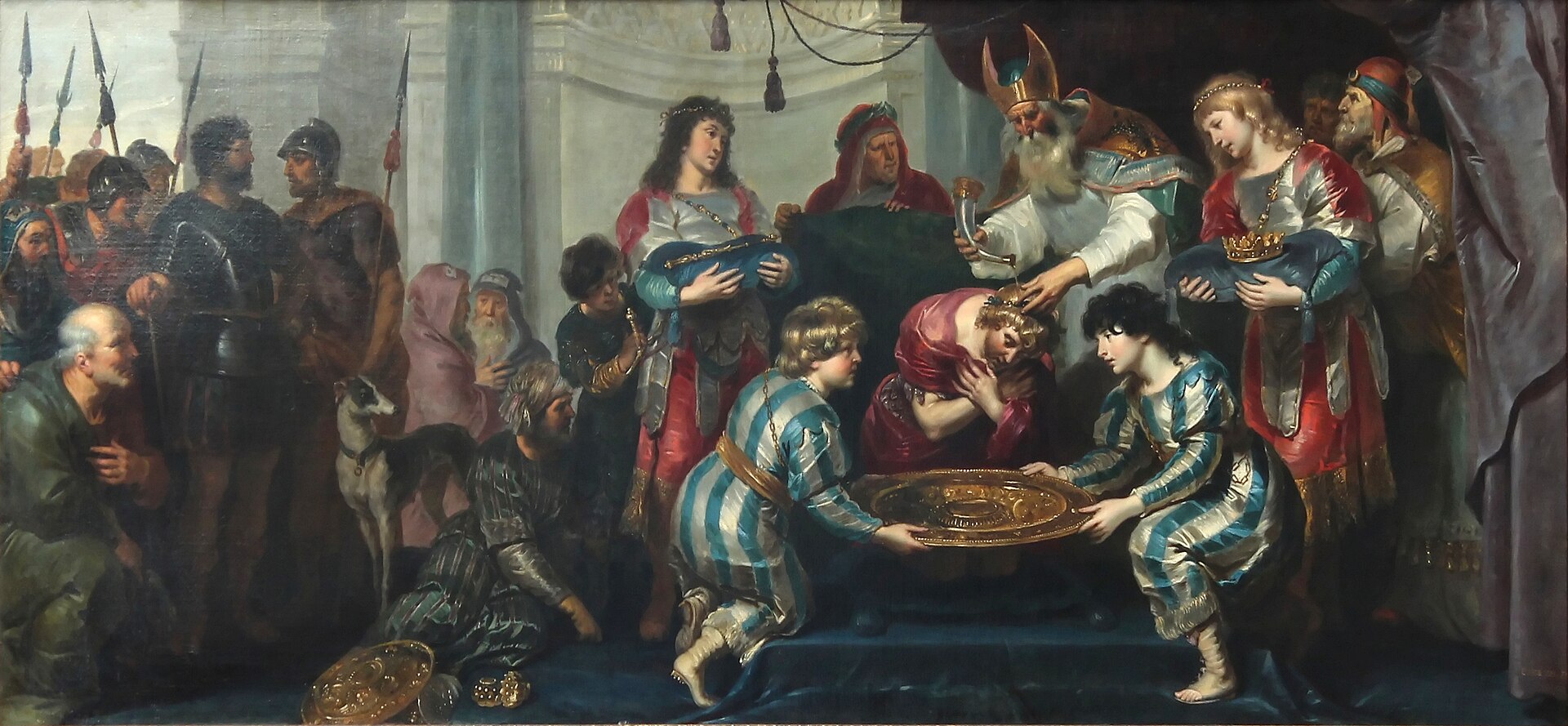
The painting
The anointing of Solomon. Cornelis de Vos, 17th century. Wikimedia Commons. Public domain.