
Psalm 131
3 verses · Song of Ascents
My heart is not proud, O LORD, my eyes are not haughty. I do not aspire to great things or matters too lofty for me.
Introduction
David, the Weaned Child, Book 5: The return and the great Hallelujah, Poetry, Psalms Overview.
David wrote this short song, and it was sung by pilgrims on the road up to Jerusalem for the feasts. It is the confession of a king who had every reason to reach for more and chose to stop reaching. The psalm before it waited through the night for mercy, and this one speaks from the calm after the waiting. Listen for the one picture it draws from family life, a child who has outgrown the breast and now rests in its mother's arms. Then listen for the last line, where one man's quiet becomes a word to the whole nation.
Context
- Who
- Israelites tempted to grasp at things above their station, or to fret at things they could not understand
- Where
- A mother holding a child who is past nursing and simply resting against her
- When
- The Songs of Ascents, three verses of quiet. Headed a song of ascents of David, which places it c. 1010 to 970 BC. Nothing in the three verses ties it to any episode of his life
Historical context
The heading assigns this psalm to David, who was king when he said he had given up reaching for great things. The things he says he has laid down are the ambitions of a public man, eyes raised too high and involvement in matters too great for him. The whole psalm turns on one household picture. Children in that world were nursed for two or three years, and weaning was a milestone worth a family feast; Genesis 21:8 records that Abraham held a great feast on the day Isaac was weaned. A nursing infant in his mother's arms is there for one thing and cries until he gets it. A weaned child in the same arms wants the arms, and the singer says his soul is the second kind.
Significance
Coming after a psalm about waiting through the night for forgiveness, this is what the waiting is meant to feel like once it has settled. For pilgrims who spent the walk worrying about the harvest, the neighbours and the empire, the instruction was to stop clawing and stay in the arms.
This chapter in Jewish lifeWhat this chapter is in Jewish life and reading.
What is done
Psalm 131 is the twelfth of the fifteen Songs of Ascents and the third of them to carry David's name. It is sung within the collection, whose setting this site records at /featured/psalms-of-ascent from Mishnah Middot 2:5 and Mishnah Sukkah 5:4. Three verses long, it is the shortest psalm of the collection, and it is the psalm in which David disclaims greatness.
How it is read
Rashi reads the disclaimer as David measuring himself against his own son. David did not behave with superiority and "did not make great things pleasures, buildings, and plantings as my son made", and stands before God like an incomplete form with neither hands nor feet (Rashi on Psalms 131:1:1, the Judaica Press complete Tanach with Rashi, translated by A. J. Rosenberg, CC-BY). On the second verse he reads the weaned child as a suckling placed on his mother, and glosses the Hebrew word for the child as one who sucks at the breast. He then applies the figure to the soul, and says that the soul within David was before God as an infant at its mother's breasts. Ibn Ezra, Malbim, Metzudat David and Radak each comment on all three verses, and the corpus holds no English version of any of them under a licence permitting quotation, so they stand as citations: Ibn Ezra on Psalms 131:1:1, Malbim on Psalms 131:1:1, Metzudat David on Psalms 131:1:1, Radak on Psalms 131:1:1.
What the rabbis say
This is one of the thinnest chapters in the corpus for rabbinic material, with seven locators in all, six Midrash and one Talmud, each of them a locator without text. Six of the seven fall on the first verse, where David says his heart is not haughty: Bamidbar Rabbah 4:20, Midrash Tehillim 16:11, Midrash Tehillim 17:1, Aggadat Bereshit 69:1, Midrash Tannaim on Deuteronomy 18:13:4 and Jerusalem Talmud Sanhedrin 2:4:5. The seventh falls on the weaned child of the second verse, at Midrash Sekhel Tov, Bereshit 21:8:1, which is the passage about the day Isaac was weaned. The corpus holds nothing more on this chapter, so this site names the locators and leaves the rest to the reader who follows them.
Sources: Rashi, Rashi on Psalms 131:1:1, 131:2:1 and 131:2:2, the Judaica Press complete Tanach with Rashi, translated by A. J. Rosenberg, CC-BY; Ibn Ezra, Ibn Ezra on Psalms 131:1:1, cited only, no English version in the corpus; Malbim, Malbim on Psalms 131:1:1, cited only; Metzudat David, Metzudat David on Psalms 131:1:1, cited only; Radak, Radak on Psalms 131:1:1, cited only; Midrash, Bamidbar Rabbah 4:20, Midrash Tehillim 16:11 and 17:1, Aggadat Bereshit 69:1, Midrash Tannaim on Deuteronomy 18:13:4, Midrash Sekhel Tov, Bereshit 21:8:1; Jerusalem Talmud, Sanhedrin 2:4:5; Mishnah, Middot 2:5 and Sukkah 5:4, as /featured/psalms-of-ascent records them; MannaFest, the Songs of Ascents, at /featured/psalms-of-ascent, 2026.
Psalms 131:1-2
My heart is not proud: The heart is not proud and the eyes are not haughty, and both Hebrew verbs are verbs of height. Verse 2 sets a picture against that height, a weaned child quiet with his mother, past crying for the breast. Matthew Henry read it as grace weaning a sanctified soul.
Psalms 131:1
“I know your humility. I know that you can say with sincerity, "Lord, my heart is not haughty or my eyes lofty"; I know that in your heart as in that of your mother the pride through which the devil fell has no place. It would be time wasted to write to you about it; for there is no greater folly than to teach a pupil what he knows already. But now that you have despised the boastfulness of the world, do not let the fact inspire you with new boastfulness.”
Jerome · written before 420 · LETTER 22.27patristic
1 more voice on this verseWhat preachers and commentators have said about this verse, in their own words.
Psalms 131:1
“Lord, my heart is not haughty. The Psalm deals with the Lord, and is a solitary colloquy with him, not a discourse before men. We have a sufficient audience when we speak with the Lord, and we may say to him many things which were not proper for the ears of men. The holy man makes his appeal to Jehovah, who alone knows the heart: a man should be slow to do this upon any matter, for the Lord is not to be trifled with; and when anyone ventures on such an appeal he should be sure of his case.”
Charles Spurgeon · The Treasury of David, Vol. 7 (1885)Particular Baptist
stilled and quieted my soul: The Hebrew verb behind stilled is shavah, to level or smooth, and quieted is damam, to be silent. Damam is the verb of Psalm 37:7. A child was weaned late in Israel, and Hannah kept Samuel with his mother until the child was weaned, at 1 Samuel 1:22.
Psalms 131:2
“Then he goes on: Like a weaned child upon his mother's breast, so will you reward my soul. We are told that when Isaac was weaned Abraham made a feast because now that he was weaned he was on the verge of boyhood and was passing beyond milk food. The Apostle feeds all that are imperfect in the faith and still babes in the things of God with the milk of knowledge. Thus to cease to need milk marks the greatest possible advance.”
Hilary of Poitiers · written before 367 · Homilies on the Psalms, Psalm 131patristic
4 more voices on this verse
Psalms 131:2
“Surely I have behaved and quieted myself,.... Or "my soul" (o); behaved quietly and peaceably towards all men, even his inferiors in Saul's court and elsewhere, and had given no tokens of a restless, turbulent, and ambitious spirit; as well as behaved patiently under all his troubles and afflictions, reproaches and calumnies: or "if I have not" (p), being in the form of an oath or imprecation, as Kimchi and Aben Ezra observe; if I have not thus behaved, let it come to me so and so, or let me be as a weaned child.”
Psalms 131:2
“I have behaved and quieted myself, as a child - On the contrary, I have been under the rod of others, and when chastised have not complained; and my silence under my affliction was the fullest proof that I neither murmured nor repined, but received all as coming from the hands of a just God. My soul is even as a weaned child - I felt I must forego many conveniences and comforts which I once enjoyed; and these I gave up without repining or demurring.”
Adam Clarke · Commentary on the Bible (1810-1826)evangelical
Psalms 131:2
“I was once conversing with a very excellent aged minister and while we were talking about our attitude and feelings, he made the following confession—he said, "When I read that passage in the Psalm, 'My soul is even as a weaned child,' I wish it were true of me, but I think I should have to make an alteration of one syllable and then it would exactly describe me at times—'My soul is even as a weaning rather than a weaned child,' for," said he, "with the infirmities of old age, I fear I get fretful and peevish and anxious.”
Psalms 131:2
“This intimates that our hearts are naturally as desirous of worldly things as the babe is of the breast, and in like manner relish them, cry for them, are fond of them, play with them, and cannot live without them. But, by the grace of God, a soul that is sanctified, is weaned from those things.”
Matthew Henry · Commentary on the Whole Bible (1707-1721)puritan
put your hope in the LORD: The last verse turns outward from one soul to all Israel. What Israel is told to do is put its hope in the LORD, and the Hebrew verb behind hope is glossed to wait. Its span is both now and forevermore.
Psalms 131:3
“But he does not demand this living bread from heaven for himself alone, he encourages all mankind to hope for it by saying: Let Israel hope in the Lord from henceforth and for evermore. He sets no temporal limit to our hope, he bids our faithful expectation stretch out into infinity. We are to hope for ever and ever, winning the hope of future life through the hope of our present life which we have in Christ Jesus our Lord, Who is blessed for ever and ever. Amen.”
Hilary of Poitiers · written before 367 · Homily on Psalm 131patristic
2 more voices on this verse
Psalms 131:3
“Let Israel hope in the Lord from henceforth and for ever. See how lovingly a man who is weaned from self thinks of others! David thinks of his people, and loses himself in his care for Israel. How he prizes the grace of hope! He has given up the things which are seen, and therefore he values the treasures which are not seen except by the eyes of hope. There is room for the largest hope when self is gone, ground for eternal hope when transient things no longer hold the mastery of our spirits.”
Charles Spurgeon · The Treasury of David, Vol. 7 (1885)Particular Baptist
Psalms 131:3
“Though David could himself wait patiently and quietly for the crown designed him, yet perhaps Israel, the people whose darling he was, would be ready to attempt something in favour of him before the time; and therefore endeavours to quiet them too, and bids them hope in the Lord that they should see a happy change of the face of affairs in due time.”
Matthew Henry · Commentary on the Whole Bible (1707-1721)puritan
How this psalm is built
The form: A song of the ascents of David on a soul stilled and quieted, given in one household picture, as Spurgeon classes it.
The patterns in this chapter
| Device | What it does | Where to see it |
|---|---|---|
| Two verbs of height laid down | Verse 1 says the heart is not proud and the eyes are not haughty, and both Hebrew verbs are verbs of height, one glossed to soar and one to rise. The psalm names the two ways a person climbs, inwardly and by what he looks at, and puts both down.Franz Delitzsch, Biblical Commentary on the Psalms, on Psalm 131:1. | Psalm 131:1 |
| The weaned child, said twice | Verse 2 gives the picture and then gives it again inside the same verse, like a weaned child with his mother, like a weaned child is my soul within me. A nursing child at its mother is there for what it can get, and a weaned child at the same mother is there for her.Matthew Henry, Commentary on the Whole Bible, 1710, on Psalm 131:2. | Psalm 131:2 |
| The turn outward in one line | Verses 1 and 2 are the most private lines in the collection, a man describing his own soul. Verse 3 turns without warning and addresses Israel, and the span it gives is both now and forevermore. One soul's stillness is handed to a nation as a command.John Gill, Exposition of the Old Testament (1748 to 1763), on Psalm 131:3. | Psalm 131:3 |
The structure
8 more paragraphs on the patterns
Three verses, and the psalm turns twice. Verse 1 is a denial of height, verse 2 is the picture that replaces it, and verse 3 turns outward to Israel.
Both Hebrew verbs in verse 1 are verbs of height, one glossed to soar and one to rise. The psalm names the two ways a person climbs, inwardly and by what he looks at, and puts both down. Verse 2 gives its picture and then gives it again inside the same verse, like a weaned child with his mother, like a weaned child is my soul within me.
Across the canon
The last verse repeats Psalm 130:7 almost word for word and adds the span both now and forevermore. The two psalms stand next to each other and end on the same charge, one after a cry out of the depths and one after a soul made quiet.
The phrase both now and forevermore also closes Psalm 121:8 and stands in Psalm 125:2. It is the collection's way of putting a span on a promise.
The lifted eyes of verse 1 answer the lifted eyes of Psalms 121:1 and 123:1. There they are raised to the hills and to the throne, and here they are the thing that must come down.
In the New Testament
No New Testament writer quotes this psalm.
Keep studying
Studies1
Sources for this chapter
The summary
Jamieson, Fausset & Brown, Commentary Critical and Explanatory; John Calvin, Commentaries; John Wesley, Notes on the Old Testament and Matthew Henry, Complete Commentary.
The form and classifications
Charles Spurgeon, The Metropolitan Tabernacle Pulpit, Sermon No. 1210, 1875; Jamieson, Fausset & Brown, Commentary Critical and Explanatory on the Whole Bible, 1871, on Psalm 131:3 and Matthew Henry, Commentary on the Whole Bible, 1710, on Psalm 131:2.
The exposition
Albert Barnes, Notes on the Book of Psalms; Charles Spurgeon, The Treasury of David; Jamieson, Fausset & Brown, Commentary Critical and Explanatory on the Whole Bible; John Gill, Exposition of the Old Testament; Keil and Delitzsch, Biblical Commentary on the Old Testament and Matthew Henry, Commentary on the Whole Bible.
The painting
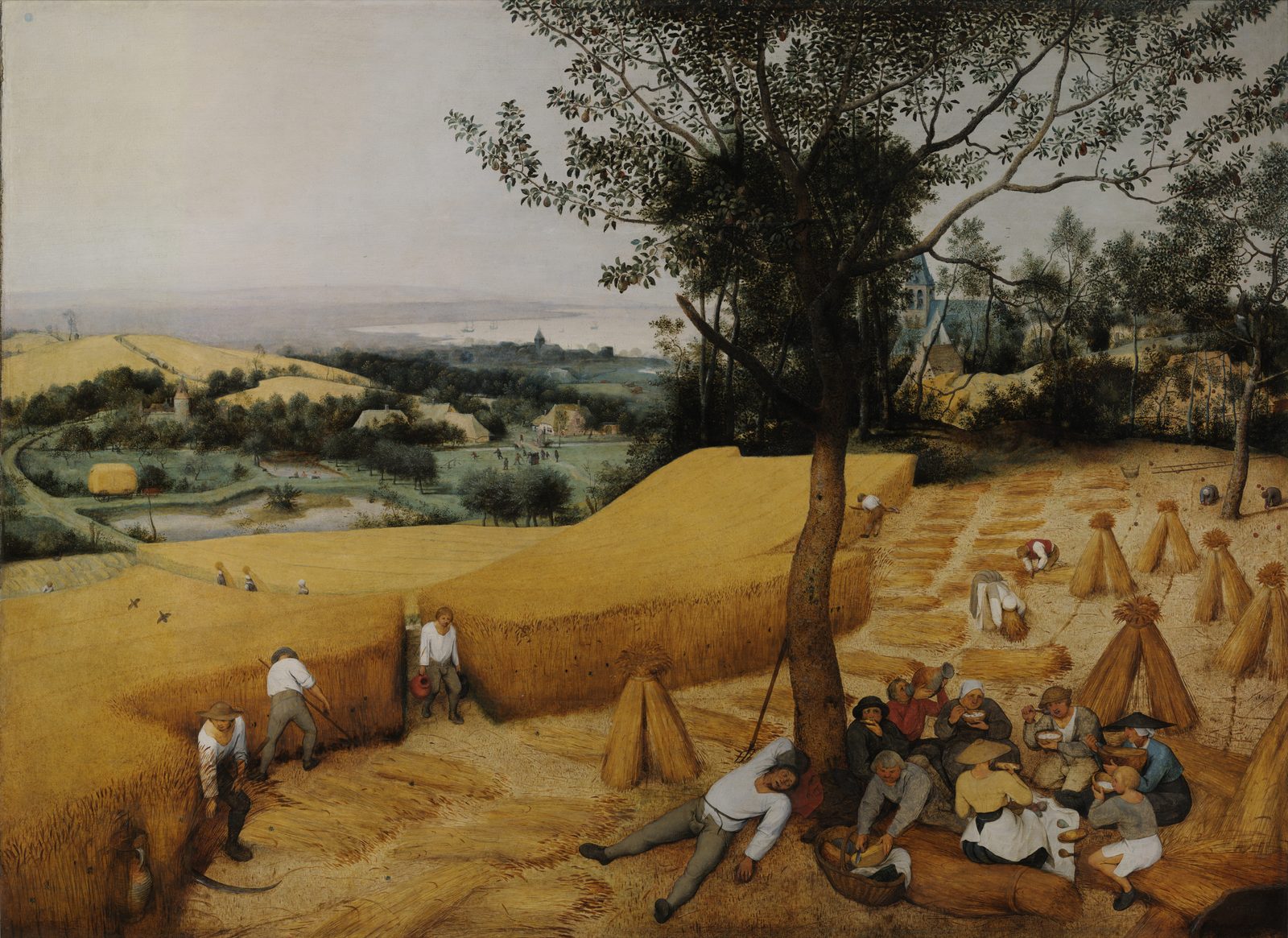
The Harvesters. Pieter Brueghel the Elder, 1565. Wikimedia Commons. Public domain.