
Psalm 123
4 verses · Song of Ascents, community lament
I lift up my eyes to You, the One enthroned in heaven.
Introduction
Author unstated, the Eyes of Servants, Book 5: The return and the great Hallelujah, Poetry, Psalms Overview.
This short psalm names no writer. It belongs to people who had been mocked for a long time by neighbours at ease, and who had nothing left to do but wait on God. The whole prayer is built on one household picture, a servant watching for a sign from the one he serves. Listen for the move from one voice to many in the second verse, and for the one thing the people ask for, said three times in two lines.
Context
- Who
- Israelites being laughed at by comfortable neighbours while they rebuilt a small province
- What
- A short prayer of a people who look to the LORD for mercy the way servants watch a master's hand.
- Where
- Judah, among neighbours who mocked a small people at work.
- When
- Undated; the scorn it describes fits the years of rebuilding after 538 BC.
- Why
- To give a community under scorn words to wait on God and ask for mercy.
Historical context
No name stands in the heading, and the psalm names no ruler, nation or year. The picture at the centre is domestic and exact. A household servant stood at the edge of the room and watched the master's or the mistress's hand. Instructions were given by gesture, a lifted finger to bring the basin, a turn of the hand to clear the table. The trouble is contempt, and two groups are named, those who are at ease and the proud. When Nehemiah's crews were rebuilding the wall, the officials of the surrounding provinces stood nearby and jeered at the workmanship. In a culture built on honour and shame, being laughed at by neighbouring provinces damaged a community's standing in every negotiation it had to make.
Significance
Sung on the way up to the feast, this let pilgrims say the thing they were carrying, that they had endured more than enough of being sneered at. What it asks for is mercy, and it asks twice. The people doing the sneering are left with God while the singers keep their eyes on the hand.
This chapter in Jewish lifeWhat this chapter is in Jewish life and reading.
What is done
Psalm 123 is the fourth of the fifteen Songs of Ascents, and in Jewish use it is said inside that collection rather than on its own. The site records the collection's setting on its page at /featured/psalms-of-ascent: the fifteen steps rising from the Court of the Women to the Court of Israel at Mishnah Middot 2:5, and the Levites singing upon them at Mishnah Sukkah 5:4. The psalm is short, and the classical commentators treat it as the prayer of a people under contempt.
How it is read
The commentators read the psalm as the voice of Israel in exile, and Rashi fixes that reading in two glosses on the last verse. He takes the ridicule as the ridicule of the complacent nations, and the contempt as contempt shown to "the valley of doves, which is Jerusalem" (Rashi on Psalms 123:4:2, the Judaica Press complete Tanach with Rashi, translated by A. J. Rosenberg, CC-BY). His two other comments here are on the wording rather than the sense. On the first verse he notes that the yod of the word for the One who dwells is superfluous, and on the last that the word for the complacent is written as one word and read as two. Ibn Ezra, Malbim, Metzudat David and Radak each comment on all four verses, and the corpus holds no English version of any of them under a licence permitting quotation, so they stand as citations: Ibn Ezra on Psalms 123:1:1, Malbim on Psalms 123:1:1, Metzudat David on Psalms 123:1:1, Radak on Psalms 123:1:1.
What the rabbis say
The corpus records twenty-one locators on this chapter, nineteen Midrash and two Talmud, each a locator without text. The lifting of the eyes to the One enthroned in heaven is where the weight of them falls, at Bamidbar Rabbah 10:1, Shemot Rabbah 25:8, Midrash Shmuel 5:15, Sifrei Devarim 346:2 and Jerusalem Talmud Pesachim 5:5:2. The figure of the servant's eyes on the hand of the master is taken up at Bereshit Rabbah 75:6, Bamidbar Rabbah 11:6, Pesikta Rabbati 30:1 and Sifrei Bamidbar 41:1. The closing verse about the contempt of the complacent is taken up at Tractate Soferim 7:3.
Sources: Rashi, Rashi on Psalms 123:1:1, 123:4:1, 123:4:2 and 123:4:3, the Judaica Press complete Tanach with Rashi, translated by A. J. Rosenberg, CC-BY; Ibn Ezra, Ibn Ezra on Psalms 123:1:1, cited only, no English version in the corpus; Malbim, Malbim on Psalms 123:1:1, cited only; Metzudat David, Metzudat David on Psalms 123:1:1, cited only; Radak, Radak on Psalms 123:1:1, cited only; Midrash, Bamidbar Rabbah 10:1 and 11:6, Shemot Rabbah 25:8, Midrash Shmuel 5:15, Bereshit Rabbah 75:6, Pesikta Rabbati 30:1, Sifrei Devarim 346:2, Sifrei Bamidbar 41:1; Jerusalem Talmud, Pesachim 5:5:2; Tractate Soferim, Soferim 7:3; Mishnah, Middot 2:5 and Sukkah 5:4, as /featured/psalms-of-ascent records them; MannaFest, the Songs of Ascents, at /featured/psalms-of-ascent, 2026.
Psalms 123:1-2
the One enthroned in heaven: The eyes that went up to the hills at Psalm 121:1 go up here to the One enthroned in heaven. Verse 2 sets the picture: servants watch the hand of a master, waiting for the sign to move. The word for eyes stands three times in that one verse.
Psalms 123:1
“Unto thee - To God. Lift I up mine eyes - In supplication and prayer. Nature prompts us to look up when we address God, as if he dwelt above us. It is the natural prompting of the heart that he must be the most exalted of all beings, dwelling above all. See Psa 121:1. O thou that dwellest in the heavens - Whose home - whose special home - is in heaven - above the sky.”
3 more voices on this verseWhat preachers and commentators have said about this verse, in their own words.
Psalms 123:1
“Unto thee lift I up mine eyes,.... Not only the eyes of his body, this being a prayer gesture; see Mat 14:19; but the eyes of his mind and understanding, opened by the Spirit of God; particularly the eye of faith, by which he looked for and expected help and salvation from the Lord.”
Psalms 123:1
“My opinion, then, rather is, that this form of prayer was composed for all the godly by some Prophet, either when the Jews were captives in Babylon, or when Antiochus Epiphanes exercised towards them the most relentless cruelty.”
John Calvin · Commentaries (1554)reformed
Psalms 123:1
“Unto thee lift I up mine eyes. It is good to have some one to look up to. The Psalmist looked so high that he could look no higher. Not to the hills, but to the God of the hills he looked. He believed in a personal God, and knew nothing of that modern pantheism which is nothing more than atheism wearing a fig leaf. The uplifted eyes naturally and instinctively represent the state of heart which fixes desire, hope, confidence, and expectation upon the Lord.”
Charles Spurgeon · The Treasury of David, Vol. 6 (1882)Particular Baptist
until He shows us mercy: The watching has an end point: until He shows mercy. Matthew Henry and Adam Clarke both allow a servant under correction, eyes on the master's hand until it stops. John Calvin reads the servants as defenseless, their safety resting on the hand of another.
Psalms 123:2
“Behold as the eyes of servants look to the hand of their masters. This similitude is very suitable to the present case. It implies that without the protection of God true believers have no comfort, are completely disarmed and exposed to all manner of wrongs, have neither strength nor courage to resist; in short, that their safety depends entirely upon aid derived from another.”
John Calvin · Commentaries (1554)reformed
2 more voices on this verse
Psalms 123:2
“Our eyes wait on the Lord, the eye of desire and prayer, the begging eye, and the eye of dependence, hope, and expectation, the longing eye. Our eyes must wait upon God as the Lord, and our God, until that he have mercy upon us. We desire mercy from him, we hope he will show us mercy, and we will continue our attendance on him till the mercy come.”
Matthew Henry · Commentary on the Whole Bible (1707-1721)puritan
Psalms 123:2
“Deference, submission, and trust, are all expressed by the figure. In the East, servants in attending on their masters are almost wholly directed by signs, which require the closest observance of the hands of the latter.”
Jamieson, Fausset & Brown · Commentary Critical and Explanatory on the Whole Bible (1871)reformed
Psalms 123:3-4
Have mercy on us: The asking is doubled inside one verse, mercy and mercy again from the LORD. What the psalm has endured much of is contempt and scorn. The word behind arrogant at verse 4 is sha'anan, secure and, in a bad sense, haughty, so the contempt comes from the proud at ease.
Psalms 123:3
“Have mercy upon us, O Lord, have mercy upon us. He hangs upon the word "mercy, "and embodies it in a vehement prayer: the very word seems to hold him, and he harps upon it. It is well for us to pray about everything, and turn everything into prayer; and especially when we are reminded of a great necessity we should catch at it as a keynote, and pitch our tune to it.”
Charles Spurgeon · The Treasury of David, Vol. 6 (1882)Particular Baptist
1 more voice on this verse
Psalms 123:3
“We find little mercy with men; their tender mercies are cruel; there are cruel mockings. But this is our comfort, that with the Lord there is mercy and we need desire no more to relieve us, and make us easy, than the mercy of God. Whatever the troubles of the church are, God's mercy is a sovereign remedy.”
Matthew Henry · Commentary on the Whole Bible (1707-1721)puritan
much scorn from the arrogant: The word for scorn is la'ag, and its verb stands at Psalm 2:4, where the One enthroned in heaven taunts the kings of the earth. This psalm lifted its eyes to the One enthroned in heaven at verse 1. The scorn of the arrogant has an answer there.
Psalms 123:4
“Our soul is exceedingly filled with the scorning of those that are at ease. Knowing no troubles of their own, the easy ones grow cruel and deride the people of the Lord. Having the godly already in secret contempt, they show it by openly scorning them. Note those who do this: they are not the poor, the humble, the troubled, but those who have a merry life of it, and are self content.”
Charles Spurgeon · The Treasury of David, Vol. 6 (1882)Particular Baptist
How this psalm is built
The form: A song of the ascents in which one picture, the eyes of a servant on his master's hand, carries the whole prayer, as Delitzsch classes it.
The patterns in this chapter
| Device | What it does | Where to see it |
|---|---|---|
| The eyes, three times in one verse | The word for eyes stands three times inside verse 2 alone, the eyes of servants, the eyes of a maidservant, and then our eyes. Each pair of eyes is fixed on a hand, waiting for the sign to move, and the third pair is fixed on the LORD.John Gill, Exposition of the Old Testament (1748 to 1763), on Psalm 123:2. | Psalm 123:1, Psalm 123:2 |
| The asking doubled | Verse 3 asks for mercy and then asks for mercy again inside the same line, and verse 4 doubles the complaint in the same way, much scorn and much contempt. The psalm says each of its two things twice and nothing else at all.Charles Spurgeon, The Treasury of David, Vol. 6, 1882, on Psalm 123:3. | Psalm 123:3, Psalm 123:4 |
| The servant and the mistress | Verse 2 gives the picture twice, once from the men's side and once from the women's, a servant with his master and a maidservant with her mistress. Both halves say the same thing, so the psalm belongs to the whole household and not to half of it.Franz Delitzsch, Biblical Commentary on the Psalms, on Psalm 123:2. | Psalm 123:2 |
The structure
10 more paragraphs on the patterns
Four verses in two pairs. Verses 1 and 2 are the look upward, held by one word: eyes stands three times inside verse 2 alone, the eyes of servants, the eyes of a maidservant, and then our eyes. Verses 3 and 4 are the petition, and each of them says its own thing twice, mercy and then mercy again, much scorn and much contempt.
Verse 2 gives the household picture from both sides, a servant with his master and a maidservant with her mistress. Both halves say the same thing, so the psalm belongs to the whole house and not to half of it.
Across the canon
The first line answers Psalm 121:1. There the eyes were lifted to the hills and the singer asked where help comes from. Here they are lifted to You, the One enthroned in heaven, and the question is gone.
The posture of verse 2 is the posture the whole collection teaches. Psalm 130:5 and 6 wait for the LORD more than watchmen wait for the morning, and Psalm 131:2 quiets the soul like a weaned child. Three psalms give three pictures of the same waiting.
The contempt of verses 3 and 4 is taken up again close by. Psalm 125:3 speaks of the scepter of the wicked resting on the land allotted to the righteous, and Psalm 129 remembers a nation ploughed over from its youth.
In the New Testament
No New Testament writer quotes or clearly alludes to this psalm.
The Songs of Ascents
Psalm 123 is the fourth of the fifteen songs of ascents and one of the shortest, four verses in all. Albert Barnes records the reading that takes the title Songs of Degrees from an ascent of thought in these psalms (Notes on the Book of Psalms, on Psalm 124:2). On that reading a line takes up the words of the line before and carries them one step further. Here the eyes of verse 1 return three times in verse 2, and the mercy that closes verse 2 opens verse 3 twice over. Albert Barnes marks the last step as well (Notes on the Book of Psalms, on Psalm 123:4). The contempt of verse 3 is carried upward in verse 4 to scorn from the arrogant and contempt from the proud. Jerome reads the fifteen songs as one climb (Homily 46, on the last Song of Ascents). He counts this psalm as the fourth step, the eyes lifted now to the One who dwells in heaven. That psalm is Psalm 133 in his numbering and Psalm 134 in the Berean.
Keep studying
Studies1
Sources for this chapter
The summary
Jamieson, Fausset & Brown, Commentary Critical and Explanatory; John Calvin, Commentaries; John Wesley, Notes on the Old Testament and Matthew Henry, Complete Commentary.
The form and classifications
Albert Barnes, Notes, Explanatory and Practical, on the Old and New Testaments (1832 to 1869), on Psalm 123:4; Charles Spurgeon, The Treasury of David, Vol. 6, 1882, on Psalm 123:3 and Franz Delitzsch, Biblical Commentary on the Psalms, on Psalm 123:2.
The exposition
Adam Clarke, Commentary on the Bible; Albert Barnes, Notes on the Book of Psalms; Charles Spurgeon, The Treasury of David; Franz Delitzsch, Biblical Commentary on the Psalms; John Calvin, Commentary on the Book of Psalms; John Gill, Exposition of the Old Testament and Matthew Henry, Commentary on the Whole Bible.
The painting
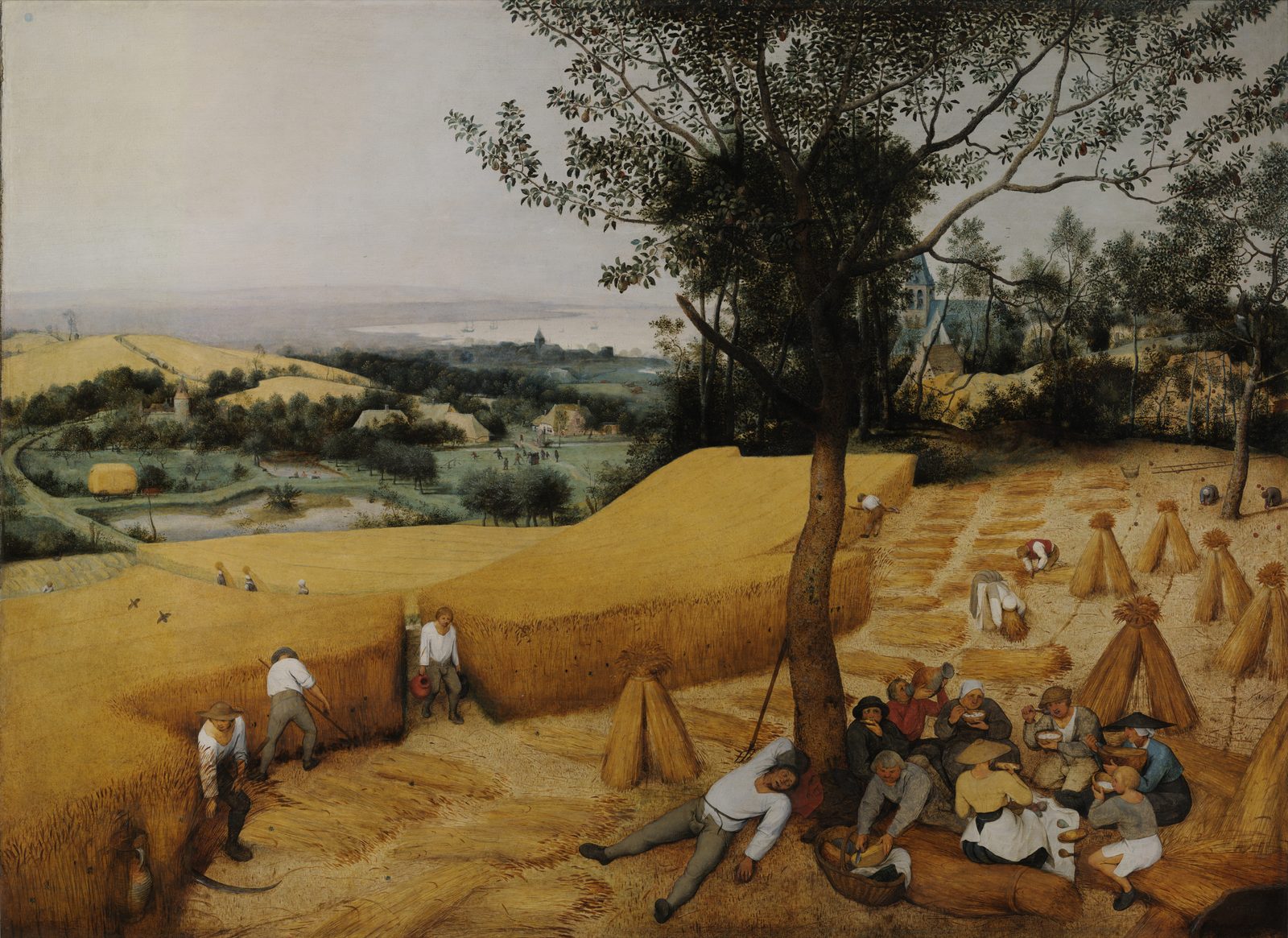
The Harvesters. Pieter Brueghel the Elder, 1565. Wikimedia Commons. Public domain.