
Psalm 111
10 verses · David and others · 10th to 5th century BC · Wisdom and poetry
Hallelujah! I will give thanks to the LORD with all my heart in the council of the upright and in the assembly.
Introduction
Author unstated, the Works of the LORD, Book 5: The return and the great Hallelujah, Poetry, Psalms Overview.
This psalm has no named writer, and it was written to be learned by heart. Its twenty-two lines each open with the next letter of the Hebrew alphabet, so anyone who knew the letters had a way into the whole poem. It is a list of what God has done for Israel, sung in company with other worshippers. Listen for how often the praise moves from His deeds to His character, and for the way the last line turns praise into a lesson. Read it beside the psalm that follows, which was built to answer it line for line.
Context
- Who
- Israelites learning the faith by heart in a community rebuilt around the reading of the law
- What
- An alphabetic hymn of praise that lists the works of the LORD, one line to each letter of the Hebrew alphabet.
- Where
- Jerusalem, in a congregation gathered for worship.
- When
- The second temple period, about 538 to 400 BC, with the author unnamed and the date inferred from the form.
- Why
- To fix what God has done in the memory of a congregation, and to close that praise on the fear of the LORD as the start of wisdom.
Historical context
The psalm is an alphabetic poem. Each of its twenty two lines begins with the next letter of the Hebrew alphabet in order, and those twenty two lines are set out in ten verses. A poem built that way is built to be memorized, and in a society where most people did not own a text, memory was how a faith was carried. The works it lists are the acts that made Israel a people: wonders to be remembered, food for those who fear Him, a covenant kept, the land of the nations handed over, and redemption already sent. Gracious and compassionate are the words God used of Himself at Exodus 34:6, when He passed in front of Moses and declared His own name. The closing line stands in the same words at Proverbs 9:10.
Significance
For a people rebuilding after the exile, a psalm that listed what God had already done was a statement that the covenant still stood. The works were in the past tense and the covenant was said to stand forever. A returned community teaching its children the faith from memory needed poems shaped to be held, and an alphabet poem is a poem with handles.
This chapter in Jewish lifeWhat this chapter is in Jewish life and reading.
What is done
Rashi reads the memorial of verse 4 as the calendar and the commandments rather than as a monument. He writes that God "set down for Israel Sabbaths and festivals and commandments", and cites the command of Deuteronomy 5:15 to remember the slavery in Egypt as the pattern of such a memorial (Rashi on Psalms 111:4:1, Rashi on Psalms, The Judaica Press complete Tanach with Rashi, translated by A. J. Rosenberg, CC-BY).
Metzudat David reads the same verse from the jar of manna, which was put away for safe keeping so that it would be a memorial (Metzudat David on Psalms 111:4:1, Metzudat David on Psalms, Sefaria Community Translation, CC0).
How it is read
The first thing the classical commentary says about this psalm is a fact about its shape. Rashi writes that it is built on the alphabet, one letter at the beginning of each verse and one in the middle, running from the first letter to the last, and that Psalm 112 is built the same way. He then gives the difference between the pair: the first speaks in praise of God, the second in praise of a righteous and God fearing person (Rashi on Psalms 111:1:1, same edition).
The steadfast commandments of verse 8 he reads as commandments held up by punishments and warnings, with the chapters of the law set next to each other in sequence so that they may be expounded, and he ends the comment at the pillars of marble in Song of Songs 5:15 (Rashi on Psalms 111:8:1, same edition).
Ibn Ezra, Radak and Metzudat David carry eighteen comments on this short chapter for which Sefaria holds no English version, and they are cited by reference (Ibn Ezra on Psalms 111:1:1, Radak on Psalms 111:1:1 and the sixteen references beside them).
What the rabbis say
Rashi carries one saying here that answers a question a reader of Genesis often asks. On verse 6, on the strength of God's works declared to His people, he reports from Midrash Tanchuma in the Buber recension at Bereishith 11 that God wrote the account of creation for Israel so that they would know the earth is His and that He may settle whom He wishes in it, and so that the nations could not say to Israel that they were thieves who conquered the land of the seven nations (Rashi on Psalms 111:6:1, same edition). The site reports it as what the rabbis taught.
The corpus records forty places where the Midrash and the Talmud cite this psalm, thirty six under Midrash and four under Talmud, and it carries the locator for each one with no text. The Babylonian Talmud cites verse 8 at Berakhot 10a:10 and verse 10 at Berakhot 17a:11, and Avot DeRabbi Natan reads verse 10 at 22:1. Tractate Soferim, which sets out the rules for writing a scroll, cites the first verse at 5:10.
Midrash Tehillim treats the psalm at 111:1, 111:2, 111:3 and 111:4, and Bereshit Rabbah reads verse 5 at 40:2 and verse 6 at 1:2. The site reports where the rabbis cite the verse and reports no saying, because the locator carries none.
Sources: Rashi, Rashi on Psalms 111, in The Judaica Press complete Tanach with Rashi, translated by A. J. Rosenberg, CC-BY; Metzudat David, Metzudat David on Psalms 111, Sefaria Community Translation, CC0; Midrash Tanchuma, Midrash Tanchuma Buber, Bereishith 11, as Rashi cites it at Rashi on Psalms 111:6:1; Ibn Ezra and Radak, their comments on Psalms 111, cited by reference; Sefaria holds no English version; The Midrash and the Talmud, the forty locators on Psalms 111 in scripts/data/sources/sefaria/psalms/111.json.
the council of the upright: The whole heart is what gives the thanks, and a gathering is where it is given. The council of the upright is a close company, and the assembly is the congregation, so the praise is heard at both scales. The heart is whole and the place is public.
Psalms 111:1
“Praise ye the Lord, or, Hallelujah! All ye his saints unite in adoring Jehovah, who worketh so gloriously. Do it now, do it always: do it heartily, do it unanimously, do it eternally. Even if others refuse, take care that ye have always a song for your God. Put away all doubt, question, murmuring, and rebellion, and give yourselves up to the praising of Jehovah, both with your lips and in your lives. I will praise the Lord with my whole heart.”
Charles Spurgeon · The Treasury of David, Vol. 5 (1878)Particular Baptist
2 more voices on this verseWhat preachers and commentators have said about this verse, in their own words.
Psalms 111:1
“In the council of the upright, and in the great congregation, are the works of the Lord. He says "of the upright," meaning those who before were sinners, but now are righteous. For is it not a thing to marvel at, when we see that the elephant and the camel, and likewise the fly and the gnat, have the same power of movement, the same breath of life, and the same members?”
Jerome · written before 420 · Homily 37, on Psalm 110patristic
Psalms 111:1
“Praise ye the Lord--or, Hallelujah (Ps 104:35). This seems to serve as a title to those of the later Psalms, which, like this, set forth God's gracious government and its blessed fruits. This praise claims the whole heart-- (Ps 86:12), and is rendered publicly. upright--a title of the true Israel (Ps 32:11).”
Jamieson, Fausset & Brown · Commentary Critical and Explanatory on the Whole Bible (1871)reformed
Psalms 111:2-3
Great are the works: , and the psalm names who examines them. Those who delight in them are the ones who have pondered them. Verse 3 turns from the work to the worker, splendid and majestic, whose righteousness endures forever.
Psalms 111:2
“The works of the Lord are great. In design, in size, in number, in excellence, all the works of the Lord are great. Even the little things of God are great. In some point of view or other each one of the productions of his power, or the deeds of his wisdom, will appear to be great to the wise in heart. Sought out of all them that have pleasure therein.”
Charles Spurgeon · The Treasury of David, Vol. 5 (1878)Particular Baptist
His righteousness endures forever: Verse 2 speaks of the works of the LORD in the plural, and verse 3 narrows to His work in the singular. Spurgeon read that single work as the salvation of His people, set apart from all His other works. Its honor rests on a righteousness that endures forever.
Psalms 111:3
“Work - Either all his works, or that eminent branch of those works, his providence towards his people. Righteousness - His justice or faithfulness in performing his word.”
John Wesley · Explanatory Notes upon the Old Testament (1765)evangelical
1 more voice on this verse
Psalms 111:3
“His work is honourable and glorious. His one special work, the salvation of his people, is here mentioned as distinguished from his many other works. This reflects honour and glory upon him. It is deservedly the theme of the highest praise, and compels those who understand it and experience it to ascribe all honour and glory unto the Lord.”
Charles Spurgeon · The Treasury of David, Vol. 5 (1878)Particular Baptist
Psalms 111:4-6
His wonders to be remembered: Gracious and compassionate is what the LORD called Himself at Exodus 34:6. The same words stand over what He does: food for those who fear Him, a covenant He keeps forever, and the land of the nations. Both the food and the land came from one hand.
Psalms 111:4
“He hath made his wonderful works to be remembered. He meant them to remain in the recollection of his people, and they do so: partly because they are in themselves memorable, and because also he has taken care to record them by the pen of inspiration, and has written them upon the hearts of his people by his Holy Spirit.”
Charles Spurgeon · The Treasury of David, Vol. 5 (1878)Particular Baptist
He provides food for those who fear Him: Gill noted that the word behind food can mean prey, and he heard in it the spoil of Egypt or the manna. Henry read the covenant as one the LORD remembers forever, even when His people forget His precepts. The food He provides is that covenant remembered.
Psalms 111:5
“He has given food to those who fear him. In famine he fed Elijah; in the desert he rained down manna for the people of the Jews: and that was fulfilled which is said, He has given food to those who fear him. This is according to the letter. But he gave as food the bread that came down from heaven: and if we are worthy of it, we are fed upon it. For how many martyrs were consumed by hunger, and are now with the Lord?”
Jerome · written before 420 · Homily 37, on Psalm 110patristic
2 more voices on this verse
Psalms 111:5
“He hath given meat to them that fear him,.... Or a "prey" (h), alluding to the spoil of the Egyptians; or to the manna; corporeal food, daily bread, which they that fear him shall not want, Psa 34:9 spiritual meat, such that endures for ever; the flesh of Christ, which is meat indeed; the word and ordinances, in which are milk for babes, and meat for strong men; savoury meat does God give his people, such as their souls love, and the world knows nothing of; all is given, and freely given, and in plenty.”
Psalms 111:5
“They are earnests of what he will do, according to his promise: He will ever be mindful of his covenant, for he has ever been so; and, as he never did, so he never will, let one jot or tittle of it fall to the ground. Though God's people have their infirmities, and are often unmindful of his commands, yet he will ever be mindful of his covenant. The Happiness of the Righteous.”
Matthew Henry · Commentary on the Whole Bible (1707-1721)puritan
the inheritance of the nations: is Canaan, given to His people as a work of power. Gill, following Kimchi, read the word shown two ways: His people saw these works of power with their own eyes and heard them foretold. Both marked the works as His.
Psalms 111:6
“He hath showed his people the power of his works,.... Or his works of power, his mighty works, in which his great power was shown; as to the people of Israel in Egypt, at the Red sea, in the wilderness, and in bringing them to and settling them in the land of Canaan; these he showed to them in fact, they saw them with their eyes; and he showed or declared them to them in prophecy, before they came to pass, as Kimchi observes, that it might not be said they came by chance.”
1 more voice on this verse
Psalms 111:6
“He hath shewed his people the power of his works. They have seen what he is able to do and what force he is prepared to put forth on their behalf. This power Israel saw in physical works, and we in spiritual wonders, for we behold the matchless energy of the Holy Ghost and feel it in our own souls.”
Charles Spurgeon · The Treasury of David, Vol. 5 (1878)Particular Baptist
Psalms 111:7-9
truth and justice: What God's hands make is true and just, and His precepts can be trusted. Redemption already sent to His people stands behind the covenant He has ordained, and the psalm calls His name holy and awesome. Verse 8 gives the term: upheld forever and ever.
Psalms 111:7
“The works of his hands are verity and judgment. Truth and justice are conspicuous in all that Jehovah does. Nothing like artifice or crooked policy can ever be seen in his proceedings; he acts faithfully and righteously towards his people, and with justice and impartiality to all mankind. This also should lead us to praise him, since it is of the utmost advantage to us to live under a sovereign whose laws, decrees, acts, and deeds are the essence of truth and justice. All his commandments are sure.”
Charles Spurgeon · The Treasury of David, Vol. 5 (1878)Particular Baptist
1 more voice on this verse
Psalms 111:7
“The works - All that he doth on the behalf of his people, or against their enemies. Truth - Are exactly agreeable to his promises, and to justice. Commandments - His laws given to the Israelites, especially the moral law.”
John Wesley · Explanatory Notes upon the Old Testament (1765)evangelical
They are upheld forever and ever: Upheld describes something propped up and supported, and Psalm 112:8 uses the same Hebrew word for the heart of the man who fears the LORD. Spurgeon read what is upheld as the LORD's works and precepts, ruled by principles that endure forever. The man is upheld as the precepts are.
Psalms 111:8
“They stand fast for ever and ever,.... Not only the covenant and its promises do, but both law and Gospel, the commandments of the one and the doctrines of the other; the law is an eternal law, as to the matter of it, and is not made void by faith, but established; and the Gospel is an everlasting Gospel, which lives and abides for ever, being established upon the word of God, which cannot be broken; and is continued in the church, the pillar and ground of truth, from whence it can never be removed.”
1 more voice on this verse
Psalms 111:8
“They stand fast for ever and ever. That is to say, his purposes, commands, and courses of action. The Lord is not swayed by transient motives, or moved by the circumstances of the hour; immutable principles rule in the courts of Jehovah, and he pursues his eternal purposes without the shadow of a turning. Our works are too often as wood, hay, and stubble, but his doings are as gold, silver, and precious stones.”
Charles Spurgeon · The Treasury of David, Vol. 5 (1878)Particular Baptist
He has sent redemption to His people: Verse 9 has three lines where the verses before it have two, and the acrostic runs on to finish in verse 10. Spurgeon read the redemption sent to His people as the deliverance from Egypt, and as the redemption bought by blood. Holy and awesome is the name over both.
Psalms 111:9
“He sent redemption unto his people. When they were in Egypt he sent not only a deliverer, but an actual deliverance; not only a redeemer, but complete redemption. He has done the like spiritually for all his people, having first by blood purchased them out of the hand of the enemy, and then by power rescued them from the bondage of their sins. Redemption we can sing of as an accomplished act: it has been wrought for us, sent to us, and enjoyed by us, and we are in very deed the Lord's redeemed.”
Charles Spurgeon · The Treasury of David, Vol. 5 (1878)Particular Baptist
3 more voices on this verse
Psalms 111:9
“Holy and terrible is his name. Holy to the holy, terrible to sinners.”
Jerome · written before 420 · Homily 37, on Psalm 110patristic
Psalms 111:9
“Redemption - The deliverance out of Egypt, which was a type of that higher redemption by Christ. Commanded - Appointed, or established firmly by his power and authority.”
John Wesley · Explanatory Notes upon the Old Testament (1765)evangelical
Psalms 111:9
“Note, What is holy is reverend; the angels have an eye to God's holiness when they cover their faces before him, and nothing is more man's honour than his sanctification.”
Matthew Henry · Commentary on the Whole Bible (1707-1721)puritan
the beginning of wisdom: Wisdom starts with the fear of the LORD. Proverbs 9:10 says it in the same words, and Job 28:28 calls that fear wisdom itself. Understanding comes to those who follow His precepts, and the psalm closes on praise that endures forever.
Psalms 111:10
“The fear of the Lord is the beginning of wisdom. It is its first principle, but it is also its head and chief attainment. The word "beginning" in Scripture sometimes means the chief; and true religion is at once the first element of wisdom, and its chief fruit. To know God so as to walk aright before him is the greatest of all the applied sciences. Holy reverence of God leads us to praise him, and this is the point which the psalm drives at, for it is a wise act on the part of a creature towards his Creator.”
Charles Spurgeon · The Treasury of David, Vol. 5 (1878)Particular Baptist
1 more voice on this verse
Psalms 111:10
“I think I shall not seem to be taking too much on myself, if, in the midst of my children, I yield to my desire to teach, seeing that the master of humility himself has said, "Come, you children, listen to me: I will teach you the fear of the Lord." Therein one may observe both the humility and the grace of his reverence for God. For in saying "the fear of the Lord," which seems to be common to all, he has described the chief mark of reverence for God.”
Ambrose of Milan · written before 397 · On the Duties of the Clergy 1.1patristic
How this psalm is built
The form: An alphabetic psalm of thanksgiving, given with the whole heart and in a public gathering, as Delitzsch classes it.
The patterns in this chapter
| Device | What it does | Where to see it |
|---|---|---|
| The alphabet across twenty-two half-lines | The psalm runs the Hebrew alphabet in order, one letter to each poetic line rather than one to each verse, so twenty-two letters are carried in ten verses.Franz Delitzsch, Biblical Commentary on the Psalms, 1871, on Psalm 111:1. | Psalm 111:1, Psalm 111:10 |
| What His hands have done | The psalm lists the works in turn: wonders to be remembered at verse 4, food for those who fear Him at verse 5, the land of the nations given to His people at verse 6, truth and justice at verse 7, and redemption sent at verse 9. Every item is something done rather than something said.John Gill, Exposition of the Old Testament, 1748 to 1763, on Psalm 111:7. | Psalm 111:4, Psalm 111:5, Psalm 111:6, Psalm 111:7, Psalm 111:9 |
| Gracious and compassionate | Verse 4 uses the pair of words God used of Himself at Exodus 34:6 when He passed before Moses. The psalm sets the same two terms over the works it is listing, so the character named at Sinai is read off what He has since done.Matthew Henry, Commentary on the Whole Bible, 1710, on Psalm 111:4. | Psalm 111:4 |
| Forever, and forever again | The word forever falls at verses 3, 5, 8, 9 and 10, over His righteousness, His covenant, His precepts, His covenant again and His praise. The psalm keeps returning to duration as the thing that makes the works worth listing.Albert Barnes, Notes, Explanatory and Practical, on the Old and New Testaments, 1832 to 1869, on Psalm 111:8. | Psalm 111:3, Psalm 111:5, Psalm 111:8, Psalm 111:9, Psalm 111:10 |
| The last line is a proverb | Verse 10 leaves the recital and states a rule. The fear of the LORD is the beginning of wisdom stands in the same words at Proverbs 9:10, and Job 28:28 calls that fear wisdom itself.Matthew Henry, Commentary on the Whole Bible, 1710, on Psalm 111:10. | Psalm 111:10 |
The list and what kind of list it is
7 more paragraphs on the patterns
Verse 2 says the works are great and sought out by those who delight in them, and the rest of the psalm names them: wonders to be remembered, food for those who fear Him, the land of the nations given to His people, truth and justice, precepts that can be trusted, and redemption already sent. Those are covenant acts, the ones the exodus generation received, and the psalm treats them as one story rather than as separate favours.
The pairing with Psalm 112
Psalm 111:3 says of the LORD that His righteousness endures forever, and Psalm 112:3 says the same clause of the man who fears Him. Psalm 111:4 calls the LORD gracious and compassionate, and Psalm 112:4 uses those words of the upright man. The second psalm is a portrait drawn from the first, which is the Psalter's own way of saying what it means to be like God.
The closing proverb
Verse 10 leaves the recital and states a rule. The fear of the LORD is the beginning of wisdom stands in the same words at Proverbs 9:10, and Job 28:28 calls that fear wisdom itself. Praise ends in instruction, and the instruction is the one Proverbs puts at the head of its own collection. Reading it here, at the end of a list of works, shows what the fear of the LORD is a response to.
The debated point
The word rendered beginning in verse 10 is reshith, which carries both first in time and first in rank. On the first sense the fear of the LORD is where wisdom starts and is left behind as one advances; on the second it is wisdom's chief part and is never left behind. The commentators divide, and the psalm's own placing of the line last, after everything it has recited, tells in favour of the second.
Key words
The words this chapter repeats, each one a lemma of the store’s tagged Hebrew however the chapter inflects it, with the verses it stands in. The grammar words are struck out, and the eight terms the psalm says the word of God by stand in the figure above the patterns rather than here. Every row opens that word’s own page.
| Word | Said | No.Strong’s | Meaning | Where it stands |
|---|---|---|---|---|
| עַד | ʻad | H5703 | perpetuity | 3, 8, 10 |
| מַעֲשֶׂה | maʻăseh | H4639 | deed | 2, 6, 7 |
| יָשָׁר | yâshâr | H3477 | upright | 1, 8 |
| אֶמֶת | ʼemeth | H571 | truth | 7, 8 |
| עוֹלָם | ʻôwlâm | H5769 | forever | 5, 8, 9 |
| בְּרִית | bᵉrîyth | H1285 | covenant | 5, 9 |
Keep studying
Sources for this chapter
The summary
Jamieson, Fausset & Brown, Commentary Critical and Explanatory; John Calvin, Commentaries; John Wesley, Notes on the Old Testament and Matthew Henry, Complete Commentary.
The context
Charles Bridges, An Exposition of the Book of Proverbs and Franz Delitzsch, Biblical Commentary on the Book of Job.
The form and classifications
Albert Barnes, Notes, Explanatory and Practical, on the Old and New Testaments, 1832 to 1869, on Psalm 111:2; Franz Delitzsch, Biblical Commentary on the Psalms, 1871, on Psalm 111:1 and Matthew Henry, Commentary on the Whole Bible, 1710, on Psalm 112:1.
The exposition
Albert Barnes, Notes on the Book of Psalms; Charles Spurgeon, The Treasury of David; Franz Delitzsch, Biblical Commentary on the Psalms; John Gill, Exposition of the Old Testament and Matthew Henry, Commentary on the Whole Bible.
The painting
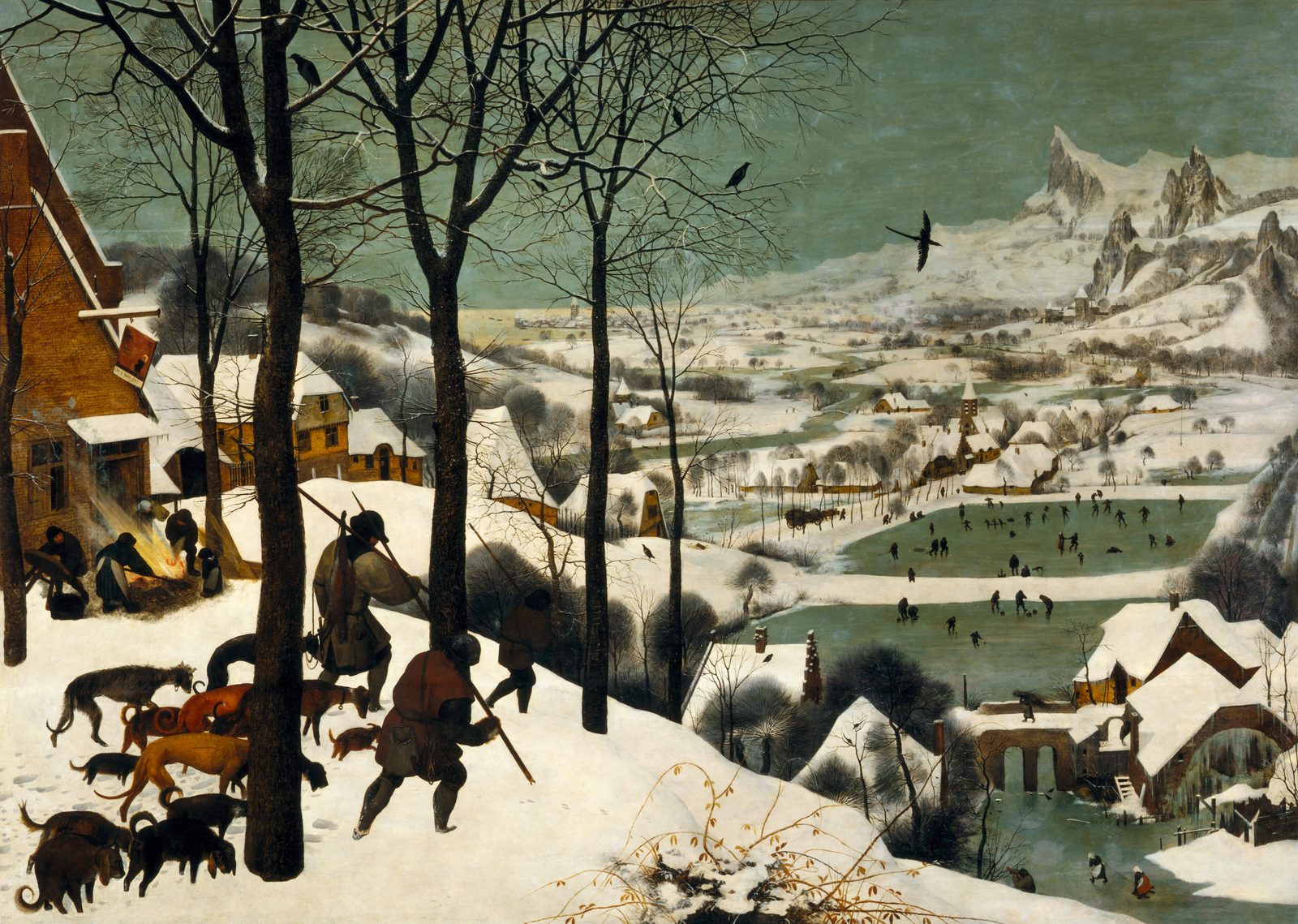
The Hunters in the Snow. Pieter Brueghel the Elder, 1565. Wikimedia Commons. Public domain.